Syllabus
• Redox reactions; conductance in electrolytic
solutions, specific and molar conductivity
variations of conductivity with concentration,
Kohlrausch’s Law, electrolysis and laws of
electrolysis (elementary idea), dry cell – electrolytic
cells and Galvanic cells; lead accumulator, EMF
of a cell, standard electrode potential, Nernst
equation and its application to chemical cells,
fuel cells; corrosion.
Electrochemistry 2
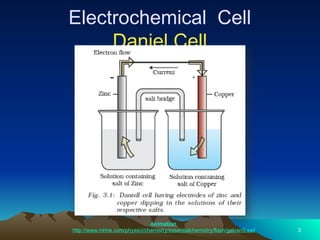
Electrochemical Cell
Daniel Cell
Animation
http://www.mhhe.com/physsci/chemistry/essentialchemistry/flash/galvan5.swf 3
Animation
Electrochemistry 4
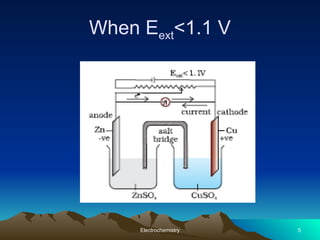
When Eext<1.1 V
Electrochemistry 5
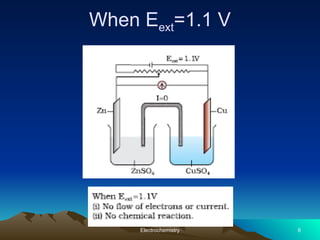
When Eext=1.1 V
Electrochemistry 6
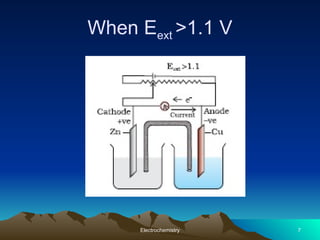
When Eext >1.1 V
Electrochemistry 7
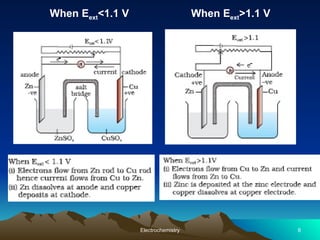
When Eext<1.1 V When Eext>1.1 V
Electrochemistry 8
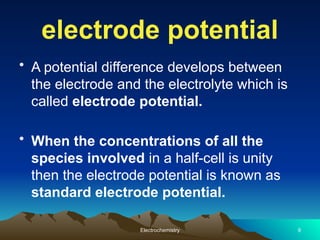
electrode potential
• A potential difference develops between
the electrode and the electrolyte which is
called electrode potential.
• When the concentrations of all the
species involved in a half-cell is unity
then the electrode potential is known as
standard electrode potential.
Electrochemistry 9
cell potential (emf)
• The potential difference between the two
electrodes of a galvanic cell is called the
cell potential and is measured in volts.
• The cell potential is the difference
between the electrode potentials
(reduction potentials) of the cathode and
anode.
• It is called the cell electromotive force
(emf) of the cell when no current is drawn
through the cell.
Electrochemistry 10
Representation of Galvanic cell
• A galvanic cell is generally represented by
putting a vertical line between metal and
electrolyte solution and putting a double
vertical line between the two electrolytes
connected by a salt bridge.
Zn (s) / Zn2+
(aq) Cu
⎥⎥ 2+
(aq) / Cu
Electrochemistry 11
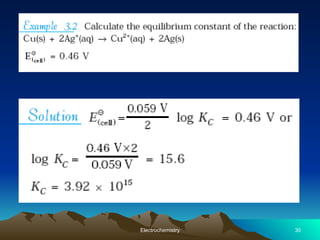
Cu(s) + 2Ag+
(aq) → Cu
⎯ 2+
(aq) + 2 Ag(s)
• Ecell = Eright – Eleft
• Half-cell reactions:
• Cathode (reduction):
2Ag+
(aq) + 2e–
→ 2Ag(s)
• Anode (oxidation):
Cu(s) → Cu2+
(aq) + 2e–
Electrochemistry 12
cell can be represented as
Cu (s) | Cu2+
(aq) || Ag+
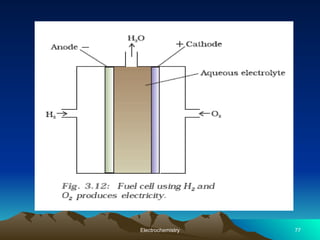
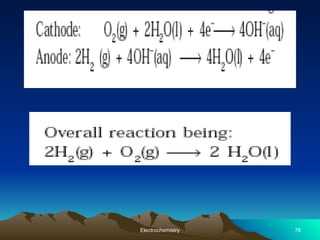
(aq) | Ag (s)
Ecell = Eright – Eleft
= EAg+
Ag – ECu
⎥ 2+
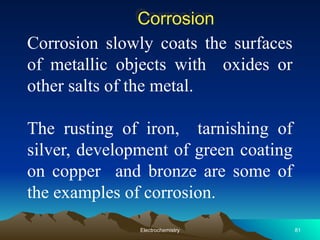
Cu
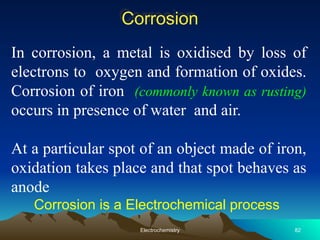
⎥
Electrochemistry 13
Measurement of Electrode Potential
• The potential of individual half-cell cannot
be measured.
• We can measure only the difference
between the two half-cell potentials that
gives the emf of the cell.
• If we arbitrarily choose the potential of one
electrode (half-cell) then that of the other
can be determined with respect to this.
Electrochemistry 14
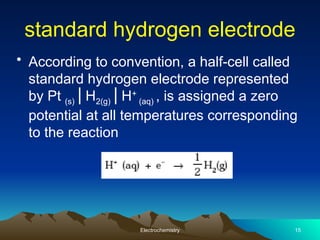
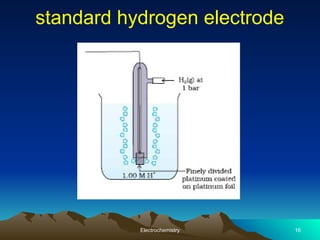
standard hydrogen electrode
• According to convention, a half-cell called
standard hydrogen electrode represented
by Pt (s) H
⎥ 2(g) H
⎥ +
(aq) , is assigned a zero
potential at all temperatures corresponding
to the reaction
Electrochemistry 15
standard hydrogen electrode
Electrochemistry 16
inert electrodes
• Sometimes metals like platinum or gold
are used as inert electrodes.
• They do not participate in the reaction but
provide their surface for oxidation or
reduction reactions and for the conduction
of electrons.
• For example, Pt is used in the following
half-cells:
Electrochemistry 17
Electrochemistry 18
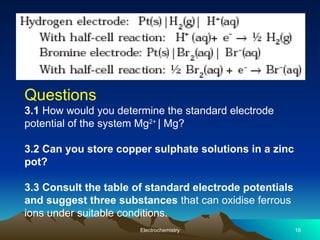
Questions
3.1 How would you determine the standard electrode
potential of the system Mg2+
| Mg?
3.2 Can you store copper sulphate solutions in a zinc
pot?
3.3 Consult the table of standard electrode potentials
and suggest three substances that can oxidise ferrous
ions under suitable conditions.
Electrochemistry 19
Electrochemistry 20
Increasing
strength
of
reducing
agent
Increasing
strength
of
oxidising
agent
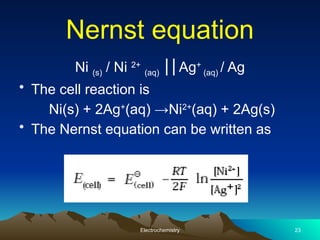
Nernst equation
Ni (s) / Ni 2+
(aq) Ag
⎥⎥ +
(aq) / Ag
• The cell reaction is
Ni(s) + 2Ag+
(aq) →Ni2+
(aq) + 2Ag(s)
• The Nernst equation can be written as
Electrochemistry 23
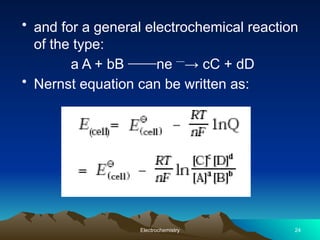
• and for a general electrochemical reaction
of the type:
a A + bB ne
⎯⎯ ⎯
→ cC + dD
• Nernst equation can be written as:
Electrochemistry 24
Electrochemistry 25
Equilibrium Constant from Nernst Equation
Electrochemistry 26
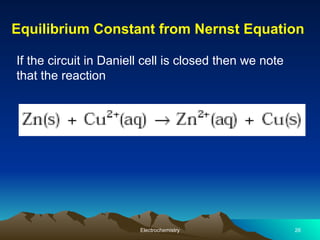
If the circuit in Daniell cell is closed then we note
that the reaction
Electrochemistry 27
• takes place and as time passes, the
concentration of Zn2+
keeps on increasing
while the concentration of Cu2+
keeps on
decreasing.
• At the same time voltage of the cell as read
on the voltmeter keeps on decreasing.
• After some time, there is no change in the
concentration of Cu2+
and Zn2+
ions and at the
same time, voltmeter gives zero reading.
• This indicates that equilibrium has been
attained.
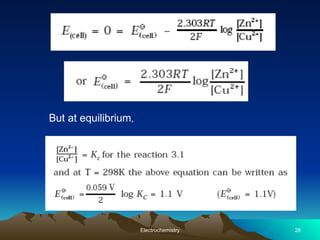
• In this situation the Nernst equation may be
written as:
Electrochemistry 28
But at equilibrium,
Electrochemistry 29
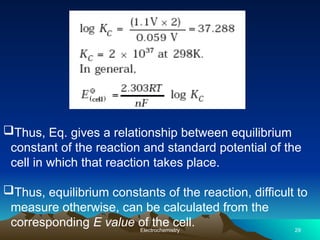
Thus, Eq. gives a relationship between equilibrium
constant of the reaction and standard potential of the
cell in which that reaction takes place.
Thus, equilibrium constants of the reaction, difficult to
measure otherwise, can be calculated from the
corresponding E value of the cell.
Electrochemistry 30
Electrochemical Cell and
Gibbs Energy of the Reaction
Electrochemistry 31
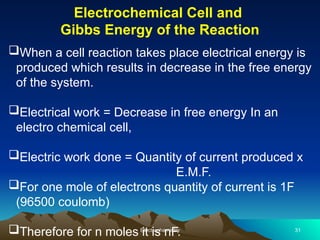
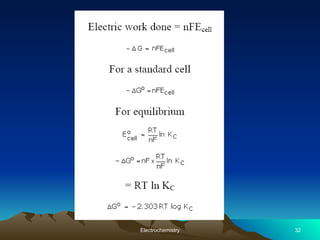
When a cell reaction takes place electrical energy is
produced which results in decrease in the free energy
of the system.
Electrical work = Decrease in free energy In an
electro chemical cell,
Electric work done = Quantity of current produced x
E.M.F.
For one mole of electrons quantity of current is 1F
(96500 coulomb)
Therefore for n moles it is nF.
Electrochemistry 32
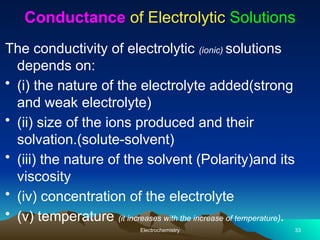
Conductance of Electrolytic Solutions
The conductivity of electrolytic (ionic) solutions
depends on:
• (i) the nature of the electrolyte added(strong
and weak electrolyte)
• (ii) size of the ions produced and their
solvation.(solute-solvent)
• (iii) the nature of the solvent (Polarity)and its
viscosity
• (iv) concentration of the electrolyte
• (v) temperature (it increases with the increase of temperature).
Electrochemistry 33
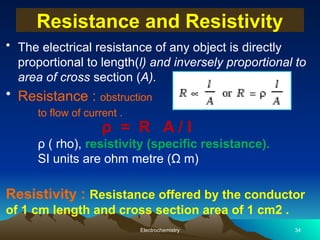
Resistance and Resistivity
• The electrical resistance of any object is directly
proportional to length(l) and inversely proportional to
area of cross section (A).
• Resistance : obstruction
to flow of current .
Electrochemistry 34
ρ = R A / l
ρ ( rho), resistivity (specific resistance).
SI units are ohm metre (Ω m)
Resistivity : Resistance offered by the conductor
of 1 cm length and cross section area of 1 cm2 .
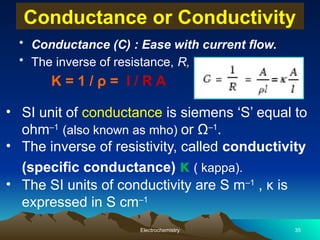
Conductance or Conductivity
• Conductance (C) : Ease with current flow.
• The inverse of resistance, R,
K = 1 / ρ = l / R A
Electrochemistry 35
• SI unit of conductance is siemens ‘S’ equal to
ohm–1
(also known as mho) or Ω–1
.
• The inverse of resistivity, called conductivity
(specific conductance) κ ( kappa).
• The SI units of conductivity are S m–1
, κ is
expressed in S cm–1
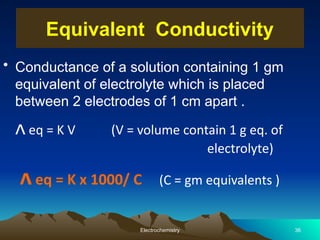
• Conductance of a solution containing 1 gm
equivalent of electrolyte which is placed
between 2 electrodes of 1 cm apart .
ᴧ eq = K V (V = volume contain 1 g eq. of
electrolyte)
ᴧeq = K x 1000/ C (C = gm equivalents )
Electrochemistry 36
Equivalent Conductivity
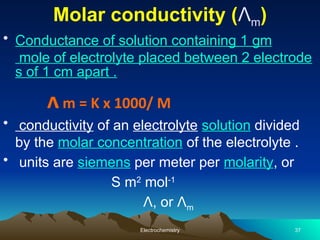
Molar conductivity (Λm)
• Conductance of solution containing 1 gm
mole of electrolyte placed between 2 electrode
s of 1 cm apart .
ᴧm = K x 1000/ M
• conductivity of an electrolyte solution divided
by the molar concentration of the electrolyte .
• units are siemens per meter per molarity, or
S m2
mol-1
Λ, or Λm
Electrochemistry 37
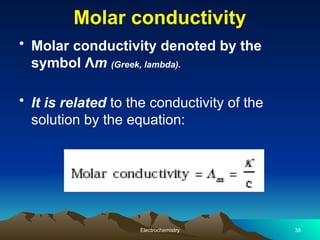
Molar conductivity
• Molar conductivity denoted by the
symbol Λm (Greek, lambda).
• It is related to the conductivity of the
solution by the equation:
Electrochemistry 38
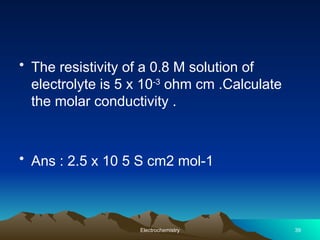
• The resistivity of a 0.8 M solution of
electrolyte is 5 x 10⁻³
ohm cm .Calculate
the molar conductivity .
• Ans : 2.5 x 10 5 S cm2 mol-1
Electrochemistry 39
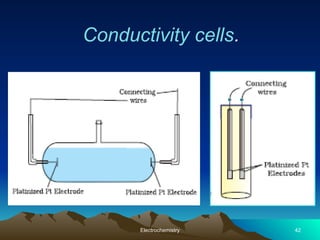
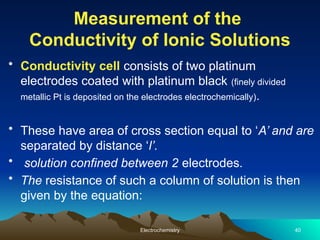
Measurement of the
Conductivity of Ionic Solutions
• Conductivity cell consists of two platinum
electrodes coated with platinum black (finely divided
metallic Pt is deposited on the electrodes electrochemically).
• These have area of cross section equal to ‘A’ and are
separated by distance ‘l’.
• solution confined between 2 electrodes.
• The resistance of such a column of solution is then
given by the equation:
Electrochemistry 40
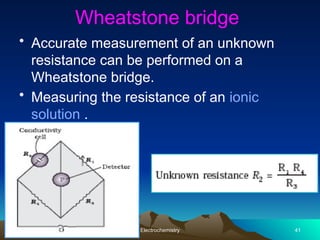
Wheatstone bridge
• Accurate measurement of an unknown
resistance can be performed on a
Wheatstone bridge.
• Measuring the resistance of an ionic
solution .
Electrochemistry 41
Conductivity cells.
Electrochemistry 42
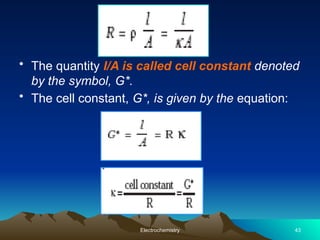
• The quantity l/A is called cell constant denoted
by the symbol, G*.
• The cell constant, G*, is given by the equation:
Electrochemistry 43
1) The resistance of 0.01 N NaCl solution at
25 o C is 200 ohm. Cell constant of
conductivity cell is unity .calculate
equivalent conductance .
Ans: 5 x 10⁻³ mho cm-1
5 x 10 2 mho cm2 eq-1
Electrochemistry 44
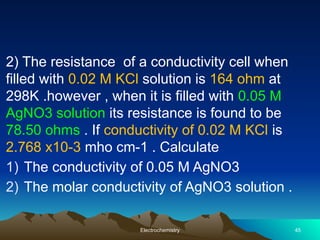
2) The resistance of a conductivity cell when
filled with 0.02 M KCl solution is 164 ohm at
298K .however , when it is filled with 0.05 M
AgNO3 solution its resistance is found to be
78.50 ohms . If conductivity of 0.02 M KCl is
2.768 x10⁻³ mho cm-1 . Calculate
1) The conductivity of 0.05 M AgNO3
2) The molar conductivity of AgNO3 solution .
Electrochemistry 45
Variation of Molar conductivity
1. Nature of electrolyte
2. Concentration
3. Temperature
Electrochemistry 46
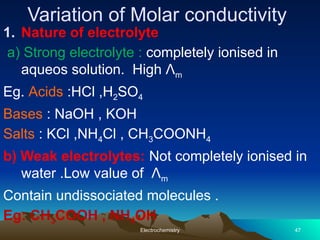
Variation of Molar conductivity
1. Nature of electrolyte
a) Strong electrolyte : completely ionised in
aqueos solution. High Λm
Eg. Acids :HCl ,H2SO4
Bases : NaOH , KOH
Salts : KCl ,NH4Cl , CH3COONH4
b) Weak electrolytes: Not completely ionised in
water .Low value of Λm
Contain undissociated molecules .
Eg: CH3COOH , NH4OH
Electrochemistry 47
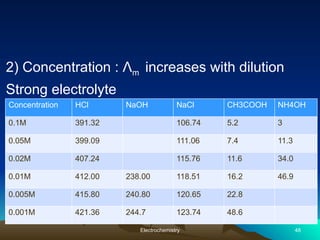
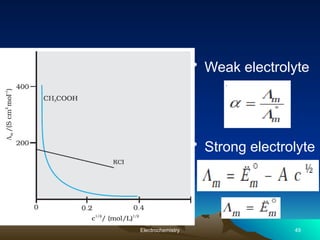
2) Concentration : Λm increases with dilution
Strong electrolyte
Electrochemistry 48
Concentration HCl NaOH NaCl CH3COOH NH4OH
0.1M 391.32 106.74 5.2 3
0.05M 399.09 111.06 7.4 11.3
0.02M 407.24 115.76 11.6 34.0
0.01M 412.00 238.00 118.51 16.2 46.9
0.005M 415.80 240.80 120.65 22.8
0.001M 421.36 244.7 123.74 48.6
• Weak electrolyte
• Strong electrolyte
Electrochemistry 49
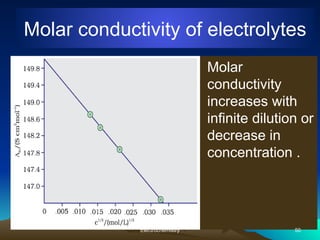
Molar conductivity of electrolytes
• Molar
conductivity
increases with
infinite dilution or
decrease in
concentration .
Electrochemistry 50
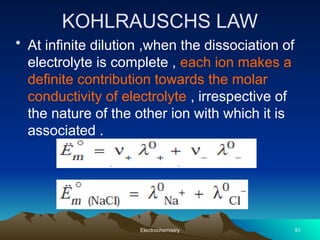
KOHLRAUSCHS LAW
• At infinite dilution ,when the dissociation of
electrolyte is complete , each ion makes a
definite contribution towards the molar
conductivity of electrolyte , irrespective of
the nature of the other ion with which it is
associated .
Electrochemistry 51
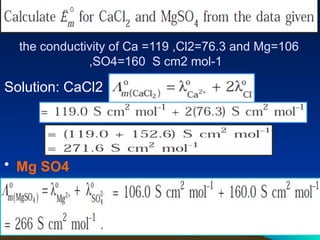
the conductivity of Ca =119 ,Cl2=76.3 and Mg=106
,SO4=160 S cm2 mol-1
Solution: CaCl2
• Mg SO4
Electrochemistry 52
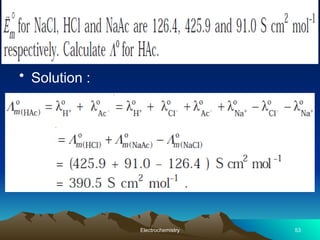
• Solution :
Electrochemistry 53
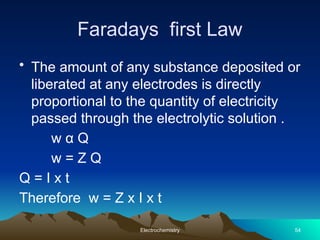
Faradays first Law
• The amount of any substance deposited or
liberated at any electrodes is directly
proportional to the quantity of electricity
passed through the electrolytic solution .
w α Q
w = Z Q
Q = I x t
Therefore w = Z x I x t
Electrochemistry 54
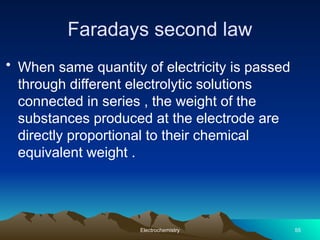
Faradays second law
• When same quantity of electricity is passed
through different electrolytic solutions
connected in series , the weight of the
substances produced at the electrode are
directly proportional to their chemical
equivalent weight .
Electrochemistry 55
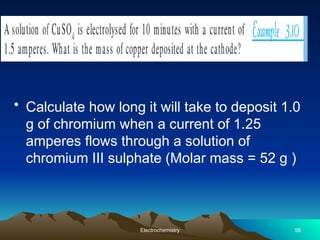
• Calculate how long it will take to deposit 1.0
g of chromium when a current of 1.25
amperes flows through a solution of
chromium III sulphate (Molar mass = 52 g )
Electrochemistry 56
Batteries
There are mainly two types of batteries.
1.Primary Batteries &
2.Secondary Batteries
57
Electrochemistry
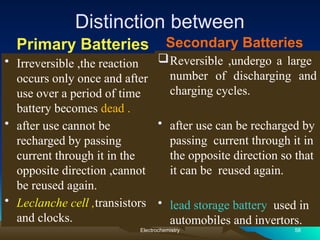
Distinction between
Primary Batteries
• Irreversible ,the reaction
occurs only once and after
use over a period of time
battery becomes dead .
• after use cannot be
recharged by passing
current through it in the
opposite direction ,cannot
be reused again.
• Leclanche cell ,transistors
and clocks.
Secondary Batteries
Reversible ,undergo a large
number of discharging and
charging cycles.
• after use can be recharged by
passing current through it in
the opposite direction so that
it can be reused again.
• lead storage battery used in
automobiles and invertors.
Electrochemistry 58
In the primary batteries, the reaction occurs
only once and after use over a period of
time battery becomes dead and cannot be
reused again.
The most familiar example of this type is
the dry cell (known as Leclanche cell after
its discoverer) which is used commonly in
our transistors and clocks.
Primary Batteries
59
Electrochemistry
DRY CELL
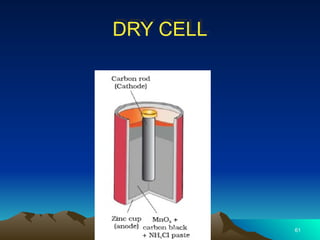
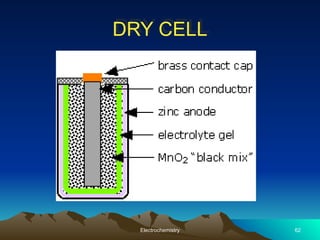
The cell consists of a zinc container that also acts as anode
and the cathode is a carbon (graphite) rod surrounded by
powdered manganese dioxide and carbon
The space between the electrodes is filled by a moist paste of
ammonium chloride (NH4Cl) and zinc chloride (ZnCl2).
60
Electrochemistry
DRY CELL
61
Electrochemistry
DRY CELL
62
Electrochemistry
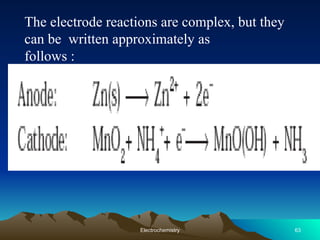
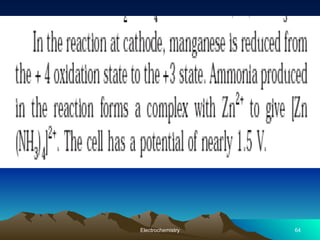
The electrode reactions are complex, but they
can be written approximately as
follows :
63
Electrochemistry
64
Electrochemistry
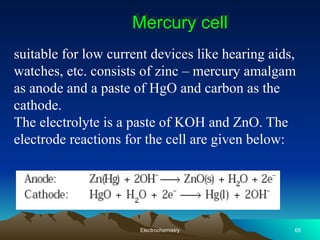
Mercury cell
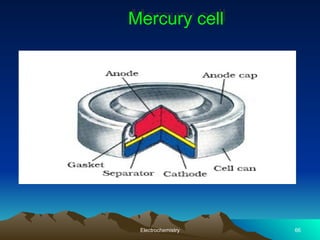
suitable for low current devices like hearing aids,
watches, etc. consists of zinc – mercury amalgam
as anode and a paste of HgO and carbon as the
cathode.
The electrolyte is a paste of KOH and ZnO. The
electrode reactions for the cell are given below:
65
Electrochemistry
Mercury cell
66
Electrochemistry
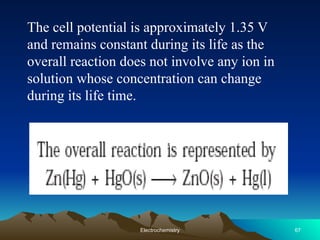
The cell potential is approximately 1.35 V
and remains constant during its life as the
overall reaction does not involve any ion in
solution whose concentration can change
during its life time.
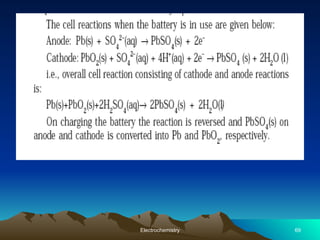
67
Electrochemistry
Secondary Batteries
A secondary cell after use can be recharged by
passing current through it in the opposite direction
so that it can be used again.
A good secondary cell can undergo a large
number of discharging and charging cycles.
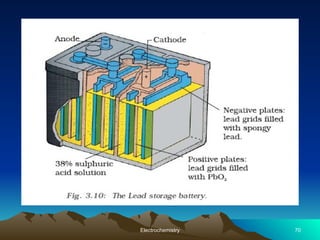
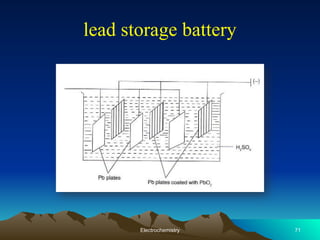
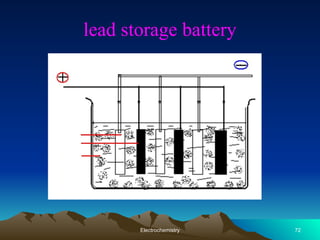
 The most important secondary cell is the lead
storage battery commonly used in automobiles and
invertors.
It consists of a lead anode and a grid of lead
packed with lead dioxide (PbO2 ) as cathode.
A 38% solution of sulphuric acid is used as an
electrolyte. 68
Electrochemistry
69
Electrochemistry
70
Electrochemistry
lead storage battery
Electrochemistry 71
lead storage battery
Electrochemistry 72
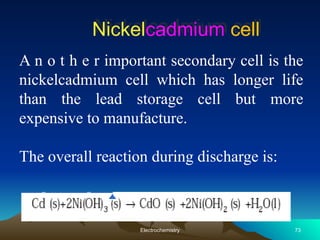
Nickelcadmium cell
A n o t h e r important secondary cell is the
nickelcadmium cell which has longer life
than the lead storage cell but more
expensive to manufacture.
The overall reaction during discharge is:
73
Electrochemistry
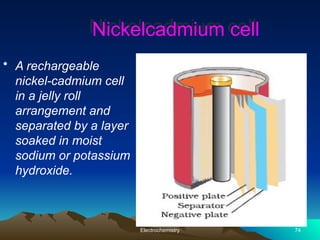
• A rechargeable
nickel-cadmium cell
in a jelly roll
arrangement and
separated by a layer
soaked in moist
sodium or potassium
hydroxide.
Nickelcadmium cell
74
Electrochemistry
Fuel Cells
Galvanic cells that are designed to
convert the energy of combustion of
fuels like hydrogen, methane,
methanol, etc. directly into electrical
energy are called fuel cells.
One of the most successful fuel cells uses the reaction of
hydrogen with oxygen to form water. The cell was used
for providing electrical power in the Apollo space programme.
The water vapours produced during the reaction were
condensed and added to the drinking water supply for the
astronauts.
In the cell, hydrogen and oxygen are bubbled through porous
carbon electrodes into concentrated aqueous sodium hydroxide
solution. Catalysts like finely divided platinum or palladium
metal are incorporated into the electrodes for increasing the
rate of electrode reactions.
The electrode reactions are given below:
H2-O2 FUEL CELL
76
Electrochemistry
77
Electrochemistry
78
Electrochemistry
1. The cell runs continuously as long as the
reactants are supplied.
2. Fuel cells produce electricity with an efficiency
of about 70 % compared to thermal plants whose
efficiency is about 40%.
3. There has been tremendous progress in the
development of new electrode materials, better
catalysts and electrolytes for increasing the
efficiency of fuel cells.
Importance of fuel Cells
Electrochemistry 79
4. These have been used in
automobiles on an experimental
basis.
5. Fuel cells are pollution free and in
view of their future importance, a
variety of fuel cells have been
fabricated and tried.
80
Electrochemistry
Corrosion
Corrosion slowly coats the surfaces
of metallic objects with oxides or
other salts of the metal.
The rusting of iron, tarnishing of
silver, development of green coating
on copper and bronze are some of
the examples of corrosion.
81
Electrochemistry
Corrosion
In corrosion, a metal is oxidised by loss of
electrons to oxygen and formation of oxides.
Corrosion of iron (commonly known as rusting)
occurs in presence of water and air.
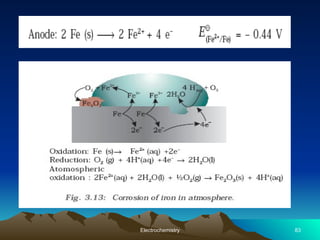
At a particular spot of an object made of iron,
oxidation takes place and that spot behaves as
anode
Corrosion is a Electrochemical process
82
Electrochemistry
83
Electrochemistry
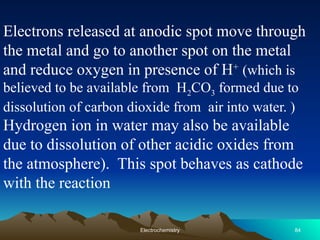
Electrons released at anodic spot move through
the metal and go to another spot on the metal
and reduce oxygen in presence of H+
(which is
believed to be available from H2CO3 formed due to
dissolution of carbon dioxide from air into water. )
Hydrogen ion in water may also be available
due to dissolution of other acidic oxides from
the atmosphere). This spot behaves as cathode
with the reaction
84
Electrochemistry
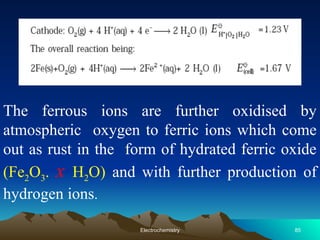
The ferrous ions are further oxidised by
atmospheric oxygen to ferric ions which come
out as rust in the form of hydrated ferric oxide
(Fe2O3. x H2O) and with further production of
hydrogen ions.
85
Electrochemistry
Prevention of corrosion
• Covering the surface with paint or by some
chemicals (e.g. bisphenol).
• Another simple method is to cover the surface
by other metals (Sn, Zn, etc.) that are inert or
react to save the object.
• An electrochemical method is to provide a
sacrificial electrode of another metal (like Mg,
Zn, etc.) which corrodes itself but saves the
object.
86
Electrochemistry

ELECTROCHEMISTRY-ppt on this topic for class XII

  • 2.
    Syllabus • Redox reactions;conductance in electrolytic solutions, specific and molar conductivity variations of conductivity with concentration, Kohlrausch’s Law, electrolysis and laws of electrolysis (elementary idea), dry cell – electrolytic cells and Galvanic cells; lead accumulator, EMF of a cell, standard electrode potential, Nernst equation and its application to chemical cells, fuel cells; corrosion. Electrochemistry 2
  • 3.
  • 4.
  • 5.
  • 6.
  • 7.
    When Eext >1.1V Electrochemistry 7
  • 8.
    When Eext<1.1 VWhen Eext>1.1 V Electrochemistry 8
  • 9.
    electrode potential • Apotential difference develops between the electrode and the electrolyte which is called electrode potential. • When the concentrations of all the species involved in a half-cell is unity then the electrode potential is known as standard electrode potential. Electrochemistry 9
  • 10.
    cell potential (emf) •The potential difference between the two electrodes of a galvanic cell is called the cell potential and is measured in volts. • The cell potential is the difference between the electrode potentials (reduction potentials) of the cathode and anode. • It is called the cell electromotive force (emf) of the cell when no current is drawn through the cell. Electrochemistry 10
  • 11.
    Representation of Galvaniccell • A galvanic cell is generally represented by putting a vertical line between metal and electrolyte solution and putting a double vertical line between the two electrolytes connected by a salt bridge. Zn (s) / Zn2+ (aq) Cu ⎥⎥ 2+ (aq) / Cu Electrochemistry 11
  • 12.
    Cu(s) + 2Ag+ (aq)→ Cu ⎯ 2+ (aq) + 2 Ag(s) • Ecell = Eright – Eleft • Half-cell reactions: • Cathode (reduction): 2Ag+ (aq) + 2e– → 2Ag(s) • Anode (oxidation): Cu(s) → Cu2+ (aq) + 2e– Electrochemistry 12
  • 13.
    cell can berepresented as Cu (s) | Cu2+ (aq) || Ag+ (aq) | Ag (s) Ecell = Eright – Eleft = EAg+ Ag – ECu ⎥ 2+ Cu ⎥ Electrochemistry 13
  • 14.
    Measurement of ElectrodePotential • The potential of individual half-cell cannot be measured. • We can measure only the difference between the two half-cell potentials that gives the emf of the cell. • If we arbitrarily choose the potential of one electrode (half-cell) then that of the other can be determined with respect to this. Electrochemistry 14
  • 15.
    standard hydrogen electrode •According to convention, a half-cell called standard hydrogen electrode represented by Pt (s) H ⎥ 2(g) H ⎥ + (aq) , is assigned a zero potential at all temperatures corresponding to the reaction Electrochemistry 15
  • 16.
  • 17.
    inert electrodes • Sometimesmetals like platinum or gold are used as inert electrodes. • They do not participate in the reaction but provide their surface for oxidation or reduction reactions and for the conduction of electrons. • For example, Pt is used in the following half-cells: Electrochemistry 17
  • 18.
    Electrochemistry 18 Questions 3.1 Howwould you determine the standard electrode potential of the system Mg2+ | Mg? 3.2 Can you store copper sulphate solutions in a zinc pot? 3.3 Consult the table of standard electrode potentials and suggest three substances that can oxidise ferrous ions under suitable conditions.
  • 19.
  • 20.
  • 21.
    Nernst equation Ni (s)/ Ni 2+ (aq) Ag ⎥⎥ + (aq) / Ag • The cell reaction is Ni(s) + 2Ag+ (aq) →Ni2+ (aq) + 2Ag(s) • The Nernst equation can be written as Electrochemistry 23
  • 22.
    • and fora general electrochemical reaction of the type: a A + bB ne ⎯⎯ ⎯ → cC + dD • Nernst equation can be written as: Electrochemistry 24
  • 23.
  • 24.
    Equilibrium Constant fromNernst Equation Electrochemistry 26 If the circuit in Daniell cell is closed then we note that the reaction
  • 25.
    Electrochemistry 27 • takesplace and as time passes, the concentration of Zn2+ keeps on increasing while the concentration of Cu2+ keeps on decreasing. • At the same time voltage of the cell as read on the voltmeter keeps on decreasing. • After some time, there is no change in the concentration of Cu2+ and Zn2+ ions and at the same time, voltmeter gives zero reading. • This indicates that equilibrium has been attained. • In this situation the Nernst equation may be written as:
  • 26.
  • 27.
    Electrochemistry 29 Thus, Eq.gives a relationship between equilibrium constant of the reaction and standard potential of the cell in which that reaction takes place. Thus, equilibrium constants of the reaction, difficult to measure otherwise, can be calculated from the corresponding E value of the cell.
  • 28.
  • 29.
    Electrochemical Cell and GibbsEnergy of the Reaction Electrochemistry 31 When a cell reaction takes place electrical energy is produced which results in decrease in the free energy of the system. Electrical work = Decrease in free energy In an electro chemical cell, Electric work done = Quantity of current produced x E.M.F. For one mole of electrons quantity of current is 1F (96500 coulomb) Therefore for n moles it is nF.
  • 30.
  • 31.
    Conductance of ElectrolyticSolutions The conductivity of electrolytic (ionic) solutions depends on: • (i) the nature of the electrolyte added(strong and weak electrolyte) • (ii) size of the ions produced and their solvation.(solute-solvent) • (iii) the nature of the solvent (Polarity)and its viscosity • (iv) concentration of the electrolyte • (v) temperature (it increases with the increase of temperature). Electrochemistry 33
  • 32.
    Resistance and Resistivity •The electrical resistance of any object is directly proportional to length(l) and inversely proportional to area of cross section (A). • Resistance : obstruction to flow of current . Electrochemistry 34 ρ = R A / l ρ ( rho), resistivity (specific resistance). SI units are ohm metre (Ω m) Resistivity : Resistance offered by the conductor of 1 cm length and cross section area of 1 cm2 .
  • 33.
    Conductance or Conductivity •Conductance (C) : Ease with current flow. • The inverse of resistance, R, K = 1 / ρ = l / R A Electrochemistry 35 • SI unit of conductance is siemens ‘S’ equal to ohm–1 (also known as mho) or Ω–1 . • The inverse of resistivity, called conductivity (specific conductance) κ ( kappa). • The SI units of conductivity are S m–1 , κ is expressed in S cm–1
  • 34.
    • Conductance ofa solution containing 1 gm equivalent of electrolyte which is placed between 2 electrodes of 1 cm apart . ᴧ eq = K V (V = volume contain 1 g eq. of electrolyte) ᴧeq = K x 1000/ C (C = gm equivalents ) Electrochemistry 36 Equivalent Conductivity
  • 35.
    Molar conductivity (Λm) •Conductance of solution containing 1 gm mole of electrolyte placed between 2 electrode s of 1 cm apart . ᴧm = K x 1000/ M • conductivity of an electrolyte solution divided by the molar concentration of the electrolyte . • units are siemens per meter per molarity, or S m2 mol-1 Λ, or Λm Electrochemistry 37
  • 36.
    Molar conductivity • Molarconductivity denoted by the symbol Λm (Greek, lambda). • It is related to the conductivity of the solution by the equation: Electrochemistry 38
  • 37.
    • The resistivityof a 0.8 M solution of electrolyte is 5 x 10⁻³ ohm cm .Calculate the molar conductivity . • Ans : 2.5 x 10 5 S cm2 mol-1 Electrochemistry 39
  • 38.
    Measurement of the Conductivityof Ionic Solutions • Conductivity cell consists of two platinum electrodes coated with platinum black (finely divided metallic Pt is deposited on the electrodes electrochemically). • These have area of cross section equal to ‘A’ and are separated by distance ‘l’. • solution confined between 2 electrodes. • The resistance of such a column of solution is then given by the equation: Electrochemistry 40
  • 39.
    Wheatstone bridge • Accuratemeasurement of an unknown resistance can be performed on a Wheatstone bridge. • Measuring the resistance of an ionic solution . Electrochemistry 41
  • 40.
  • 41.
    • The quantityl/A is called cell constant denoted by the symbol, G*. • The cell constant, G*, is given by the equation: Electrochemistry 43
  • 42.
    1) The resistanceof 0.01 N NaCl solution at 25 o C is 200 ohm. Cell constant of conductivity cell is unity .calculate equivalent conductance . Ans: 5 x 10⁻³ mho cm-1 5 x 10 2 mho cm2 eq-1 Electrochemistry 44
  • 43.
    2) The resistanceof a conductivity cell when filled with 0.02 M KCl solution is 164 ohm at 298K .however , when it is filled with 0.05 M AgNO3 solution its resistance is found to be 78.50 ohms . If conductivity of 0.02 M KCl is 2.768 x10⁻³ mho cm-1 . Calculate 1) The conductivity of 0.05 M AgNO3 2) The molar conductivity of AgNO3 solution . Electrochemistry 45
  • 44.
    Variation of Molarconductivity 1. Nature of electrolyte 2. Concentration 3. Temperature Electrochemistry 46
  • 45.
    Variation of Molarconductivity 1. Nature of electrolyte a) Strong electrolyte : completely ionised in aqueos solution. High Λm Eg. Acids :HCl ,H2SO4 Bases : NaOH , KOH Salts : KCl ,NH4Cl , CH3COONH4 b) Weak electrolytes: Not completely ionised in water .Low value of Λm Contain undissociated molecules . Eg: CH3COOH , NH4OH Electrochemistry 47
  • 46.
    2) Concentration :Λm increases with dilution Strong electrolyte Electrochemistry 48 Concentration HCl NaOH NaCl CH3COOH NH4OH 0.1M 391.32 106.74 5.2 3 0.05M 399.09 111.06 7.4 11.3 0.02M 407.24 115.76 11.6 34.0 0.01M 412.00 238.00 118.51 16.2 46.9 0.005M 415.80 240.80 120.65 22.8 0.001M 421.36 244.7 123.74 48.6
  • 47.
    • Weak electrolyte •Strong electrolyte Electrochemistry 49
  • 48.
    Molar conductivity ofelectrolytes • Molar conductivity increases with infinite dilution or decrease in concentration . Electrochemistry 50
  • 49.
    KOHLRAUSCHS LAW • Atinfinite dilution ,when the dissociation of electrolyte is complete , each ion makes a definite contribution towards the molar conductivity of electrolyte , irrespective of the nature of the other ion with which it is associated . Electrochemistry 51
  • 50.
    the conductivity ofCa =119 ,Cl2=76.3 and Mg=106 ,SO4=160 S cm2 mol-1 Solution: CaCl2 • Mg SO4 Electrochemistry 52
  • 51.
  • 52.
    Faradays first Law •The amount of any substance deposited or liberated at any electrodes is directly proportional to the quantity of electricity passed through the electrolytic solution . w α Q w = Z Q Q = I x t Therefore w = Z x I x t Electrochemistry 54
  • 53.
    Faradays second law •When same quantity of electricity is passed through different electrolytic solutions connected in series , the weight of the substances produced at the electrode are directly proportional to their chemical equivalent weight . Electrochemistry 55
  • 54.
    • Calculate howlong it will take to deposit 1.0 g of chromium when a current of 1.25 amperes flows through a solution of chromium III sulphate (Molar mass = 52 g ) Electrochemistry 56
  • 55.
    Batteries There are mainlytwo types of batteries. 1.Primary Batteries & 2.Secondary Batteries 57 Electrochemistry
  • 56.
    Distinction between Primary Batteries •Irreversible ,the reaction occurs only once and after use over a period of time battery becomes dead . • after use cannot be recharged by passing current through it in the opposite direction ,cannot be reused again. • Leclanche cell ,transistors and clocks. Secondary Batteries Reversible ,undergo a large number of discharging and charging cycles. • after use can be recharged by passing current through it in the opposite direction so that it can be reused again. • lead storage battery used in automobiles and invertors. Electrochemistry 58
  • 57.
    In the primarybatteries, the reaction occurs only once and after use over a period of time battery becomes dead and cannot be reused again. The most familiar example of this type is the dry cell (known as Leclanche cell after its discoverer) which is used commonly in our transistors and clocks. Primary Batteries 59 Electrochemistry
  • 58.
    DRY CELL The cellconsists of a zinc container that also acts as anode and the cathode is a carbon (graphite) rod surrounded by powdered manganese dioxide and carbon The space between the electrodes is filled by a moist paste of ammonium chloride (NH4Cl) and zinc chloride (ZnCl2). 60 Electrochemistry
  • 59.
  • 60.
  • 61.
    The electrode reactionsare complex, but they can be written approximately as follows : 63 Electrochemistry
  • 62.
  • 63.
    Mercury cell suitable forlow current devices like hearing aids, watches, etc. consists of zinc – mercury amalgam as anode and a paste of HgO and carbon as the cathode. The electrolyte is a paste of KOH and ZnO. The electrode reactions for the cell are given below: 65 Electrochemistry
  • 64.
  • 65.
    The cell potentialis approximately 1.35 V and remains constant during its life as the overall reaction does not involve any ion in solution whose concentration can change during its life time. 67 Electrochemistry
  • 66.
    Secondary Batteries A secondarycell after use can be recharged by passing current through it in the opposite direction so that it can be used again. A good secondary cell can undergo a large number of discharging and charging cycles.  The most important secondary cell is the lead storage battery commonly used in automobiles and invertors. It consists of a lead anode and a grid of lead packed with lead dioxide (PbO2 ) as cathode. A 38% solution of sulphuric acid is used as an electrolyte. 68 Electrochemistry
  • 67.
  • 68.
  • 69.
  • 70.
  • 71.
    Nickelcadmium cell A no t h e r important secondary cell is the nickelcadmium cell which has longer life than the lead storage cell but more expensive to manufacture. The overall reaction during discharge is: 73 Electrochemistry
  • 72.
    • A rechargeable nickel-cadmiumcell in a jelly roll arrangement and separated by a layer soaked in moist sodium or potassium hydroxide. Nickelcadmium cell 74 Electrochemistry
  • 73.
    Fuel Cells Galvanic cellsthat are designed to convert the energy of combustion of fuels like hydrogen, methane, methanol, etc. directly into electrical energy are called fuel cells.
  • 74.
    One of themost successful fuel cells uses the reaction of hydrogen with oxygen to form water. The cell was used for providing electrical power in the Apollo space programme. The water vapours produced during the reaction were condensed and added to the drinking water supply for the astronauts. In the cell, hydrogen and oxygen are bubbled through porous carbon electrodes into concentrated aqueous sodium hydroxide solution. Catalysts like finely divided platinum or palladium metal are incorporated into the electrodes for increasing the rate of electrode reactions. The electrode reactions are given below: H2-O2 FUEL CELL 76 Electrochemistry
  • 75.
  • 76.
  • 77.
    1. The cellruns continuously as long as the reactants are supplied. 2. Fuel cells produce electricity with an efficiency of about 70 % compared to thermal plants whose efficiency is about 40%. 3. There has been tremendous progress in the development of new electrode materials, better catalysts and electrolytes for increasing the efficiency of fuel cells. Importance of fuel Cells Electrochemistry 79
  • 78.
    4. These havebeen used in automobiles on an experimental basis. 5. Fuel cells are pollution free and in view of their future importance, a variety of fuel cells have been fabricated and tried. 80 Electrochemistry
  • 79.
    Corrosion Corrosion slowly coatsthe surfaces of metallic objects with oxides or other salts of the metal. The rusting of iron, tarnishing of silver, development of green coating on copper and bronze are some of the examples of corrosion. 81 Electrochemistry
  • 80.
    Corrosion In corrosion, ametal is oxidised by loss of electrons to oxygen and formation of oxides. Corrosion of iron (commonly known as rusting) occurs in presence of water and air. At a particular spot of an object made of iron, oxidation takes place and that spot behaves as anode Corrosion is a Electrochemical process 82 Electrochemistry
  • 81.
  • 82.
    Electrons released atanodic spot move through the metal and go to another spot on the metal and reduce oxygen in presence of H+ (which is believed to be available from H2CO3 formed due to dissolution of carbon dioxide from air into water. ) Hydrogen ion in water may also be available due to dissolution of other acidic oxides from the atmosphere). This spot behaves as cathode with the reaction 84 Electrochemistry
  • 83.
    The ferrous ionsare further oxidised by atmospheric oxygen to ferric ions which come out as rust in the form of hydrated ferric oxide (Fe2O3. x H2O) and with further production of hydrogen ions. 85 Electrochemistry
  • 84.
    Prevention of corrosion •Covering the surface with paint or by some chemicals (e.g. bisphenol). • Another simple method is to cover the surface by other metals (Sn, Zn, etc.) that are inert or react to save the object. • An electrochemical method is to provide a sacrificial electrode of another metal (like Mg, Zn, etc.) which corrodes itself but saves the object. 86 Electrochemistry