Close your eyes and ears for five
seconds…….
What do you feel?
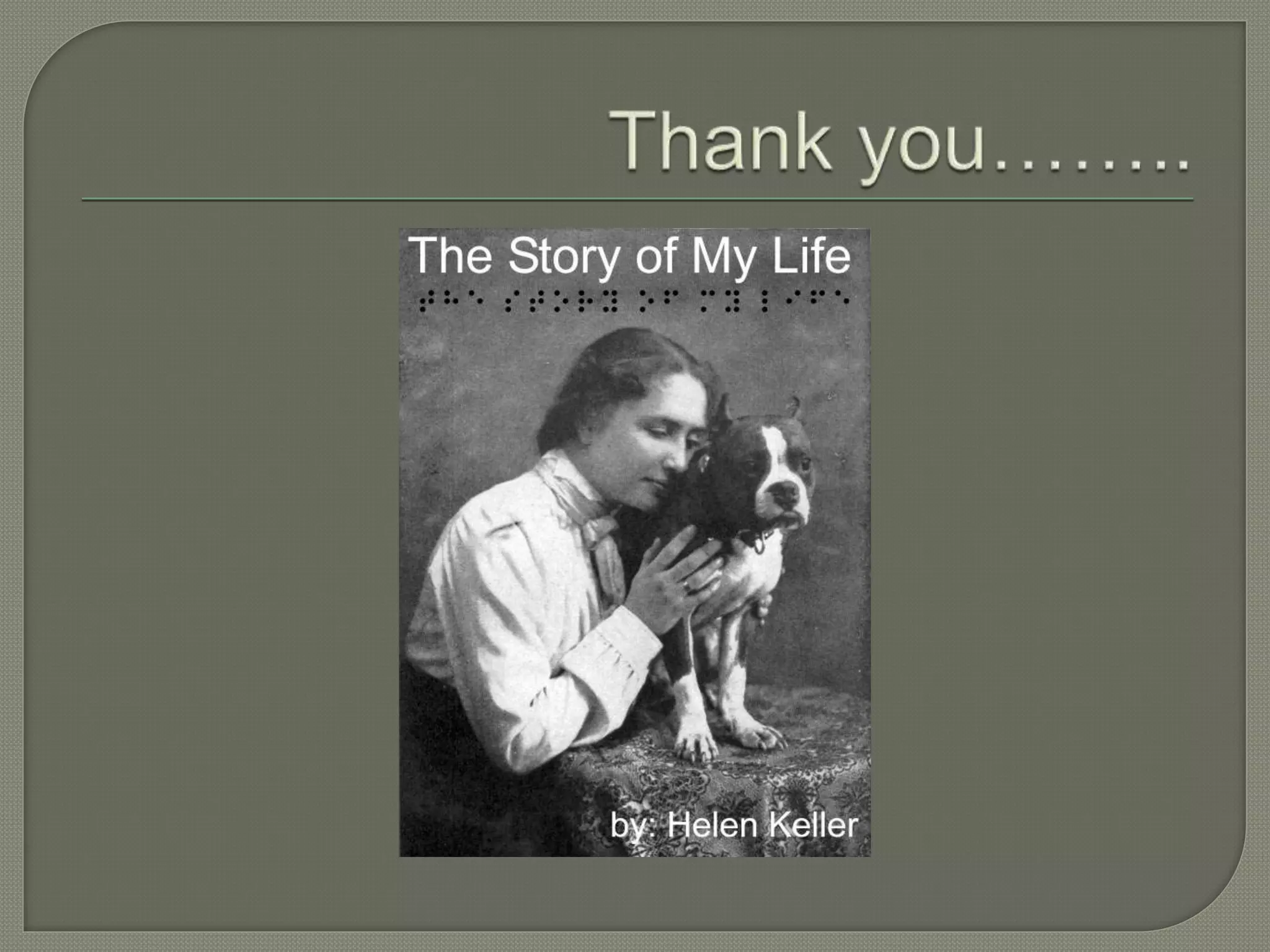
Author: Helen Keller
She, is both deaf and blind.
Who would believe such a person would
write books on her own.
This book shows that Helen’s life is neither
a miracle nor a joke
She published “The story of my life” when
she was twenty.
It describes how she withstood against her
disabilities
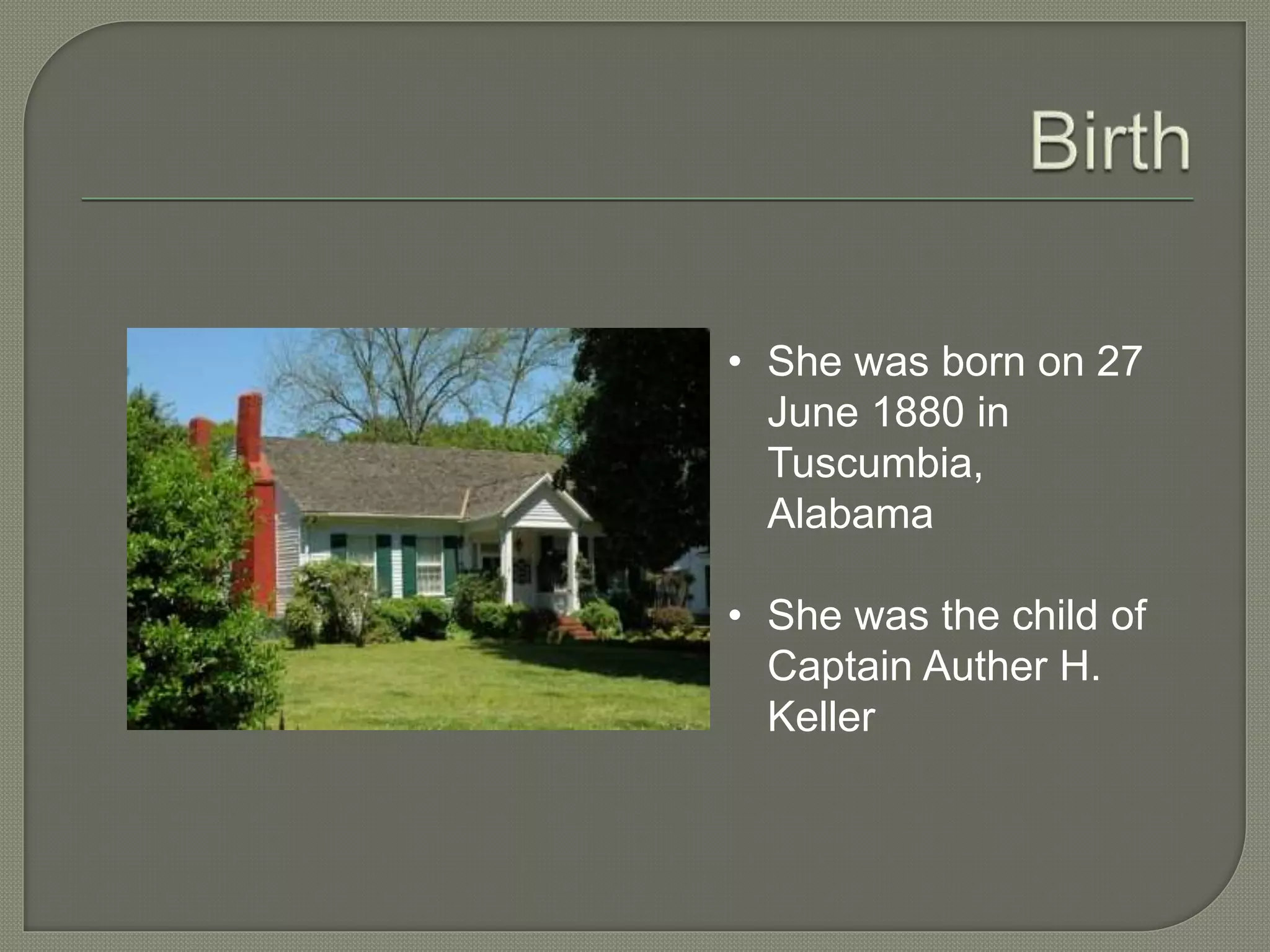
• She was born on 27
June 1880 in
Tuscumbia,
Alabama
• She was the child of
Captain Auther H.
Keller
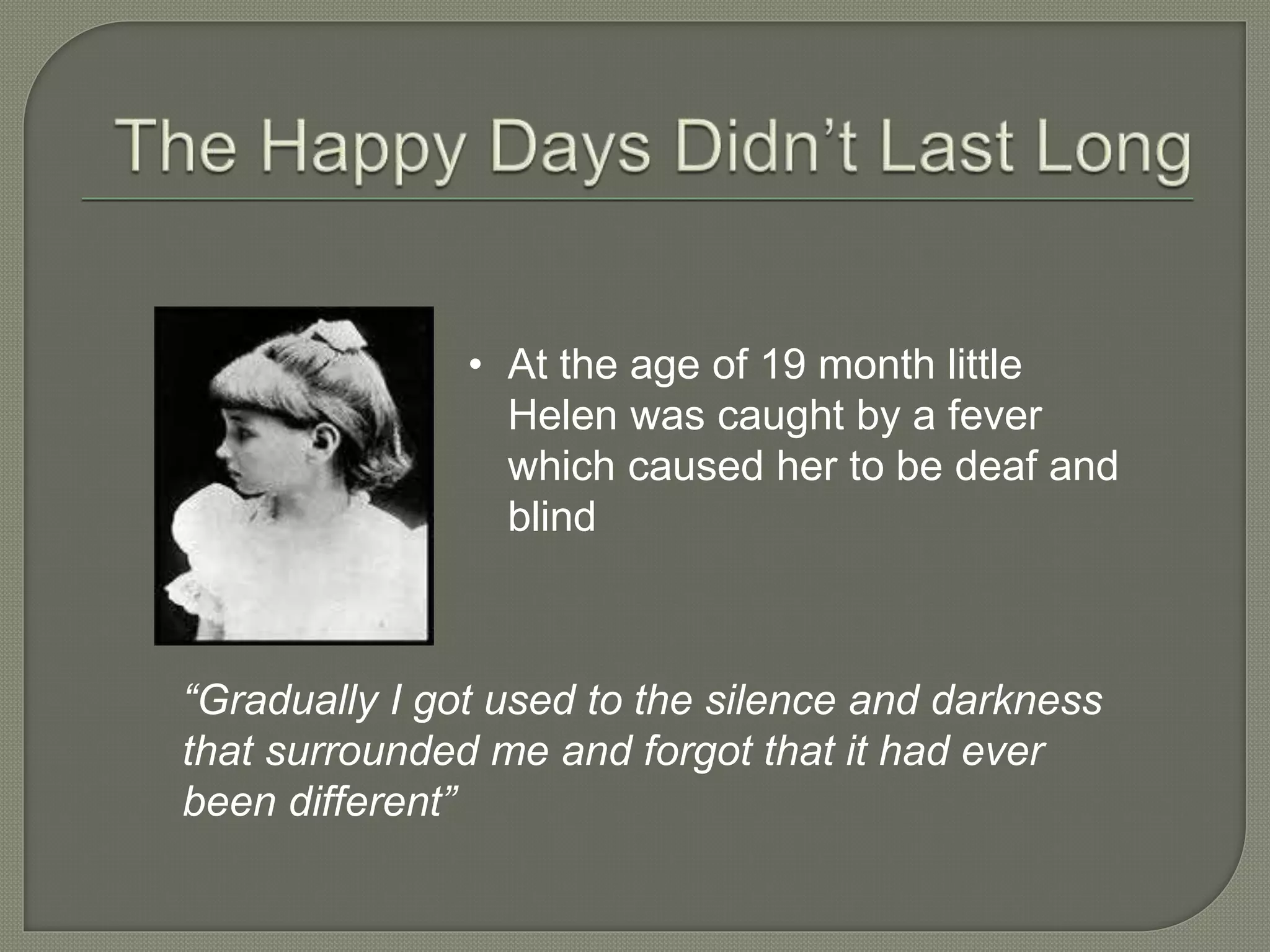
• At the age of 19 month little
Helen was caught by a fever
which caused her to be deaf and
blind
“Gradually I got used to the silence and darkness
that surrounded me and forgot that it had ever
been different”
 The only word she could remember was “Water”, this
was her only word in her world at that time
 A shake of head for NO, a nod for YES was her
communicate
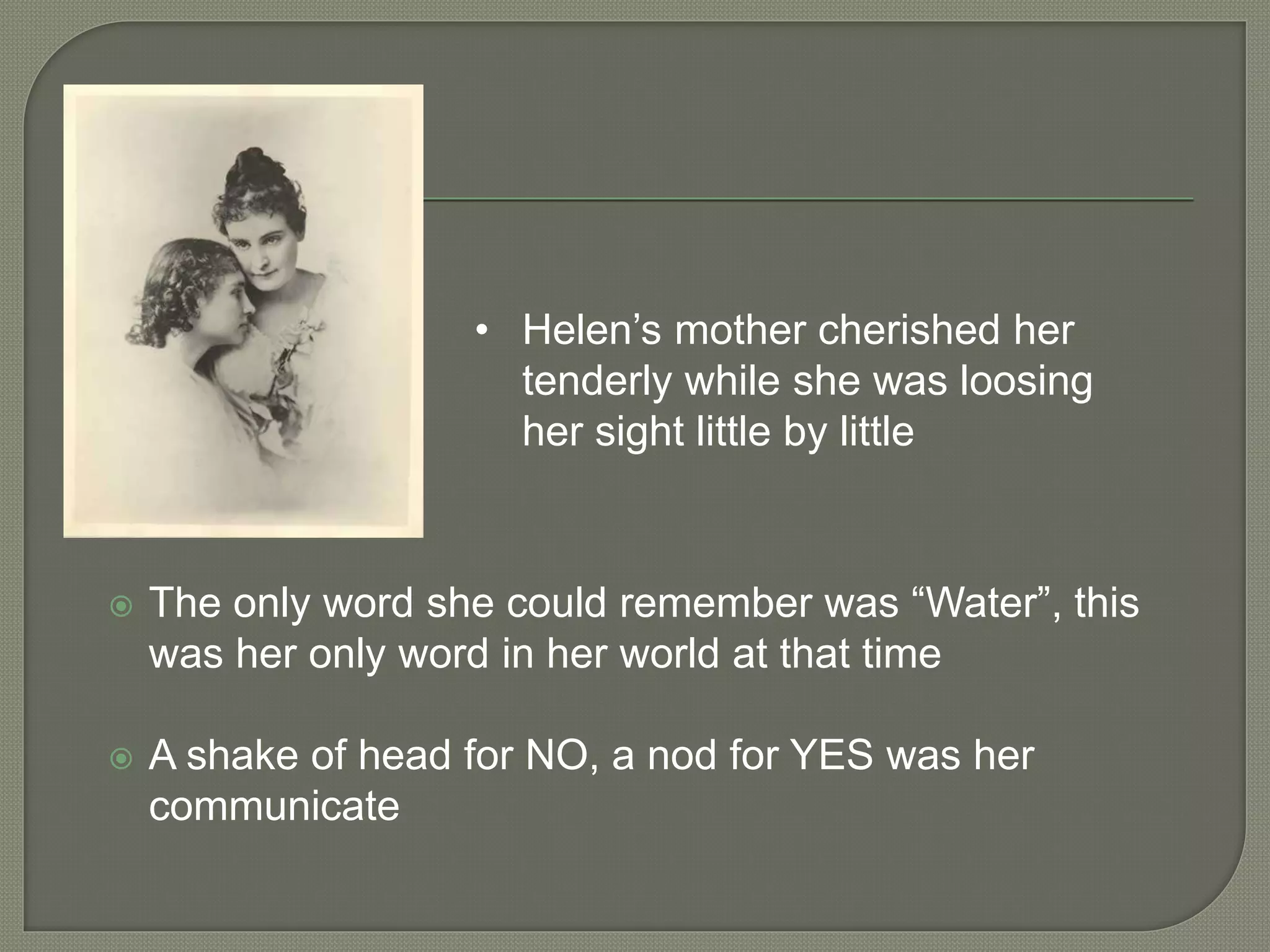
• Helen’s mother cherished her
tenderly while she was loosing
her sight little by little
 She was struggling to be free. Free from the world of
misery & bitterness where she experienced failures when
expressing herself
 Her parents suffered too. They searched for teachers
having the method to teach a child who’s both deaf and
blind.
 Helen’s parents were able to find Alexander Grahm Bell
and with his help they were able to find a way to educate
little Helen.
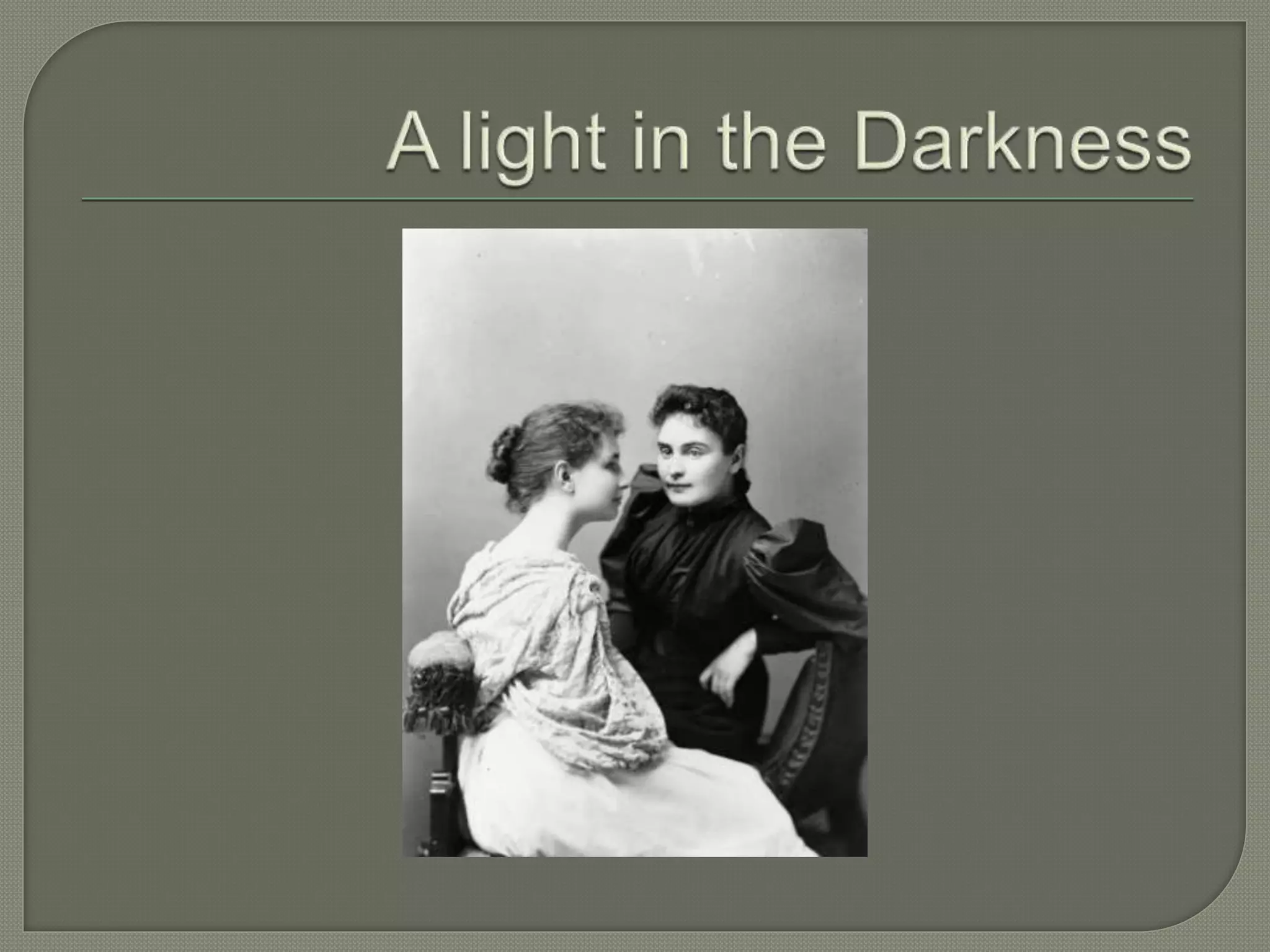
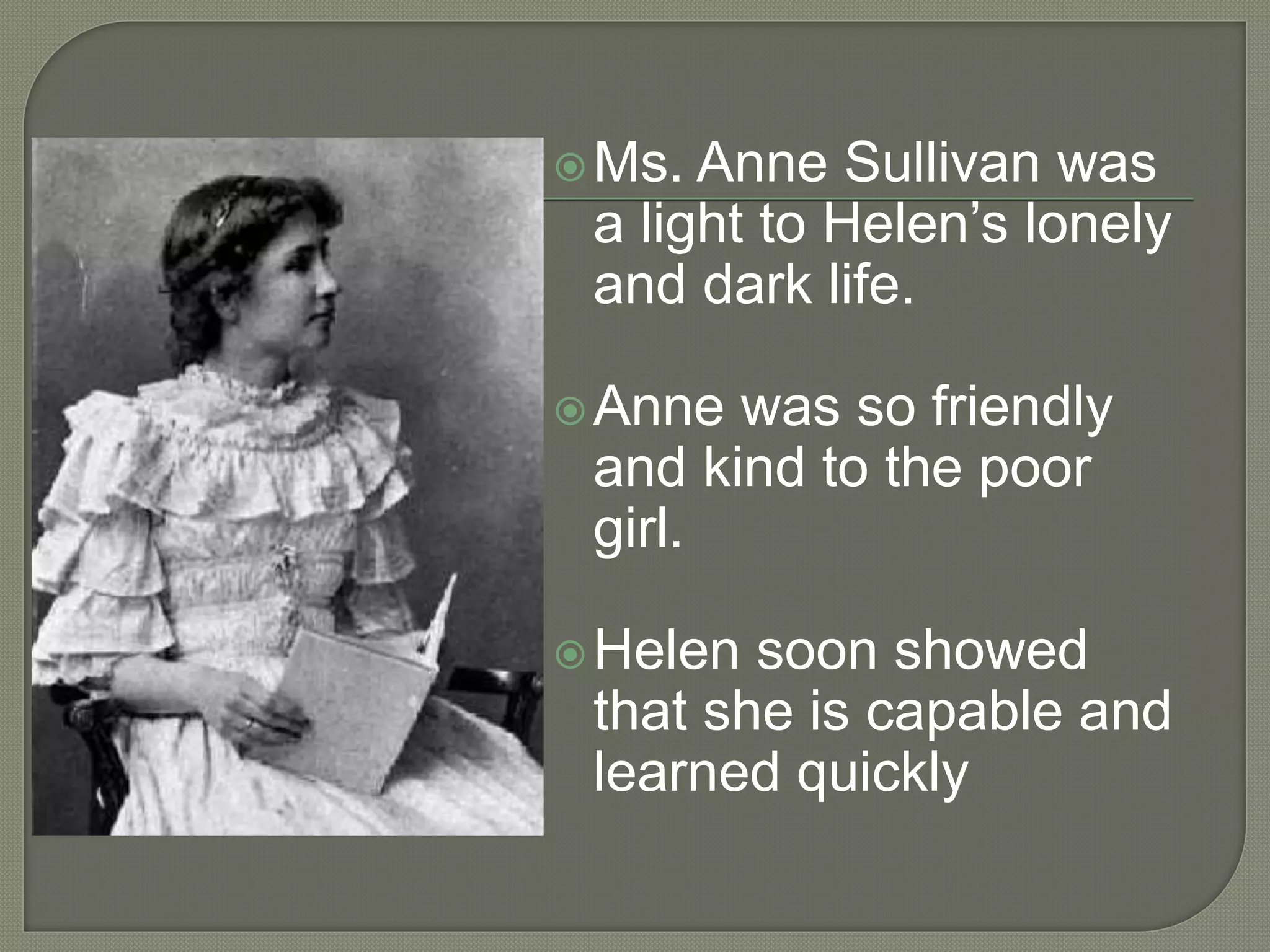
Ms. Anne Sullivan was
a light to Helen’s lonely
and dark life.
Anne was so friendly
and kind to the poor
girl.
Helen soon showed
that she is capable and
learned quickly
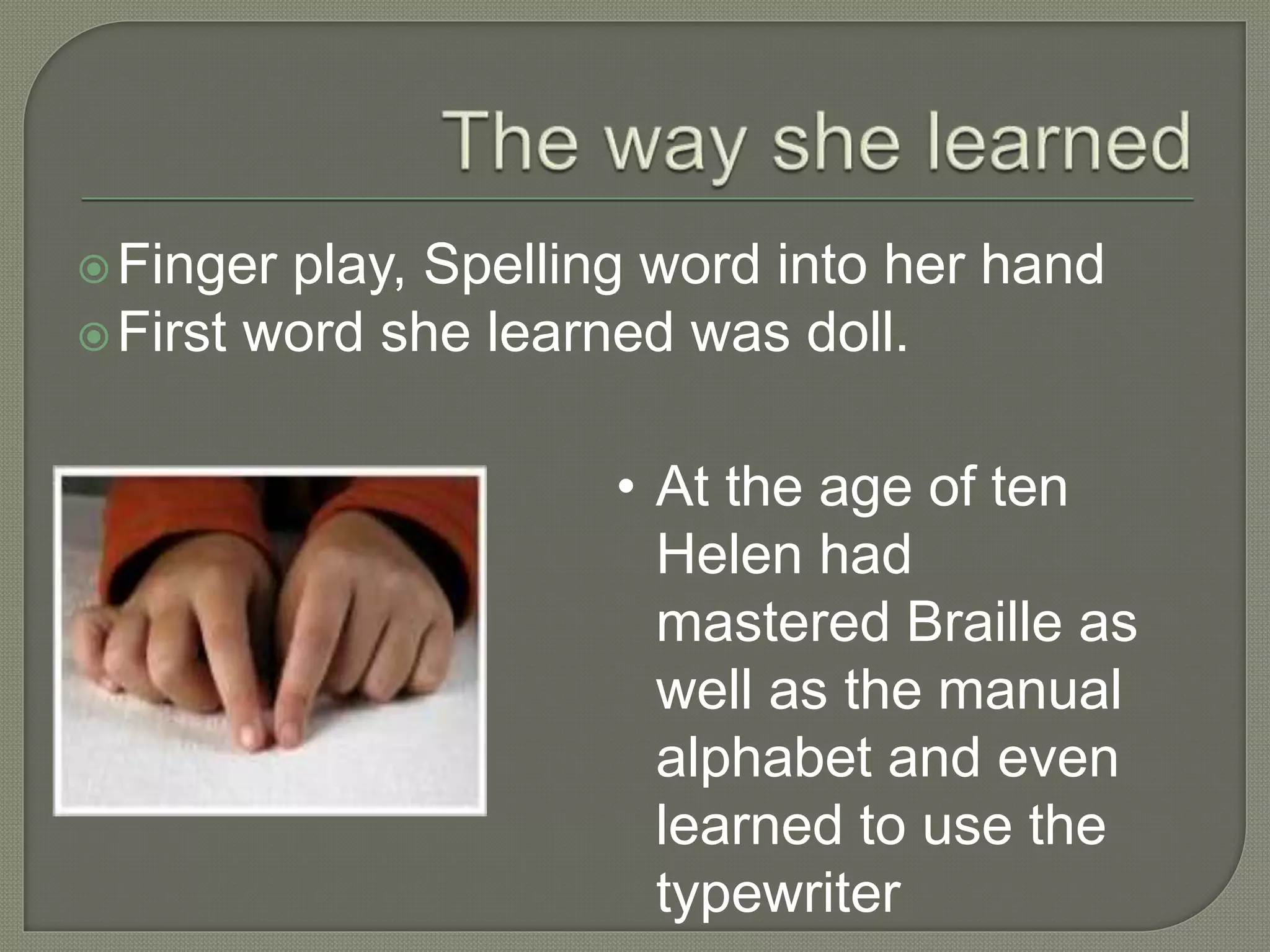
Finger play, Spelling word into her hand
First word she learned was doll.
• At the age of ten
Helen had
mastered Braille as
well as the manual
alphabet and even
learned to use the
typewriter
Water was the word which Helen couldn’t
understand easily.
Ms.Sullivan put Helen’s hand under water
coming out from the pump and spelled w-
a-t-e-r to her hand
When she realized what water means she
rejoiced.
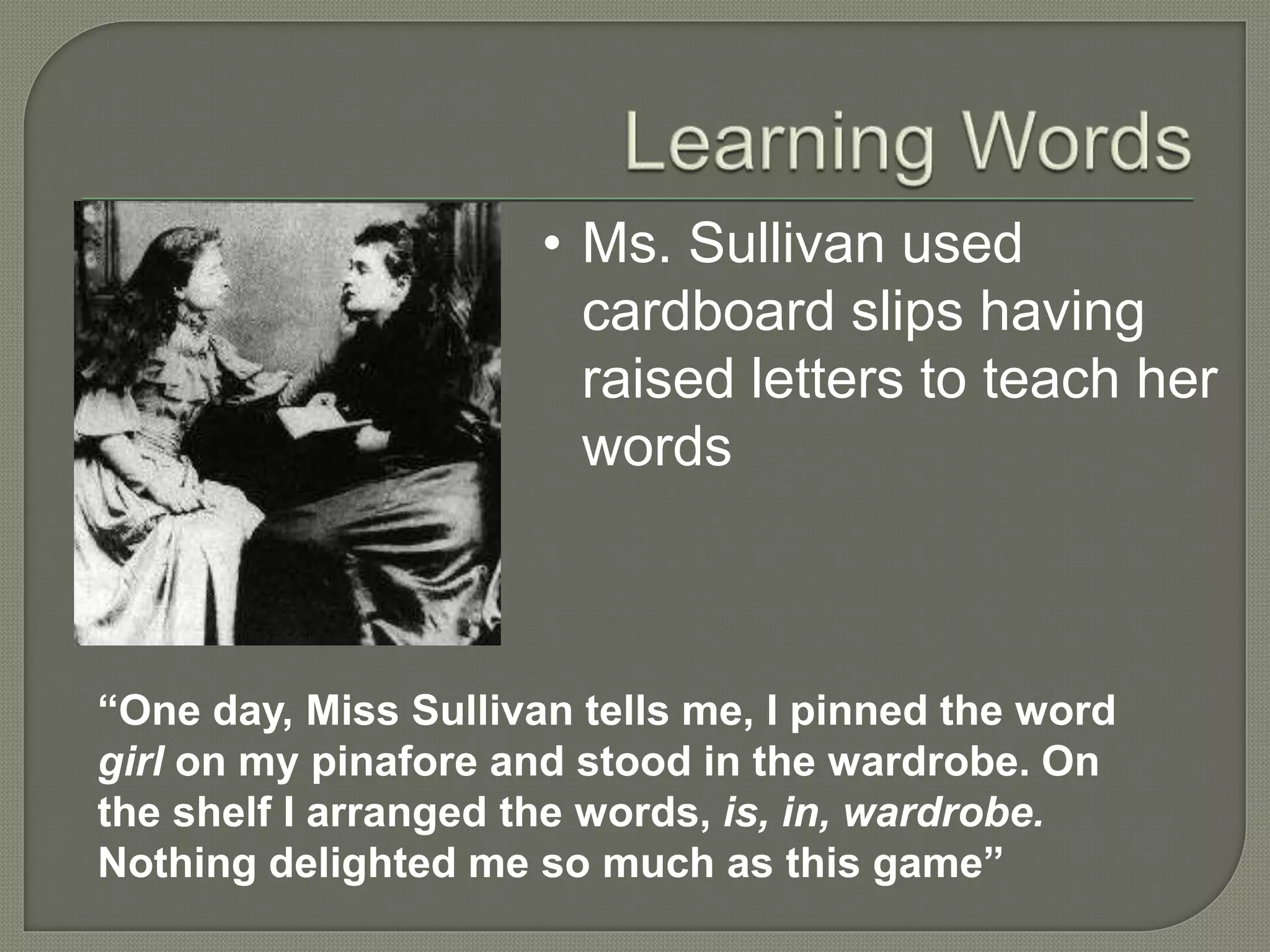
• Ms. Sullivan used
cardboard slips having
raised letters to teach her
words
“One day, Miss Sullivan tells me, I pinned the word
girl on my pinafore and stood in the wardrobe. On
the shelf I arranged the words, is, in, wardrobe.
Nothing delighted me so much as this game”
Primarily her teacher was Ms. Anne
Sullivan
In 1888 entered to Perkins School in
Boston
 Wright-Humason School for the Deaf in
New York City in 1894
In 1896 - Entered Cambridge College for
Young Ladies
 What had she
achieved?
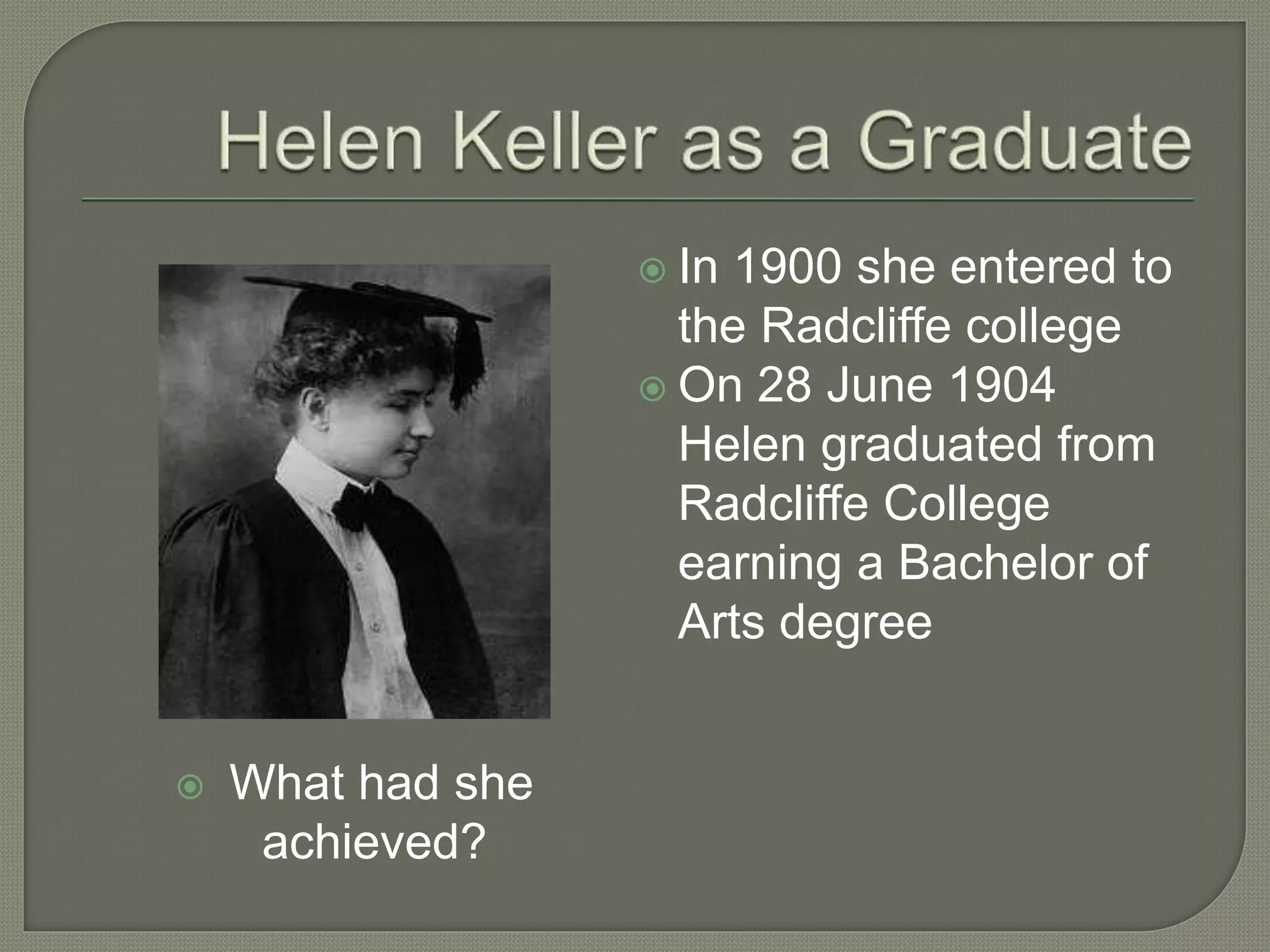
 In 1900 she entered to
the Radcliffe college
 On 28 June 1904
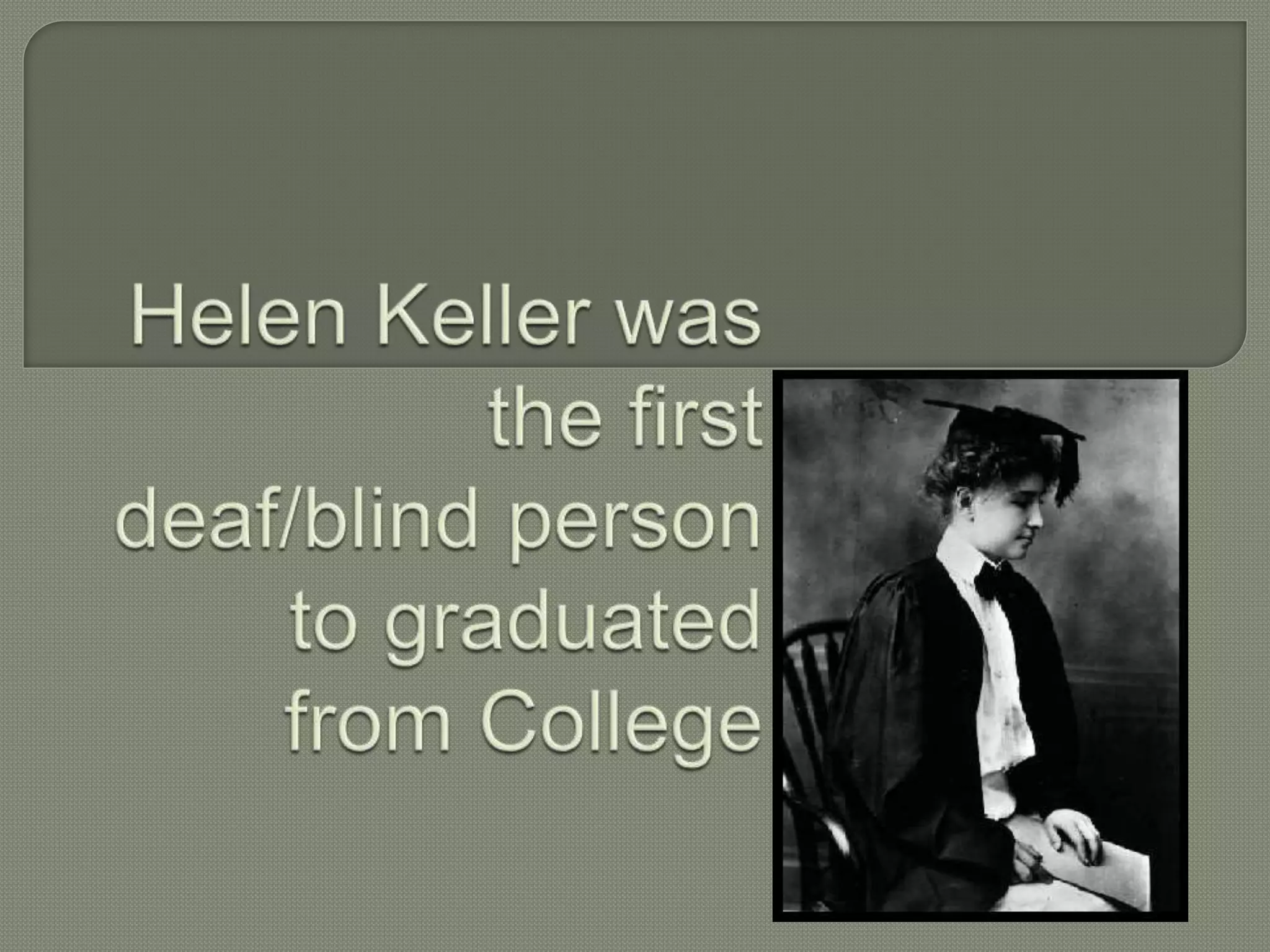
Helen graduated from
Radcliffe College
earning a Bachelor of
Arts degree
Temple and Harvard Universities in the
United States
 Glasgow and Berlin Universities in Europe
 Delhi University in India
Witwatersrand University in South Africa
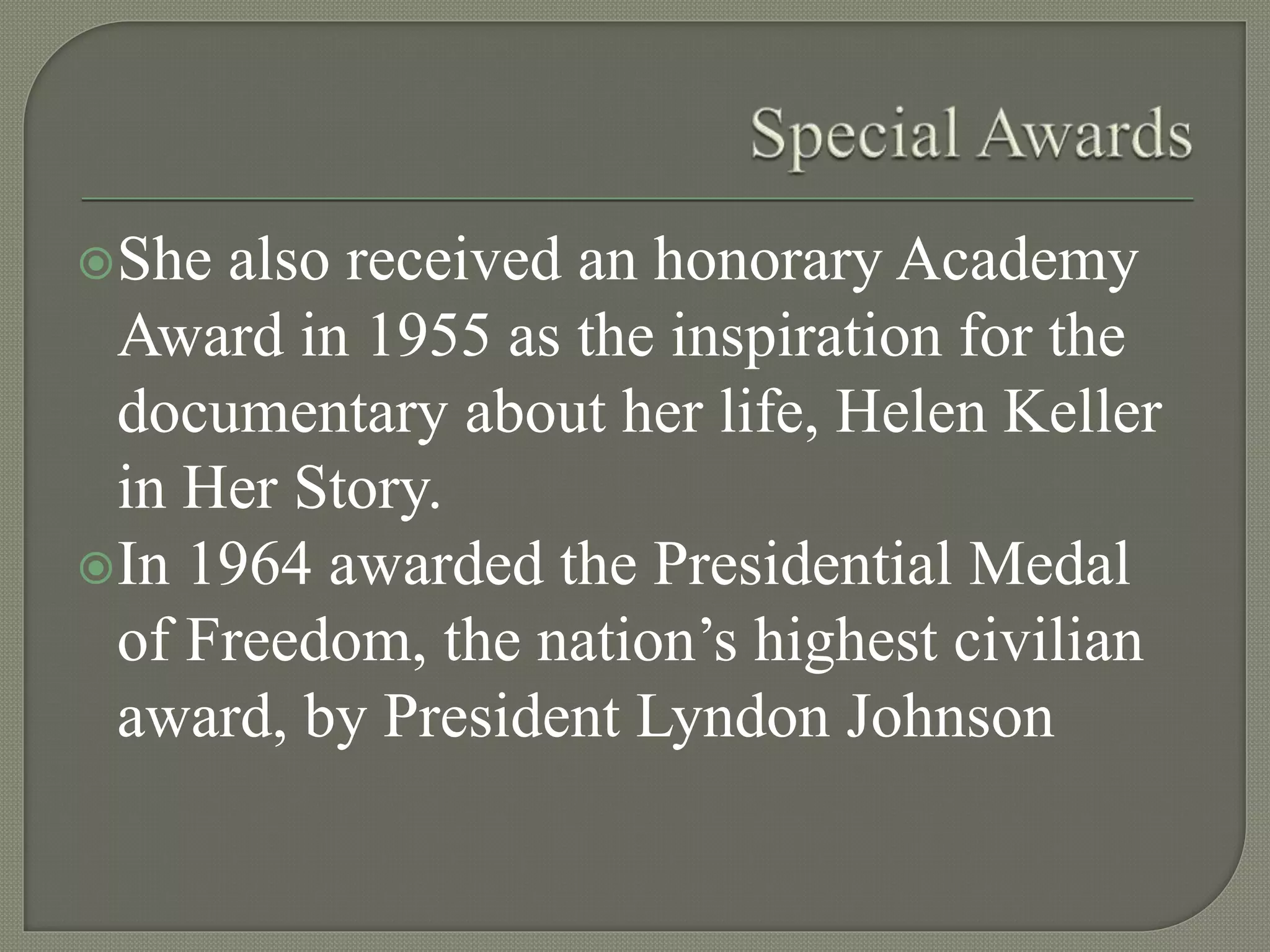
She also received an honorary Academy
Award in 1955 as the inspiration for the
documentary about her life, Helen Keller
in Her Story.
In 1964 awarded the Presidential Medal
of Freedom, the nation’s highest civilian
award, by President Lyndon Johnson
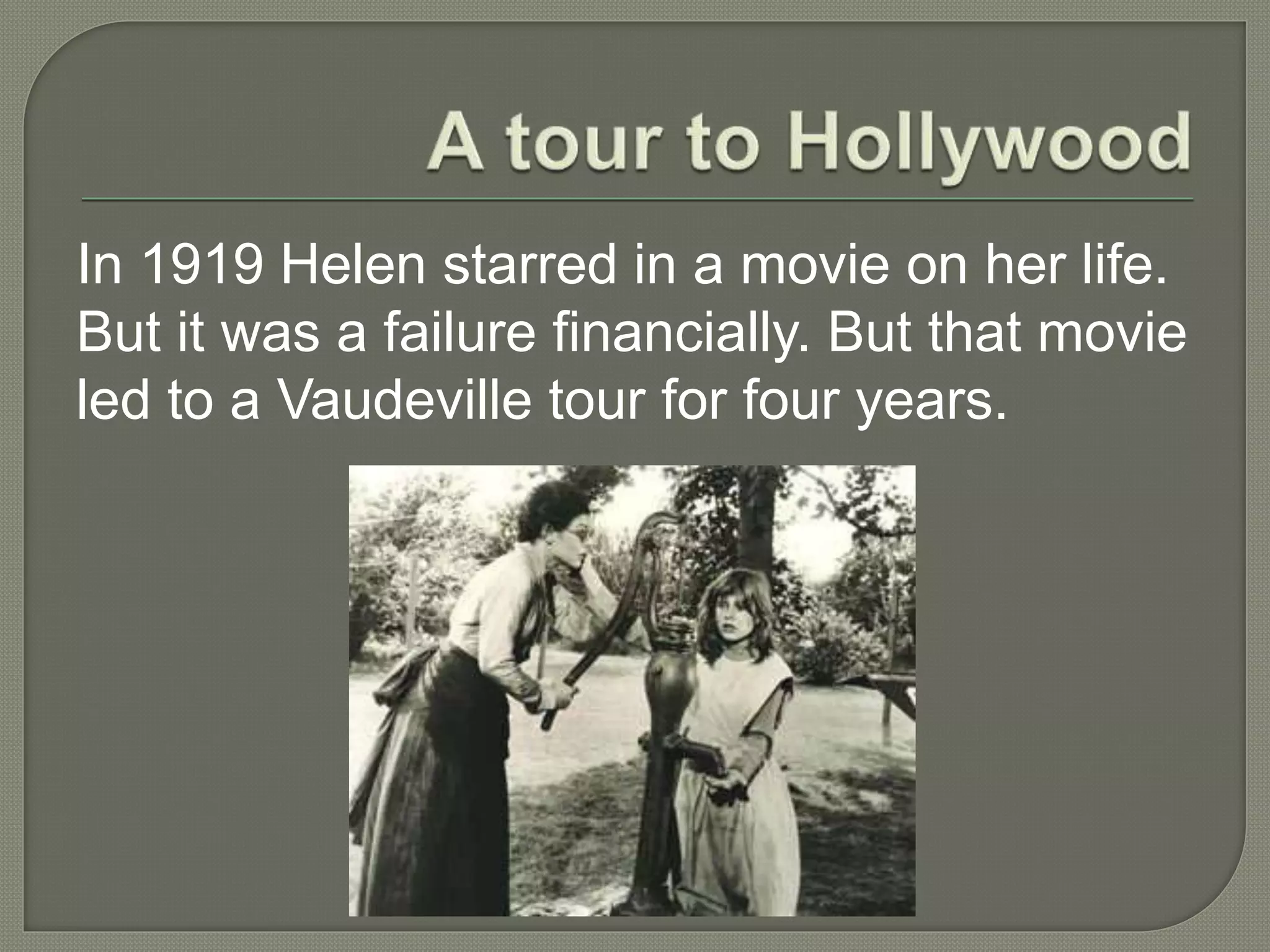
In 1919 Helen starred in a movie on her life.
But it was a failure financially. But that movie
led to a Vaudeville tour for four years.
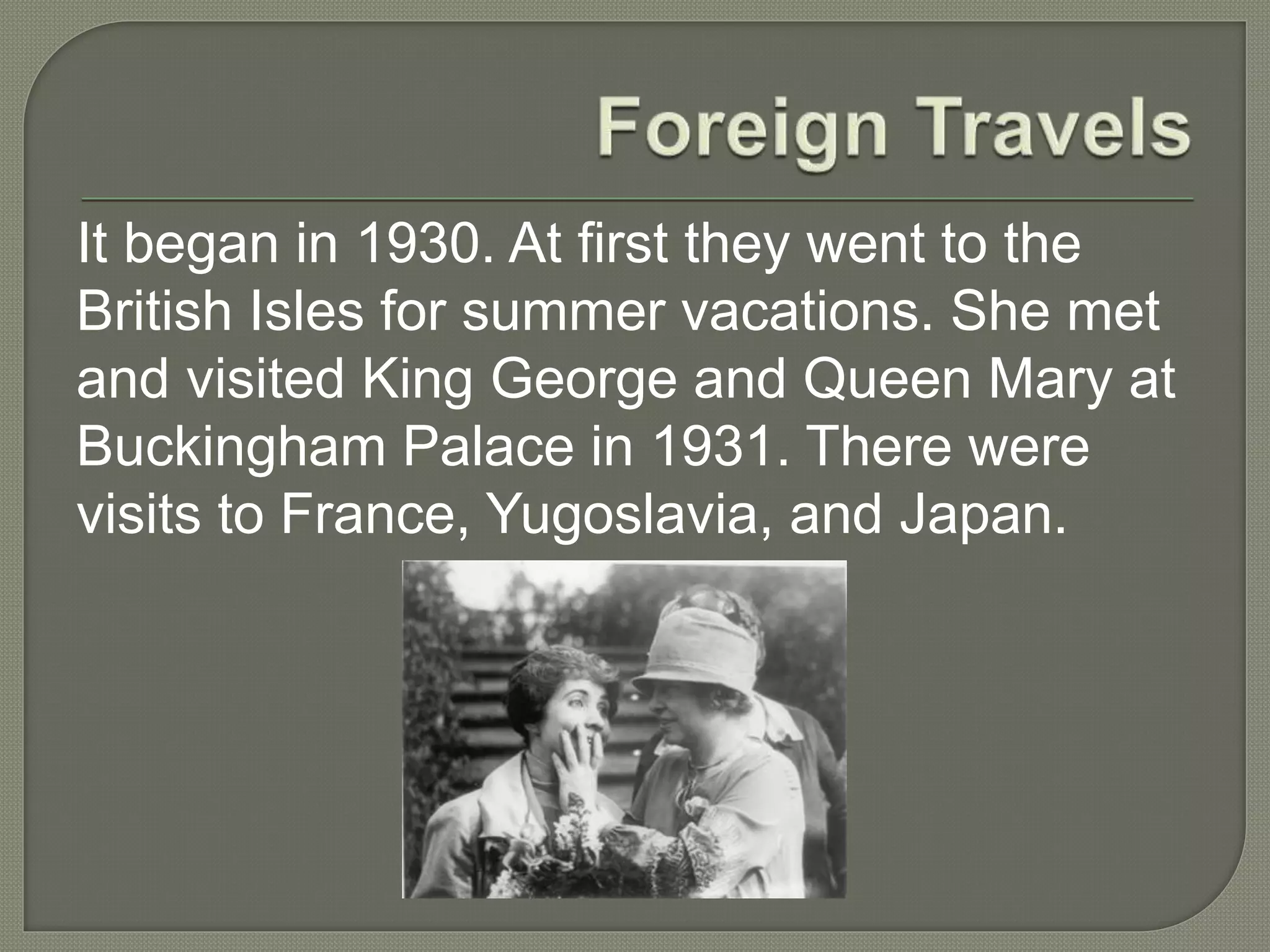
It began in 1930. At first they went to the
British Isles for summer vacations. She met
and visited King George and Queen Mary at
Buckingham Palace in 1931. There were
visits to France, Yugoslavia, and Japan.
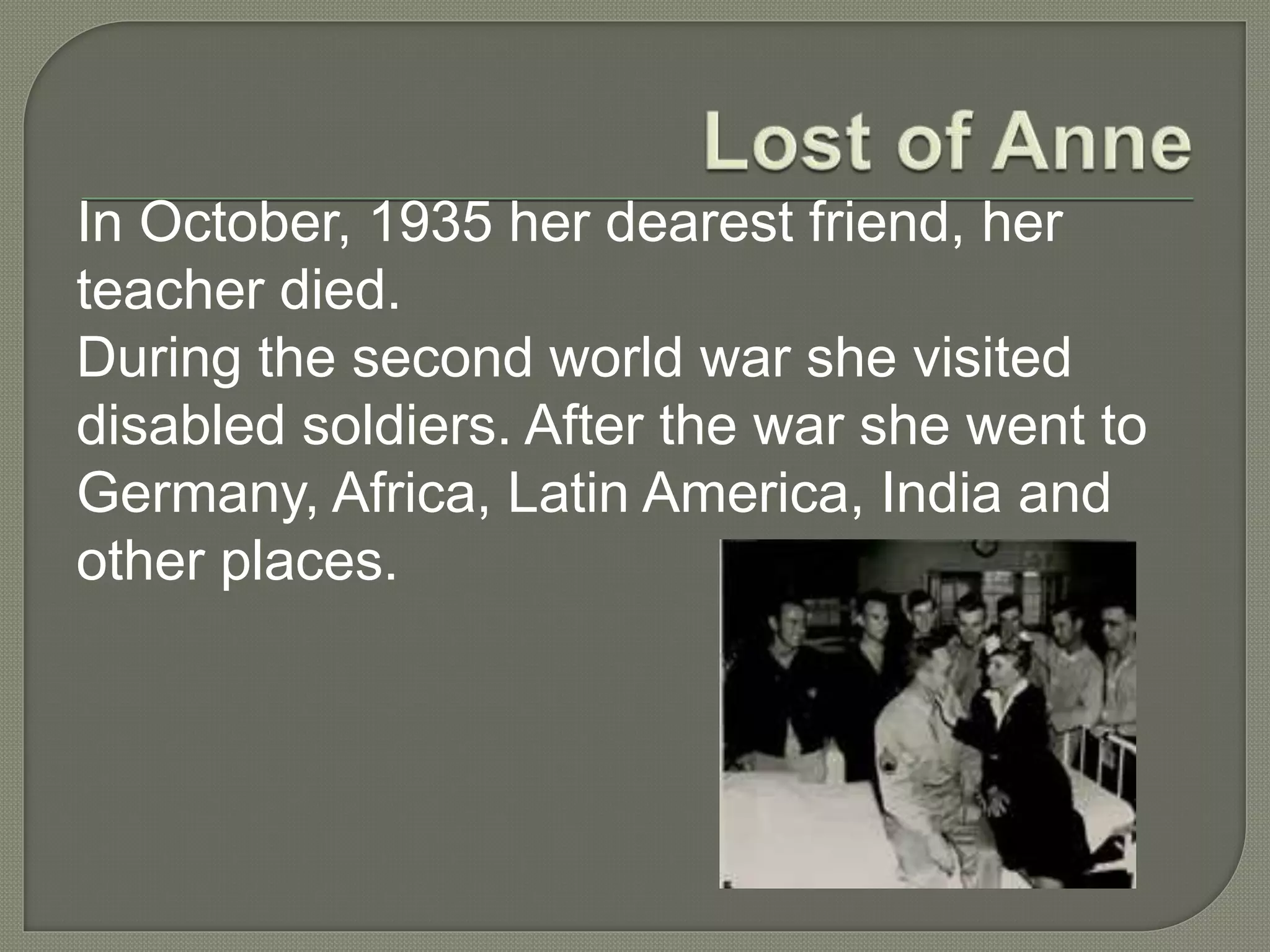
In October, 1935 her dearest friend, her
teacher died.
During the second world war she visited
disabled soldiers. After the war she went to
Germany, Africa, Latin America, India and
other places.
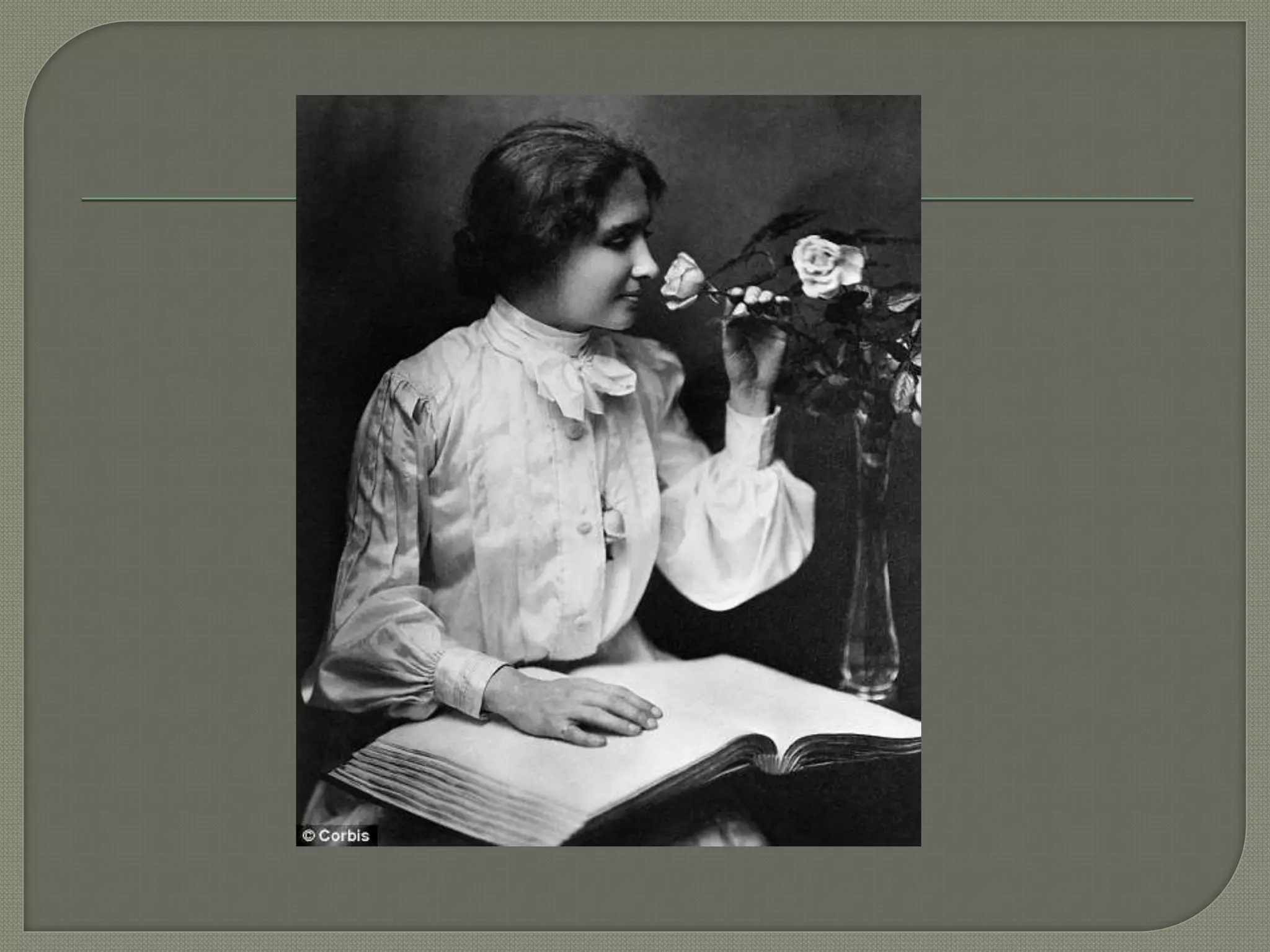
Helen retires from public life In October
1961 Helen suffered the first of a series of
strokes, and her public life was to draw to a
close.
On June 1, 1968, at Arcan Ridge, Helen
Keller died peacefully in her sleep.
To a normal person sun is
light and warmth.
But to a blind person?
In little Helen’s own words
“It seemed to me that there could be
nothing more beautiful than the sun,
whose warmth makes all things grow”
“I learned how the sun and the rain make to
grow out of the ground every tree”
“She sends the sunshine and rain to make
them grow”
“I think the sunshine is Nature's warm
smile, and the raindrops are her tears”
Blindness or deafness is not a problem to
love the nature.
“The best and most beautiful things in the
world cannot be seen or even touched.
They must be felt with the heart."
Nature is "a feeling, a love and an appetite."
“I think you will be glad to hear that these
poems have taught me to enjoy and love
the beautiful springtime, even though I
cannot see the fair, frail blossoms which
proclaim its approach, or hear the joyous
warbling of the home-coming birds. Sweet
Mother Nature can have no secrets from
me when my poet is near.”
Few know what joy it is to feel the roses
pressing softly into the hand, or the
beautiful motion of the lilies as they sway
in the morning breeze.
“Even in the days before my teacher came,
I used to feel along the square stiff
boxwood hedges, and, guided by the
sense of smell, would find the first violets
and lilies.”
“There, too, after a fit of temper, I went to
find comfort and to hide my hot face in the
cool leaves and grass.”
"The public must learn that the blind man is
neither genius nor a freak nor an idiot. He
has a mind that can be educated, a hand
which can be trained, ambitions which it is
right for him to strive to realise, and it is the
duty of the public to help him make the best
of himself so that he can win light through
work"
In 1915, the Permanent Blind
War Relief Fund, later called
the American Braille Press, was
founded. She was a member of
its first board of directors.
Helen joined American
Foundation for the Blind in 1921
and worked for the organization
for over 40 years.
“I WILL NOT JUST
LIVE MY LIFE. I
WILL NOT JUST
SPEND MY LIFE. I
WILL INVEST MY
LIFE."
There are many valuable things
we can learn from “The story of
my Life”
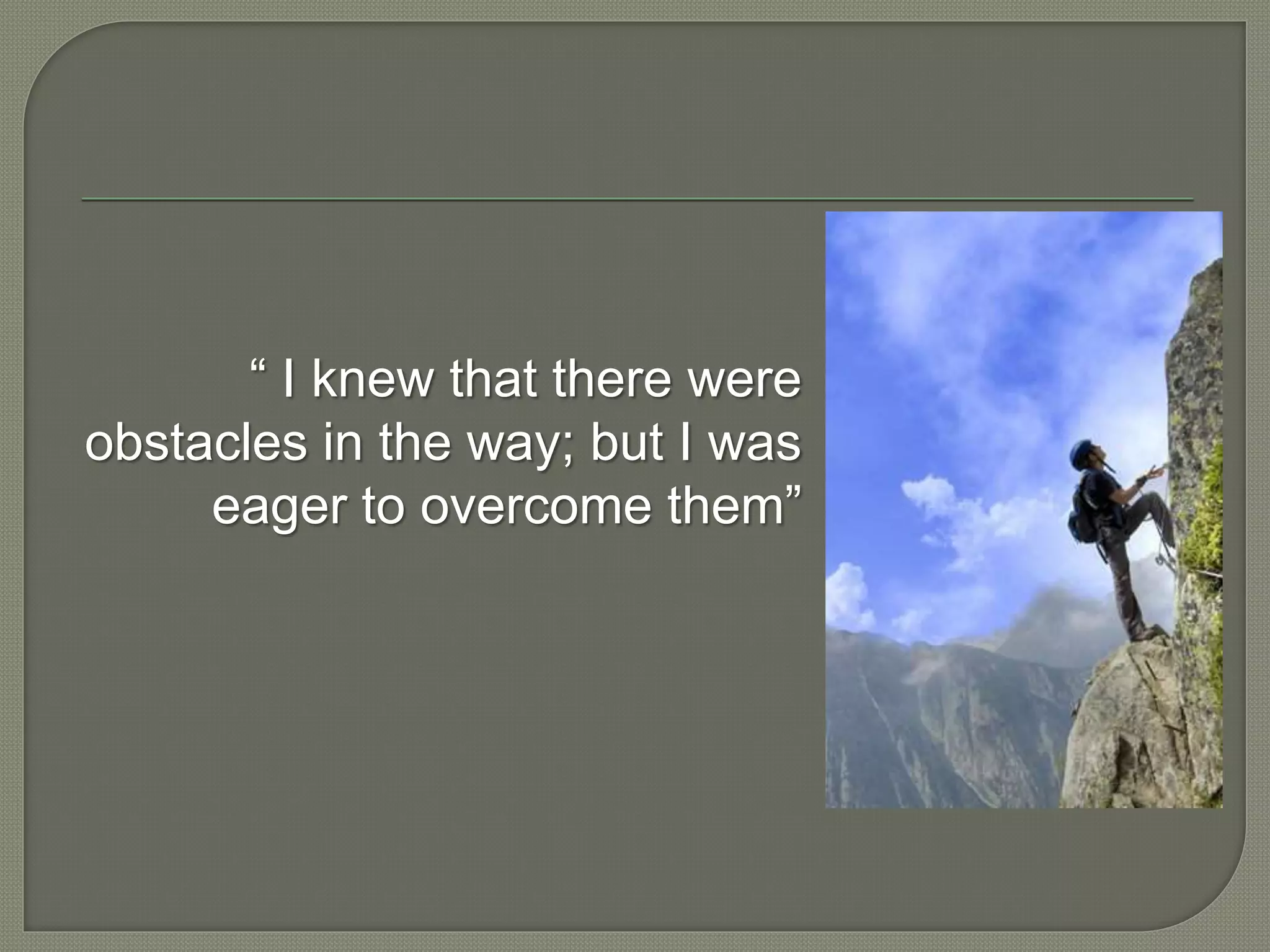
“ I knew that there were
obstacles in the way; but I was
eager to overcome them”
“That living word awakened my soul,
gave it light hope, joy, set it free!”
“There were barriers still, it is true, but
barriers that could in time be swept
away”
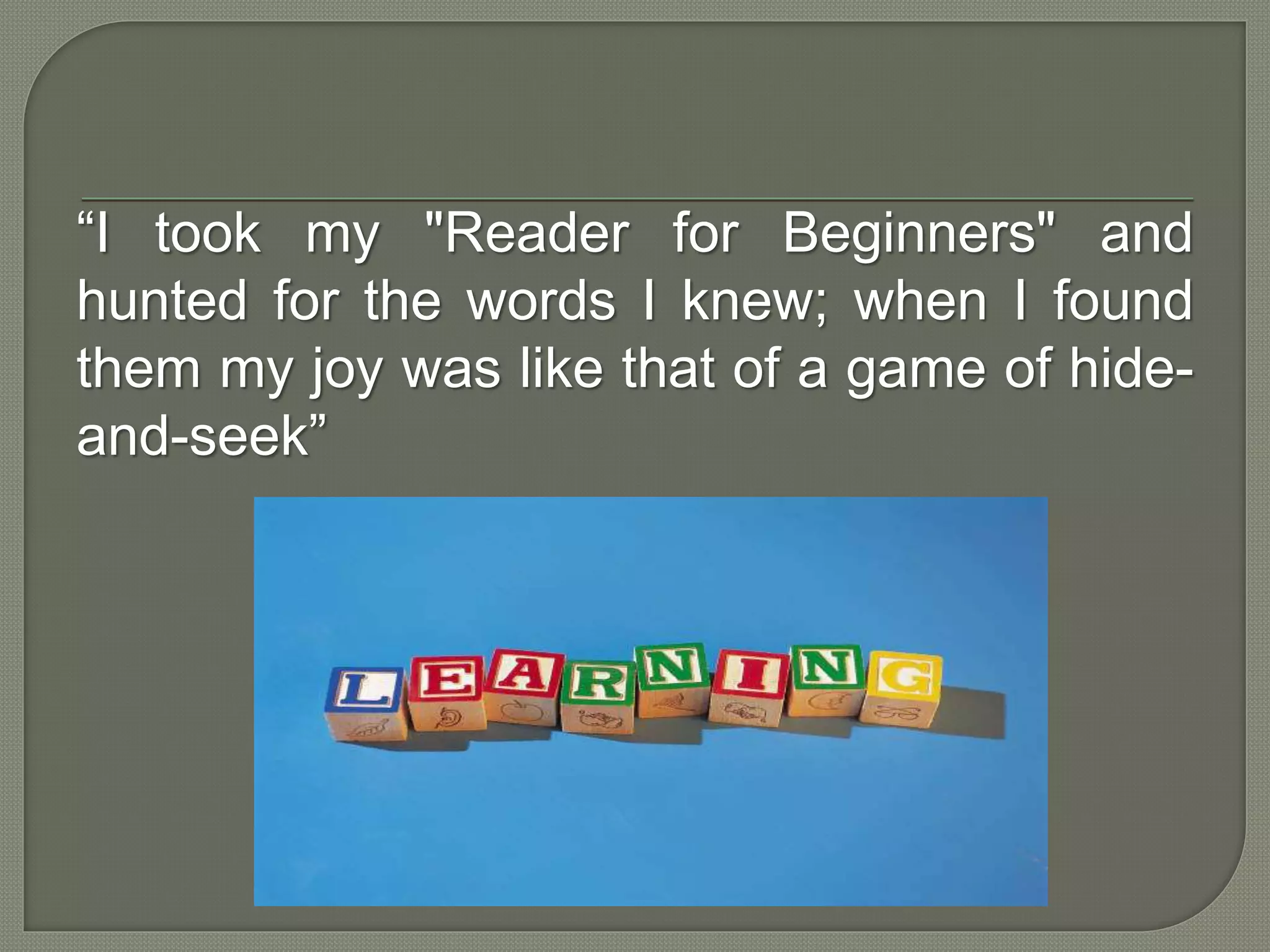
“I took my "Reader for Beginners" and
hunted for the words I knew; when I found
them my joy was like that of a game of hide-
and-seek”
…and find it again and
keep it better, I trudge
on, I gain a little, I feel
encouraged, I get more
eager and climb higher
and begin to see the
widening horizon
I slip back many times, I fall, I
stand still, I run against the
edge of hidden obstacles, I
lose my temper…
Every one who wishes to
gain true knowledge must
climb the Hill Difficulty alone,
and since there is no royal
road to the summit, I must
zigzag it in my own way
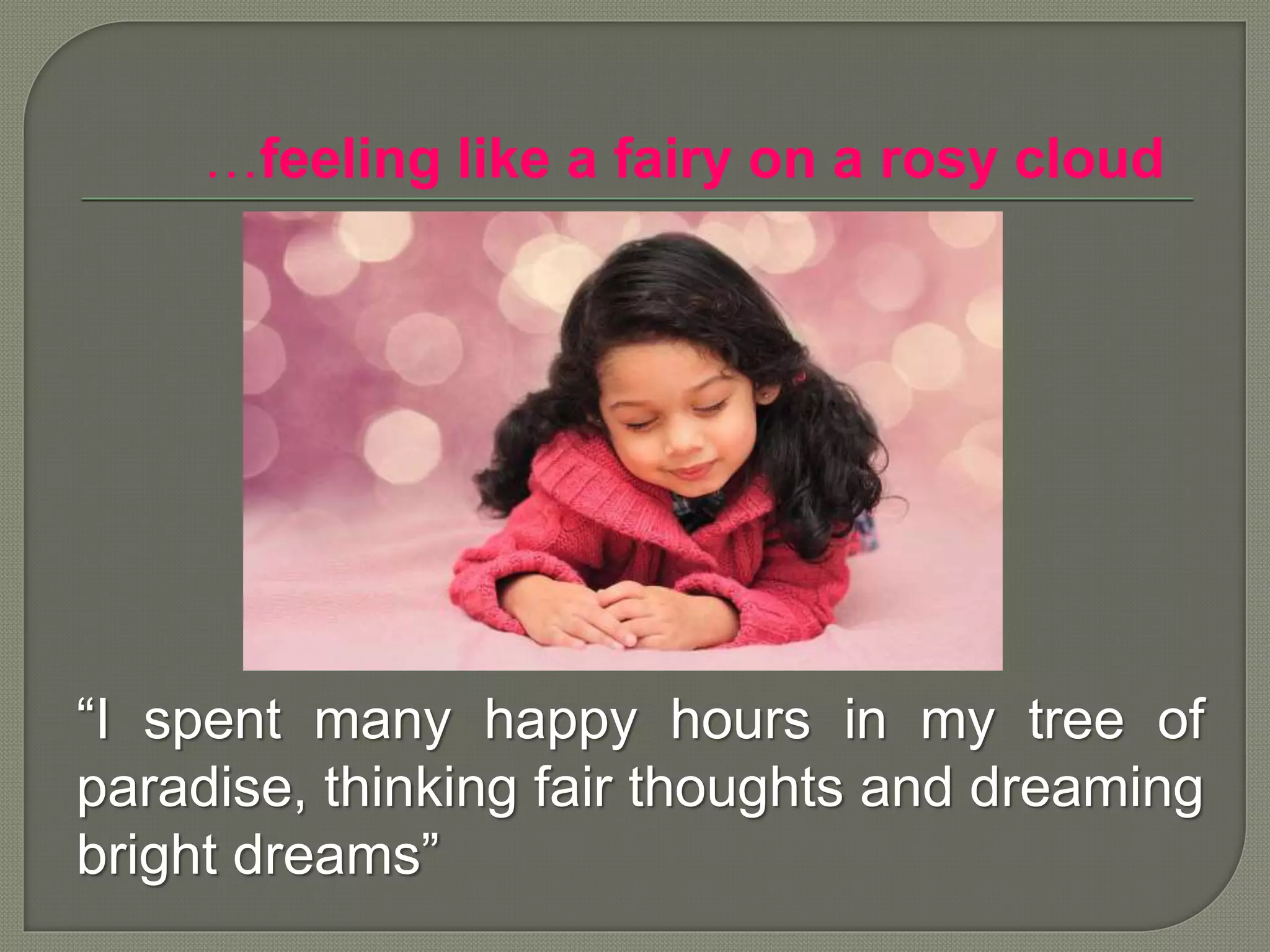
…feeling like a fairy on a rosy cloud
“I spent many happy hours in my tree of
paradise, thinking fair thoughts and dreaming
bright dreams”
She knew the beauty of inner strength and
power of the feelings, more than anyone
else…
A woman with great
patience, compassion,
love, kindness,
determination & optimistic
attitude
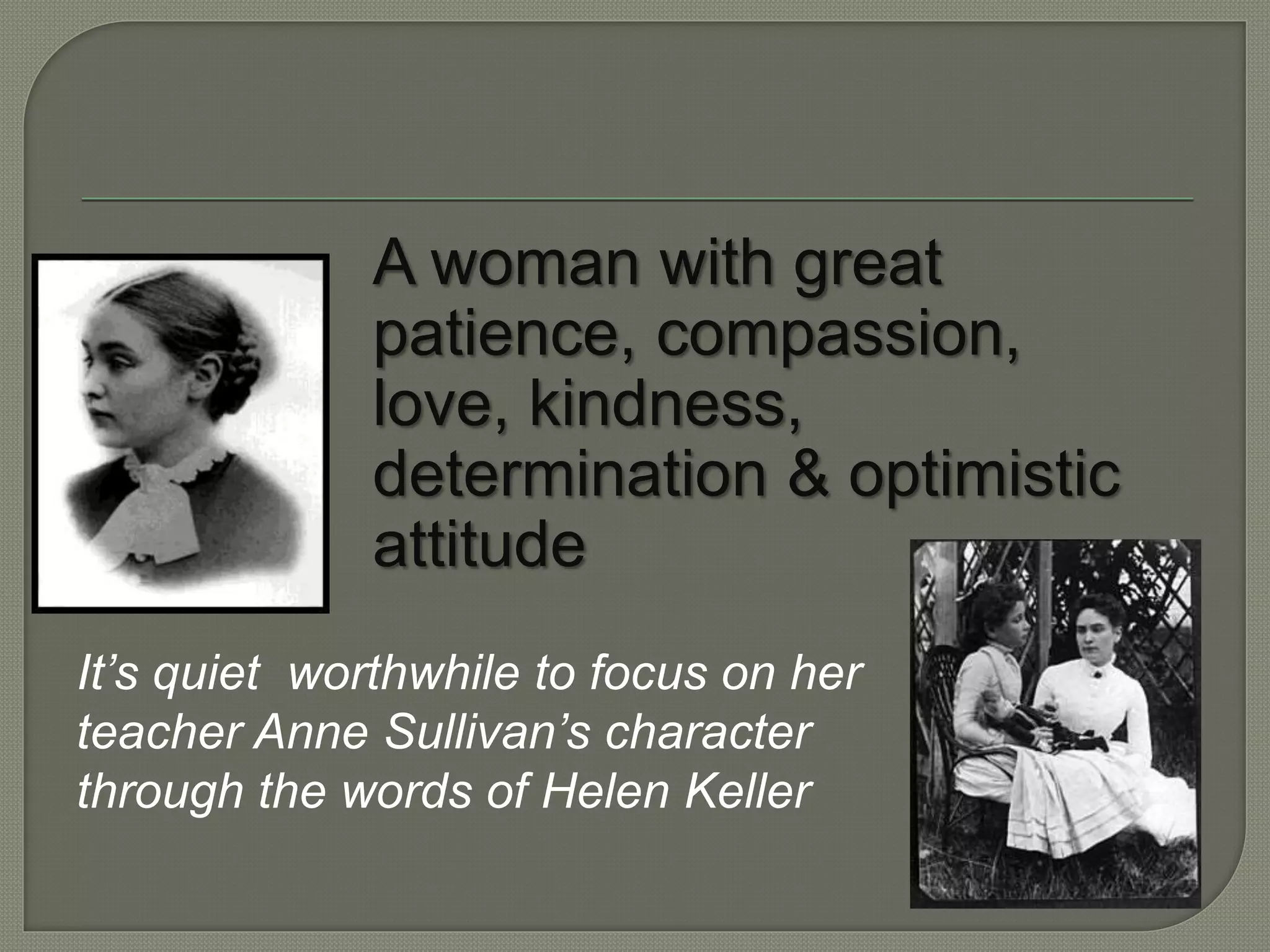
It’s quiet worthwhile to focus on her
teacher Anne Sullivan’s character
through the words of Helen Keller
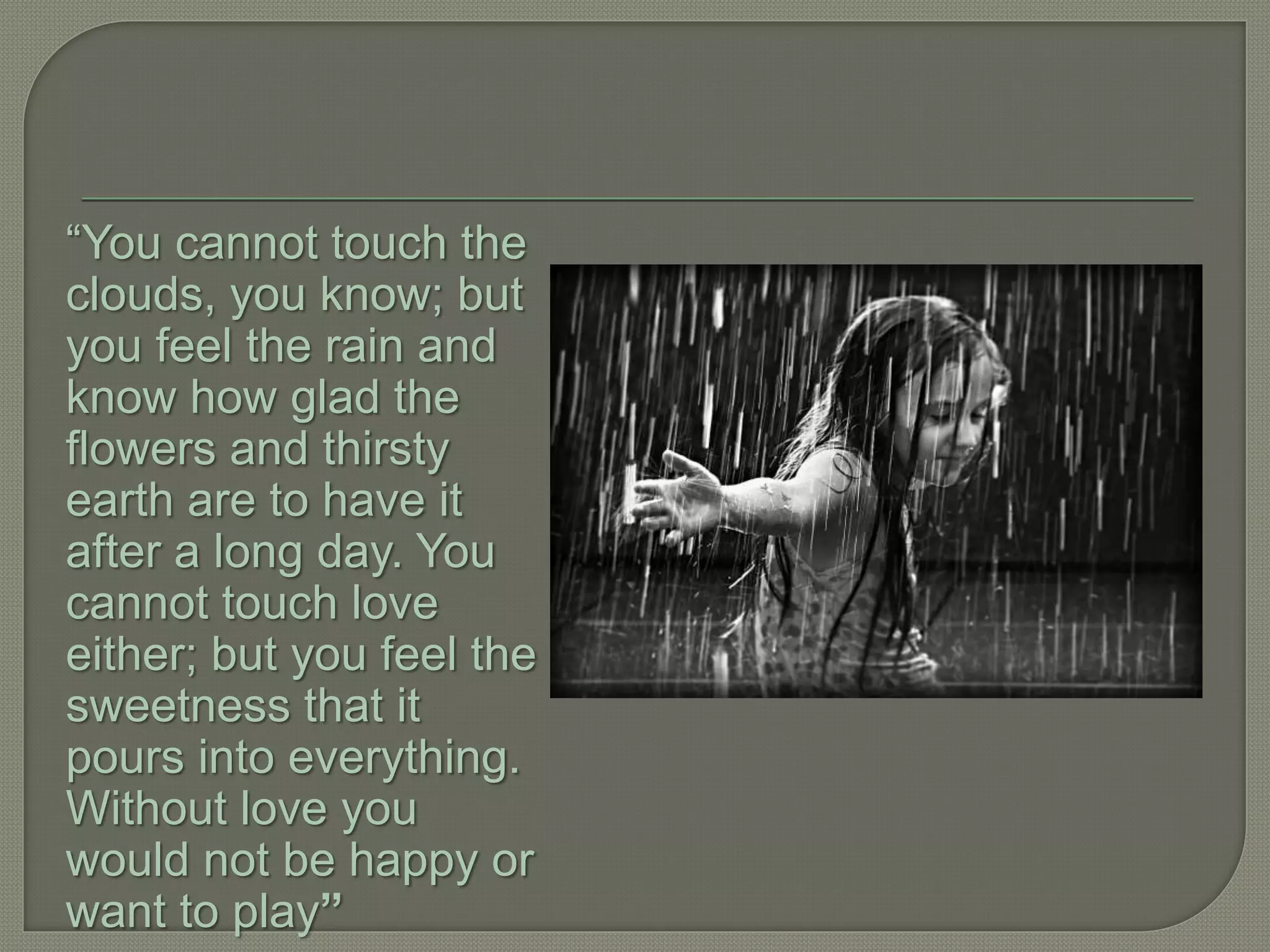
“You cannot touch the
clouds, you know; but
you feel the rain and
know how glad the
flowers and thirsty
earth are to have it
after a long day. You
cannot touch love
either; but you feel the
sweetness that it
pours into everything.
Without love you
would not be happy or
want to play”
A powerful teaching methodology
Adhering to the principles of effective child
education
The reference to the nature
“She linked my earliest thoughts with
nature and made me feel that “birds and
flowers and I were happy peers””
She knew the best for her…
A gradual but effective teaching procedure
she followed
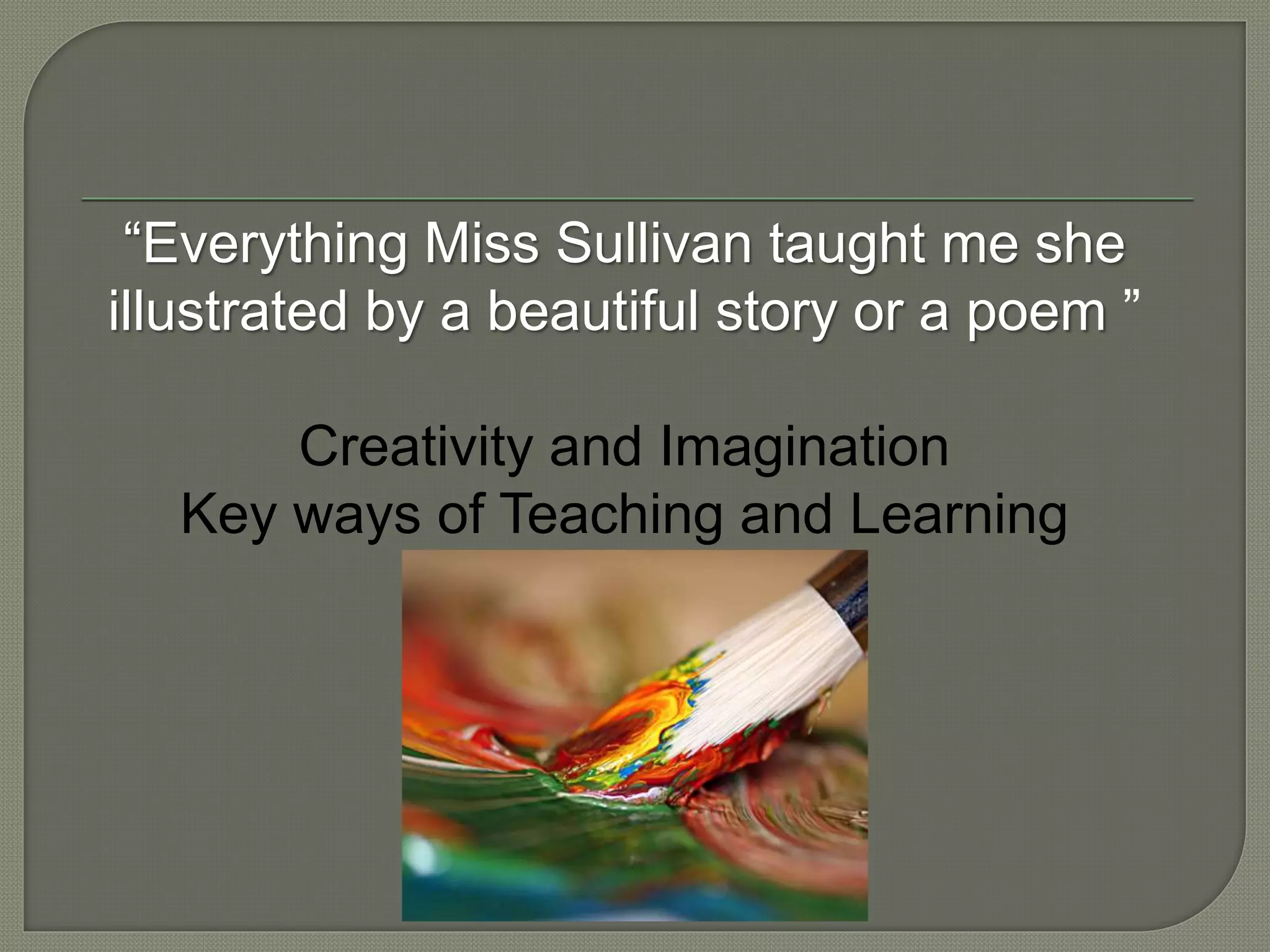
“Everything Miss Sullivan taught me she
illustrated by a beautiful story or a poem ”
Creativity and Imagination
Key ways of Teaching and Learning
Any Q’s?
Chamila Wijayarathna
Maduranga Siriwardena
Nadeeshaan Gunasinghe
Dinithi Sumanaweera
Kelum Deshapriya

Final 121114041321-phpapp01

  • 1.
    Close your eyesand ears for five seconds……. What do you feel?
  • 2.
  • 3.
    She, is bothdeaf and blind. Who would believe such a person would write books on her own.
  • 4.
    This book showsthat Helen’s life is neither a miracle nor a joke She published “The story of my life” when she was twenty. It describes how she withstood against her disabilities
  • 5.
    • She wasborn on 27 June 1880 in Tuscumbia, Alabama • She was the child of Captain Auther H. Keller
  • 6.
    • At theage of 19 month little Helen was caught by a fever which caused her to be deaf and blind “Gradually I got used to the silence and darkness that surrounded me and forgot that it had ever been different”
  • 7.
     The onlyword she could remember was “Water”, this was her only word in her world at that time  A shake of head for NO, a nod for YES was her communicate • Helen’s mother cherished her tenderly while she was loosing her sight little by little
  • 8.
     She wasstruggling to be free. Free from the world of misery & bitterness where she experienced failures when expressing herself  Her parents suffered too. They searched for teachers having the method to teach a child who’s both deaf and blind.  Helen’s parents were able to find Alexander Grahm Bell and with his help they were able to find a way to educate little Helen.
  • 10.
    Ms. Anne Sullivanwas a light to Helen’s lonely and dark life. Anne was so friendly and kind to the poor girl. Helen soon showed that she is capable and learned quickly
  • 11.
    Finger play, Spellingword into her hand First word she learned was doll. • At the age of ten Helen had mastered Braille as well as the manual alphabet and even learned to use the typewriter
  • 12.
    Water was theword which Helen couldn’t understand easily. Ms.Sullivan put Helen’s hand under water coming out from the pump and spelled w- a-t-e-r to her hand When she realized what water means she rejoiced.
  • 13.
    • Ms. Sullivanused cardboard slips having raised letters to teach her words “One day, Miss Sullivan tells me, I pinned the word girl on my pinafore and stood in the wardrobe. On the shelf I arranged the words, is, in, wardrobe. Nothing delighted me so much as this game”
  • 14.
    Primarily her teacherwas Ms. Anne Sullivan In 1888 entered to Perkins School in Boston  Wright-Humason School for the Deaf in New York City in 1894 In 1896 - Entered Cambridge College for Young Ladies
  • 15.
     What hadshe achieved?  In 1900 she entered to the Radcliffe college  On 28 June 1904 Helen graduated from Radcliffe College earning a Bachelor of Arts degree
  • 16.
    Temple and HarvardUniversities in the United States  Glasgow and Berlin Universities in Europe  Delhi University in India Witwatersrand University in South Africa
  • 17.
    She also receivedan honorary Academy Award in 1955 as the inspiration for the documentary about her life, Helen Keller in Her Story. In 1964 awarded the Presidential Medal of Freedom, the nation’s highest civilian award, by President Lyndon Johnson
  • 18.
    In 1919 Helenstarred in a movie on her life. But it was a failure financially. But that movie led to a Vaudeville tour for four years.
  • 19.
    It began in1930. At first they went to the British Isles for summer vacations. She met and visited King George and Queen Mary at Buckingham Palace in 1931. There were visits to France, Yugoslavia, and Japan.
  • 20.
    In October, 1935her dearest friend, her teacher died. During the second world war she visited disabled soldiers. After the war she went to Germany, Africa, Latin America, India and other places.
  • 21.
    Helen retires frompublic life In October 1961 Helen suffered the first of a series of strokes, and her public life was to draw to a close. On June 1, 1968, at Arcan Ridge, Helen Keller died peacefully in her sleep.
  • 23.
    To a normalperson sun is light and warmth. But to a blind person? In little Helen’s own words “It seemed to me that there could be nothing more beautiful than the sun, whose warmth makes all things grow”
  • 24.
    “I learned howthe sun and the rain make to grow out of the ground every tree” “She sends the sunshine and rain to make them grow” “I think the sunshine is Nature's warm smile, and the raindrops are her tears”
  • 25.
    Blindness or deafnessis not a problem to love the nature. “The best and most beautiful things in the world cannot be seen or even touched. They must be felt with the heart." Nature is "a feeling, a love and an appetite."
  • 26.
    “I think youwill be glad to hear that these poems have taught me to enjoy and love the beautiful springtime, even though I cannot see the fair, frail blossoms which proclaim its approach, or hear the joyous warbling of the home-coming birds. Sweet Mother Nature can have no secrets from me when my poet is near.”
  • 27.
    Few know whatjoy it is to feel the roses pressing softly into the hand, or the beautiful motion of the lilies as they sway in the morning breeze.
  • 28.
    “Even in thedays before my teacher came, I used to feel along the square stiff boxwood hedges, and, guided by the sense of smell, would find the first violets and lilies.” “There, too, after a fit of temper, I went to find comfort and to hide my hot face in the cool leaves and grass.”
  • 32.
    "The public mustlearn that the blind man is neither genius nor a freak nor an idiot. He has a mind that can be educated, a hand which can be trained, ambitions which it is right for him to strive to realise, and it is the duty of the public to help him make the best of himself so that he can win light through work"
  • 34.
    In 1915, thePermanent Blind War Relief Fund, later called the American Braille Press, was founded. She was a member of its first board of directors.
  • 36.
    Helen joined American Foundationfor the Blind in 1921 and worked for the organization for over 40 years.
  • 37.
    “I WILL NOTJUST LIVE MY LIFE. I WILL NOT JUST SPEND MY LIFE. I WILL INVEST MY LIFE."
  • 38.
    There are manyvaluable things we can learn from “The story of my Life”
  • 39.
    “ I knewthat there were obstacles in the way; but I was eager to overcome them”
  • 40.
    “That living wordawakened my soul, gave it light hope, joy, set it free!” “There were barriers still, it is true, but barriers that could in time be swept away”
  • 41.
    “I took my"Reader for Beginners" and hunted for the words I knew; when I found them my joy was like that of a game of hide- and-seek”
  • 42.
    …and find itagain and keep it better, I trudge on, I gain a little, I feel encouraged, I get more eager and climb higher and begin to see the widening horizon I slip back many times, I fall, I stand still, I run against the edge of hidden obstacles, I lose my temper… Every one who wishes to gain true knowledge must climb the Hill Difficulty alone, and since there is no royal road to the summit, I must zigzag it in my own way
  • 43.
    …feeling like afairy on a rosy cloud “I spent many happy hours in my tree of paradise, thinking fair thoughts and dreaming bright dreams”
  • 44.
    She knew thebeauty of inner strength and power of the feelings, more than anyone else…
  • 45.
    A woman withgreat patience, compassion, love, kindness, determination & optimistic attitude It’s quiet worthwhile to focus on her teacher Anne Sullivan’s character through the words of Helen Keller
  • 46.
    “You cannot touchthe clouds, you know; but you feel the rain and know how glad the flowers and thirsty earth are to have it after a long day. You cannot touch love either; but you feel the sweetness that it pours into everything. Without love you would not be happy or want to play”
  • 47.
    A powerful teachingmethodology Adhering to the principles of effective child education The reference to the nature
  • 48.
    “She linked myearliest thoughts with nature and made me feel that “birds and flowers and I were happy peers”” She knew the best for her… A gradual but effective teaching procedure she followed
  • 49.
    “Everything Miss Sullivantaught me she illustrated by a beautiful story or a poem ” Creativity and Imagination Key ways of Teaching and Learning
  • 50.
  • 52.
    Chamila Wijayarathna Maduranga Siriwardena NadeeshaanGunasinghe Dinithi Sumanaweera Kelum Deshapriya

Editor's Notes

  • #4 The story of my life. One of the most inspiring books we can find. The author Hellen Keller, who she was both blind and deaf. Who can believe that such a person could write a this sort of book. But as I mentioned earlier this is one of the most inspiring book we can find among a number of such books. This includes the biography of Hellen keller.
  • #5 This books shows that her life was neither a miracle nor a joke. She has showed how she withstood against her disabilities. The best example we can gain from this book is she wrote this letter at the age of twenty and she was the first blind and deaf person who graduated.
  • #6 Hellen was born on 27 June 1880 in Tuscumbia, Alabama and she was the eldest child of her father Captain Auther H. Keller. She was a charming child. As always the first child of the family does she was beloved by every one of the family.
  • #7 She mentioned here at the age of one she walked and she did everything as every little girl does. But the Happy days didn’t last long. Misery and fate didn’t let the happiness to be last long. At the age off 19 months she was caught by a fever and this caused her to be deaf and blind Gradually I got used to the silence and darkness that surrounded me and forgot that it had ever been different”
  • #8 Little by little Hellen lost both her sight and hearing. But her mother soon realized her change. When she passed by and when the bell rang for the lunch Hellen didn’t respond to them properly. But her mother were always with her, she was cherished by her mother. The only word Hellen could say was water at that age. Her way of communication were her own set of signs, a shake of head for No, a nod for Yes were them.
  • #9 Hellen was bit angrier and unconscious. The reason was that she could not understand what the others say and the others didn’t respond to her as she expected. Her parents were worried about this matter and they tried to cure Hellen. The accompanied her to an eminent oculist in Baltimore. But he could not cure Hellen. Instead he gave them a hope. That Hellen could be taught. Her parents consulted Dr. Alexander Grahm Bell as  Dr. Chisholm said and Dr. Grahm Bell found a teacher to teach Hellen.
  • #10 A new page of her life started after this.
  • #11 Ms.Anne Sullivan was the teacher who was once lost her sight almost and could cure it to an extent to read and do her day to day works. Ms. Anne was very kind and generous to Hellen and she was the light to Hellen’s dark life. When she started teaching Hellen soon showed her capabilities of learning quickly.
  • #12 Anne mostly used finger play and spelling words to her hands. In this way Anne taught the first word d-o-l-l to Hellen. She used a woolen doll and put it on Hellen’s hand and spelled it on her hand. At the age of ten Hellen had mastered Braille and also the manual alphabet.
  • #13 Water, the word which Hellen couldn’t understand a long time, once she and Anne were at the outdoor Ms.Anne held Hellen’s hand under the flow of water from the pump and spelled w-a-t-e-r to her hand. Suddenly Hellen realized that the word water means the cool liquid which was dripping through her fingers.
  • #14 To teach Hellen the words Ms.Sullivan used cardboard slips having raised letters
  • #15 Her first teacher Anne, teach her to use finger spelling, words, to identify objects and so many things. She learnt very quickly. In schools she learn languages, art ect.
  • #16 Although she is a blind/deaf person and much of her communication was by finger spelling, she had wonderful courage to be graduate. Her graduate life start in 1900. she entered Radcliffe College, becoming the first deaf blind person to have ever enrolled at an institution of higher learning. During their time at the College Helen began to write about her life. “The Story of My Life” was published in 1903 . On 28 June 1904 Helen graduated from Radcliffe College, becoming the first deaf blind person to earn a Bachelor of Arts degree
  • #17 Not only that she had earned so many degrees. She received honorary doctoral degrees from, Temple and Harvard Universities in the United States, Glasgow and Berlin Universities in Europe, Delhi University in India and Witwatersrand University in South Africa. Also she had received special awards.
  • #18 In 1955 she received an honorary Academy Award as the inspiration for the documentary about her life, Helen Keller in Her Story. And also in 1964 she awarded the Presidential Medal of Freedom, the nation’s highest civilian award, by President Lyndon Johnson. She speech to various people as many organizations invite her.
  • #19 In 1919, Helen starred in a movie (a silent movie) on her life. This was received well but was a failure financially. Helen had hoped to support herself from the profits, but it was not to be. However, the movie led to a vaudeville tour for four years in the early 1920s which was a financial success.
  • #20 Foreign Travels Beginning in 1930, Helen, Anne and Polly began a series of overseas trips. At first they went to the British Isles for summer vacations. She met and visited the Queen at Buckingham Palace. There were visits to France, Yugoslavia, and Japan.
  • #21 In that time Anne Sullivan Macy's health was failing. She lost her sight and there was an "internal disorder“. In October, 1935, Helen's Teacher and her dearest friend died. After loss of Anne Polly Thompson continued as her companion until Polly's death in 1960. Although she missed Anne she continue her social works with the help of Polly. During the second World War, she visited disabled soldiers. After the war she went to Germany, Africa, Latin America, India and other places.
  • #22 Helen was cremated in Bridgeport, Connecticut and a funeral service was held at the National Cathedral in Washington DC where the urn containing her ashes would later be deposited next to those of Anne Sullivan and Polly Thomson.
  • #26 “The best and most beautiful things in the world cannot be seen or even touched. They must be felt with the heart."  - Letter to Mr. Brookes
  • #27 Letter to Dr. Holmes
  • #28 “Sometimes I rose at dawn and stole into the garden while the heavy dew lay on the grass and flowers. Few know what joy it is to feel the roses pressing softly into the hand, or the beautiful motion of the lilies as they sway in the morning breeze. Sometimes I caught an insect in the flower I was plucking, and I felt the faint noise of a pair of wings rubbed together in a sudden terror, as the little creature became aware of a pressure from without.”
  • #29 What joy it was to lose myself in that garden of flowers, to wander happily from spot to spot, until, coming suddenly upon a beautiful vine, I recognized it by its leaves and blossoms, and knew it was the vine which covered the tumble-down summer-house at the farther end of the garden! Here, also, were trailing clematis, drooping jessamine, and some rare sweet flowers called butterfly lilies, because their fragile petals resemble butterflies' wings. But the roses–they were loveliest of all. Never have I found in the greenhouses of the North such heart-satisfying roses as the climbing roses of my southern home. They used to hang in long festoons from our porch, filling the whole air with their fragrance, untainted by any earthy smell; and in the early morning, washed in the dew, they felt so soft, so pure, I could not help wondering if they did not resemble the asphodels of God's garden.
  • #30 In 1904 Helen graduated from Radcliffe College, becoming the first deaf-blind person to obtain a Bachelor of Arts Degree. She received honorary doctoral degrees from Temple and Harvard Universities in the United States; Glasgow and Berlin Universities in Europe; Delhi University in India; and Witwatersrand University in South Africa. She also received an honorary Academy Award in 1955 as the inspiration for the documentary about her life, Helen Keller in Her Story.
  • #31 These achievements by her caused to change public attitudes on disable people. She showed that being disable is not an obstacle to the life. And they are capable of doing any thing that a normal person can do.
  • #32 Through her writing, lectures and the way she lived her life, she has shown millions of people that disability need not be the end of the world. You don’t have to lose your life because you are disable, you still can win your life.
  • #33 She said "The public must learn that the blind man is neither genius nor a freak nor an idiot. He has a mind that can be educated, a hand which can be trained, ambitions which it is right for him to strive to realise, and it is the duty of the public to help him make the best of himself so that he can win light through work"
  • #34 She devoted her life to get a better place for disables in society. She worked to improve education facilities to deaf-blind people.
  • #36 Helen Keller was as interested in the welfare of blind persons in other countries as she was for those in her own country; conditions in poor and war-ravaged nations were of particular concern. Helen's ability to empathize with the individual citizen in need as well as her ability to work with world leaders to shape global policy on vision loss made her a supremely effective ambassador for disabled persons worldwide.