Academic & School Libraries
Academic: History Early University Libraries: Harvard in 1636 owned 5,000 volumes Yale in in 1750 had 2,000 volumes Why? Publishing industry Fiscal Library’s roles
History 19 th  Century: support teaching & research Why the change? Library’s role Classical education vs. practical application Teaching Methods emphasized research & independent study Morrill Land Grant Act of 1862
Professionalism Systematic & professional library education ALA founded in 1876 These led to trained professionals who took over the maintenance of the collection from the faculty.
Staffing College Administration Library Director/Dean Professional Librarians: Subject Specialists, Catalogers, Public Service Desks Paraprofessionals: student workers, library assistants, clerks In the best case scenarios, the Library Director reports directly to the President of the university.
Staffing Librarians are considered faculty Tenure:  publish or perish 2 nd  Masters or PhD Involved professionally
Funding University determines budget Fundraising may or may not exist. % devoted to materials is higher than public Facility management is done by the university and not the library Hidden costs (utilities, maintenance) are not in the budget
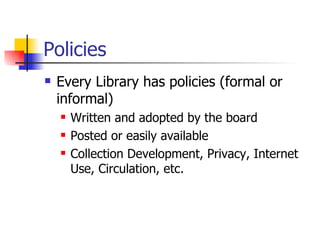
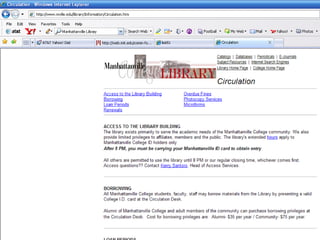
Policies Every Library has policies (formal or informal) Written and adopted by the board Posted or easily available Collection Development, Privacy, Internet Use, Circulation, etc.
 
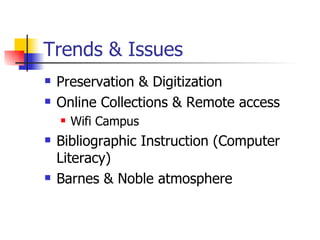
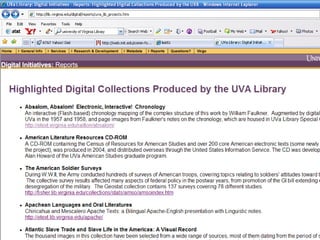
Trends & Issues Preservation & Digitization Online Collections & Remote access Wifi Campus Bibliographic Instruction (Computer Literacy) Barnes & Noble atmosphere


School Libraries: History 1835: New York State permitted tax dollars to be used for school libraries 1852: 1 st  compulsory school attendance law is passed 1875: 20 more states had passed laws similar to New York 1890s: begin to see growth in number of school libraries
School Libraries: History 1892: New York passed legislation to provide matching funds to purchase books Why such slow growth? Teaching method: rote memorization
Professionalism Public Libraries: services to children ALA with NEA developed standards Curriculum support Emphasis centralization of collections Library Instruction
The Other Dewey John Dewey theories impacted the growth of school libraries: Child’s growth & development (not subject matter) Experiential education Explore subjects of interest to the individual Social experiences that teach self-direction
Staffing Often one professional library Reports to school principal May have Coordinator for the whole school system (dual reporting role) May be closely aligned with IT Paraprofessionals and/or volunteers
Funding Precarious at best Poor economic times: 0% Relies upon school fairs and donations Set by Board of Education Community votes
Policies Very important to set intellectual freedom policies and procedures What happens when a parent questions a book? Stay on shelve while reviewed be committee Has community members, teachers, and board Ultimately goes to the Board of Education
Issues Intellectual Freedom Internet and Social Networking Nettracker Rooms Gives reading levels of websites Computer Literacy

Academic & School Libraries

  • 1.
  • 2.
    Academic: History EarlyUniversity Libraries: Harvard in 1636 owned 5,000 volumes Yale in in 1750 had 2,000 volumes Why? Publishing industry Fiscal Library’s roles
  • 3.
    History 19 th Century: support teaching & research Why the change? Library’s role Classical education vs. practical application Teaching Methods emphasized research & independent study Morrill Land Grant Act of 1862
  • 4.
    Professionalism Systematic &professional library education ALA founded in 1876 These led to trained professionals who took over the maintenance of the collection from the faculty.
  • 5.
    Staffing College AdministrationLibrary Director/Dean Professional Librarians: Subject Specialists, Catalogers, Public Service Desks Paraprofessionals: student workers, library assistants, clerks In the best case scenarios, the Library Director reports directly to the President of the university.
  • 6.
    Staffing Librarians areconsidered faculty Tenure: publish or perish 2 nd Masters or PhD Involved professionally
  • 7.
    Funding University determinesbudget Fundraising may or may not exist. % devoted to materials is higher than public Facility management is done by the university and not the library Hidden costs (utilities, maintenance) are not in the budget
  • 8.
    Policies Every Libraryhas policies (formal or informal) Written and adopted by the board Posted or easily available Collection Development, Privacy, Internet Use, Circulation, etc.
  • 9.
  • 10.
    Trends & IssuesPreservation & Digitization Online Collections & Remote access Wifi Campus Bibliographic Instruction (Computer Literacy) Barnes & Noble atmosphere
  • 11.
  • 12.
  • 13.
  • 14.
    School Libraries: History1835: New York State permitted tax dollars to be used for school libraries 1852: 1 st compulsory school attendance law is passed 1875: 20 more states had passed laws similar to New York 1890s: begin to see growth in number of school libraries
  • 15.
    School Libraries: History1892: New York passed legislation to provide matching funds to purchase books Why such slow growth? Teaching method: rote memorization
  • 16.
    Professionalism Public Libraries:services to children ALA with NEA developed standards Curriculum support Emphasis centralization of collections Library Instruction
  • 17.
    The Other DeweyJohn Dewey theories impacted the growth of school libraries: Child’s growth & development (not subject matter) Experiential education Explore subjects of interest to the individual Social experiences that teach self-direction
  • 18.
    Staffing Often oneprofessional library Reports to school principal May have Coordinator for the whole school system (dual reporting role) May be closely aligned with IT Paraprofessionals and/or volunteers
  • 19.
    Funding Precarious atbest Poor economic times: 0% Relies upon school fairs and donations Set by Board of Education Community votes
  • 20.
    Policies Very importantto set intellectual freedom policies and procedures What happens when a parent questions a book? Stay on shelve while reviewed be committee Has community members, teachers, and board Ultimately goes to the Board of Education
  • 21.
    Issues Intellectual FreedomInternet and Social Networking Nettracker Rooms Gives reading levels of websites Computer Literacy