HOW TO WRITE
AN OBJECTIVE
SUMMARY
WHAT IS A SUMMARY?
 “A summary is a reduction of a large amount
of information to its most important points.”
 Main Ideas
 Major Details
 Enough examples or explanations for your
paper to be clear
Guidelines for Writing Summaries
WHAT GOES IN A SUMMARY?
 Begin with a sentence or two that state the
title of the selection, the author, and the
main idea of the whole selection.
 After the first sentence, only write about the
major details and enough explanation to make
the points clear.
 Only use objective language
 Write using 3rd person
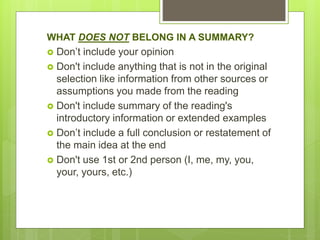
WHAT DOES NOT BELONG IN A SUMMARY?
 Don’t include your opinion
 Don't include anything that is not in the original
selection like information from other sources or
assumptions you made from the reading
 Don't include summary of the reading's
introductory information or extended examples
 Don’t include a full conclusion or restatement of
the main idea at the end
 Don't use 1st or 2nd person (I, me, my, you,
your, yours, etc.)
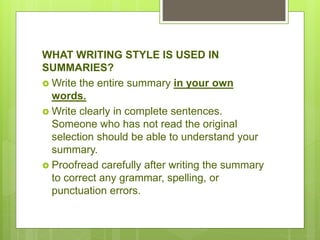
WHAT WRITING STYLE IS USED IN
SUMMARIES?
 Write the entire summary in your own
words.
 Write clearly in complete sentences.
Someone who has not read the original
selection should be able to understand your
summary.
 Proofread carefully after writing the summary
to correct any grammar, spelling, or
punctuation errors.
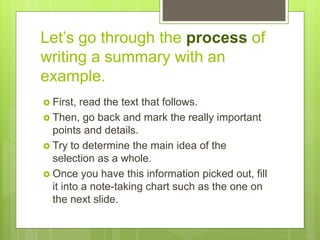
Let’s go through the process of
writing a summary with an
example.
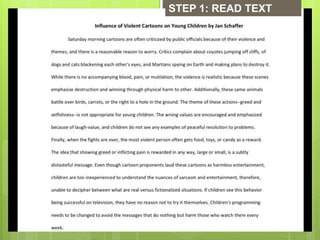
 First, read the text that follows.
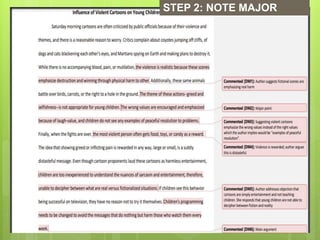
 Then, go back and mark the really important
points and details.
 Try to determine the main idea of the
selection as a whole.
 Once you have this information picked out, fill
it into a note-taking chart such as the one on
the next slide.
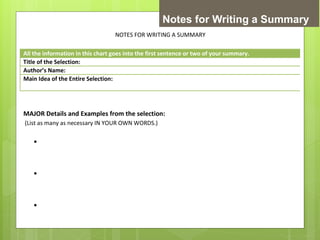
Notes for Writing a Summary
NOTES FOR WRITING A SUMMARY
All the information in this chart goes into the first sentence or two of your summary.
Title of the Selection:
Author’s Name:
Main Idea of the Entire Selection:
MAJOR Details and Examples from the selection:
(List as many as necessary IN YOUR OWN WORDS.)



STEP 1: READ TEXT
STEP 2: NOTE MAJOR
POINTS
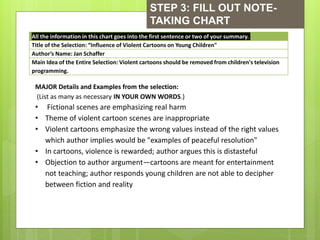
STEP 3: FILL OUT NOTE-
TAKING CHART
All the information in this chart goes into the first sentence or two of your summary.
Title of the Selection: “Influence of Violent Cartoons on Young Children"
Author’s Name: Jan Schaffer
Main Idea of the Entire Selection: Violent cartoons should be removed from children's television
programming.
MAJOR Details and Examples from the selection:
(List as many as necessary IN YOUR OWN WORDS.)
• Fictional scenes are emphasizing real harm
• Theme of violent cartoon scenes are inappropriate
• Violent cartoons emphasize the wrong values instead of the right values
which author implies would be "examples of peaceful resolution"
• In cartoons, violence is rewarded; author argues this is distasteful
• Objection to author argument—cartoons are meant for entertainment
not teaching; author responds young children are not able to decipher
between fiction and reality
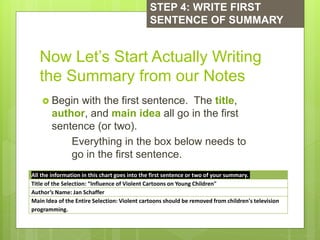
STEP 4: WRITE FIRST
SENTENCE OF SUMMARY
Now Let’s Start Actually Writing
the Summary from our Notes
 Begin with the first sentence. The title,
author, and main idea all go in the first
sentence (or two).
Everything in the box below needs to
go in the first sentence.
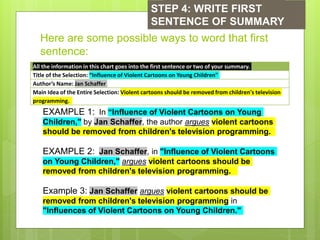
All the information in this chart goes into the first sentence or two of your summary.
Title of the Selection: “Influence of Violent Cartoons on Young Children"
Author’s Name: Jan Schaffer
Main Idea of the Entire Selection: Violent cartoons should be removed from children's television
programming.
Here are some possible ways to word that first
sentence:
EXAMPLE 1: In “Influence of Violent Cartoons on Young
Children," by Jan Schaffer, the author argues violent cartoons
should be removed from children's television programming.
EXAMPLE 2: Jan Schaffer, in "Influence of Violent Cartoons
on Young Children," argues violent cartoons should be
removed from children's television programming.
Example 3: Jan Schaffer argues violent cartoons should be
removed from children's television programming in
"Influences of Violent Cartoons on Young Children."
All the information in this chart goes into the first sentence or two of your summary.
Title of the Selection: “Influence of Violent Cartoons on Young Children"
Author’s Name: Jan Schaffer
Main Idea of the Entire Selection: Violent cartoons should be removed from children's television
programming.
STEP 4: WRITE FIRST
SENTENCE OF SUMMARY
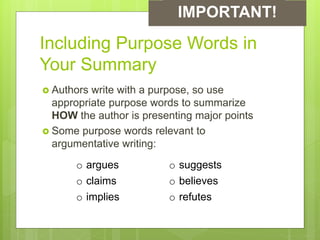
Including Purpose Words in
Your Summary
 Authors write with a purpose, so use
appropriate purpose words to summarize
HOW the author is presenting major points
 Some purpose words relevant to
argumentative writing:
o argues o suggests
o claims o believes
o implies o refutes
IMPORTANT!
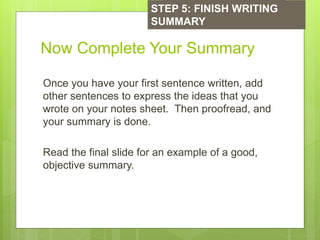
Now Complete Your Summary
Once you have your first sentence written, add
other sentences to express the ideas that you
wrote on your notes sheet. Then proofread, and
your summary is done.
Read the final slide for an example of a good,
objective summary.
STEP 5: FINISH WRITING
SUMMARY
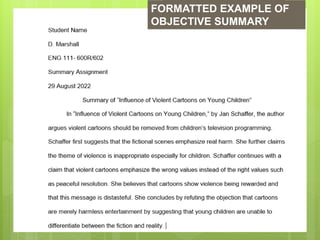
FORMATTED EXAMPLE OF
OBJECTIVE SUMMARY

How to Write an Objective Summary- PowerPoint Presentation

  • 1.
    HOW TO WRITE ANOBJECTIVE SUMMARY
  • 2.
    WHAT IS ASUMMARY?  “A summary is a reduction of a large amount of information to its most important points.”  Main Ideas  Major Details  Enough examples or explanations for your paper to be clear
  • 3.
    Guidelines for WritingSummaries WHAT GOES IN A SUMMARY?  Begin with a sentence or two that state the title of the selection, the author, and the main idea of the whole selection.  After the first sentence, only write about the major details and enough explanation to make the points clear.  Only use objective language  Write using 3rd person
  • 4.
    WHAT DOES NOTBELONG IN A SUMMARY?  Don’t include your opinion  Don't include anything that is not in the original selection like information from other sources or assumptions you made from the reading  Don't include summary of the reading's introductory information or extended examples  Don’t include a full conclusion or restatement of the main idea at the end  Don't use 1st or 2nd person (I, me, my, you, your, yours, etc.)
  • 5.
    WHAT WRITING STYLEIS USED IN SUMMARIES?  Write the entire summary in your own words.  Write clearly in complete sentences. Someone who has not read the original selection should be able to understand your summary.  Proofread carefully after writing the summary to correct any grammar, spelling, or punctuation errors.
  • 6.
    Let’s go throughthe process of writing a summary with an example.  First, read the text that follows.  Then, go back and mark the really important points and details.  Try to determine the main idea of the selection as a whole.  Once you have this information picked out, fill it into a note-taking chart such as the one on the next slide.
  • 7.
    Notes for Writinga Summary NOTES FOR WRITING A SUMMARY All the information in this chart goes into the first sentence or two of your summary. Title of the Selection: Author’s Name: Main Idea of the Entire Selection: MAJOR Details and Examples from the selection: (List as many as necessary IN YOUR OWN WORDS.)   
  • 8.
  • 9.
    STEP 2: NOTEMAJOR POINTS
  • 10.
    STEP 3: FILLOUT NOTE- TAKING CHART All the information in this chart goes into the first sentence or two of your summary. Title of the Selection: “Influence of Violent Cartoons on Young Children" Author’s Name: Jan Schaffer Main Idea of the Entire Selection: Violent cartoons should be removed from children's television programming. MAJOR Details and Examples from the selection: (List as many as necessary IN YOUR OWN WORDS.) • Fictional scenes are emphasizing real harm • Theme of violent cartoon scenes are inappropriate • Violent cartoons emphasize the wrong values instead of the right values which author implies would be "examples of peaceful resolution" • In cartoons, violence is rewarded; author argues this is distasteful • Objection to author argument—cartoons are meant for entertainment not teaching; author responds young children are not able to decipher between fiction and reality
  • 11.
    STEP 4: WRITEFIRST SENTENCE OF SUMMARY Now Let’s Start Actually Writing the Summary from our Notes  Begin with the first sentence. The title, author, and main idea all go in the first sentence (or two). Everything in the box below needs to go in the first sentence. All the information in this chart goes into the first sentence or two of your summary. Title of the Selection: “Influence of Violent Cartoons on Young Children" Author’s Name: Jan Schaffer Main Idea of the Entire Selection: Violent cartoons should be removed from children's television programming.
  • 12.
    Here are somepossible ways to word that first sentence: EXAMPLE 1: In “Influence of Violent Cartoons on Young Children," by Jan Schaffer, the author argues violent cartoons should be removed from children's television programming. EXAMPLE 2: Jan Schaffer, in "Influence of Violent Cartoons on Young Children," argues violent cartoons should be removed from children's television programming. Example 3: Jan Schaffer argues violent cartoons should be removed from children's television programming in "Influences of Violent Cartoons on Young Children." All the information in this chart goes into the first sentence or two of your summary. Title of the Selection: “Influence of Violent Cartoons on Young Children" Author’s Name: Jan Schaffer Main Idea of the Entire Selection: Violent cartoons should be removed from children's television programming. STEP 4: WRITE FIRST SENTENCE OF SUMMARY
  • 13.
    Including Purpose Wordsin Your Summary  Authors write with a purpose, so use appropriate purpose words to summarize HOW the author is presenting major points  Some purpose words relevant to argumentative writing: o argues o suggests o claims o believes o implies o refutes IMPORTANT!
  • 14.
    Now Complete YourSummary Once you have your first sentence written, add other sentences to express the ideas that you wrote on your notes sheet. Then proofread, and your summary is done. Read the final slide for an example of a good, objective summary. STEP 5: FINISH WRITING SUMMARY
  • 15.