Somali National University
Puntland-Baran Branch
Trace Elements
Ismail Katun Mohamud
B.Sc. Geology and Meng Petroleum Engineering
TRACE ELEMENTS
 In geochemistry, trace elements refer to chemical elements that exist in very small
concentrations within a rock, mineral, soil, or other geological materials.
 These elements are present in amounts generally less than 0.1% by weight or less than
1000ppm.
 Despite their low abundance, trace elements play crucial roles in understanding
geological processes, mineral formation, and environmental conditions.
TYPES OF TRACE ELEMENTS
 Compatibility is a measure of how readily a particular trace element substitutes for a major
element within a mineral. Trace elements could be divided into two groups:
1) Incompatible trace elements
 Elements that are too large and/or too highly charged to fit easily into common
rock-forming minerals that crystallize from melts. These elements become
concentrated in melts. There are two groups of incompatible elements:
a) Large-ion lithophile elements or low field strength elements (LIL or LFSE):
Incompatible owing to large size and low charge (e.g., Rb+, Cs+, Sr2+, Ba2+).
b) High-field strength elements (HFSE): Incompatible owing to large size and
high charge (e.g., Zr4+, Hf 4+, Ta4+, Nb5+, Th4+and U4+).
2) Compatible trace elements:
 These trace elements have a similar ionic radius and charge to the major
elements they substitute for in minerals.
 They are more easily incorporated into the crystal lattice of minerals without
causing significant distortions or structural strain.
 Common compatible elements include elements like magnesium (Mg), nickel
(Ni), and chromium (Cr).
RARE EARTH ELEMENTS (REE)
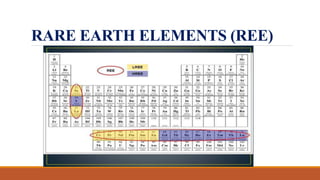
 Group of elements comprising the 15 elements from Lanthanum ( at no. 57 )
to Lutetium ( at no. 71).
 Yttrium ( at no. 39 ) and Scandium ( at no. 21 ) are also sometimes included in
this group.
RARE EARTH ELEMENTS (REE)
IMPORTANCE OF TRACE ELEMENTS
 Indicator of Geological Processes: Trace elements can serve as indicators of various
geological processes, such as magma differentiation, metamorphism, and alteration.
 Mineralogy and Petrology: The presence or absence of certain trace elements can influence
the mineralogy and petrology of rocks.
 The correlation coefficient r is a measure of the linear relationship between two
variables.
 The correlation coefficient is also known as the Pearson product-moment
correlation coefficient.
 The value of r can range from -1 to +1 and is independent of the units of
measurement. A value of r near 0 indicates little linear correlation between
variables; a value near +1 or -1 indicates a high level of correlation.
 When two variables have a positive correlation coefficient, an
increase in the value of one variable indicates a likely
increase in the value of the second variable.
 A correlation coefficient of less than 0 indicates a negative
linear correlation.
 That is, when one variable shows an increase in value, the
other variable tends to show a decrease.
Consider two variables x and y:
1. If r = 1, then x and y are perfectly positively correlated. The possible values
of x and y all lie on a straight line with a positive slope in the (x,y) plane.
2. If r = 0, then x and y are not correlated. They do not have an apparent linear
relationship. However, this does not mean that x and y are statistically
independent.
3. If r = -1, then x and y are perfectly negatively correlated. The possible
values of x and y all lie on a straight line with a negative slope in the (x,y)
plane.
 The quantity r, called the linear correlation coefficient, measures the strength and the
direction of a linear relationship between two variables.
 The linear correlation coefficient is sometimes referred to as the Pearson product moment
correlation coefficient
 The mathematical formula for computing r is:
 where n is the number of pairs of data. Product-moment
THANKS

chapter 8 trace Elements in geochemistry.pptx

  • 1.
    Somali National University Puntland-BaranBranch Trace Elements Ismail Katun Mohamud B.Sc. Geology and Meng Petroleum Engineering
  • 2.
    TRACE ELEMENTS  Ingeochemistry, trace elements refer to chemical elements that exist in very small concentrations within a rock, mineral, soil, or other geological materials.  These elements are present in amounts generally less than 0.1% by weight or less than 1000ppm.  Despite their low abundance, trace elements play crucial roles in understanding geological processes, mineral formation, and environmental conditions.
  • 3.
    TYPES OF TRACEELEMENTS  Compatibility is a measure of how readily a particular trace element substitutes for a major element within a mineral. Trace elements could be divided into two groups:
  • 4.
    1) Incompatible traceelements  Elements that are too large and/or too highly charged to fit easily into common rock-forming minerals that crystallize from melts. These elements become concentrated in melts. There are two groups of incompatible elements: a) Large-ion lithophile elements or low field strength elements (LIL or LFSE): Incompatible owing to large size and low charge (e.g., Rb+, Cs+, Sr2+, Ba2+). b) High-field strength elements (HFSE): Incompatible owing to large size and high charge (e.g., Zr4+, Hf 4+, Ta4+, Nb5+, Th4+and U4+).
  • 5.
    2) Compatible traceelements:  These trace elements have a similar ionic radius and charge to the major elements they substitute for in minerals.  They are more easily incorporated into the crystal lattice of minerals without causing significant distortions or structural strain.  Common compatible elements include elements like magnesium (Mg), nickel (Ni), and chromium (Cr).
  • 6.
    RARE EARTH ELEMENTS(REE)  Group of elements comprising the 15 elements from Lanthanum ( at no. 57 ) to Lutetium ( at no. 71).  Yttrium ( at no. 39 ) and Scandium ( at no. 21 ) are also sometimes included in this group.
  • 7.
  • 8.
    IMPORTANCE OF TRACEELEMENTS  Indicator of Geological Processes: Trace elements can serve as indicators of various geological processes, such as magma differentiation, metamorphism, and alteration.  Mineralogy and Petrology: The presence or absence of certain trace elements can influence the mineralogy and petrology of rocks.
  • 9.
     The correlationcoefficient r is a measure of the linear relationship between two variables.  The correlation coefficient is also known as the Pearson product-moment correlation coefficient.  The value of r can range from -1 to +1 and is independent of the units of measurement. A value of r near 0 indicates little linear correlation between variables; a value near +1 or -1 indicates a high level of correlation.
  • 10.
     When twovariables have a positive correlation coefficient, an increase in the value of one variable indicates a likely increase in the value of the second variable.  A correlation coefficient of less than 0 indicates a negative linear correlation.  That is, when one variable shows an increase in value, the other variable tends to show a decrease.
  • 11.
    Consider two variablesx and y: 1. If r = 1, then x and y are perfectly positively correlated. The possible values of x and y all lie on a straight line with a positive slope in the (x,y) plane. 2. If r = 0, then x and y are not correlated. They do not have an apparent linear relationship. However, this does not mean that x and y are statistically independent. 3. If r = -1, then x and y are perfectly negatively correlated. The possible values of x and y all lie on a straight line with a negative slope in the (x,y) plane.
  • 12.
     The quantityr, called the linear correlation coefficient, measures the strength and the direction of a linear relationship between two variables.  The linear correlation coefficient is sometimes referred to as the Pearson product moment correlation coefficient  The mathematical formula for computing r is:  where n is the number of pairs of data. Product-moment
  • 20.