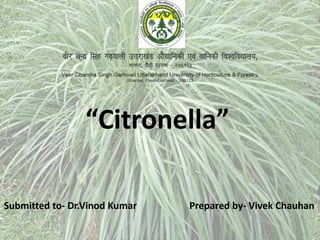

“Citronella”
Submitted to- Dr.Vinod Kumar Prepared by- Vivek Chauhan
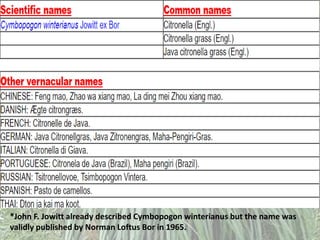
*John F. Jowitt already described Cymbopogon winterianus but the name was
validly published by Norman Loftus Bor in 1965.
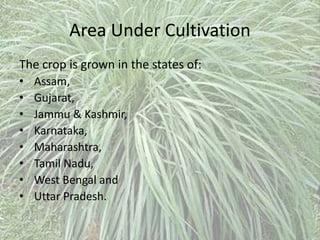
Area Under Cultivation
The crop is grown in the states of:
• Assam,
• Gujarat,
• Jammu & Kashmir,
• Karnataka,
• Maharashtra,
• Tamil Nadu,
• West Bengal and
• Uttar Pradesh.
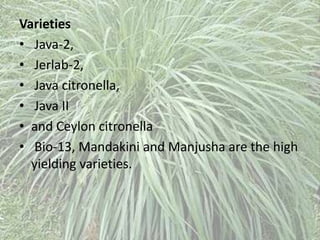
Varieties
• Java-2,
• Jerlab-2,
• Java citronella,
• Java II
• and Ceylon citronella
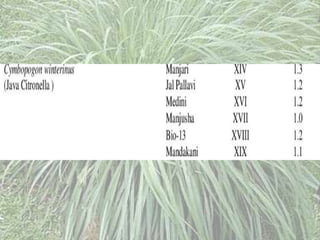
• Bio-13, Mandakini and Manjusha are the high
yielding varieties.
Genetic Information
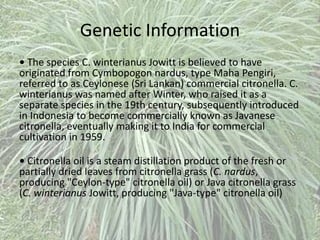
• The species C. winterianus Jowitt is believed to have
originated from Cymbopogon nardus, type Maha Pengiri,
referred to as Ceylonese (Sri Lankan) commercial citronella. C.
winterianus was named after Winter, who raised it as a
separate species in the 19th century, subsequently introduced
in Indonesia to become commercially known as Javanese
citronella, eventually making it to India for commercial
cultivation in 1959.
• Citronella oil is a steam distillation product of the fresh or
partially dried leaves from citronella grass (C. nardus,
producing "Ceylon-type" citronella oil) or Java citronella grass
(C. winterianus Jowitt, producing "Java-type" citronella oil)
Botany
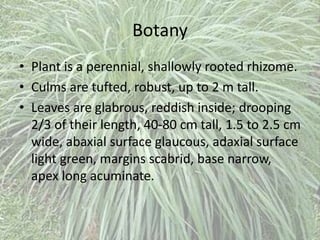
• Plant is a perennial, shallowly rooted rhizome.
• Culms are tufted, robust, up to 2 m tall.
• Leaves are glabrous, reddish inside; drooping
2/3 of their length, 40-80 cm tall, 1.5 to 2.5 cm
wide, abaxial surface glaucous, adaxial surface
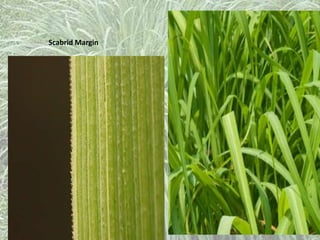
light green, margins scabrid, base narrow,
apex long acuminate.
Scabrid Margin
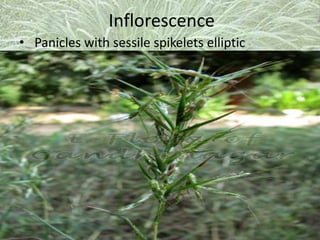
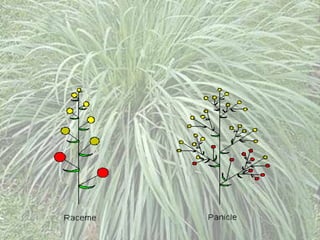
Inflorescence
• Panicles with sessile spikelets elliptic
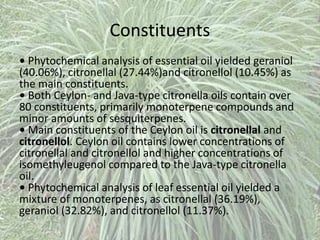
Constituents
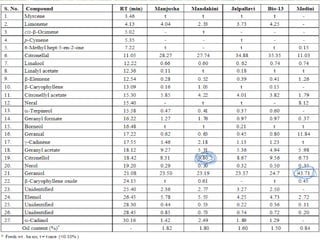
• Phytochemical analysis of essential oil yielded geraniol
(40.06%), citronellal (27.44%)and citronellol (10.45%) as
the main constituents.
• Both Ceylon- and Java-type citronella oils contain over
80 constituents, primarily monoterpene compounds and
minor amounts of sesquiterpenes.
• Main constituents of the Ceylon oil is citronellal and
citronellol. Ceylon oil contains lower concentrations of
citronellal and citronellol and higher concentrations of
isomethyleugenol compared to the Java-type citronella
oil.
• Phytochemical analysis of leaf essential oil yielded a
mixture of monoterpenes, as citronellal (36.19%),
geraniol (32.82%), and citronellol (11.37%).
Properties
The citronella oil from steam distillation
considered rubefacient, antispasmodic,
diaphoretic, sedating, analgesic.
Significance
• The citronella oil obtained from steam distillation
of leaves is considered rubifacient,
antispasmodic, diaphoretic, sedating, analgesic.
• It is employed in traditional mosquito repellents
and household fumigants.
• It is also used as food flavoring agent, in
beverages, baked goods, cereals, candies, dairy
products, gelatins and puddings.
• It is also used in aroma therapy.
Products
Propagation
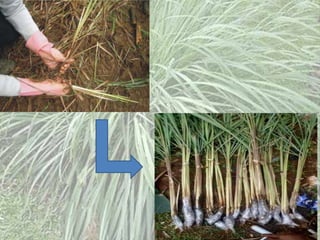
• Citronella is a perennial grass, however, it does not
produce viable seeds, therefore, the species can be
propagated only vegetatively by slips.
• This is achieved by splitting well-grown clumps. It has
been observed that an year old clump yields on an
average about 50 slips.
• The clump is gently separated into a number of slips .
• These slips are the unit of propagation and on planting
establish themselves as plants or bushes.
• Fibrous roots and leaves should be trimmed off the
slips before planting.
Soil
• It performs best on free-draining loam and
sand soils of a moderately acid to alkaline
nature,
• Generally with a pH of 5.5 to 7.8, and on sites
with full to partial sun exposure.
• It has poor tolerance to drought and clayey,
slow-draining or waterlogged soils.
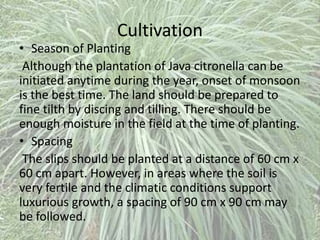
Cultivation
• Season of Planting
Although the plantation of Java citronella can be
initiated anytime during the year, onset of monsoon
is the best time. The land should be prepared to
fine tilth by discing and tilling. There should be
enough moisture in the field at the time of planting.
• Spacing
The slips should be planted at a distance of 60 cm x
60 cm apart. However, in areas where the soil is
very fertile and the climatic conditions support
luxurious growth, a spacing of 90 cm x 90 cm may
be followed.
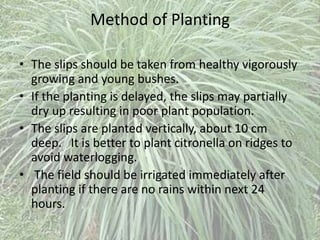
Method of Planting
• The slips should be taken from healthy vigorously
growing and young bushes.
• If the planting is delayed, the slips may partially
dry up resulting in poor plant population.
• The slips are planted vertically, about 10 cm
deep. It is better to plant citronella on ridges to
avoid waterlogging.
• The field should be irrigated immediately after
planting if there are no rains within next 24
hours.
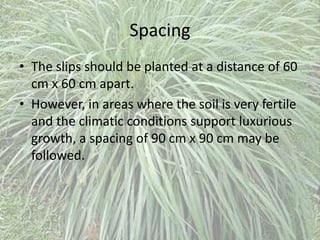
Spacing
• The slips should be planted at a distance of 60
cm x 60 cm apart.
• However, in areas where the soil is very fertile
and the climatic conditions support luxurious
growth, a spacing of 90 cm x 90 cm may be
followed.
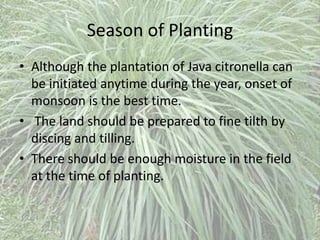
Season of Planting
• Although the plantation of Java citronella can
be initiated anytime during the year, onset of
monsoon is the best time.
• The land should be prepared to fine tilth by
discing and tilling.
• There should be enough moisture in the field
at the time of planting.
Manuring & Fertilization
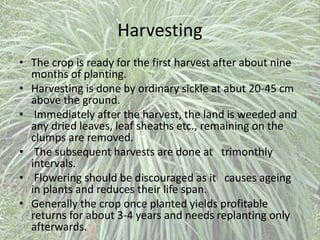
• Java citronella generally requires high dose of
nitrogen for good growth.
• Under the agroclimatic conditions of North-
Eastern India and North India, 80-120 kg N /ha
per year is recommended.
• For the soils with high fertility level, the dose may
be reduced.
• The recommended annual doses of P and K are
40 kg/ha each.
Harvesting
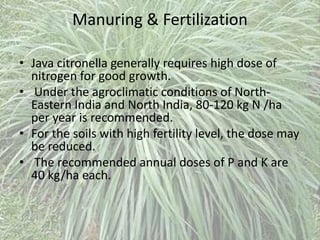
• The crop is ready for the first harvest after about nine
months of planting.
• Harvesting is done by ordinary sickle at abut 20-45 cm
above the ground.
• Immediately after the harvest, the land is weeded and
any dried leaves, leaf sheaths etc., remaining on the
clumps are removed.
• The subsequent harvests are done at trimonthly
intervals.
• Flowering should be discouraged as it causes ageing
in plants and reduces their life span.
• Generally the crop once planted yields profitable
returns for about 3-4 years and needs replanting only
afterwards.
Yield
• On an average, the oil content is about 1% on the basis
of fresh weight of leaves.
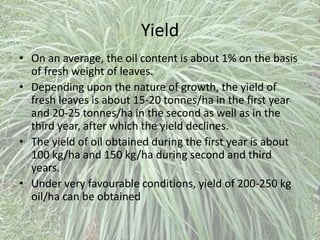
• Depending upon the nature of growth, the yield of
fresh leaves is about 15-20 tonnes/ha in the first year
and 20-25 tonnes/ha in the second as well as in the
third year, after which the yield declines.
• The yield of oil obtained during the first year is about
100 kg/ha and 150 kg/ha during second and third
years.
• Under very favourable conditions, yield of 200-250 kg
oil/ha can be obtained
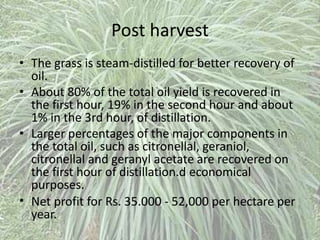
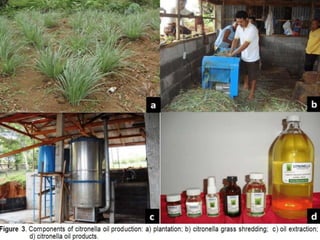
Post harvest
• The grass is steam-distilled for better recovery of
oil.
• About 80% of the total oil yield is recovered in
the first hour, 19% in the second hour and about
1% in the 3rd hour, of distillation.
• Larger percentages of the major components in
the total oil, such as citronellal, geraniol,
citronellal and geranyl acetate are recovered on
the first hour of distillation.d economical
purposes.
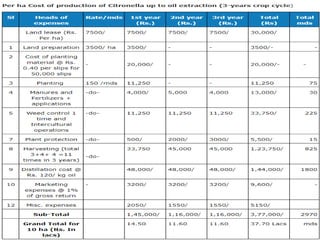
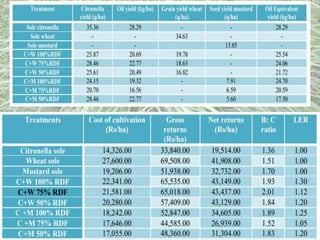
• Net profit for Rs. 35.000 - 52,000 per hectare per
year.
Plant Protection
• The plants are sometimes affected by yellowing and leaf
crinkling disease. In this disease the young leaves are
twisted and crinkled.
• This disease is more in summer season. The affected plants
are sprayed with 0.1% monochrotophos at weekly intervals.
• As a manure to avoid attack of this disease. Monocrotophos
may be sprayed from February onwards at 15 - 20 days
intervals. Thimmet @ 7 kg per hectare can also be applied.
• Some slips die of root rot in areas which tend to waterlog.
Water-logging is to be prevented and drainage is to be
created in such areas.
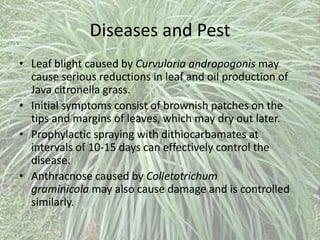
Diseases and Pest
• Leaf blight caused by Curvularia andropogonis may
cause serious reductions in leaf and oil production of
Java citronella grass.
• Initial symptoms consist of brownish patches on the
tips and margins of leaves, which may dry out later.
• Prophylactic spraying with dithiocarbamates at
intervals of 10-15 days can effectively control the
disease.
• Anthracnose caused by Colletotrichum
graminicola may also cause damage and is controlled
similarly.
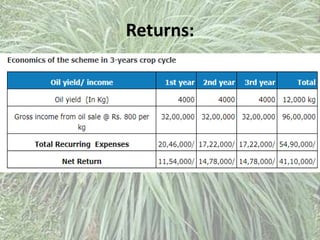
Returns:
Reference:
• https://uses.plantnet-
project.org/en/Cymbopogon_winterianus_(PROSEA)
• http://www.upsbdb.org/pdf/Souvenir2011/16.pdf
• http://agritech.tnau.ac.in/horticulture/horti_aromatic%20crops_cit
ronella.html
• http://www.stuartxchange.org/Citronella.html
• https://www.researchgate.net/publication/234007235_Qualitative_
performance_of_Java_citronella_Cymbopogon_winterianus_Jowitt
_cultivars_in_Kumaon_Himalaya
• https://www.rarepalmseeds.com/cymbopogon-winterianus
• https://www.ripublication.com/ijbb17/ijbbv13n2_04.pdf
• https://www.ijcmas.com/7-1-
2018/Rahul%20Kumar%20Mishra,%20et%20al.pdf
Thank You..!

Citronella: The Useful Grass.

  • 1.
    “Citronella” Submitted to- Dr.VinodKumar Prepared by- Vivek Chauhan
  • 2.
    *John F. Jowittalready described Cymbopogon winterianus but the name was validly published by Norman Loftus Bor in 1965.
  • 3.
    Area Under Cultivation Thecrop is grown in the states of: • Assam, • Gujarat, • Jammu & Kashmir, • Karnataka, • Maharashtra, • Tamil Nadu, • West Bengal and • Uttar Pradesh.
  • 4.
    Varieties • Java-2, • Jerlab-2, •Java citronella, • Java II • and Ceylon citronella • Bio-13, Mandakini and Manjusha are the high yielding varieties.
  • 5.
    Genetic Information • Thespecies C. winterianus Jowitt is believed to have originated from Cymbopogon nardus, type Maha Pengiri, referred to as Ceylonese (Sri Lankan) commercial citronella. C. winterianus was named after Winter, who raised it as a separate species in the 19th century, subsequently introduced in Indonesia to become commercially known as Javanese citronella, eventually making it to India for commercial cultivation in 1959. • Citronella oil is a steam distillation product of the fresh or partially dried leaves from citronella grass (C. nardus, producing "Ceylon-type" citronella oil) or Java citronella grass (C. winterianus Jowitt, producing "Java-type" citronella oil)
  • 6.
    Botany • Plant isa perennial, shallowly rooted rhizome. • Culms are tufted, robust, up to 2 m tall. • Leaves are glabrous, reddish inside; drooping 2/3 of their length, 40-80 cm tall, 1.5 to 2.5 cm wide, abaxial surface glaucous, adaxial surface light green, margins scabrid, base narrow, apex long acuminate.
  • 7.
  • 8.
    Inflorescence • Panicles withsessile spikelets elliptic
  • 10.
    Constituents • Phytochemical analysisof essential oil yielded geraniol (40.06%), citronellal (27.44%)and citronellol (10.45%) as the main constituents. • Both Ceylon- and Java-type citronella oils contain over 80 constituents, primarily monoterpene compounds and minor amounts of sesquiterpenes. • Main constituents of the Ceylon oil is citronellal and citronellol. Ceylon oil contains lower concentrations of citronellal and citronellol and higher concentrations of isomethyleugenol compared to the Java-type citronella oil. • Phytochemical analysis of leaf essential oil yielded a mixture of monoterpenes, as citronellal (36.19%), geraniol (32.82%), and citronellol (11.37%).
  • 12.
    Properties The citronella oilfrom steam distillation considered rubefacient, antispasmodic, diaphoretic, sedating, analgesic.
  • 13.
    Significance • The citronellaoil obtained from steam distillation of leaves is considered rubifacient, antispasmodic, diaphoretic, sedating, analgesic. • It is employed in traditional mosquito repellents and household fumigants. • It is also used as food flavoring agent, in beverages, baked goods, cereals, candies, dairy products, gelatins and puddings. • It is also used in aroma therapy.
  • 14.
  • 15.
    Propagation • Citronella isa perennial grass, however, it does not produce viable seeds, therefore, the species can be propagated only vegetatively by slips. • This is achieved by splitting well-grown clumps. It has been observed that an year old clump yields on an average about 50 slips. • The clump is gently separated into a number of slips . • These slips are the unit of propagation and on planting establish themselves as plants or bushes. • Fibrous roots and leaves should be trimmed off the slips before planting.
  • 17.
    Soil • It performsbest on free-draining loam and sand soils of a moderately acid to alkaline nature, • Generally with a pH of 5.5 to 7.8, and on sites with full to partial sun exposure. • It has poor tolerance to drought and clayey, slow-draining or waterlogged soils.
  • 18.
    Cultivation • Season ofPlanting Although the plantation of Java citronella can be initiated anytime during the year, onset of monsoon is the best time. The land should be prepared to fine tilth by discing and tilling. There should be enough moisture in the field at the time of planting. • Spacing The slips should be planted at a distance of 60 cm x 60 cm apart. However, in areas where the soil is very fertile and the climatic conditions support luxurious growth, a spacing of 90 cm x 90 cm may be followed.
  • 19.
    Method of Planting •The slips should be taken from healthy vigorously growing and young bushes. • If the planting is delayed, the slips may partially dry up resulting in poor plant population. • The slips are planted vertically, about 10 cm deep. It is better to plant citronella on ridges to avoid waterlogging. • The field should be irrigated immediately after planting if there are no rains within next 24 hours.
  • 20.
    Spacing • The slipsshould be planted at a distance of 60 cm x 60 cm apart. • However, in areas where the soil is very fertile and the climatic conditions support luxurious growth, a spacing of 90 cm x 90 cm may be followed.
  • 21.
    Season of Planting •Although the plantation of Java citronella can be initiated anytime during the year, onset of monsoon is the best time. • The land should be prepared to fine tilth by discing and tilling. • There should be enough moisture in the field at the time of planting.
  • 22.
    Manuring & Fertilization •Java citronella generally requires high dose of nitrogen for good growth. • Under the agroclimatic conditions of North- Eastern India and North India, 80-120 kg N /ha per year is recommended. • For the soils with high fertility level, the dose may be reduced. • The recommended annual doses of P and K are 40 kg/ha each.
  • 23.
    Harvesting • The cropis ready for the first harvest after about nine months of planting. • Harvesting is done by ordinary sickle at abut 20-45 cm above the ground. • Immediately after the harvest, the land is weeded and any dried leaves, leaf sheaths etc., remaining on the clumps are removed. • The subsequent harvests are done at trimonthly intervals. • Flowering should be discouraged as it causes ageing in plants and reduces their life span. • Generally the crop once planted yields profitable returns for about 3-4 years and needs replanting only afterwards.
  • 24.
    Yield • On anaverage, the oil content is about 1% on the basis of fresh weight of leaves. • Depending upon the nature of growth, the yield of fresh leaves is about 15-20 tonnes/ha in the first year and 20-25 tonnes/ha in the second as well as in the third year, after which the yield declines. • The yield of oil obtained during the first year is about 100 kg/ha and 150 kg/ha during second and third years. • Under very favourable conditions, yield of 200-250 kg oil/ha can be obtained
  • 26.
    Post harvest • Thegrass is steam-distilled for better recovery of oil. • About 80% of the total oil yield is recovered in the first hour, 19% in the second hour and about 1% in the 3rd hour, of distillation. • Larger percentages of the major components in the total oil, such as citronellal, geraniol, citronellal and geranyl acetate are recovered on the first hour of distillation.d economical purposes. • Net profit for Rs. 35.000 - 52,000 per hectare per year.
  • 28.
    Plant Protection • Theplants are sometimes affected by yellowing and leaf crinkling disease. In this disease the young leaves are twisted and crinkled. • This disease is more in summer season. The affected plants are sprayed with 0.1% monochrotophos at weekly intervals. • As a manure to avoid attack of this disease. Monocrotophos may be sprayed from February onwards at 15 - 20 days intervals. Thimmet @ 7 kg per hectare can also be applied. • Some slips die of root rot in areas which tend to waterlog. Water-logging is to be prevented and drainage is to be created in such areas.
  • 29.
    Diseases and Pest •Leaf blight caused by Curvularia andropogonis may cause serious reductions in leaf and oil production of Java citronella grass. • Initial symptoms consist of brownish patches on the tips and margins of leaves, which may dry out later. • Prophylactic spraying with dithiocarbamates at intervals of 10-15 days can effectively control the disease. • Anthracnose caused by Colletotrichum graminicola may also cause damage and is controlled similarly.
  • 31.
  • 33.
    Reference: • https://uses.plantnet- project.org/en/Cymbopogon_winterianus_(PROSEA) • http://www.upsbdb.org/pdf/Souvenir2011/16.pdf •http://agritech.tnau.ac.in/horticulture/horti_aromatic%20crops_cit ronella.html • http://www.stuartxchange.org/Citronella.html • https://www.researchgate.net/publication/234007235_Qualitative_ performance_of_Java_citronella_Cymbopogon_winterianus_Jowitt _cultivars_in_Kumaon_Himalaya • https://www.rarepalmseeds.com/cymbopogon-winterianus • https://www.ripublication.com/ijbb17/ijbbv13n2_04.pdf • https://www.ijcmas.com/7-1- 2018/Rahul%20Kumar%20Mishra,%20et%20al.pdf
  • 34.