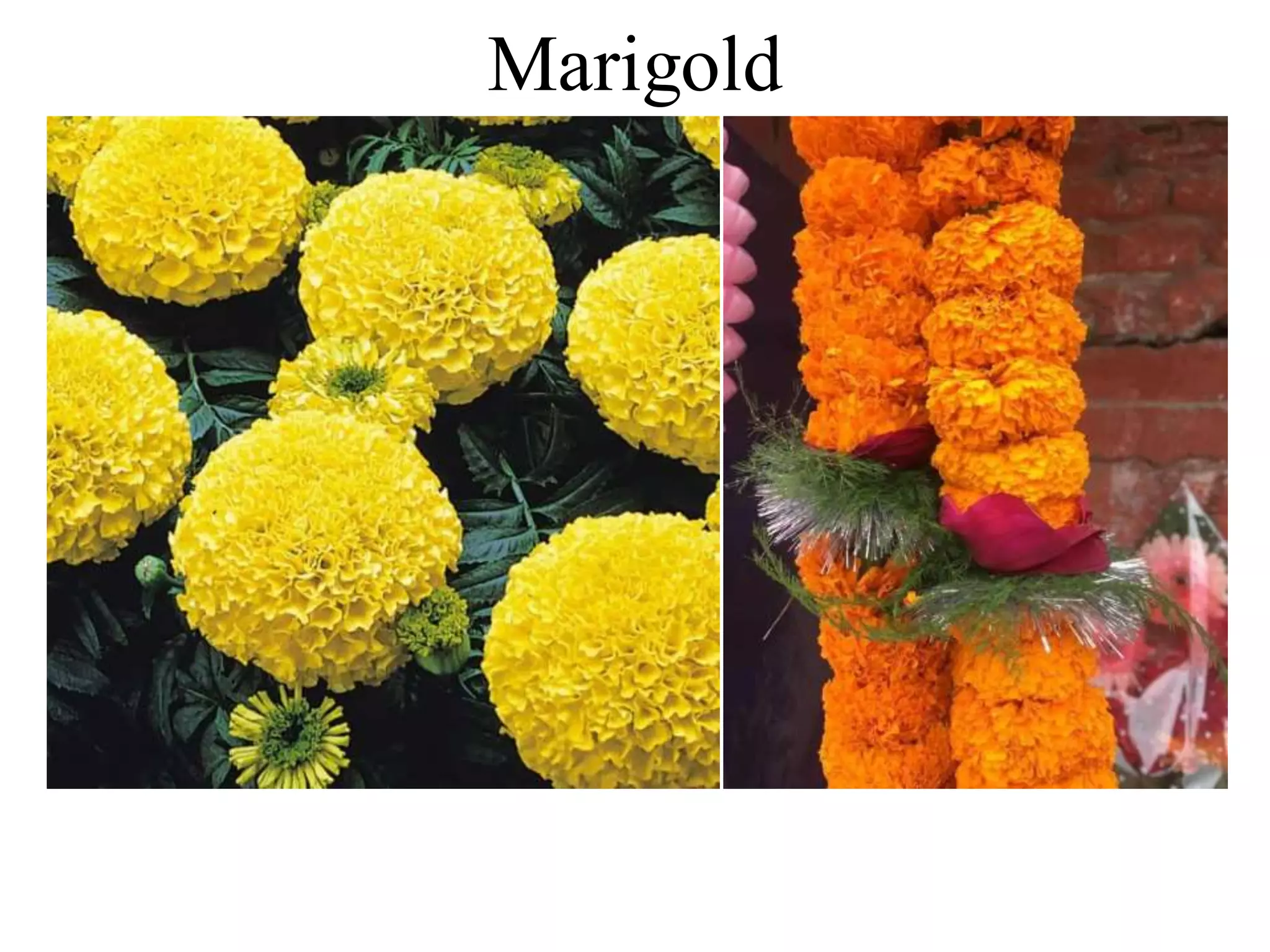
Marigold
Introduction
Marigold is one of the most commonly grown flowers for garden
decoration and extensively used as loose flowers for making garlands
for religious and social functions
Family: Asteraceae
It has gained popularity amongst the gardeners on account of its
easy culture and wide adaptability
Its habit of free flowering, short duration to produce marketable
flowers, wide spectrum of attractive colours, shape, size and good
keeping quality has attracted the attention of flower growers
Used in crop rotation to reduce the infestation of nematodes
Demand of this flower is very high during dashain and tihar
Varieties
 33 species and numerousvarieties are available
 Tageteserecta (African Marigold)-Tall growing
plant / big size flowers; are easy to grow and thrive
under hot, dry conditions.
 Varieties: Giant DoubleAfrican, Orange, Giant
DoubleAfrican Yellow,Dubloon
 Tagetespatula (FrenchMarigold)-Dwarfplant
with small flowers
 Varieties: Red Brocade, RustyRed, Butter Scotch
 T. tenuifolia (Signet Merigold)-Dwarfand bushy
plant. Flowers have 5 rays, roundish and obovate
with spicy tarragon flavor.
 Varieties: Golden Gem, Lulu, Pumila and Ursula
Climate and soil
 Marigold requires mild climate for luxuriant growth and flowering.
 The optimum temperature range for its profuse growth is 18-20°C.
 Temperatures above 35°C restrict the growth of the plants, which leads
to reduction in flower size and number.
 In severe winter, plants and flowers are damaged by frost.
 Ceases to grow in high temperature thereby affecting flower quality and
quantity
 Sowing and planting is carried out during rainy season, winter and
summer season
 Under Nepalese condition, best flowering is observed in August to
December
Soil
 Cultivated in wide variety of soil
 Sandy loam soil with pH 5.6 to 6.5 is ideal for its cultivation
 Well drained, good water holding soil is preferred
 Soil preparation: 2-3 times ploughing and apply 50 tons of FYM/ha
 Prepare bed of convenient size to facilitate irrigation and other
intercultural operations
 Planting: By seeds and Cuttings
 Seed rate and nursery raising
 Optimum temp for seed germination- 18 to 30°C
 Seed rate- 1.5 kg/ha
 Can be grown in pots, seed boxes or on flat or raised nursery beds (3m
x 1 m- 8 to 10 beds for one ha)
 Apply FYM 10kg/bed
 Line sowing and thinning is done
Seed Sowing Time
Cuttings
 About 10 cm long cuttings are prepared
and planted in the sand
 Cuttings treated with PGR helps for
enhancing rooting
 Transplanting seedlings
 One month seedlings with 3-4 leaves are transplanted
 Very old seedlings are not preferred for transplanting
 Spacing
 T. erecta var. Giant Double African Orange: 40 x 30 cm; T. patula cv.
Red Brocade: 20 x 20 cm
 Manures and fertilizers
 N- 100 kg, P2O5- 100 kg and K2O- 100 kg per ha at the time of land
preparation
 Additional 100 kg of N- one month after seedlings are transplanted
 Weeding and hoeing- 3-4 times during entire period
 Irrigation- As per the soil type and weather condition. Constant
moisture supply be maintained from bud formation to harvesting of
flowers.
 Three weeks after transplanting earthing up is done
 Pinching of marigold plants
 T. erecta var. has apical dominance characteristics
 Pinching the plants 40 days after transplanting enables the plants
to yield more flowers
 Pinching helps for bushy growth of the plant and development
of lateral branches.
 Pinching results into production of more number of flowers.
 Harvesting, packing and transportation
 Pluck when they attain the full size depending upon the variety
 Field irrigation before plucking may help increase the vase life of
flowers
 Primarily used for makign garlands so packing in bamboo baskets or
wooden boxes are fine
 Yield- 200-225, 150-175 and 100-120 quintals per ha during rainy,
winter and summer season respectively
 Diseases
 Damping off, leaf spots and blight, inflorescence blight, flower bud rot,
powdery mildew
 Insect-pests
 Red spider mite, Hairy caterpillar
Disease
1. Damping off (Rhizoctonia solani): Post emergence symptoms appear on lower
part of hypocotyls as water soaked brown necrotic ring leading to collapse of
seedling. When infected seedlings are pulled out the root system appears partially
or full decayed. Control: Sterilization of soil before raising seedlings and post
emergence seedling treatment with Copper fungicide minimizes the disease.
2. Collar rot: These pathogens cause collar rot in nursery stage or in grown up
plants depending upon soil type, moisture conditions and other factors. Control is
similar to damping off.
3. Leaf spot and blight: Various species of Alternaria caercospora and septoria
are known to cause leaf spot and blight of marigold. The symptoms appear as
minute, brown circular spots which enlarge at later stage of infection various
fungicides, such as Blitox (4%) and Bavistin (0.1%) can be used to control to
disease.
4. Powdery mildew: At first whitish tiny, superficial spots appear on leaves. Later
on the whole aerial parts of the plant are covered with whitish powder. Spraying
with calixion sulfex will minimize the disease infestation. Karathane (0.5%) or
dusting with sulphur powder at fortnight interval.
Pests
1. Red spider mite: These mites sometimes appear during
flowering time and give a dusty appearance. It can be
controlled by spraying metasystox or Rogor or Nuvan 1ml/l
of water.
2. Hairy caterpillar: It is a polyphagous insect and the
caterpillar eats away the foliage. This part can be controlled
by sprays of Nuron @ 1 ml/l of water.
For more informationrelated to marigoldcultivationby
cutting method ,you can watch this awesome youtube video
by clickingthe link given below:-
https://ouo.io/Ys32pL

Introduction of marigold

  • 1.
  • 2.
    Introduction Marigold is oneof the most commonly grown flowers for garden decoration and extensively used as loose flowers for making garlands for religious and social functions Family: Asteraceae It has gained popularity amongst the gardeners on account of its easy culture and wide adaptability Its habit of free flowering, short duration to produce marketable flowers, wide spectrum of attractive colours, shape, size and good keeping quality has attracted the attention of flower growers Used in crop rotation to reduce the infestation of nematodes Demand of this flower is very high during dashain and tihar
  • 4.
    Varieties  33 speciesand numerousvarieties are available  Tageteserecta (African Marigold)-Tall growing plant / big size flowers; are easy to grow and thrive under hot, dry conditions.  Varieties: Giant DoubleAfrican, Orange, Giant DoubleAfrican Yellow,Dubloon  Tagetespatula (FrenchMarigold)-Dwarfplant with small flowers  Varieties: Red Brocade, RustyRed, Butter Scotch  T. tenuifolia (Signet Merigold)-Dwarfand bushy plant. Flowers have 5 rays, roundish and obovate with spicy tarragon flavor.  Varieties: Golden Gem, Lulu, Pumila and Ursula
  • 6.
    Climate and soil Marigold requires mild climate for luxuriant growth and flowering.  The optimum temperature range for its profuse growth is 18-20°C.  Temperatures above 35°C restrict the growth of the plants, which leads to reduction in flower size and number.  In severe winter, plants and flowers are damaged by frost.  Ceases to grow in high temperature thereby affecting flower quality and quantity  Sowing and planting is carried out during rainy season, winter and summer season  Under Nepalese condition, best flowering is observed in August to December Soil  Cultivated in wide variety of soil  Sandy loam soil with pH 5.6 to 6.5 is ideal for its cultivation  Well drained, good water holding soil is preferred
  • 7.
     Soil preparation:2-3 times ploughing and apply 50 tons of FYM/ha  Prepare bed of convenient size to facilitate irrigation and other intercultural operations  Planting: By seeds and Cuttings  Seed rate and nursery raising  Optimum temp for seed germination- 18 to 30°C  Seed rate- 1.5 kg/ha  Can be grown in pots, seed boxes or on flat or raised nursery beds (3m x 1 m- 8 to 10 beds for one ha)  Apply FYM 10kg/bed  Line sowing and thinning is done
  • 8.
    Seed Sowing Time Cuttings About 10 cm long cuttings are prepared and planted in the sand  Cuttings treated with PGR helps for enhancing rooting
  • 9.
     Transplanting seedlings One month seedlings with 3-4 leaves are transplanted  Very old seedlings are not preferred for transplanting  Spacing  T. erecta var. Giant Double African Orange: 40 x 30 cm; T. patula cv. Red Brocade: 20 x 20 cm  Manures and fertilizers  N- 100 kg, P2O5- 100 kg and K2O- 100 kg per ha at the time of land preparation  Additional 100 kg of N- one month after seedlings are transplanted  Weeding and hoeing- 3-4 times during entire period
  • 10.
     Irrigation- Asper the soil type and weather condition. Constant moisture supply be maintained from bud formation to harvesting of flowers.  Three weeks after transplanting earthing up is done  Pinching of marigold plants  T. erecta var. has apical dominance characteristics  Pinching the plants 40 days after transplanting enables the plants to yield more flowers  Pinching helps for bushy growth of the plant and development of lateral branches.  Pinching results into production of more number of flowers.
  • 11.
     Harvesting, packingand transportation  Pluck when they attain the full size depending upon the variety  Field irrigation before plucking may help increase the vase life of flowers  Primarily used for makign garlands so packing in bamboo baskets or wooden boxes are fine  Yield- 200-225, 150-175 and 100-120 quintals per ha during rainy, winter and summer season respectively  Diseases  Damping off, leaf spots and blight, inflorescence blight, flower bud rot, powdery mildew  Insect-pests  Red spider mite, Hairy caterpillar
  • 12.
    Disease 1. Damping off(Rhizoctonia solani): Post emergence symptoms appear on lower part of hypocotyls as water soaked brown necrotic ring leading to collapse of seedling. When infected seedlings are pulled out the root system appears partially or full decayed. Control: Sterilization of soil before raising seedlings and post emergence seedling treatment with Copper fungicide minimizes the disease. 2. Collar rot: These pathogens cause collar rot in nursery stage or in grown up plants depending upon soil type, moisture conditions and other factors. Control is similar to damping off. 3. Leaf spot and blight: Various species of Alternaria caercospora and septoria are known to cause leaf spot and blight of marigold. The symptoms appear as minute, brown circular spots which enlarge at later stage of infection various fungicides, such as Blitox (4%) and Bavistin (0.1%) can be used to control to disease. 4. Powdery mildew: At first whitish tiny, superficial spots appear on leaves. Later on the whole aerial parts of the plant are covered with whitish powder. Spraying with calixion sulfex will minimize the disease infestation. Karathane (0.5%) or dusting with sulphur powder at fortnight interval.
  • 13.
    Pests 1. Red spidermite: These mites sometimes appear during flowering time and give a dusty appearance. It can be controlled by spraying metasystox or Rogor or Nuvan 1ml/l of water. 2. Hairy caterpillar: It is a polyphagous insect and the caterpillar eats away the foliage. This part can be controlled by sprays of Nuron @ 1 ml/l of water.
  • 14.
    For more informationrelatedto marigoldcultivationby cutting method ,you can watch this awesome youtube video by clickingthe link given below:- https://ouo.io/Ys32pL