ā€œPlantation Trees In North Indiaā€
Submitted to: Dr. Reena Joshi Presented by: Vivek Chauhan (16091)
North India
The Northern part of India is endowed with immense topographical
diversity, historical monuments, different cultures, wildlife parks and
sanctuaries, holy temples and rivers and diversified climatic
conditions. Most of the countries famous hill stations are situated in
Northern India. The entire northern part of the country shares its
borders with countries like; Pakistan, China, Nepal and Bhutan.
There are 6 North Indian States and one Union Territory namely;
Delhi
Haryana
Jammu and Kashmir
Himachal Pradesh
Uttar Pradesh
Punjab
Uttrakhand
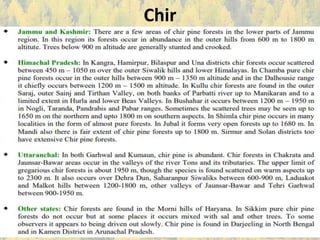
Chir
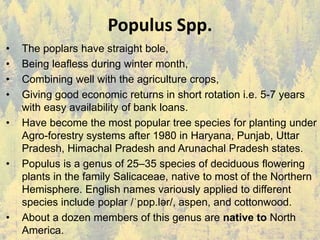
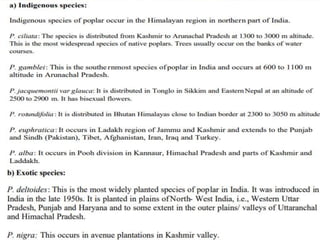
Populus Spp.
• The poplars have straight bole,
• Being leafless during winter month,
• Combining well with the agriculture crops,
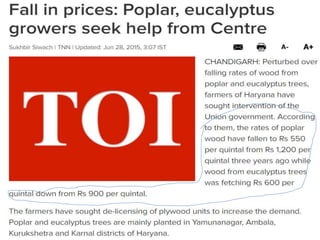
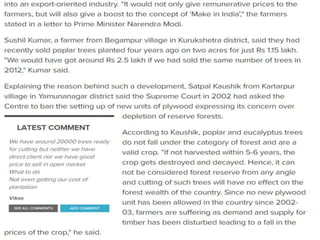
• Giving good economic returns in short rotation i.e. 5-7 years
with easy availability of bank loans.
• Have become the most popular tree species for planting under
Agro-forestry systems after 1980 in Haryana, Punjab, Uttar
Pradesh, Himachal Pradesh and Arunachal Pradesh states.
• Populus is a genus of 25–35 species of deciduous flowering
plants in the family Salicaceae, native to most of the Northern
Hemisphere. English names variously applied to different
species include poplar /ˈpɒp.lər/, aspen, and cottonwood.
• About a dozen members of this genus are native to North
America.
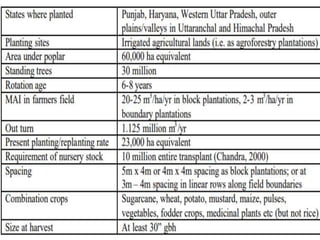
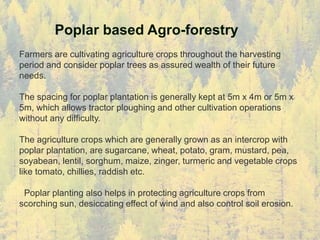
Poplar based Agro-forestry
Farmers are cultivating agriculture crops throughout the harvesting
period and consider poplar trees as assured wealth of their future
needs.
The spacing for poplar plantation is generally kept at 5m x 4m or 5m x
5m, which allows tractor ploughing and other cultivation operations
without any difficulty.
The agriculture crops which are generally grown as an intercrop with
poplar plantation, are sugarcane, wheat, potato, gram, mustard, pea,
soyabean, lentil, sorghum, maize, zinger, turmeric and vegetable crops
like tomato, chillies, raddish etc.
Poplar planting also helps in protecting agriculture crops from
scorching sun, desiccating effect of wind and also control soil erosion.
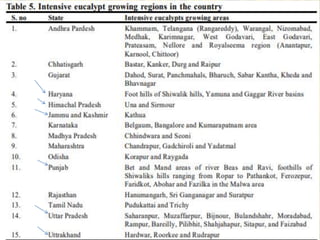
Eucalyptus spp.
• Eucalypt has a long history in India. It was first
planted around 1790 by Tippu Sultan, the ruler of
Mysore, in his palace garden on Nandi hills near
Bangalore.
• According to one version he received seed from
Australia and introduced about 16 species
(Shyam Sundar, 1984).
• There are more than 700 species
of eucalyptus and most are native to Australia; a
very small number are found in adjacent areas of
New Guinea and Indonesia.
UTILISATION OF EUCALYPTUS
• Charcoal: Eucalypt gives good charcoal. Wherever farm forestry has flourished,
eucalypt wood is used for charcoal manufacture to meet the semi urban and urban
demand.
• Poles: Eucalypt poles are good for transmission purposes and are also used in
construction of dwelling houses, work sheds and in mines. Eucalypt poles have
good demand near cities for use as scaffolding material.
• Timber: Earlier, eucalypt wood was not considered a good timber. The quality of
the timber depends upon the species and edapho-climatic factors.
• Rural small scale industries: Rural small scale industries are developing fast in the
country-side, important ones among them being brick making, jaggery making,
pottery, tile manufacturing, lime production, dyeing, smithy, etc. All these
industries require firewood or charcoal, provided by eucalypt plantations.
• Honey and oil: Several eucalypt species are rich in nectar and pollen. Bee keeping
is profitable and this activity is improving. Leaves of Eucalyptus globulus and E.
citriodora are used for extraction of oil. It is a cottage industry providing
employment in some parts of India.
• Paper and pulp: One of the most important uses of eucalypt wood so far has been
in the paper and pulp industry. The demand for paper and pulp is going to increase
many fold in India and eucalypt, being one of the good pulpwood materials, will be
in continuing demand.
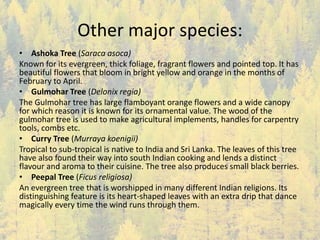
Other major species:
• Ashoka Tree (Saraca asoca)
Known for its evergreen, thick foliage, fragrant flowers and pointed top. It has
beautiful flowers that bloom in bright yellow and orange in the months of
February to April.
• Gulmohar Tree (Delonix regia)
The Gulmohar tree has large flamboyant orange flowers and a wide canopy
for which reason it is known for its ornamental value. The wood of the
gulmohar tree is used to make agricultural implements, handles for carpentry
tools, combs etc.
• Curry Tree (Murraya koenigii)
Tropical to sub-tropical is native to India and Sri Lanka. The leaves of this tree
have also found their way into south Indian cooking and lends a distinct
flavour and aroma to their cuisine. The tree also produces small black berries.
• Peepal Tree (Ficus religiosa)
An evergreen tree that is worshipped in many different Indian religions. Its
distinguishing feature is its heart-shaped leaves with an extra drip that dance
magically every time the wind runs through them.
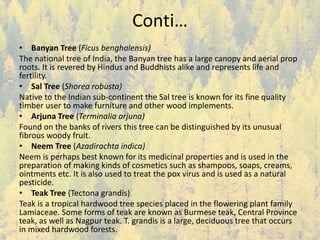
Conti…
• Banyan Tree (Ficus benghalensis)
The national tree of India, the Banyan tree has a large canopy and aerial prop
roots. It is revered by Hindus and Buddhists alike and represents life and
fertility.
• Sal Tree (Shorea robusta)
Native to the Indian sub-continent the Sal tree is known for its fine quality
timber user to make furniture and other wood implements.
• Arjuna Tree (Terminalia arjuna)
Found on the banks of rivers this tree can be distinguished by its unusual
fibrous woody fruit.
• Neem Tree (Azadirachta indica)
Neem is perhaps best known for its medicinal properties and is used in the
preparation of making kinds of cosmetics such as shampoos, soaps, creams,
ointments etc. It is also used to treat the pox virus and is used as a natural
pesticide.
• Teak Tree (Tectona grandis)
Teak is a tropical hardwood tree species placed in the flowering plant family
Lamiaceae. Some forms of teak are known as Burmese teak, Central Province
teak, as well as Nagpur teak. T. grandis is a large, deciduous tree that occurs
in mixed hardwood forests.
State wise plantations
• Uttar pradesh:
The various varieties of Rosewood, Neem,
Cassia, Gulmohar, Jakranda, Cirrus, Kanji,
Mango, Chitwan, Banyan, Pipal, Ficus, Mulsri,
Bauhinia, Kadamb, Tamarind, Bel and Mahua are
being planted in the state as per soil and
climatic conditions. The state government is
emphasizing on more and more plantation of
large and conventional trees.
Conti…
• Himachal Pradesh:
1) The Himalayan Cedar:
Scientific name: Cedrus deodara Indianname: Deodar
2) The Spruce:
Scientificname: Picea smithiana Indianname: Rai
3) The Silver Fir:
Scientific name: Picea pindrow Indianname: Rau
4) The Roxburghi Pine
Scintific name: Pinus roxburghi Indianname: Cheel
5) The Blue Pine
Scientific name: Pinus wallichiana Indian name: Kail
6) The White Oak
Scientific name: Quercus incana Inidanname: Ban
7) The Green Oak
Scientific name: Quercus dilatata Indianname: Moru
8) The Brown Oak
Scientific name: Quercus semiscarpifolia Indian name: Kharsu
9) The Rhododendron
Scientific name: Rhododendron arboreum Indian name: Brass
Jammu & Kashmir
• Jammu and Kashmir state is rich in green wealth,
• it has a wide variety of trees like Tahli (Seesam),Kikkar ,
Pallahi(Acacia species )Shahtoot (Mulberry), Kher (
Katha)Ber (Zizipus) ,Amaltas ( Cassia fistula), Indian
drum stick ( Moringa ) Mango ( Mengifera
indica)Amrood ( Guava )Amla ( Embellica )Curry patta ,
Dharenk ( Melia indica ) Neem ( Melia azadarichta).
Pine ( Pinus species )Deodar ( Cedrus deodara) , apple,
Wall nut , Almond, willow ( bait )Safe da (Eucalyptus
species ) and many more rarely known species.
References
• http://www.frienvis.nic.in/WriteReadData/UserFiles/file/Content-
Page/Books/Eucalypts/Eucalypts-in-Agroforestry.pdf
• http://www.fao.org/3/ac772e/ac772e06.htm
• http://haryanaforest.gov.in/en-us/Agro-Forestry-Models
• http://agritech.tnau.ac.in/kvk/tct.pdf
• https://www.grow-trees.com/blog/uncategorized/common-trees-
in-india/
• http://wgbis.ces.iisc.ernet.in/energy/water/paper/ETR79/CES_TVR
_ETR_79_Avenue_trees.pdf
• http://www.pbforests.gov.in/punjabi/Pdfs/working_plan/Working%
20Plan%20for%20Patiala%20Forest%20Division.pdf
• http://www.fao.org/forestry/6470-
0e476a569c0c19869e4f7e5eb88ad3d17.pdf
• https://www.quora.com/What-trees-are-native-to-Jammu-Kashmir
Thank you…!

North indian plantations: An Introduction.

  • 1.
    ā€œPlantation Trees InNorth Indiaā€ Submitted to: Dr. Reena Joshi Presented by: Vivek Chauhan (16091)
  • 2.
    North India The Northernpart of India is endowed with immense topographical diversity, historical monuments, different cultures, wildlife parks and sanctuaries, holy temples and rivers and diversified climatic conditions. Most of the countries famous hill stations are situated in Northern India. The entire northern part of the country shares its borders with countries like; Pakistan, China, Nepal and Bhutan. There are 6 North Indian States and one Union Territory namely; Delhi Haryana Jammu and Kashmir Himachal Pradesh Uttar Pradesh Punjab Uttrakhand
  • 4.
  • 5.
    Populus Spp. • Thepoplars have straight bole, • Being leafless during winter month, • Combining well with the agriculture crops, • Giving good economic returns in short rotation i.e. 5-7 years with easy availability of bank loans. • Have become the most popular tree species for planting under Agro-forestry systems after 1980 in Haryana, Punjab, Uttar Pradesh, Himachal Pradesh and Arunachal Pradesh states. • Populus is a genus of 25–35 species of deciduous flowering plants in the family Salicaceae, native to most of the Northern Hemisphere. English names variously applied to different species include poplar /ˈpɒp.lər/, aspen, and cottonwood. • About a dozen members of this genus are native to North America.
  • 7.
    Poplar based Agro-forestry Farmersare cultivating agriculture crops throughout the harvesting period and consider poplar trees as assured wealth of their future needs. The spacing for poplar plantation is generally kept at 5m x 4m or 5m x 5m, which allows tractor ploughing and other cultivation operations without any difficulty. The agriculture crops which are generally grown as an intercrop with poplar plantation, are sugarcane, wheat, potato, gram, mustard, pea, soyabean, lentil, sorghum, maize, zinger, turmeric and vegetable crops like tomato, chillies, raddish etc. Poplar planting also helps in protecting agriculture crops from scorching sun, desiccating effect of wind and also control soil erosion.
  • 9.
    Eucalyptus spp. • Eucalypthas a long history in India. It was first planted around 1790 by Tippu Sultan, the ruler of Mysore, in his palace garden on Nandi hills near Bangalore. • According to one version he received seed from Australia and introduced about 16 species (Shyam Sundar, 1984). • There are more than 700 species of eucalyptus and most are native to Australia; a very small number are found in adjacent areas of New Guinea and Indonesia.
  • 11.
    UTILISATION OF EUCALYPTUS •Charcoal: Eucalypt gives good charcoal. Wherever farm forestry has flourished, eucalypt wood is used for charcoal manufacture to meet the semi urban and urban demand. • Poles: Eucalypt poles are good for transmission purposes and are also used in construction of dwelling houses, work sheds and in mines. Eucalypt poles have good demand near cities for use as scaffolding material. • Timber: Earlier, eucalypt wood was not considered a good timber. The quality of the timber depends upon the species and edapho-climatic factors. • Rural small scale industries: Rural small scale industries are developing fast in the country-side, important ones among them being brick making, jaggery making, pottery, tile manufacturing, lime production, dyeing, smithy, etc. All these industries require firewood or charcoal, provided by eucalypt plantations. • Honey and oil: Several eucalypt species are rich in nectar and pollen. Bee keeping is profitable and this activity is improving. Leaves of Eucalyptus globulus and E. citriodora are used for extraction of oil. It is a cottage industry providing employment in some parts of India. • Paper and pulp: One of the most important uses of eucalypt wood so far has been in the paper and pulp industry. The demand for paper and pulp is going to increase many fold in India and eucalypt, being one of the good pulpwood materials, will be in continuing demand.
  • 14.
    Other major species: •Ashoka Tree (Saraca asoca) Known for its evergreen, thick foliage, fragrant flowers and pointed top. It has beautiful flowers that bloom in bright yellow and orange in the months of February to April. • Gulmohar Tree (Delonix regia) The Gulmohar tree has large flamboyant orange flowers and a wide canopy for which reason it is known for its ornamental value. The wood of the gulmohar tree is used to make agricultural implements, handles for carpentry tools, combs etc. • Curry Tree (Murraya koenigii) Tropical to sub-tropical is native to India and Sri Lanka. The leaves of this tree have also found their way into south Indian cooking and lends a distinct flavour and aroma to their cuisine. The tree also produces small black berries. • Peepal Tree (Ficus religiosa) An evergreen tree that is worshipped in many different Indian religions. Its distinguishing feature is its heart-shaped leaves with an extra drip that dance magically every time the wind runs through them.
  • 15.
    Conti… • Banyan Tree(Ficus benghalensis) The national tree of India, the Banyan tree has a large canopy and aerial prop roots. It is revered by Hindus and Buddhists alike and represents life and fertility. • Sal Tree (Shorea robusta) Native to the Indian sub-continent the Sal tree is known for its fine quality timber user to make furniture and other wood implements. • Arjuna Tree (Terminalia arjuna) Found on the banks of rivers this tree can be distinguished by its unusual fibrous woody fruit. • Neem Tree (Azadirachta indica) Neem is perhaps best known for its medicinal properties and is used in the preparation of making kinds of cosmetics such as shampoos, soaps, creams, ointments etc. It is also used to treat the pox virus and is used as a natural pesticide. • Teak Tree (Tectona grandis) Teak is a tropical hardwood tree species placed in the flowering plant family Lamiaceae. Some forms of teak are known as Burmese teak, Central Province teak, as well as Nagpur teak. T. grandis is a large, deciduous tree that occurs in mixed hardwood forests.
  • 16.
    State wise plantations •Uttar pradesh: The various varieties of Rosewood, Neem, Cassia, Gulmohar, Jakranda, Cirrus, Kanji, Mango, Chitwan, Banyan, Pipal, Ficus, Mulsri, Bauhinia, Kadamb, Tamarind, Bel and Mahua are being planted in the state as per soil and climatic conditions. The state government is emphasizing on more and more plantation of large and conventional trees.
  • 17.
    Conti… • Himachal Pradesh: 1)The Himalayan Cedar: Scientific name: Cedrus deodara Indianname: Deodar 2) The Spruce: Scientificname: Picea smithiana Indianname: Rai 3) The Silver Fir: Scientific name: Picea pindrow Indianname: Rau 4) The Roxburghi Pine Scintific name: Pinus roxburghi Indianname: Cheel 5) The Blue Pine Scientific name: Pinus wallichiana Indian name: Kail 6) The White Oak Scientific name: Quercus incana Inidanname: Ban 7) The Green Oak Scientific name: Quercus dilatata Indianname: Moru 8) The Brown Oak Scientific name: Quercus semiscarpifolia Indian name: Kharsu 9) The Rhododendron Scientific name: Rhododendron arboreum Indian name: Brass
  • 18.
    Jammu & Kashmir •Jammu and Kashmir state is rich in green wealth, • it has a wide variety of trees like Tahli (Seesam),Kikkar , Pallahi(Acacia species )Shahtoot (Mulberry), Kher ( Katha)Ber (Zizipus) ,Amaltas ( Cassia fistula), Indian drum stick ( Moringa ) Mango ( Mengifera indica)Amrood ( Guava )Amla ( Embellica )Curry patta , Dharenk ( Melia indica ) Neem ( Melia azadarichta). Pine ( Pinus species )Deodar ( Cedrus deodara) , apple, Wall nut , Almond, willow ( bait )Safe da (Eucalyptus species ) and many more rarely known species.
  • 19.
    References • http://www.frienvis.nic.in/WriteReadData/UserFiles/file/Content- Page/Books/Eucalypts/Eucalypts-in-Agroforestry.pdf • http://www.fao.org/3/ac772e/ac772e06.htm •http://haryanaforest.gov.in/en-us/Agro-Forestry-Models • http://agritech.tnau.ac.in/kvk/tct.pdf • https://www.grow-trees.com/blog/uncategorized/common-trees- in-india/ • http://wgbis.ces.iisc.ernet.in/energy/water/paper/ETR79/CES_TVR _ETR_79_Avenue_trees.pdf • http://www.pbforests.gov.in/punjabi/Pdfs/working_plan/Working% 20Plan%20for%20Patiala%20Forest%20Division.pdf • http://www.fao.org/forestry/6470- 0e476a569c0c19869e4f7e5eb88ad3d17.pdf • https://www.quora.com/What-trees-are-native-to-Jammu-Kashmir
  • 20.