Circulatory System
Chapter 34
2
Circulatory SystemsCirculatory Systems
OutlineOutline
Transport in InvertebratesTransport in Invertebrates
Open versus Closed Circulatory SystemsOpen versus Closed Circulatory Systems
Transport in VertebratesTransport in Vertebrates
Transport in HumansTransport in Humans
HeartbeatHeartbeat
Vascular PathwaysVascular Pathways
Blood PressureBlood Pressure
Cardiovascular DisordersCardiovascular Disorders
BloodBlood
ComponentsComponents
ClottingClotting
3
Circulatory SystemsCirculatory Systems
Transport in InvertebratesTransport in Invertebrates
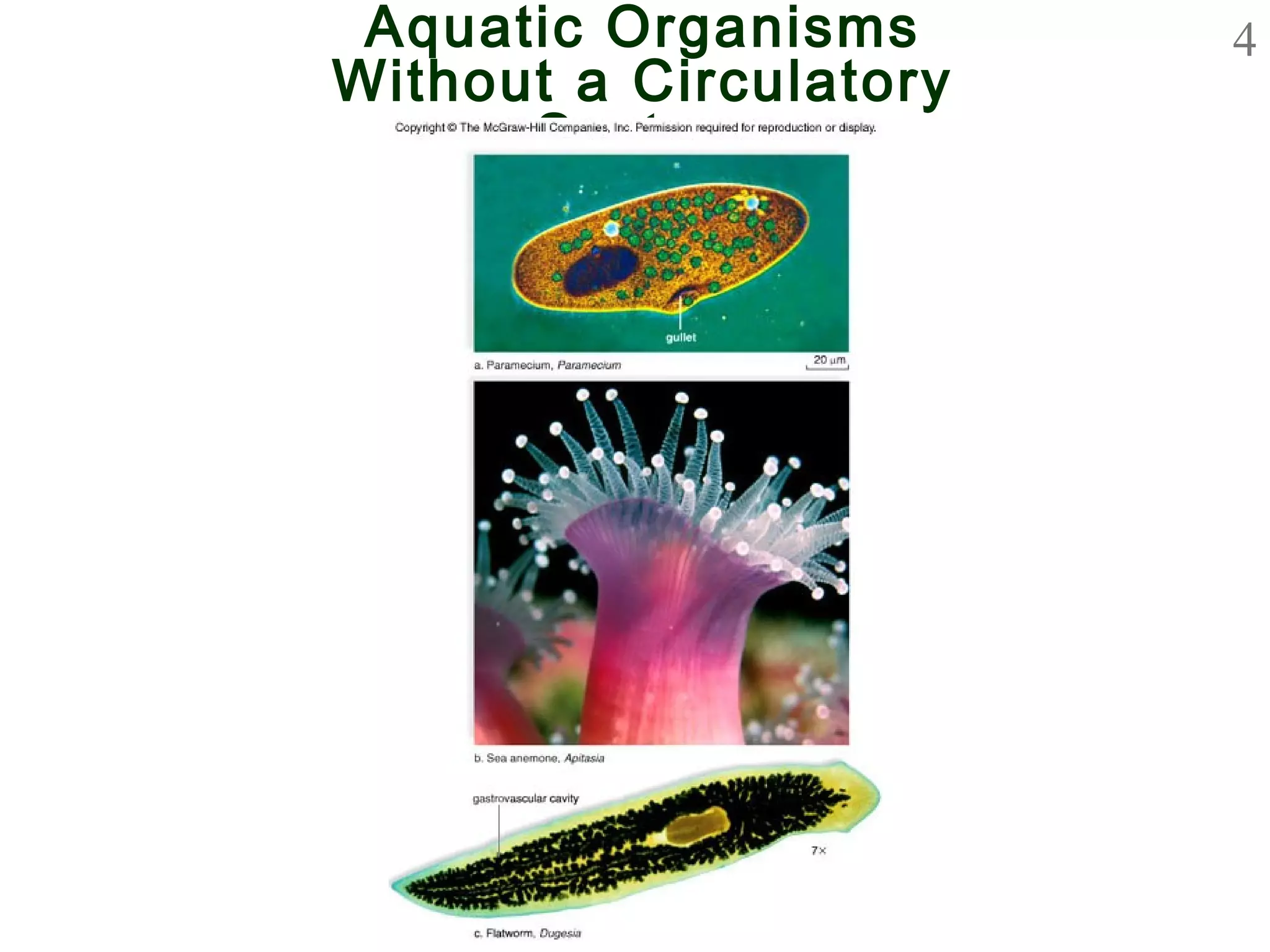
Small aquatic animals with no circulatorySmall aquatic animals with no circulatory
systemsystem
May rely on external water inMay rely on external water in
gastrovascular cavity to service cellsgastrovascular cavity to service cells
Roundworms and otherRoundworms and other
pseudocoelomatespseudocoelomates
Use a fluid-filled body cavity as a meansUse a fluid-filled body cavity as a means
of transporting substancesof transporting substances
Fluid-filled cavity can also act as aFluid-filled cavity can also act as a
hydrostatic skeletonhydrostatic skeleton
Animals that have a rigid skeletonAnimals that have a rigid skeleton
May still rely on body fluids for theMay still rely on body fluids for the
purpose of locomotionpurpose of locomotion
Bivalves pump hemolymph into the footBivalves pump hemolymph into the foot
4Aquatic Organisms
Without a Circulatory
System
5
Circulatory SystemsCirculatory Systems
Open vs. ClosedOpen vs. Closed
Invertebrate CirculationInvertebrate Circulation
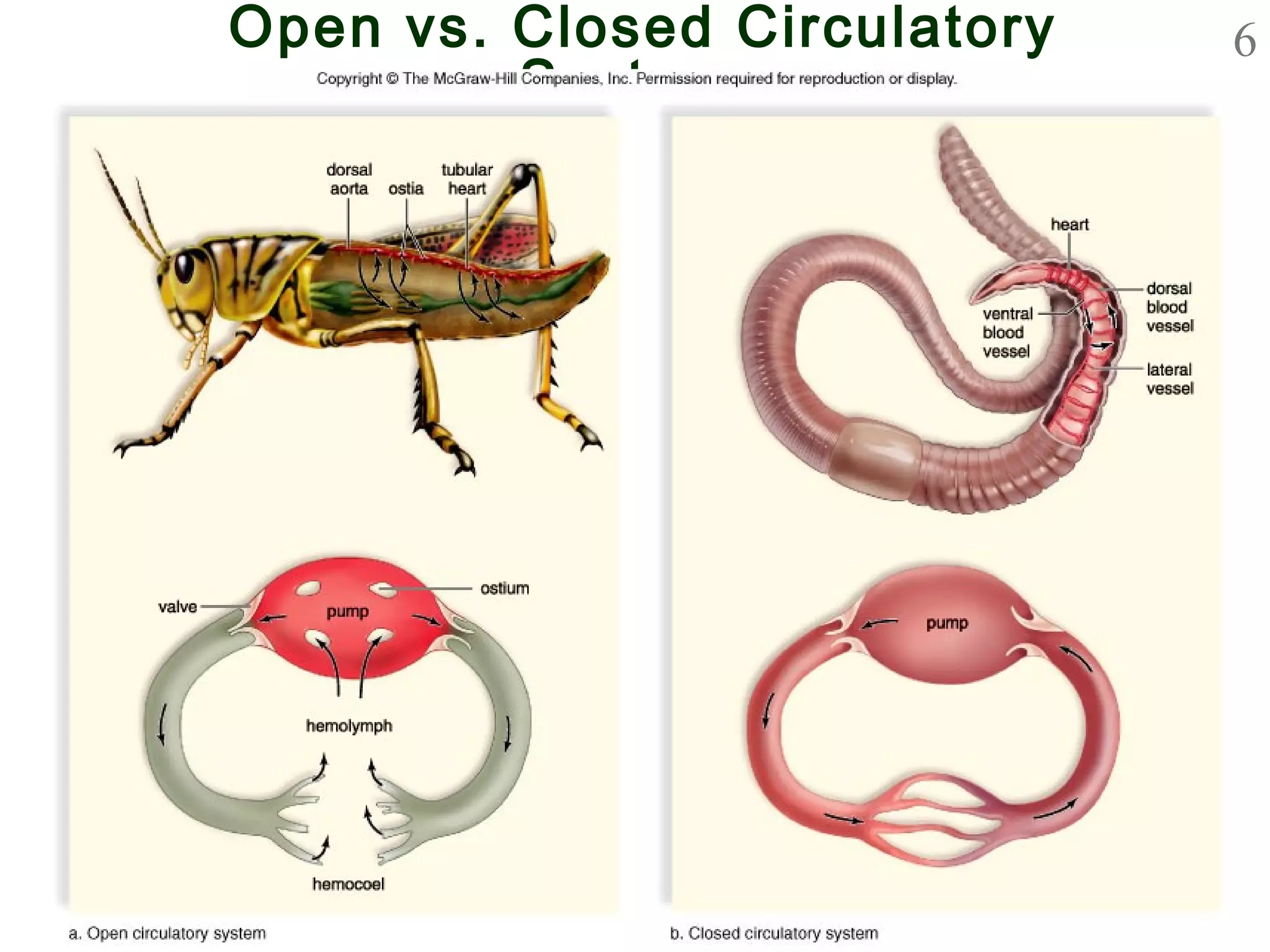
Two types of circulatory fluids:Two types of circulatory fluids:
 Blood - contained within blood vesselsBlood - contained within blood vessels
 Hemolymph - flows into hemocoelHemolymph - flows into hemocoel
Open Circulatory SystemOpen Circulatory System
 Heart pumps hemolymph via vesselsHeart pumps hemolymph via vessels
 Vessels empty into tissue spacesVessels empty into tissue spaces
Closed Circulatory SystemClosed Circulatory System
 Heart pumps blood to capillariesHeart pumps blood to capillaries
 Gases and materials diffuse to and from nearbyGases and materials diffuse to and from nearby
cellscells
 Vessels return blood to heart without itVessels return blood to heart without it
6Open vs. Closed Circulatory
Systems
7
Circulatory SystemsCirculatory Systems
Transport in the VertebratesTransport in the Vertebrates
All vertebrates have a closed cardiovascularAll vertebrates have a closed cardiovascular
systemsystem
Vertebrate heart:Vertebrate heart:
 Atrial chamber(s) of heart receive blood fromAtrial chamber(s) of heart receive blood from
general circulationgeneral circulation
 Ventricle chamber(s) of heart pump blood outVentricle chamber(s) of heart pump blood out
through blood vesselsthrough blood vessels
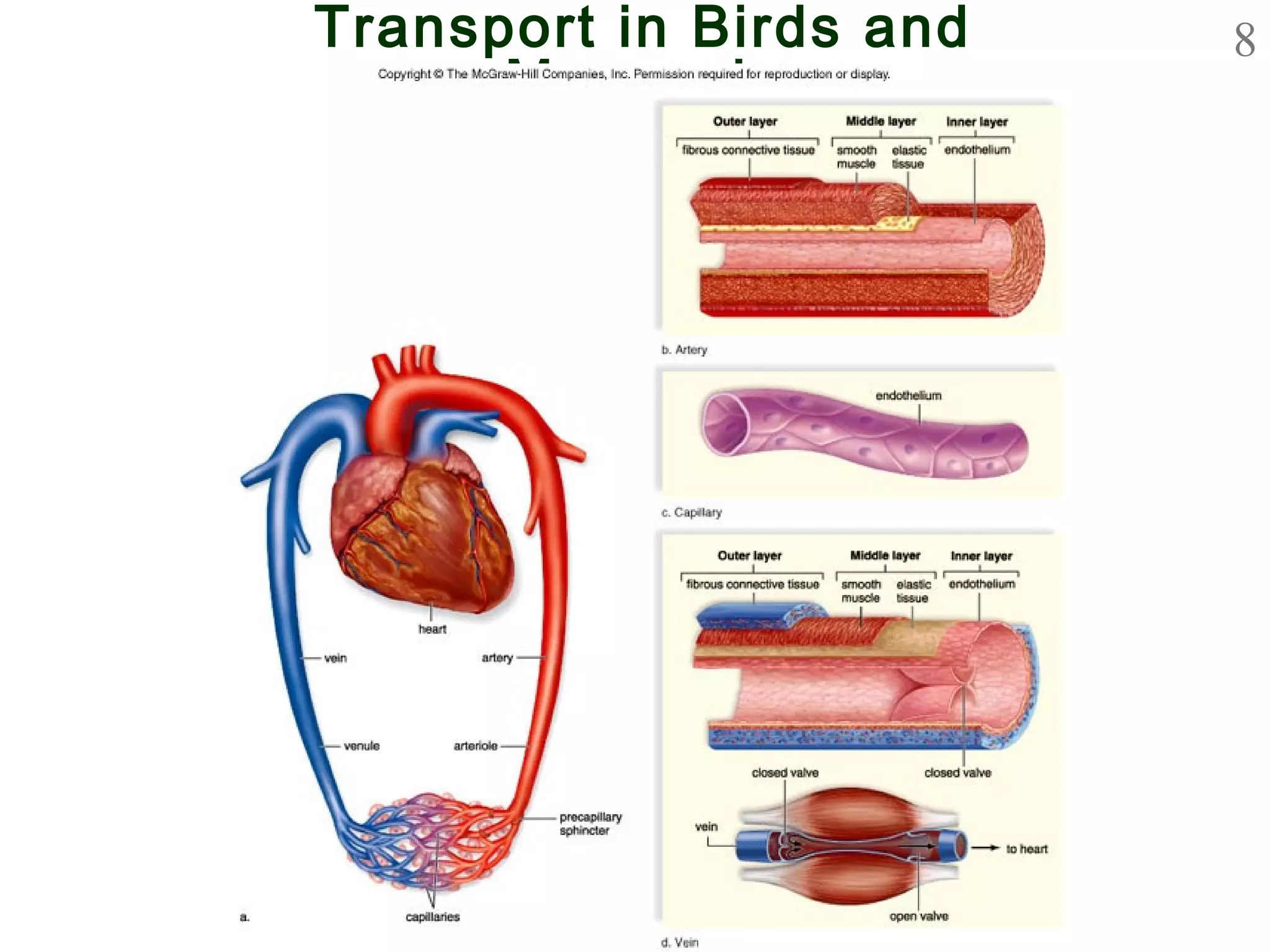
Vertebrate vessels:Vertebrate vessels:
 Arteries - Carry blood away from heartArteries - Carry blood away from heart
 Arterioles – Lead to capillariesArterioles – Lead to capillaries
 Capillaries - Exchange materials with tissueCapillaries - Exchange materials with tissue
fluidfluid
 Venules - Lead to veinsVenules - Lead to veins
8Transport in Birds and
Mammals
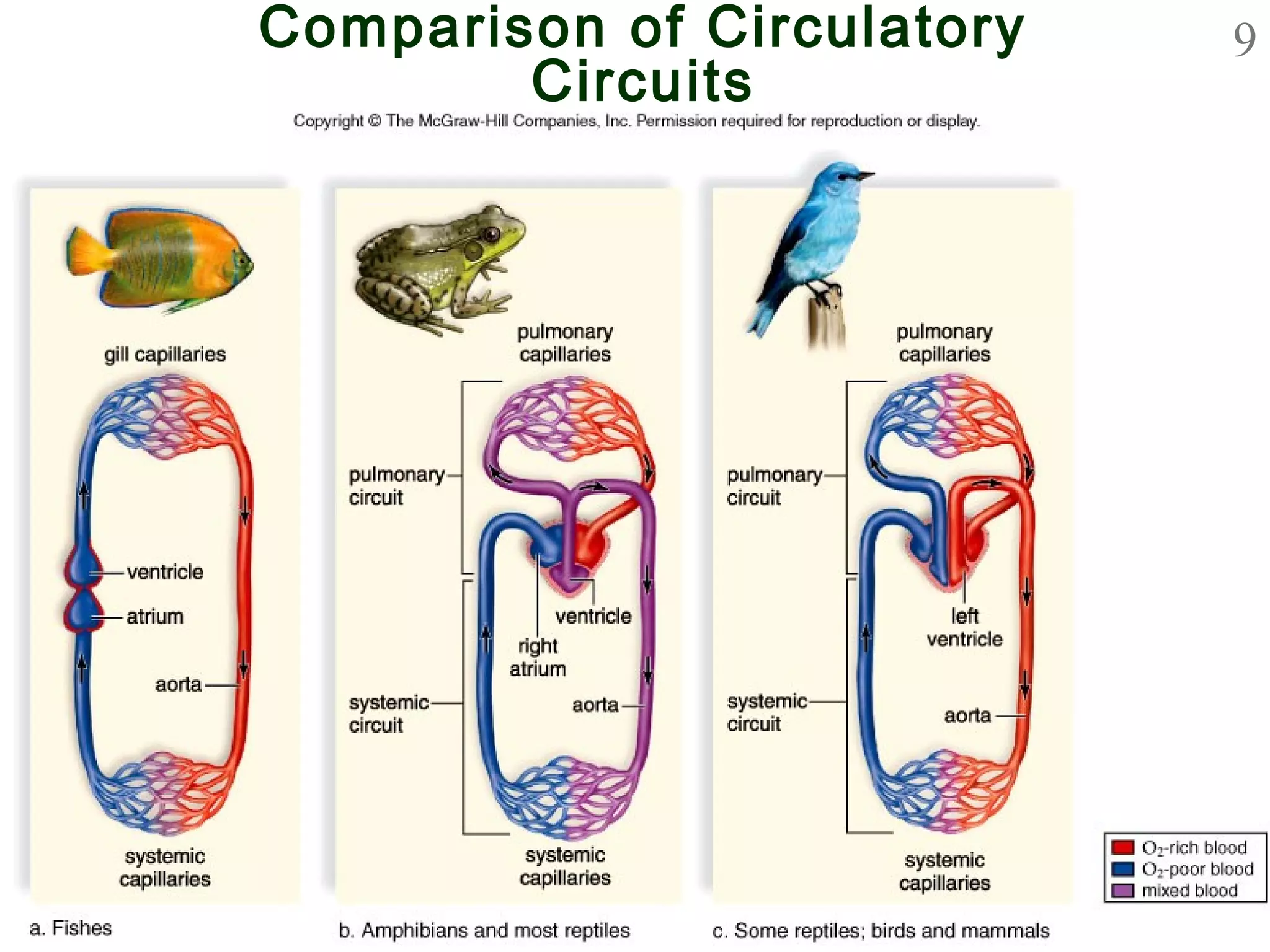
9Comparison of Circulatory
Circuits
in Vertebrates
10
Circulatory SystemsCirculatory Systems
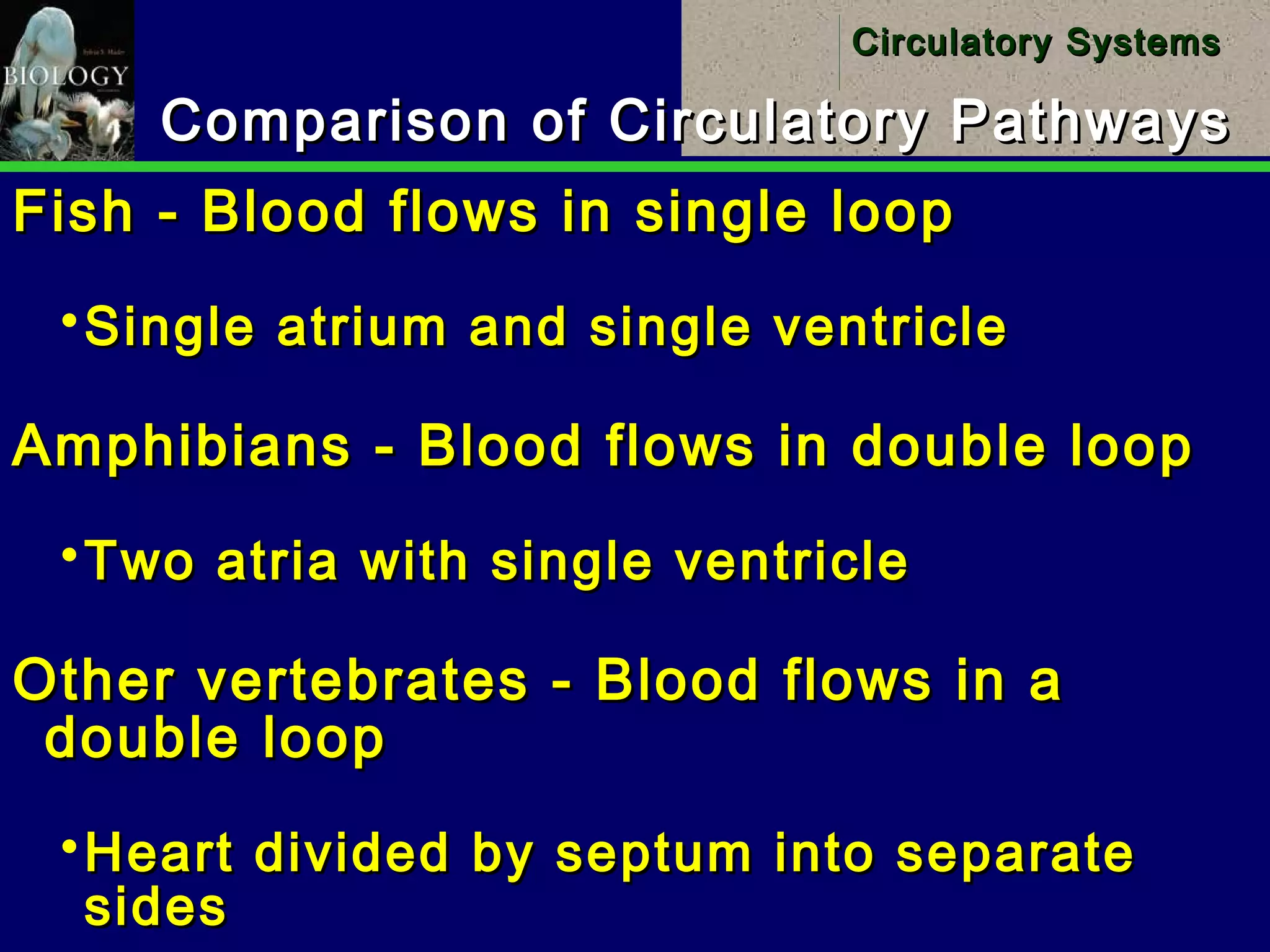
Comparison of Circulatory PathwaysComparison of Circulatory Pathways
Fish - Blood flows in single loopFish - Blood flows in single loop
Single atrium and single ventricleSingle atrium and single ventricle
Amphibians - Blood flows in double loopAmphibians - Blood flows in double loop
Two atria with single ventricleTwo atria with single ventricle
Other vertebrates - Blood flows in aOther vertebrates - Blood flows in a
double loopdouble loop
Heart divided by septum into separateHeart divided by septum into separate
sidessides
11
Circulatory SystemsCirculatory Systems
Transport in HumansTransport in Humans
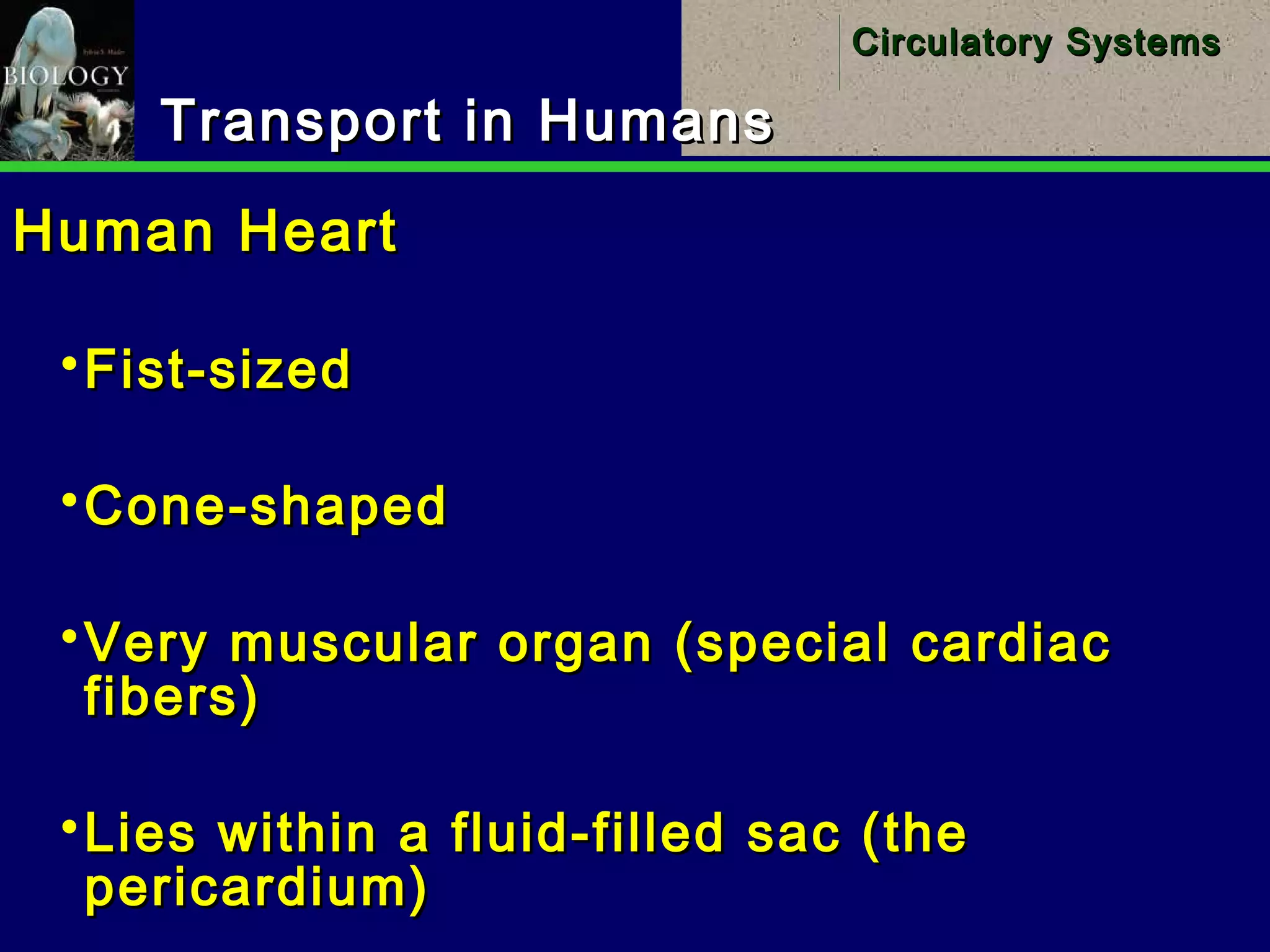
Human HeartHuman Heart
Fist-sizedFist-sized
Cone-shapedCone-shaped
Very muscular organ (special cardiacVery muscular organ (special cardiac
fibers)fibers)
Lies within a fluid-filled sac (theLies within a fluid-filled sac (the
pericardium)pericardium)
12
Circulatory SystemsCirculatory Systems
Human Heart:Human Heart:
Gross AnatomyGross Anatomy
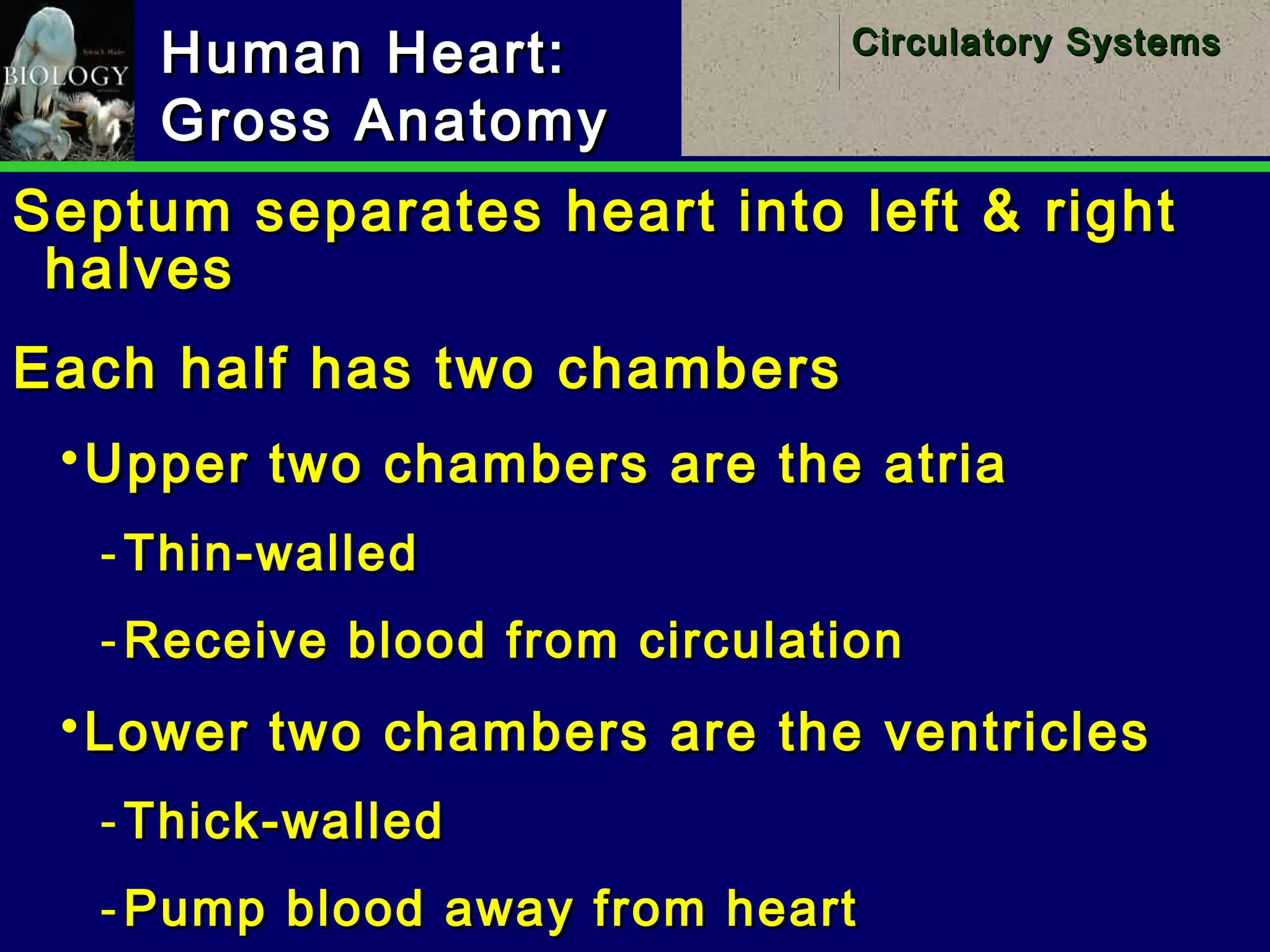
Septum separates heart into left & rightSeptum separates heart into left & right
halveshalves
Each half has two chambersEach half has two chambers
Upper two chambers are the atriaUpper two chambers are the atria
­ Thin-walledThin-walled
­ Receive blood from circulationReceive blood from circulation
Lower two chambers are the ventriclesLower two chambers are the ventricles
­ Thick-walledThick-walled
­ Pump blood away from heartPump blood away from heart
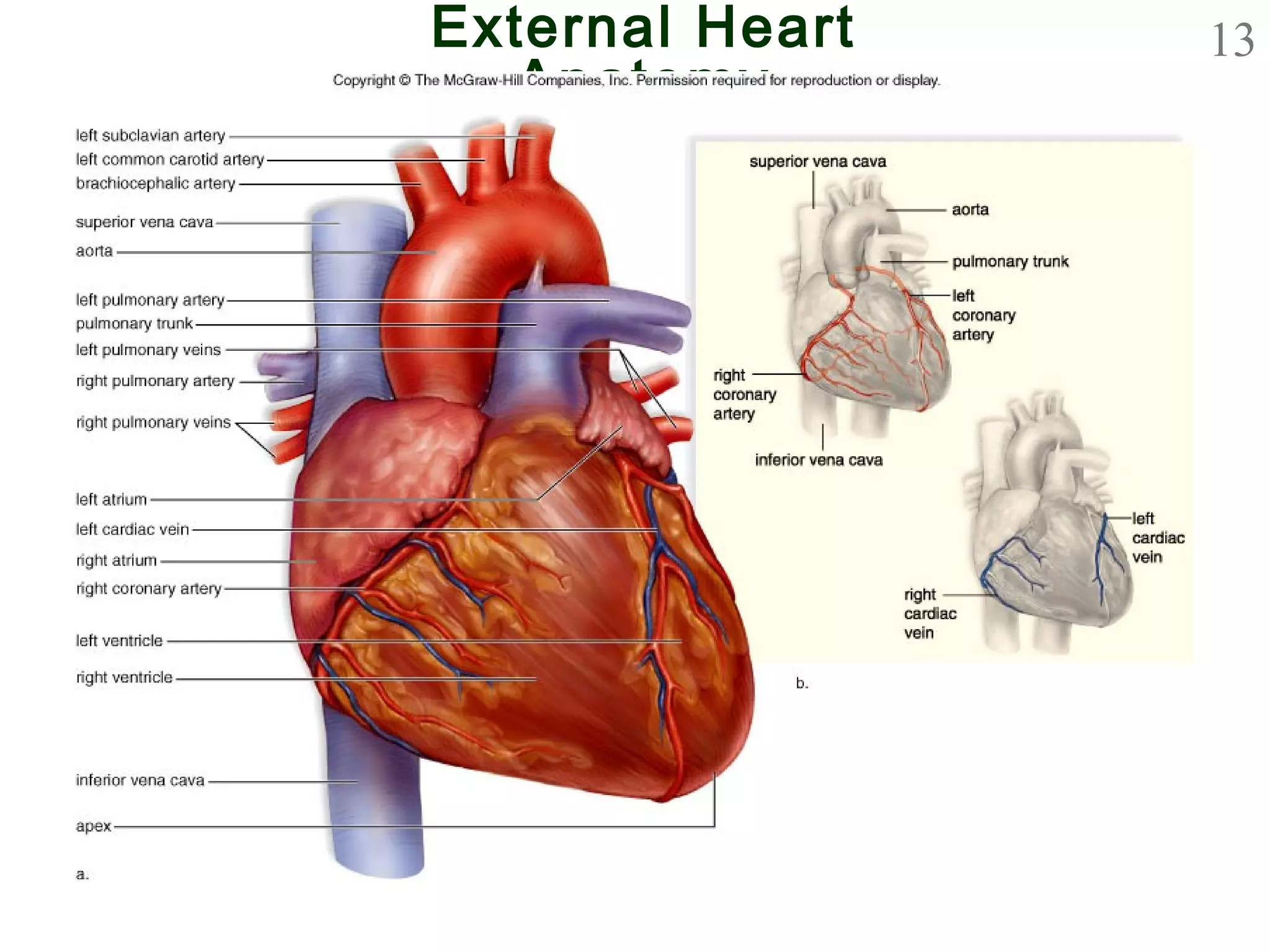
13External Heart
Anatomy
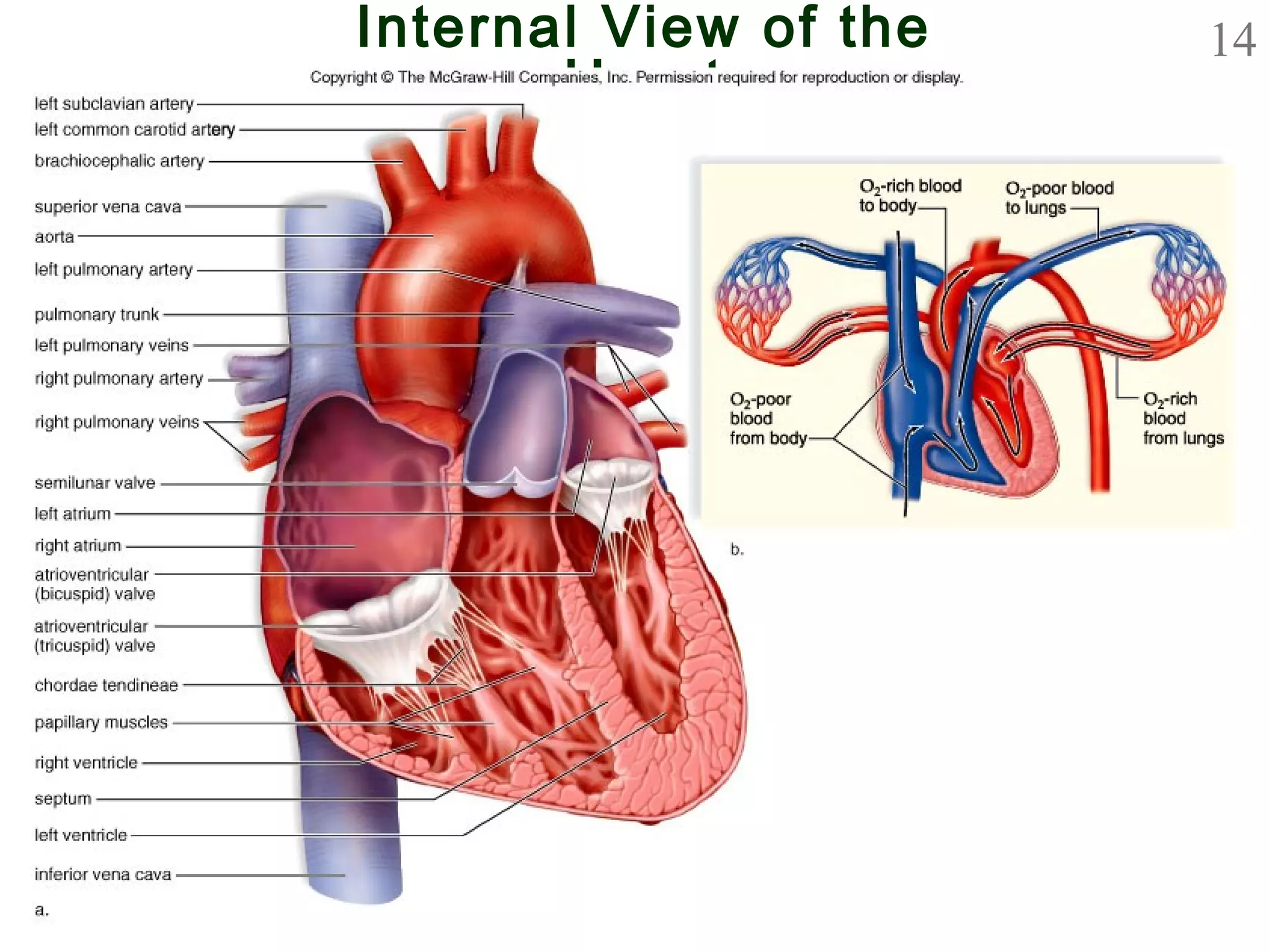
14Internal View of the
Heart
15
Circulatory SystemsCirculatory Systems
Human Heart:Human Heart:
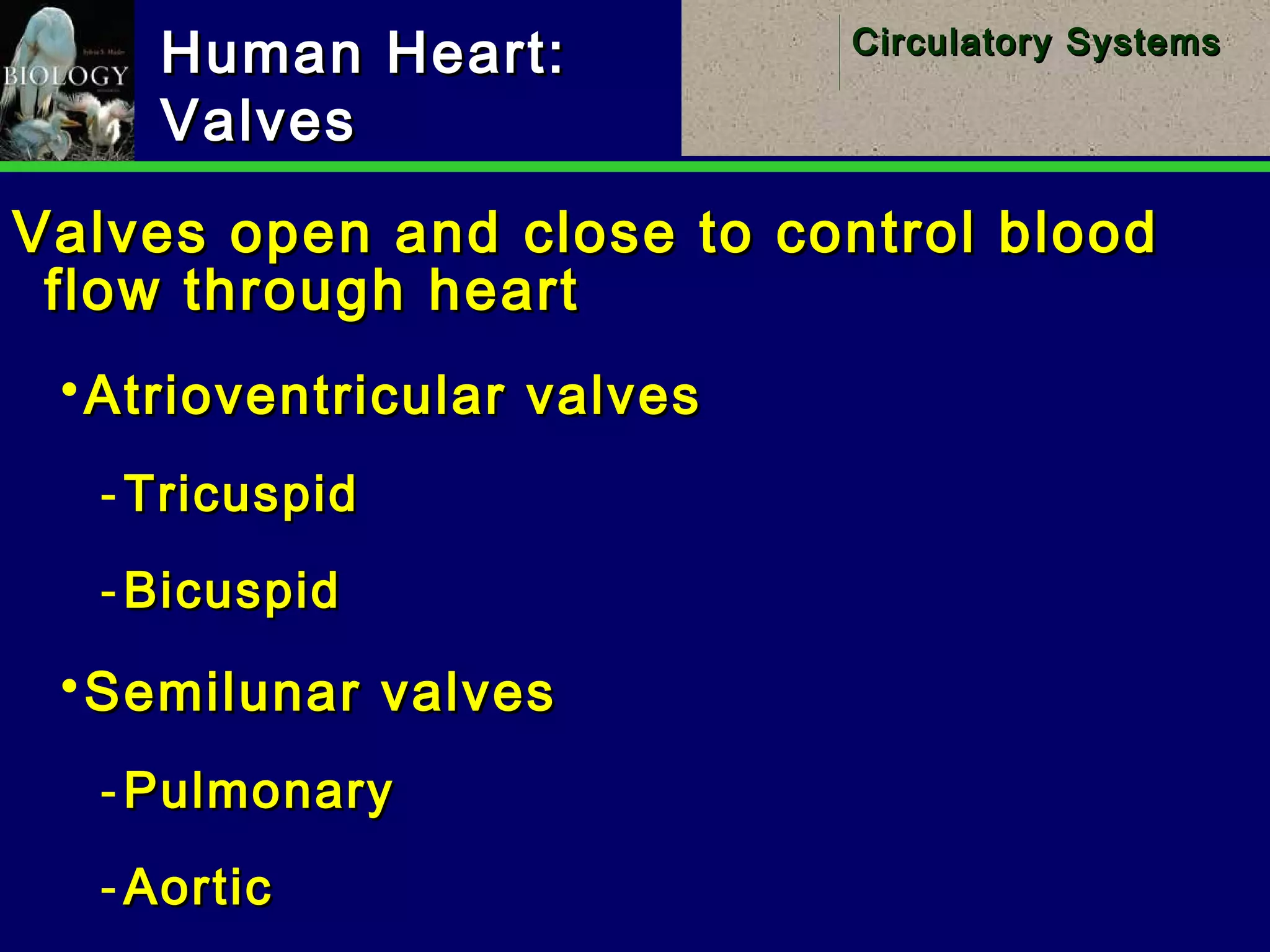
ValvesValves
Valves open and close to control bloodValves open and close to control blood
flow through heartflow through heart
Atrioventricular valvesAtrioventricular valves
­ TricuspidTricuspid
­ BicuspidBicuspid
Semilunar valvesSemilunar valves
­ PulmonaryPulmonary
­ AorticAortic
16
Circulatory SystemsCirculatory Systems
Transport in HumansTransport in Humans
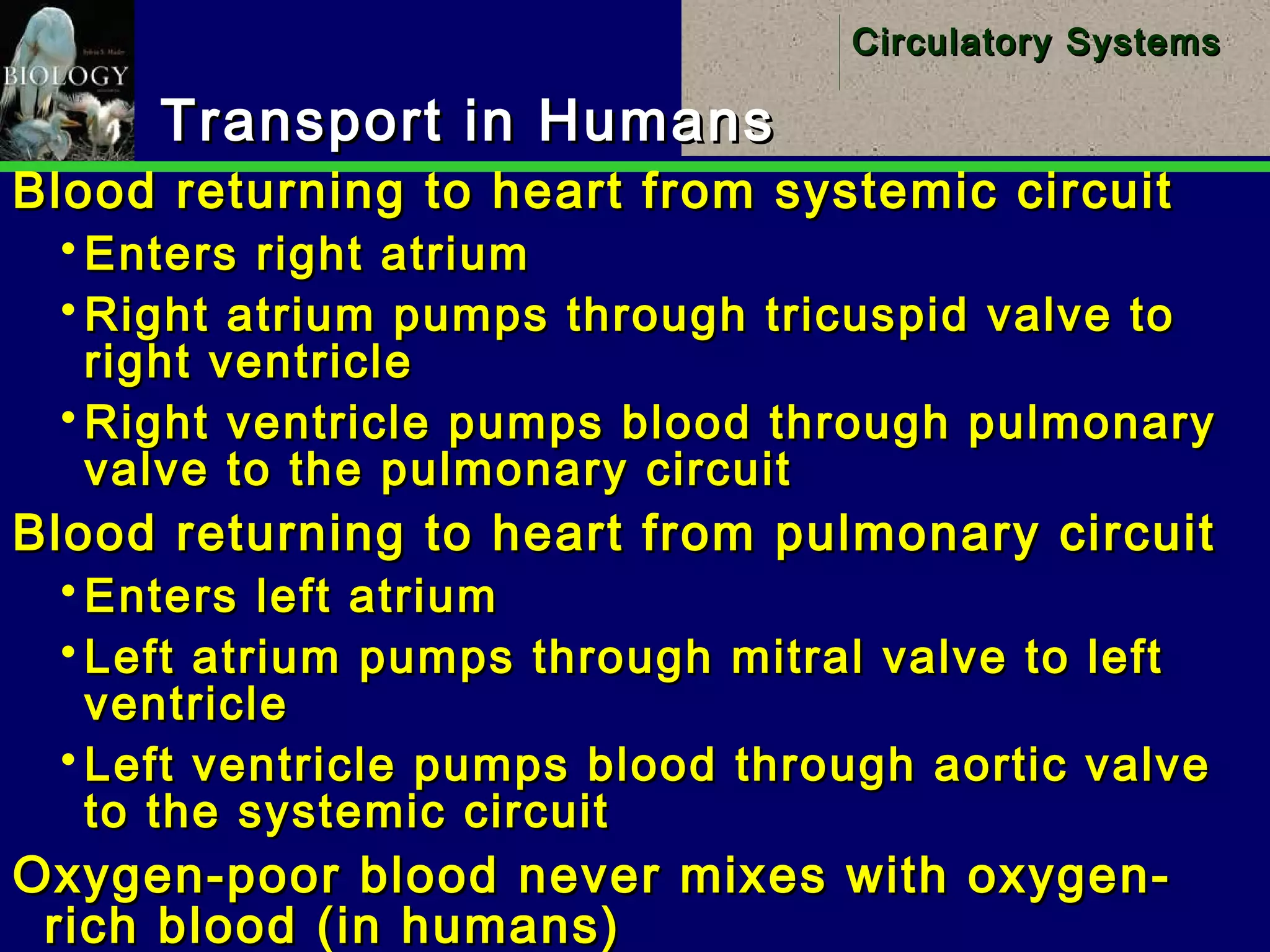
Blood returning to heart from systemic circuitBlood returning to heart from systemic circuit
 Enters right atriumEnters right atrium
 Right atrium pumps through tricuspid valve toRight atrium pumps through tricuspid valve to
right ventricleright ventricle
 Right ventricle pumps blood through pulmonaryRight ventricle pumps blood through pulmonary
valve to the pulmonary circuitvalve to the pulmonary circuit
Blood returning to heart from pulmonary circuitBlood returning to heart from pulmonary circuit
 Enters left atriumEnters left atrium
 Left atrium pumps through mitral valve to leftLeft atrium pumps through mitral valve to left
ventricleventricle
 Left ventricle pumps blood through aortic valveLeft ventricle pumps blood through aortic valve
to the systemic circuitto the systemic circuit
Oxygen-poor blood never mixes with oxygen-Oxygen-poor blood never mixes with oxygen-
rich blood (in humans)rich blood (in humans)
17
Circulatory SystemsCirculatory Systems
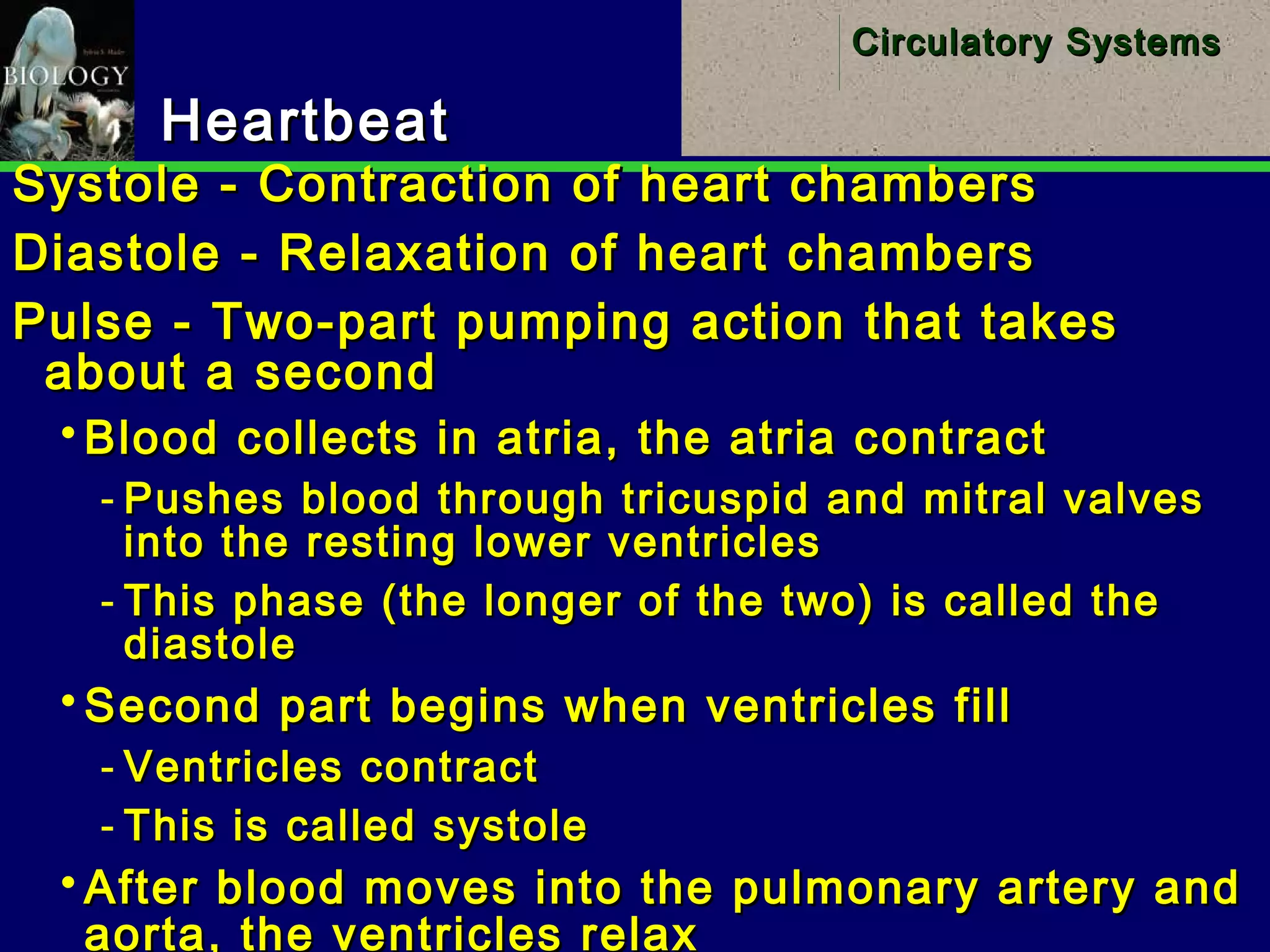
HeartbeatHeartbeat
Systole - Contraction of heart chambersSystole - Contraction of heart chambers
Diastole - Relaxation of heart chambersDiastole - Relaxation of heart chambers
Pulse - Two-part pumping action that takesPulse - Two-part pumping action that takes
about a secondabout a second
 Blood collects in atria, the atria contractBlood collects in atria, the atria contract
­ Pushes blood through tricuspid and mitral valvesPushes blood through tricuspid and mitral valves
into the resting lower ventriclesinto the resting lower ventricles
­ This phase (the longer of the two) is called theThis phase (the longer of the two) is called the
diastolediastole
 Second part begins when ventricles fillSecond part begins when ventricles fill
­ Ventricles contractVentricles contract
­ This is called systoleThis is called systole
 After blood moves into the pulmonary artery andAfter blood moves into the pulmonary artery and
aorta, the ventricles relaxaorta, the ventricles relax
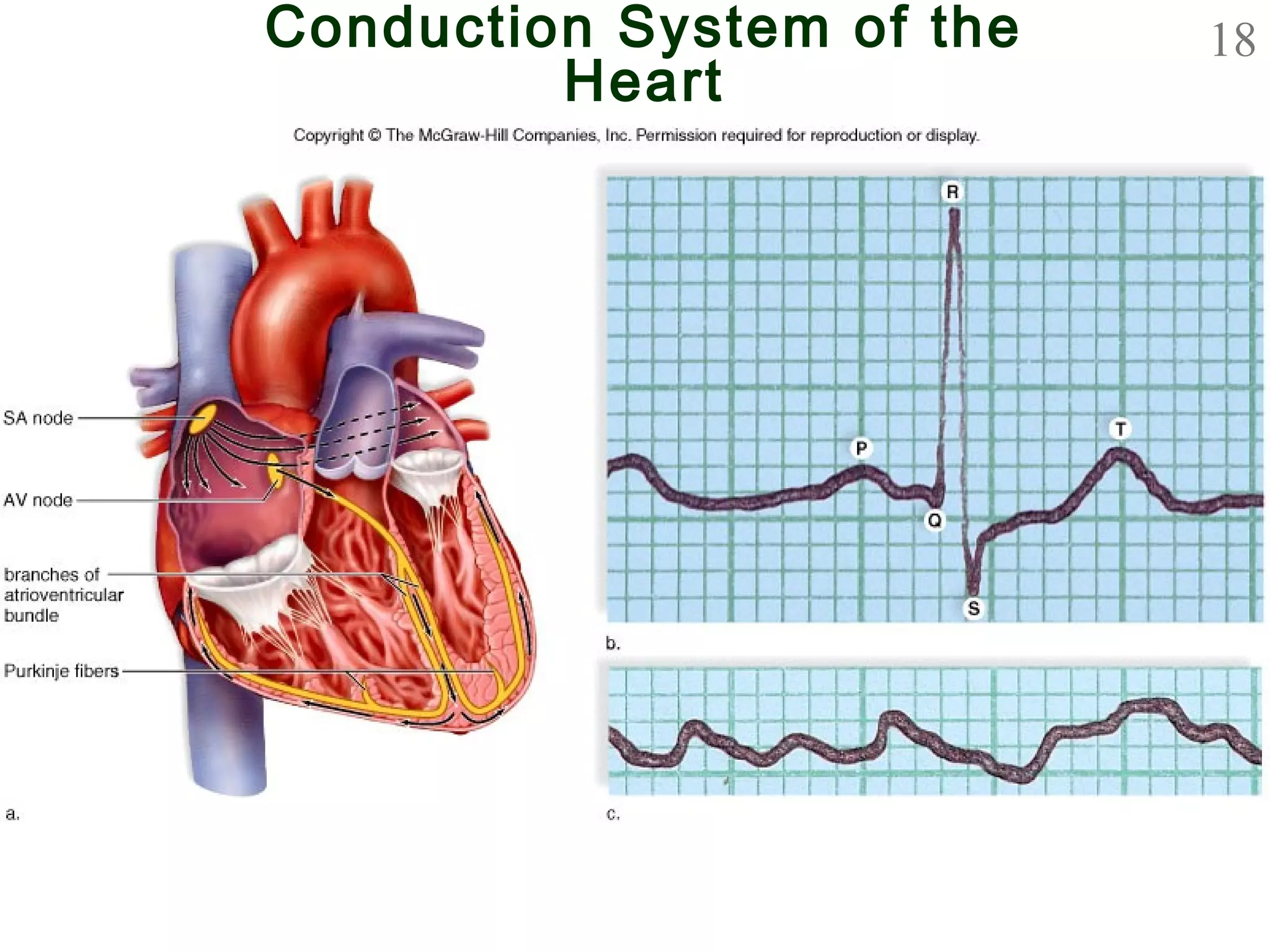
18Conduction System of the
Heart
19
Circulatory SystemsCirculatory Systems
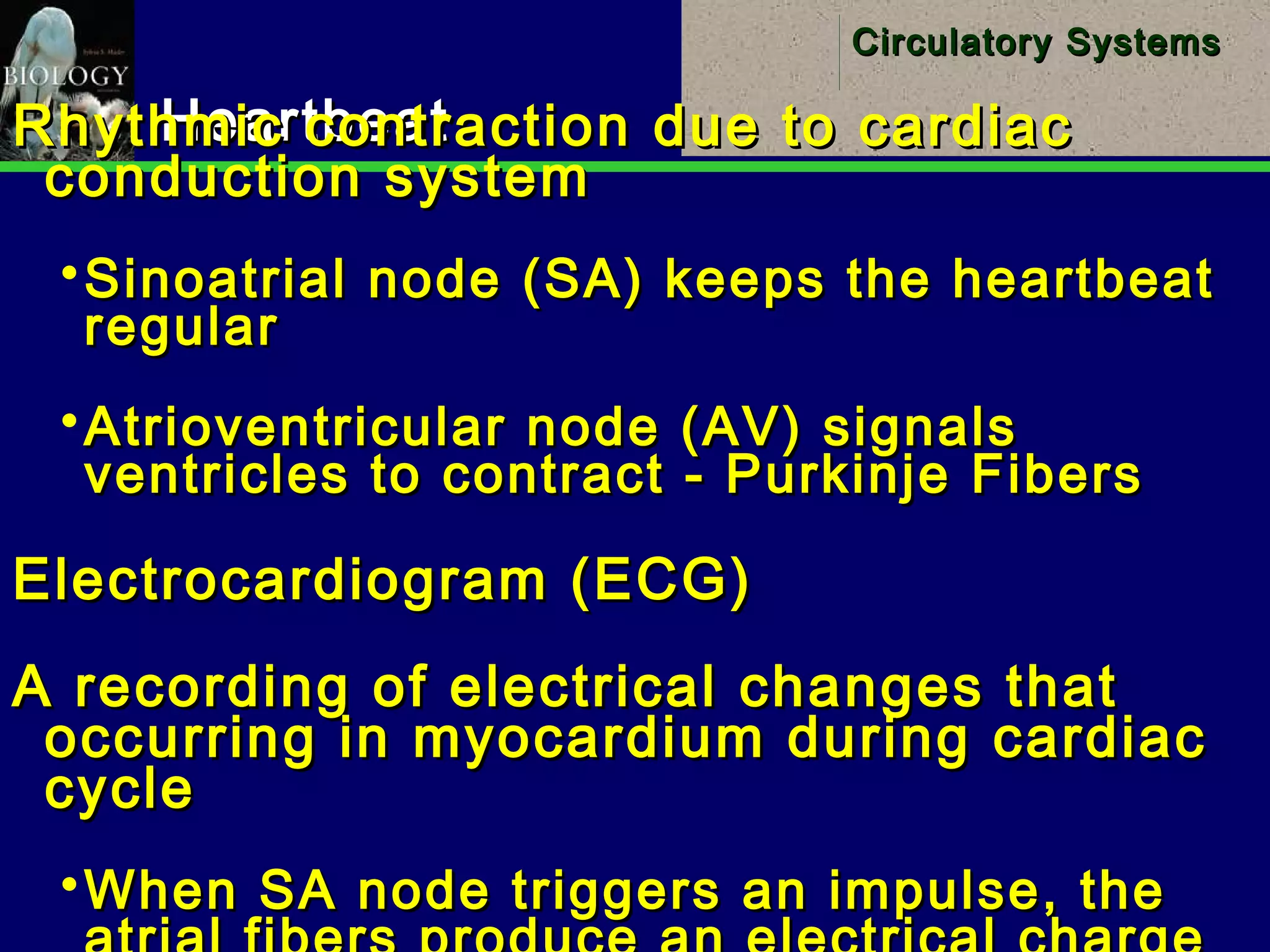
HeartbeatHeartbeatRhythmic contraction due to cardiacRhythmic contraction due to cardiac
conduction systemconduction system
Sinoatrial node (SA) keeps the heartbeatSinoatrial node (SA) keeps the heartbeat
regularregular
Atrioventricular node (AV) signalsAtrioventricular node (AV) signals
ventricles to contract - Purkinje Fibersventricles to contract - Purkinje Fibers
Electrocardiogram (ECG)Electrocardiogram (ECG)
A recording of electrical changes thatA recording of electrical changes that
occurring in myocardium during cardiacoccurring in myocardium during cardiac
cyclecycle
When SA node triggers an impulse, theWhen SA node triggers an impulse, the
20
Circulatory SystemsCirculatory Systems
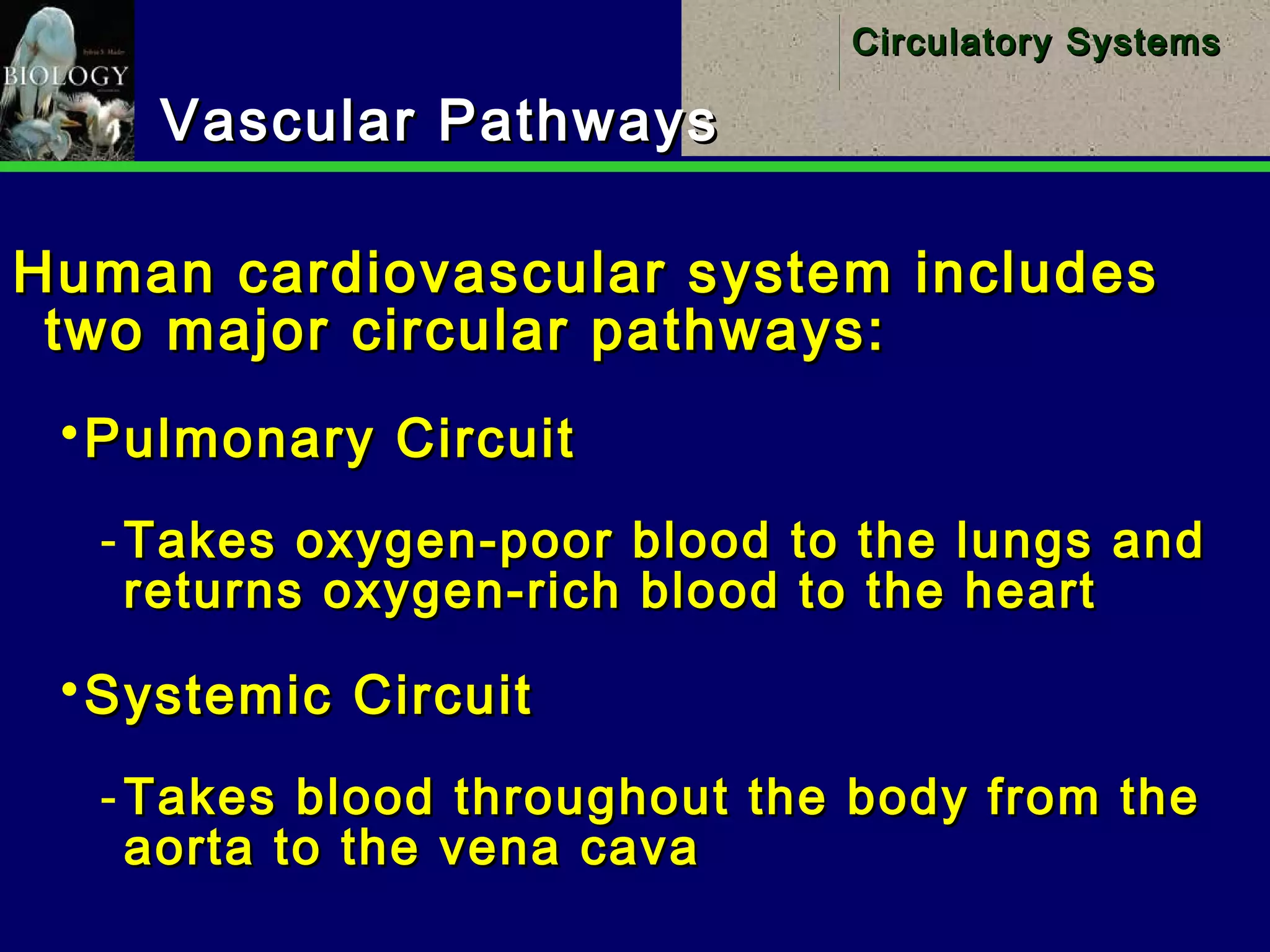
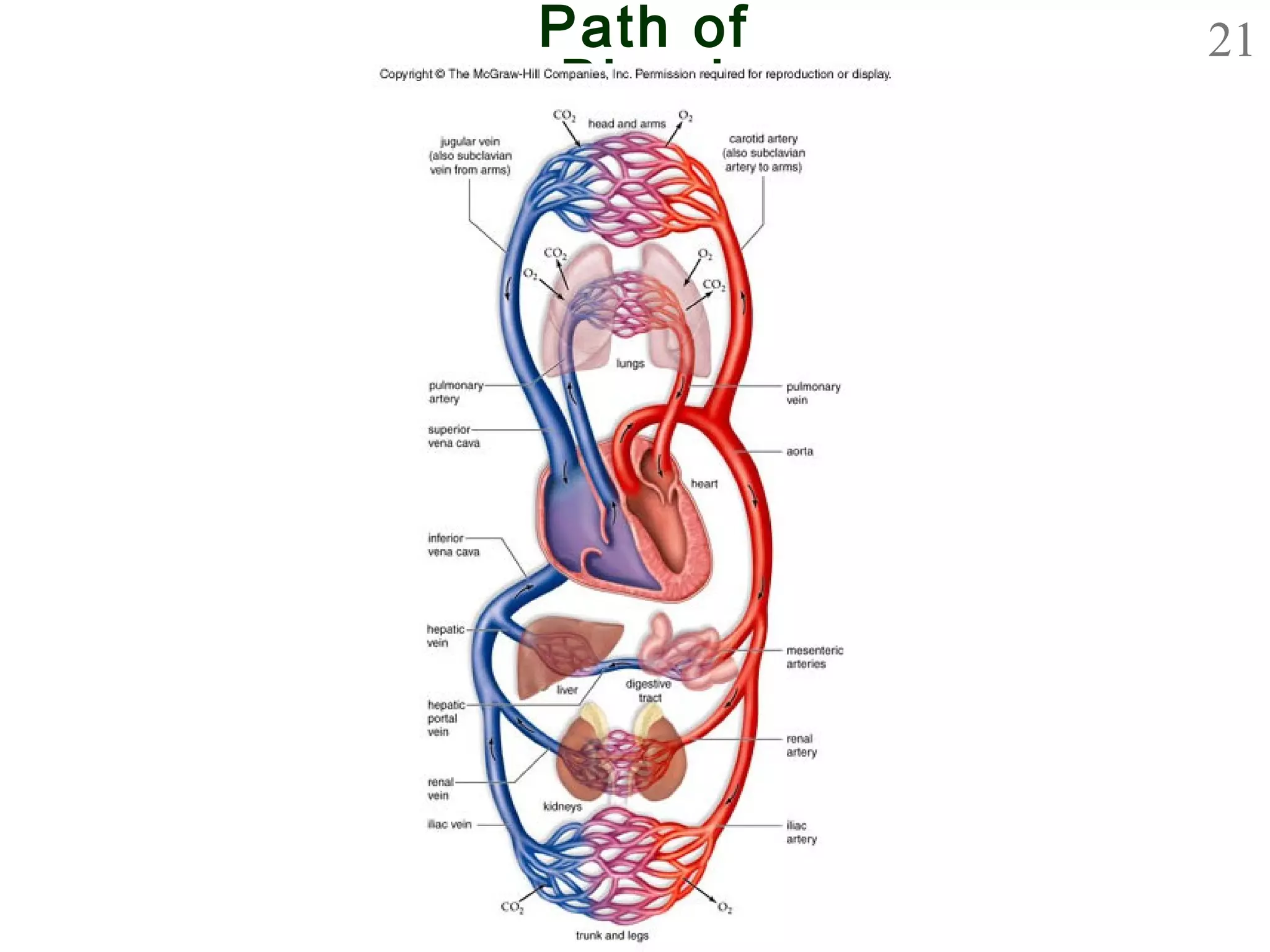
Vascular PathwaysVascular Pathways
Human cardiovascular system includesHuman cardiovascular system includes
two major circular pathways:two major circular pathways:
Pulmonary CircuitPulmonary Circuit
­ Takes oxygen-poor blood to the lungs andTakes oxygen-poor blood to the lungs and
returns oxygen-rich blood to the heartreturns oxygen-rich blood to the heart
Systemic CircuitSystemic Circuit
­ Takes blood throughout the body from theTakes blood throughout the body from the
aorta to the vena cavaaorta to the vena cava
21Path of
Blood
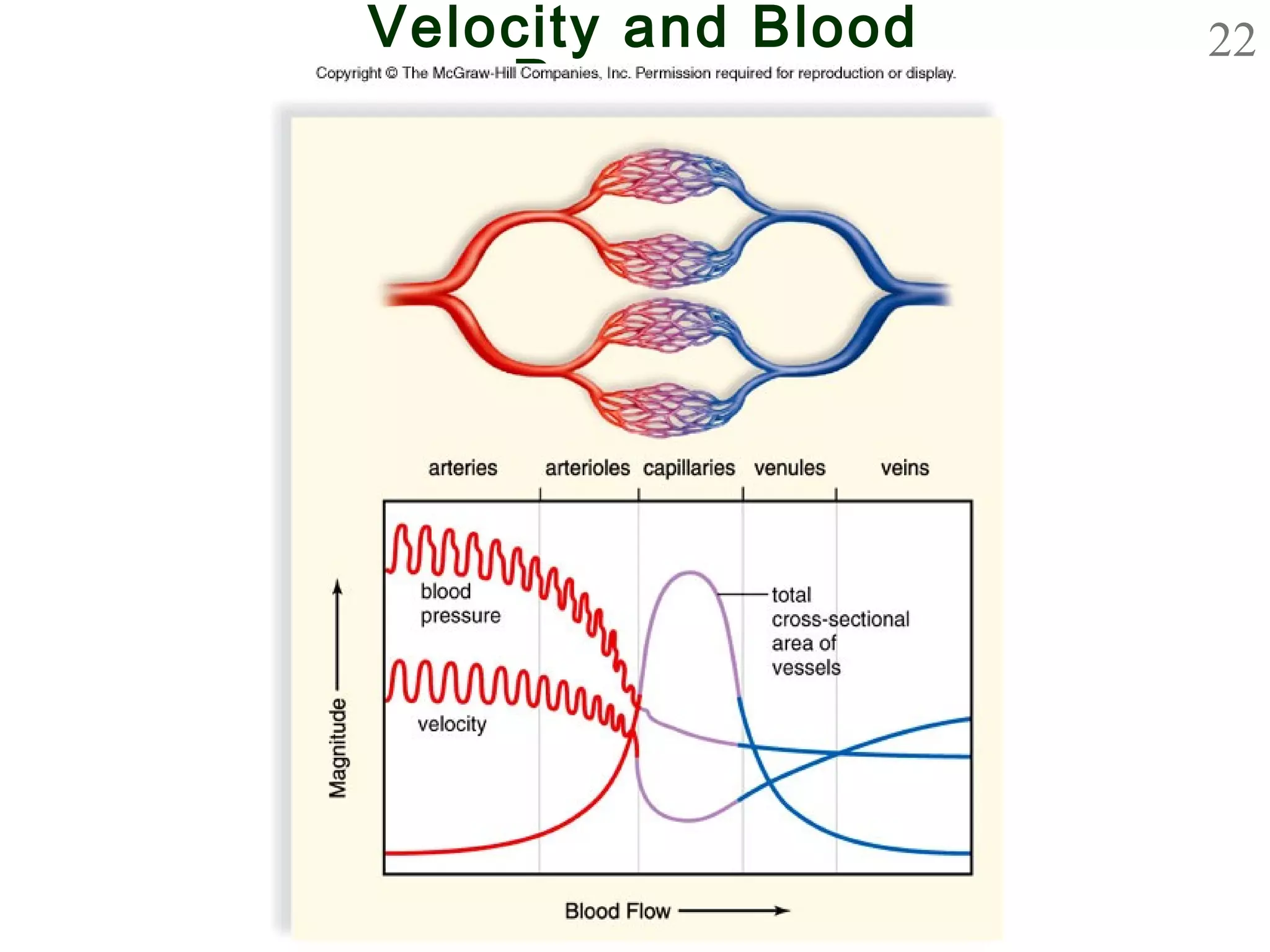
22Velocity and Blood
Pressure
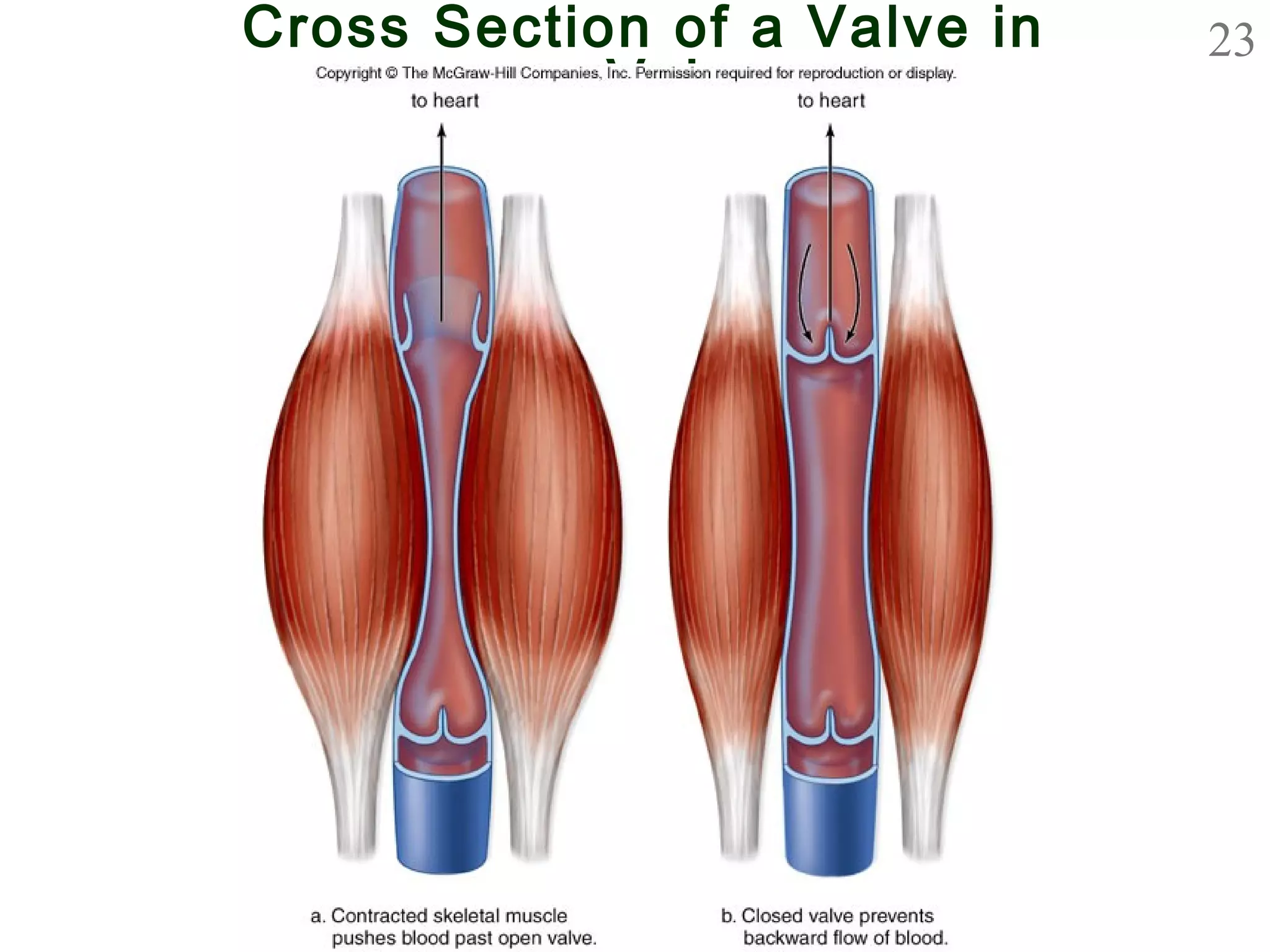
23Cross Section of a Valve in
a Vein
24
Circulatory SystemsCirculatory Systems
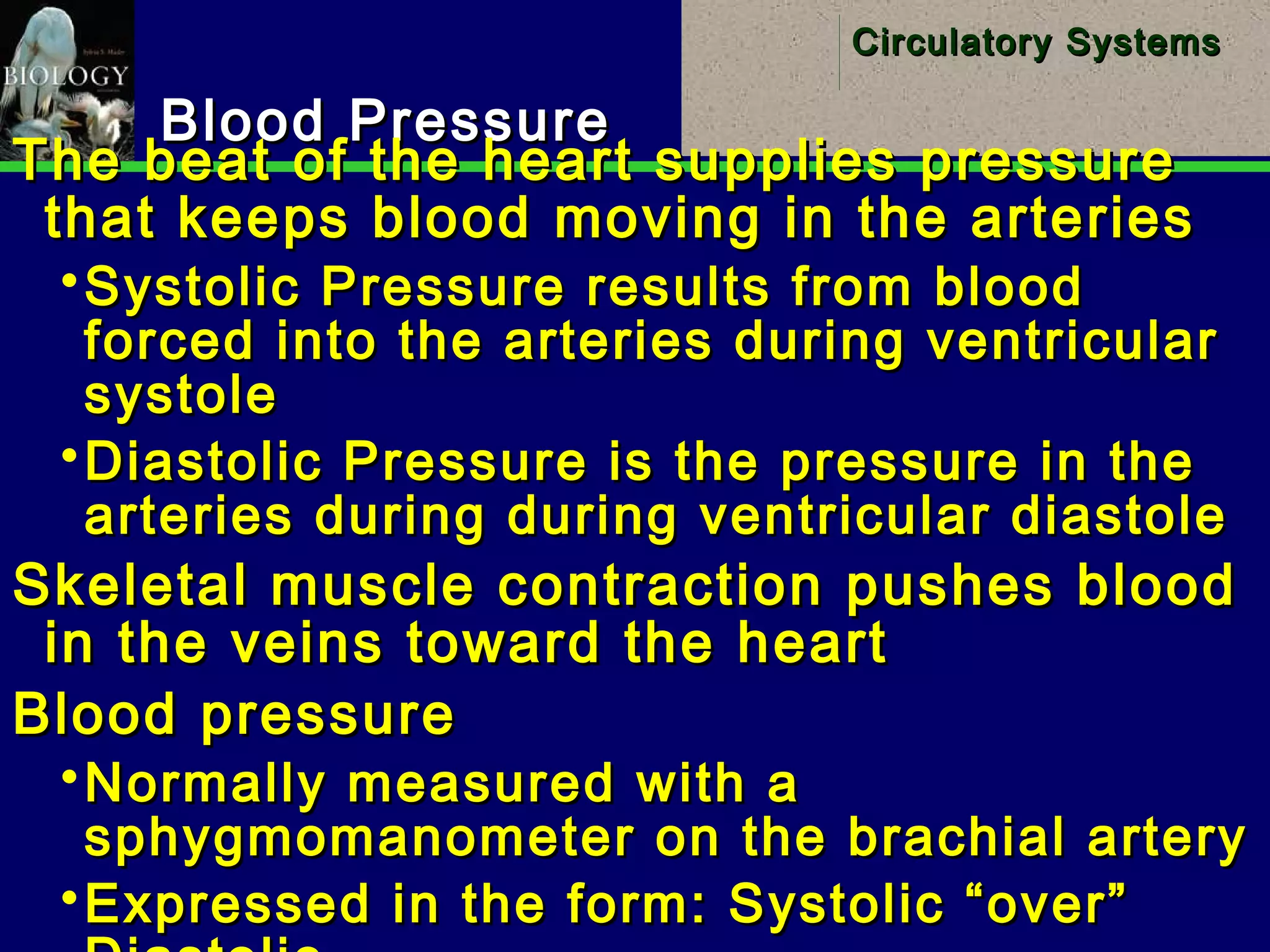
Blood PressureBlood Pressure
The beat of the heart supplies pressureThe beat of the heart supplies pressure
that keeps blood moving in the arteriesthat keeps blood moving in the arteries
Systolic Pressure results from bloodSystolic Pressure results from blood
forced into the arteries during ventricularforced into the arteries during ventricular
systolesystole
Diastolic Pressure is the pressure in theDiastolic Pressure is the pressure in the
arteries during during ventricular diastolearteries during during ventricular diastole
Skeletal muscle contraction pushes bloodSkeletal muscle contraction pushes blood
in the veins toward the heartin the veins toward the heart
Blood pressureBlood pressure
Normally measured with aNormally measured with a
sphygmomanometer on the brachial arterysphygmomanometer on the brachial artery
Expressed in the form: Systolic “over”Expressed in the form: Systolic “over”
25
Circulatory SystemsCirculatory Systems
Cardiovascular DisordersCardiovascular Disorders
Hypertension - High blood pressureHypertension - High blood pressure
Atherosclerosis - Accumulation of fattyAtherosclerosis - Accumulation of fatty
materials in inner linings of arteriesmaterials in inner linings of arteries
Stroke - Cranial arteriole bursts or isStroke - Cranial arteriole bursts or is
blocked by an embolusblocked by an embolus
Heart attack – (Myocardial infarction)Heart attack – (Myocardial infarction)
Coronary artery becomes partiallyCoronary artery becomes partially
blockedblocked
Angina pectoris – Painful squeezingAngina pectoris – Painful squeezing
sensation from myocardial oxygensensation from myocardial oxygen
26
Circulatory SystemsCirculatory Systems
Blood:Blood:
Homeostasis FunctionsHomeostasis Functions
Transports substances to and fromTransports substances to and from
capillaries for exchange with tissue fluidcapillaries for exchange with tissue fluid
Guards against pathogen invasionGuards against pathogen invasion
Regulates body temperatureRegulates body temperature
Buffers body pHBuffers body pH
Maintain osmotic pressureMaintain osmotic pressure
Clots prevent blood/fluid lossClots prevent blood/fluid loss
27
Circulatory SystemsCirculatory Systems
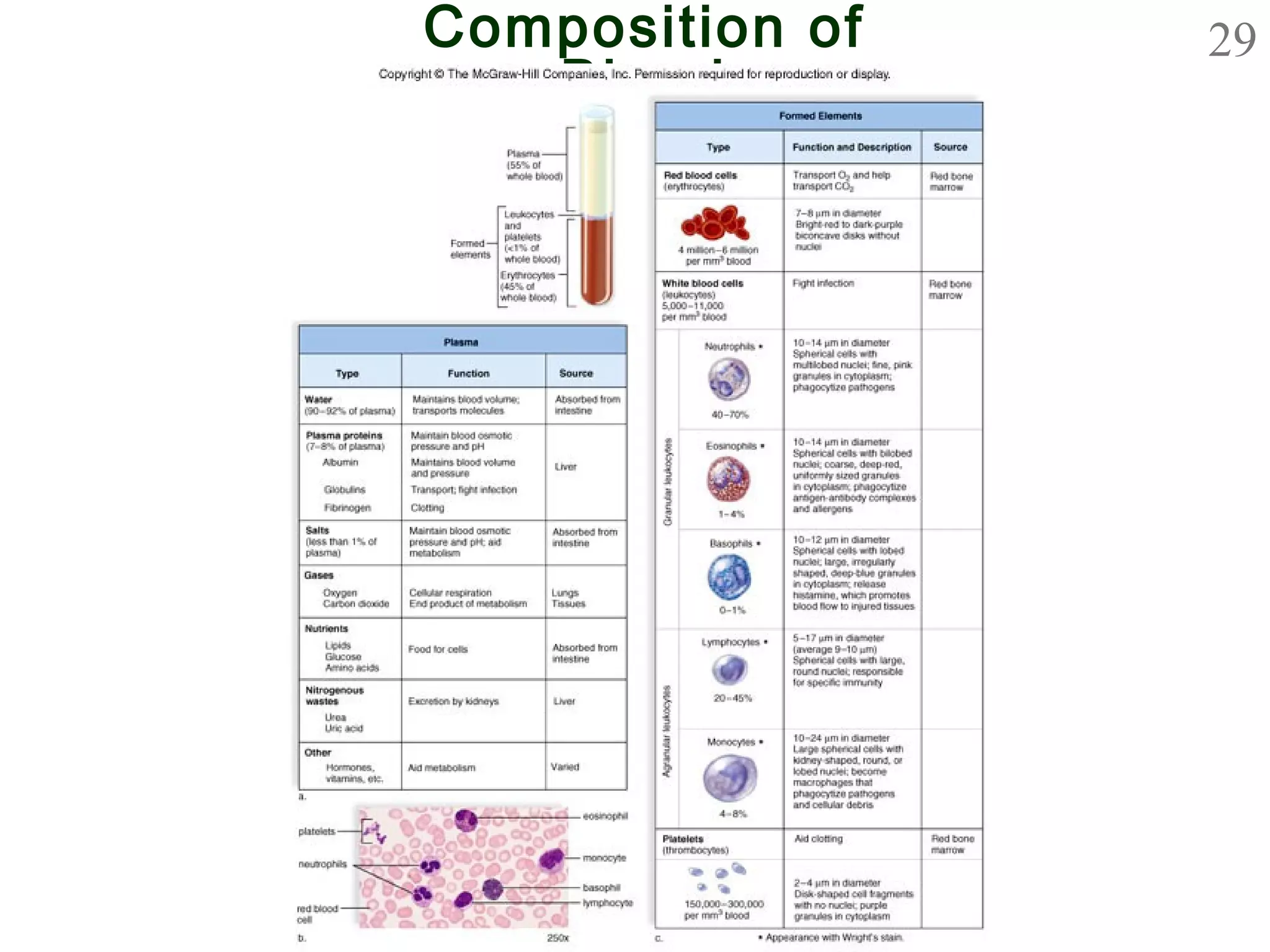
Red Blood CellsRed Blood Cells
Small, biconcave disksSmall, biconcave disks
Lack a nucleus and contain hemoglobinLack a nucleus and contain hemoglobin
Hemoglobin containsHemoglobin contains
­ Four globin protein chainsFour globin protein chains
­ Each associated with an iron-containingEach associated with an iron-containing
hemeheme
­ Manufactured continuously in bone marrowManufactured continuously in bone marrow
of skull, ribs, vertebrae, and ends of longof skull, ribs, vertebrae, and ends of long
bonesbones
28
Circulatory SystemsCirculatory Systems
White Blood CellsWhite Blood Cells
Most types larger than red blood cellsMost types larger than red blood cells
Contain a nucleus and lack hemoglobinContain a nucleus and lack hemoglobin
Important in inflammatory responseImportant in inflammatory response
Neutrophils enter tissue fluid andNeutrophils enter tissue fluid and
phagocytize foreign materialphagocytize foreign material
Lymphocytes (T Cells) attack infectedLymphocytes (T Cells) attack infected
cellscells
Antigens cause body to produceAntigens cause body to produce
antibodiesantibodies
29Composition of
Blood
30
Circulatory SystemsCirculatory Systems
PlateletsPlatelets
PlateletsPlatelets
Result from fragmentation ofResult from fragmentation of
megakaryocytesmegakaryocytes
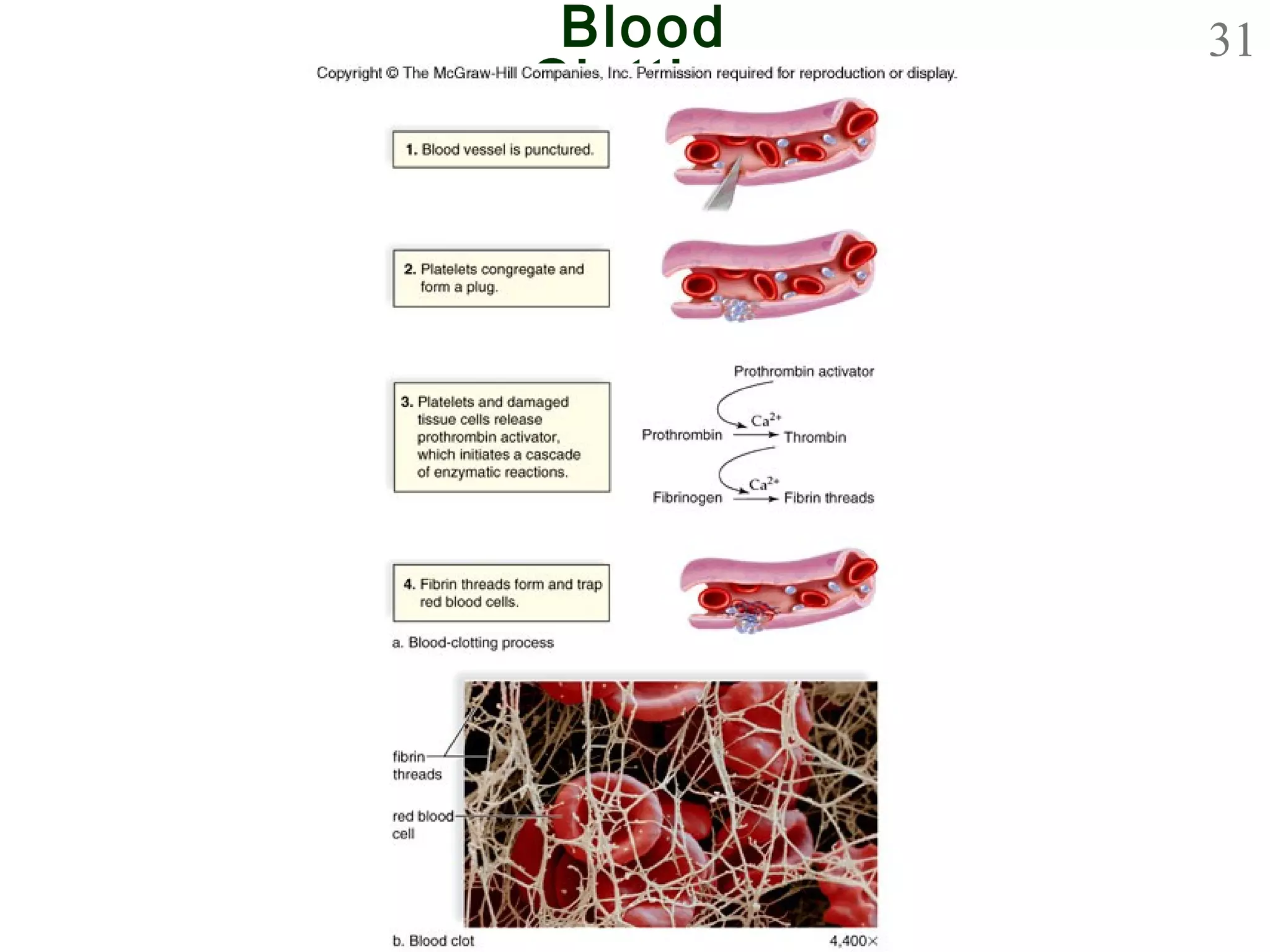
Involved in coagulationInvolved in coagulation
Blood clot consists of:Blood clot consists of:
PlateletsPlatelets
Red blood cellsRed blood cells
All entangled within fibrin threadsAll entangled within fibrin threads
31Blood
Clotting
32
Circulatory SystemsCirculatory Systems
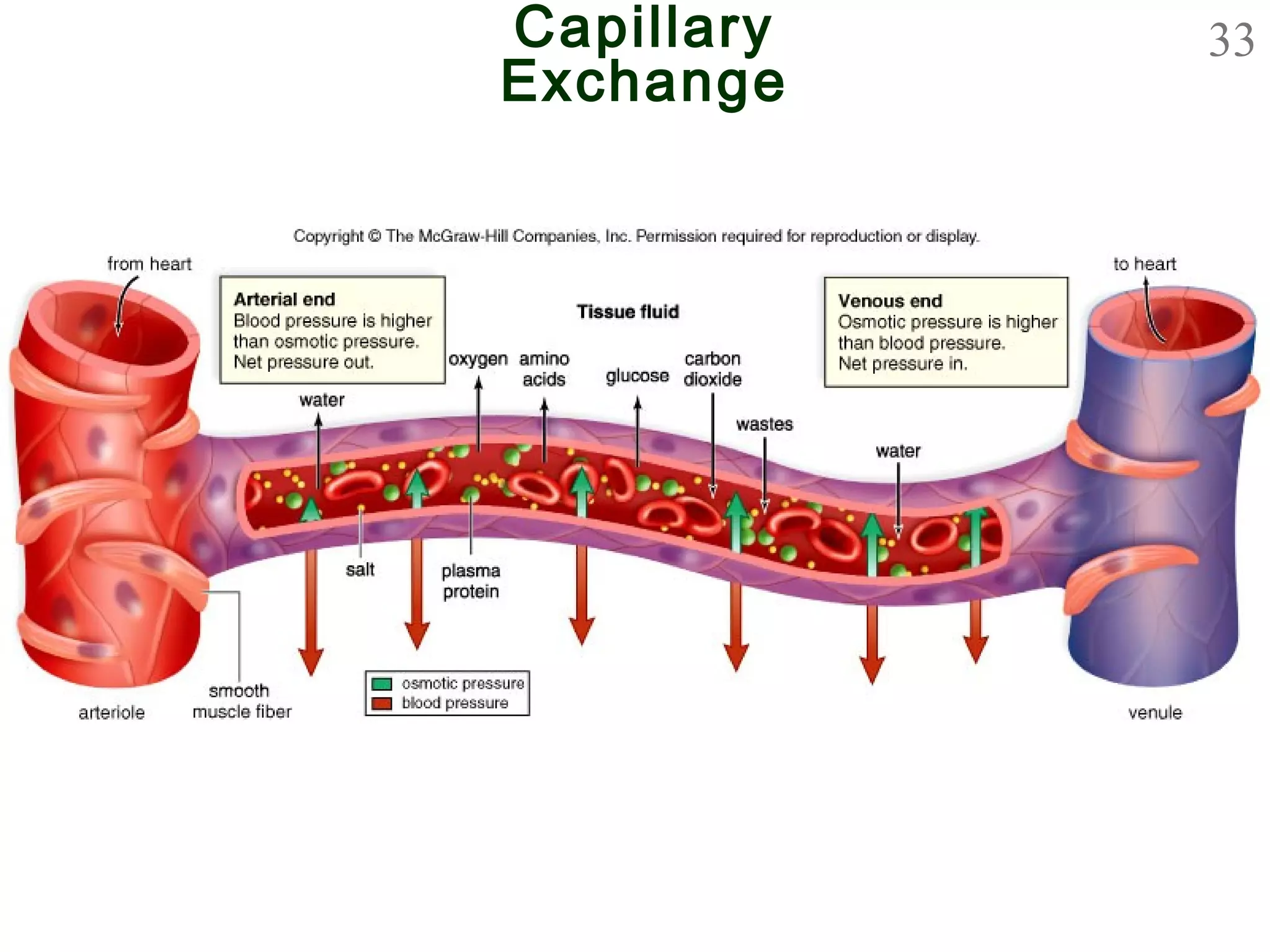
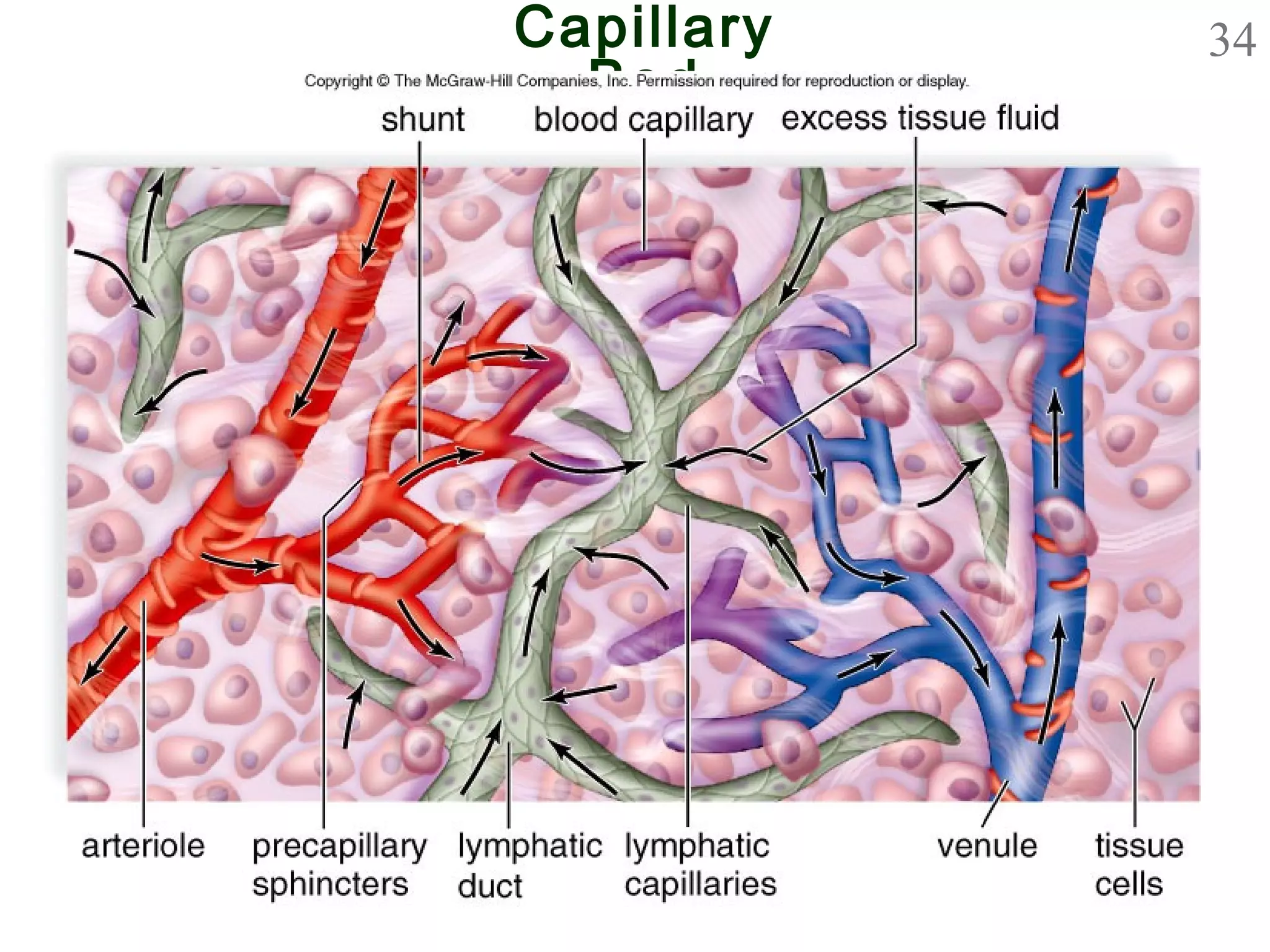
Capillary ExchangeCapillary Exchange
Capillaries very narrow – Tiny RBCs mustCapillaries very narrow – Tiny RBCs must
go through single filego through single file
Wall of capillaries very thin to facilitateWall of capillaries very thin to facilitate
diffusion of nutrients, gasses and wastesdiffusion of nutrients, gasses and wastes
Oxygen and nutrients exit a capillary nearOxygen and nutrients exit a capillary near
the arterial endthe arterial end
Carbon dioxide and waste moleculesCarbon dioxide and waste molecules
enter a capillary near the venous endenter a capillary near the venous end
33Capillary
Exchange
34Capillary
Bed
35
Circulatory SystemsCirculatory Systems
ReviewReview
Transport in InvertebratesTransport in Invertebrates
Open versus Closed Circulatory SystemsOpen versus Closed Circulatory Systems
Transport in VertebratesTransport in Vertebrates
Transport in HumansTransport in Humans
HeartbeatHeartbeat
Vascular PathwaysVascular Pathways
Blood PressureBlood Pressure
Cardiovascular DisordersCardiovascular Disorders
BloodBlood
ComponentsComponents
ClottingClotting
Circulatory System
Ending Slide Chapter 34

Circulation and Cardiovascular System

  • 1.
  • 2.
    2 Circulatory SystemsCirculatory Systems OutlineOutline Transportin InvertebratesTransport in Invertebrates Open versus Closed Circulatory SystemsOpen versus Closed Circulatory Systems Transport in VertebratesTransport in Vertebrates Transport in HumansTransport in Humans HeartbeatHeartbeat Vascular PathwaysVascular Pathways Blood PressureBlood Pressure Cardiovascular DisordersCardiovascular Disorders BloodBlood ComponentsComponents ClottingClotting
  • 3.
    3 Circulatory SystemsCirculatory Systems Transportin InvertebratesTransport in Invertebrates Small aquatic animals with no circulatorySmall aquatic animals with no circulatory systemsystem May rely on external water inMay rely on external water in gastrovascular cavity to service cellsgastrovascular cavity to service cells Roundworms and otherRoundworms and other pseudocoelomatespseudocoelomates Use a fluid-filled body cavity as a meansUse a fluid-filled body cavity as a means of transporting substancesof transporting substances Fluid-filled cavity can also act as aFluid-filled cavity can also act as a hydrostatic skeletonhydrostatic skeleton Animals that have a rigid skeletonAnimals that have a rigid skeleton May still rely on body fluids for theMay still rely on body fluids for the purpose of locomotionpurpose of locomotion Bivalves pump hemolymph into the footBivalves pump hemolymph into the foot
  • 4.
    4Aquatic Organisms Without aCirculatory System
  • 5.
    5 Circulatory SystemsCirculatory Systems Openvs. ClosedOpen vs. Closed Invertebrate CirculationInvertebrate Circulation Two types of circulatory fluids:Two types of circulatory fluids:  Blood - contained within blood vesselsBlood - contained within blood vessels  Hemolymph - flows into hemocoelHemolymph - flows into hemocoel Open Circulatory SystemOpen Circulatory System  Heart pumps hemolymph via vesselsHeart pumps hemolymph via vessels  Vessels empty into tissue spacesVessels empty into tissue spaces Closed Circulatory SystemClosed Circulatory System  Heart pumps blood to capillariesHeart pumps blood to capillaries  Gases and materials diffuse to and from nearbyGases and materials diffuse to and from nearby cellscells  Vessels return blood to heart without itVessels return blood to heart without it
  • 6.
    6Open vs. ClosedCirculatory Systems
  • 7.
    7 Circulatory SystemsCirculatory Systems Transportin the VertebratesTransport in the Vertebrates All vertebrates have a closed cardiovascularAll vertebrates have a closed cardiovascular systemsystem Vertebrate heart:Vertebrate heart:  Atrial chamber(s) of heart receive blood fromAtrial chamber(s) of heart receive blood from general circulationgeneral circulation  Ventricle chamber(s) of heart pump blood outVentricle chamber(s) of heart pump blood out through blood vesselsthrough blood vessels Vertebrate vessels:Vertebrate vessels:  Arteries - Carry blood away from heartArteries - Carry blood away from heart  Arterioles – Lead to capillariesArterioles – Lead to capillaries  Capillaries - Exchange materials with tissueCapillaries - Exchange materials with tissue fluidfluid  Venules - Lead to veinsVenules - Lead to veins
  • 8.
  • 9.
  • 10.
    10 Circulatory SystemsCirculatory Systems Comparisonof Circulatory PathwaysComparison of Circulatory Pathways Fish - Blood flows in single loopFish - Blood flows in single loop Single atrium and single ventricleSingle atrium and single ventricle Amphibians - Blood flows in double loopAmphibians - Blood flows in double loop Two atria with single ventricleTwo atria with single ventricle Other vertebrates - Blood flows in aOther vertebrates - Blood flows in a double loopdouble loop Heart divided by septum into separateHeart divided by septum into separate sidessides
  • 11.
    11 Circulatory SystemsCirculatory Systems Transportin HumansTransport in Humans Human HeartHuman Heart Fist-sizedFist-sized Cone-shapedCone-shaped Very muscular organ (special cardiacVery muscular organ (special cardiac fibers)fibers) Lies within a fluid-filled sac (theLies within a fluid-filled sac (the pericardium)pericardium)
  • 12.
    12 Circulatory SystemsCirculatory Systems HumanHeart:Human Heart: Gross AnatomyGross Anatomy Septum separates heart into left & rightSeptum separates heart into left & right halveshalves Each half has two chambersEach half has two chambers Upper two chambers are the atriaUpper two chambers are the atria ­ Thin-walledThin-walled ­ Receive blood from circulationReceive blood from circulation Lower two chambers are the ventriclesLower two chambers are the ventricles ­ Thick-walledThick-walled ­ Pump blood away from heartPump blood away from heart
  • 13.
  • 14.
  • 15.
    15 Circulatory SystemsCirculatory Systems HumanHeart:Human Heart: ValvesValves Valves open and close to control bloodValves open and close to control blood flow through heartflow through heart Atrioventricular valvesAtrioventricular valves ­ TricuspidTricuspid ­ BicuspidBicuspid Semilunar valvesSemilunar valves ­ PulmonaryPulmonary ­ AorticAortic
  • 16.
    16 Circulatory SystemsCirculatory Systems Transportin HumansTransport in Humans Blood returning to heart from systemic circuitBlood returning to heart from systemic circuit  Enters right atriumEnters right atrium  Right atrium pumps through tricuspid valve toRight atrium pumps through tricuspid valve to right ventricleright ventricle  Right ventricle pumps blood through pulmonaryRight ventricle pumps blood through pulmonary valve to the pulmonary circuitvalve to the pulmonary circuit Blood returning to heart from pulmonary circuitBlood returning to heart from pulmonary circuit  Enters left atriumEnters left atrium  Left atrium pumps through mitral valve to leftLeft atrium pumps through mitral valve to left ventricleventricle  Left ventricle pumps blood through aortic valveLeft ventricle pumps blood through aortic valve to the systemic circuitto the systemic circuit Oxygen-poor blood never mixes with oxygen-Oxygen-poor blood never mixes with oxygen- rich blood (in humans)rich blood (in humans)
  • 17.
    17 Circulatory SystemsCirculatory Systems HeartbeatHeartbeat Systole- Contraction of heart chambersSystole - Contraction of heart chambers Diastole - Relaxation of heart chambersDiastole - Relaxation of heart chambers Pulse - Two-part pumping action that takesPulse - Two-part pumping action that takes about a secondabout a second  Blood collects in atria, the atria contractBlood collects in atria, the atria contract ­ Pushes blood through tricuspid and mitral valvesPushes blood through tricuspid and mitral valves into the resting lower ventriclesinto the resting lower ventricles ­ This phase (the longer of the two) is called theThis phase (the longer of the two) is called the diastolediastole  Second part begins when ventricles fillSecond part begins when ventricles fill ­ Ventricles contractVentricles contract ­ This is called systoleThis is called systole  After blood moves into the pulmonary artery andAfter blood moves into the pulmonary artery and aorta, the ventricles relaxaorta, the ventricles relax
  • 18.
  • 19.
    19 Circulatory SystemsCirculatory Systems HeartbeatHeartbeatRhythmiccontraction due to cardiacRhythmic contraction due to cardiac conduction systemconduction system Sinoatrial node (SA) keeps the heartbeatSinoatrial node (SA) keeps the heartbeat regularregular Atrioventricular node (AV) signalsAtrioventricular node (AV) signals ventricles to contract - Purkinje Fibersventricles to contract - Purkinje Fibers Electrocardiogram (ECG)Electrocardiogram (ECG) A recording of electrical changes thatA recording of electrical changes that occurring in myocardium during cardiacoccurring in myocardium during cardiac cyclecycle When SA node triggers an impulse, theWhen SA node triggers an impulse, the
  • 20.
    20 Circulatory SystemsCirculatory Systems VascularPathwaysVascular Pathways Human cardiovascular system includesHuman cardiovascular system includes two major circular pathways:two major circular pathways: Pulmonary CircuitPulmonary Circuit ­ Takes oxygen-poor blood to the lungs andTakes oxygen-poor blood to the lungs and returns oxygen-rich blood to the heartreturns oxygen-rich blood to the heart Systemic CircuitSystemic Circuit ­ Takes blood throughout the body from theTakes blood throughout the body from the aorta to the vena cavaaorta to the vena cava
  • 21.
  • 22.
  • 23.
    23Cross Section ofa Valve in a Vein
  • 24.
    24 Circulatory SystemsCirculatory Systems BloodPressureBlood Pressure The beat of the heart supplies pressureThe beat of the heart supplies pressure that keeps blood moving in the arteriesthat keeps blood moving in the arteries Systolic Pressure results from bloodSystolic Pressure results from blood forced into the arteries during ventricularforced into the arteries during ventricular systolesystole Diastolic Pressure is the pressure in theDiastolic Pressure is the pressure in the arteries during during ventricular diastolearteries during during ventricular diastole Skeletal muscle contraction pushes bloodSkeletal muscle contraction pushes blood in the veins toward the heartin the veins toward the heart Blood pressureBlood pressure Normally measured with aNormally measured with a sphygmomanometer on the brachial arterysphygmomanometer on the brachial artery Expressed in the form: Systolic “over”Expressed in the form: Systolic “over”
  • 25.
    25 Circulatory SystemsCirculatory Systems CardiovascularDisordersCardiovascular Disorders Hypertension - High blood pressureHypertension - High blood pressure Atherosclerosis - Accumulation of fattyAtherosclerosis - Accumulation of fatty materials in inner linings of arteriesmaterials in inner linings of arteries Stroke - Cranial arteriole bursts or isStroke - Cranial arteriole bursts or is blocked by an embolusblocked by an embolus Heart attack – (Myocardial infarction)Heart attack – (Myocardial infarction) Coronary artery becomes partiallyCoronary artery becomes partially blockedblocked Angina pectoris – Painful squeezingAngina pectoris – Painful squeezing sensation from myocardial oxygensensation from myocardial oxygen
  • 26.
    26 Circulatory SystemsCirculatory Systems Blood:Blood: HomeostasisFunctionsHomeostasis Functions Transports substances to and fromTransports substances to and from capillaries for exchange with tissue fluidcapillaries for exchange with tissue fluid Guards against pathogen invasionGuards against pathogen invasion Regulates body temperatureRegulates body temperature Buffers body pHBuffers body pH Maintain osmotic pressureMaintain osmotic pressure Clots prevent blood/fluid lossClots prevent blood/fluid loss
  • 27.
    27 Circulatory SystemsCirculatory Systems RedBlood CellsRed Blood Cells Small, biconcave disksSmall, biconcave disks Lack a nucleus and contain hemoglobinLack a nucleus and contain hemoglobin Hemoglobin containsHemoglobin contains ­ Four globin protein chainsFour globin protein chains ­ Each associated with an iron-containingEach associated with an iron-containing hemeheme ­ Manufactured continuously in bone marrowManufactured continuously in bone marrow of skull, ribs, vertebrae, and ends of longof skull, ribs, vertebrae, and ends of long bonesbones
  • 28.
    28 Circulatory SystemsCirculatory Systems WhiteBlood CellsWhite Blood Cells Most types larger than red blood cellsMost types larger than red blood cells Contain a nucleus and lack hemoglobinContain a nucleus and lack hemoglobin Important in inflammatory responseImportant in inflammatory response Neutrophils enter tissue fluid andNeutrophils enter tissue fluid and phagocytize foreign materialphagocytize foreign material Lymphocytes (T Cells) attack infectedLymphocytes (T Cells) attack infected cellscells Antigens cause body to produceAntigens cause body to produce antibodiesantibodies
  • 29.
  • 30.
    30 Circulatory SystemsCirculatory Systems PlateletsPlatelets PlateletsPlatelets Resultfrom fragmentation ofResult from fragmentation of megakaryocytesmegakaryocytes Involved in coagulationInvolved in coagulation Blood clot consists of:Blood clot consists of: PlateletsPlatelets Red blood cellsRed blood cells All entangled within fibrin threadsAll entangled within fibrin threads
  • 31.
  • 32.
    32 Circulatory SystemsCirculatory Systems CapillaryExchangeCapillary Exchange Capillaries very narrow – Tiny RBCs mustCapillaries very narrow – Tiny RBCs must go through single filego through single file Wall of capillaries very thin to facilitateWall of capillaries very thin to facilitate diffusion of nutrients, gasses and wastesdiffusion of nutrients, gasses and wastes Oxygen and nutrients exit a capillary nearOxygen and nutrients exit a capillary near the arterial endthe arterial end Carbon dioxide and waste moleculesCarbon dioxide and waste molecules enter a capillary near the venous endenter a capillary near the venous end
  • 33.
  • 34.
  • 35.
    35 Circulatory SystemsCirculatory Systems ReviewReview Transportin InvertebratesTransport in Invertebrates Open versus Closed Circulatory SystemsOpen versus Closed Circulatory Systems Transport in VertebratesTransport in Vertebrates Transport in HumansTransport in Humans HeartbeatHeartbeat Vascular PathwaysVascular Pathways Blood PressureBlood Pressure Cardiovascular DisordersCardiovascular Disorders BloodBlood ComponentsComponents ClottingClotting
  • 36.