Emma Mc Conologue
Cinematography (Shot Types) and Examples
ShotTypes/Movement:
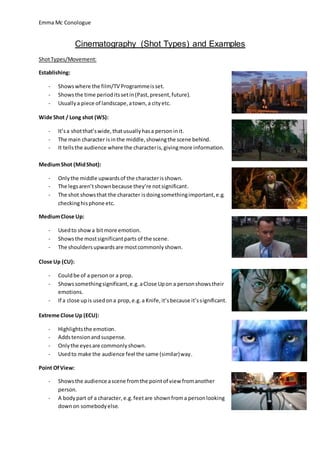
Establishing:
- Showswhere the film/TV Programmeisset.
- Showsthe time perioditssetin(Past,present,future).
- Usuallya piece of landscape,atown,a cityetc.
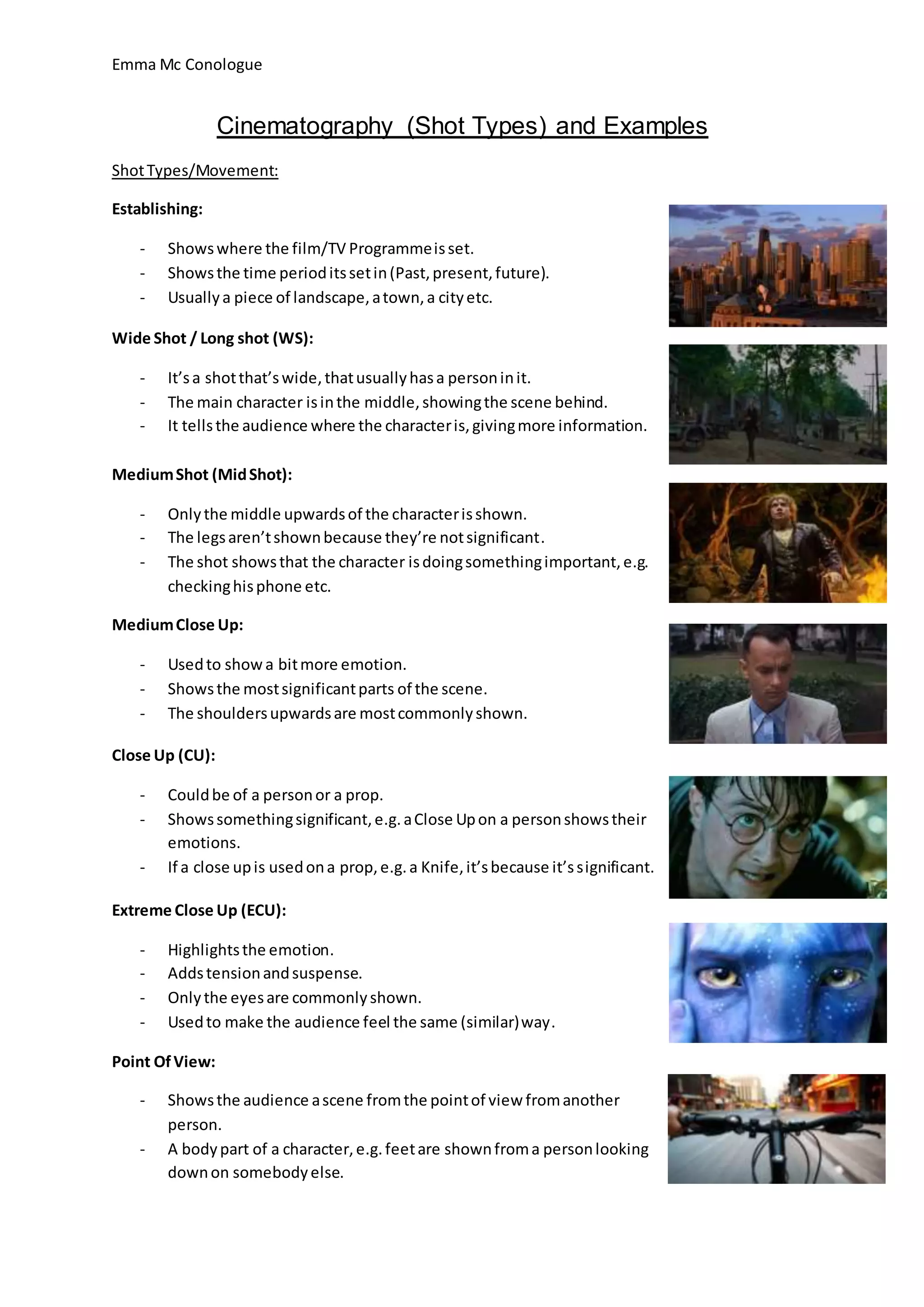
Wide Shot / Long shot (WS):
- It’sa shotthat’swide,thatusuallyhasa personinit.
- The main character isinthe middle,showingthe scene behind.
- It tellsthe audience where the characteris,givingmore information.
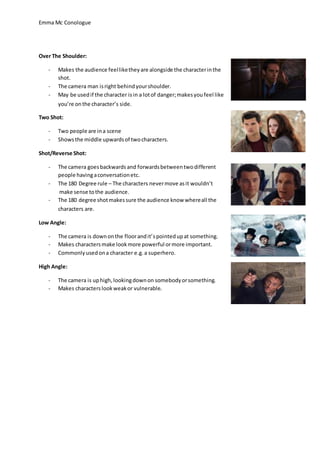
MediumShot (MidShot):
- Onlythe middle upwardsof the characterisshown.
- The legsaren’tshownbecause they’re notsignificant.
- The shot showsthat the character isdoingsomethingimportant,e.g.
checkinghisphone etc.
MediumClose Up:
- Usedto showa bitmore emotion.
- Showsthe mostsignificantparts of the scene.
- The shouldersupwardsare mostcommonlyshown.
Close Up (CU):
- Couldbe of a personor a prop.
- Showssomethingsignificant,e.g.aClose Upon a personshowstheir
emotions.
- If a close upis usedona prop,e.g.a Knife,it’sbecause it’ssignificant.
Extreme Close Up (ECU):
- Highlightsthe emotion.
- Addstensionandsuspense.
- Onlythe eyesare commonlyshown.
- Usedto make the audience feel the same (similar)way.
Point OfView:
- Showsthe audience ascene fromthe pointof view fromanother
person.
- A bodypart of a character,e.g.feetare shownfroma personlooking
downon somebodyelse.
Emma Mc Conologue
Over The Shoulder:
- Makes the audience feelliketheyare alongside the characterinthe
shot.
- The camera man isright behindyourshoulder.
- May be usedif the character isin a lotof danger;makesyoufeel like
you’re onthe character’s side.
Two Shot:
- Two people are ina scene
- Showsthe middle upwardsof twocharacters.
Shot/Reverse Shot:
- The camera goesbackwardsand forwardsbetweentwodifferent
people havingaconversationetc.
- The 180 Degree rule – The characters nevermove asit wouldn’t
make sense tothe audience.
- The 180 degree shotmakessure the audience know whereall the
characters are.
Low Angle:
- The camera is downonthe floorandit’spointedupat something.
- Makes charactersmake lookmore powerful ormore important.
- Commonlyusedona character e.g.a superhero.
High Angle:
- The camera is uphigh,lookingdownon somebodyorsomething.
- Makes characterslookweakor vulnerable.

Cinematography - shot types

  • 1.
    Emma Mc Conologue Cinematography(Shot Types) and Examples ShotTypes/Movement: Establishing: - Showswhere the film/TV Programmeisset. - Showsthe time perioditssetin(Past,present,future). - Usuallya piece of landscape,atown,a cityetc. Wide Shot / Long shot (WS): - It’sa shotthat’swide,thatusuallyhasa personinit. - The main character isinthe middle,showingthe scene behind. - It tellsthe audience where the characteris,givingmore information. MediumShot (MidShot): - Onlythe middle upwardsof the characterisshown. - The legsaren’tshownbecause they’re notsignificant. - The shot showsthat the character isdoingsomethingimportant,e.g. checkinghisphone etc. MediumClose Up: - Usedto showa bitmore emotion. - Showsthe mostsignificantparts of the scene. - The shouldersupwardsare mostcommonlyshown. Close Up (CU): - Couldbe of a personor a prop. - Showssomethingsignificant,e.g.aClose Upon a personshowstheir emotions. - If a close upis usedona prop,e.g.a Knife,it’sbecause it’ssignificant. Extreme Close Up (ECU): - Highlightsthe emotion. - Addstensionandsuspense. - Onlythe eyesare commonlyshown. - Usedto make the audience feel the same (similar)way. Point OfView: - Showsthe audience ascene fromthe pointof view fromanother person. - A bodypart of a character,e.g.feetare shownfroma personlooking downon somebodyelse.
  • 2.
    Emma Mc Conologue OverThe Shoulder: - Makes the audience feelliketheyare alongside the characterinthe shot. - The camera man isright behindyourshoulder. - May be usedif the character isin a lotof danger;makesyoufeel like you’re onthe character’s side. Two Shot: - Two people are ina scene - Showsthe middle upwardsof twocharacters. Shot/Reverse Shot: - The camera goesbackwardsand forwardsbetweentwodifferent people havingaconversationetc. - The 180 Degree rule – The characters nevermove asit wouldn’t make sense tothe audience. - The 180 degree shotmakessure the audience know whereall the characters are. Low Angle: - The camera is downonthe floorandit’spointedupat something. - Makes charactersmake lookmore powerful ormore important. - Commonlyusedona character e.g.a superhero. High Angle: - The camera is uphigh,lookingdownon somebodyorsomething. - Makes characterslookweakor vulnerable.