NARRATIVE PATTERNSBY SIAN LYNES
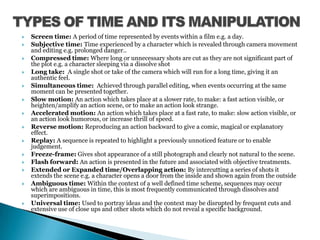
TYPES OF TIME AND ITS MANIPULATIONScreen time: A period of time represented by events within a film e.g. a day.Subjective time: Time experienced by a character which is revealed through camera movement and editing e.g. prolonged danger..Compressed time: Where long or unnecessary shots are cut as they are not significant part of the plot e.g. a character sleeping via a dissolve shotLong take:  A single shot or take of the camera which will run for a long time, giving it an authentic feel.Simultaneous time:  Achieved through parallel editing, when events occurring at the same moment can be presented together.Slow motion: An action which takes place at a slower rate, to make: a fast action visible, or heighten/amplify an action scene, or to make an action look strange.Accelerated motion: An action which takes place at a fast rate, to make: slow action visible, or an action look humorous, or increase thrill of speed.Reverse motion: Reproducing an action backward to give a comic, magical or explanatory effect.Replay: A sequence is repeated to highlight a previously unnoticed feature or to enable judgement.Freeze-frame: Gives shot appearance of a still photograph and clearly not natural to the scene.Flash forward: An action is presented in the future and associated with objective treatments.Extended or Expanded time/Overlapping action: By intercutting a series of shots it extends the scene e.g. a character opens a door from the inside and shown again from the outsideAmbiguous time: Within the context of a well defined time scheme, sequences may occur which are ambiguous in time, this is most frequently communicated through dissolves and superimpositions.Universal time: Used to portray ideas and the context may be disrupted by frequent cuts and extensive use of close ups and other shots which do not reveal a specific background.
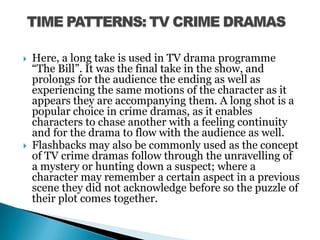
Here, a long take is used in TV drama programme “The Bill”. It was the final take in the show, and prolongs for the audience the ending as well as experiencing the same motions of the character as it appears they are accompanying them. A long shot is a popular choice in crime dramas, as it enables characters to chase another with a feeling continuity and for the drama to flow with the audience as well. Flashbacks may also be commonly used as the concept of TV crime dramas follow through the unravelling of a mystery or hunting down a suspect; where a character may remember a certain aspect in a previous scene they did not acknowledge before so the puzzle of their plot comes together. TIME PATTERNS: TV CRIME DRAMAS
In period dramas, for example Lark Rise to Candleford, the most popular manipulation of time is screen time. The plot normally consists of the drama evolving through the days and weeks of show, just like the characters would in their time. It would be a rarity to manipulate time other than subjective, compressed or screen time; as these particular adds to the authenticity of the time and the fact the audience can also unravel the plot alongside the characters.  TIME PATTERNS: TV PERIOD DRAMA
In family drama, the plot is always more dramatic and action filled. The show ‘Pushing Daisies’ was a uniquely shot drama and in this final clip of the series it flashes back to the first episode to remind the audience of what had previously occurred to have reached that particular moment. Simultaneous time is combined with a long shot (that is CGI based) to link up other significant characters in the story to how their lives would change at that particular moment along with the main characters when their final fate is revealed. This unites the plot into a content ending, so the audience know how all character’s fates end with and thus the pieces of the plot finally come together.TIME PATTERNS: FAMILY DRAMA
In TV dramas relationships between characters can be portrayed differently as their bond develops. In this Gavin and Stacey shot we see that compressed time is used from inside the club to outside so the audience do not have to follow every movement the characters do but have a relative idea of what has happened (as the non inclusive shot is not significant to both of the character’s development of relationship.) Long takes are also used so the audience can follow the character’s conversation and understand their perspective on one another. TIME PATTERNS: RELATIONSHIPS
Most famously, in TV drama ‘24’, it titles synchronises with a timer and allows a simultaneous time to use parallel editing to show the actions of characters at the same time. This is used similarly in ‘Heroes’ where characters are shown in cross cutting where they are at a particular time so the audience gets a sense of timing of each character and how long it will be until a resolution is held. TIME PATTERNS: POST-MODERN

Narrative patterns

  • 1.
  • 2.
    TYPES OF TIMEAND ITS MANIPULATIONScreen time: A period of time represented by events within a film e.g. a day.Subjective time: Time experienced by a character which is revealed through camera movement and editing e.g. prolonged danger..Compressed time: Where long or unnecessary shots are cut as they are not significant part of the plot e.g. a character sleeping via a dissolve shotLong take: A single shot or take of the camera which will run for a long time, giving it an authentic feel.Simultaneous time: Achieved through parallel editing, when events occurring at the same moment can be presented together.Slow motion: An action which takes place at a slower rate, to make: a fast action visible, or heighten/amplify an action scene, or to make an action look strange.Accelerated motion: An action which takes place at a fast rate, to make: slow action visible, or an action look humorous, or increase thrill of speed.Reverse motion: Reproducing an action backward to give a comic, magical or explanatory effect.Replay: A sequence is repeated to highlight a previously unnoticed feature or to enable judgement.Freeze-frame: Gives shot appearance of a still photograph and clearly not natural to the scene.Flash forward: An action is presented in the future and associated with objective treatments.Extended or Expanded time/Overlapping action: By intercutting a series of shots it extends the scene e.g. a character opens a door from the inside and shown again from the outsideAmbiguous time: Within the context of a well defined time scheme, sequences may occur which are ambiguous in time, this is most frequently communicated through dissolves and superimpositions.Universal time: Used to portray ideas and the context may be disrupted by frequent cuts and extensive use of close ups and other shots which do not reveal a specific background.
  • 3.
    Here, a longtake is used in TV drama programme “The Bill”. It was the final take in the show, and prolongs for the audience the ending as well as experiencing the same motions of the character as it appears they are accompanying them. A long shot is a popular choice in crime dramas, as it enables characters to chase another with a feeling continuity and for the drama to flow with the audience as well. Flashbacks may also be commonly used as the concept of TV crime dramas follow through the unravelling of a mystery or hunting down a suspect; where a character may remember a certain aspect in a previous scene they did not acknowledge before so the puzzle of their plot comes together. TIME PATTERNS: TV CRIME DRAMAS
  • 4.
    In period dramas,for example Lark Rise to Candleford, the most popular manipulation of time is screen time. The plot normally consists of the drama evolving through the days and weeks of show, just like the characters would in their time. It would be a rarity to manipulate time other than subjective, compressed or screen time; as these particular adds to the authenticity of the time and the fact the audience can also unravel the plot alongside the characters. TIME PATTERNS: TV PERIOD DRAMA
  • 5.
    In family drama,the plot is always more dramatic and action filled. The show ‘Pushing Daisies’ was a uniquely shot drama and in this final clip of the series it flashes back to the first episode to remind the audience of what had previously occurred to have reached that particular moment. Simultaneous time is combined with a long shot (that is CGI based) to link up other significant characters in the story to how their lives would change at that particular moment along with the main characters when their final fate is revealed. This unites the plot into a content ending, so the audience know how all character’s fates end with and thus the pieces of the plot finally come together.TIME PATTERNS: FAMILY DRAMA
  • 6.
    In TV dramasrelationships between characters can be portrayed differently as their bond develops. In this Gavin and Stacey shot we see that compressed time is used from inside the club to outside so the audience do not have to follow every movement the characters do but have a relative idea of what has happened (as the non inclusive shot is not significant to both of the character’s development of relationship.) Long takes are also used so the audience can follow the character’s conversation and understand their perspective on one another. TIME PATTERNS: RELATIONSHIPS
  • 7.
    Most famously, inTV drama ‘24’, it titles synchronises with a timer and allows a simultaneous time to use parallel editing to show the actions of characters at the same time. This is used similarly in ‘Heroes’ where characters are shown in cross cutting where they are at a particular time so the audience gets a sense of timing of each character and how long it will be until a resolution is held. TIME PATTERNS: POST-MODERN