Cinematography
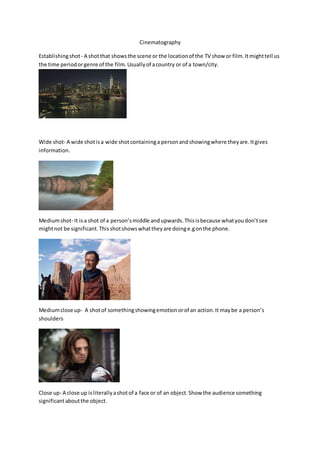
- Establishing Shot – tells the audiencethe location,genre and the time frame.
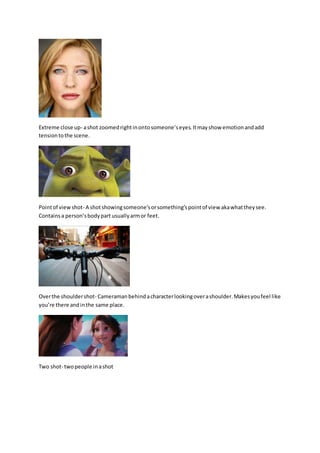
- Wide Shot – Involves a person and the scene to show where the character is.
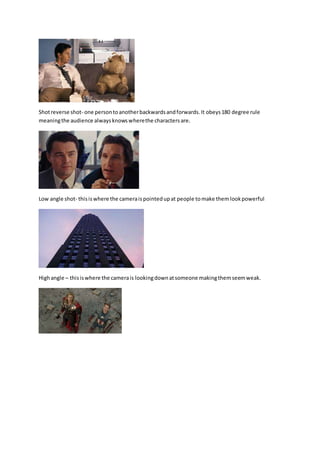
- Medium Shot/Mid Shot – Shows the top half of a person’s body. Usually middle
upwards.
- Medium Close Up – Shows face and shoulders froma slightdistance.
- Close Up – Shows a face or an object which is closeto the camera. Shot of
significance.
- Extreme Close Up – Of a certain body part e.g. eyes to showemotion and create
tension.
- Point of view shot – From another actor ‘eyes’. Seeing it from another
perspective
- Over the shoulder shot - Shot is recorded from over the actors shoulder.
- Two shot - Two people in one shot
- Shot Reverse Shot – From one person to the other, flip between people in the camera view. Has to
obey the 180 degree rule.
- Low Angle Shot – A shot taken from below to showimportance/power
- High Angle Shot – Shot taken from above to show less power and hierarchy.
Cinematography and Shots

Cinematography and Shots

  • 1.
    Cinematography - Establishing Shot– tells the audiencethe location,genre and the time frame. - Wide Shot – Involves a person and the scene to show where the character is. - Medium Shot/Mid Shot – Shows the top half of a person’s body. Usually middle upwards. - Medium Close Up – Shows face and shoulders froma slightdistance. - Close Up – Shows a face or an object which is closeto the camera. Shot of significance. - Extreme Close Up – Of a certain body part e.g. eyes to showemotion and create tension. - Point of view shot – From another actor ‘eyes’. Seeing it from another perspective - Over the shoulder shot - Shot is recorded from over the actors shoulder. - Two shot - Two people in one shot - Shot Reverse Shot – From one person to the other, flip between people in the camera view. Has to obey the 180 degree rule. - Low Angle Shot – A shot taken from below to showimportance/power - High Angle Shot – Shot taken from above to show less power and hierarchy.