Cinematography
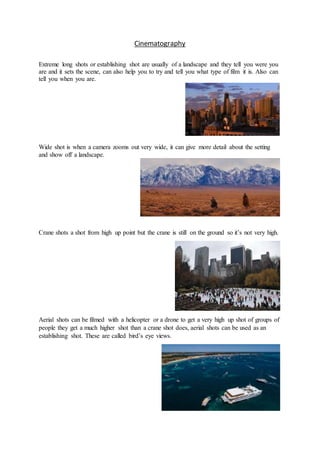
Extreme long shots or establishing shot are usually of a landscape and they tell you were you
are and it sets the scene, can also help you to try and tell you what type of film it is. Also can
tell you when you are.
Wide shot is when a camera zooms out very wide, it can give more detail about the setting
and show off a landscape.
Crane shots a shot from high up point but the crane is still on the ground so it’s not very high.
Aerial shots can be filmed with a helicopter or a drone to get a very high up shot of groups of
people they get a much higher shot than a crane shot does, aerial shots can be used as an
establishing shot. These are called bird’s eye views.
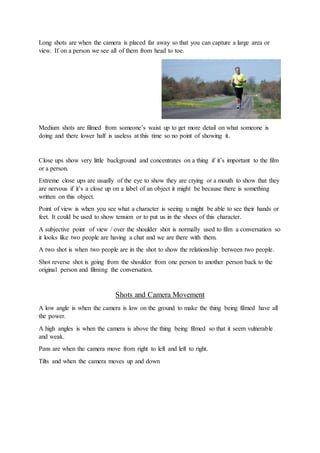
Long shots are when the camera is placed far away so that you can capture a large area or
view. If on a person we see all of them from head to toe.
Medium shots are filmed from someone’s waist up to get more detail on what someone is
doing and there lower half is useless at this time so no point of showing it.
Close ups show very little background and concentrates on a thing if it’s important to the film
or a person.
Extreme close ups are usually of the eye to show they are crying or a mouth to show that they
are nervous if it’s a close up on a label of an object it might be because there is something
written on this object.
Point of view is when you see what a character is seeing u might be able to see their hands or
feet. It could be used to show tension or to put us in the shoes of this character.
A subjective point of view / over the shoulder shot is normally used to film a conversation so
it looks like two people are having a chat and we are there with them.
A two shot is when two people are in the shot to show the relationship between two people.
Shot reverse shot is going from the shoulder from one person to another person back to the
original person and filming the conversation.
Shots and Camera Movement
A low angle is when the camera is low on the ground to make the thing being filmed have all
the power.
A high angles is when the camera is above the thing being filmed so that it seem vulnerable
and weak.
Pans are when the camera move from right to left and left to right.
Tilts and when the camera moves up and down

Cinematography

  • 1.
    Cinematography Extreme long shotsor establishing shot are usually of a landscape and they tell you were you are and it sets the scene, can also help you to try and tell you what type of film it is. Also can tell you when you are. Wide shot is when a camera zooms out very wide, it can give more detail about the setting and show off a landscape. Crane shots a shot from high up point but the crane is still on the ground so it’s not very high. Aerial shots can be filmed with a helicopter or a drone to get a very high up shot of groups of people they get a much higher shot than a crane shot does, aerial shots can be used as an establishing shot. These are called bird’s eye views.
  • 2.
    Long shots arewhen the camera is placed far away so that you can capture a large area or view. If on a person we see all of them from head to toe. Medium shots are filmed from someone’s waist up to get more detail on what someone is doing and there lower half is useless at this time so no point of showing it. Close ups show very little background and concentrates on a thing if it’s important to the film or a person. Extreme close ups are usually of the eye to show they are crying or a mouth to show that they are nervous if it’s a close up on a label of an object it might be because there is something written on this object. Point of view is when you see what a character is seeing u might be able to see their hands or feet. It could be used to show tension or to put us in the shoes of this character. A subjective point of view / over the shoulder shot is normally used to film a conversation so it looks like two people are having a chat and we are there with them. A two shot is when two people are in the shot to show the relationship between two people. Shot reverse shot is going from the shoulder from one person to another person back to the original person and filming the conversation. Shots and Camera Movement A low angle is when the camera is low on the ground to make the thing being filmed have all the power. A high angles is when the camera is above the thing being filmed so that it seem vulnerable and weak. Pans are when the camera move from right to left and left to right. Tilts and when the camera moves up and down