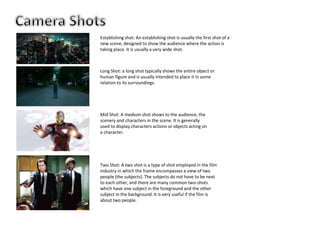
Establishing shot: An establishing shot is usually the first shot of a
new scene, designed to show the audience where the action is
taking place. It is usually a very wide shot.
Long Shot: a long shot typically shows the entire object or
human figure and is usually intended to place it in some
relation to its surroundings.
Mid Shot: A medium shot shows to the audience, the
scenery and characters in the scene. It is generally
used to display characters actions or objects acting on
a character.
Two Shot: A two shot is a type of shot employed in the film
industry in which the frame encompasses a view of two
people (the subjects). The subjects do not have to be next
to each other, and there are many common two-shots
which have one subject in the foreground and the other
subject in the background. It is very useful if the film is
about two people.
Close-up: A close-up is a type of shot, which tightly frames a person or an object.
Close-ups are one of the standard shots used regularly with medium shots and
long shots
Extreme Close-up: The shot is so tight that only a detail of the subject, such as
someone's eyes, can be seen. in a sequence, usually in a scene of dialogue.
Over the shoulder: over the shoulder shot is a shot of someone
or something taken from the perspective or camera angle from
the shoulder of another person. The back of the shoulder and
head of this person is used to frame the image of whatever the
camera is pointing toward.
High Angle Shot: High-angle shots can make the subject seem
vulnerable or powerless when applied with the correct mood.
In film, they can make the scene more dramatic. If there is a
person at high elevation who is talking to someone below
them, this shot is often used.
Low Angle Shot: A low-angle shot, is a shot from a camera angle
positioned low on the vertical axis, anywhere below the eye line,
looking up.Psychologically, the effect of the low-angle shot is that it
makes the subject look strong and powerful.
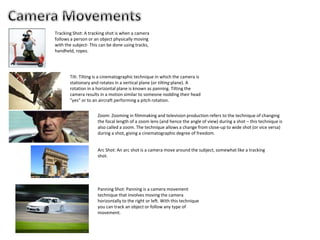
Tracking Shot: A tracking shot is when a camera
follows a person or an object physically moving
with the subject- This can be done using tracks,
handheld, ropes.
Tilt: Tilting is a cinematographic technique in which the camera is
stationary and rotates in a vertical plane (or tilting plane). A
rotation in a horizontal plane is known as panning. Tilting the
camera results in a motion similar to someone nodding their head
"yes" or to an aircraft performing a pitch rotation.
Zoom: Zooming in filmmaking and television production refers to the technique of changing
the focal length of a zoom lens (and hence the angle of view) during a shot – this technique is
also called a zoom. The technique allows a change from close-up to wide shot (or vice versa)
during a shot, giving a cinematographic degree of freedom.
Arc Shot: An arc shot is a camera move around the subject, somewhat like a tracking
shot.
Panning Shot: Panning is a camera movement
technique that involves moving the camera
horizontally to the right or left. With this technique
you can track an object or follow any type of
movement.

Camera shots

  • 1.
    Establishing shot: Anestablishing shot is usually the first shot of a new scene, designed to show the audience where the action is taking place. It is usually a very wide shot. Long Shot: a long shot typically shows the entire object or human figure and is usually intended to place it in some relation to its surroundings. Mid Shot: A medium shot shows to the audience, the scenery and characters in the scene. It is generally used to display characters actions or objects acting on a character. Two Shot: A two shot is a type of shot employed in the film industry in which the frame encompasses a view of two people (the subjects). The subjects do not have to be next to each other, and there are many common two-shots which have one subject in the foreground and the other subject in the background. It is very useful if the film is about two people.
  • 2.
    Close-up: A close-upis a type of shot, which tightly frames a person or an object. Close-ups are one of the standard shots used regularly with medium shots and long shots Extreme Close-up: The shot is so tight that only a detail of the subject, such as someone's eyes, can be seen. in a sequence, usually in a scene of dialogue.
  • 3.
    Over the shoulder:over the shoulder shot is a shot of someone or something taken from the perspective or camera angle from the shoulder of another person. The back of the shoulder and head of this person is used to frame the image of whatever the camera is pointing toward. High Angle Shot: High-angle shots can make the subject seem vulnerable or powerless when applied with the correct mood. In film, they can make the scene more dramatic. If there is a person at high elevation who is talking to someone below them, this shot is often used. Low Angle Shot: A low-angle shot, is a shot from a camera angle positioned low on the vertical axis, anywhere below the eye line, looking up.Psychologically, the effect of the low-angle shot is that it makes the subject look strong and powerful.
  • 4.
    Tracking Shot: Atracking shot is when a camera follows a person or an object physically moving with the subject- This can be done using tracks, handheld, ropes. Tilt: Tilting is a cinematographic technique in which the camera is stationary and rotates in a vertical plane (or tilting plane). A rotation in a horizontal plane is known as panning. Tilting the camera results in a motion similar to someone nodding their head "yes" or to an aircraft performing a pitch rotation. Zoom: Zooming in filmmaking and television production refers to the technique of changing the focal length of a zoom lens (and hence the angle of view) during a shot – this technique is also called a zoom. The technique allows a change from close-up to wide shot (or vice versa) during a shot, giving a cinematographic degree of freedom. Arc Shot: An arc shot is a camera move around the subject, somewhat like a tracking shot. Panning Shot: Panning is a camera movement technique that involves moving the camera horizontally to the right or left. With this technique you can track an object or follow any type of movement.