Efficient data collection from rural households
– is RHOMIS for you?
James Hammond, Tim Pagella, Todd Rosenstock, Leo Gorman,
Sam Adams, Jacob van Etten, Nils Teufel, Mark van Wijk.
Commonwealth Heads of Statistics Conference
23 November 2018
Improved food and
nutrition security for
health
Improved natural
resource systems and
ecosystem services
Reduced poverty
ILRI: the International Livestock Research
Institute
ILRI’s mission is
to improve food and nutritional security
and to reduce poverty in developing countries
through research for
efficient, safe and sustainable
use of livestock —
ensuring better lives through livestock.
Sustainable Farming Systems
RHOMIS
Rural Household Multi-Indicator Survey
Carefully designed and refined over 4 years
•Use global indicators
•Standardise and harmonise data
•Collect data very efficiently
•Makes use of digital technologies
and advances in indicator
development; 1 hour per household
•Flexibility and adaptability: a tool
that can be used in many locations
and settings
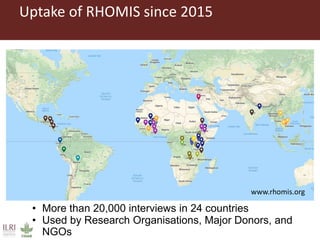
Uptake of RHOMIS since 2015
• More than 20,000 interviews in 24 countries
• Used by Research Organisations, Major Donors, and
NGOs
www.rhomis.org
Farm HH Characteristics:
Family Size/Composition
Gendered Decision-Making
Agricultural System:
Land Allocation
Farm Diversity
Natural Resource
Management (NRM)
Intensification Practices:
Fertilization
Irrigation
Integration
Livelihoods:
Market Orientation
Livestock Orientation
Off-Farm Activities
Drivers & Strategies Welfare
Food Security:
Calorie Availability
Food Insecurity Experience
Scale (FIES)
Household Diet Diversity
Score (HDDS)
Poverty:
Probability of Poverty
Indicator (PPI)
Gross Income ($ per day)
Environment:
GHG Emissions
GHG Emissions Intensity
+ Other User-Defined
Indicators of Interest
Agricultural System:
Farm Productivity
Crop Productivity
Livestock Productivity
Economic:
Value and Sales of Farm
Production
Off-farm income
Performance
+ Optional Additional
Modules
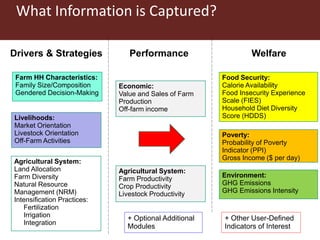
What Information is Captured?
Website
Survey
definition
Library of analysis code
(linked to database)
Survey
template
Completed
survey
Database
Interview
farmer
Digital surveys: data processing and basic
analyses much quicker and easier
Visualization
of results
Could RHOMIS be useful for National
Statistics Offices?
• Could be an efficient intermediate to Agricultural
Census or other very detailed surveys (e.g. LSMS)
• Data processing, reporting, analysis very quick
• Structured data could be valuable for research on
agricultural practices, poverty, policy impacts
• Output data could be integrated into reporting
platforms
• Global effort for open data
What SDG indicators are covered?
The RHoMIS tool monitors indicators for 5 SDGs
Can be used as a diagnostic tool to understand
progress towards 7 SDGs
Co-develop a version of the tool with a
National Statistics Office
We invite interested parties to make contact with
us and co-develop the RHOMIS tool.
• Needs assessment with NSO
• Adapt questionnaire, user interface, and
reporting platform
• Pilot testing of the tool
• Evaluate and refine for large scale use
• Possibly make tool available to
commonwealth community
Contact details
• Hammond et al 2017, Agricultural Systems,
151, 225–233
• Fraval et al 2018, Agricultural Systems, 160,
87-95
• Fraval et al, in press, Experimental Agriculture
• Frelat et al, 2016, PNAS, 113 (2) 458-463
J.Hammond@cigar.org
www.rhomis.org
This presentation is licensed for use under the Creative Commons Attribution 4.0 International Licence.
better lives through livestock
ilri.org
ILRI thanks all donors and organizations which globally support its work through their contributions
to the CGIAR Trust Fund

Efficient data collection from rural households – is RHOMIS for you?

  • 1.
    Efficient data collectionfrom rural households – is RHOMIS for you? James Hammond, Tim Pagella, Todd Rosenstock, Leo Gorman, Sam Adams, Jacob van Etten, Nils Teufel, Mark van Wijk. Commonwealth Heads of Statistics Conference 23 November 2018
  • 2.
    Improved food and nutritionsecurity for health Improved natural resource systems and ecosystem services Reduced poverty ILRI: the International Livestock Research Institute ILRI’s mission is to improve food and nutritional security and to reduce poverty in developing countries through research for efficient, safe and sustainable use of livestock — ensuring better lives through livestock.
  • 3.
  • 4.
    RHOMIS Rural Household Multi-IndicatorSurvey Carefully designed and refined over 4 years •Use global indicators •Standardise and harmonise data •Collect data very efficiently •Makes use of digital technologies and advances in indicator development; 1 hour per household •Flexibility and adaptability: a tool that can be used in many locations and settings
  • 5.
    Uptake of RHOMISsince 2015 • More than 20,000 interviews in 24 countries • Used by Research Organisations, Major Donors, and NGOs www.rhomis.org
  • 6.
    Farm HH Characteristics: FamilySize/Composition Gendered Decision-Making Agricultural System: Land Allocation Farm Diversity Natural Resource Management (NRM) Intensification Practices: Fertilization Irrigation Integration Livelihoods: Market Orientation Livestock Orientation Off-Farm Activities Drivers & Strategies Welfare Food Security: Calorie Availability Food Insecurity Experience Scale (FIES) Household Diet Diversity Score (HDDS) Poverty: Probability of Poverty Indicator (PPI) Gross Income ($ per day) Environment: GHG Emissions GHG Emissions Intensity + Other User-Defined Indicators of Interest Agricultural System: Farm Productivity Crop Productivity Livestock Productivity Economic: Value and Sales of Farm Production Off-farm income Performance + Optional Additional Modules What Information is Captured?
  • 7.
    Website Survey definition Library of analysiscode (linked to database) Survey template Completed survey Database Interview farmer Digital surveys: data processing and basic analyses much quicker and easier Visualization of results
  • 8.
    Could RHOMIS beuseful for National Statistics Offices? • Could be an efficient intermediate to Agricultural Census or other very detailed surveys (e.g. LSMS) • Data processing, reporting, analysis very quick • Structured data could be valuable for research on agricultural practices, poverty, policy impacts • Output data could be integrated into reporting platforms • Global effort for open data
  • 9.
    What SDG indicatorsare covered? The RHoMIS tool monitors indicators for 5 SDGs Can be used as a diagnostic tool to understand progress towards 7 SDGs
  • 10.
    Co-develop a versionof the tool with a National Statistics Office We invite interested parties to make contact with us and co-develop the RHOMIS tool. • Needs assessment with NSO • Adapt questionnaire, user interface, and reporting platform • Pilot testing of the tool • Evaluate and refine for large scale use • Possibly make tool available to commonwealth community
  • 11.
    Contact details • Hammondet al 2017, Agricultural Systems, 151, 225–233 • Fraval et al 2018, Agricultural Systems, 160, 87-95 • Fraval et al, in press, Experimental Agriculture • Frelat et al, 2016, PNAS, 113 (2) 458-463 J.Hammond@cigar.org www.rhomis.org
  • 12.
    This presentation islicensed for use under the Creative Commons Attribution 4.0 International Licence. better lives through livestock ilri.org ILRI thanks all donors and organizations which globally support its work through their contributions to the CGIAR Trust Fund

Editor's Notes

  • #3 Aligned to Agenda 2030 and the SDGs. Part of the CGIAR – one of the major global efforts to address poverty and hunger through agriculture ILRI: Campuses in Nairobi and Addis, offices in 14 other countries. ILRI works on issue such as animal genetics, disease and treatment and feed. Also policy, markets, economics, environmental and gender issues.
  • #10 Monitoring tool: SDG1: Incomes and vulnerability SDG2: Experience of hunger, agricultural productivity, and a bit about sustainable land use even SDG5 – diagnostic but not directly monitor indicators SDG6 – Water access and sanitation and hygiene practices SDG9 – transport, value chains, markets, credit SDG10 – diagnostic for ineqaulity in rural areas SDG13 – diagnostics for CSA Diagnostic tool: AND can help identify which causes, or hotspots where certain issues occur