Key Population Data for Decision Making
Nana Fosua Clement, FHI360, Ghana.
December 4, 2015
Washington, DC
M & E approaches for key population programs: perils,
pitfalls, and promising practices
Ghana : SHARP, SHARPER into LINKAGES
Outline
• Background
• Perils and pitfalls
• Promising practices
• Lesson learnt
Background
SHARP, SHARPER unto LINKAGES
• USAID-funded projects for KP HIV interventions in
Ghana
• Strong component of M & E design for interventions
• M & E design fit within country context for effective
collaboration from relevant stakeholders and
smooth execution.
• Projects led by FHI360
Perils and pitfalls (SHARP: 2004 – 2009)
Country context – limited KP data so focus on general
population for HIV intervention
• FSW data available for programming
• Very limited data on MSM so few development
partners and CSO implementing KP interventions.
• Country focus on general pop HIV (known/available
data)
• First bio-behavioural study on MSM - homophobic
environment, chased out from community, study on
hold for 3 months
• M & E tools developed for effective data collection –
time consuming and slow
Perils and pitfalls (SHARPER: 2010 – 2014)
Country context - Quality mechanisms for
standardized M&E for programing
• KP – stigma, discrimination, fear
• Utilization of evidence-based data available from
M & E
o public health facilities
o CSO community
o KP community
• Interest in KP program increase thus need to
standardize intervention including M&E (good and
bad)
Perils and pitfalls (LINKAGES:2015 –2016)
Country context – UNAIDS 90-90-90 strategy
• Community KP prevention intervention with
running M & E system, CST services tracked for
general population at public health facilities
• M & E system to merge both – data for decision
making and effective programming
• Transition period vrs. national M & E system
launch
Promising practices
• Performance monitoring to include performance-
based feedback, dialogue and funding - strengthens the
capacity of implementers to implement improved interventions
and to show greater accountability.
• KP IBBSS : FSW - 3 completed, 1 underway; MSM – 1
completed, 1 underway
• Development/Standardized data collection tools and
strategic documents for effective programming
o KP SOP, KP Strategic Plan (SP) and National SP
o Community mapping - Better target services to KP
hotspots
o National KP data collection tools
Promising practices
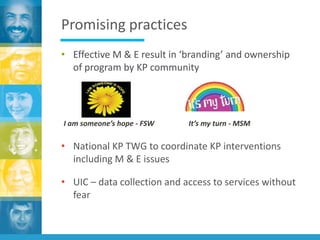
• Effective M & E result in ‘branding’ and ownership
of program by KP community
• National KP TWG to coordinate KP interventions
including M & E issues
• UIC – data collection and access to services without
fear
I am someone’s hope - FSW It’s my turn - MSM
Lesson learnt
• Very careful with HOW, WHEN, WHERE, and
TO WHOM sensitive KP information is
released.
• Be particularly wary of the press – gain trust
with the KP community and stakeholders
Result - proper KP data for decision making.
»
Stay Connected with LINKAGES
• Follow LINKAGES on Twitter:
www.twitter.com/LINKAGESproject
• Like the project on Facebook:
www.facebook.com/LINKAGESproject
• Subscribe to the LINKAGES blog
www.linkagesproject.wordpress.com
• Subscribe to The LINK, LINKAGES’s quarterly
project e-newsletter
• Check out LINKAGES’s quarterly research digest
Acknowledgements

M & E approaches for key population programs: perils, pitfalls, and promising practices

  • 1.
    Key Population Datafor Decision Making Nana Fosua Clement, FHI360, Ghana. December 4, 2015 Washington, DC M & E approaches for key population programs: perils, pitfalls, and promising practices Ghana : SHARP, SHARPER into LINKAGES
  • 2.
    Outline • Background • Perilsand pitfalls • Promising practices • Lesson learnt
  • 3.
    Background SHARP, SHARPER untoLINKAGES • USAID-funded projects for KP HIV interventions in Ghana • Strong component of M & E design for interventions • M & E design fit within country context for effective collaboration from relevant stakeholders and smooth execution. • Projects led by FHI360
  • 4.
    Perils and pitfalls(SHARP: 2004 – 2009) Country context – limited KP data so focus on general population for HIV intervention • FSW data available for programming • Very limited data on MSM so few development partners and CSO implementing KP interventions. • Country focus on general pop HIV (known/available data) • First bio-behavioural study on MSM - homophobic environment, chased out from community, study on hold for 3 months • M & E tools developed for effective data collection – time consuming and slow
  • 5.
    Perils and pitfalls(SHARPER: 2010 – 2014) Country context - Quality mechanisms for standardized M&E for programing • KP – stigma, discrimination, fear • Utilization of evidence-based data available from M & E o public health facilities o CSO community o KP community • Interest in KP program increase thus need to standardize intervention including M&E (good and bad)
  • 6.
    Perils and pitfalls(LINKAGES:2015 –2016) Country context – UNAIDS 90-90-90 strategy • Community KP prevention intervention with running M & E system, CST services tracked for general population at public health facilities • M & E system to merge both – data for decision making and effective programming • Transition period vrs. national M & E system launch
  • 7.
    Promising practices • Performancemonitoring to include performance- based feedback, dialogue and funding - strengthens the capacity of implementers to implement improved interventions and to show greater accountability. • KP IBBSS : FSW - 3 completed, 1 underway; MSM – 1 completed, 1 underway • Development/Standardized data collection tools and strategic documents for effective programming o KP SOP, KP Strategic Plan (SP) and National SP o Community mapping - Better target services to KP hotspots o National KP data collection tools
  • 8.
    Promising practices • EffectiveM & E result in ‘branding’ and ownership of program by KP community • National KP TWG to coordinate KP interventions including M & E issues • UIC – data collection and access to services without fear I am someone’s hope - FSW It’s my turn - MSM
  • 9.
    Lesson learnt • Verycareful with HOW, WHEN, WHERE, and TO WHOM sensitive KP information is released. • Be particularly wary of the press – gain trust with the KP community and stakeholders Result - proper KP data for decision making. »
  • 10.
    Stay Connected withLINKAGES • Follow LINKAGES on Twitter: www.twitter.com/LINKAGESproject • Like the project on Facebook: www.facebook.com/LINKAGESproject • Subscribe to the LINKAGES blog www.linkagesproject.wordpress.com • Subscribe to The LINK, LINKAGES’s quarterly project e-newsletter • Check out LINKAGES’s quarterly research digest
  • 11.