Conference Objectives &
Expected Outcomes
Tsitsi Makombe
Senior Program Manager
International Food Policy Research Institute (IFPRI)
October 26, 2017
Conference Objectives
Day 1
 Discuss important issues raised &
recommendations of the 2016 ATOR
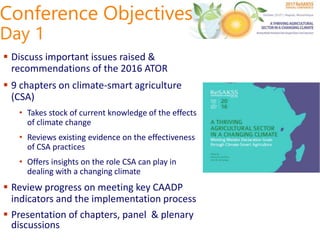
 9 chapters on climate-smart agriculture
(CSA)
• Takes stock of current knowledge of the effects
of climate change
• Reviews existing evidence on the effectiveness
of CSA practices
• Offers insights on the role CSA can play in
dealing with a changing climate
 Review progress on meeting key CAADP
indicators and the implementation process
 Presentation of chapters, panel & plenary
discussions
Conference Objectives
Day 2
 Assess outcomes, lessons learned, and next steps in preparing
for first CAADP Biennial Review
 Assess progress, lessons learned, and next steps in formulating
next generation national agriculture investment plans (NAIPs)
and ensuring compliance with Malabo themes and goals
 Examine strategies and best practices for mobilizing local
expertise to support CAADP planning and implementation
 Presentation of progress,
panel & plenary discussions
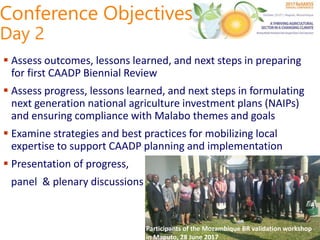
Participants of the Mozambique BR validation workshop
in Maputo, 28 June 2017
Expected Outcomes
Shared understanding of the latest evidence on:
1) Effectiveness of CSA practices and tools and how
they can support agricultural development and
food security in the face of climate change in
Africa
2) Policy actions for ensuring widespread adoption
of CSA practices and tools and the achievement
of Malabo Declaration goals
Expected Outcomes
Shared lessons and experiences on:
1) Preparing for first CAADP BR Process
• Critical success factors
• Required next steps
2) Appraising and formulating NAIPs
• Actions needed to ensure a successful NAIP appraisal and
design process
• Required support and next steps in extending support to
more countries
3) Mobilizing expertise to support CAADP processes
• Organizing local centers of expertise to support CAADP
analyses, review, and dialogue processes at country level
2016 ATOR Chapters &
Conference Presentations
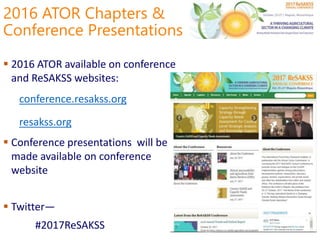
 2016 ATOR available on conference
and ReSAKSS websites:
conference.resakss.org
resakss.org
 Conference presentations will be
made available on conference
website
 Twitter—
#2017ReSAKSS
Thank you!

Conference Objectives & Expected Outcomes

  • 1.
    Conference Objectives & ExpectedOutcomes Tsitsi Makombe Senior Program Manager International Food Policy Research Institute (IFPRI) October 26, 2017
  • 2.
    Conference Objectives Day 1 Discuss important issues raised & recommendations of the 2016 ATOR  9 chapters on climate-smart agriculture (CSA) • Takes stock of current knowledge of the effects of climate change • Reviews existing evidence on the effectiveness of CSA practices • Offers insights on the role CSA can play in dealing with a changing climate  Review progress on meeting key CAADP indicators and the implementation process  Presentation of chapters, panel & plenary discussions
  • 3.
    Conference Objectives Day 2 Assess outcomes, lessons learned, and next steps in preparing for first CAADP Biennial Review  Assess progress, lessons learned, and next steps in formulating next generation national agriculture investment plans (NAIPs) and ensuring compliance with Malabo themes and goals  Examine strategies and best practices for mobilizing local expertise to support CAADP planning and implementation  Presentation of progress, panel & plenary discussions Participants of the Mozambique BR validation workshop in Maputo, 28 June 2017
  • 4.
    Expected Outcomes Shared understandingof the latest evidence on: 1) Effectiveness of CSA practices and tools and how they can support agricultural development and food security in the face of climate change in Africa 2) Policy actions for ensuring widespread adoption of CSA practices and tools and the achievement of Malabo Declaration goals
  • 5.
    Expected Outcomes Shared lessonsand experiences on: 1) Preparing for first CAADP BR Process • Critical success factors • Required next steps 2) Appraising and formulating NAIPs • Actions needed to ensure a successful NAIP appraisal and design process • Required support and next steps in extending support to more countries 3) Mobilizing expertise to support CAADP processes • Organizing local centers of expertise to support CAADP analyses, review, and dialogue processes at country level
  • 6.
    2016 ATOR Chapters& Conference Presentations  2016 ATOR available on conference and ReSAKSS websites: conference.resakss.org resakss.org  Conference presentations will be made available on conference website  Twitter— #2017ReSAKSS
  • 7.