Kent LTC Year of Care Programme:
Using whole population linked
datasets to develop higher value
models of care
Dr Abraham George
Asst Dir / Consultant in Public Health
Kent County Council
Aims
• Use whole population integrated data sets to help
commissioners evaluate relative impact of different
integrated care initiatives
• Use routine administration data to develop a different
method of commissioning – capitated funding model –
to intervene earlier, support independent living,
prevent ‘crisis’ and rehospitalisation
• Use the same routine administrative data to develop a
different method of payment for services which is not
cost per activity but is outcomes based
• Design personal health and social care budgets to
support integrated personalisation
Setting the scope of our funding model
Developing ‘currencies’ & identify potential “at risk”
cohort
• Whole population approach (SUS & provider data into local data
warehouse)
• Standard currency agreed across Kent
• List segmented by LTC currency (Bands B – E applied - B=2,C=3-
5,D=6-8,E=9+)
• Tariff to be developed for each currency band
• Risk stratification of whole population using hospital and primary
care data
• Risk Score over time mapped (looking for rise in risk score in last
3 to 6 mths)
• Multi-morbidity mapped for ‘at risk’ group across 18 Long Term
Conditions
‘YOC Cohort’
YOC vs Non YOC average costs
YoC vs non YoC average costs
breakdown
Multimorbidity profile (YoC) Cohort
(n=23,600)
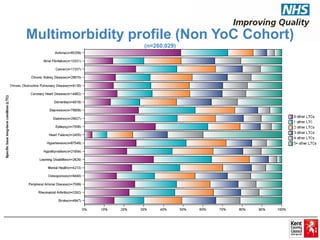
Multimorbidity profile (Non YoC Cohort)
(n=260,029)
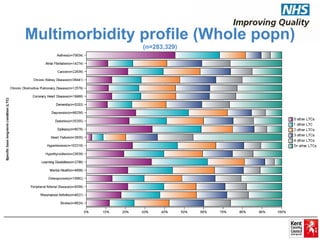
Multimorbidity profile (Whole popn)
(n=283,329)
Next steps
• Increase the number of GP practices flowing data to
KMHIS
• Increase the number of providers flowing data to KMHIS
• Develop a Data Quality Improvement Plan across the
system
• Work with Commissioners and Providers to develop a
commissioning model in each health system
• Work with commissioners and providers to develop the
contracting model to support the commissioning model
• Develop a standard set of reports and dashboards to
support the monitoring evaluation of Integrated Care
services across Kent
• Use linked datasets for enhanced analytics purposes
(service evaluation, system modelling, economic
evaluation of prevention, etc)
Abraham George: Kent Year of Care Programme

Abraham George: Kent Year of Care Programme

  • 1.
    Kent LTC Yearof Care Programme: Using whole population linked datasets to develop higher value models of care Dr Abraham George Asst Dir / Consultant in Public Health Kent County Council
  • 2.
    Aims • Use wholepopulation integrated data sets to help commissioners evaluate relative impact of different integrated care initiatives • Use routine administration data to develop a different method of commissioning – capitated funding model – to intervene earlier, support independent living, prevent ‘crisis’ and rehospitalisation • Use the same routine administrative data to develop a different method of payment for services which is not cost per activity but is outcomes based • Design personal health and social care budgets to support integrated personalisation
  • 3.
    Setting the scopeof our funding model
  • 4.
    Setting the scopeof our funding model
  • 5.
    Setting the scopeof our funding model
  • 6.
    Developing ‘currencies’ &identify potential “at risk” cohort • Whole population approach (SUS & provider data into local data warehouse) • Standard currency agreed across Kent • List segmented by LTC currency (Bands B – E applied - B=2,C=3- 5,D=6-8,E=9+) • Tariff to be developed for each currency band • Risk stratification of whole population using hospital and primary care data • Risk Score over time mapped (looking for rise in risk score in last 3 to 6 mths) • Multi-morbidity mapped for ‘at risk’ group across 18 Long Term Conditions
  • 8.
  • 9.
    YOC vs NonYOC average costs
  • 10.
    YoC vs nonYoC average costs breakdown
  • 11.
  • 12.
    Multimorbidity profile (NonYoC Cohort) (n=260,029)
  • 13.
  • 14.
    Next steps • Increasethe number of GP practices flowing data to KMHIS • Increase the number of providers flowing data to KMHIS • Develop a Data Quality Improvement Plan across the system • Work with Commissioners and Providers to develop a commissioning model in each health system • Work with commissioners and providers to develop the contracting model to support the commissioning model • Develop a standard set of reports and dashboards to support the monitoring evaluation of Integrated Care services across Kent • Use linked datasets for enhanced analytics purposes (service evaluation, system modelling, economic evaluation of prevention, etc)