Presented By,
NAUSHEEN FATHIMA
1
 Introduction
 Definition
 Altered Kinetics In Pregnancy
 Plasma Drug Monitoring During Pregnancy
 Points To Be Considered In Teratogenic Drug
Selection
 Altered Pharmacokinetics In Children
 Issues In Therapeutics
 Factors To Be Considered When Selecting A Drug
Dosage Regimen Or Route Of Administration For A
Child Patient
 Monitoring
 References
2
Clinical pharmacokinetic studies are performed
to examine the absorption, distribution, metabolism,
and excretion of a drug under investigation
(investigational drug and approved drug) in healthy
volunteers and/or patients. Data obtained from such
studies are useful for the design and conduct of
subsequent clinical trials. They are also necessary for
appropriate analysis and evaluation of the efficacy
and safety data obtained in clinical trials for new drug
development and in post-marketing clinical trials.
3
The application of pharmacokinetic
principles in the dosage regimen design
for the safe and effective management of
illness in individual patient is called as
clinical pharmacokinetics.
4
 Two compartment model is the simplest model in
pregnant ladies (mother & fetus).
 But in practice, many compartments in mother & fetus
may present.(e.g. Placenta, amniotic fluid)
DURING ABSORPTION:
In Stomach:
 Acidic drugs in ionized form, so reaching of intestine is
delayed.
 Therefore, no change in extent of absorption but kinetic
of absorption is changed.
5
In Intestine
 Though peristaltic movement is decreased, blood flow is
more which increase the rate of transport from mucosal
side to serosal side. Therefore, no problem in absorption.
DURING DISTRIBUTION:
 Decrease in albumin concentration due to hemoglobin
dilution.
 In pregnancy: Though there is increased production on
proteins, decrease in amount of proteins occurs. This
resembles hypo albuminemia.
 Due to decrease in protein binding, increase in free drug
concentration leads to increased therapeutic effect.
 Also increase in elimination or metabolism and increase in
volume of distribution.
6
CLEARANCE
 Increase in renal plasma flow by 50-100%.
 Increase in GFR up to 70%.
 Increased levels of unbound drug in plasma.
 Hepatic clearance is variable.
 Progesterone increases intrinsic hepatic clearance
which leads to rapid metabolic degradation,
especially of the more lipid soluble drugs.
Examples of such drugs include digoxin, gentamycin &
cephalexin.
7
PLASMA DRUG MONITORING DURING
PREGNANCY
 The physiological changes during pregnancy is longer (1
day-10 months) but return is very quick (5-7 weeks after
parturition)
 Monitoring is not useful in drugs used during
childbirth.(1- stage:10 months,
 2- stage: few hrs, 3- stage: few weeks).therefore 2nd stage
is not very important.
 Plasma levels of anticonvulsants may fall during 1st stage
& 3rd stage because of
 Increased intrinsic clearance and increased fluid volume.
 Therefore, dosage adjustment based on the free fraction
of the drug should be made.
8
 Monitoring every 4 weeks from onset of pregnancy
till parturition & weekly after birth
 For 2-3 weeks and then every two weeks until drug
level stabilize is recommended.
 Plasma lithium levels should be monitored every two
weeks during three trimesters and every day after
parturition until levels stabilize.
 Digoxin is also needed monitoring.
 Serum concentration on antibiotics also needs
monitoring.
9
 Teratogenecity: Birth defects in 2-4% of total birth.
 Of these, 65-70% with unknown cause, 25% due to
genetic defects, 3% due to chromosomal aberration
and only 3% due to infections, drugs.
 Pre-implantation (1-16 days): Complete damage of
replacement of cell possible.
 Organogenesis’s (17-56 days): Possibility of
congenital malformation.
10
Here, the organs are not matured.
The development of organs continues until
at least to the age of 12 yrs.
Pediatrics – branch of medicine dealing
with the development of disease and
disorders in children.
Pediatric patients were always considered in
the past for treatment as mini adults.
11
 Neonate: The first 30 days of life.
 Infant: From 1 month to 1 yr.
 Child: From 1yr to 12 yrs.
 Adolescent: From 12 yrs to 18 yrs.
General Consideration
 Infancy and childhood is a period of rapid growth and
development of organ systems and so careful
administration of drugs should be ensured.
 During the age of 1-12 yrs almost 60% drop in extra
cellular volume.
 Dosage is adjusted based on pharmacokinetic data of a
given age group for the desired response. But considering
each individuals drug handling capacity often the most
rational approach.
12
DURING ABSORPTION
 Until the 2nd yr of life, GI acid secretion is not
increased and it is comparable on a per kg basis to
that observed in adult.
 Gastric pH is neutral birth, so bioavailability of acid
labile drug increase.(e.g. pencillin)
 Intestinal peristalsis is lower until 1 yr.
 Drug absorbed by the oral route is erratic in the new
born baby of any gestation.
 Thus it is usual to give many drugs by the iv/im route
to ensure maximum bioavailability.
 Drugs that are not acid liable show oral
bioavailability equal to that of adults. (e.g.
paracetamol, digoxin).
13
DURING DISTRIBUTION
 Children’s total body water content is more and drugs that
are highly water soluble are absorbed faster.
 Total body water decreases throughout the first year and
shift from predominantly extra cellular to intra cellular
fluid.
 Lipophilic drugs have a large Vd despite of lower adipose
tissue. (because of high affinity of these lipid site)
 Dosage adjustment has to be done to drugs that are highly
water soluble like gentamycin to avoid ADR.
 Large inter patient variability in Vd due to varied nature
of maturation.
 Albumin concentration remains comparable with adult
but, α-1 acid, glycoprotein concentration is low.
 Therefore protein binding of acidic drugs is more (due to
more albumin) and for the basis drugs it is less (due to
less α-1 acid glycoprotein)
14
DURING METABOLISM
 At birth majority of the metabolic enzyme
systems are either absent or present in
considerably reduced amounts compared to
adults.(exemption: sulfate conjugation is more)
 Glucuronidation is very less. Therefore
chloramphenicol is not bound extensively.
 As there is no elemination (metabolism)
accumulation of chloramphenicol occur which
leads grow baby syndrome.
 Caffeine in children may have half life of even 5
days. But in adults it is 4 hrs.
 So drugs that are extensively metabolized by liver
should be administered cautiously.(caffeine,
lidocaine, chloramphenicol)
15
DURING ELIMINATION
Renal drug elimination is the primary route for
antimicrobial agents which are most commonly
used drugs in children.(β-lactum antibodies,
aminoglycosides)
Renal system undergoes active maturation
during first 2 yrs of life. However, GFR may
reach adult values in 2 months.
Inter individual variation is prominent (eg:
gentamycin, ampicillin, frusemide)
16
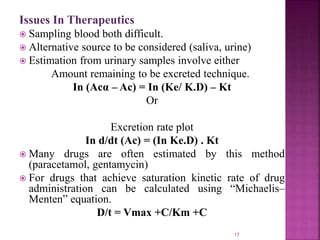
Issues In Therapeutics
 Sampling blood both difficult.
 Alternative source to be considered (saliva, urine)
 Estimation from urinary samples involve either
Amount remaining to be excreted technique.
In (Acα – Ac) = In (Ke/ K.D) – Kt
Or
Excretion rate plot
In d/dt (Ac) = (In Ke.D) . Kt
 Many drugs are often estimated by this method
(paracetamol, gentamycin)
 For drugs that achieve saturation kinetic rate of drug
administration can be calculated using “Michaelis–
Menten” equation.
D/t = Vmax +C/Km +C
17
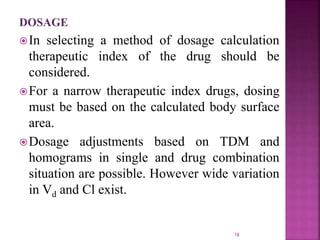
DOSAGE
In selecting a method of dosage calculation
therapeutic index of the drug should be
considered.
For a narrow therapeutic index drugs, dosing
must be based on the calculated body surface
area.
Dosage adjustments based on TDM and
homograms in single and drug combination
situation are possible. However wide variation
in Vd and Cl exist.
18
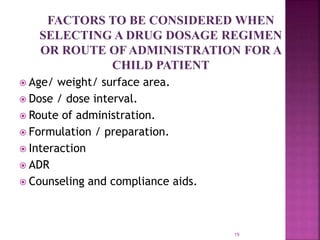
FACTORS TO BE CONSIDERED WHEN
SELECTING A DRUG DOSAGE REGIMEN
OR ROUTE OF ADMINISTRATION FOR A
CHILD PATIENT
 Age/ weight/ surface area.
 Dose / dose interval.
 Route of administration.
 Formulation / preparation.
 Interaction
 ADR
 Counseling and compliance aids.
19
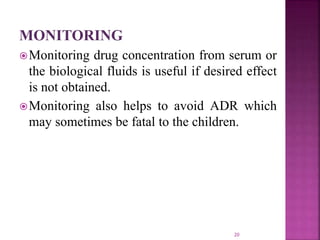
MONITORING
Monitoring drug concentration from serum or
the biological fluids is useful if desired effect
is not obtained.
Monitoring also helps to avoid ADR which
may sometimes be fatal to the children.
20
 Milo Gibaldi, Biopharmaceutics and clinical
pharmacokinetics; page no: 154- 157.
 http://www.nihs.go.jp/phar/pdf/ClPkEng011122.pdf
 http://ajprd.com/downloadebooks_pdf/41.pdf
21

Clinical Pharmacokinetics

  • 1.
  • 2.
     Introduction  Definition Altered Kinetics In Pregnancy  Plasma Drug Monitoring During Pregnancy  Points To Be Considered In Teratogenic Drug Selection  Altered Pharmacokinetics In Children  Issues In Therapeutics  Factors To Be Considered When Selecting A Drug Dosage Regimen Or Route Of Administration For A Child Patient  Monitoring  References 2
  • 3.
    Clinical pharmacokinetic studiesare performed to examine the absorption, distribution, metabolism, and excretion of a drug under investigation (investigational drug and approved drug) in healthy volunteers and/or patients. Data obtained from such studies are useful for the design and conduct of subsequent clinical trials. They are also necessary for appropriate analysis and evaluation of the efficacy and safety data obtained in clinical trials for new drug development and in post-marketing clinical trials. 3
  • 4.
    The application ofpharmacokinetic principles in the dosage regimen design for the safe and effective management of illness in individual patient is called as clinical pharmacokinetics. 4
  • 5.
     Two compartmentmodel is the simplest model in pregnant ladies (mother & fetus).  But in practice, many compartments in mother & fetus may present.(e.g. Placenta, amniotic fluid) DURING ABSORPTION: In Stomach:  Acidic drugs in ionized form, so reaching of intestine is delayed.  Therefore, no change in extent of absorption but kinetic of absorption is changed. 5
  • 6.
    In Intestine  Thoughperistaltic movement is decreased, blood flow is more which increase the rate of transport from mucosal side to serosal side. Therefore, no problem in absorption. DURING DISTRIBUTION:  Decrease in albumin concentration due to hemoglobin dilution.  In pregnancy: Though there is increased production on proteins, decrease in amount of proteins occurs. This resembles hypo albuminemia.  Due to decrease in protein binding, increase in free drug concentration leads to increased therapeutic effect.  Also increase in elimination or metabolism and increase in volume of distribution. 6
  • 7.
    CLEARANCE  Increase inrenal plasma flow by 50-100%.  Increase in GFR up to 70%.  Increased levels of unbound drug in plasma.  Hepatic clearance is variable.  Progesterone increases intrinsic hepatic clearance which leads to rapid metabolic degradation, especially of the more lipid soluble drugs. Examples of such drugs include digoxin, gentamycin & cephalexin. 7
  • 8.
    PLASMA DRUG MONITORINGDURING PREGNANCY  The physiological changes during pregnancy is longer (1 day-10 months) but return is very quick (5-7 weeks after parturition)  Monitoring is not useful in drugs used during childbirth.(1- stage:10 months,  2- stage: few hrs, 3- stage: few weeks).therefore 2nd stage is not very important.  Plasma levels of anticonvulsants may fall during 1st stage & 3rd stage because of  Increased intrinsic clearance and increased fluid volume.  Therefore, dosage adjustment based on the free fraction of the drug should be made. 8
  • 9.
     Monitoring every4 weeks from onset of pregnancy till parturition & weekly after birth  For 2-3 weeks and then every two weeks until drug level stabilize is recommended.  Plasma lithium levels should be monitored every two weeks during three trimesters and every day after parturition until levels stabilize.  Digoxin is also needed monitoring.  Serum concentration on antibiotics also needs monitoring. 9
  • 10.
     Teratogenecity: Birthdefects in 2-4% of total birth.  Of these, 65-70% with unknown cause, 25% due to genetic defects, 3% due to chromosomal aberration and only 3% due to infections, drugs.  Pre-implantation (1-16 days): Complete damage of replacement of cell possible.  Organogenesis’s (17-56 days): Possibility of congenital malformation. 10
  • 11.
    Here, the organsare not matured. The development of organs continues until at least to the age of 12 yrs. Pediatrics – branch of medicine dealing with the development of disease and disorders in children. Pediatric patients were always considered in the past for treatment as mini adults. 11
  • 12.
     Neonate: Thefirst 30 days of life.  Infant: From 1 month to 1 yr.  Child: From 1yr to 12 yrs.  Adolescent: From 12 yrs to 18 yrs. General Consideration  Infancy and childhood is a period of rapid growth and development of organ systems and so careful administration of drugs should be ensured.  During the age of 1-12 yrs almost 60% drop in extra cellular volume.  Dosage is adjusted based on pharmacokinetic data of a given age group for the desired response. But considering each individuals drug handling capacity often the most rational approach. 12
  • 13.
    DURING ABSORPTION  Untilthe 2nd yr of life, GI acid secretion is not increased and it is comparable on a per kg basis to that observed in adult.  Gastric pH is neutral birth, so bioavailability of acid labile drug increase.(e.g. pencillin)  Intestinal peristalsis is lower until 1 yr.  Drug absorbed by the oral route is erratic in the new born baby of any gestation.  Thus it is usual to give many drugs by the iv/im route to ensure maximum bioavailability.  Drugs that are not acid liable show oral bioavailability equal to that of adults. (e.g. paracetamol, digoxin). 13
  • 14.
    DURING DISTRIBUTION  Children’stotal body water content is more and drugs that are highly water soluble are absorbed faster.  Total body water decreases throughout the first year and shift from predominantly extra cellular to intra cellular fluid.  Lipophilic drugs have a large Vd despite of lower adipose tissue. (because of high affinity of these lipid site)  Dosage adjustment has to be done to drugs that are highly water soluble like gentamycin to avoid ADR.  Large inter patient variability in Vd due to varied nature of maturation.  Albumin concentration remains comparable with adult but, α-1 acid, glycoprotein concentration is low.  Therefore protein binding of acidic drugs is more (due to more albumin) and for the basis drugs it is less (due to less α-1 acid glycoprotein) 14
  • 15.
    DURING METABOLISM  Atbirth majority of the metabolic enzyme systems are either absent or present in considerably reduced amounts compared to adults.(exemption: sulfate conjugation is more)  Glucuronidation is very less. Therefore chloramphenicol is not bound extensively.  As there is no elemination (metabolism) accumulation of chloramphenicol occur which leads grow baby syndrome.  Caffeine in children may have half life of even 5 days. But in adults it is 4 hrs.  So drugs that are extensively metabolized by liver should be administered cautiously.(caffeine, lidocaine, chloramphenicol) 15
  • 16.
    DURING ELIMINATION Renal drugelimination is the primary route for antimicrobial agents which are most commonly used drugs in children.(β-lactum antibodies, aminoglycosides) Renal system undergoes active maturation during first 2 yrs of life. However, GFR may reach adult values in 2 months. Inter individual variation is prominent (eg: gentamycin, ampicillin, frusemide) 16
  • 17.
    Issues In Therapeutics Sampling blood both difficult.  Alternative source to be considered (saliva, urine)  Estimation from urinary samples involve either Amount remaining to be excreted technique. In (Acα – Ac) = In (Ke/ K.D) – Kt Or Excretion rate plot In d/dt (Ac) = (In Ke.D) . Kt  Many drugs are often estimated by this method (paracetamol, gentamycin)  For drugs that achieve saturation kinetic rate of drug administration can be calculated using “Michaelis– Menten” equation. D/t = Vmax +C/Km +C 17
  • 18.
    DOSAGE In selecting amethod of dosage calculation therapeutic index of the drug should be considered. For a narrow therapeutic index drugs, dosing must be based on the calculated body surface area. Dosage adjustments based on TDM and homograms in single and drug combination situation are possible. However wide variation in Vd and Cl exist. 18
  • 19.
    FACTORS TO BECONSIDERED WHEN SELECTING A DRUG DOSAGE REGIMEN OR ROUTE OF ADMINISTRATION FOR A CHILD PATIENT  Age/ weight/ surface area.  Dose / dose interval.  Route of administration.  Formulation / preparation.  Interaction  ADR  Counseling and compliance aids. 19
  • 20.
    MONITORING Monitoring drug concentrationfrom serum or the biological fluids is useful if desired effect is not obtained. Monitoring also helps to avoid ADR which may sometimes be fatal to the children. 20
  • 21.
     Milo Gibaldi,Biopharmaceutics and clinical pharmacokinetics; page no: 154- 157.  http://www.nihs.go.jp/phar/pdf/ClPkEng011122.pdf  http://ajprd.com/downloadebooks_pdf/41.pdf 21