BRISTOW OPERATION
PROCEDURE
Basuki W
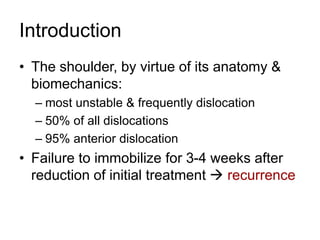
Introduction
• The shoulder, by virtue of its anatomy &
biomechanics:
– most unstable & frequently dislocation
– 50% of all dislocations
– 95% anterior dislocation
• Failure to immobilize for 3-4 weeks after
reduction of initial treatment  recurrence
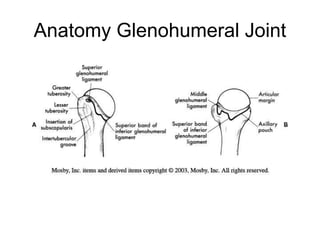
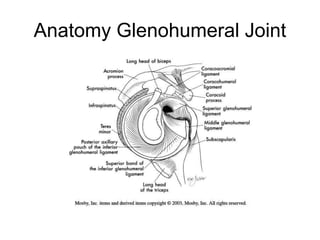
Anatomy Glenohumeral Joint
Pathologic Anatomy
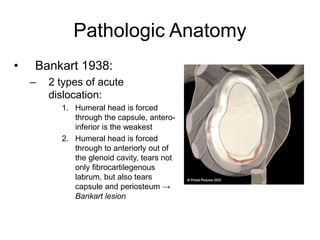
• Bankart 1938:
– 2 types of acute
dislocation:
1. Humeral head is forced
through the capsule, antero-
inferior is the weakest
2. Humeral head is forced
through to anteriorly out of
the glenoid cavity, tears not
only fibrocartilegenous
labrum, but also tears
capsule and periosteum →
Bankart lesion
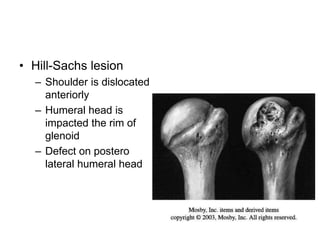
• Hill-Sachs lesion
– Shoulder is dislocated
anteriorly
– Humeral head is
impacted the rim of
glenoid
– Defect on postero
lateral humeral head
Surgical treatment
• Anterior instability:
– No single best procedure
• Ideally, the procedure:
1. Low recurrence rate
2. Low complication rate
3. Low re-operation rate
4. No harm (arthritis)
5. Maintain motion
6. Applicable in most cases
7. Allows observation of the joint
8. Corrects the pathologic
9. Not to difficult
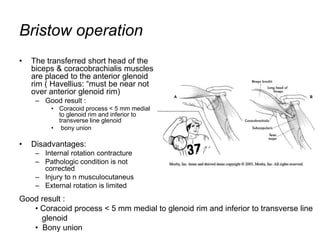
Bristow operation
• The transferred short head of the
biceps & coracobrachialis muscles
are placed to the anterior glenoid
rim ( Havellius: “must be near not
over anterior glenoid rim)
– Good result :
• Coracoid process < 5 mm medial
to glenoid rim and inferior to
transverse line glenoid
• bony union
• Disadvantages:
– Internal rotation contracture
– Pathologic condition is not
corrected
– Injury to n musculocutaneus
– External rotation is limited
Good result :
• Coracoid process < 5 mm medial to glenoid rim and inferior to transverse line
glenoid
• Bony union
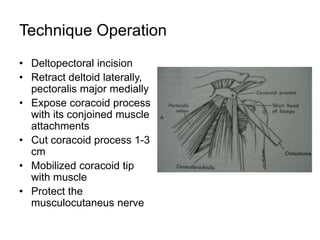
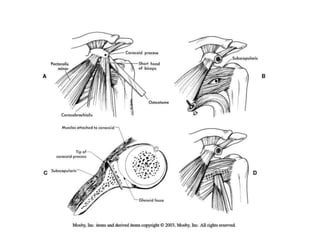
Technique Operation
• Deltopectoral incision
• Retract deltoid laterally,
pectoralis major medially
• Expose coracoid process
with its conjoined muscle
attachments
• Cut coracoid process 1-3
cm
• Mobilized coracoid tip
with muscle
• Protect the
musculocutaneus nerve
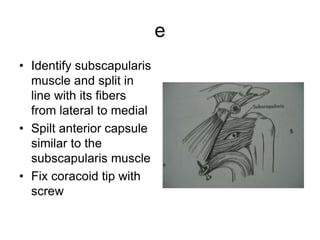
e
• Identify subscapularis
muscle and split in
line with its fibers
from lateral to medial
• Spilt anterior capsule
similar to the
subscapularis muscle
• Fix coracoid tip with
screw
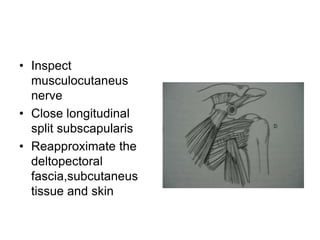
• Inspect
musculocutaneus
nerve
• Close longitudinal
split subscapularis
• Reapproximate the
deltopectoral
fascia,subcutaneus
tissue and skin
Post Operative
• Immobilized in sling,
• After 2-3 days sling removed, and start
pendulum type exercises
• After 3 weeks start to isometric exercise
• After 6 weeks increasing ROM without
weights
• Noncontact sport are permited after 3
months
• Contact sport after 6 months
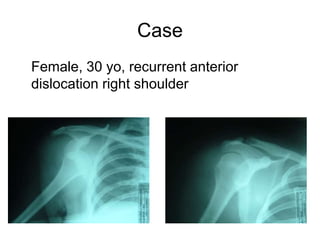
Case
Female, 30 yo, recurrent anterior
dislocation right shoulder
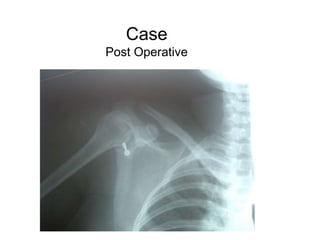
Case
Post Operative
Bristow.ppt

Bristow.ppt

  • 1.
  • 2.
    Introduction • The shoulder,by virtue of its anatomy & biomechanics: – most unstable & frequently dislocation – 50% of all dislocations – 95% anterior dislocation • Failure to immobilize for 3-4 weeks after reduction of initial treatment  recurrence
  • 3.
  • 4.
  • 5.
    Pathologic Anatomy • Bankart1938: – 2 types of acute dislocation: 1. Humeral head is forced through the capsule, antero- inferior is the weakest 2. Humeral head is forced through to anteriorly out of the glenoid cavity, tears not only fibrocartilegenous labrum, but also tears capsule and periosteum → Bankart lesion
  • 6.
    • Hill-Sachs lesion –Shoulder is dislocated anteriorly – Humeral head is impacted the rim of glenoid – Defect on postero lateral humeral head
  • 7.
    Surgical treatment • Anteriorinstability: – No single best procedure • Ideally, the procedure: 1. Low recurrence rate 2. Low complication rate 3. Low re-operation rate 4. No harm (arthritis) 5. Maintain motion 6. Applicable in most cases 7. Allows observation of the joint 8. Corrects the pathologic 9. Not to difficult
  • 8.
    Bristow operation • Thetransferred short head of the biceps & coracobrachialis muscles are placed to the anterior glenoid rim ( Havellius: “must be near not over anterior glenoid rim) – Good result : • Coracoid process < 5 mm medial to glenoid rim and inferior to transverse line glenoid • bony union • Disadvantages: – Internal rotation contracture – Pathologic condition is not corrected – Injury to n musculocutaneus – External rotation is limited Good result : • Coracoid process < 5 mm medial to glenoid rim and inferior to transverse line glenoid • Bony union
  • 9.
    Technique Operation • Deltopectoralincision • Retract deltoid laterally, pectoralis major medially • Expose coracoid process with its conjoined muscle attachments • Cut coracoid process 1-3 cm • Mobilized coracoid tip with muscle • Protect the musculocutaneus nerve
  • 10.
    e • Identify subscapularis muscleand split in line with its fibers from lateral to medial • Spilt anterior capsule similar to the subscapularis muscle • Fix coracoid tip with screw
  • 11.
    • Inspect musculocutaneus nerve • Closelongitudinal split subscapularis • Reapproximate the deltopectoral fascia,subcutaneus tissue and skin
  • 13.
    Post Operative • Immobilizedin sling, • After 2-3 days sling removed, and start pendulum type exercises • After 3 weeks start to isometric exercise • After 6 weeks increasing ROM without weights • Noncontact sport are permited after 3 months • Contact sport after 6 months
  • 14.
    Case Female, 30 yo,recurrent anterior dislocation right shoulder
  • 15.