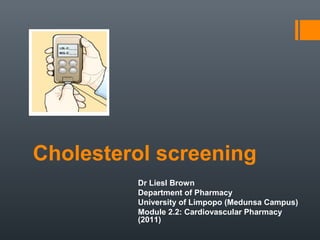
Cholesterol screening
         Dr Liesl Brown
         Department of Pharmacy
         University of Limpopo (Medunsa Campus)
         Module 2.2: Cardiovascular Pharmacy
         (2011)
Aim
How to screen for cholesterol in
 Community Pharmacy setting
Objectives
After this practical experience, you will be able to provide the
 answers to the following questions:

 WHAT is a cholesterol-screening test?
 WHO should have their cholesterol tested checked?
 HOW frequent should cholesterol be screened?
 WHAT is the importance of a cholesterol screening test?
 WHAT are the normal (reference) values of a cholesterol
  screening test?
 WHAT are the precautions that need to be taken by a pharmacist
        (operator) and by the subject (patient/volunteer)?
 HOW reliable are the results of a cholesterol screening test?
 WHAT factors can affect the screening results?
Hyperlipideamia (HLD)
Definition:
 Hyperlipideamia is a term used to describe all
    conditions characterized by high cholesterol
    levels

   Characterized by an increase in blood conc. of 1
    / > types of lipids (fats) in the blood (e.g.
    cholesterol, cholesterol esters, triglycerides,
    phospholipids)

    One of the main causes of:
     Atherosclerosis
     Coronary heart disease
Drugs that give rise to drug-
induced HLD

   Thiazide diuretics (LDL and total CHOL (TC)
    increase)
   Certain β-blockers (TG increase and HDL decreases)
   Progestins (TC increases)
   Glucocorticoids (TC increases)
   Anabolic steroids (TC increases and HDL decreases)
   Cyclosporine (TG and LDL increases)
   Isotretinoin (TG increases and HDL decreases)
   Large amounts of alcohol (TG increases)
   Oestrogen in oral contraceptives
Other factors that give rise to HLD


   Very high KJ diet
   Diet rich in (unsaturated) fats
   Diet rich in cholesterol
   Very low fibre diet
   Lack of exercises
   Smoking
   Moderate / high alcohol abuse
   High androgen levels (men > premenopausal
    women)
Determination & screening of
cholesterol
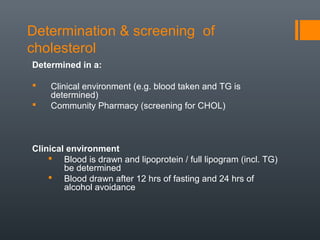
Determined in a:

   Clinical environment (e.g. blood taken and TG is
    determined)
   Community Pharmacy (screening for CHOL)


Clinical environment
     Blood is drawn and lipoprotein / full lipogram (incl. TG)
        be determined
     Blood drawn after 12 hrs of fasting and 24 hrs of
        alcohol avoidance
Determination & screening of
cholesterol
Community pharmacy (Screening for CHOL)

      CHOL is screened
      Only total CHOL is determined
      Units: mmol/L; mg/100 ml/ mg/dl (1 mmol =
       387 mg)
      Total CHOL represented as:
           Desired
           Moderately high
           Seriously high

      Above is linked to age
Determination & screening of
cholesterol
Other application locations:

     Doctor’s offices
     Medical clinics
     Homes
     Field Hospitals
Which persons’ total CHOL should be
tested?

   Patients with a personal history of CV disease

   Should there be a family history of CV disease – esp. in patients <
    50 years

   Children, should there be a family history of hyperlipoproteinemia

   Should there be evidence of DM, hypertension, serious obesity (BMI
    > 30), gout / smoking

   Women: 35-59 years of age with two/> risk factors* (*smoking,
    hypertension, obesity, DM, family history of CV disease &
    hypercholesterolemia)

   Men 35-59 years of age with one risk factor*

   Men: 20-34 years and 60-69 years of age, with 2/> risk factors*

   Adults > 20 years of age – non fasting CHOL screen done once
    every 5 years
Patient factors which influence TC
levels

   Posture/position of patient
   Food and alcohol ingestion
   Physical activity
   Recent cardiac conditions
   Pregnancy
   Gender
   Age
   Trauma/infection
   Biological (‘time of the day’) variation
Patient factors which influence TC
levels
    Posture/position of patient
     TC increases in the standing position
     Determinations done in the same position (sitting)
     Sitting for at least 5 min. prior to test, so that the effect
       can be stabilized

    Food and alcohol ingestion
     TC can be determined without patient fasting
     Dietary cholesterol will cause a small/insignificant
       increase in TC
     Alcohol ingestion will give rise to a modest decrease in
       TC

    Physical activity
     Strenuous physical activity 24 hrs prior to the
       screening lowers TG levels
     Above influences TC levels
Patient factors which influence TC
levels
    Recent cardiac conditions
       TC levels decrease sign. following a MI (for various days, until
        about 8 weeks)
       CHOL levels can also decrease following cardiac catheterization

    Pregnancy
       TC increases by 20 to 35%

    Gender
       After puberty: HDL levels are lower in men than women
                        TG and VLDL levels are higher in men than women
       After puberty: Oestrogen lowers LDL levels and increase HDL
        (women)
                       Androgens increase LDL and decreases HDL (men)
       During menstruation: TC lower during luteal phase than other
        stages of the menstrual cycle
Patient factors which influence TC
levels
    Age
     Birth to six months: plasma levels rise rapidly
       Childhood: plasma CHOL levels stay reasonably
       constant
       After puberty: plasma CHOL rises
       Adulthood: plasma CHOL reaches a peak:
            men: 50 to 60 yrs of age
            women: 60 to 70 yrs of age

    Trauma/infection
     Trauma: CHOL levels decrease by 40% and remain
        lowered for 5 to 6 weeks after the event
     Infection (bacterial / viral)/bad pain/operation: CHOL
        levels are lowered and remain lowered for 8 weeks
        after such events
Patient factors which influence TC levels
    Biological (‘time of the day’) variation
     During the day: TC variation of 2 to 3% during
       the day
     Seasonal variation: TC levels lower in summer
       than winter
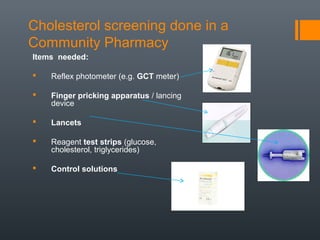
Cholesterol screening done in a
Community Pharmacy
Items needed:

   Reflex photometer (e.g. GCT meter)

   Finger pricking apparatus / lancing
    device

   Lancets

   Reagent test strips (glucose,
    cholesterol, triglycerides)

   Control solutions
Examples of different types of GTC-meters
Cholesterol screening done in a
Community Pharmacy
Calibration

    Calibration with a code strip serves to
     adjust the meter to a specific characteristics
     of the CHOL / GLUC / TG test strips used
    Code strips are wrapped individually in the
     pack of test strips purchased
     (!! Storage of the test strip in its wrapping
     and not in the test-strip vial – print on the
     code strip may impair the test strip quality
     and lead to erroneous results !!)
    Calibration must take place when:
     The meter is switched on for the first
          time
     Whenever new test strips are used
Cholesterol screening done in a
Community Pharmacy
Cholesterol screening done in a
Community Pharmacy
Cholesterol screening done in a
Community Pharmacy
Measurement procedures

   STEP 1: Wash and dry
    hands thoroughly. Rinse with
    clear water before
    commencing measurement
    (!! TG measurements – all
    creams and many soap
    products e.g. shower gels,
    shampoos) contain fat –
    leads to false results !!)

    STEP 2: Prepare lancing
     device
     Select penetration depth
        (e.g. ‘soft skin’ hands vs.
        ‘hard skin’ hands)
Cholesterol screening done in a
Community Pharmacy
Measurement procedures

    STEP 3: Switch on
     apparatus
     Word CHOL / GLUC / TG
        appears
     Corresponding code no.,
        time, and date appears
     When word CODE
        appears, the apparatus is
        ready for measurements

   STEP 4: Remove the test
    strip from its wrapping. Close
    vial immediately
Cholesterol screening done in a
Community Pharmacy
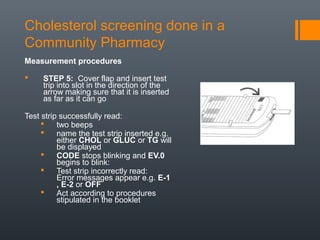
Measurement procedures

    STEP 5: Cover flap and insert test
     trip into slot in the direction of the
     arrow making sure that it is inserted
     as far as it can go

Test strip successfully read:
         two beeps
         name the test strip inserted e.g.
          either CHOL or GLUC or TG will
          be displayed
         CODE stops blinking and EV.0
          begins to blink:
         Test strip incorrectly read:
          Error messages appear e.g. E-1
          , E-2 or OFF
         Act according to procedures
          stipulated in the booklet
Cholesterol screening done in a
Community Pharmacy
   STEP 6: Open flap
       EV.O blinks on display together with
        measurement time: 180 sec (max) for
        TG (reaction time = 174 sec)

   STEP 7: Rub and kneed a fingertip to
    facilitate the withdrawal and application
    of blood

   STEP 8: Prick the massaged place on
    the fingertip with the lancing device
Cholesterol screening done in a
Community Pharmacy
Cholesterol screening done in a
Community Pharmacy
    STEP 9:
       Cover yellow test field completely
        with blood (otherwise falsely low
        results will be measured)

       If too little blood is applied, do
        not rub it in or apply second drip,
        repeat the measurement with a
        fresh test strip

       Allow hanging blood drop to form
        without applying too much
        pressure

       Carefully drop blood to yellow
        test field on top of strip without
        touching top of strip
Cholesterol screening done in a
    Community Pharmacy
     STEP 9 (cont.):

        If too little blood is applied, do not rub it in or apply second drip,
         repeat the measurement with a fresh test strip
Cholesterol screening done in a
Community Pharmacy
   STEP 10: Close the flap
    after applying the drop
Cholesterol screening done in a
    Community Pharmacy
     STEP 11: Meter counts down in seconds to 0.
      Last four sec is heard at the end of the
      measurement followed by a long beep
      Measured value (in mg/dl or mmol/l)
         appears on the display and EV.O blinks
      Measured values only within certain
         ranges:
          CHOL 150 – 300 mg/dl (3.88 - 7.76
             mmol/l)
          Blood GLC 20 – 600 mg/dl (1.1 – 33.3
             mmol/l)
          TG 70 – 600 mg/dl (0.80 – 6.86
             mmol/l)
          Above the ranges : HI shown
          Below the ranges: LO shown (also
             when too little blood is used)
          Open flap. Remove test strip
          Close flap and switch meter off
Cholesterol screening done in a
Community Pharmacy
Cholesterol Action Limits
Heart Foundation recommendations
SA Heart Foundation recommends the following classification
    for TC levels:

          <5.0 mmol/L – Desirable
          5-6.5 mmol/L – Moderate risk
          6.5-7.8 mmol/L – High Risk
          >7.8 mmol/L – Very high risk

      Recommended that > 1 test be done for confirmation
       (esp. moderate/high TC)

      TC screening can be done – fasting/non-fasting
       conditions
Factors influencing the accuracy of
results
Factors influencing the accuracy of results

   Instrumental factors
   Sampling
   Quality control procedures


   Instrumental factors

       Apparatus of Community Pharmacies compare well with
        apparatus in Clinical environments
       Comparing results: variation from 1 to 5% (Community Pharmacy
        results lower than standard operating laboratories results
Factors influencing the accuracy of
    results
     Sampling
      Has a strong influence on the accuracy of results
      Personnel have to be trained in the correct procedures
      Results of finger pricking sample vary about 4% from the
        venous puncture sample
      !! Finger should not be ‘milked’ at all – blood will then
        mix with the ECF and result in giving falsely low
        CHOL levels
      Capillary tube should not be pushed into the finger
Factors influencing the accuracy of
results
    Quality control procedures
     Standing correct quality SOP should be adhered to at all
       times
     Accuracy of the sample should be evaluated through the
       test of std solutions with a known CHOL level
        Should be done weekly / after 100 tests (which ever
            comes first)
        Records should be kept of the results and carefully
            studied
     Analyzers that do not comply with ≈ 5% or < standard
       precision, should be removed from service until repaired
     Comparing: venous puncture sample of same patient
       (screen test done in a Community Pharmacy) vs.
       laboratory (clinical setting)
     Optical system of the apparatus should be cleaned with
       70% alcohol
        Should not be used within 15 min. after the cleaning
            procedure
     Instruction manual should be strictly adhered to
References
   Davies, A, Blakeley, AGH and Kidd, C. Human Physiology. McGraw-
    Hill:Boston, Massachusetts

   Griesel, MS. Primary screening and monitoring services for
    pharmacists. PSSA Publications: Potchefstroom, Chapter 2, pp. 48-61

    Internet resources:
        http://www.diavant.com/diavant/CMSFront.html?pgid=3,1,5,0

       http://www.diavant.com/diavant/CMSFront.html?pgid=1,3,9,1

       http://www.roche-diagnostics.com/products_services/accutrend_gct.html


   SAMF, 9h edition, Section on Serum lipid-modifying agents
Hands on screening of cholesterol levels in
blood plasma using photometers
Hands on screening of cholesterol levels in
blood plasma using photometers
DE 519                                CE S522

                          CE


                           302B

TA N309


                                   VA
                                   520C

Cholesterol Screening

  • 1.
    Cholesterol screening Dr Liesl Brown Department of Pharmacy University of Limpopo (Medunsa Campus) Module 2.2: Cardiovascular Pharmacy (2011)
  • 2.
    Aim How to screenfor cholesterol in Community Pharmacy setting
  • 3.
    Objectives After this practicalexperience, you will be able to provide the answers to the following questions:  WHAT is a cholesterol-screening test?  WHO should have their cholesterol tested checked?  HOW frequent should cholesterol be screened?  WHAT is the importance of a cholesterol screening test?  WHAT are the normal (reference) values of a cholesterol screening test?  WHAT are the precautions that need to be taken by a pharmacist (operator) and by the subject (patient/volunteer)?  HOW reliable are the results of a cholesterol screening test?  WHAT factors can affect the screening results?
  • 4.
    Hyperlipideamia (HLD) Definition:  Hyperlipideamiais a term used to describe all conditions characterized by high cholesterol levels  Characterized by an increase in blood conc. of 1 / > types of lipids (fats) in the blood (e.g. cholesterol, cholesterol esters, triglycerides, phospholipids)  One of the main causes of:  Atherosclerosis  Coronary heart disease
  • 5.
    Drugs that giverise to drug- induced HLD  Thiazide diuretics (LDL and total CHOL (TC) increase)  Certain β-blockers (TG increase and HDL decreases)  Progestins (TC increases)  Glucocorticoids (TC increases)  Anabolic steroids (TC increases and HDL decreases)  Cyclosporine (TG and LDL increases)  Isotretinoin (TG increases and HDL decreases)  Large amounts of alcohol (TG increases)  Oestrogen in oral contraceptives
  • 6.
    Other factors thatgive rise to HLD  Very high KJ diet  Diet rich in (unsaturated) fats  Diet rich in cholesterol  Very low fibre diet  Lack of exercises  Smoking  Moderate / high alcohol abuse  High androgen levels (men > premenopausal women)
  • 7.
    Determination & screeningof cholesterol Determined in a:  Clinical environment (e.g. blood taken and TG is determined)  Community Pharmacy (screening for CHOL) Clinical environment  Blood is drawn and lipoprotein / full lipogram (incl. TG) be determined  Blood drawn after 12 hrs of fasting and 24 hrs of alcohol avoidance
  • 8.
    Determination & screeningof cholesterol Community pharmacy (Screening for CHOL)  CHOL is screened  Only total CHOL is determined  Units: mmol/L; mg/100 ml/ mg/dl (1 mmol = 387 mg)  Total CHOL represented as:  Desired  Moderately high  Seriously high  Above is linked to age
  • 9.
    Determination & screeningof cholesterol Other application locations:  Doctor’s offices  Medical clinics  Homes  Field Hospitals
  • 10.
    Which persons’ totalCHOL should be tested?  Patients with a personal history of CV disease  Should there be a family history of CV disease – esp. in patients < 50 years  Children, should there be a family history of hyperlipoproteinemia  Should there be evidence of DM, hypertension, serious obesity (BMI > 30), gout / smoking  Women: 35-59 years of age with two/> risk factors* (*smoking, hypertension, obesity, DM, family history of CV disease & hypercholesterolemia)  Men 35-59 years of age with one risk factor*  Men: 20-34 years and 60-69 years of age, with 2/> risk factors*  Adults > 20 years of age – non fasting CHOL screen done once every 5 years
  • 11.
    Patient factors whichinfluence TC levels  Posture/position of patient  Food and alcohol ingestion  Physical activity  Recent cardiac conditions  Pregnancy  Gender  Age  Trauma/infection  Biological (‘time of the day’) variation
  • 12.
    Patient factors whichinfluence TC levels  Posture/position of patient  TC increases in the standing position  Determinations done in the same position (sitting)  Sitting for at least 5 min. prior to test, so that the effect can be stabilized  Food and alcohol ingestion  TC can be determined without patient fasting  Dietary cholesterol will cause a small/insignificant increase in TC  Alcohol ingestion will give rise to a modest decrease in TC  Physical activity  Strenuous physical activity 24 hrs prior to the screening lowers TG levels  Above influences TC levels
  • 13.
    Patient factors whichinfluence TC levels  Recent cardiac conditions  TC levels decrease sign. following a MI (for various days, until about 8 weeks)  CHOL levels can also decrease following cardiac catheterization  Pregnancy  TC increases by 20 to 35%  Gender  After puberty: HDL levels are lower in men than women TG and VLDL levels are higher in men than women  After puberty: Oestrogen lowers LDL levels and increase HDL (women) Androgens increase LDL and decreases HDL (men)  During menstruation: TC lower during luteal phase than other stages of the menstrual cycle
  • 14.
    Patient factors whichinfluence TC levels  Age  Birth to six months: plasma levels rise rapidly Childhood: plasma CHOL levels stay reasonably constant After puberty: plasma CHOL rises Adulthood: plasma CHOL reaches a peak:  men: 50 to 60 yrs of age  women: 60 to 70 yrs of age  Trauma/infection  Trauma: CHOL levels decrease by 40% and remain lowered for 5 to 6 weeks after the event  Infection (bacterial / viral)/bad pain/operation: CHOL levels are lowered and remain lowered for 8 weeks after such events
  • 15.
    Patient factors whichinfluence TC levels  Biological (‘time of the day’) variation  During the day: TC variation of 2 to 3% during the day  Seasonal variation: TC levels lower in summer than winter
  • 16.
    Cholesterol screening donein a Community Pharmacy Items needed:  Reflex photometer (e.g. GCT meter)  Finger pricking apparatus / lancing device  Lancets  Reagent test strips (glucose, cholesterol, triglycerides)  Control solutions
  • 17.
    Examples of differenttypes of GTC-meters
  • 18.
    Cholesterol screening donein a Community Pharmacy Calibration  Calibration with a code strip serves to adjust the meter to a specific characteristics of the CHOL / GLUC / TG test strips used  Code strips are wrapped individually in the pack of test strips purchased (!! Storage of the test strip in its wrapping and not in the test-strip vial – print on the code strip may impair the test strip quality and lead to erroneous results !!)  Calibration must take place when:  The meter is switched on for the first time  Whenever new test strips are used
  • 19.
    Cholesterol screening donein a Community Pharmacy
  • 20.
    Cholesterol screening donein a Community Pharmacy
  • 21.
    Cholesterol screening donein a Community Pharmacy Measurement procedures  STEP 1: Wash and dry hands thoroughly. Rinse with clear water before commencing measurement (!! TG measurements – all creams and many soap products e.g. shower gels, shampoos) contain fat – leads to false results !!)  STEP 2: Prepare lancing device  Select penetration depth (e.g. ‘soft skin’ hands vs. ‘hard skin’ hands)
  • 22.
    Cholesterol screening donein a Community Pharmacy Measurement procedures  STEP 3: Switch on apparatus  Word CHOL / GLUC / TG appears  Corresponding code no., time, and date appears  When word CODE appears, the apparatus is ready for measurements  STEP 4: Remove the test strip from its wrapping. Close vial immediately
  • 23.
    Cholesterol screening donein a Community Pharmacy Measurement procedures  STEP 5: Cover flap and insert test trip into slot in the direction of the arrow making sure that it is inserted as far as it can go Test strip successfully read:  two beeps  name the test strip inserted e.g. either CHOL or GLUC or TG will be displayed  CODE stops blinking and EV.0 begins to blink:  Test strip incorrectly read: Error messages appear e.g. E-1 , E-2 or OFF  Act according to procedures stipulated in the booklet
  • 24.
    Cholesterol screening donein a Community Pharmacy  STEP 6: Open flap  EV.O blinks on display together with measurement time: 180 sec (max) for TG (reaction time = 174 sec)  STEP 7: Rub and kneed a fingertip to facilitate the withdrawal and application of blood  STEP 8: Prick the massaged place on the fingertip with the lancing device
  • 25.
    Cholesterol screening donein a Community Pharmacy
  • 26.
    Cholesterol screening donein a Community Pharmacy  STEP 9:  Cover yellow test field completely with blood (otherwise falsely low results will be measured)  If too little blood is applied, do not rub it in or apply second drip, repeat the measurement with a fresh test strip  Allow hanging blood drop to form without applying too much pressure  Carefully drop blood to yellow test field on top of strip without touching top of strip
  • 27.
    Cholesterol screening donein a Community Pharmacy  STEP 9 (cont.):  If too little blood is applied, do not rub it in or apply second drip, repeat the measurement with a fresh test strip
  • 28.
    Cholesterol screening donein a Community Pharmacy  STEP 10: Close the flap after applying the drop
  • 29.
    Cholesterol screening donein a Community Pharmacy  STEP 11: Meter counts down in seconds to 0. Last four sec is heard at the end of the measurement followed by a long beep  Measured value (in mg/dl or mmol/l) appears on the display and EV.O blinks  Measured values only within certain ranges:  CHOL 150 – 300 mg/dl (3.88 - 7.76 mmol/l)  Blood GLC 20 – 600 mg/dl (1.1 – 33.3 mmol/l)  TG 70 – 600 mg/dl (0.80 – 6.86 mmol/l)  Above the ranges : HI shown  Below the ranges: LO shown (also when too little blood is used)  Open flap. Remove test strip  Close flap and switch meter off
  • 30.
    Cholesterol screening donein a Community Pharmacy
  • 31.
  • 32.
    Heart Foundation recommendations SAHeart Foundation recommends the following classification for TC levels:  <5.0 mmol/L – Desirable  5-6.5 mmol/L – Moderate risk  6.5-7.8 mmol/L – High Risk  >7.8 mmol/L – Very high risk  Recommended that > 1 test be done for confirmation (esp. moderate/high TC)  TC screening can be done – fasting/non-fasting conditions
  • 33.
    Factors influencing theaccuracy of results Factors influencing the accuracy of results  Instrumental factors  Sampling  Quality control procedures  Instrumental factors  Apparatus of Community Pharmacies compare well with apparatus in Clinical environments  Comparing results: variation from 1 to 5% (Community Pharmacy results lower than standard operating laboratories results
  • 34.
    Factors influencing theaccuracy of results  Sampling  Has a strong influence on the accuracy of results  Personnel have to be trained in the correct procedures  Results of finger pricking sample vary about 4% from the venous puncture sample  !! Finger should not be ‘milked’ at all – blood will then mix with the ECF and result in giving falsely low CHOL levels  Capillary tube should not be pushed into the finger
  • 35.
    Factors influencing theaccuracy of results  Quality control procedures  Standing correct quality SOP should be adhered to at all times  Accuracy of the sample should be evaluated through the test of std solutions with a known CHOL level  Should be done weekly / after 100 tests (which ever comes first)  Records should be kept of the results and carefully studied  Analyzers that do not comply with ≈ 5% or < standard precision, should be removed from service until repaired  Comparing: venous puncture sample of same patient (screen test done in a Community Pharmacy) vs. laboratory (clinical setting)  Optical system of the apparatus should be cleaned with 70% alcohol  Should not be used within 15 min. after the cleaning procedure  Instruction manual should be strictly adhered to
  • 36.
    References  Davies, A, Blakeley, AGH and Kidd, C. Human Physiology. McGraw- Hill:Boston, Massachusetts  Griesel, MS. Primary screening and monitoring services for pharmacists. PSSA Publications: Potchefstroom, Chapter 2, pp. 48-61  Internet resources:  http://www.diavant.com/diavant/CMSFront.html?pgid=3,1,5,0  http://www.diavant.com/diavant/CMSFront.html?pgid=1,3,9,1  http://www.roche-diagnostics.com/products_services/accutrend_gct.html  SAMF, 9h edition, Section on Serum lipid-modifying agents
  • 37.
    Hands on screeningof cholesterol levels in blood plasma using photometers
  • 38.
    Hands on screeningof cholesterol levels in blood plasma using photometers DE 519 CE S522 CE 302B TA N309 VA 520C