Cholesterol Numbers: What Do They Mean
Cholesterol is a fat used by the body that is produced by the body
and that also comes from animal-based foods. Important numbers
to know are total cholesterol, HDL or good cholesterol, LDL or bad
cholesterol, and triglycerides.
What is cholesterol?
You probably have heard about cholesterol, but you might not be
sure exactly what it is. Cholesterol is a waxy type of fat, or lipid,
which moves throughout your body in your blood. Lipids are
substances that do not dissolve in water, so they do not come
apart in blood. Your body makes cholesterol, but you can also get
it from foods. Cholesterol is only found in foods that come from
animals.
Why is cholesterol important to our bodies?
Every cell in the body needs cholesterol, which helps the cell
membranes form the layers. These layers protect the contents of
the cell by acting as the gatekeeper to what things can enter or
leave the cell. It is made by the liver and is also used by the liver to
make bile, which helps you digest foods. Cholesterol is also
needed to make certain hormones and to produce vitamin D. Your
liver makes enough cholesterol to meet your body’s needs for
these important functions.
What are the types of cholesterol?
Cholesterol moves throughout the body carried by lipoproteins in
the blood. These lipoproteins include:
● Low-density lipoprotein (LDL) is one of the two main
lipoproteins. LDL is often called “the bad cholesterol.”
● High-density lipoprotein (HDL) is the other main lipoprotein.
HDL is often called “the good cholesterol.”
● Very-low-density lipoproteins (VLDL) are particles in the
blood that carry triglycerides.
If cholesterol is necessary, why do we have to worry about how much we have?
Having enough cholesterol to meet your needs is important.
Having too much cholesterol can cause problems. If your
cholesterol levels are high, the condition is called
hypercholesterolemia. If your cholesterol levels are low, the
condition is called hypocholesterolemia. It is not common to have
cholesterol levels that are too low, but it can happen.
What is low-density lipoprotein (LDL)?
You might think it is weird that the low-density lipoprotein is called
the bad cholesterol when we always hear about how we should
lower our cholesterol. However, LDL is “bad” because of what it
does.
LDL can build up on the walls of your arteries and make them
narrower. The fatty deposits form plaque that lines your arteries
and may cause blockages. This build-up is called atherosclerosis.
Arteries are the blood vessels that carry oxygen-rich blood away
from your heart to all other organs in the body.
The fats linked to LDL cholesterol levels and those that you
should minimize in your diet are called saturated fats and trans
fats. Saturated fats are solid or wax-like when they are at room
temperature. You mostly find saturated fats in products that come
from animals, such as meat, milk, cheese and butter.
Trans fats result when liquid fats are put through the
hydrogenation process to become solid. Trans fats are found in
fast foods and fried foods and are used to extend the shelf-life of
processed foods like cookies, crackers and baked goods.
What is high-density lipoprotein (HDL)?
HDL is called the “good cholesterol.” It's good because it carries
away other kinds of cholesterol, (including LDL), away from the
arteries. It might help to think of HDL as a delivery truck and LDL
as a dump truck. HDL drops off other types of cholesterol at the
liver to be removed from the body. It's believed that higher levels
of HDL reduce the risk for heart disease.
What kind of test measures cholesterol?
Everyone over the age of 20 should get their cholesterol levels
measured at least once every five years. Your healthcare provider
will order a blood test that will indicate how much cholesterol is
carried in your bloodstream. This test will give your cholesterol
levels. Your provider might also order what is called a lipid panel
or a lipid profile. The panel gives you the following numbers:
● Total cholesterol.
● LDL levels.
● HDL levels.
● VLDL levels and triglycerides.
● Non-HDL cholesterol.
● Ratio between cholesterol and HDL.
There are advanced tests that break down the size and shapes of
LDL cholesterol levels, and also give the LDL particle number, but
those are not normally ordered. Some test makers say that the
more advanced tests are better at indicating who is at risk for
heart disease, but most providers still feel that the usual tests are
adequate
How is the total cholesterol, or blood cholesterol, test done?
A blood test is a routine test. A phlebotomist is a person whose
job is to draw blood. Blood is usually drawn from the vein in your
arm. You will sit down and the phlebotomist will wrap a rubber
band around your upper arm so that the vein in your elbow sticks
out. Then they will use a needle to puncture the vein and remove
blood. The blood is sent to the lab to be examined.
You’ve probably been at health fairs where testing is offered. In
that case, the person performing the test takes a drop of blood
from your finger. The finger-stick test uses a small blade to poke a
hole in the tip of your finger to get the blood.
How do you prepare for a cholesterol test?
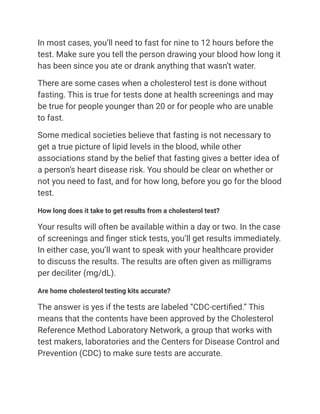
In most cases, you’ll need to fast for nine to 12 hours before the
test. Make sure you tell the person drawing your blood how long it
has been since you ate or drank anything that wasn’t water.
There are some cases when a cholesterol test is done without
fasting. This is true for tests done at health screenings and may
be true for people younger than 20 or for people who are unable
to fast.
Some medical societies believe that fasting is not necessary to
get a true picture of lipid levels in the blood, while other
associations stand by the belief that fasting gives a better idea of
a person’s heart disease risk. You should be clear on whether or
not you need to fast, and for how long, before you go for the blood
test.
How long does it take to get results from a cholesterol test?
Your results will often be available within a day or two. In the case
of screenings and finger stick tests, you’ll get results immediately.
In either case, you’ll want to speak with your healthcare provider
to discuss the results. The results are often given as milligrams
per deciliter (mg/dL).
Are home cholesterol testing kits accurate?
The answer is yes if the tests are labeled “CDC-certified.” This
means that the contents have been approved by the Cholesterol
Reference Method Laboratory Network, a group that works with
test makers, laboratories and the Centers for Disease Control and
Prevention (CDC) to make sure tests are accurate.
For home tests, you will still need to fast for 12 hours and to
obtain blood for testing. Some kits come with packages for
mailing to a lab for results. Other kits have a monitor so you can
get the results at home. The cost of such home kits varies.
What are normal levels of cholesterol?
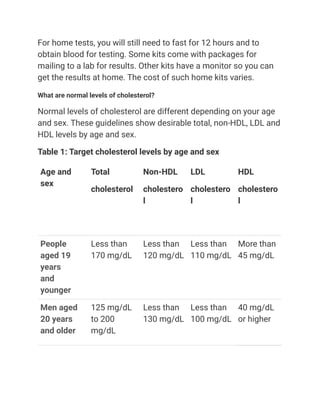
Normal levels of cholesterol are different depending on your age
and sex. These guidelines show desirable total, non-HDL, LDL and
HDL levels by age and sex.
Table 1: Target cholesterol levels by age and sex
Age and
sex
Total
cholesterol
Non-HDL
cholestero
l
LDL
cholestero
l
HDL
cholestero
l
People
aged 19
years
and
younger
Less than
170 mg/dL
Less than
120 mg/dL
Less than
110 mg/dL
More than
45 mg/dL
Men aged
20 years
and older
125 mg/dL
to 200
mg/dL
Less than
130 mg/dL
Less than
100 mg/dL
40 mg/dL
or higher
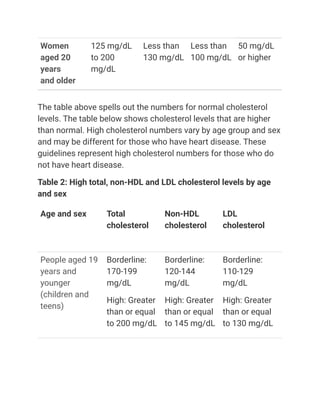
Women
aged 20
years
and older
125 mg/dL
to 200
mg/dL
Less than
130 mg/dL
Less than
100 mg/dL
50 mg/dL
or higher
The table above spells out the numbers for normal cholesterol
levels. The table below shows cholesterol levels that are higher
than normal. High cholesterol numbers vary by age group and sex
and may be different for those who have heart disease. These
guidelines represent high cholesterol numbers for those who do
not have heart disease.
Table 2: High total, non-HDL and LDL cholesterol levels by age
and sex
Age and sex Total
cholesterol
Non-HDL
cholesterol
LDL
cholesterol
People aged 19
years and
younger
(children and
teens)
Borderline:
170-199
mg/dL
High: Greater
than or equal
to 200 mg/dL
Borderline:
120-144
mg/dL
High: Greater
than or equal
to 145 mg/dL
Borderline:
110-129
mg/dL
High: Greater
than or equal
to 130 mg/dL
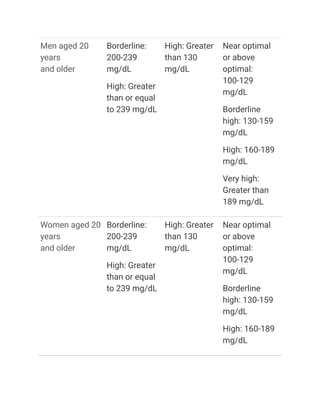
Men aged 20
years
and older
Borderline:
200-239
mg/dL
High: Greater
than or equal
to 239 mg/dL
​
High: Greater
than 130
mg/dL
Near optimal
or above
optimal:
100-129
mg/dL
Borderline
high: 130-159
mg/dL
High: 160-189
mg/dL
Very high:
Greater than
189 mg/dL
Women aged 20
years
and older
Borderline:
200-239
mg/dL
High: Greater
than or equal
to 239 mg/dL
High: Greater
than 130
mg/dL
Near optimal
or above
optimal:
100-129
mg/dL
Borderline
high: 130-159
mg/dL
High: 160-189
mg/dL
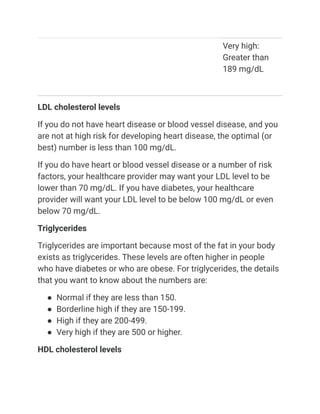
Very high:
Greater than
189 mg/dL
LDL cholesterol levels
If you do not have heart disease or blood vessel disease, and you
are not at high risk for developing heart disease, the optimal (or
best) number is less than 100 mg/dL.
If you do have heart or blood vessel disease or a number of risk
factors, your healthcare provider may want your LDL level to be
lower than 70 mg/dL. If you have diabetes, your healthcare
provider will want your LDL level to be below 100 mg/dL or even
below 70 mg/dL.
Triglycerides
Triglycerides are important because most of the fat in your body
exists as triglycerides. These levels are often higher in people
who have diabetes or who are obese. For triglycerides, the details
that you want to know about the numbers are:
● Normal if they are less than 150.
● Borderline high if they are 150-199.
● High if they are 200-499.
● Very high if they are 500 or higher.
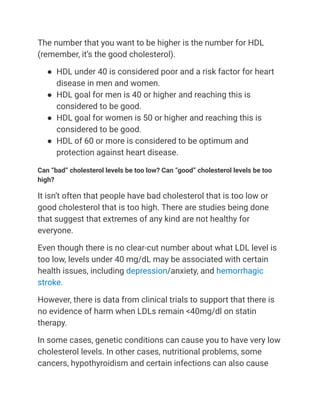
HDL cholesterol levels
The number that you want to be higher is the number for HDL
(remember, it’s the good cholesterol).
● HDL under 40 is considered poor and a risk factor for heart
disease in men and women.
● HDL goal for men is 40 or higher and reaching this is
considered to be good.
● HDL goal for women is 50 or higher and reaching this is
considered to be good.
● HDL of 60 or more is considered to be optimum and
protection against heart disease.
Can “bad” cholesterol levels be too low? Can “good” cholesterol levels be too
high?
It isn’t often that people have bad cholesterol that is too low or
good cholesterol that is too high. There are studies being done
that suggest that extremes of any kind are not healthy for
everyone.
Even though there is no clear-cut number about what LDL level is
too low, levels under 40 mg/dL may be associated with certain
health issues, including depression/anxiety, and hemorrhagic
stroke.
However, there is data from clinical trials to support that there is
no evidence of harm when LDLs remain <40mg/dl on statin
therapy.
In some cases, genetic conditions can cause you to have very low
cholesterol levels. In other cases, nutritional problems, some
cancers, hypothyroidism and certain infections can also cause
low cholesterol levels. In any of these types of situations, the
underlying issues need to be addressed.
In terms of having too much of a good thing, researchers are
studying the effects of too much HDL, the good cholesterol. No
conclusions have been reached, but there have been studies into
the possible relationship between high HDL and cancer, and a
greater risk of heart attack among the high risk. Excessively high
HDL may be dysfunctional HDL and not protective.
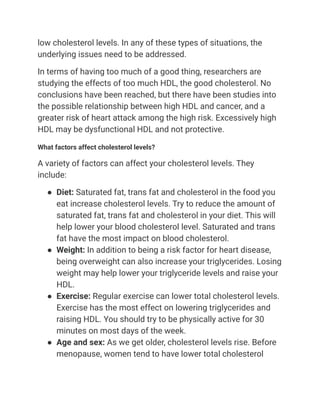
What factors affect cholesterol levels?
A variety of factors can affect your cholesterol levels. They
include:
● Diet: Saturated fat, trans fat and cholesterol in the food you
eat increase cholesterol levels. Try to reduce the amount of
saturated fat, trans fat and cholesterol in your diet. This will
help lower your blood cholesterol level. Saturated and trans
fat have the most impact on blood cholesterol.
● Weight: In addition to being a risk factor for heart disease,
being overweight can also increase your triglycerides. Losing
weight may help lower your triglyceride levels and raise your
HDL.
● Exercise: Regular exercise can lower total cholesterol levels.
Exercise has the most effect on lowering triglycerides and
raising HDL. You should try to be physically active for 30
minutes on most days of the week.
● Age and sex: As we get older, cholesterol levels rise. Before
menopause, women tend to have lower total cholesterol
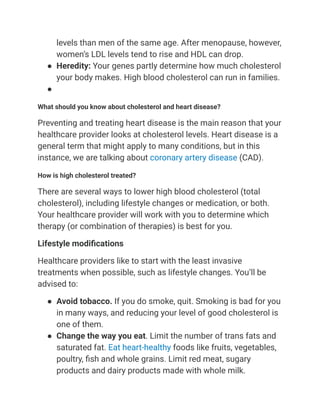
levels than men of the same age. After menopause, however,
women’s LDL levels tend to rise and HDL can drop.
● Heredity: Your genes partly determine how much cholesterol
your body makes. High blood cholesterol can run in families.
●
What should you know about cholesterol and heart disease?
Preventing and treating heart disease is the main reason that your
healthcare provider looks at cholesterol levels. Heart disease is a
general term that might apply to many conditions, but in this
instance, we are talking about coronary artery disease (CAD).
How is high cholesterol treated?
There are several ways to lower high blood cholesterol (total
cholesterol), including lifestyle changes or medication, or both.
Your healthcare provider will work with you to determine which
therapy (or combination of therapies) is best for you.
Lifestyle modifications
Healthcare providers like to start with the least invasive
treatments when possible, such as lifestyle changes. You’ll be
advised to:
● Avoid tobacco. If you do smoke, quit. Smoking is bad for you
in many ways, and reducing your level of good cholesterol is
one of them.
● Change the way you eat. Limit the number of trans fats and
saturated fat. Eat heart-healthy foods like fruits, vegetables,
poultry, fish and whole grains. Limit red meat, sugary
products and dairy products made with whole milk.
● Get more exercise. Try to get about 150 minutes of physical
activity every week, or about 30 minutes per day for most
days of the week.
● Keep a healthy weight. If you need to lose weight, talk to
your healthcare provider about safe ways to do this. You’ll
see results even before you reach your ideal weight. Losing
even 10% of your body weight makes a difference in your
cholesterol levels.
● Reduce the effect of negative emotions. Learn healthy ways
to deal with anger, stress or other negative emotions.
● Control blood sugar and blood pressure. Make sure you
follow your healthcare provider’s instructions for blood sugar
levels, especially if you have diabetes, and for keeping blood
pressure in the healthy range.
Medications
There are several different types of medications that are designed
to treat high cholesterol levels.
Statin medications are one of the most well-known categories of
cholesterol drugs. Statins work by reducing the amount of
cholesterol produced by the liver. Statins lower blood cholesterol
and may help reduce the risk of heart attacks and strokes, which
is one reason why they are so widely prescribed. Statins that are
available in the U.S. include:
● Atorvastatin (Lipitor®).
● Fluvastatin (Lescol®, Lescol XL®).
● Lovastatin (Mevacor®, Altoprev®).
● Pravastatin (Pravachol®).
● Rosuvastatin(Crestor®).
● Simvastatin (Zocor®).
● Pitavastatin (Livalo®, Zypitamag®).
Statins are also available in combination medications, such as
Advicor® (lovastatin and niacin), Caduet® (atorvastatin and
amlodipine) and Vytorin® (simvastatin and ezetimibe).
Statins are not advisable for every person with high cholesterol,
especially for those with liver problems. Although side effects are
not very common, they can include muscle pain, higher blood
glucose levels and memory issues.
Bile acid sequestrants or bile acid-binding drugs are another
class of medications that treat high cholesterol levels. The drugs,
also called resins, cling to the bile acid, which then cannot be
used for digestion. In response, the liver makes more bile by using
up more cholesterol. These drugs include:
● Cholestyramine (Questran®, Questran® Light).
● Colestipol (Colestid®).
● ColesevelamHcl (WelChol®).
Resins are not appropriate for everyone. These drugs also have
side effects such as constipation and stomach pain.
Fibrates are also called fibric acid derivatives. They are more
effective at cutting triglyceride levels than reducing LDL
cholesterol. They may also help to boost levels of HDL
cholesterol. These products include:
● Fenofibrate (Antara®, Tricor®, Fenoglide®, Fibricor®,
Lipidil®, Lipofen®, Trilipix® and Triglide®)
● Gemfibrozil (Lopid®)
Other classes of drugs that healthcare providers might suggest to
decrease LDL cholesterol include:
● PCSK9 inhibitors, including alirocumab and evolocumab.
● Selective cholesterol absorption inhibitors, such as
ezetimibe (Zetia®).
● Adenosine triphosphate-citrate lyase (ACL) inhibitors, such
as bempedoic acid (Nexletol®).
● Omega 3 fatty acids and fatty acid esters.
● Nicotinic acid, also known as niacin.
You might be given a prescription for these medicines if you are
taking a statin and have not been able to reduce LDL to levels that
your provider feels are low enough.
For people who are not helped enough by lifestyle changes and
medication, often those with a genetic issue, there is a process
called lipoprotein apheresis. This means using equipment to
remove lipoproteins from blood and plasma and then return the
blood and plasma to the body. This process might be combined
with some of the new drug treatments.
What complications are possible if you don’t treat high cholesterol levels in your
blood?
The main reason to treat high cholesterol is to prevent or treat
coronary heart disease (CHD), also called coronary artery disease
or CAD. CHD happens when heart is not able to get enough
oxygen-rich blood to function well and kills more people in the
U.S. than any other cause of death. CHD usually refers to the large
arteries, but there is also a condition called coronary
microvascular disease that affects the small vessels and causes
damage.
Can you get rid of cholesterol deposits?
Researchers are working on ways to eliminate plaque (cholesterol
deposits) from coronary arteries. One method that has been
proposed involves using combinations of medicines (statins and
PCSK9 inhibitors) in healthy people aged 25 to 55 years. It is
suggested that getting the levels of cholesterol down very low will
allow arteries to clear up and heal up.
Several researchers believe that the way to reverse heart disease
and prevent it in the first place is found in a whole-food,
plant-based diet. Studies have been done that have shown that
limiting nutrition to whole foods that are plant-based have been
successful in reducing blood cholesterol and even, in some cases,
lessening plaque buildup.
How can you prevent high cholesterol levels and coronary heart disease (CHD)?
Prevention methods are very much the same as treatment
methods. First, don’t smoke. If you do smoke, make plans to quit
now. Find ways to add physical activity to each of your days. Take
steps to keep your weight in a healthy range. Eat well. Consider
following the Mediterranean diet. It is the only diet proven to
reduce the risk of heart disease. Take care of any other medical
conditions you might have by following your healthcare provider’s
advice and instructions. Learn to really relax and calm down.
When should you contact your healthcare provider about your cholesterol
levels?
In truth, your healthcare provider will probably talk to you about
your numbers first. As always, contact your provider if you have
any new or worsening pain or other uncomfortable feelings. Make
sure you know what medications you take and what they are
expected to do. Call the provider if you have a reaction to the
medicine.
Before you go to the office, and after you have had a cholesterol
test, it helps to have a list of questions prepared about your test
results and any proposed treatment.
A note from Cleveland Clinic
When considering cholesterol numbers, it’s important to
remember that you really have the ability to make those numbers
go in your favor. What you choose to eat, how much you are able
to move and how you deal with life’s ups and downs are things
that you can influence.
SHARE Facebook Twitter LinkedIn EmailPrint
Last reviewed by a Cleveland Clinic medical professional on
07/31/2020.
References
Get useful, helpful and relevant health + wellness information
Health Essentials logo stacked.
ENEWS
Cholesterol Numbers_ What Do They Mean.pdf

Cholesterol Numbers_ What Do They Mean.pdf

  • 1.
    Cholesterol Numbers: WhatDo They Mean Cholesterol is a fat used by the body that is produced by the body and that also comes from animal-based foods. Important numbers to know are total cholesterol, HDL or good cholesterol, LDL or bad cholesterol, and triglycerides. What is cholesterol? You probably have heard about cholesterol, but you might not be sure exactly what it is. Cholesterol is a waxy type of fat, or lipid, which moves throughout your body in your blood. Lipids are substances that do not dissolve in water, so they do not come apart in blood. Your body makes cholesterol, but you can also get it from foods. Cholesterol is only found in foods that come from animals. Why is cholesterol important to our bodies? Every cell in the body needs cholesterol, which helps the cell membranes form the layers. These layers protect the contents of the cell by acting as the gatekeeper to what things can enter or leave the cell. It is made by the liver and is also used by the liver to make bile, which helps you digest foods. Cholesterol is also needed to make certain hormones and to produce vitamin D. Your liver makes enough cholesterol to meet your body’s needs for these important functions.
  • 2.
    What are thetypes of cholesterol? What are the types of cholesterol? Cholesterol moves throughout the body carried by lipoproteins in the blood. These lipoproteins include: ● Low-density lipoprotein (LDL) is one of the two main lipoproteins. LDL is often called “the bad cholesterol.” ● High-density lipoprotein (HDL) is the other main lipoprotein. HDL is often called “the good cholesterol.” ● Very-low-density lipoproteins (VLDL) are particles in the blood that carry triglycerides. If cholesterol is necessary, why do we have to worry about how much we have? Having enough cholesterol to meet your needs is important. Having too much cholesterol can cause problems. If your cholesterol levels are high, the condition is called hypercholesterolemia. If your cholesterol levels are low, the condition is called hypocholesterolemia. It is not common to have cholesterol levels that are too low, but it can happen. What is low-density lipoprotein (LDL)? You might think it is weird that the low-density lipoprotein is called the bad cholesterol when we always hear about how we should lower our cholesterol. However, LDL is “bad” because of what it does.
  • 3.
    LDL can buildup on the walls of your arteries and make them narrower. The fatty deposits form plaque that lines your arteries and may cause blockages. This build-up is called atherosclerosis. Arteries are the blood vessels that carry oxygen-rich blood away from your heart to all other organs in the body. The fats linked to LDL cholesterol levels and those that you should minimize in your diet are called saturated fats and trans fats. Saturated fats are solid or wax-like when they are at room temperature. You mostly find saturated fats in products that come from animals, such as meat, milk, cheese and butter. Trans fats result when liquid fats are put through the hydrogenation process to become solid. Trans fats are found in fast foods and fried foods and are used to extend the shelf-life of processed foods like cookies, crackers and baked goods. What is high-density lipoprotein (HDL)? HDL is called the “good cholesterol.” It's good because it carries away other kinds of cholesterol, (including LDL), away from the arteries. It might help to think of HDL as a delivery truck and LDL as a dump truck. HDL drops off other types of cholesterol at the liver to be removed from the body. It's believed that higher levels of HDL reduce the risk for heart disease. What kind of test measures cholesterol? Everyone over the age of 20 should get their cholesterol levels measured at least once every five years. Your healthcare provider will order a blood test that will indicate how much cholesterol is carried in your bloodstream. This test will give your cholesterol
  • 4.
    levels. Your providermight also order what is called a lipid panel or a lipid profile. The panel gives you the following numbers: ● Total cholesterol. ● LDL levels. ● HDL levels. ● VLDL levels and triglycerides. ● Non-HDL cholesterol. ● Ratio between cholesterol and HDL. There are advanced tests that break down the size and shapes of LDL cholesterol levels, and also give the LDL particle number, but those are not normally ordered. Some test makers say that the more advanced tests are better at indicating who is at risk for heart disease, but most providers still feel that the usual tests are adequate How is the total cholesterol, or blood cholesterol, test done? A blood test is a routine test. A phlebotomist is a person whose job is to draw blood. Blood is usually drawn from the vein in your arm. You will sit down and the phlebotomist will wrap a rubber band around your upper arm so that the vein in your elbow sticks out. Then they will use a needle to puncture the vein and remove blood. The blood is sent to the lab to be examined. You’ve probably been at health fairs where testing is offered. In that case, the person performing the test takes a drop of blood from your finger. The finger-stick test uses a small blade to poke a hole in the tip of your finger to get the blood. How do you prepare for a cholesterol test?
  • 5.
    In most cases,you’ll need to fast for nine to 12 hours before the test. Make sure you tell the person drawing your blood how long it has been since you ate or drank anything that wasn’t water. There are some cases when a cholesterol test is done without fasting. This is true for tests done at health screenings and may be true for people younger than 20 or for people who are unable to fast. Some medical societies believe that fasting is not necessary to get a true picture of lipid levels in the blood, while other associations stand by the belief that fasting gives a better idea of a person’s heart disease risk. You should be clear on whether or not you need to fast, and for how long, before you go for the blood test. How long does it take to get results from a cholesterol test? Your results will often be available within a day or two. In the case of screenings and finger stick tests, you’ll get results immediately. In either case, you’ll want to speak with your healthcare provider to discuss the results. The results are often given as milligrams per deciliter (mg/dL). Are home cholesterol testing kits accurate? The answer is yes if the tests are labeled “CDC-certified.” This means that the contents have been approved by the Cholesterol Reference Method Laboratory Network, a group that works with test makers, laboratories and the Centers for Disease Control and Prevention (CDC) to make sure tests are accurate.
  • 6.
    For home tests,you will still need to fast for 12 hours and to obtain blood for testing. Some kits come with packages for mailing to a lab for results. Other kits have a monitor so you can get the results at home. The cost of such home kits varies. What are normal levels of cholesterol? Normal levels of cholesterol are different depending on your age and sex. These guidelines show desirable total, non-HDL, LDL and HDL levels by age and sex. Table 1: Target cholesterol levels by age and sex Age and sex Total cholesterol Non-HDL cholestero l LDL cholestero l HDL cholestero l People aged 19 years and younger Less than 170 mg/dL Less than 120 mg/dL Less than 110 mg/dL More than 45 mg/dL Men aged 20 years and older 125 mg/dL to 200 mg/dL Less than 130 mg/dL Less than 100 mg/dL 40 mg/dL or higher
  • 7.
    Women aged 20 years and older 125mg/dL to 200 mg/dL Less than 130 mg/dL Less than 100 mg/dL 50 mg/dL or higher The table above spells out the numbers for normal cholesterol levels. The table below shows cholesterol levels that are higher than normal. High cholesterol numbers vary by age group and sex and may be different for those who have heart disease. These guidelines represent high cholesterol numbers for those who do not have heart disease. Table 2: High total, non-HDL and LDL cholesterol levels by age and sex Age and sex Total cholesterol Non-HDL cholesterol LDL cholesterol People aged 19 years and younger (children and teens) Borderline: 170-199 mg/dL High: Greater than or equal to 200 mg/dL Borderline: 120-144 mg/dL High: Greater than or equal to 145 mg/dL Borderline: 110-129 mg/dL High: Greater than or equal to 130 mg/dL
  • 8.
    Men aged 20 years andolder Borderline: 200-239 mg/dL High: Greater than or equal to 239 mg/dL ​ High: Greater than 130 mg/dL Near optimal or above optimal: 100-129 mg/dL Borderline high: 130-159 mg/dL High: 160-189 mg/dL Very high: Greater than 189 mg/dL Women aged 20 years and older Borderline: 200-239 mg/dL High: Greater than or equal to 239 mg/dL High: Greater than 130 mg/dL Near optimal or above optimal: 100-129 mg/dL Borderline high: 130-159 mg/dL High: 160-189 mg/dL
  • 9.
    Very high: Greater than 189mg/dL LDL cholesterol levels If you do not have heart disease or blood vessel disease, and you are not at high risk for developing heart disease, the optimal (or best) number is less than 100 mg/dL. If you do have heart or blood vessel disease or a number of risk factors, your healthcare provider may want your LDL level to be lower than 70 mg/dL. If you have diabetes, your healthcare provider will want your LDL level to be below 100 mg/dL or even below 70 mg/dL. Triglycerides Triglycerides are important because most of the fat in your body exists as triglycerides. These levels are often higher in people who have diabetes or who are obese. For triglycerides, the details that you want to know about the numbers are: ● Normal if they are less than 150. ● Borderline high if they are 150-199. ● High if they are 200-499. ● Very high if they are 500 or higher. HDL cholesterol levels
  • 10.
    The number thatyou want to be higher is the number for HDL (remember, it’s the good cholesterol). ● HDL under 40 is considered poor and a risk factor for heart disease in men and women. ● HDL goal for men is 40 or higher and reaching this is considered to be good. ● HDL goal for women is 50 or higher and reaching this is considered to be good. ● HDL of 60 or more is considered to be optimum and protection against heart disease. Can “bad” cholesterol levels be too low? Can “good” cholesterol levels be too high? It isn’t often that people have bad cholesterol that is too low or good cholesterol that is too high. There are studies being done that suggest that extremes of any kind are not healthy for everyone. Even though there is no clear-cut number about what LDL level is too low, levels under 40 mg/dL may be associated with certain health issues, including depression/anxiety, and hemorrhagic stroke. However, there is data from clinical trials to support that there is no evidence of harm when LDLs remain <40mg/dl on statin therapy. In some cases, genetic conditions can cause you to have very low cholesterol levels. In other cases, nutritional problems, some cancers, hypothyroidism and certain infections can also cause
  • 11.
    low cholesterol levels.In any of these types of situations, the underlying issues need to be addressed. In terms of having too much of a good thing, researchers are studying the effects of too much HDL, the good cholesterol. No conclusions have been reached, but there have been studies into the possible relationship between high HDL and cancer, and a greater risk of heart attack among the high risk. Excessively high HDL may be dysfunctional HDL and not protective. What factors affect cholesterol levels? A variety of factors can affect your cholesterol levels. They include: ● Diet: Saturated fat, trans fat and cholesterol in the food you eat increase cholesterol levels. Try to reduce the amount of saturated fat, trans fat and cholesterol in your diet. This will help lower your blood cholesterol level. Saturated and trans fat have the most impact on blood cholesterol. ● Weight: In addition to being a risk factor for heart disease, being overweight can also increase your triglycerides. Losing weight may help lower your triglyceride levels and raise your HDL. ● Exercise: Regular exercise can lower total cholesterol levels. Exercise has the most effect on lowering triglycerides and raising HDL. You should try to be physically active for 30 minutes on most days of the week. ● Age and sex: As we get older, cholesterol levels rise. Before menopause, women tend to have lower total cholesterol
  • 12.
    levels than menof the same age. After menopause, however, women’s LDL levels tend to rise and HDL can drop. ● Heredity: Your genes partly determine how much cholesterol your body makes. High blood cholesterol can run in families. ● What should you know about cholesterol and heart disease? Preventing and treating heart disease is the main reason that your healthcare provider looks at cholesterol levels. Heart disease is a general term that might apply to many conditions, but in this instance, we are talking about coronary artery disease (CAD). How is high cholesterol treated? There are several ways to lower high blood cholesterol (total cholesterol), including lifestyle changes or medication, or both. Your healthcare provider will work with you to determine which therapy (or combination of therapies) is best for you. Lifestyle modifications Healthcare providers like to start with the least invasive treatments when possible, such as lifestyle changes. You’ll be advised to: ● Avoid tobacco. If you do smoke, quit. Smoking is bad for you in many ways, and reducing your level of good cholesterol is one of them. ● Change the way you eat. Limit the number of trans fats and saturated fat. Eat heart-healthy foods like fruits, vegetables, poultry, fish and whole grains. Limit red meat, sugary products and dairy products made with whole milk.
  • 13.
    ● Get moreexercise. Try to get about 150 minutes of physical activity every week, or about 30 minutes per day for most days of the week. ● Keep a healthy weight. If you need to lose weight, talk to your healthcare provider about safe ways to do this. You’ll see results even before you reach your ideal weight. Losing even 10% of your body weight makes a difference in your cholesterol levels. ● Reduce the effect of negative emotions. Learn healthy ways to deal with anger, stress or other negative emotions. ● Control blood sugar and blood pressure. Make sure you follow your healthcare provider’s instructions for blood sugar levels, especially if you have diabetes, and for keeping blood pressure in the healthy range. Medications There are several different types of medications that are designed to treat high cholesterol levels. Statin medications are one of the most well-known categories of cholesterol drugs. Statins work by reducing the amount of cholesterol produced by the liver. Statins lower blood cholesterol and may help reduce the risk of heart attacks and strokes, which is one reason why they are so widely prescribed. Statins that are available in the U.S. include: ● Atorvastatin (Lipitor®). ● Fluvastatin (Lescol®, Lescol XL®). ● Lovastatin (Mevacor®, Altoprev®). ● Pravastatin (Pravachol®).
  • 14.
    ● Rosuvastatin(Crestor®). ● Simvastatin(Zocor®). ● Pitavastatin (Livalo®, Zypitamag®). Statins are also available in combination medications, such as Advicor® (lovastatin and niacin), Caduet® (atorvastatin and amlodipine) and Vytorin® (simvastatin and ezetimibe). Statins are not advisable for every person with high cholesterol, especially for those with liver problems. Although side effects are not very common, they can include muscle pain, higher blood glucose levels and memory issues. Bile acid sequestrants or bile acid-binding drugs are another class of medications that treat high cholesterol levels. The drugs, also called resins, cling to the bile acid, which then cannot be used for digestion. In response, the liver makes more bile by using up more cholesterol. These drugs include: ● Cholestyramine (Questran®, Questran® Light). ● Colestipol (Colestid®). ● ColesevelamHcl (WelChol®). Resins are not appropriate for everyone. These drugs also have side effects such as constipation and stomach pain. Fibrates are also called fibric acid derivatives. They are more effective at cutting triglyceride levels than reducing LDL cholesterol. They may also help to boost levels of HDL cholesterol. These products include:
  • 15.
    ● Fenofibrate (Antara®,Tricor®, Fenoglide®, Fibricor®, Lipidil®, Lipofen®, Trilipix® and Triglide®) ● Gemfibrozil (Lopid®) Other classes of drugs that healthcare providers might suggest to decrease LDL cholesterol include: ● PCSK9 inhibitors, including alirocumab and evolocumab. ● Selective cholesterol absorption inhibitors, such as ezetimibe (Zetia®). ● Adenosine triphosphate-citrate lyase (ACL) inhibitors, such as bempedoic acid (Nexletol®). ● Omega 3 fatty acids and fatty acid esters. ● Nicotinic acid, also known as niacin. You might be given a prescription for these medicines if you are taking a statin and have not been able to reduce LDL to levels that your provider feels are low enough. For people who are not helped enough by lifestyle changes and medication, often those with a genetic issue, there is a process called lipoprotein apheresis. This means using equipment to remove lipoproteins from blood and plasma and then return the blood and plasma to the body. This process might be combined with some of the new drug treatments. What complications are possible if you don’t treat high cholesterol levels in your blood? The main reason to treat high cholesterol is to prevent or treat coronary heart disease (CHD), also called coronary artery disease or CAD. CHD happens when heart is not able to get enough
  • 16.
    oxygen-rich blood tofunction well and kills more people in the U.S. than any other cause of death. CHD usually refers to the large arteries, but there is also a condition called coronary microvascular disease that affects the small vessels and causes damage. Can you get rid of cholesterol deposits? Researchers are working on ways to eliminate plaque (cholesterol deposits) from coronary arteries. One method that has been proposed involves using combinations of medicines (statins and PCSK9 inhibitors) in healthy people aged 25 to 55 years. It is suggested that getting the levels of cholesterol down very low will allow arteries to clear up and heal up. Several researchers believe that the way to reverse heart disease and prevent it in the first place is found in a whole-food, plant-based diet. Studies have been done that have shown that limiting nutrition to whole foods that are plant-based have been successful in reducing blood cholesterol and even, in some cases, lessening plaque buildup. How can you prevent high cholesterol levels and coronary heart disease (CHD)? Prevention methods are very much the same as treatment methods. First, don’t smoke. If you do smoke, make plans to quit now. Find ways to add physical activity to each of your days. Take steps to keep your weight in a healthy range. Eat well. Consider following the Mediterranean diet. It is the only diet proven to reduce the risk of heart disease. Take care of any other medical conditions you might have by following your healthcare provider’s advice and instructions. Learn to really relax and calm down.
  • 17.
    When should youcontact your healthcare provider about your cholesterol levels? In truth, your healthcare provider will probably talk to you about your numbers first. As always, contact your provider if you have any new or worsening pain or other uncomfortable feelings. Make sure you know what medications you take and what they are expected to do. Call the provider if you have a reaction to the medicine. Before you go to the office, and after you have had a cholesterol test, it helps to have a list of questions prepared about your test results and any proposed treatment. A note from Cleveland Clinic When considering cholesterol numbers, it’s important to remember that you really have the ability to make those numbers go in your favor. What you choose to eat, how much you are able to move and how you deal with life’s ups and downs are things that you can influence. SHARE Facebook Twitter LinkedIn EmailPrint Last reviewed by a Cleveland Clinic medical professional on 07/31/2020. References Get useful, helpful and relevant health + wellness information Health Essentials logo stacked. ENEWS