Dyslipidemia and Exercise
Dyslipidemia Abnormal blood lipid / lipoprotein levels Severe dyslipidemia linked to genetic defects in cholesterol metabolism Less severe cases  response to other diseases or combining a specific genetic pattern with various environmental exposures (diet, smoking)
Overview of Pathophysiology TG and CHL move b/t the intestine, liver and tissue A variety of environmental, genetic and pathologic factors alter TG and CHL transport  High lipoprotein concentrations may alter pathways influence CAD risk Combined these factors are related to elevated lipid levels known as DYSLIPIDEMIA
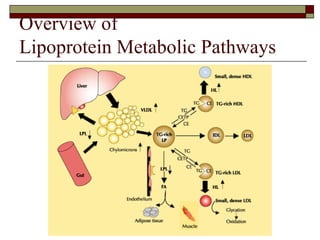
Overview of  Lipoprotein Metabolic Pathways
Lipids Lipids non-soluble in plasma so combines with proteins to form lipoproteins  Chylomicrons: from absorption of dietary triglyceride Very-low-density-Lipoprotein (VLDL): synthesized in the liver, primary transport mechanism for synthesized triglyceride Low-density-Lipoprotein (LDL): final stage of breakdown VLDL, carier of cholesterol High-density-Lipoprotein (HDL): involved in reverse transport of cholesterol
Triglycerides Composed of  three fatty acids  and a  glycerol  molecule Several functions Membrane structure Eich energy source 9 calories of energy for each fat gram Found in all cell membranes
Cholesterol Waxy, fat-like substance produced by  liver  Absorbed by intestine during  food digestion Dietary cholesterol is present in most food derived from animals (not in plants) Essential to body  to build cell membranes, produce sex hormones, form bile acids (necessary for digestion of fats) Travels thru  bloodstream  as part of a larger particle called  Lipoproteins  classified based on thickness or density of the surrounding protein shell
LDL-”the bad guy” VLDL molecule with most of TriG removed;  all of the chol remains Consumed by the body cells as  building blocks  for hormones and cell membranes Excess LDL in blood forms deposits (plaques) on artery walls which narrows them Susceptible to  oxidation  by free radicals which enhances the  atherosclerotic  process Blood clots as plaques grow leading to atherosclerosis,  HD and heart attacks
HDL-”the good guy” Transports excess cholesterol back to the liver to be excreted (reverse chol transport) Exists in two main subclasses:  HDL2 and HDL 3
Forms of Dyslipidemia Hypercholesterolemia  elevated blood cholesterol levels Hypertriglyceridemia elevated triglyceride levels Hyperlipidema  elevated chol and TG Hyperlipoproteinemia  elevated lipoproteins Hypoalphalipoprotein syndrome  low LDL
Causative Factors for Dyslipidemia Heredity/Genetics Advanced age Gender Smoking Excessive alcohol consumption Fat diet Over fat Certain meds Steroids DM, Hypothyroid Menopause
Video http://www.youtube.com/watch?v=hRx_i9npTDU&feature=related http://www.youtube.com/watch?v=QfaoHAIUy0g http://www.youtube.com/watch?v=R1DAjRixZKg&feature=related http://www.youtube.com/watch?v=-WhADd1GKtA&feature=related
Forms Dyslipidemia: Lipids General term for  fat molecules  from  diet  or  produced by the body :  either in the form of  triglycerides or cholesterol Required for absorption of fat soluble vitamins (A,D,E,K) Insoluble  in blood and must combine with proteins (lipoproteins) to circulate Excess is harmful and increases  risk Some is  essential  for good health and normal functioning
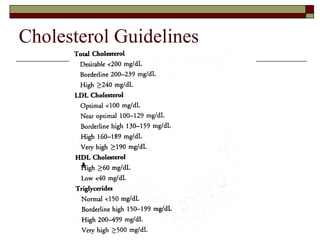
Cholesterol Guidelines
Diagnostic and Lab Evaluations Identified thru a  complete blood lipid profile  following a 12-hr fast Most lab reports will provide:  total cholesterol, HDL, LDL and TG National Cholesterol Education Program (NCEP) goals for both individual  management  of CHOL Recommends: adults over 20 have their total chol measured 1 time every 5 years
Treatments Intensity of treatment depends on patients overall risk status for disease Diet and exercise-3 to 6 months Pharmacological management-considered an adjunct to the above
Types of Medications Used Statins -most effective and most commonly used Nicotinic acid-comes with several side effects:  skin irritation/flushing Bile Acid Sequestrants (reduce uptake) Fibric Acids (increase HDL) Probucol-inhibits LDL oxidation Estrogen Replacement Therapy (ERT)
Impact of Statins Powerful effect to lower LDL and raise HDL by blocking an enzyme needed to produce cholesterol in the liver Typical improvements:  18-55% decrease in LDL, 5-15% increase in HDL and 7-30% decrease in TG
Statins: Cholesterol Lowering Drugs Name Brands Crestor Lipitor* Altacor Zocor* Pravachol Zetia Advicor Mevacor* Additional Benefits: Improved endothelial function Decrease vascular inflammation Decrease potential for thrombosis Promote plaque stabilization
Complications HTN -drive LDL particles into the arterial wall with higher pressures Diabetes  makes LDL particles more likely to stick within the arterial wall Smoking -makes arterial endothelium more permeable (vulnerable) Metabolic Syndrome
Effects of Exercise on Lipid Metabolism Lowering of TG’s is most consistent effect of acute and chronic exercise (better skeletal muscle uptake) HDL’s often increased with sustained aerobic exercise (exp of > 1200 cal/wk) Weight/fat loss is required for significant reductions in LDL and TCH Total amount of PA is more important than intensity to induce benefits No conclusive evidence for resistance training  impact Improvement in lipid profiles is NOT universal w/ EX
Exercise and PA Guidelines Check with individuals physician (meds and coexisting conditions) Emphasize aerobic endurance and caloric exp 3-5x/wk for 20-60 min Progress as tolerated to 5-7x/wk for 40-60 min Ex with higher volume and intensity shown to increase HDL
Ex Rx Guidelines Mode:  aerobic large muscle activities Intensity:  moderate (40-75% of FC) Frequency:  most days of week-volume  Duration:  as tolerated, the more the better-can accumulate thru day Total energy expenditure = 1000-1600 kcal/wk
Dyslipidemia: Exercise Prescription Frequency:  ≥5 d·wk -1  to maximize caloric expenditure Intensity:  40% to 75% VO 2 R or HRR Time:  30 to 60 min·d -1 . However, to promote or maintain weight loss, 50 to 60 min/d -1  or more of daily exercise is recommended. Performance of intermittent exercise of at least 10 minutes in duration to accumulate these duration recommendations is an effective alternative to continuous exercise.  .
Dyslipidemia: Exercise Prescription (cont.) Type:  the primary mode should be aerobic physical activities that involve the large muscle groups. As part of a balanced exercise program, resistance training exercise should be incorporated. People with dyslipidemia without comorbidities may follow the resistance training guidelines for healthy adults.

Ped488 dyslipidemia s 11

  • 1.
  • 2.
    Dyslipidemia Abnormal bloodlipid / lipoprotein levels Severe dyslipidemia linked to genetic defects in cholesterol metabolism Less severe cases response to other diseases or combining a specific genetic pattern with various environmental exposures (diet, smoking)
  • 3.
    Overview of PathophysiologyTG and CHL move b/t the intestine, liver and tissue A variety of environmental, genetic and pathologic factors alter TG and CHL transport High lipoprotein concentrations may alter pathways influence CAD risk Combined these factors are related to elevated lipid levels known as DYSLIPIDEMIA
  • 4.
    Overview of Lipoprotein Metabolic Pathways
  • 5.
    Lipids Lipids non-solublein plasma so combines with proteins to form lipoproteins Chylomicrons: from absorption of dietary triglyceride Very-low-density-Lipoprotein (VLDL): synthesized in the liver, primary transport mechanism for synthesized triglyceride Low-density-Lipoprotein (LDL): final stage of breakdown VLDL, carier of cholesterol High-density-Lipoprotein (HDL): involved in reverse transport of cholesterol
  • 6.
    Triglycerides Composed of three fatty acids and a glycerol molecule Several functions Membrane structure Eich energy source 9 calories of energy for each fat gram Found in all cell membranes
  • 7.
    Cholesterol Waxy, fat-likesubstance produced by liver Absorbed by intestine during food digestion Dietary cholesterol is present in most food derived from animals (not in plants) Essential to body to build cell membranes, produce sex hormones, form bile acids (necessary for digestion of fats) Travels thru bloodstream as part of a larger particle called Lipoproteins classified based on thickness or density of the surrounding protein shell
  • 8.
    LDL-”the bad guy”VLDL molecule with most of TriG removed; all of the chol remains Consumed by the body cells as building blocks for hormones and cell membranes Excess LDL in blood forms deposits (plaques) on artery walls which narrows them Susceptible to oxidation by free radicals which enhances the atherosclerotic process Blood clots as plaques grow leading to atherosclerosis, HD and heart attacks
  • 9.
    HDL-”the good guy”Transports excess cholesterol back to the liver to be excreted (reverse chol transport) Exists in two main subclasses: HDL2 and HDL 3
  • 10.
    Forms of DyslipidemiaHypercholesterolemia elevated blood cholesterol levels Hypertriglyceridemia elevated triglyceride levels Hyperlipidema elevated chol and TG Hyperlipoproteinemia elevated lipoproteins Hypoalphalipoprotein syndrome low LDL
  • 11.
    Causative Factors forDyslipidemia Heredity/Genetics Advanced age Gender Smoking Excessive alcohol consumption Fat diet Over fat Certain meds Steroids DM, Hypothyroid Menopause
  • 12.
    Video http://www.youtube.com/watch?v=hRx_i9npTDU&feature=related http://www.youtube.com/watch?v=QfaoHAIUy0ghttp://www.youtube.com/watch?v=R1DAjRixZKg&feature=related http://www.youtube.com/watch?v=-WhADd1GKtA&feature=related
  • 13.
    Forms Dyslipidemia: LipidsGeneral term for fat molecules from diet or produced by the body : either in the form of triglycerides or cholesterol Required for absorption of fat soluble vitamins (A,D,E,K) Insoluble in blood and must combine with proteins (lipoproteins) to circulate Excess is harmful and increases risk Some is essential for good health and normal functioning
  • 14.
  • 15.
    Diagnostic and LabEvaluations Identified thru a complete blood lipid profile following a 12-hr fast Most lab reports will provide: total cholesterol, HDL, LDL and TG National Cholesterol Education Program (NCEP) goals for both individual management of CHOL Recommends: adults over 20 have their total chol measured 1 time every 5 years
  • 16.
    Treatments Intensity oftreatment depends on patients overall risk status for disease Diet and exercise-3 to 6 months Pharmacological management-considered an adjunct to the above
  • 17.
    Types of MedicationsUsed Statins -most effective and most commonly used Nicotinic acid-comes with several side effects: skin irritation/flushing Bile Acid Sequestrants (reduce uptake) Fibric Acids (increase HDL) Probucol-inhibits LDL oxidation Estrogen Replacement Therapy (ERT)
  • 18.
    Impact of StatinsPowerful effect to lower LDL and raise HDL by blocking an enzyme needed to produce cholesterol in the liver Typical improvements: 18-55% decrease in LDL, 5-15% increase in HDL and 7-30% decrease in TG
  • 19.
    Statins: Cholesterol LoweringDrugs Name Brands Crestor Lipitor* Altacor Zocor* Pravachol Zetia Advicor Mevacor* Additional Benefits: Improved endothelial function Decrease vascular inflammation Decrease potential for thrombosis Promote plaque stabilization
  • 20.
    Complications HTN -driveLDL particles into the arterial wall with higher pressures Diabetes makes LDL particles more likely to stick within the arterial wall Smoking -makes arterial endothelium more permeable (vulnerable) Metabolic Syndrome
  • 21.
    Effects of Exerciseon Lipid Metabolism Lowering of TG’s is most consistent effect of acute and chronic exercise (better skeletal muscle uptake) HDL’s often increased with sustained aerobic exercise (exp of > 1200 cal/wk) Weight/fat loss is required for significant reductions in LDL and TCH Total amount of PA is more important than intensity to induce benefits No conclusive evidence for resistance training impact Improvement in lipid profiles is NOT universal w/ EX
  • 22.
    Exercise and PAGuidelines Check with individuals physician (meds and coexisting conditions) Emphasize aerobic endurance and caloric exp 3-5x/wk for 20-60 min Progress as tolerated to 5-7x/wk for 40-60 min Ex with higher volume and intensity shown to increase HDL
  • 23.
    Ex Rx GuidelinesMode: aerobic large muscle activities Intensity: moderate (40-75% of FC) Frequency: most days of week-volume Duration: as tolerated, the more the better-can accumulate thru day Total energy expenditure = 1000-1600 kcal/wk
  • 24.
    Dyslipidemia: Exercise PrescriptionFrequency: ≥5 d·wk -1 to maximize caloric expenditure Intensity: 40% to 75% VO 2 R or HRR Time: 30 to 60 min·d -1 . However, to promote or maintain weight loss, 50 to 60 min/d -1 or more of daily exercise is recommended. Performance of intermittent exercise of at least 10 minutes in duration to accumulate these duration recommendations is an effective alternative to continuous exercise. .
  • 25.
    Dyslipidemia: Exercise Prescription(cont.) Type: the primary mode should be aerobic physical activities that involve the large muscle groups. As part of a balanced exercise program, resistance training exercise should be incorporated. People with dyslipidemia without comorbidities may follow the resistance training guidelines for healthy adults.

Editor's Notes

  • #15 Triglycerides <150 Normal 150-199 Borderline high 200-499 High > Very High Total Cholesterol <200 Desia
  • #18 New class of agents: HMG-CoA reductase inhibitors (Lovastatin (mevacor) and Simvastatin (zocor) reduce levels of total and LDL-chol more powerfully and simultaneously boost HDL Bile Acids-administered as a powdered resin dissolved in liquid or as tablets. Resins inhibit the intestinal reabsorption of bile and its transport in the portal circulation to the liver. This loss of bile stimulates the up-regulation of hepatic (liver) LDL receptor activity that reduces plasma LDL levels. These drugs are most effective when give with the fattiest meal as it encounters bile in the gut. Major side effects are constipation, bloating and gas and they interfere with absorption of fat soluble vitamins. Fibric Acids-reduces elevated TG levels-well tolerated with few side effects Nicotinic acid-useful for those with low HDL or elevated TG-main effect is to inhibit lipolysis which reduces the quantity of plasma FFA and their available transport to the lever which reduces their synthesis into TG
  • #20 *These drugs have a powerful effect on lowering LDL and raising HDL by blocking an enzyme needed to produce cholesterol in the liver