Valvular Heart Surgery

Valvular Heart Disease is still very common in our country. Most
of these are due to Rheumatic Heart Disease. Normally these
start with recurrent throat infection and joint pains in childhood /
teen age. These young adults develop valve problems.
Valve surgeries can be done either by a conventional route or by
a minimally invasive route. Dr S K Sinha, who is Director CTVS
Max Hospital Saket at Delhi, India, specializes in doing valve
surgeries by minimally invasive route. Here instead of a mid line
sternum splitting incision a small incision on the right chest
beneath the breast is made and with the help of specialized
instruments valve is repaired or replaced.
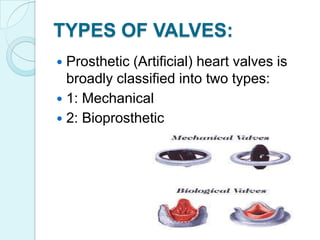
TYPES OF VALVES:
Prosthetic (Artificial) heart valves is
broadly classified into two types:
 1: Mechanical
 2: Bioprosthetic

1: Mechanical Valve


Mechanical Valves are valves which
are made of Pyrolite carbon(one of
the strongest material known to
mankind). It is used in younger
patients, will last a lifetime. However it
is important that patients take Warfarin
or Acitrome lifelong. Below 50 years of
age this is valve of choice. Exception
being female patients who want to
undergo pregnancy.
2: Bioprosthetic valves


Bioprosthetics or biological valves are
made up of biological tissue
(Pericardium), best suited for patients
above 50years of age.
Warfarin/Acetrome is not needed. This
valve is supposed to last 20-25 years
hence not recommended in patients
below 50 years of age.
Care after a Valve
Replacement.
It is important that patients take care of themselves
after a Valve Replacement. Most common problems to
be prevented are:
 Infection – The most dreaded complication. Infection
occurring in the valve is dangerous. Any fever is a sign
of infection. Toothache is dreaded as bacteria,
circulates in the blood, hence oral hygiene is of utmost
importance. Dr S K Sinha recommends morning
evening brushing of teeth, Hot Saline Gargles and
Listerine/betadine mouth wash before going to bed.
Slightest toothache antibiotics are recommended.
 Urinary tract infection, skin infection in the form of
recurrent boils and abscess should be prevented and if
it occurs early antibiotics therapy is a must.

Contact Dr SK Sinha
Max Super Speciality Hospital (
East Block),1 & 2 Press, Enclave
Rd, Saket, New Delhi, DL 110017,
India
 Mobile:09811321668
 Email: sksinha@maxhealthcare.co
m


Valvular heart surgery

  • 1.
    Valvular Heart Surgery ValvularHeart Disease is still very common in our country. Most of these are due to Rheumatic Heart Disease. Normally these start with recurrent throat infection and joint pains in childhood / teen age. These young adults develop valve problems. Valve surgeries can be done either by a conventional route or by a minimally invasive route. Dr S K Sinha, who is Director CTVS Max Hospital Saket at Delhi, India, specializes in doing valve surgeries by minimally invasive route. Here instead of a mid line sternum splitting incision a small incision on the right chest beneath the breast is made and with the help of specialized instruments valve is repaired or replaced.
  • 2.
    TYPES OF VALVES: Prosthetic(Artificial) heart valves is broadly classified into two types:  1: Mechanical  2: Bioprosthetic 
  • 3.
    1: Mechanical Valve  MechanicalValves are valves which are made of Pyrolite carbon(one of the strongest material known to mankind). It is used in younger patients, will last a lifetime. However it is important that patients take Warfarin or Acitrome lifelong. Below 50 years of age this is valve of choice. Exception being female patients who want to undergo pregnancy.
  • 4.
    2: Bioprosthetic valves  Bioprostheticsor biological valves are made up of biological tissue (Pericardium), best suited for patients above 50years of age. Warfarin/Acetrome is not needed. This valve is supposed to last 20-25 years hence not recommended in patients below 50 years of age.
  • 5.
    Care after aValve Replacement. It is important that patients take care of themselves after a Valve Replacement. Most common problems to be prevented are:  Infection – The most dreaded complication. Infection occurring in the valve is dangerous. Any fever is a sign of infection. Toothache is dreaded as bacteria, circulates in the blood, hence oral hygiene is of utmost importance. Dr S K Sinha recommends morning evening brushing of teeth, Hot Saline Gargles and Listerine/betadine mouth wash before going to bed. Slightest toothache antibiotics are recommended.  Urinary tract infection, skin infection in the form of recurrent boils and abscess should be prevented and if it occurs early antibiotics therapy is a must. 
  • 6.
    Contact Dr SKSinha Max Super Speciality Hospital ( East Block),1 & 2 Press, Enclave Rd, Saket, New Delhi, DL 110017, India  Mobile:09811321668  Email: sksinha@maxhealthcare.co m 