
ESI SCHEME AND CGHS
Mrs. Namita Batra Guin
Associate Professor
Deptt. of Community Health Nursing
ESI SCHEME
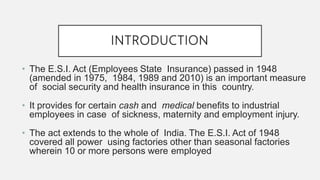
INTRODUCTION
• The E.S.I. Act (Employees State Insurance) passed in 1948
(amended in 1975, 1984, 1989 and 2010) is an important measure
of social security and health insurance in this country.
• It provides for certain cash and medical benefits to industrial
employees in case of sickness, maternity and employment injury.
• The act extends to the whole of India. The E.S.I. Act of 1948
covered all power using factories other than seasonal factories
wherein 10 or more persons were employed
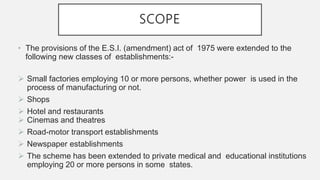
SCOPE
• The provisions of the E.S.I. (amendment) act of 1975 were extended to the
following new classes of establishments:-
 Small factories employing 10 or more persons, whether power is used in the
process of manufacturing or not.
 Shops
 Hotel and restaurants
 Cinemas and theatres
 Road-motor transport establishments
 Newspaper establishments
 The scheme has been extended to private medical and educational institutions
employing 20 or more persons in some states.
BENEFITS TO EMPLOYEES
 Medical benefits
 Sickness benefits
 Maternity benefits
 Disablement benefits
 Dependant’s benefits
 Funeral expenses
 Rehabilitation allowance
MEDICAL BENEFITS
 DIRECT PATTERN: In areas having a concentration of 1000 or more employee’s
family units, service dispensaries are established with full time medical and
paramedical personnel.
• In areas where the employees are less than 750, part time ESI dispensaries are
established.
• If the residential concentration of employees is scattered over a long distance,
mobile dispensaries are established.
 INDIRECT PATTERN/ PANEL SYSTEM: Registered medical practitioners
designated as Insurance Medical Practitioners are appointed to provide
medical care.
SICKNESS BENEFITS
 EXTENDED SICKNESS BENEFIT: In addition to 91 days of sickness benefit,
insured persons suffering from certain long-term diseases are entitled to
extended sickness benefit, for a maximum period of 2 years. 34 diseases for
which extended sickness benefit with effect from 1.1.2000 is payable, in case
where the insured person has been in continuous employment for 2 years.
 ENHANCED SICKNESS BENEFIT: is payable to insured women for 14 days
for tubectomy and for 7 days in case of vasectomy in respect of male IPs.
The amount payable is double the standard sickness benefit
MATERNITY BENEFIT
 The benefit is payable in cash to an insured women for
confinement/miscarriage or sickness arising out of pregnancy/
confinement or premature birth of child or miscarriage.
 For confinement, the duration of benefit is 12 week(84 days), for
miscarriage 6 weeks and for sickness arising out of confinement etc.
30 days.
 The benefit is allowed at about full wages.
 The rate of confinement expenses has been increased from Rs. 2,500
to 5,000 per confinement.
DISABLEMENT BENEFIT
The Act provides for cash payment , besides free medical
treatment, in the event of temporary or permanent disablement as a
result of employment injury as well as occupational diseases.
The rate of temporary disablement benefit is about 90 percent of the
wages as long as the temporary disablement lasts.
In case of total permanent disablement, the insured person is given life
pension worked out on the basis of loss of earning capacity
determined by a medical officer
DEPENDANT’S BENEFIT
 In case of death, as a result of employment injury, the dependants of
an insured person are eligible for periodical payments.
 Pension at the rate of 90% of the wages is payable, shared by
dependants in a fixed ratio, on monthly basis in accordance with the
prescribed share.
 An eligible son or daughter is entitled to dependant’s benefit up to the
age of 18; the benefit is withdrawn if the daughter marries earlier.
FUNERAL EXPENSES
 Funeral benefit is a cash payment payable on the death of an insured
person towards the expenses on his funeral, the amount not
exceeding Rs. 10,000.
REHABILITATION
 On monthly payment of Rs. 10, the insured person and his family
members continue to get medical treatment after permanent
disablement or retirement
BENEFITS TO EMPLOYER
 Exemption from the applicability of Workmen’s Compensation
Act, 1923.
 Exemption from Maternity Benefit Act, 1961.
 Exemption from payment of medical allowance to employees and
their dependent's or arranging for their medical care.
 Rebate under the Income Tax Act on contribution deposited in the
ESI account.
 Healthy work-force
CGHS SCHEME
INTRODUCTION
• Central Government Health Scheme is providing comprehensive
medical care to the Central Government employees and pensioners
enrolled under the scheme.
• It was introduced in Delhi in 1954.
• CGHS is the model Health care facility provider for Central
Government employees & Pensioners and is unique of its kind due
to the large volume of beneficiary base, and open-ended generous
approach of providing health care.
OBJECTIVES
• To give extensive medical facilities too
central government employees and their
family members
• To save the government from heavy
expenses on medical refund.
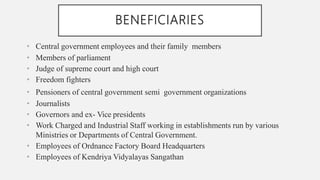
BENEFICIARIES
• Central government employees and their family members
• Members of parliament
• Judge of supreme court and high court
• Freedom fighters
• Pensioners of central government semi government organizations
• Journalists
• Governors and ex- Vice presidents
• Work Charged and Industrial Staff working in establishments run by various
Ministries or Departments of Central Government.
• Employees of Ordnance Factory Board Headquarters
• Employees of Kendriya Vidyalayas Sangathan
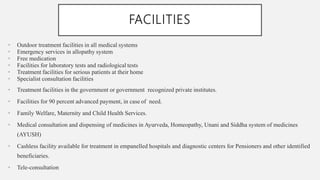
FACILITIES
• Outdoor treatment facilities in all medical systems
• Emergency services in allopathy system
• Free medication
• Facilities for laboratory tests and radiological tests
• Treatment facilities for serious patients at their home
• Specialist consultation facilities
• Treatment facilities in the government or government recognized private institutes.
• Facilities for 90 percent advanced payment, in case of need.
• Family Welfare, Maternity and Child Health Services.
• Medical consultation and dispensing of medicines in Ayurveda, Homeopathy, Unani and Siddha system of medicines
(AYUSH)
• Cashless facility available for treatment in empanelled hospitals and diagnostic centers for Pensioners and other identified
beneficiaries.
• Tele-consultation
THANK YOU

Esi and cghs

  • 1.
    ESI SCHEME ANDCGHS Mrs. Namita Batra Guin Associate Professor Deptt. of Community Health Nursing
  • 2.
  • 3.
    INTRODUCTION • The E.S.I.Act (Employees State Insurance) passed in 1948 (amended in 1975, 1984, 1989 and 2010) is an important measure of social security and health insurance in this country. • It provides for certain cash and medical benefits to industrial employees in case of sickness, maternity and employment injury. • The act extends to the whole of India. The E.S.I. Act of 1948 covered all power using factories other than seasonal factories wherein 10 or more persons were employed
  • 4.
    SCOPE • The provisionsof the E.S.I. (amendment) act of 1975 were extended to the following new classes of establishments:-  Small factories employing 10 or more persons, whether power is used in the process of manufacturing or not.  Shops  Hotel and restaurants  Cinemas and theatres  Road-motor transport establishments  Newspaper establishments  The scheme has been extended to private medical and educational institutions employing 20 or more persons in some states.
  • 5.
    BENEFITS TO EMPLOYEES Medical benefits  Sickness benefits  Maternity benefits  Disablement benefits  Dependant’s benefits  Funeral expenses  Rehabilitation allowance
  • 6.
    MEDICAL BENEFITS  DIRECTPATTERN: In areas having a concentration of 1000 or more employee’s family units, service dispensaries are established with full time medical and paramedical personnel. • In areas where the employees are less than 750, part time ESI dispensaries are established. • If the residential concentration of employees is scattered over a long distance, mobile dispensaries are established.  INDIRECT PATTERN/ PANEL SYSTEM: Registered medical practitioners designated as Insurance Medical Practitioners are appointed to provide medical care.
  • 7.
    SICKNESS BENEFITS  EXTENDEDSICKNESS BENEFIT: In addition to 91 days of sickness benefit, insured persons suffering from certain long-term diseases are entitled to extended sickness benefit, for a maximum period of 2 years. 34 diseases for which extended sickness benefit with effect from 1.1.2000 is payable, in case where the insured person has been in continuous employment for 2 years.  ENHANCED SICKNESS BENEFIT: is payable to insured women for 14 days for tubectomy and for 7 days in case of vasectomy in respect of male IPs. The amount payable is double the standard sickness benefit
  • 8.
    MATERNITY BENEFIT  Thebenefit is payable in cash to an insured women for confinement/miscarriage or sickness arising out of pregnancy/ confinement or premature birth of child or miscarriage.  For confinement, the duration of benefit is 12 week(84 days), for miscarriage 6 weeks and for sickness arising out of confinement etc. 30 days.  The benefit is allowed at about full wages.  The rate of confinement expenses has been increased from Rs. 2,500 to 5,000 per confinement.
  • 9.
    DISABLEMENT BENEFIT The Actprovides for cash payment , besides free medical treatment, in the event of temporary or permanent disablement as a result of employment injury as well as occupational diseases. The rate of temporary disablement benefit is about 90 percent of the wages as long as the temporary disablement lasts. In case of total permanent disablement, the insured person is given life pension worked out on the basis of loss of earning capacity determined by a medical officer
  • 10.
    DEPENDANT’S BENEFIT  Incase of death, as a result of employment injury, the dependants of an insured person are eligible for periodical payments.  Pension at the rate of 90% of the wages is payable, shared by dependants in a fixed ratio, on monthly basis in accordance with the prescribed share.  An eligible son or daughter is entitled to dependant’s benefit up to the age of 18; the benefit is withdrawn if the daughter marries earlier.
  • 11.
    FUNERAL EXPENSES  Funeralbenefit is a cash payment payable on the death of an insured person towards the expenses on his funeral, the amount not exceeding Rs. 10,000.
  • 12.
    REHABILITATION  On monthlypayment of Rs. 10, the insured person and his family members continue to get medical treatment after permanent disablement or retirement
  • 13.
    BENEFITS TO EMPLOYER Exemption from the applicability of Workmen’s Compensation Act, 1923.  Exemption from Maternity Benefit Act, 1961.  Exemption from payment of medical allowance to employees and their dependent's or arranging for their medical care.  Rebate under the Income Tax Act on contribution deposited in the ESI account.  Healthy work-force
  • 14.
  • 15.
    INTRODUCTION • Central GovernmentHealth Scheme is providing comprehensive medical care to the Central Government employees and pensioners enrolled under the scheme. • It was introduced in Delhi in 1954. • CGHS is the model Health care facility provider for Central Government employees & Pensioners and is unique of its kind due to the large volume of beneficiary base, and open-ended generous approach of providing health care.
  • 16.
    OBJECTIVES • To giveextensive medical facilities too central government employees and their family members • To save the government from heavy expenses on medical refund.
  • 17.
    BENEFICIARIES • Central governmentemployees and their family members • Members of parliament • Judge of supreme court and high court • Freedom fighters • Pensioners of central government semi government organizations • Journalists • Governors and ex- Vice presidents • Work Charged and Industrial Staff working in establishments run by various Ministries or Departments of Central Government. • Employees of Ordnance Factory Board Headquarters • Employees of Kendriya Vidyalayas Sangathan
  • 18.
    FACILITIES • Outdoor treatmentfacilities in all medical systems • Emergency services in allopathy system • Free medication • Facilities for laboratory tests and radiological tests • Treatment facilities for serious patients at their home • Specialist consultation facilities • Treatment facilities in the government or government recognized private institutes. • Facilities for 90 percent advanced payment, in case of need. • Family Welfare, Maternity and Child Health Services. • Medical consultation and dispensing of medicines in Ayurveda, Homeopathy, Unani and Siddha system of medicines (AYUSH) • Cashless facility available for treatment in empanelled hospitals and diagnostic centers for Pensioners and other identified beneficiaries. • Tele-consultation
  • 19.