ChinaChina
China

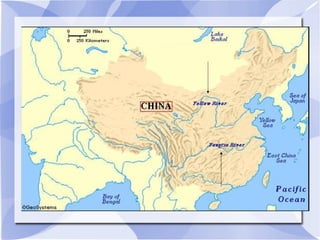
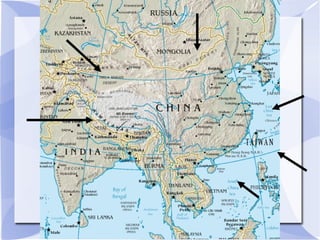
Centered on the Huang He (Yellow River)
and Yangtze rivers and was geographically
isolated.

Chinese culture began around 1500 BC.

China was governed by dynasties.

Chinese rulers were considered divine, but
they served under a Mandate of Heaven
only as long as their rule was just.

Confucianism and Taoism were important
contributions.
River Dynasties in China

China’s geography insured that it would
develop apart from other cultures. It was
isolated from other areas. The land lies
protected by a great ocean, huge deserts,
and high mountains.

The mountains did not protect China
totally. Many times during Chinese
history, people living to the north and
west of China invaded the land.
Family is central to Chinese society

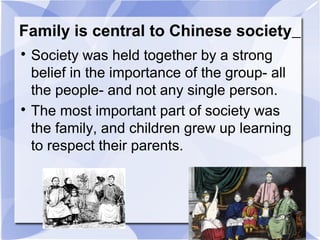
Society was held together by a strong
belief in the importance of the group- all
the people- and not any single person.

The most important part of society was
the family, and children grew up learning
to respect their parents.
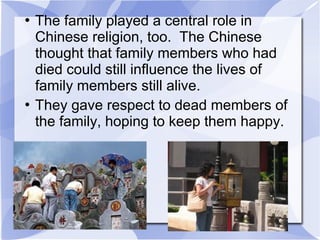
 The family played a central role in
Chinese religion, too. The Chinese
thought that family members who had
died could still influence the lives of
family members still alive.
 They gave respect to dead members of
the family, hoping to keep them happy.
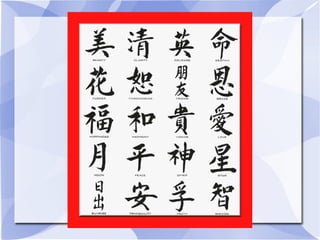
China’s written language

The Chinese system of writing differed
from those other groups. Symbols stood
for ideas, not sounds. As a result, the
many different groups in China, who all
had a special language, could still
understand the same writing.

The written language had thousands of
symbols, however, which made it very
hard to learn. Only specially trained
people learned to read and write.
The Great Wall of China

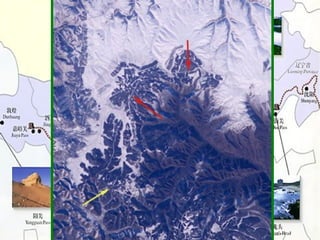
Migratory invaders raided Chinese
settlements from the North.

Qin Shi Huangdi built the Great Wall to
protect from these invasions.

It stretched over 2000 miles. The towers
were around 40 feet tall.

Many people died constructing the wall,
and in battles that raged around it, that
the Great Wall is sometimes called the
world’s largest cemetery.
Chinese Contributions

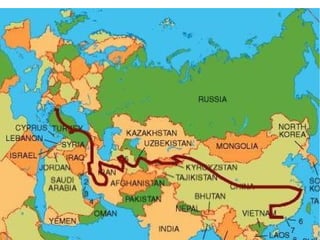
Silk Road- facilitated trade and
contact between China and other
cultures as far away as Rome.

Civil service system

Paper

Porcelain

Silk- only the Chinese knew how to
make silk and it was in high demand
in Rome, India and other areas.
Silk Road
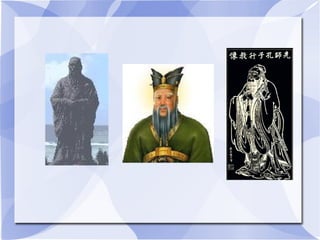
Confucius seeks to organize Chinese society

One of the most important of these thinkers
was Confucius. Born in 551 BC, he
became a well educated man who thought
deeply about the troubles of China.

He believed that a time of peace could
return if people would work at five basic
relationships: ruler and subject, father and
son, husband and wife, older and younger
brothers, and friend and friend.

The family relationships, he thought, were
the most important.
Confucian ideas lay the groundwork
for a civil service

He also tried to change government
for the better. Using his ideas, the
Chinese built a system in which
people could work in the government
only if they had a good education.

Over time, the ideas of Confucius
spread to other countries of East
Asia.
Confucianism

Belief that humans are good, not
bad

Respect for elders

Code of Politeness, still used in
Chinese society today

Emphasis on education

Ancestor worship
Taoists seek accord with nature.

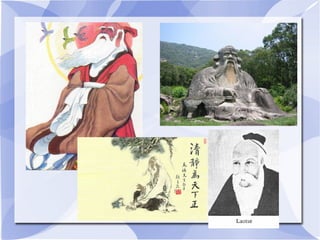
Another thinker of this period was
Laozi, who was more interested in
putting people in touch with the
powerful forces of nature.

Nature follows a universal force called
the Dao, or “the Way”, said Laozi.

People do not follow this force, but
they can learn to do so.
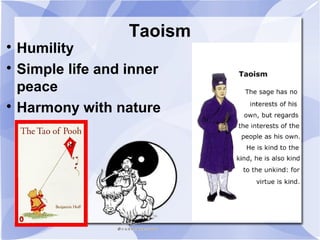
Taoism

Humility

Simple life and inner
peace

Harmony with nature
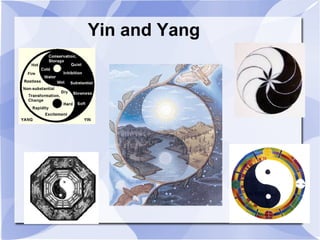
Yin and Yang
Yin/ Yang

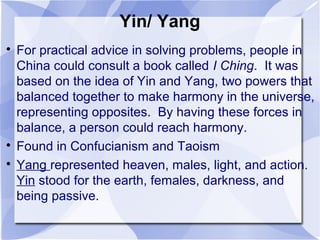
For practical advice in solving problems, people in
China could consult a book called I Ching. It was
based on the idea of Yin and Yang, two powers that
balanced together to make harmony in the universe,
representing opposites. By having these forces in
balance, a person could reach harmony.

Found in Confucianism and Taoism

Yang represented heaven, males, light, and action.
Yin stood for the earth, females, darkness, and
being passive.

China

  • 1.
  • 2.
    China  Centered on theHuang He (Yellow River) and Yangtze rivers and was geographically isolated.  Chinese culture began around 1500 BC.  China was governed by dynasties.  Chinese rulers were considered divine, but they served under a Mandate of Heaven only as long as their rule was just.  Confucianism and Taoism were important contributions.
  • 4.
    River Dynasties inChina  China’s geography insured that it would develop apart from other cultures. It was isolated from other areas. The land lies protected by a great ocean, huge deserts, and high mountains.  The mountains did not protect China totally. Many times during Chinese history, people living to the north and west of China invaded the land.
  • 6.
    Family is centralto Chinese society  Society was held together by a strong belief in the importance of the group- all the people- and not any single person.  The most important part of society was the family, and children grew up learning to respect their parents.
  • 7.
     The familyplayed a central role in Chinese religion, too. The Chinese thought that family members who had died could still influence the lives of family members still alive.  They gave respect to dead members of the family, hoping to keep them happy.
  • 8.
    China’s written language  TheChinese system of writing differed from those other groups. Symbols stood for ideas, not sounds. As a result, the many different groups in China, who all had a special language, could still understand the same writing.  The written language had thousands of symbols, however, which made it very hard to learn. Only specially trained people learned to read and write.
  • 10.
    The Great Wallof China  Migratory invaders raided Chinese settlements from the North.  Qin Shi Huangdi built the Great Wall to protect from these invasions.  It stretched over 2000 miles. The towers were around 40 feet tall.  Many people died constructing the wall, and in battles that raged around it, that the Great Wall is sometimes called the world’s largest cemetery.
  • 12.
    Chinese Contributions  Silk Road-facilitated trade and contact between China and other cultures as far away as Rome.  Civil service system  Paper  Porcelain  Silk- only the Chinese knew how to make silk and it was in high demand in Rome, India and other areas.
  • 13.
  • 15.
    Confucius seeks toorganize Chinese society  One of the most important of these thinkers was Confucius. Born in 551 BC, he became a well educated man who thought deeply about the troubles of China.  He believed that a time of peace could return if people would work at five basic relationships: ruler and subject, father and son, husband and wife, older and younger brothers, and friend and friend.  The family relationships, he thought, were the most important.
  • 16.
    Confucian ideas laythe groundwork for a civil service  He also tried to change government for the better. Using his ideas, the Chinese built a system in which people could work in the government only if they had a good education.  Over time, the ideas of Confucius spread to other countries of East Asia.
  • 17.
    Confucianism  Belief that humansare good, not bad  Respect for elders  Code of Politeness, still used in Chinese society today  Emphasis on education  Ancestor worship
  • 18.
    Taoists seek accordwith nature.  Another thinker of this period was Laozi, who was more interested in putting people in touch with the powerful forces of nature.  Nature follows a universal force called the Dao, or “the Way”, said Laozi.  People do not follow this force, but they can learn to do so.
  • 20.
    Taoism  Humility  Simple life andinner peace  Harmony with nature
  • 21.
  • 22.
    Yin/ Yang  For practicaladvice in solving problems, people in China could consult a book called I Ching. It was based on the idea of Yin and Yang, two powers that balanced together to make harmony in the universe, representing opposites. By having these forces in balance, a person could reach harmony.  Found in Confucianism and Taoism  Yang represented heaven, males, light, and action. Yin stood for the earth, females, darkness, and being passive.