


by: Shiela Ann R. Neron
Hinduism is a religion that began in India. 
The religion dates back to 1500 B.C., making it the world's 
oldest religion. 
Hinduism is the third largest religion in the world, with 
approximately 900 million adherents. 
The origins cannot be ascribed to any single founder or a 
specific time or a single place.
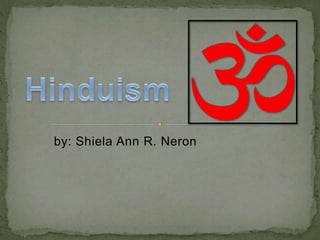
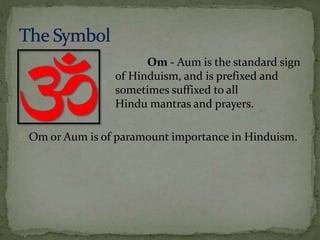
Om - Aum is the standard sign 
of Hinduism, and is prefixed and 
sometimes suffixed to all 
Hindu mantras and prayers. 
Om or Aum is of paramount importance in Hinduism.
A diverse body of religion, philosophy, and cultural 
practice native to and predominant in India, 
characterized by a belief in reincarnation and a 
supreme being of many forms and natures, by the 
view that opposing theories are aspects of one 
eternal truth, and by a desire for liberation from 
earthly evils.
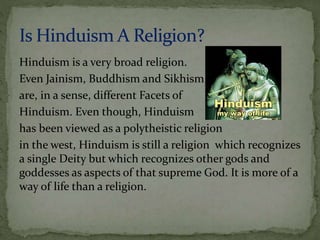
Hinduism is a very broad religion. 
Even Jainism, Buddhism and Sikhism 
are, in a sense, different Facets of 
Hinduism. Even though, Hinduism 
has been viewed as a polytheistic religion 
in the west, Hinduism is still a religion which recognizes 
a single Deity but which recognizes other gods and 
goddesses as aspects of that supreme God. It is more of a 
way of life than a religion.
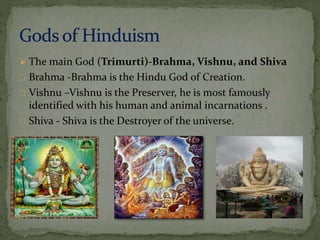
 The main God (Trimurti)-Brahma, Vishnu, and Shiva 
Brahma -Brahma is the Hindu God of Creation. 
Vishnu –Vishnu is the Preserver, he is most famously 
identified with his human and animal incarnations . 
Shiva - Shiva is the Destroyer of the universe.
1. Priest – act as a counselor. 
2. Warrior – they protect society. 
3. Merchant - includes landowners and money lender. 
4. Servants – does manual work and is expected to serve 
the higher caste . 
5. The untouchable (dalit) – traditionally does dirty work, 
cleaning toilets, sweeping streets etc.
1. Student – this is the first stage of laying a religious 
foundation for life between the ages of 8-20. 
2. Householder-Marriage (traditionally arranged) 
occurs about age 21 and above. 
3. Retiree – when grand children arrive. 
4. Renunciate – wandering holy man.
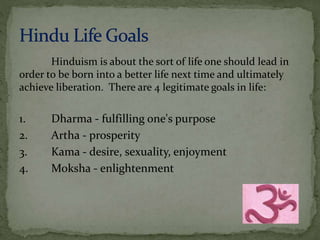
Hinduism is about the sort of life one should lead in 
order to be born into a better life next time and ultimately 
achieve liberation. There are 4 legitimate goals in life: 
1. Dharma - fulfilling one's purpose 
2. Artha - prosperity 
3. Kama - desire, sexuality, enjoyment 
4. Moksha - enlightenment
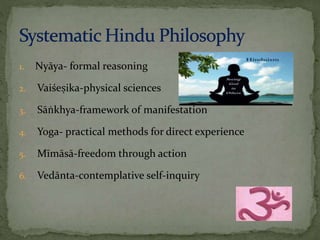
1. Nyāya- formal reasoning 
2. Vaiśeṣika-physical sciences 
3. Sāṅkhya-framework of manifestation 
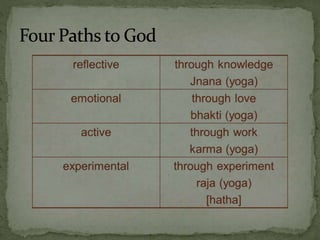
4. Yoga- practical methods for direct experience 
5. Mīmāsā-freedom through action 
6. Vedānta-contemplative self-inquiry
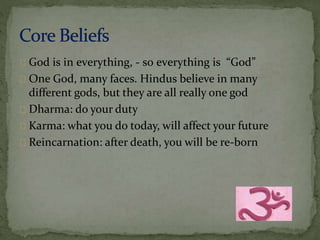
God is in everything, - so everything is “God” 
One God, many faces. Hindus believe in many 
different gods, but they are all really one god 
Dharma: do your duty 
Karma: what you do today, will affect your future 
Reincarnation: after death, you will be re-born
Two aims of Hindu Education: 
1. To see, hear and desire better, purer, finer and deeper. 
2. To learn the principles of a thing, it’s source and 
foundation. 
An education which only deals with man’s secular concerns 
is self-defeating. 
Hindu educators prescribed meditation for overcoming the 
sickness of the soul and restless mind. 
Emphasized the importance of a certain atmosphere in 
which alone any worthwhile education is possible.
http://hinduism.about.com/od/basics/a/principles.htm 
http://www.patheos.com/Library/Hinduism/Ethics- 
Morality-Community/Principles-of-Moral-Thought-and- 
Action.html 
www.en.wikipedia.com/hinduism 
www.slideshare.com/hinduism 
http://forum.yogananda.net/index.php?/topic/6520- 
principles-of-sanatana-dharma-hinduism/ 
www.hinduwebsite.com/stages
THE END. 
THANK YOU!

Hinduism

  • 2.
  • 3.
    Hinduism is areligion that began in India. The religion dates back to 1500 B.C., making it the world's oldest religion. Hinduism is the third largest religion in the world, with approximately 900 million adherents. The origins cannot be ascribed to any single founder or a specific time or a single place.
  • 4.
    Om - Aumis the standard sign of Hinduism, and is prefixed and sometimes suffixed to all Hindu mantras and prayers. Om or Aum is of paramount importance in Hinduism.
  • 5.
    A diverse bodyof religion, philosophy, and cultural practice native to and predominant in India, characterized by a belief in reincarnation and a supreme being of many forms and natures, by the view that opposing theories are aspects of one eternal truth, and by a desire for liberation from earthly evils.
  • 6.
    Hinduism is avery broad religion. Even Jainism, Buddhism and Sikhism are, in a sense, different Facets of Hinduism. Even though, Hinduism has been viewed as a polytheistic religion in the west, Hinduism is still a religion which recognizes a single Deity but which recognizes other gods and goddesses as aspects of that supreme God. It is more of a way of life than a religion.
  • 7.
     The mainGod (Trimurti)-Brahma, Vishnu, and Shiva Brahma -Brahma is the Hindu God of Creation. Vishnu –Vishnu is the Preserver, he is most famously identified with his human and animal incarnations . Shiva - Shiva is the Destroyer of the universe.
  • 8.
    1. Priest –act as a counselor. 2. Warrior – they protect society. 3. Merchant - includes landowners and money lender. 4. Servants – does manual work and is expected to serve the higher caste . 5. The untouchable (dalit) – traditionally does dirty work, cleaning toilets, sweeping streets etc.
  • 9.
    1. Student –this is the first stage of laying a religious foundation for life between the ages of 8-20. 2. Householder-Marriage (traditionally arranged) occurs about age 21 and above. 3. Retiree – when grand children arrive. 4. Renunciate – wandering holy man.
  • 10.
    Hinduism is aboutthe sort of life one should lead in order to be born into a better life next time and ultimately achieve liberation. There are 4 legitimate goals in life: 1. Dharma - fulfilling one's purpose 2. Artha - prosperity 3. Kama - desire, sexuality, enjoyment 4. Moksha - enlightenment
  • 11.
    1. Nyāya- formalreasoning 2. Vaiśeṣika-physical sciences 3. Sāṅkhya-framework of manifestation 4. Yoga- practical methods for direct experience 5. Mīmāsā-freedom through action 6. Vedānta-contemplative self-inquiry
  • 13.
    God is ineverything, - so everything is “God” One God, many faces. Hindus believe in many different gods, but they are all really one god Dharma: do your duty Karma: what you do today, will affect your future Reincarnation: after death, you will be re-born
  • 14.
    Two aims ofHindu Education: 1. To see, hear and desire better, purer, finer and deeper. 2. To learn the principles of a thing, it’s source and foundation. An education which only deals with man’s secular concerns is self-defeating. Hindu educators prescribed meditation for overcoming the sickness of the soul and restless mind. Emphasized the importance of a certain atmosphere in which alone any worthwhile education is possible.
  • 15.
    http://hinduism.about.com/od/basics/a/principles.htm http://www.patheos.com/Library/Hinduism/Ethics- Morality-Community/Principles-of-Moral-Thought-and- Action.html www.en.wikipedia.com/hinduism www.slideshare.com/hinduism http://forum.yogananda.net/index.php?/topic/6520- principles-of-sanatana-dharma-hinduism/ www.hinduwebsite.com/stages
  • 16.