Chilled Beam System
Design and Applications
Abhilash P, Mechanical Engineer, Bengaluru
October 29, 2024
OVERVIEW
October 29, 2024
1. Introduction
2. Components of Chilled
Beam
3. Types of Chilled Beam
4. Active Beam Overview
5. Active Beam Function
6. Why Chilled Beam
7. Air Side information
8. Water Side Information
9. Capacity Overview
10. Benefits and limitations
11. Applications with
Examples
Introduction
A Chilled Beam is a type of convection HAC system designed to heat or cool large
buildings
A Chilled beam is a air distribution device with integral coil installed within in order
provide Sensible Cooling and Heating
Primarily used in spaces where humidity can be controlled
Alternative to both Fan coil Units and VAV systems
Components of Chilled Beam
Air handling units
Major component within any chilled beam or chilled ceiling system
Role – to clean and condition the air as it enters the building
Mixing Boxes
Dampers are used in mixing boxes to regulate the mixture of fresh air and re-circulate air
Coils
Heat exchangers designed transfer the energy from a medium (usually water) to the air
Individual coil for heating and cooling
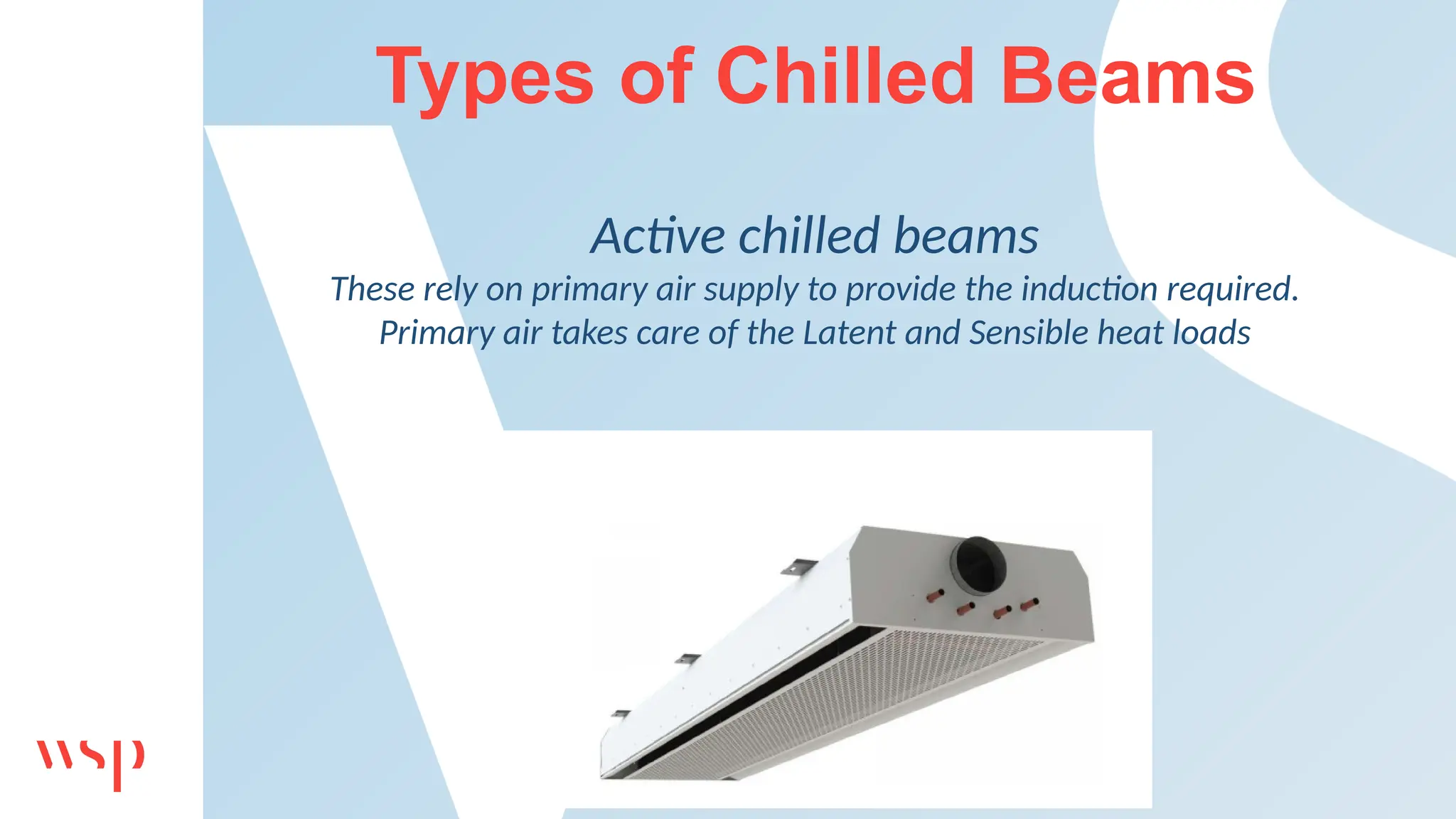
Types of Chilled Beams
Active chilled beams
These rely on primary air supply to provide the induction required.
Primary air takes care of the Latent and Sensible heat loads
Types of Chilled Beams
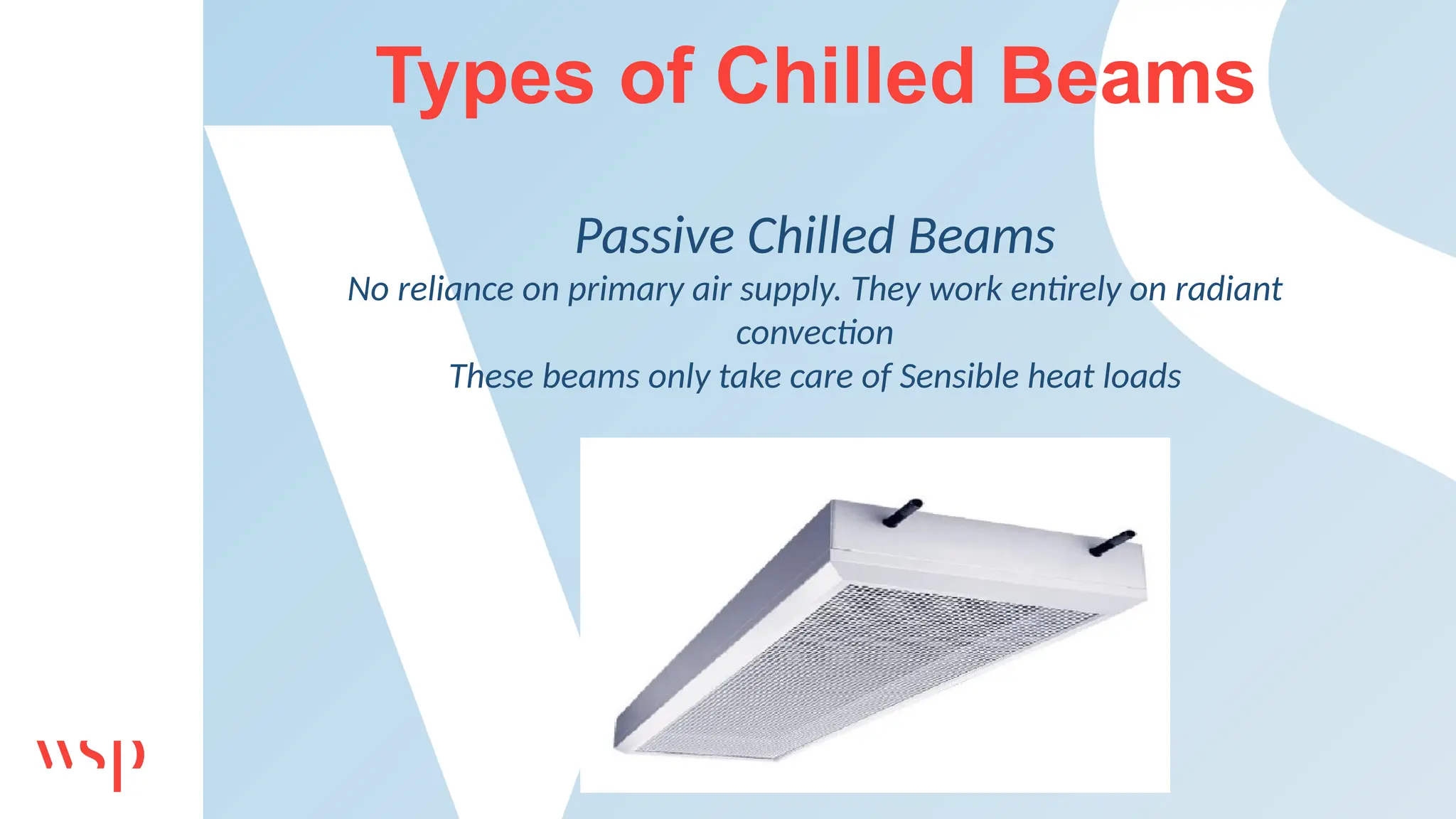
Passive Chilled Beams
No reliance on primary air supply. They work entirely on radiant
convection
These beams only take care of Sensible heat loads
Types of Chilled Beams
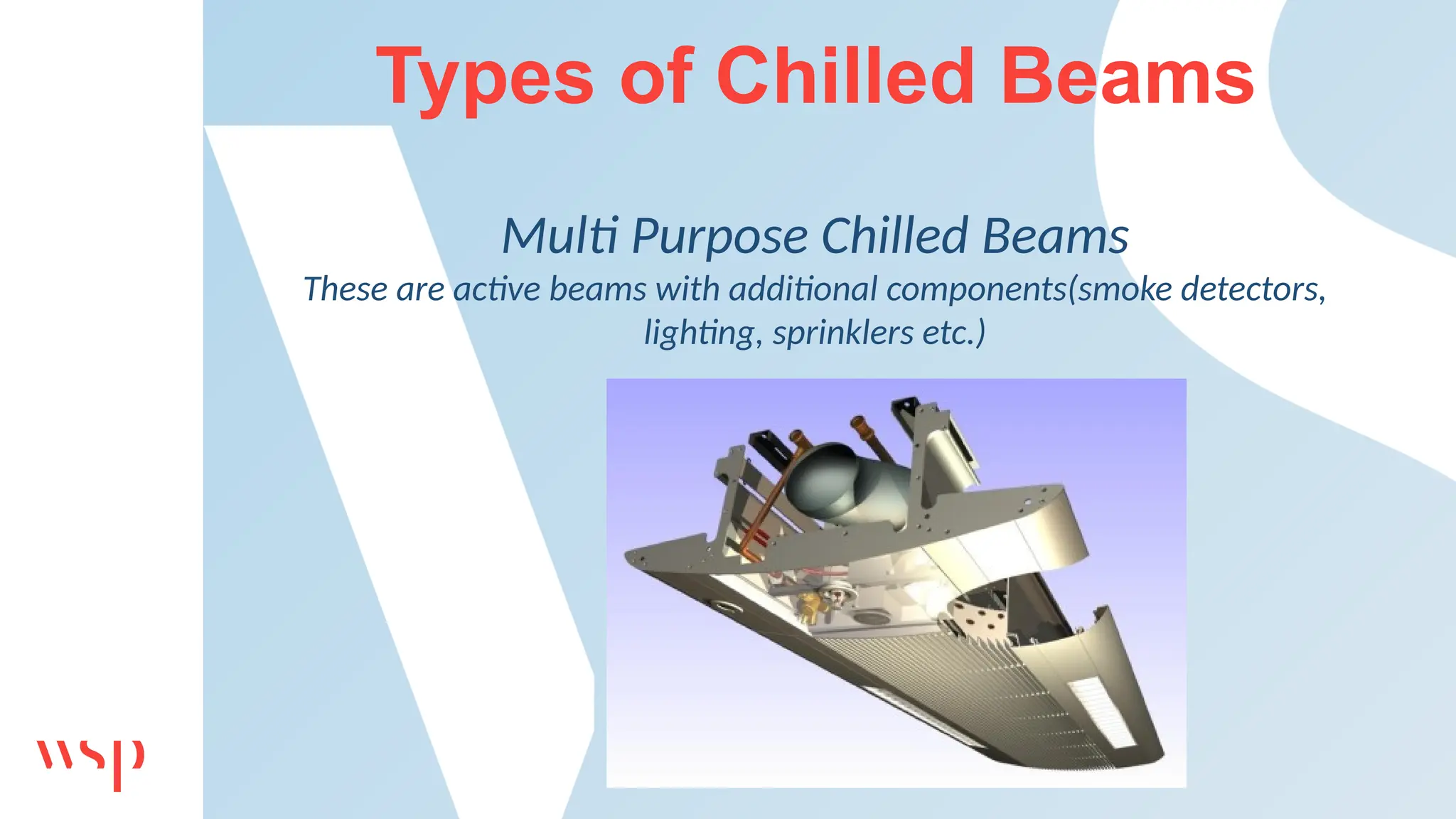
Multi Purpose Chilled Beams
These are active beams with additional components(smoke detectors,
lighting, sprinklers etc.)
Active Beam overview
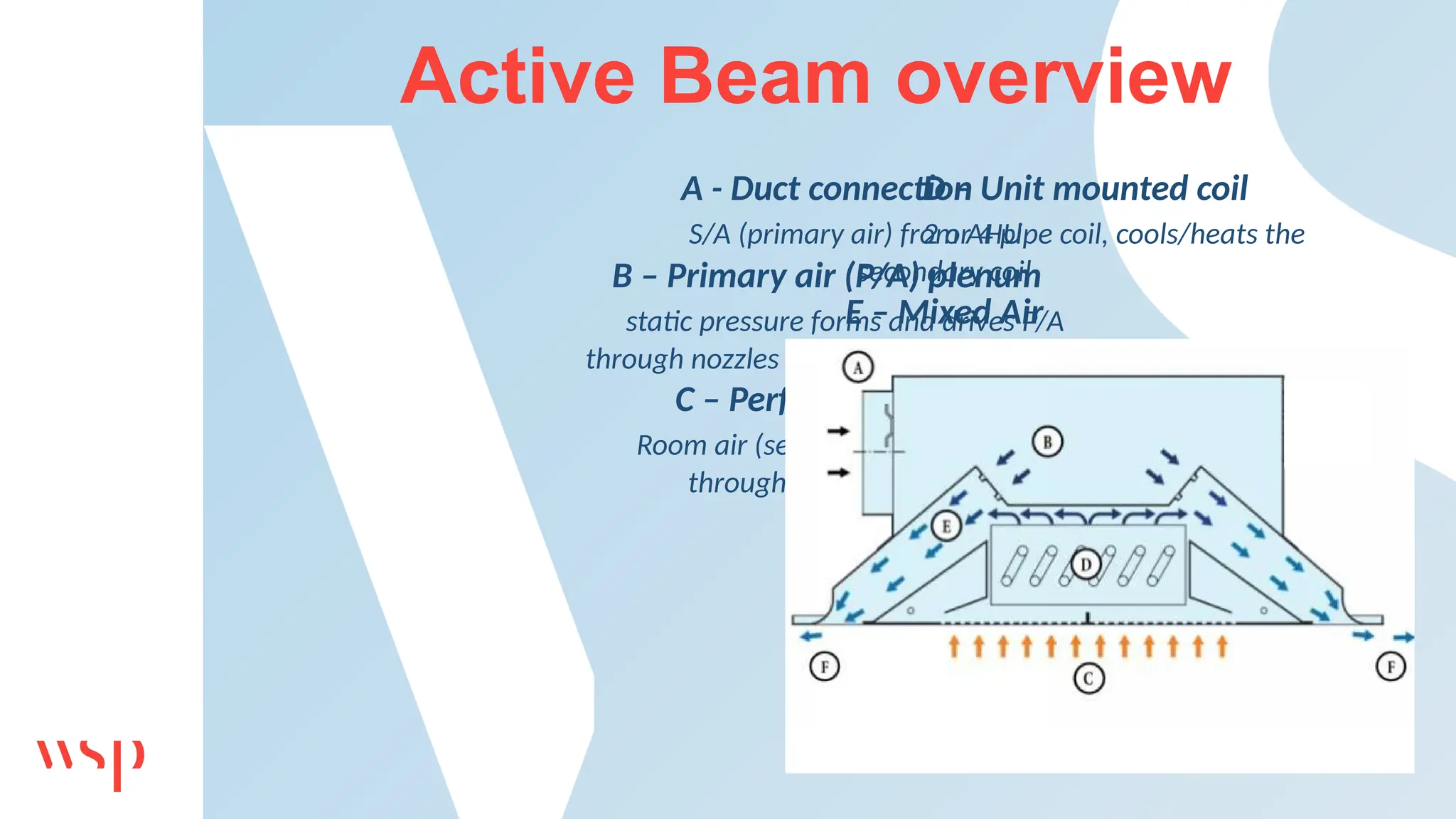
A - Duct connection
S/A (primary air) from AHU
B – Primary air (P/A) plenum
static pressure forms and drives P/A
through nozzles
C – Perforated Grille
Room air (secondary air) is induced,
through grille, into coil
D – Unit mounted coil
2 or 4 pipe coil, cools/heats the
secondary coil
E – Mixed Air
P/A and secondary air mix
F – Discharge air
static pressure forms and drives P/A
through nozzles
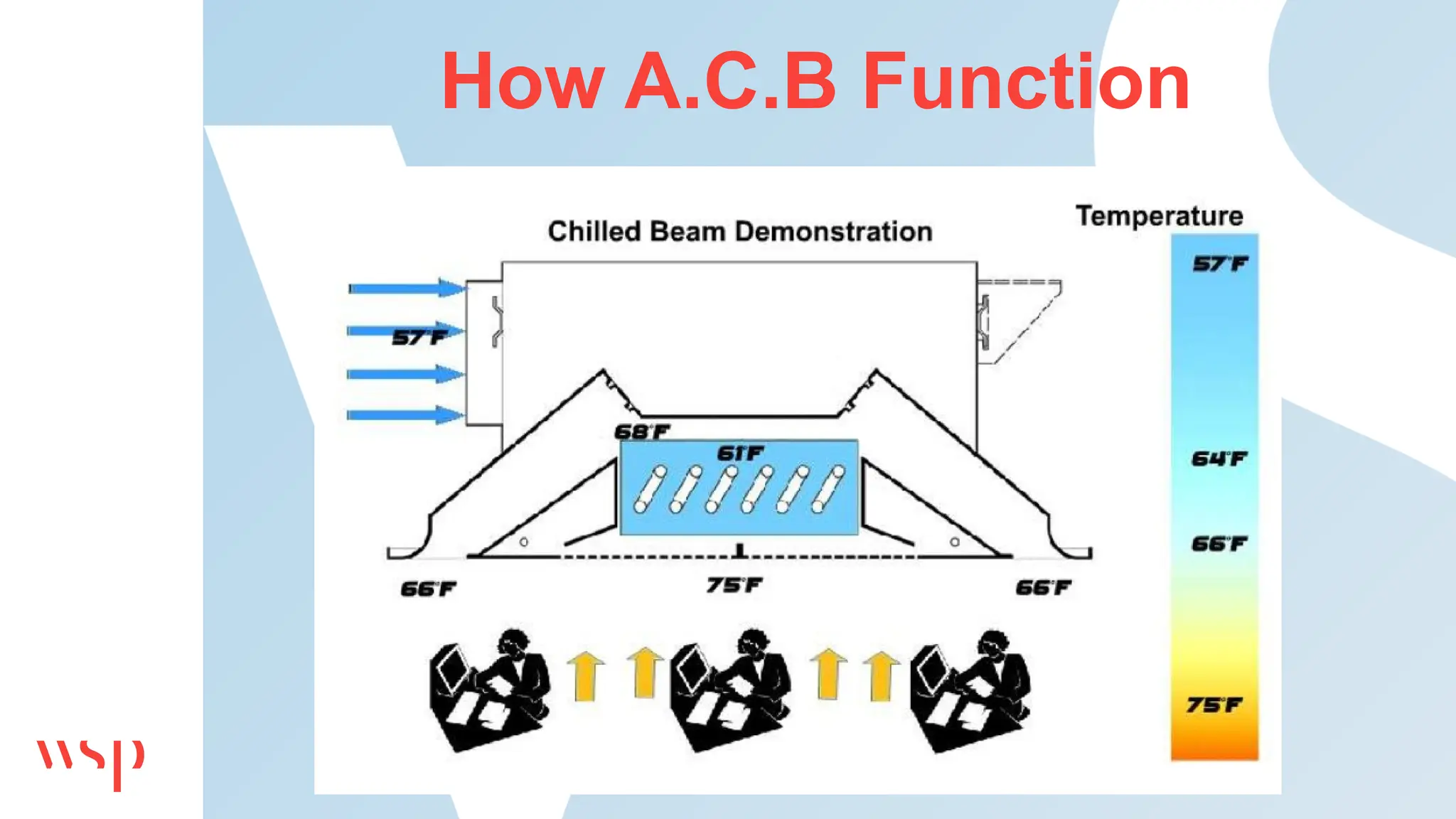
How A.C.B Function
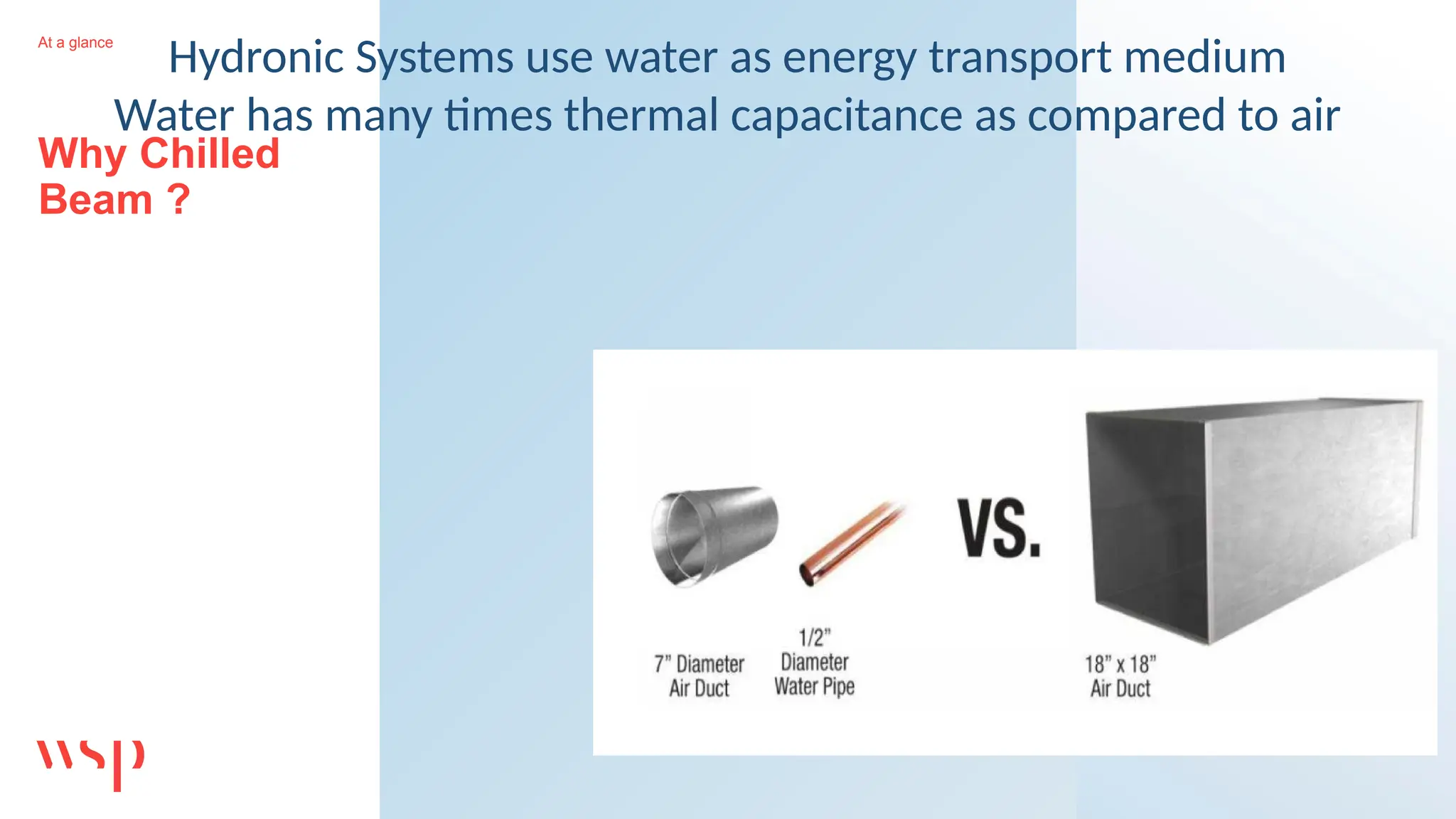
Hydronic Systems use water as energy transport medium
Water has many times thermal capacitance as compared to air
At a glance
Why Chilled
Beam ?
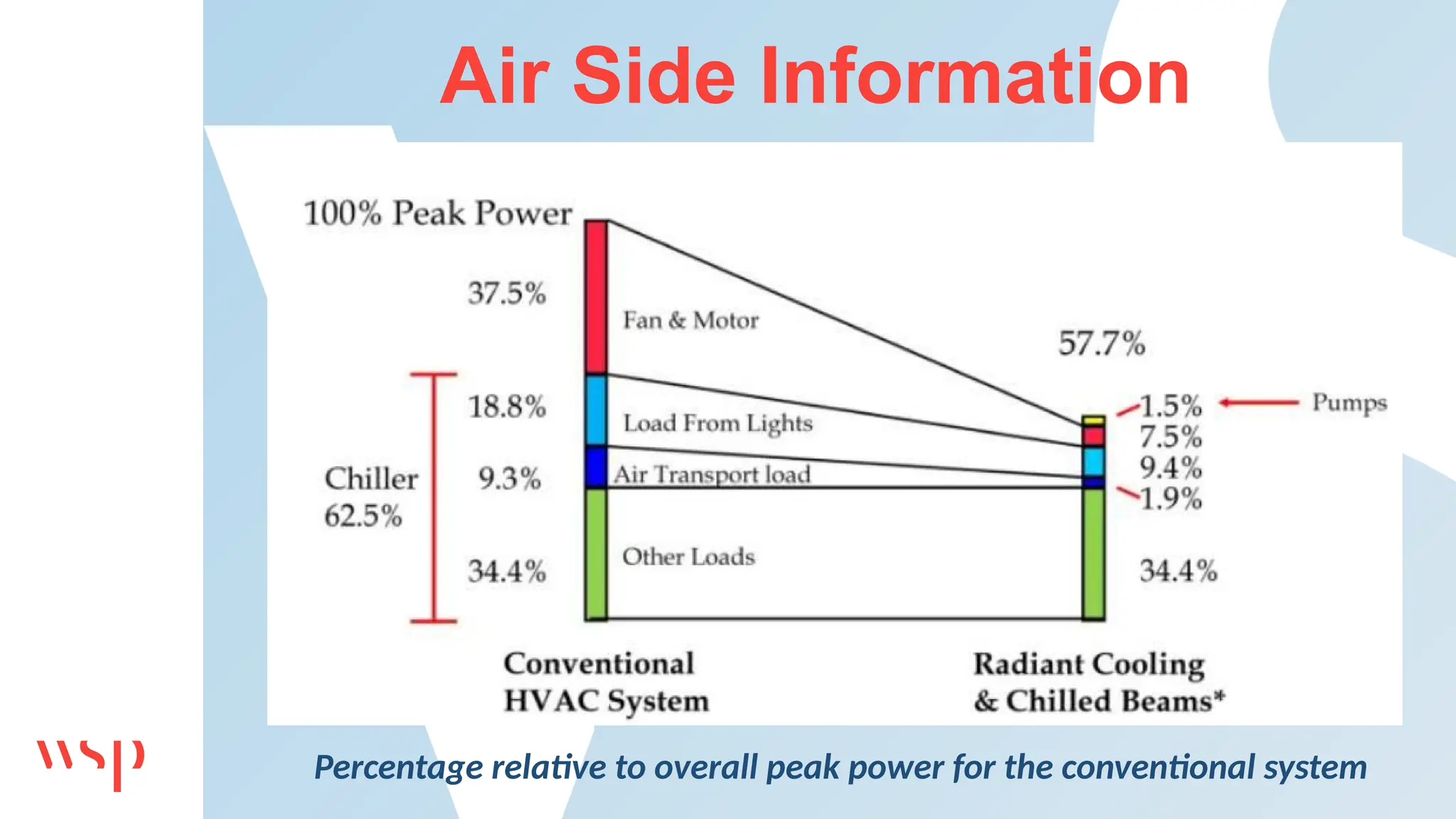
Air Side Information
Percentage relative to overall peak power for the conventional system
0 5 10 15 20 35 40 45 50 55 60
25
30
DRY BULB TEMPERATURE - °C
5
10
15
20
25
15 20 25 30 35 40 45 50 55 60 65
70
75
80
85
90
95
100
105
110
110
115
115
120
120
125
125
130
130
135
135
140
145
150
E
N
T
H
A
L
P
Y
-
K
J
P
E
R
K
G
O
F
D
R
Y
AI
R
-15
-10
-5
0
5
10
15
20 25
30
35
40
45
50
55
60
65
70
75
80
85
90
95
100
105
E
N
T
H
A
L
P
Y
-
K
J
P
E
R
K
G
O
F
D
R
Y
A
I
R
S
A
T
U
R
A
T
I
O
N
T
E
M
P
E
R
A
T
U
R
E
-
°
C
-15
-10
-5
0
0
5
5
10
10
15
15
20
20
25
25
30
W
ET
BULB
TEM
PERATURE
- °C
30
15%
2
5
%
2%
4%
6%
8%
10% RELATIVE HUMIDITY
20%
30%
4
0
%
5
0
%
6
0
%
70%
8
0
%
9
0
%
.7
4
.7
6
.7
8
.8
0
.8
2
.8
4
.8
6
.8
8
.9
0
S
P
E
C
IF
IC
V
O
L
U
M
E
m
³/
k
g
O
F
D
R
Y
A
IR
.9
2
.9
4
.9
6
.9
8
H
U
M
I
D
IT
Y
R
A
TI
O
-
G
R
A
M
S
O
F
M
O
IS
T
U
R
E
P
E
R
KI
L
O
G
R
A
M
O
F
D
R
Y
AI
R
PSYCHROMETRIC CHART
BAROMETRIC PRESSURE 760 mm of Mercury
-20 -15
-10
-5
Linric Company Psychrometric Chart, www.linric.com
1
2
3
4
5
6
7
8
9
10
11
12
13
14
17
16
15
18
23
22
21
20
19
24
28
27
26
25
29
30
31
32
30
34
33
V
A
P
O
R
P
R
E
S
S
U
R
E
-
M
M
O
F
M
E
R
C
U
R
Y
-20
-40
-10
0
10
20
25
30
D
E
W
P
O
I
N
T
-
°
C
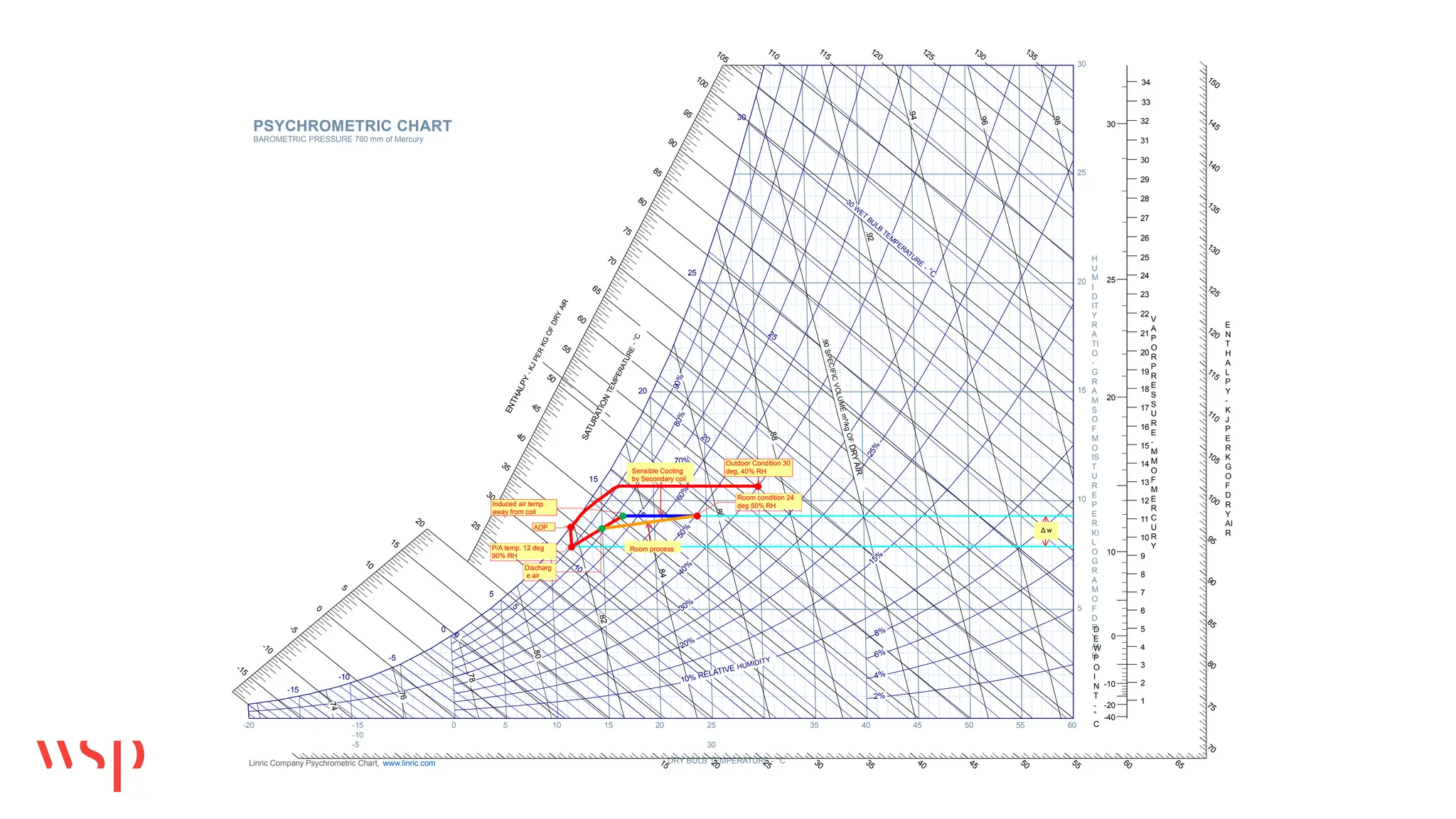
Outdoor Condition 30
deg, 40% RH
ADP
P/A temp. 12 deg
90% RH
Induced air temp.
away from coil
Sensible Cooling
by Secondary coil
Discharg
e air
Room condition 24
deg 50% RH
Room process
Δ w
Air Side Information(Psychrometrics)
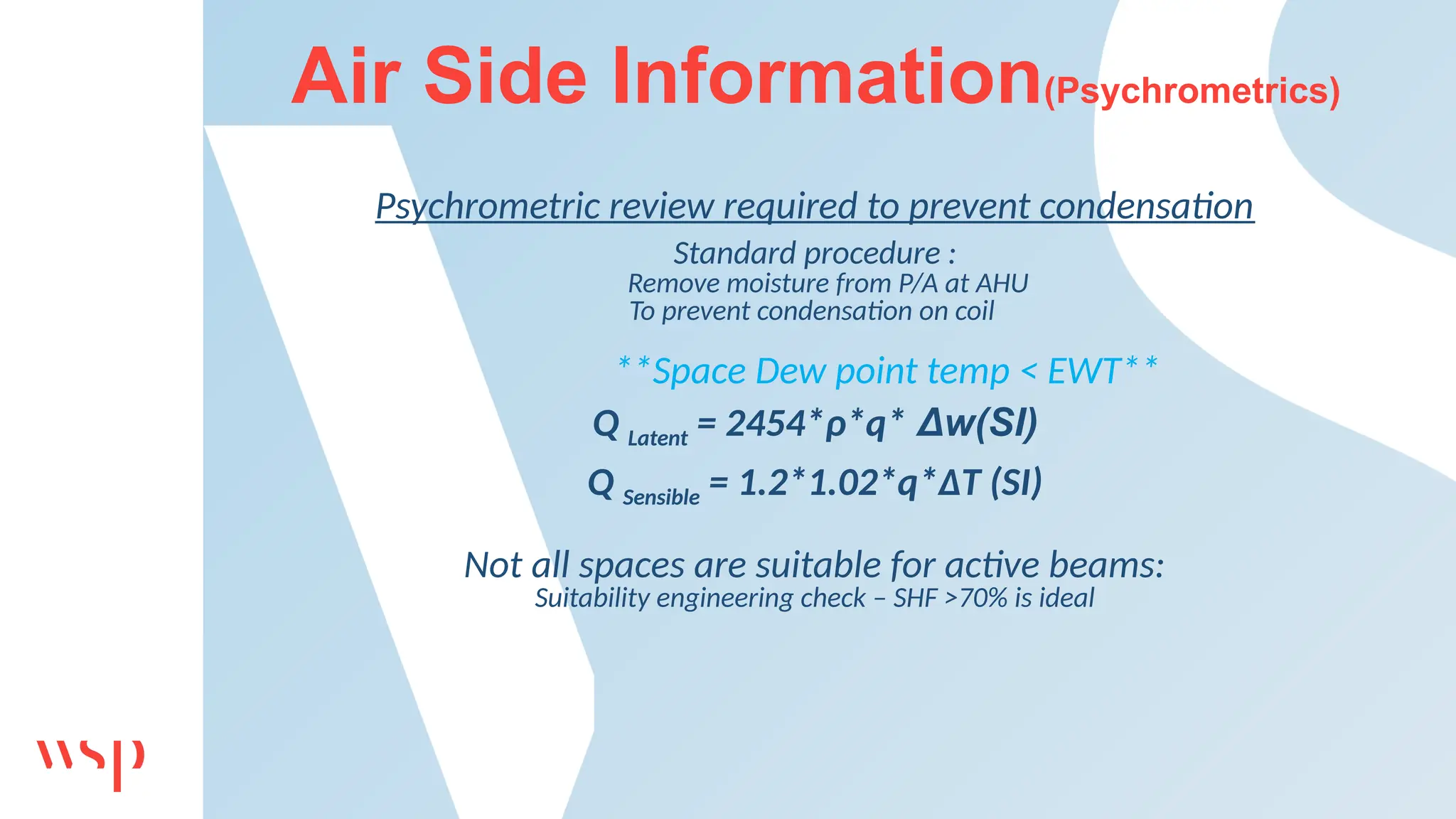
Psychrometric review required to prevent condensation
Standard procedure :
Remove moisture from P/A at AHU
To prevent condensation on coil
**Space Dew point temp < EWT**
Q Latent = 2454*ρ*q* Δw(SI)
Q Sensible = 1.2*1.02*q*ΔT (SI)
Not all spaces are suitable for active beams:
Suitability engineering check – SHF >70% is ideal
Air Side Information(Primary Air)
Meet all ventilation requirements
- Min. vent.(O/A requirements)
- Remove 100% of the latent loads (Psychrometric)
- Provide enough Rm./A to meet Sensible loads
**Greatest of these sets the minimum air flow rate**
Decreased AHU & Duct Size
Decrease in fan energy ( majority of the energy is saved at the fan).
Water Side Information
Coil responsible for majority of the Sensible load
- Cooling and heating
Design requirements
- Water flowrate
- Temperatures(EWT, LWT)
- Generally EWT= 1 to 2 deg above SPACE dew point temperature
Capacity Overview
Air Side :
100% Latent energy capacity, increased by
- Increasing Δw between P/A & Rm/A
- Increasing Airflow rate
Minor Sensible capacity is increased by
- Increasing ΔT between P/A & Rm/A
- Increasing Airflow rate
Water Side :
Sensible capacity, is increased by :
- Increasing ΔT between water & Rm/A
- Increasing water flow rate
Total Capacity = Air Capacity + Water capacity
Chilled Beam Benefits
Significant Fan energy savings (lower overall S/A)
Increased air circulation with high thermal comfort
Smaller AHU & Ductwork
- Lower floor – floor heights
- Significant reduction in riser space
Low maintenance requirements
Water side free cooling may be an option
Quick response time
Low to Reasonable acoustics
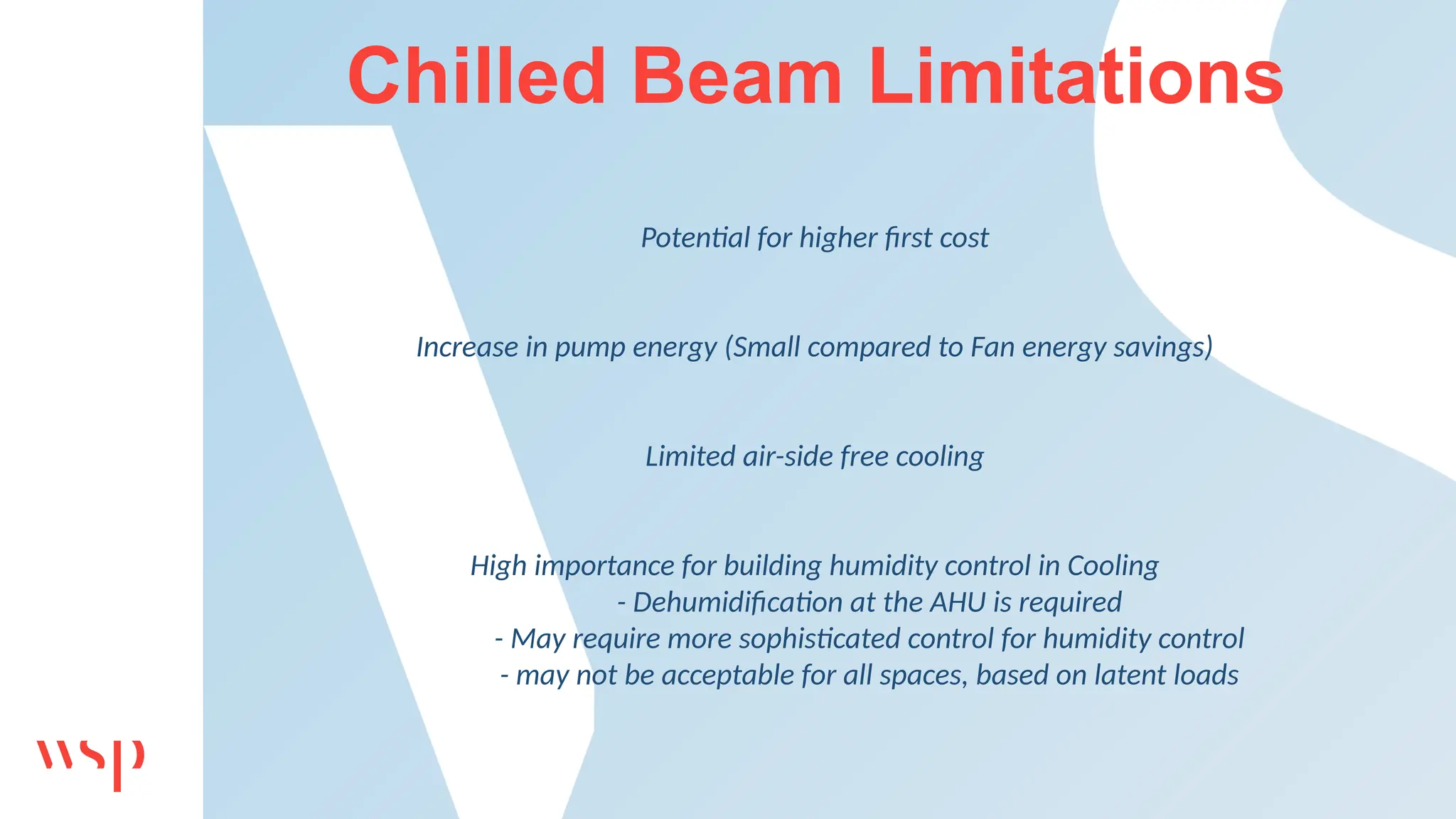
Chilled Beam Limitations
Potential for higher first cost
Increase in pump energy (Small compared to Fan energy savings)
Limited air-side free cooling
High importance for building humidity control in Cooling
- Dehumidification at the AHU is required
- May require more sophisticated control for humidity control
- may not be acceptable for all spaces, based on latent loads
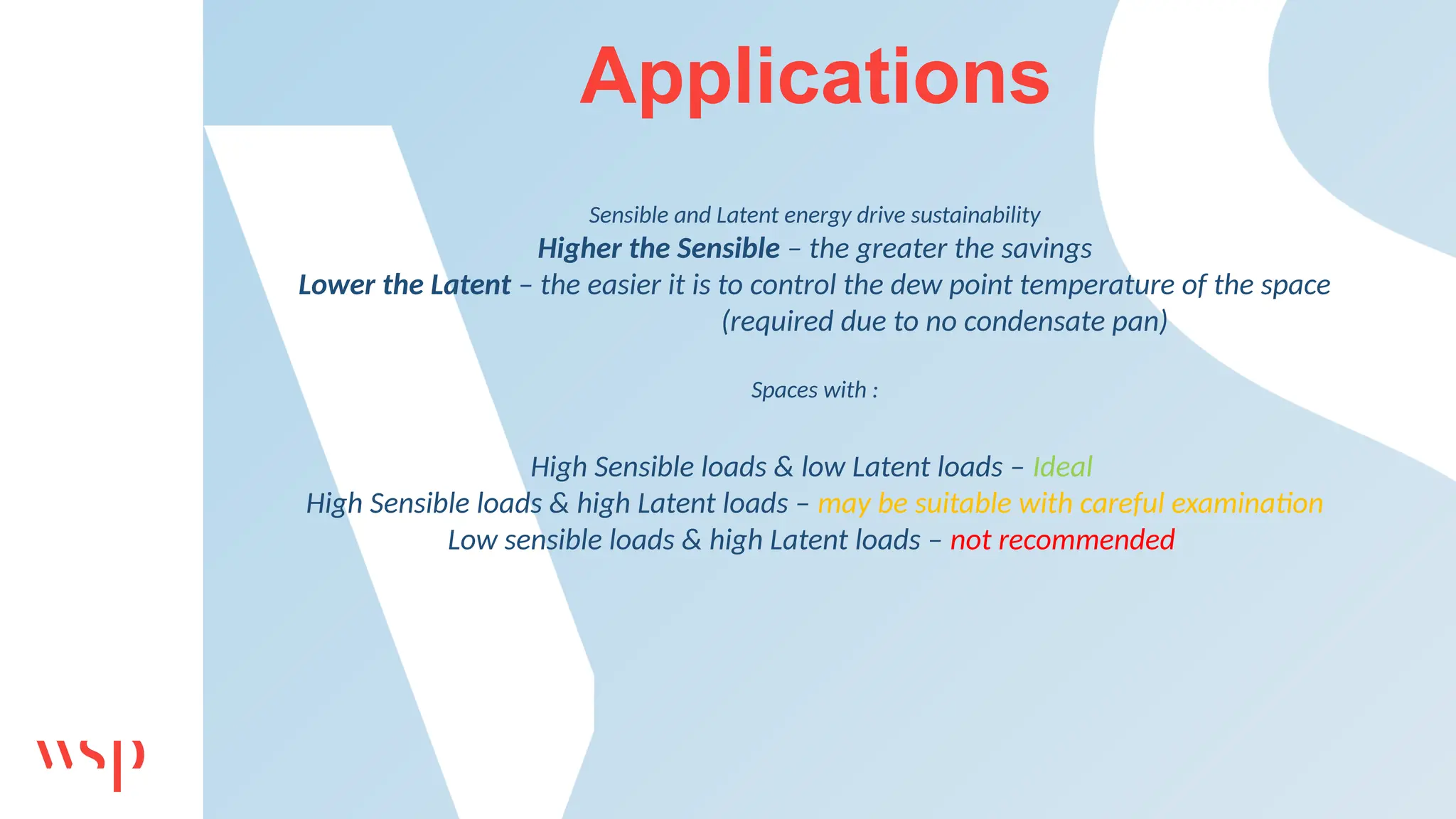
Applications
Sensible and Latent energy drive sustainability
Higher the Sensible – the greater the savings
Lower the Latent – the easier it is to control the dew point temperature of the space
(required due to no condensate pan)
Spaces with :
High Sensible loads & low Latent loads – Ideal
High Sensible loads & high Latent loads – may be suitable with careful examination
Low sensible loads & high Latent loads – not recommended
Applications
Open Office Area
Applications
Child Care Centre
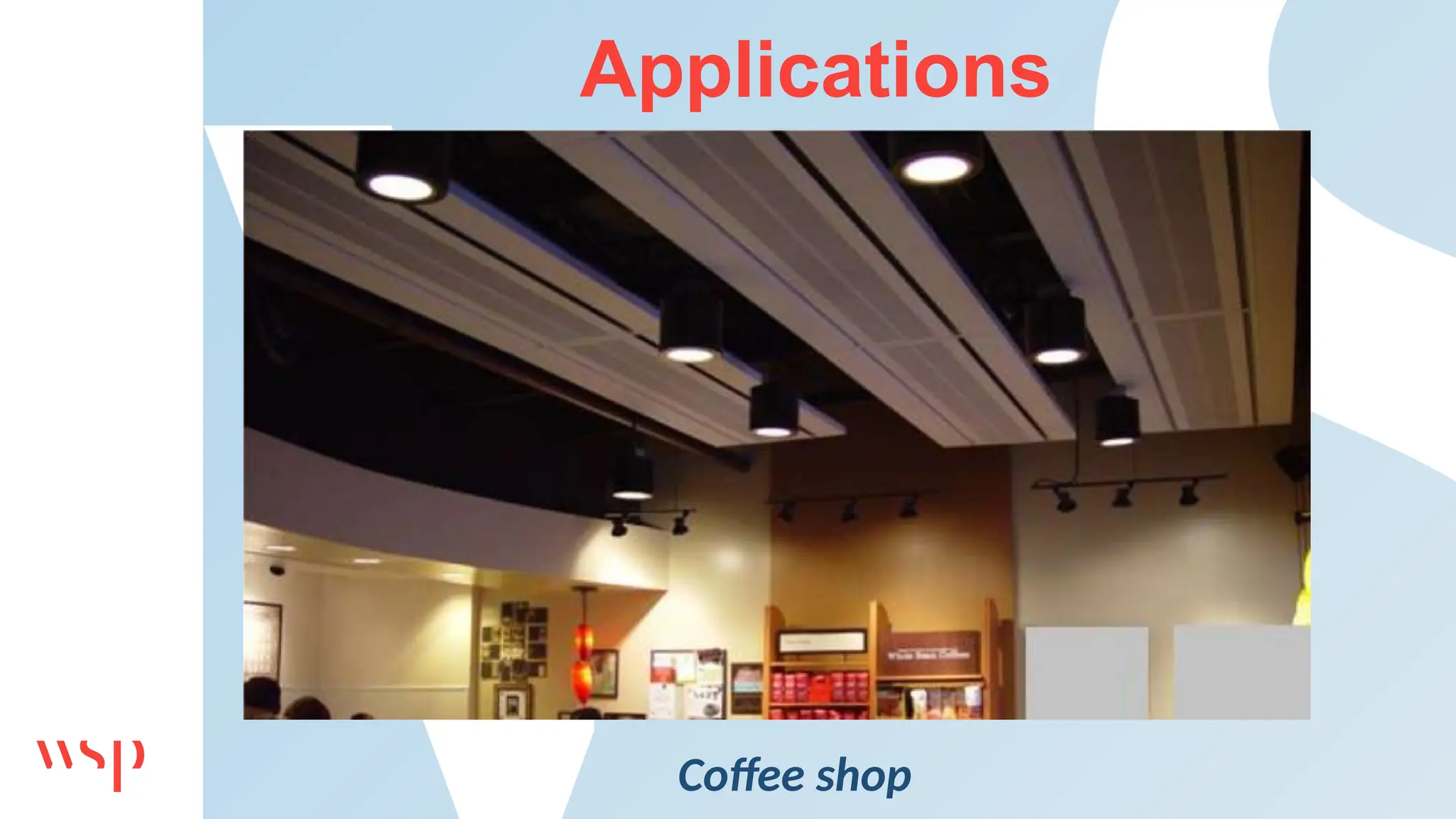
Applications
Coffee shop
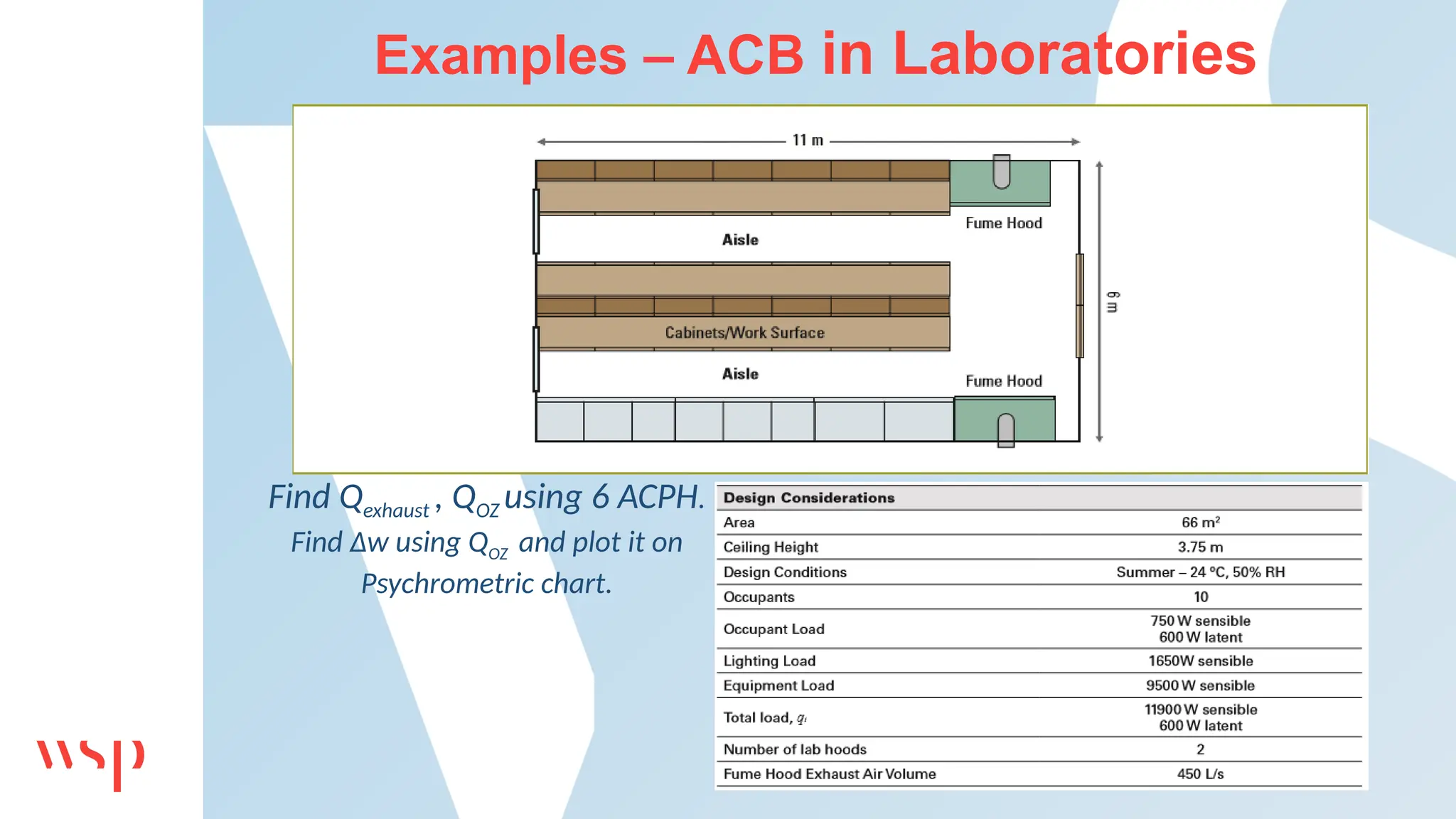
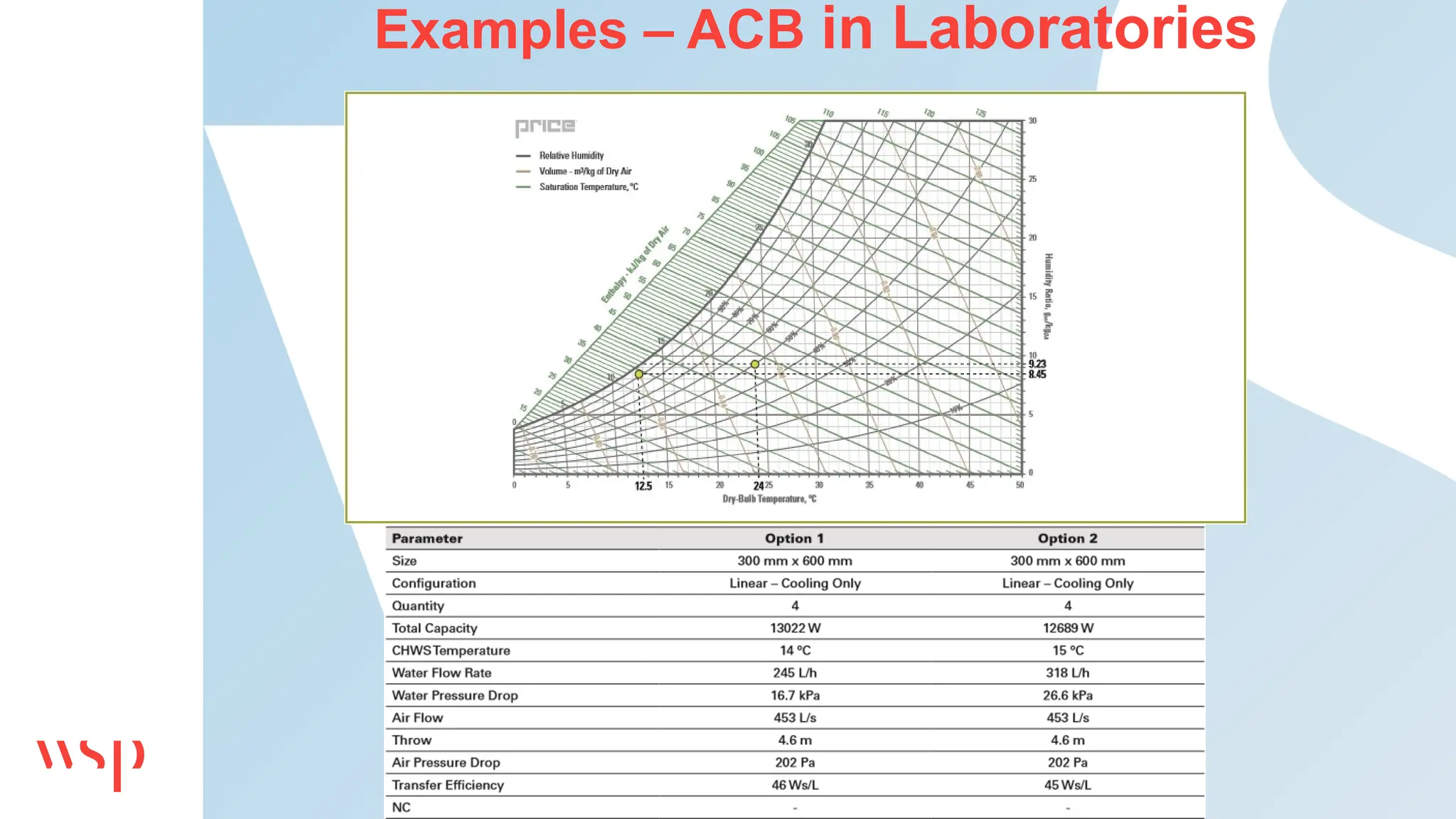
Examples – ACB in Laboratories
Find Qexhaust , QOZ using 6 ACPH.
Find Δw using QOZ and plot it on
Psychrometric chart.
Examples – ACB in Laboratories
Qexhaust = max[450 l/s,{(11 m)*(6 m)*(3.75 m)*(6 acph)*h/3.6}]
= max(450 l/s, 413 l/s)
= 450 l/s.
QOZ = (1-20%)*Qexhaust = 360 l/s = Qs
QL = 2500*ρ*Qs* Δw
ΔW = 0.55 g/kg
at 240
C, 50%RH humidity ratio is 9.5 g/kg
Ws = 9.5 – 0.55 = 8.95 g/kg (plotting it in psychrometric chart)
Examples – ACB in Laboratories
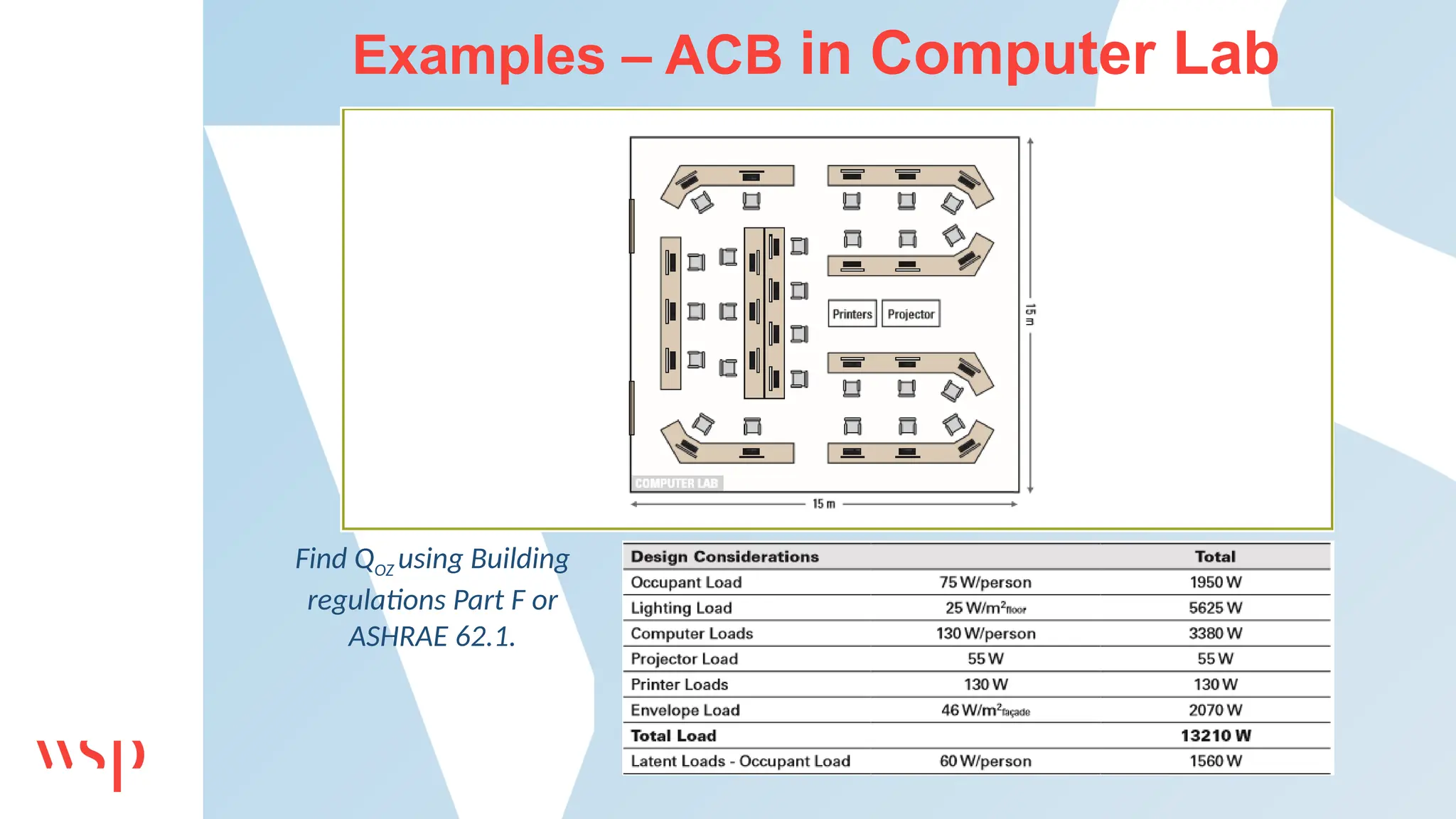
Examples – ACB in Computer Lab
Find QOZ using Building
regulations Part F or
ASHRAE 62.1.
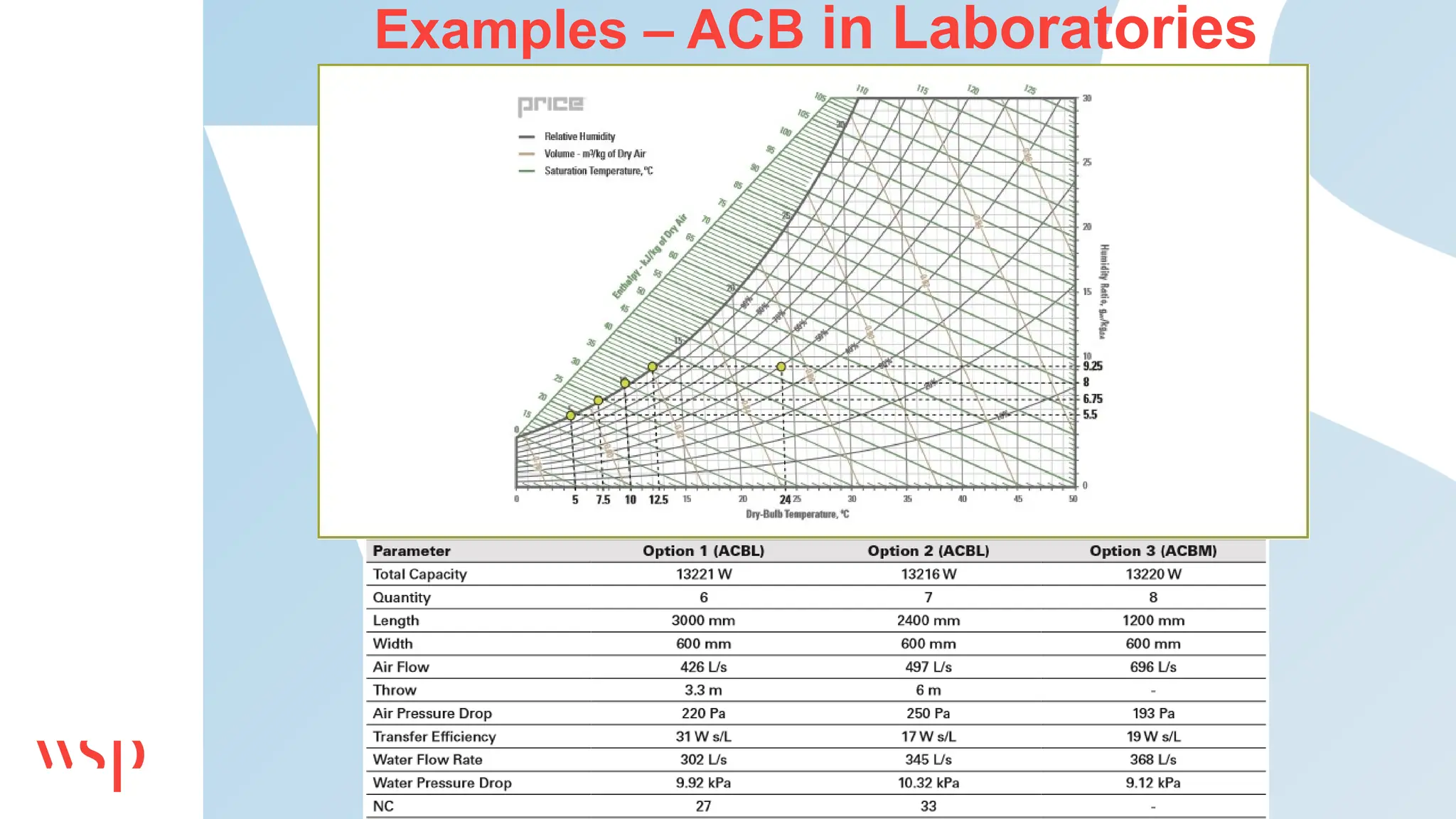
Examples – ACB in Laboratories
Questions ?
wsp.com
Thank you!
wsp.com

Chilled Beam System Design and Applications

  • 1.
    Chilled Beam System Designand Applications Abhilash P, Mechanical Engineer, Bengaluru October 29, 2024
  • 2.
    OVERVIEW October 29, 2024 1.Introduction 2. Components of Chilled Beam 3. Types of Chilled Beam 4. Active Beam Overview 5. Active Beam Function 6. Why Chilled Beam 7. Air Side information 8. Water Side Information 9. Capacity Overview 10. Benefits and limitations 11. Applications with Examples
  • 3.
    Introduction A Chilled Beamis a type of convection HAC system designed to heat or cool large buildings A Chilled beam is a air distribution device with integral coil installed within in order provide Sensible Cooling and Heating Primarily used in spaces where humidity can be controlled Alternative to both Fan coil Units and VAV systems
  • 4.
    Components of ChilledBeam Air handling units Major component within any chilled beam or chilled ceiling system Role – to clean and condition the air as it enters the building Mixing Boxes Dampers are used in mixing boxes to regulate the mixture of fresh air and re-circulate air Coils Heat exchangers designed transfer the energy from a medium (usually water) to the air Individual coil for heating and cooling
  • 5.
    Types of ChilledBeams Active chilled beams These rely on primary air supply to provide the induction required. Primary air takes care of the Latent and Sensible heat loads
  • 6.
    Types of ChilledBeams Passive Chilled Beams No reliance on primary air supply. They work entirely on radiant convection These beams only take care of Sensible heat loads
  • 7.
    Types of ChilledBeams Multi Purpose Chilled Beams These are active beams with additional components(smoke detectors, lighting, sprinklers etc.)
  • 8.
    Active Beam overview A- Duct connection S/A (primary air) from AHU B – Primary air (P/A) plenum static pressure forms and drives P/A through nozzles C – Perforated Grille Room air (secondary air) is induced, through grille, into coil D – Unit mounted coil 2 or 4 pipe coil, cools/heats the secondary coil E – Mixed Air P/A and secondary air mix F – Discharge air static pressure forms and drives P/A through nozzles
  • 9.
  • 10.
    Hydronic Systems usewater as energy transport medium Water has many times thermal capacitance as compared to air At a glance Why Chilled Beam ?
  • 11.
    Air Side Information Percentagerelative to overall peak power for the conventional system
  • 12.
    0 5 1015 20 35 40 45 50 55 60 25 30 DRY BULB TEMPERATURE - °C 5 10 15 20 25 15 20 25 30 35 40 45 50 55 60 65 70 75 80 85 90 95 100 105 110 110 115 115 120 120 125 125 130 130 135 135 140 145 150 E N T H A L P Y - K J P E R K G O F D R Y AI R -15 -10 -5 0 5 10 15 20 25 30 35 40 45 50 55 60 65 70 75 80 85 90 95 100 105 E N T H A L P Y - K J P E R K G O F D R Y A I R S A T U R A T I O N T E M P E R A T U R E - ° C -15 -10 -5 0 0 5 5 10 10 15 15 20 20 25 25 30 W ET BULB TEM PERATURE - °C 30 15% 2 5 % 2% 4% 6% 8% 10% RELATIVE HUMIDITY 20% 30% 4 0 % 5 0 % 6 0 % 70% 8 0 % 9 0 % .7 4 .7 6 .7 8 .8 0 .8 2 .8 4 .8 6 .8 8 .9 0 S P E C IF IC V O L U M E m ³/ k g O F D R Y A IR .9 2 .9 4 .9 6 .9 8 H U M I D IT Y R A TI O - G R A M S O F M O IS T U R E P E R KI L O G R A M O F D R Y AI R PSYCHROMETRIC CHART BAROMETRIC PRESSURE 760 mm of Mercury -20 -15 -10 -5 Linric Company Psychrometric Chart, www.linric.com 1 2 3 4 5 6 7 8 9 10 11 12 13 14 17 16 15 18 23 22 21 20 19 24 28 27 26 25 29 30 31 32 30 34 33 V A P O R P R E S S U R E - M M O F M E R C U R Y -20 -40 -10 0 10 20 25 30 D E W P O I N T - ° C Outdoor Condition 30 deg, 40% RH ADP P/A temp. 12 deg 90% RH Induced air temp. away from coil Sensible Cooling by Secondary coil Discharg e air Room condition 24 deg 50% RH Room process Δ w
  • 13.
    Air Side Information(Psychrometrics) Psychrometricreview required to prevent condensation Standard procedure : Remove moisture from P/A at AHU To prevent condensation on coil **Space Dew point temp < EWT** Q Latent = 2454*ρ*q* Δw(SI) Q Sensible = 1.2*1.02*q*ΔT (SI) Not all spaces are suitable for active beams: Suitability engineering check – SHF >70% is ideal
  • 14.
    Air Side Information(PrimaryAir) Meet all ventilation requirements - Min. vent.(O/A requirements) - Remove 100% of the latent loads (Psychrometric) - Provide enough Rm./A to meet Sensible loads **Greatest of these sets the minimum air flow rate** Decreased AHU & Duct Size Decrease in fan energy ( majority of the energy is saved at the fan).
  • 15.
    Water Side Information Coilresponsible for majority of the Sensible load - Cooling and heating Design requirements - Water flowrate - Temperatures(EWT, LWT) - Generally EWT= 1 to 2 deg above SPACE dew point temperature
  • 16.
    Capacity Overview Air Side: 100% Latent energy capacity, increased by - Increasing Δw between P/A & Rm/A - Increasing Airflow rate Minor Sensible capacity is increased by - Increasing ΔT between P/A & Rm/A - Increasing Airflow rate Water Side : Sensible capacity, is increased by : - Increasing ΔT between water & Rm/A - Increasing water flow rate Total Capacity = Air Capacity + Water capacity
  • 17.
    Chilled Beam Benefits SignificantFan energy savings (lower overall S/A) Increased air circulation with high thermal comfort Smaller AHU & Ductwork - Lower floor – floor heights - Significant reduction in riser space Low maintenance requirements Water side free cooling may be an option Quick response time Low to Reasonable acoustics
  • 18.
    Chilled Beam Limitations Potentialfor higher first cost Increase in pump energy (Small compared to Fan energy savings) Limited air-side free cooling High importance for building humidity control in Cooling - Dehumidification at the AHU is required - May require more sophisticated control for humidity control - may not be acceptable for all spaces, based on latent loads
  • 19.
    Applications Sensible and Latentenergy drive sustainability Higher the Sensible – the greater the savings Lower the Latent – the easier it is to control the dew point temperature of the space (required due to no condensate pan) Spaces with : High Sensible loads & low Latent loads – Ideal High Sensible loads & high Latent loads – may be suitable with careful examination Low sensible loads & high Latent loads – not recommended
  • 20.
  • 21.
  • 22.
  • 23.
    Examples – ACBin Laboratories Find Qexhaust , QOZ using 6 ACPH. Find Δw using QOZ and plot it on Psychrometric chart.
  • 24.
    Examples – ACBin Laboratories Qexhaust = max[450 l/s,{(11 m)*(6 m)*(3.75 m)*(6 acph)*h/3.6}] = max(450 l/s, 413 l/s) = 450 l/s. QOZ = (1-20%)*Qexhaust = 360 l/s = Qs QL = 2500*ρ*Qs* Δw ΔW = 0.55 g/kg at 240 C, 50%RH humidity ratio is 9.5 g/kg Ws = 9.5 – 0.55 = 8.95 g/kg (plotting it in psychrometric chart)
  • 25.
    Examples – ACBin Laboratories
  • 26.
    Examples – ACBin Computer Lab Find QOZ using Building regulations Part F or ASHRAE 62.1.
  • 27.
    Examples – ACBin Laboratories
  • 28.
  • 29.