







Tantish Kamaruddin
UTM Skudai
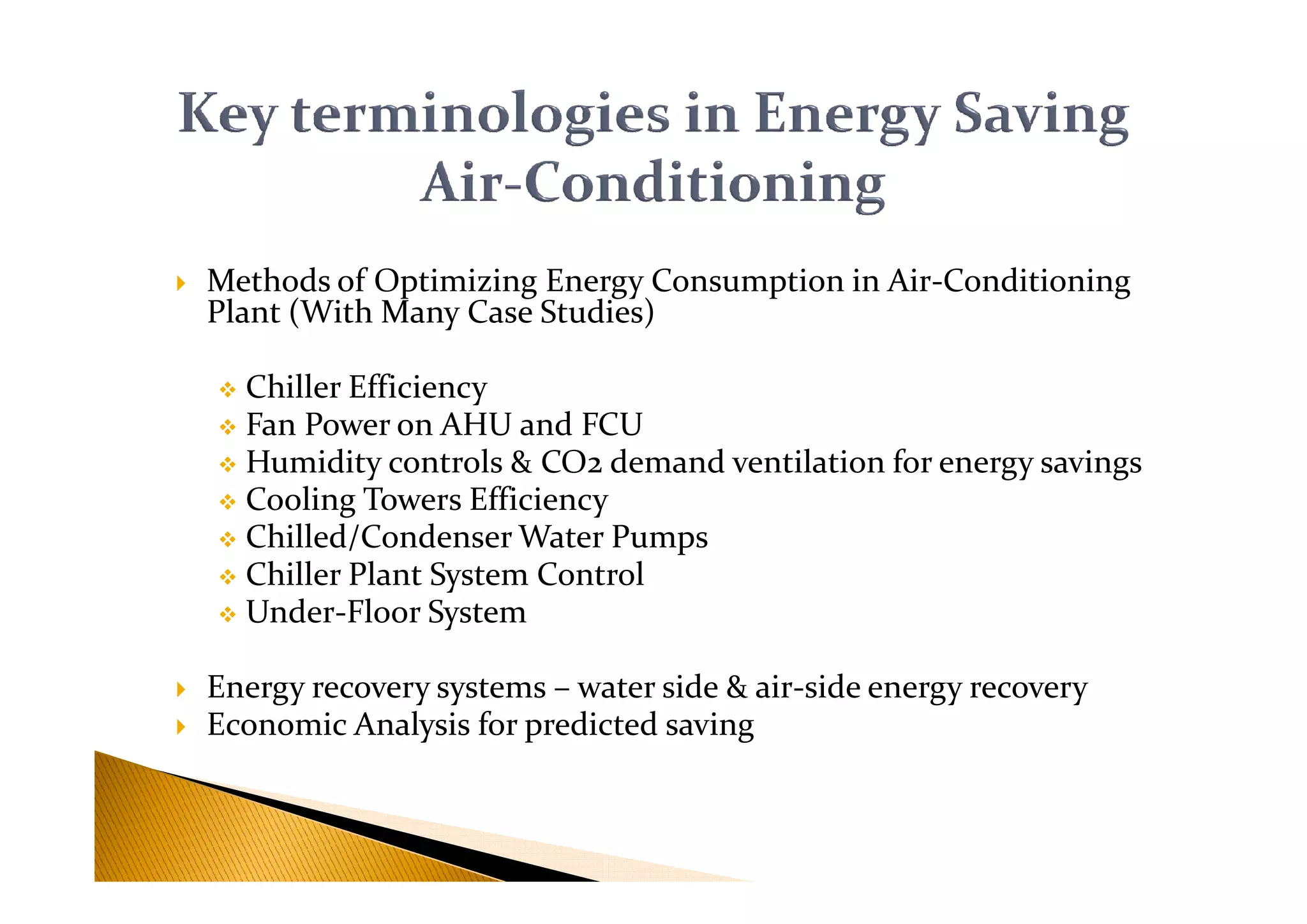
Methods of Optimizing Energy Consumption in Air-Conditioning
Plant (With Many Case Studies)
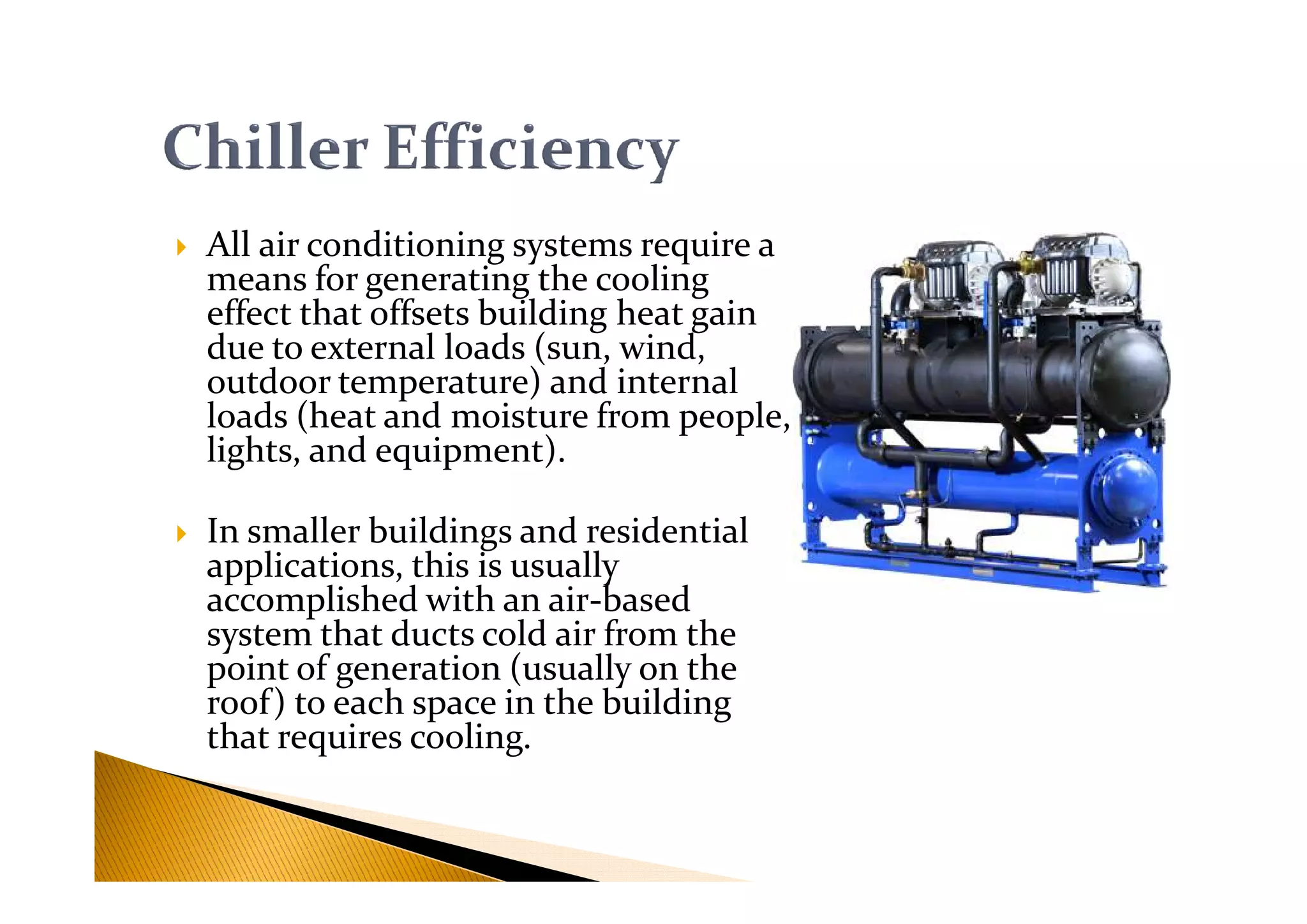
Chiller Efficiency
Fan Power on AHU and FCU
Humidity controls & CO2 demand ventilation for energy savingsHumidity controls & CO2 demand ventilation for energy savings
Cooling Towers Efficiency
Chilled/Condenser Water Pumps
Chiller Plant System Control
Under-Floor System
Energy recovery systems – water side & air-side energy recovery
Economic Analysis for predicted saving
All air conditioning systems require a
means for generating the cooling
effect that offsets building heat gain
due to external loads (sun, wind,
outdoor temperature) and internal
loads (heat and moisture from people,
lights, and equipment).lights, and equipment).
In smaller buildings and residential
applications, this is usually
accomplished with an air-based
system that ducts cold air from the
point of generation (usually on the
roof) to each space in the building
that requires cooling.
Larger buildings and multiple building campuses usually use a
chiller plant to provide cooling.
In such systems, chilled water is centrally generated and then
piped throughout the building to air handling units serving
individual tenant spaces, single floors, or several floors.
Ductwork then runs from each air handler to the zones that are
served. Chilled water-based systems result in far less ductworkserved. Chilled water-based systems result in far less ductwork
than all-air systems because chilled water piping is used to convey
thermal energy from the point of generation to each point of use.
Whereas the all-air systems used to cool smaller buildings usually
contain all of their components packaged within a single cabinet
(ergo the term “packaged cooling unit”), a chiller plant is a
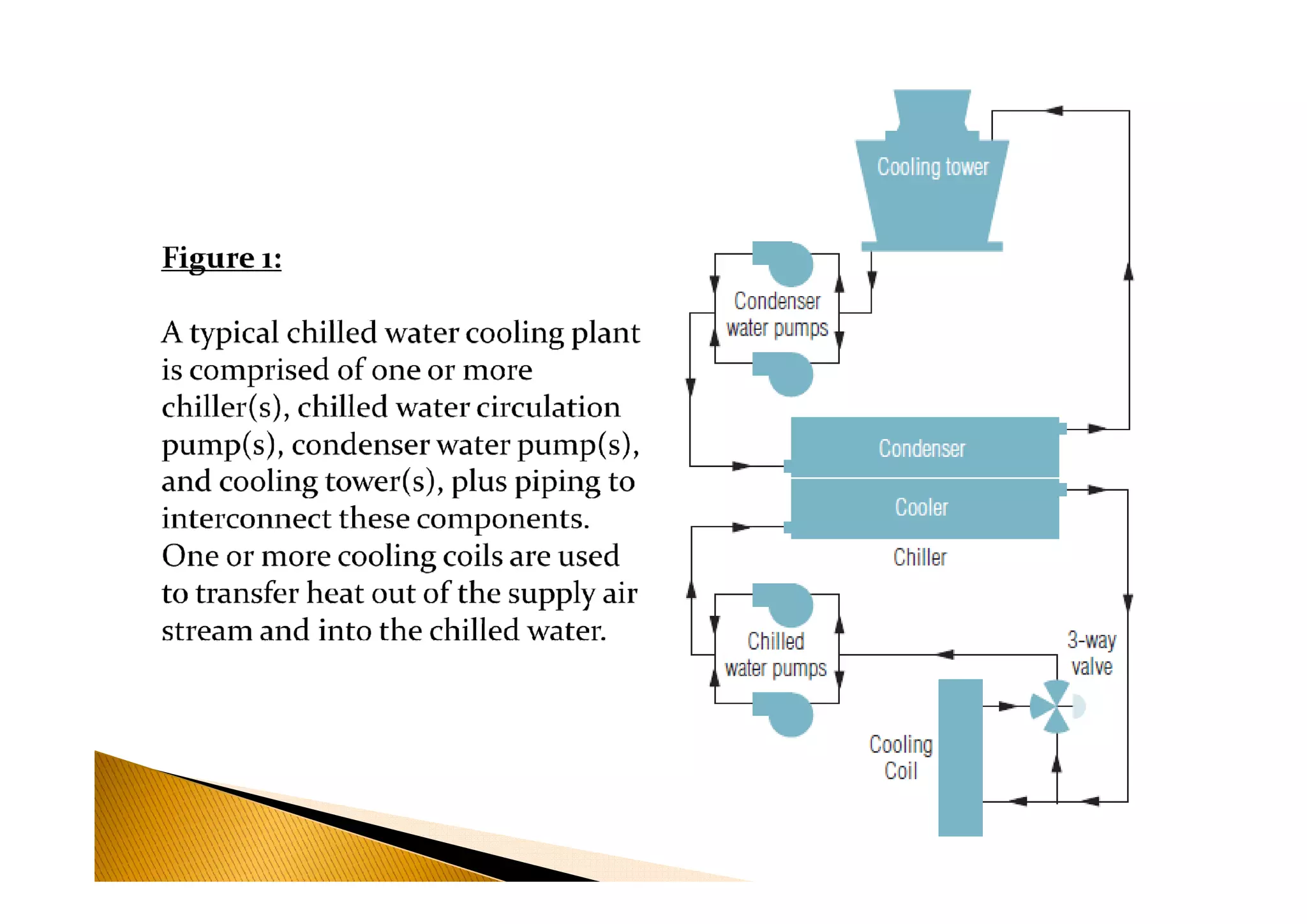
collection of individual components that have been selected to
work together as a system (Figure 1).
Though more costly to install and more complicated to
operate, a chiller plant offers a number of benefits over
simple packaged cooling units, including greater energy
efficiency, better controllability, and longer life.
Additionally, a chiller-based system can be much more
efficient in terms of space utilization within the building
because components need not be located within the same
space.space.
Chiller plants are usually used to cool large buildings because
their components require much less space within the
building than all-air systems. One reason that less space is
needed is that the size of pipes that convey chilled water
throughout the building is much smaller than the size of air
ducts that would deliver cold air to provide the same cooling
effect.
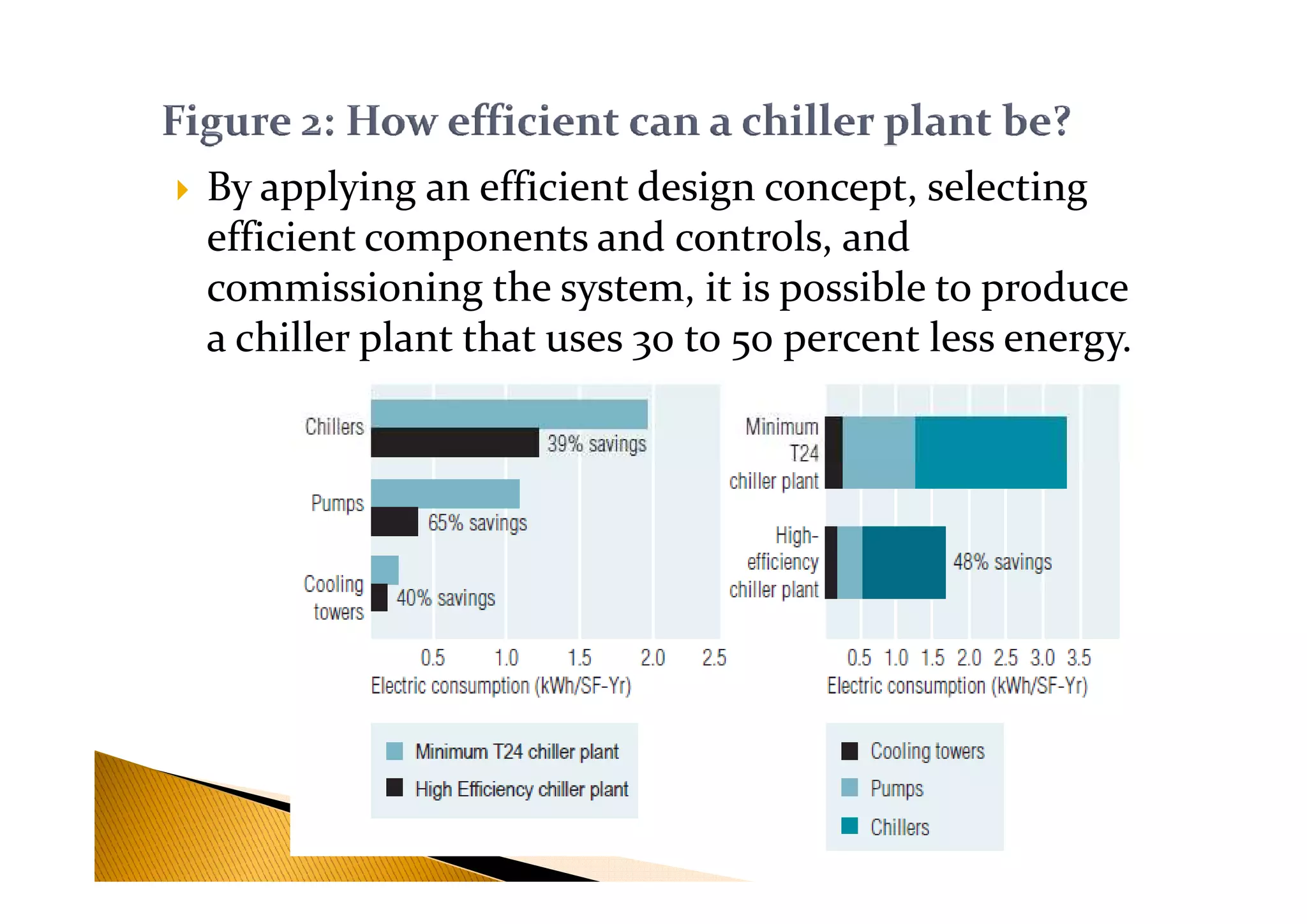
By applying an efficient design concept, selecting
efficient components and controls, and
commissioning the system, it is possible to produce
a chiller plant that uses 30 to 50 percent less energy.
1. An efficient design concept
Selecting an appropriate design concept that is
responsive to the anticipated operating conditions
is essential to achieving efficiency. Examplesis essential to achieving efficiency. Examples
include using a variable-flow pumping system for
large campus applications, and selecting the
quantity, type, and configuration of chillers based
upon the expected load profile.
2. Efficient components
Chillers, pumps, fans, and motors should all be
selected for stand-alone as well as systemic
efficiency. Examples include premium efficiencyefficiency. Examples include premium efficiency
motors, pumps that have high efficiency at the
anticipated operating conditions, chillers that are
efficient at both full and partial loads, and induced-
draft cooling towers.
3. Proper installation, commissioning, and
operation
A chiller plant that meets the first two criteria can
still waste a lot of energy—and provide poorstill waste a lot of energy—and provide poor
comfort to building occupants—if it is not installed
or operated properly. For this reason, following a
formal commissioning process that functionally
tests the plant under all modes of operation can
provide some assurance that the potential efficiency
of the system will be realized.
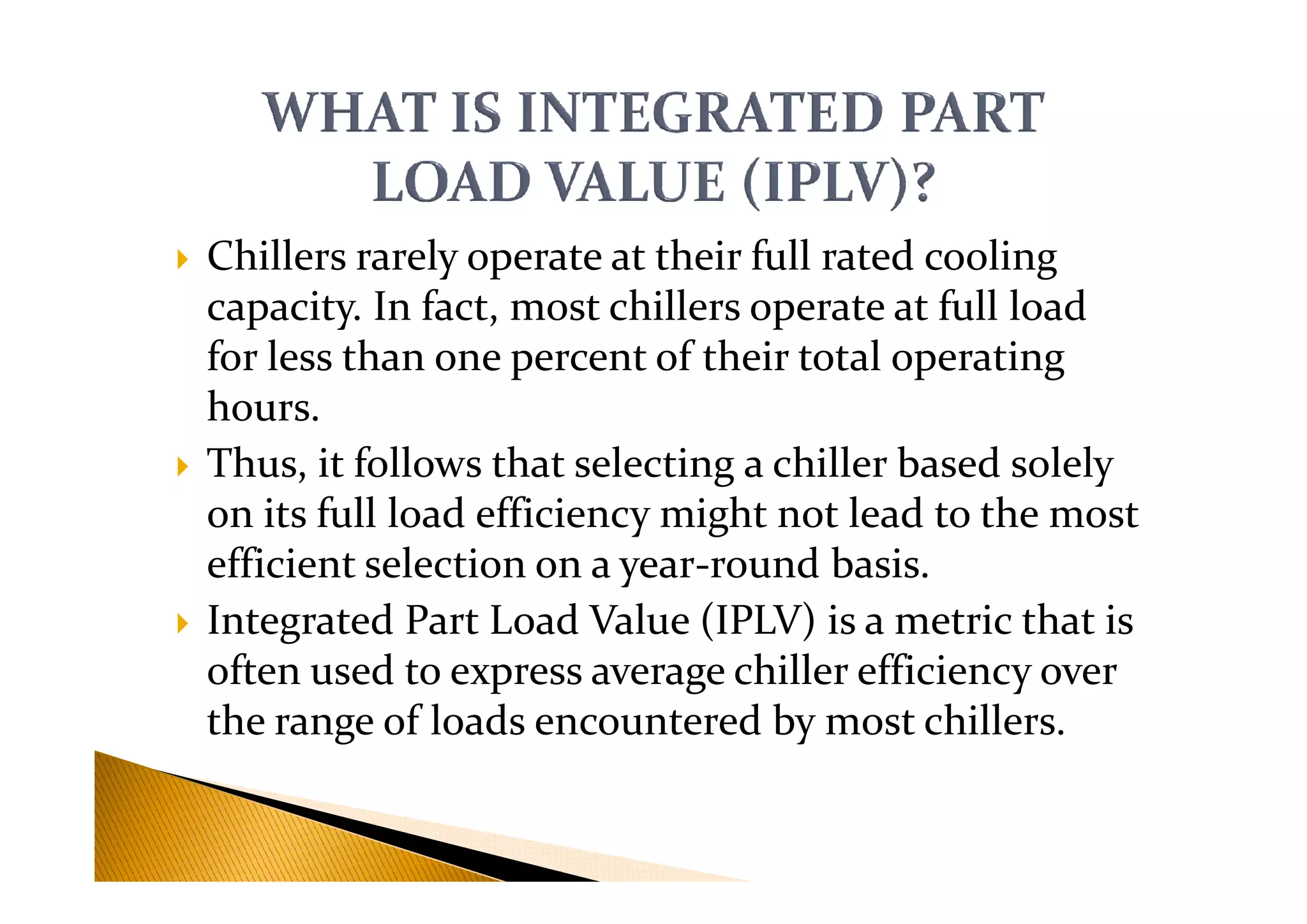
Chillers rarely operate at their full rated cooling
capacity. In fact, most chillers operate at full load
for less than one percent of their total operating
hours.
Thus, it follows that selecting a chiller based solelyThus, it follows that selecting a chiller based solely
on its full load efficiency might not lead to the most
efficient selection on a year-round basis.
Integrated Part Load Value (IPLV) is a metric that is
often used to express average chiller efficiency over
the range of loads encountered by most chillers.
IPLV is the weighted average cooling efficiency at
part load capacities related to a typical season
rather than a single rated condition, based upon a
representative load profile that assumes the chiller
operates as follows:
■ 100% load: 1% of operating hours■ 100% load: 1% of operating hours
■ 75% load: 42% of operating hours
■ 50% load: 45% of operating hours
■ 25% load: 12% of operating hours
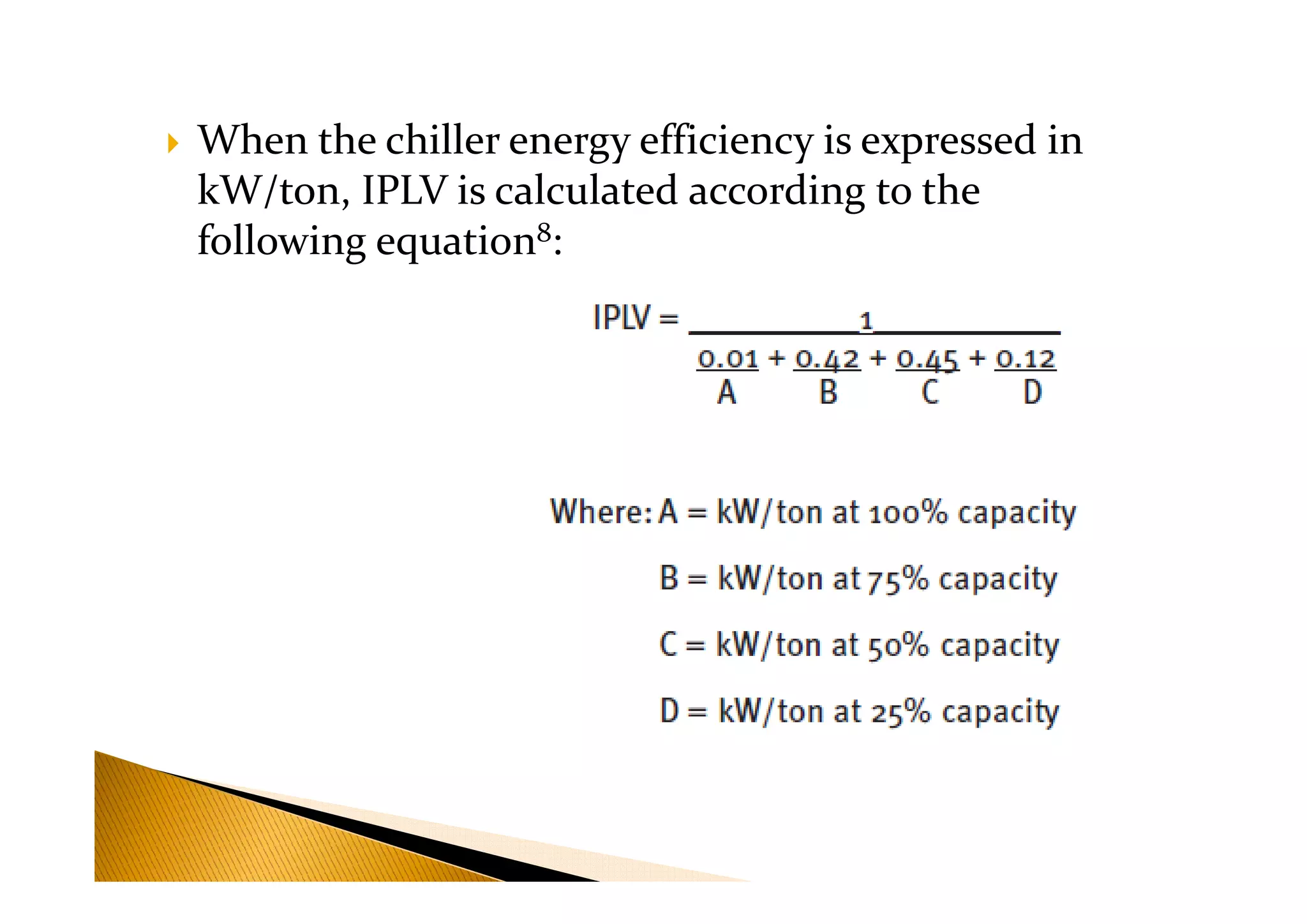
When the chiller energy efficiency is expressed in
kW/ton, IPLV is calculated according to the
following equation8:
A common mistake that people outside of the
HVAC industry make is assuming that the air
handling unit and fan coil unit are similar enough
to refer to interchangeably. An AHU is a
component that circulates air through ducts to
provide heating, cooling, and ventilation inside ofprovide heating, cooling, and ventilation inside of
a building. The FCU does not require the use of
any ducting as it is a self-contained system that
delivers air directly. Although these two unit types
might be mistaken for one another, it’s important
to understand the main features and differences.
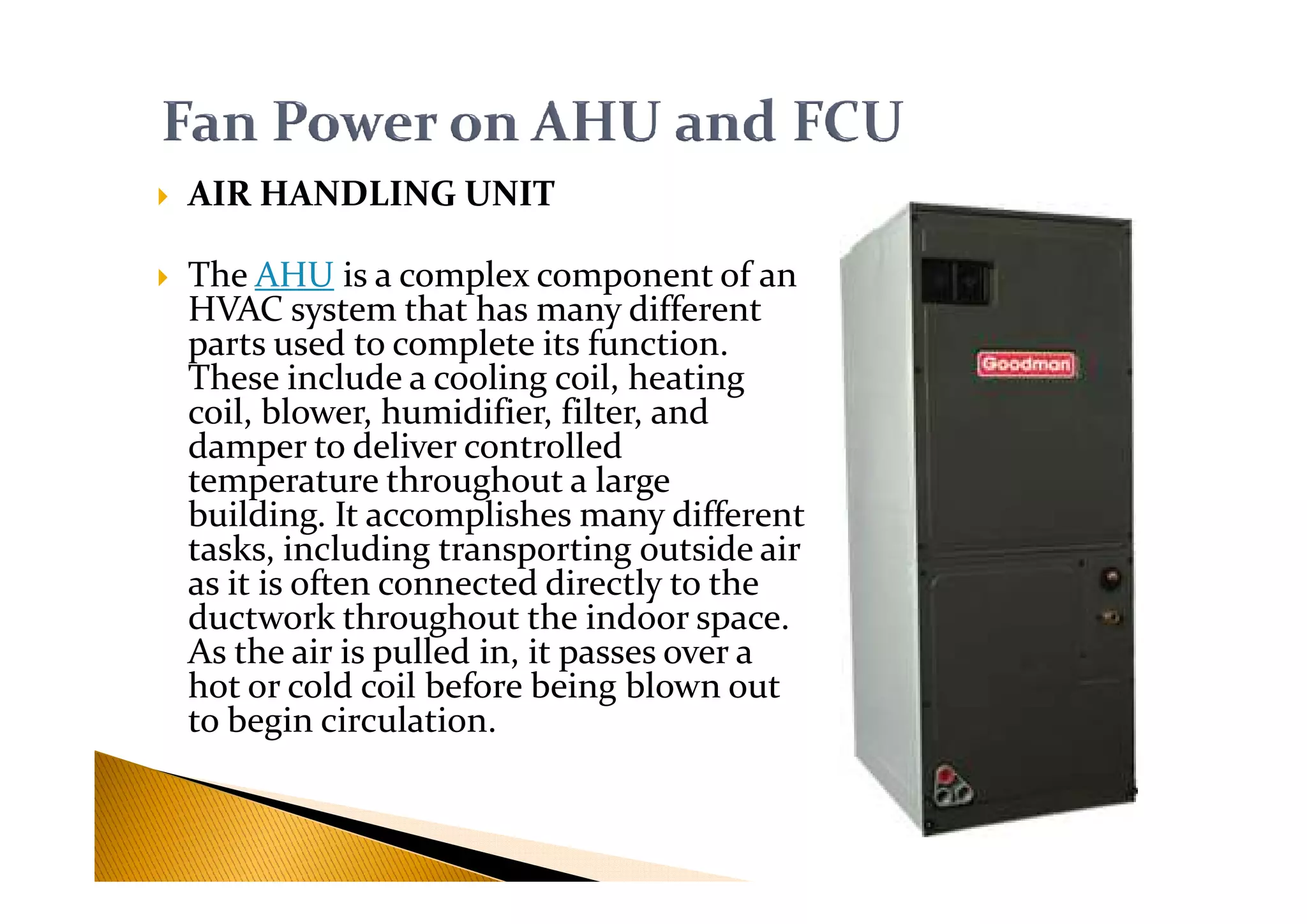
AIR HANDLING UNIT
The AHU is a complex component of an
HVAC system that has many different
parts used to complete its function.
These include a cooling coil, heating
coil, blower, humidifier, filter, and
damper to deliver controlled
temperature throughout a large
damper to deliver controlled
temperature throughout a large
building. It accomplishes many different
tasks, including transporting outside air
as it is often connected directly to the
ductwork throughout the indoor space.
As the air is pulled in, it passes over a
hot or cold coil before being blown out
to begin circulation.
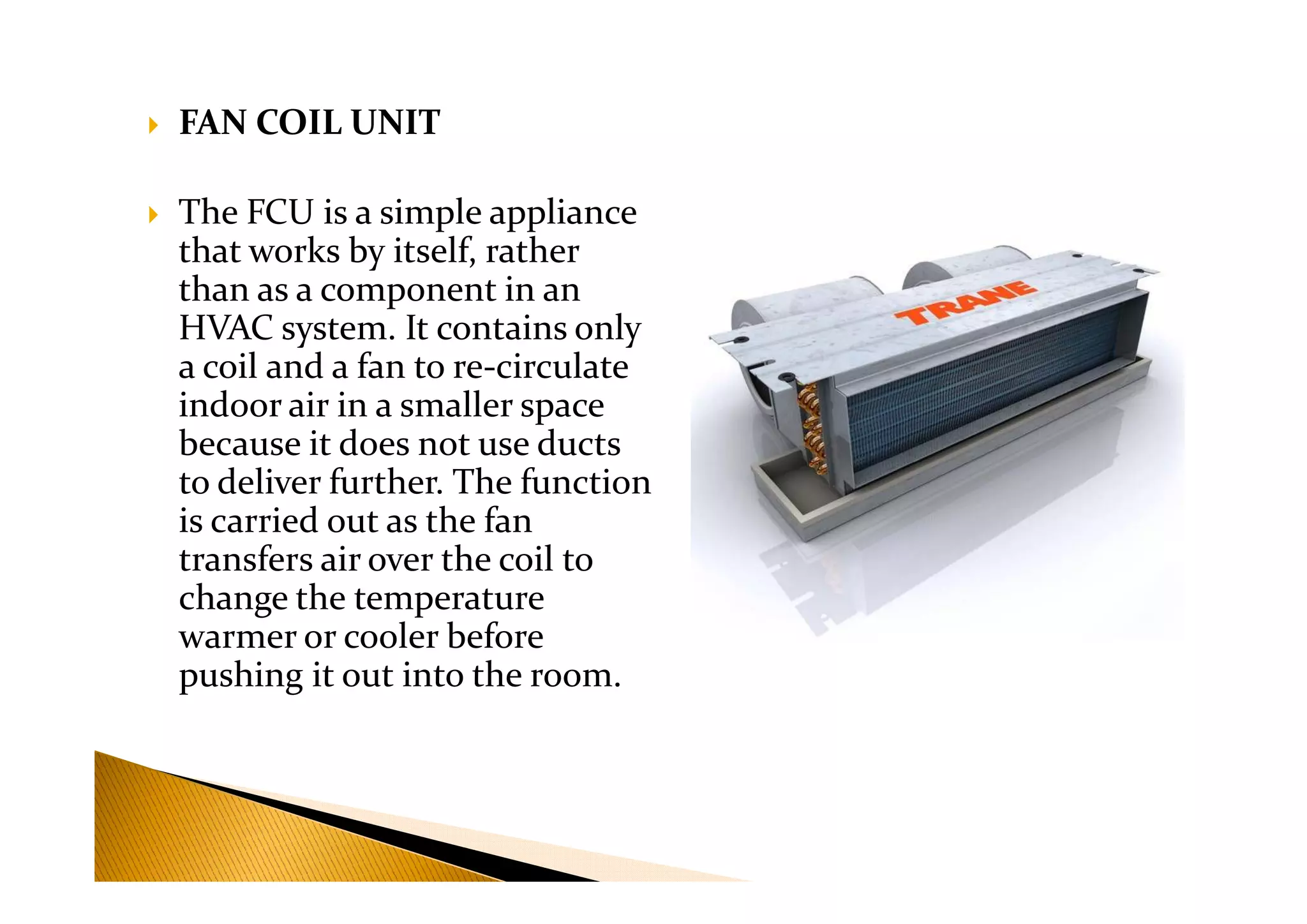
FAN COIL UNIT
The FCU is a simple appliance
that works by itself, rather
than as a component in an
HVAC system. It contains only
a coil and a fan to re-circulate
indoor air in a smaller space
because it does not use ducts
to deliver further. The function
because it does not use ducts
to deliver further. The function
is carried out as the fan
transfers air over the coil to
change the temperature
warmer or cooler before
pushing it out into the room.
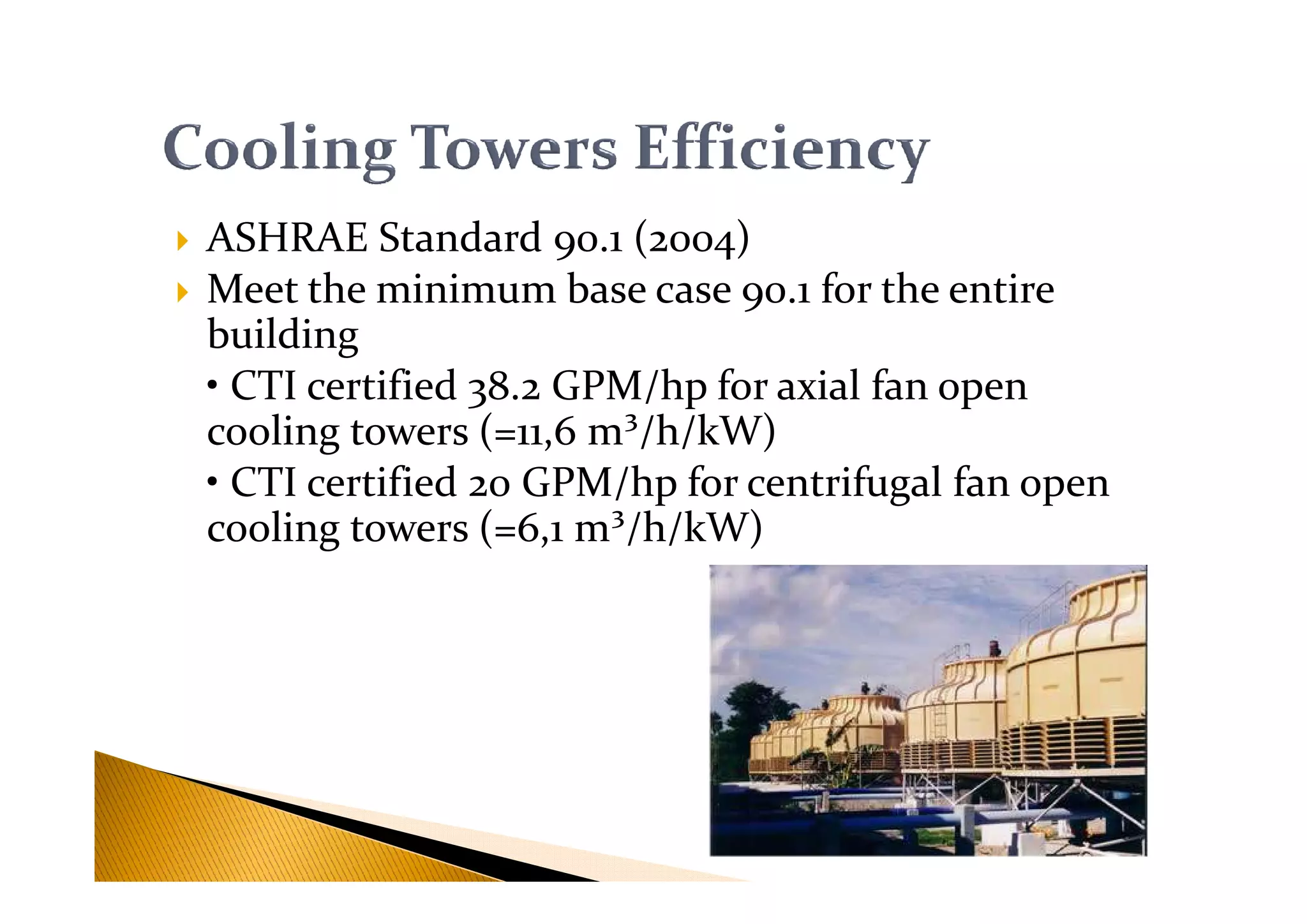
ASHRAE Standard 90.1 (2004)
Meet the minimum base case 90.1 for the entire
building
• CTI certified 38.2 GPM/hp for axial fan open
cooling towers (=11,6 m³/h/kW)
• CTI certified 20 GPM/hp for centrifugal fan open• CTI certified 20 GPM/hp for centrifugal fan open
cooling towers (=6,1 m³/h/kW)
ASHRAE Standard 90.1 (2010)
Looking to achieve 30% energy savings over
previous version.
Part of ASHRAE’s goal to achieve market-viable net-
zero energy buildings by 2030.zero energy buildings by 2030.
Efficiencies defined for Evaporative Fluid Coolers.
Centrifugal fans will have same requirements as
axial fans.
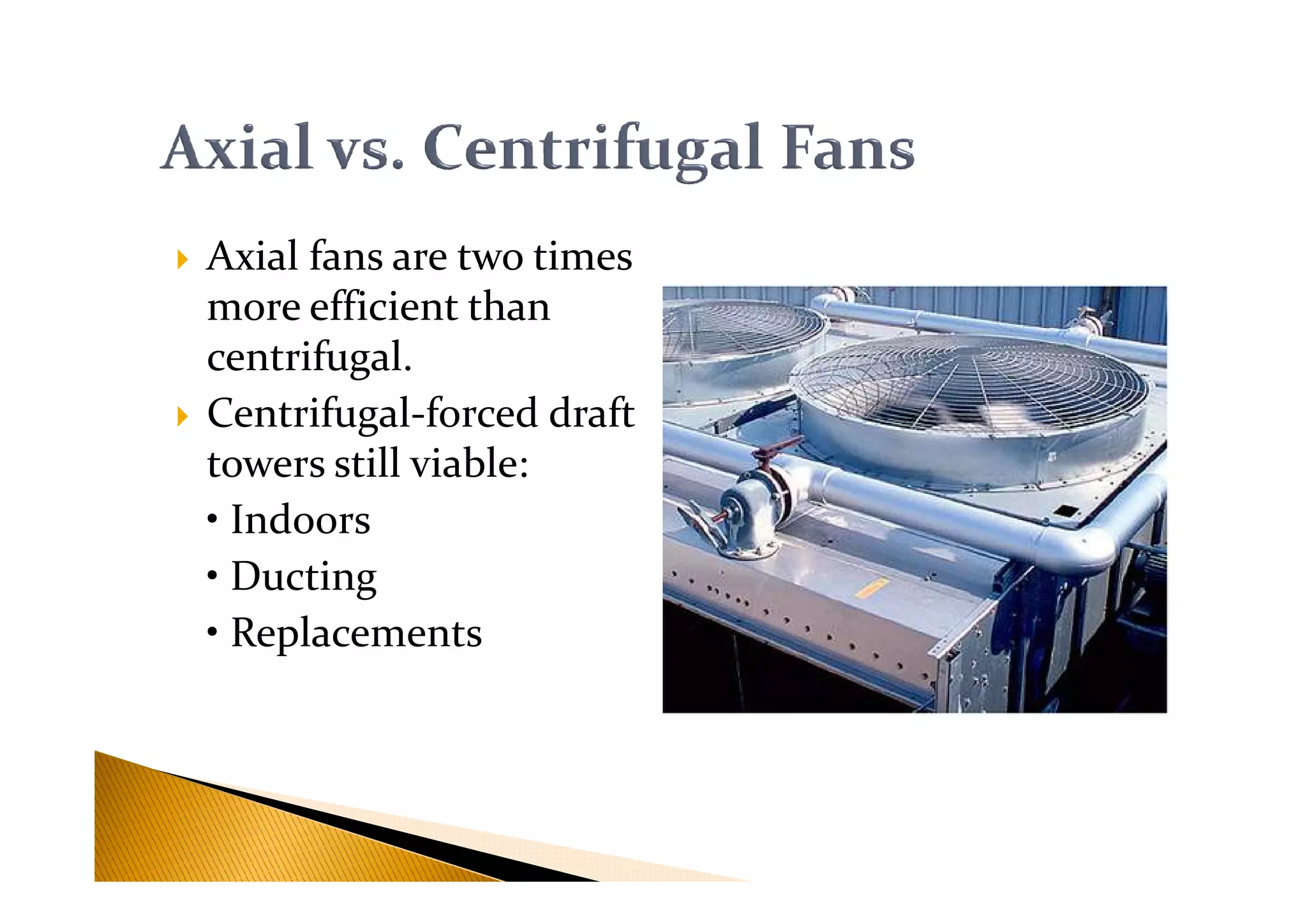
Axial fans are two times
more efficient than
centrifugal.
Centrifugal-forced draft
towers still viable:towers still viable:
• Indoors
• Ducting
• Replacements
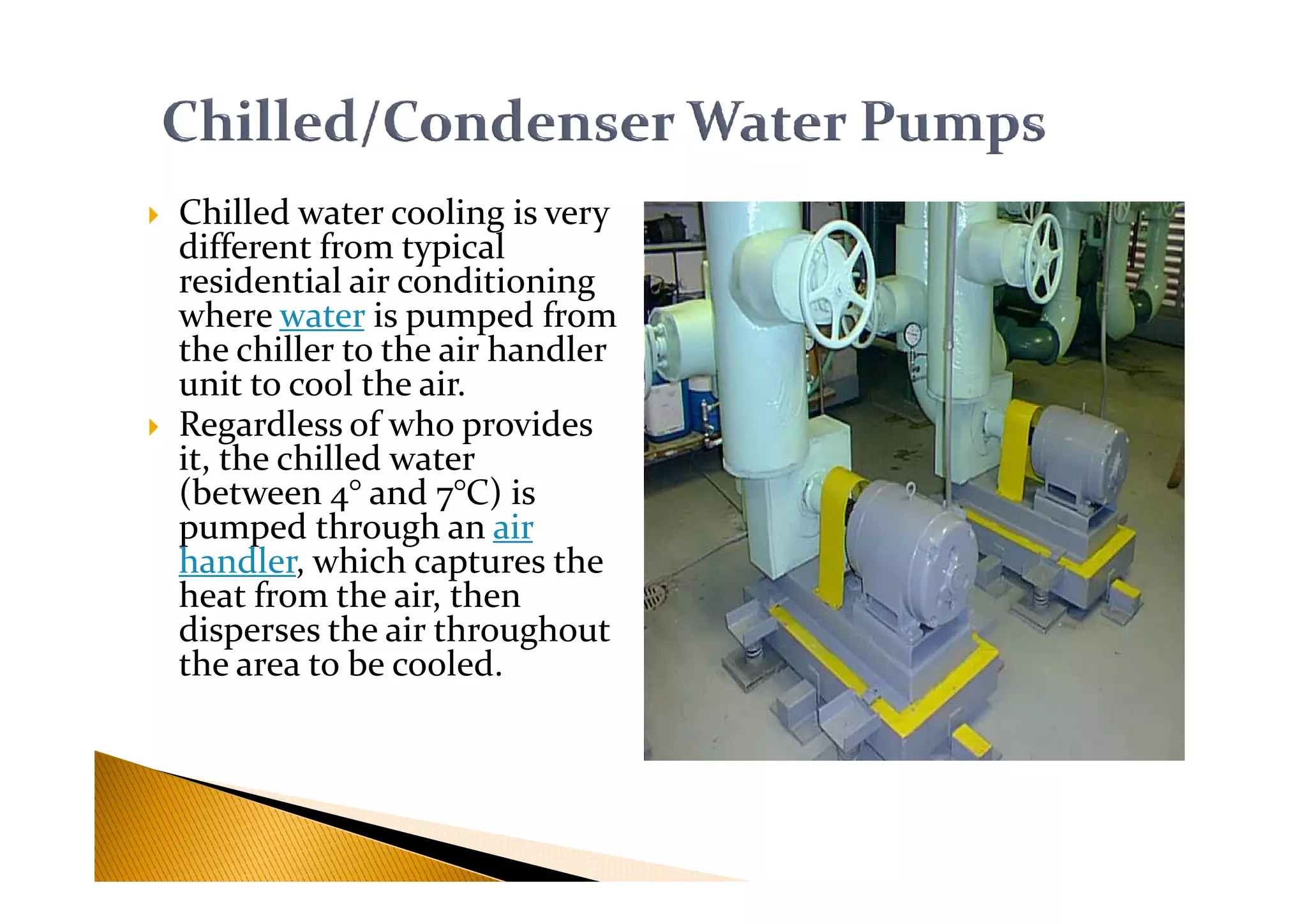
Chilled water cooling is very
different from typical
residential air conditioning
where water is pumped from
the chiller to the air handler
unit to cool the air.
Regardless of who provides
it, the chilled waterit, the chilled water
(between 4° and 7°C) is
pumped through an air
handler, which captures the
heat from the air, then
disperses the air throughout
the area to be cooled.
Analysis of overall owning and operating costs and comparisons of
alternatives require an understanding of the cost of lost opportunities,
inflation, and the time value of money. This process of economic
analysis of alternatives falls into two general categories:
• simple payback analysis and
• detailed economic analyses (life-cycle cost analyses).
A simple payback analysis reveals options that have short versus long
paybacks. Often, however, alternatives are similar and have similar
paybacks. For a more accurate comparison, a more comprehensive
economic analysis is warranted. Many times it is appropriate to have
both a simple payback analysis and a detailed economic analysis. The
simple payback analysis shows which options should not be
considered further, and the detailed economic analysis determines
which of the viable options are the strongest. The strongest options
can be accepted or further analyzed if they include competing
alternatives.
In the simple payback technique, a projection of the revenue
stream, cost savings, and other factors is estimated and
compared to the initial capital outlay.
This simple technique ignores the cost of borrowing money
(interest) and lost opportunity costs.
It also ignores inflation and the time value of money.
Example
Equipment item 1 costs $10 000 and will save $2000 per year
in operating costs; equipment item 2 costs $12 000 and saves
$3000 per year. Which item has the best simple payback?
Item 1 $10 000/($2000/yr) = 5 year simple payback
Item 2 $12 000/($3000/yr) = 4 year simple payback
The cost or value of money is a function of the
available interest rate and inflation rate.
The future value F of a present sum of money P over
n periods with compound interest rate i per period
is:
Example 3. Calculate the value in 10 years at 10% per year
interest of a system presently valued at $10,000.
Example 4. Using the present worth factor for 10% per
year interest and an analysis period of 10 years, calculate
the present value of a future sum of money valued at $10the present value of a future sum of money valued at $10
000. (Stated another way, determine what sum of money
must be invested today at 10% per year interest to yield $10
000 10 years from now.)
The present worth factor for a series of future equal
payments (e.g., operating costs) is given by
All sophisticated economic analysis methods use the basic
principles of present value analysis to account for the time
value of money. Therefore, a good understanding of these
principles is important.
The total present value (present worth) for any analysis is
determined by summing the present worth of all individual
items under consideration, both future single payment items
and series of equal future payments. The scenario with the
highest present value is the preferred alternative.
Sometimes also known as Net Present Value (NPV).
NPV = (present worth factor x Saving per Year) –
Investment
Example:
Life cycle: 15 years, Interest: 2.5%Life cycle: 15 years, Interest: 2.5%
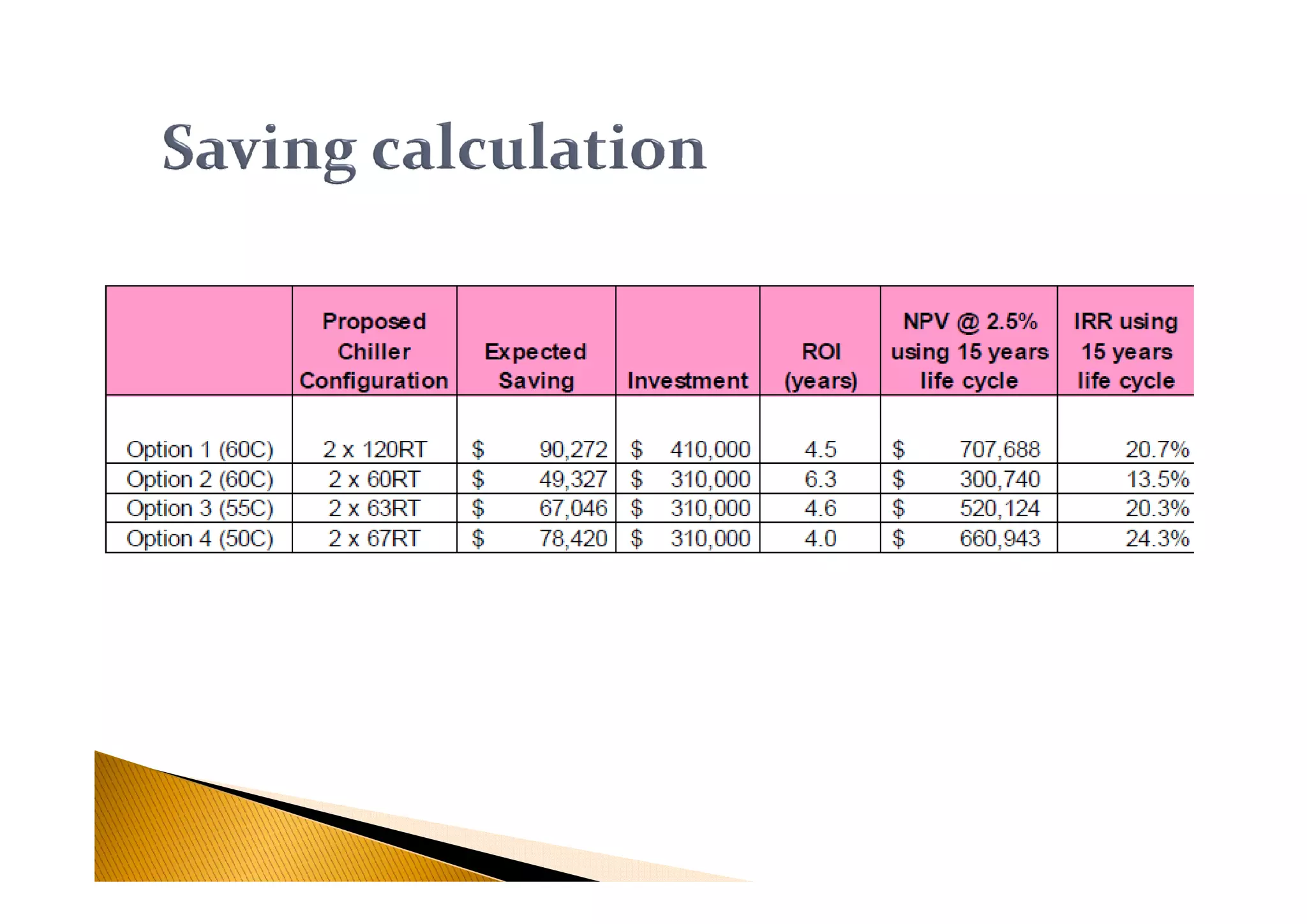
Initial investment: $410,000, Annual Saving: $90,272
P.W.F = 12.382
Net Present Value = (12.382 x $90,272) - $410,000 =
$707,748
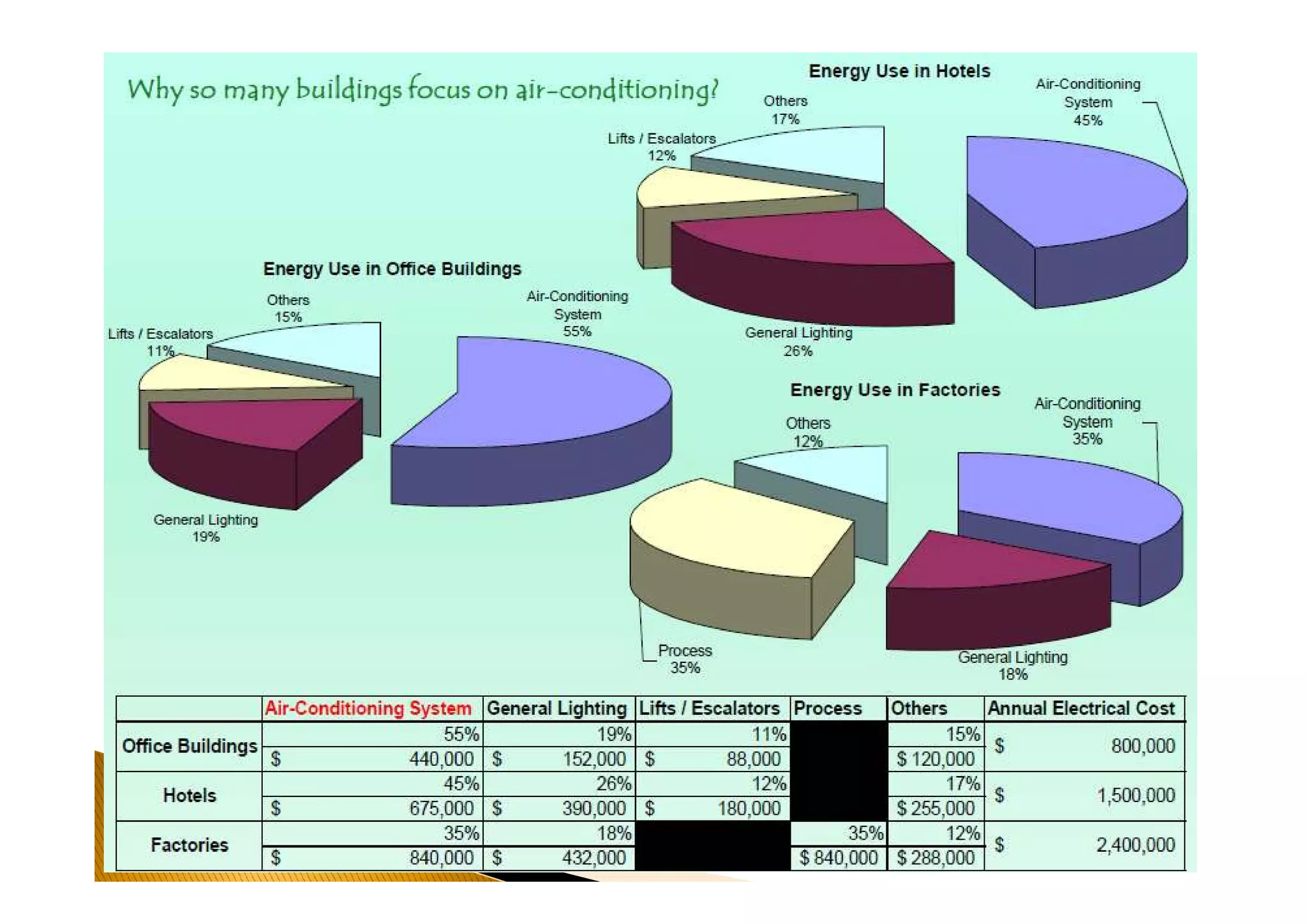
Air conditioning System is one of the areas that has
the most Energy Conservation Opportunities
A huge saving can be achieved with little
improvement on System Efficiency. By following
conventional design method, unlikely to obtainconventional design method, unlikely to obtain
Green Certifications.
By adopting Proper Data Acquisition approach for
existing buildings, there are huge areas of
improvement we could identify in HVAC system in a
more professional and accurate methodology.
Energy Efficient Air Conditioning System

Energy Efficient Air Conditioning System

  • 1.
  • 2.
    Methods of OptimizingEnergy Consumption in Air-Conditioning Plant (With Many Case Studies) Chiller Efficiency Fan Power on AHU and FCU Humidity controls & CO2 demand ventilation for energy savingsHumidity controls & CO2 demand ventilation for energy savings Cooling Towers Efficiency Chilled/Condenser Water Pumps Chiller Plant System Control Under-Floor System Energy recovery systems – water side & air-side energy recovery Economic Analysis for predicted saving
  • 6.
    All air conditioningsystems require a means for generating the cooling effect that offsets building heat gain due to external loads (sun, wind, outdoor temperature) and internal loads (heat and moisture from people, lights, and equipment).lights, and equipment). In smaller buildings and residential applications, this is usually accomplished with an air-based system that ducts cold air from the point of generation (usually on the roof) to each space in the building that requires cooling.
  • 7.
    Larger buildings andmultiple building campuses usually use a chiller plant to provide cooling. In such systems, chilled water is centrally generated and then piped throughout the building to air handling units serving individual tenant spaces, single floors, or several floors. Ductwork then runs from each air handler to the zones that are served. Chilled water-based systems result in far less ductworkserved. Chilled water-based systems result in far less ductwork than all-air systems because chilled water piping is used to convey thermal energy from the point of generation to each point of use. Whereas the all-air systems used to cool smaller buildings usually contain all of their components packaged within a single cabinet (ergo the term “packaged cooling unit”), a chiller plant is a collection of individual components that have been selected to work together as a system (Figure 1).
  • 8.
    Though more costlyto install and more complicated to operate, a chiller plant offers a number of benefits over simple packaged cooling units, including greater energy efficiency, better controllability, and longer life. Additionally, a chiller-based system can be much more efficient in terms of space utilization within the building because components need not be located within the same space.space. Chiller plants are usually used to cool large buildings because their components require much less space within the building than all-air systems. One reason that less space is needed is that the size of pipes that convey chilled water throughout the building is much smaller than the size of air ducts that would deliver cold air to provide the same cooling effect.
  • 10.
    By applying anefficient design concept, selecting efficient components and controls, and commissioning the system, it is possible to produce a chiller plant that uses 30 to 50 percent less energy.
  • 11.
    1. An efficientdesign concept Selecting an appropriate design concept that is responsive to the anticipated operating conditions is essential to achieving efficiency. Examplesis essential to achieving efficiency. Examples include using a variable-flow pumping system for large campus applications, and selecting the quantity, type, and configuration of chillers based upon the expected load profile.
  • 12.
    2. Efficient components Chillers,pumps, fans, and motors should all be selected for stand-alone as well as systemic efficiency. Examples include premium efficiencyefficiency. Examples include premium efficiency motors, pumps that have high efficiency at the anticipated operating conditions, chillers that are efficient at both full and partial loads, and induced- draft cooling towers.
  • 13.
    3. Proper installation,commissioning, and operation A chiller plant that meets the first two criteria can still waste a lot of energy—and provide poorstill waste a lot of energy—and provide poor comfort to building occupants—if it is not installed or operated properly. For this reason, following a formal commissioning process that functionally tests the plant under all modes of operation can provide some assurance that the potential efficiency of the system will be realized.
  • 15.
    Chillers rarely operateat their full rated cooling capacity. In fact, most chillers operate at full load for less than one percent of their total operating hours. Thus, it follows that selecting a chiller based solelyThus, it follows that selecting a chiller based solely on its full load efficiency might not lead to the most efficient selection on a year-round basis. Integrated Part Load Value (IPLV) is a metric that is often used to express average chiller efficiency over the range of loads encountered by most chillers.
  • 16.
    IPLV is theweighted average cooling efficiency at part load capacities related to a typical season rather than a single rated condition, based upon a representative load profile that assumes the chiller operates as follows: ■ 100% load: 1% of operating hours■ 100% load: 1% of operating hours ■ 75% load: 42% of operating hours ■ 50% load: 45% of operating hours ■ 25% load: 12% of operating hours
  • 17.
    When the chillerenergy efficiency is expressed in kW/ton, IPLV is calculated according to the following equation8:
  • 18.
    A common mistakethat people outside of the HVAC industry make is assuming that the air handling unit and fan coil unit are similar enough to refer to interchangeably. An AHU is a component that circulates air through ducts to provide heating, cooling, and ventilation inside ofprovide heating, cooling, and ventilation inside of a building. The FCU does not require the use of any ducting as it is a self-contained system that delivers air directly. Although these two unit types might be mistaken for one another, it’s important to understand the main features and differences.
  • 19.
    AIR HANDLING UNIT TheAHU is a complex component of an HVAC system that has many different parts used to complete its function. These include a cooling coil, heating coil, blower, humidifier, filter, and damper to deliver controlled temperature throughout a large damper to deliver controlled temperature throughout a large building. It accomplishes many different tasks, including transporting outside air as it is often connected directly to the ductwork throughout the indoor space. As the air is pulled in, it passes over a hot or cold coil before being blown out to begin circulation.
  • 20.
    FAN COIL UNIT TheFCU is a simple appliance that works by itself, rather than as a component in an HVAC system. It contains only a coil and a fan to re-circulate indoor air in a smaller space because it does not use ducts to deliver further. The function because it does not use ducts to deliver further. The function is carried out as the fan transfers air over the coil to change the temperature warmer or cooler before pushing it out into the room.
  • 21.
    ASHRAE Standard 90.1(2004) Meet the minimum base case 90.1 for the entire building • CTI certified 38.2 GPM/hp for axial fan open cooling towers (=11,6 m³/h/kW) • CTI certified 20 GPM/hp for centrifugal fan open• CTI certified 20 GPM/hp for centrifugal fan open cooling towers (=6,1 m³/h/kW)
  • 22.
    ASHRAE Standard 90.1(2010) Looking to achieve 30% energy savings over previous version. Part of ASHRAE’s goal to achieve market-viable net- zero energy buildings by 2030.zero energy buildings by 2030. Efficiencies defined for Evaporative Fluid Coolers. Centrifugal fans will have same requirements as axial fans.
  • 23.
    Axial fans aretwo times more efficient than centrifugal. Centrifugal-forced draft towers still viable:towers still viable: • Indoors • Ducting • Replacements
  • 24.
    Chilled water coolingis very different from typical residential air conditioning where water is pumped from the chiller to the air handler unit to cool the air. Regardless of who provides it, the chilled waterit, the chilled water (between 4° and 7°C) is pumped through an air handler, which captures the heat from the air, then disperses the air throughout the area to be cooled.
  • 25.
    Analysis of overallowning and operating costs and comparisons of alternatives require an understanding of the cost of lost opportunities, inflation, and the time value of money. This process of economic analysis of alternatives falls into two general categories: • simple payback analysis and • detailed economic analyses (life-cycle cost analyses). A simple payback analysis reveals options that have short versus long paybacks. Often, however, alternatives are similar and have similar paybacks. For a more accurate comparison, a more comprehensive economic analysis is warranted. Many times it is appropriate to have both a simple payback analysis and a detailed economic analysis. The simple payback analysis shows which options should not be considered further, and the detailed economic analysis determines which of the viable options are the strongest. The strongest options can be accepted or further analyzed if they include competing alternatives.
  • 26.
    In the simplepayback technique, a projection of the revenue stream, cost savings, and other factors is estimated and compared to the initial capital outlay. This simple technique ignores the cost of borrowing money (interest) and lost opportunity costs. It also ignores inflation and the time value of money. Example Equipment item 1 costs $10 000 and will save $2000 per year in operating costs; equipment item 2 costs $12 000 and saves $3000 per year. Which item has the best simple payback? Item 1 $10 000/($2000/yr) = 5 year simple payback Item 2 $12 000/($3000/yr) = 4 year simple payback
  • 27.
    The cost orvalue of money is a function of the available interest rate and inflation rate. The future value F of a present sum of money P over n periods with compound interest rate i per period is:
  • 28.
    Example 3. Calculatethe value in 10 years at 10% per year interest of a system presently valued at $10,000. Example 4. Using the present worth factor for 10% per year interest and an analysis period of 10 years, calculate the present value of a future sum of money valued at $10the present value of a future sum of money valued at $10 000. (Stated another way, determine what sum of money must be invested today at 10% per year interest to yield $10 000 10 years from now.)
  • 29.
    The present worthfactor for a series of future equal payments (e.g., operating costs) is given by
  • 30.
    All sophisticated economicanalysis methods use the basic principles of present value analysis to account for the time value of money. Therefore, a good understanding of these principles is important. The total present value (present worth) for any analysis is determined by summing the present worth of all individual items under consideration, both future single payment items and series of equal future payments. The scenario with the highest present value is the preferred alternative. Sometimes also known as Net Present Value (NPV).
  • 31.
    NPV = (presentworth factor x Saving per Year) – Investment Example: Life cycle: 15 years, Interest: 2.5%Life cycle: 15 years, Interest: 2.5% Initial investment: $410,000, Annual Saving: $90,272 P.W.F = 12.382 Net Present Value = (12.382 x $90,272) - $410,000 = $707,748
  • 35.
    Air conditioning Systemis one of the areas that has the most Energy Conservation Opportunities A huge saving can be achieved with little improvement on System Efficiency. By following conventional design method, unlikely to obtainconventional design method, unlikely to obtain Green Certifications. By adopting Proper Data Acquisition approach for existing buildings, there are huge areas of improvement we could identify in HVAC system in a more professional and accurate methodology.