THE PENNSYLVANIA STATE UNIVERSITY
SCHREYER HONORS COLLEGE
DEPARTMENT OF ARCHITECTURAL ENGINEERING
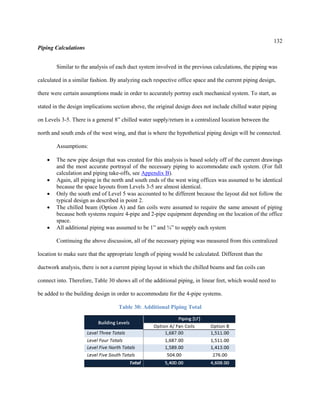
RUTGERS ACADEMIC BUILDING
ANDREW KOFFKE
SPRING 2015
A thesis
submitted in partial fulfillment
of the requirements
for a baccalaureate degree in Architectural Engineering
with honors in Architectural Engineering
Reviewed and approved* by the following:
Donghyun Rim
Assistant Professor
Thesis Supervisor
Richard G. Mistrick
Associate Professor of Architectural Engineering
Honors Adviser
* Signatures are on file in the Schreyer Honors College.
i
ABSTRACT
This report analyzes the Northeast Education Building, which is a new university
building project consisting of office space as well as several lecture halls. As a new icon on this
university’s campus, the building was originally designed with energy in mind striving for a
LEED Silver rating. From a mechanical perspective, this thesis report studies the current design
to see where potential improvements could be made, ultimately providing an alternative solution
to the original project. Overall, the alternative design proposal is analyzed to see whether there
are potential benefits to the new system and to understand why the design team may have chosen
the original system. For this report, the main study revolves around an analysis of the building’s
heating and cooling system in the office spaces on the upper levels. As designed, the offices are
conditioned utilizing a standard air-driven system with VAV terminal units. While this system is
fully capable of conditioning the rooms appropriately, the newly proposed design involves two
different hydronic systems – active chilled beams and fan coil units. In general, the main study of
this report analyzes whether an air or water driven system operates more effectively and
efficiently to heat and cool each space. As stated, the original engineers designed this building
with energy in mind; therefore, one of the main goals of the redesign system was to enhance this
project with an energy efficient system that would offer future payback in both utility costs and
energy usage.
The other main component of this thesis report was to analyze the potential daylighting
benefits in conjunction with the proposed mechanical design. Currently, the architecture of the
Northeast Education Building is underutilized with respect to daylighting. As one system, the
mechanical and electrical designs should utilize more natural light in the building to improve the
ii
cost reduction benefits and provide a more aesthetically pleasing environment for the students
and professors alike. By implementing a photocell design in the circulation spaces in addition to
providing new LED luminaires, the building realizes potential energy benefits with this newly
specified equipment. Given the analysis provided by both the mechanical and electrical system
redesigns, this report also shows the difference in upfront capital costs in addition to potential
pay back periods. While saving energy is a beneficial part of new building designs, owners will
not realistically consider the more expensive technology if it does not prove to be cost effective.
This report shows how each redesign compares when new equipment is specified as well as the
potential cost savings on downsized equipment and materials. Ultimately, between all three
major studies, the Northeast Education Building is redesigned in a logical, energy efficient
manner. And while some of the hypothesized studies did not prove to be as beneficial as
originally thought, there are several design considerations and further studies that would benefit
the original design.
This report shows the following information:
Hydronic System Study Mechanical | Construction
Option A: Chilled Beams Option B: Chilled Beams Option C: Fan Coils
78% air savings
Annual energy savings: $7,800
Capital Costs: $282,000 (14 yrs.)
62% air savings
Annual energy savings: $6,500
Capital Costs: $270,000 (18 yrs.)
32% air savings
Annual energy savings: $1,100
Capital Costs: $268,000 (N/A)
Electrical System Study Electrical Breadth
Photocells w/ Dimming Ballasts
Energy savings: 32.15%
T8 LED Luminaire
Energy savings: 15%
iii
TABLE OF CONTENTS
LIST OF FIGURES .....................................................................................................vi
LIST OF TABLES.......................................................................................................ix
ACKNOWLEDGEMENTS.........................................................................................xi
Chapter 1 | Existing Systems Overview.......................................................................12
Equipment........................................................................................................................12
Heating Equipment...................................................................................................12
Cooling Equipment ..................................................................................................13
Airside Distribution..................................................................................................14
Water Distribution....................................................................................................16
System Schematics...........................................................................................................17
Chilled Water Plant ..................................................................................................17
Hot Water Plant........................................................................................................18
DOAS System Controls ...........................................................................................19
East & West AHU Controls .....................................................................................20
Tiered Lecture Hall Controls....................................................................................21
Air Distribution Box Controls..................................................................................22
Mechanical Space Requirement.......................................................................................23
Building Load Estimation ................................................................................................24
Design Conditions....................................................................................................24
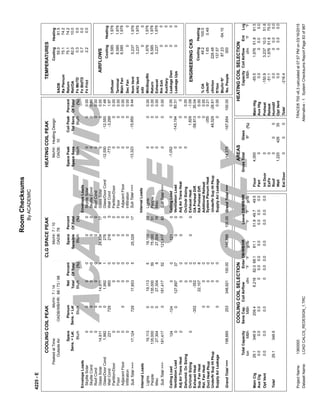
Building Load Assumption ......................................................................................27
Original Estimation Results .....................................................................................29
Energy Consumption & Associated Costs .......................................................................30
Building Energy .......................................................................................................30
Annual Energy Consumption...................................................................................32
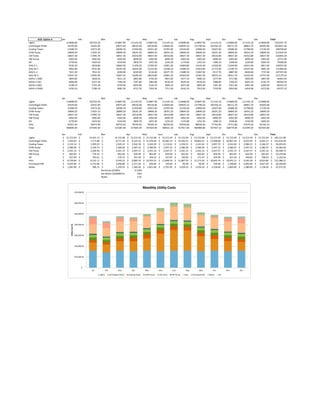
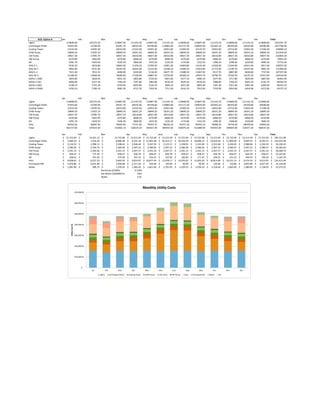
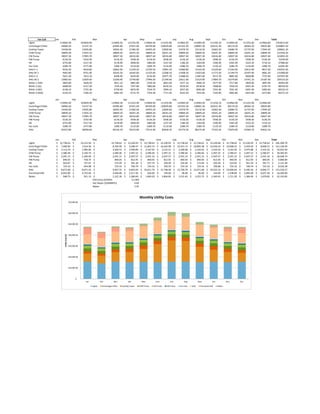
Annual Operating Costs ...........................................................................................35
LEED Analysis ................................................................................................................37
Water Efficiency ......................................................................................................37
Energy & Atmosphere..............................................................................................38
Indoor Environmental Quality..................................................................................39
LEED Analysis Summary ........................................................................................40
ASHRAE Standard 62.1 Compliance ..............................................................................41
ASHRAE 62.1 Section 5: Systems and Equipment .................................................41
ASHRAE 62.1 Conclusions .....................................................................................64
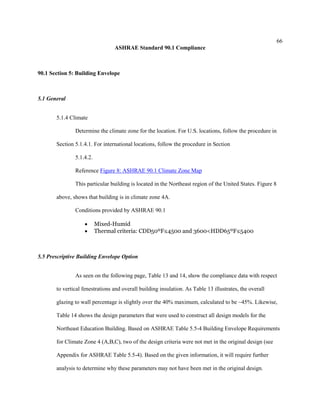
ASHRAE Standard 90.1 Compliance ..............................................................................66
90.1 Section 5: Building Envelope...........................................................................66
90.1 Section 9: Lighting...........................................................................................69
ASHRAE 90.1 Conclusions .....................................................................................70
Mechanical System Evaluation........................................................................................70
Chapter 2 | Proposed Redesign ....................................................................................72
iv
System Evaluation............................................................................................................72
Alternatives Considered...................................................................................................72
Alternatives ..............................................................................................................73
Limitations ...............................................................................................................74
Proposed Alternatives ......................................................................................................74
Displacement Ventilation Expansion .......................................................................75
Impact of Displacement Ventilation Expansion.......................................................76
Chilled Beam Implementation..................................................................................76
Impact of Chilled Beam System...............................................................................78
Breadth Analysis..............................................................................................................78
Construction Analysis ..............................................................................................78
Daylighting Analysis................................................................................................79
Masters Coursework.........................................................................................................79
Tools & Methods .............................................................................................................80
Load Simulation.......................................................................................................80
Plan of Action ..................................................................................................................81
Chapter 3 | Proposed Redesign Analysis .....................................................................82
Depth Study 1 | Chilled Beam Implementation................................................................82
System Definition.....................................................................................................82
Initial Research.........................................................................................................82
Spaces Analyzed ......................................................................................................86
System Analysis.......................................................................................................87
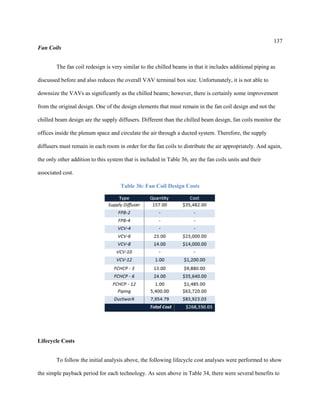
Depth Study 2 | Fan Coil Implementation........................................................................89
System Definition.....................................................................................................89
Initial Research.........................................................................................................90
Spaces Analyzed ......................................................................................................93
System Analysis.......................................................................................................94
Depth Study 1 & 2 Comparison.......................................................................................95
Airflow Comparison.................................................................................................95
Depth Study Overview | Cost Analysis............................................................................97
General Overview ....................................................................................................97
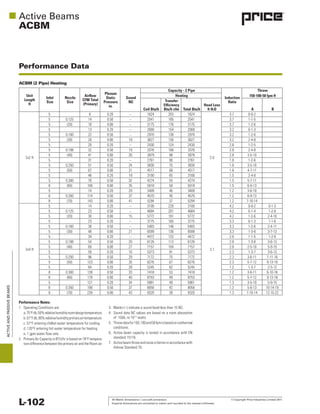
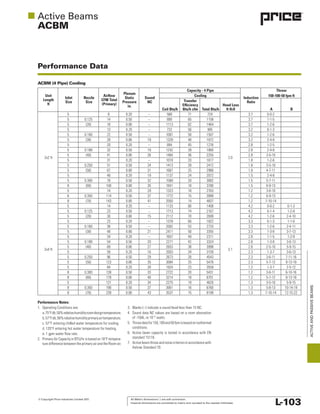
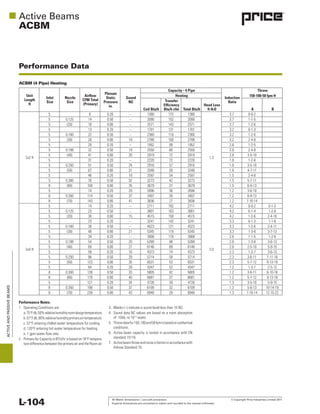
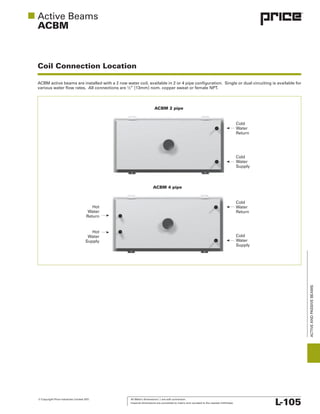
Active Chilled Beam: Option A...............................................................................97
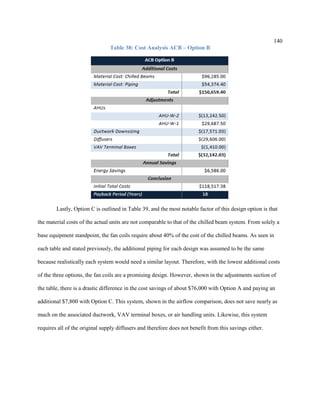
Active Chilled Beam: Option B ...............................................................................98
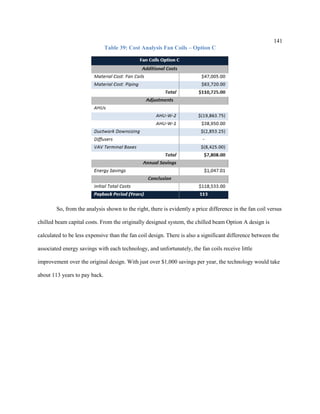
Fan Coil Units: Option C .........................................................................................99
Depth Study 3 | Photocell Implementation ......................................................................100
System Definition.....................................................................................................100
Spaces Analyzed ......................................................................................................100
Electricity Requirements..........................................................................................102
Depth Study Overview | Utility Analysis.........................................................................102
General Overview ....................................................................................................102
Electricity Requirements..........................................................................................103
Hot Water Requirements..........................................................................................105
Master’s Coursework | Displacement Ventilation............................................................107
General Overview ....................................................................................................107
System Definition.....................................................................................................108
System Considerations.............................................................................................108
Energy Calculations .................................................................................................109
v
Design Considerations..............................................................................................111
Occupant Comfort Levels | Master’s Analysis.........................................................112
Depth Study Conclusions.................................................................................................115
Breadth Analysis 1 | Lighting & Electrical ......................................................................117
Photocell Analysis....................................................................................................117
Equipment Specification ..........................................................................................119
119
Equipment Comparison............................................................................................119
Sample Calculation ..................................................................................................120
Project Compatibility ...............................................................................................121
Luminaire Alternatives.............................................................................................122
Breadth Analysis 2 | Construction....................................................................................129
General Overview ....................................................................................................129
Redesign Implications..............................................................................................129
Building System Analysis ........................................................................................130
Cost Data..................................................................................................................133
Individual System Costs...........................................................................................134
Lifecycle Costs.........................................................................................................137
Chapter 4 | Final Conclusions......................................................................................142
Water vs. Air....................................................................................................................142
Potential Considerations...........................................................................................143
Appendix A Building Drawings .................................................................................145
Appendix B Calculations............................................................................................146
Appendix C Equipment Specifications.......................................................................147
BIBLIOGRAPHY........................................................................................................148
vi
LIST OF FIGURES
Figure 1. Chilled Water Plant Controls....................................................................................18
Figure 2. Hot Water Plant Controls .........................................................................................19
Figure 3. DOAS Controls ........................................................................................................20
Figure 4. 30% OA AHU Controls............................................................................................21
Figure 5. RAHU Controls........................................................................................................22
Figure 6. Box Controls w/ Fin Tube Radiation........................................................................22
Figure 7. Box Controls w/o Fin Tube Radiation......................................................................23
Figure 8. ASHRAE 90.1 Climate Zone Map...........................................................................25
Figure 9. U.S. Energy Information Administration – Electric Power Monthly Rates .............32
Figure 10. Baseline Monthly Electrical Consumption.............................................................33
Figure 11. Baseline Annual Electrical Consumption...............................................................33
Figure 12. Baseline Hot Water Consumption ..........................................................................35
Figure 13. Baseline Water Consumption .................................................................................35
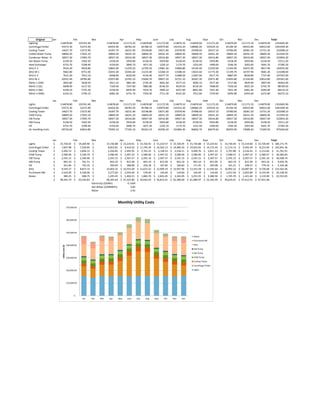
Figure 14. Monthly Utility Costs.............................................................................................37
Figure 15. Minimum Energy Cost Savings Percentage for Each Point Threshold..................39
Figure 16. AHU Schedule and Associated Notes ....................................................................41
Figure 17: Air Terminal Box Assembly Schedule...................................................................42
Figure 18: Typical Air Distribution System ............................................................................42
Figure 19: Typical Restroom Air Distribution.........................................................................43
Figure 20: Typical VAV Schedule...........................................................................................44
Figure 21: Return Air Dampers ..............................................................................................45
Figure 22: EAHU-E-1 Outdoor Air Intake ..............................................................................47
Figure 23: EAHU-W-1 Outdoor Air Intake.............................................................................48
Figure 24: East-West Section – Mechanical Space..................................................................49
vii
Figure 25: Hot Water Source ...................................................................................................51
Figure 26: AHU Filter Schedule..............................................................................................52
Figure 27: Cooling Tower Design ...........................................................................................57
Figure 28: Ventilation Equipment Clearance...........................................................................58
Figure 29: AHU-W-1 Maintenance Access.............................................................................59
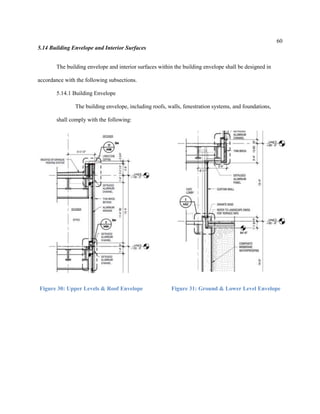
Figure 30: Upper Levels & Roof Envelope .............................................................................................
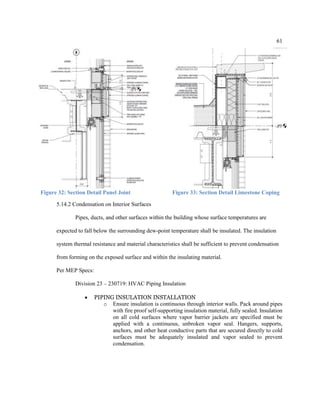
Figure 31: Ground & Lower Level Envelope ..................................................................60
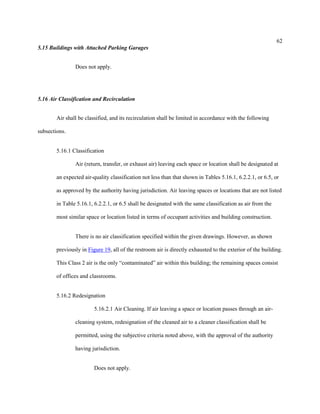
Figure 32: Section Detail Panel Joint.........................................................................................................
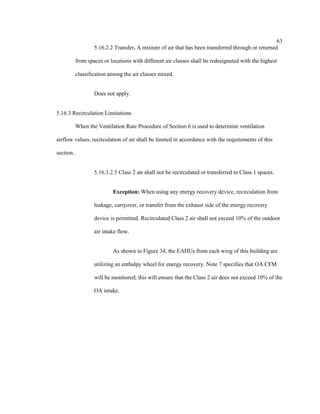
Figure 33: Section Detail Limestone Coping...................................................................61
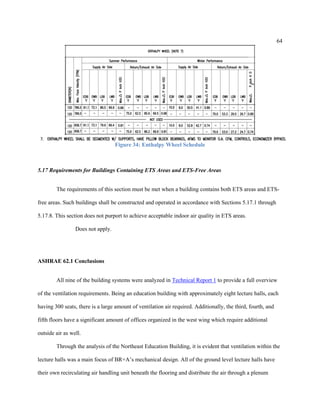
Figure 34: Enthalpy Wheel Schedule.......................................................................................64
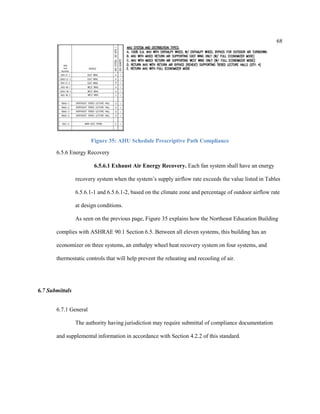
Figure 35: AHU Schedule Prescriptive Path Compliance .......................................................68
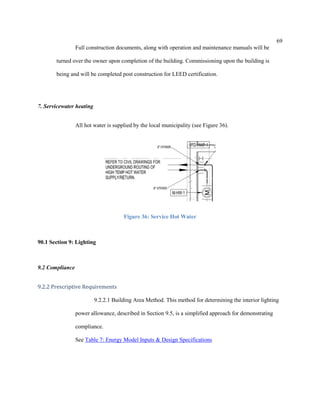
Figure 36: Service Hot Water ..................................................................................................69
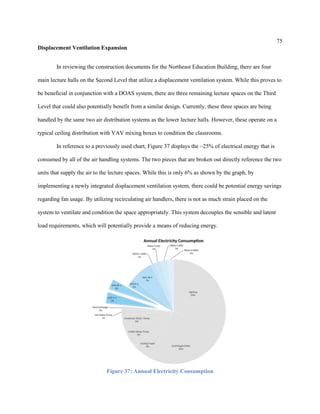
Figure 37: Annual Electricity Consumption ............................................................................75
Figure 38: HVAC System Annual Energy Usage....................................................................77
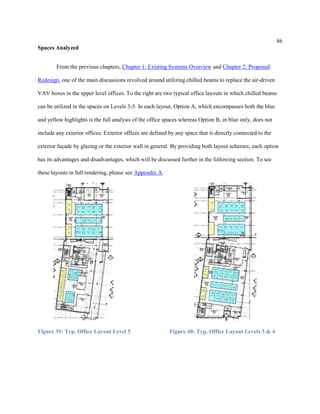
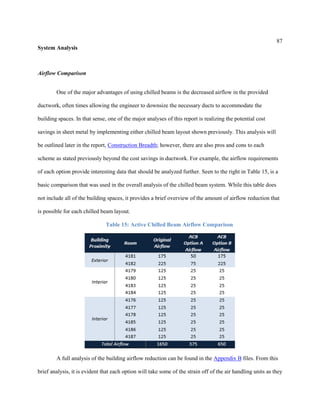
Figure 39: Typ. Office Layout Level 5......................................................................................................
Figure 40: Typ. Office Layout Levels 3 & 4....................................................................86
Figure 41: Annual Cooling Needs (MWh/year).......................................................................92
Figure 42: Electrical Annual Consumption (MWh/year).........................................................92
Figure 43: Typical Photocell Building Space Analysis ...........................................................101
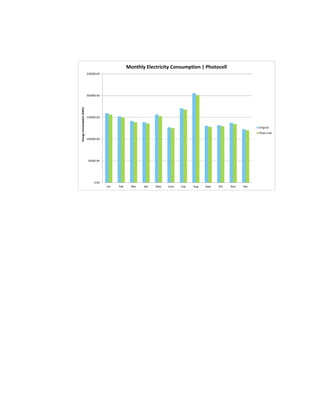
Figure 44: Electrical Consumption with Photocell Implementation........................................102
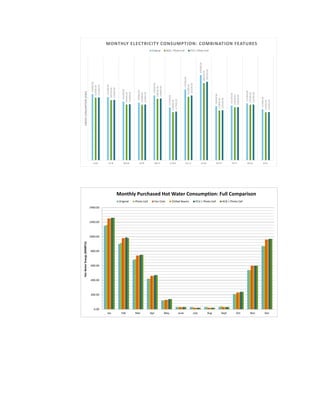
Figure 45: Full Analysis of Electricity Consumption ..............................................................104
Figure 46: Individual Feature Electricity Consumption Comparison......................................104
Figure 47: Combined Feature Electricity Consumption Comparison......................................105
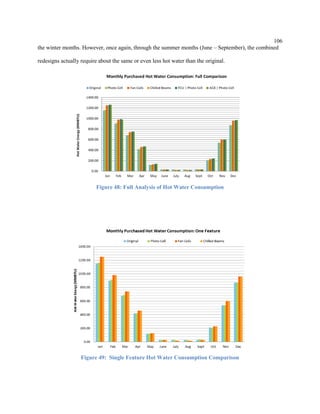
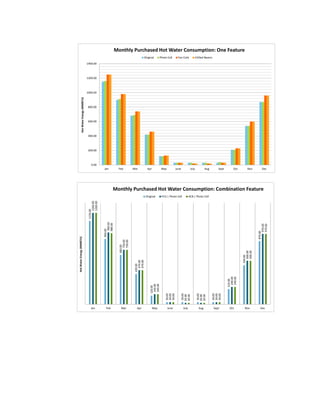
Figure 48: Full Analysis of Hot Water Consumption..............................................................106
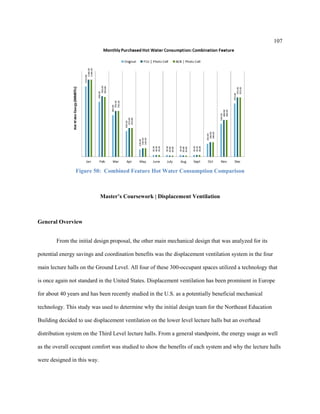
Figure 49: Single Feature Hot Water Consumption Comparison ...........................................106
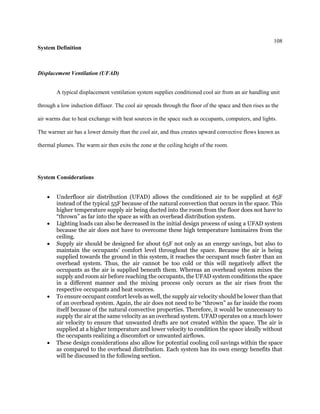
Figure 50: Combined Feature Hot Water Consumption Comparison.....................................107
Figure 51: Overhead Distribution Design Geometry..............................................................113
viii
Figure 52: Overhead Distribution Design Velocity Distribution............................................113
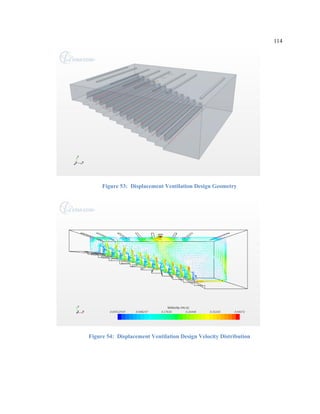
Figure 53: Displacement Ventilation Design Geometry.........................................................114
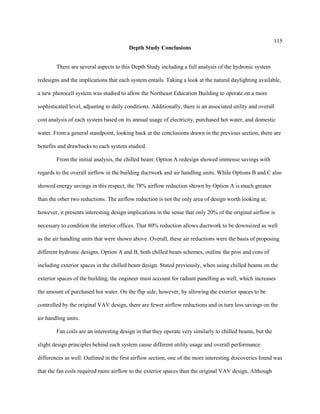
Figure 54: Displacement Ventilation Design Velocity Distribution.......................................114
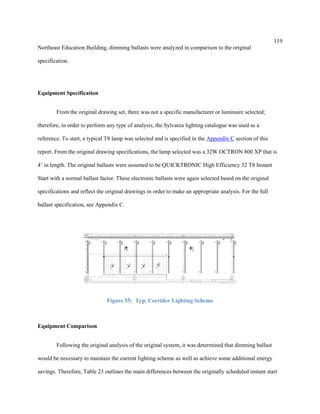
Figure 55: Typ. Corridor Lighting Scheme ............................................................................119
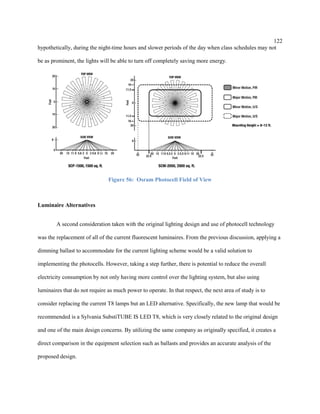
Figure 56: Osram Photocell Field of View .............................................................................122
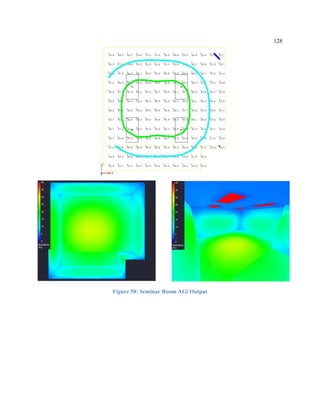
Figure 57: Gallery Corridor AGi Output .................................................................................127
Figure 58: Seminar Room AGi Output....................................................................................128
ix
LIST OF TABLES
Table 1. Air Handling Unit Design Conditions .......................................................................15
Table 2. Pump Design Conditions ...........................................................................................16
Table 3. Mechanical Space ......................................................................................................23
Table 4. Outdoor Design Specifications (ASHRAE 2009 Fundamentals Handbook).............25
Table 5. Indoor Design Specifications (BR+A).......................................................................26
Table 6. Building Construction and Associated U-values .......................................................26
Table 7. Energy Model Inputs & Design Specifications..........................................................27
Table 8. Cooling Air Handling Unit Loads (BR+A) ...............................................................29
Table 9. Heating Air Handling Unit Loads (BR+A)................................................................29
Table 10. Heating & Cooling Load Comparison (Design Values provided by BR+A)...........30
Table 11. Energy Rate Analysis...............................................................................................32
Table 12. Energy Rate Analysis...............................................................................................36
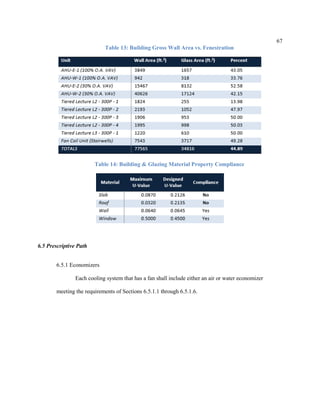
Table 13: Building Gross Wall Area vs. Fenestration .............................................................67
Table 14: Building & Glazing Material Property Compliance ................................................67
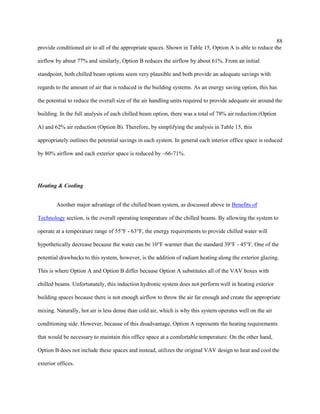
Table 15: Active Chilled Beam Airflow Comparison..............................................................87
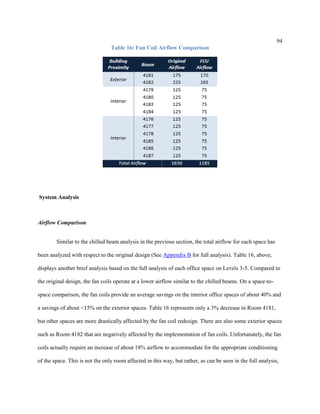
Table 16: Fan Coil Airflow Comparison .................................................................................94
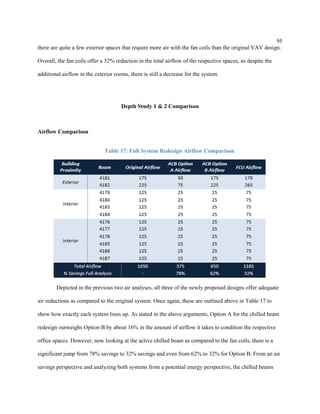
Table 17: Full System Redesign Airflow Comparison ............................................................95
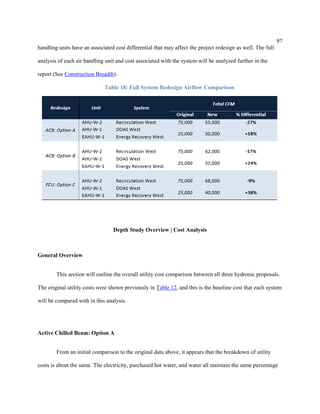
Table 18: Full System Redesign Airflow Comparison ............................................................97
Table 19: Chilled Beam: Option A Cost Analysis...................................................................98
Table 20: Chilled Beam: Option B Cost Analysis ...................................................................99
Table 21: Fan Coil: Option C Cost Analysis ...........................................................................100
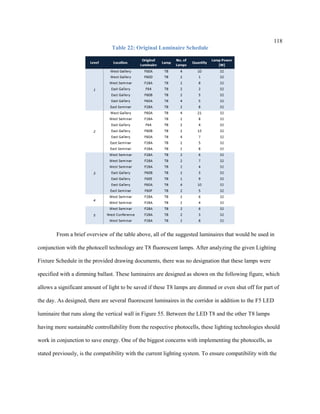
Table 22: Original Luminaire Schedule...................................................................................118
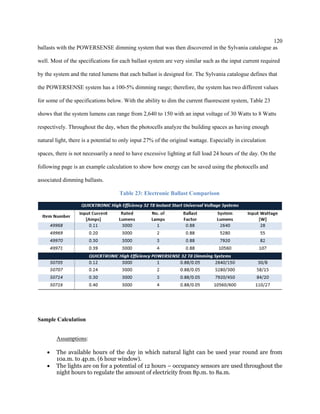
Table 23: Electronic Ballast Comparison ................................................................................120
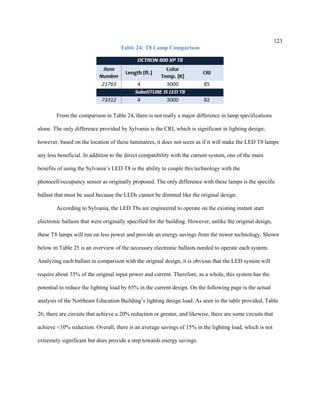
Table 24: T8 Lamp Comparison..............................................................................................123
x
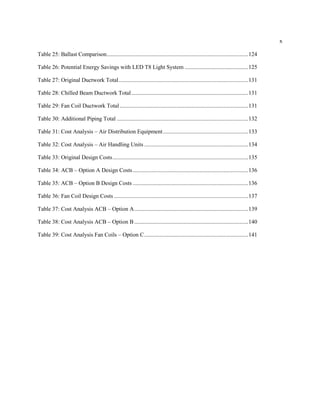
Table 25: Ballast Comparison..................................................................................................124
Table 26: Potential Energy Savings with LED T8 Light System ............................................125
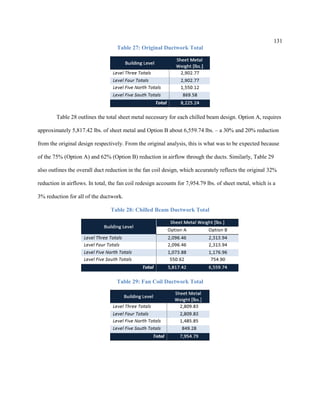
Table 27: Original Ductwork Total..........................................................................................131
Table 28: Chilled Beam Ductwork Total.................................................................................131
Table 29: Fan Coil Ductwork Total.........................................................................................131
Table 30: Additional Piping Total ...........................................................................................132
Table 31: Cost Analysis – Air Distribution Equipment...........................................................133
Table 32: Cost Analysis – Air Handling Units ........................................................................134
Table 33: Original Design Costs..............................................................................................135
Table 34: ACB – Option A Design Costs................................................................................136
Table 35: ACB – Option B Design Costs ................................................................................136
Table 36: Fan Coil Design Costs .............................................................................................137
Table 37: Cost Analysis ACB – Option A...............................................................................139
Table 38: Cost Analysis ACB – Option B...............................................................................140
Table 39: Cost Analysis Fan Coils – Option C........................................................................141
xi
ACKNOWLEDGEMENTS
I would like to personally thank every individual for helping me through each aspect of
my senior thesis project. All of these individuals have enhanced my project in different aspects.
By offering their extensive knowledge, field experience, and sound advice, I was able to
complete this project.
Patrick Duffy Associate Principal | BR+A Consulting Engineers
Project Team
Architecture Elkus | Manfredi Architects
MEP Bard, Rao + Athanas Consulting Engineers
Ryan Diaz Sales Engineer | Del-Ren HVAC, Inc.
Dr. Donghyun Rim Assistant Professor | Penn State AE Department
Bill Pawlak Chief Estimator | Southland Industries
Penn State Architectural Engineering Department Faculty & Staff
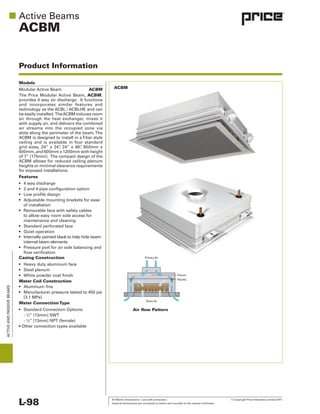
Cover Image © Project Developer
12
Chapter 1 | Existing Systems Overview
Equipment
Heating Equipment
Campus Central Heating Plant
This campus consists of five central heating plants to maintain all of the buildings at the
appropriate condition during the winter months. Of the five heating plants, the one that supplies the hot
water for the Northeast Education Building has the capacity to produce 85 million BTU/hour.
Heat Exchanger
With the newly implemented high temperature hot water distribution piping, the central plant is
able to deliver the appropriate water to the Northeast Education Building. Located within the building in
the Lower Level Mechanical Room, there is a water-water heat exchanger. This particular heat exchanger
supplies all of the hot water for the entire building and is piped into the building through 6-inch pipes.
Overall, this heat exchanger (HE-1) consists of four tube passes with the capacity to handle 325°F water
at 215 GPM. Piping in this high temperature hot water allows the water-water heat exchanger to produce
a minimum of 8,000 MBH for use throughout the building.
13
Equipment
Throughout the building, there are several types of equipment that are utilized to heat the spaces.
More specifically, finned tube radiation is used within the two lecture halls located on the third floor. The
four main lecture halls in the building were designed with a displacement ventilation or floor distribution
system, which accounts for the cooling and heating of the daily occupants. Because the upper lecture halls
were not designed in this fashion, but rather have a typical ceiling distribution system, there is a need for
finned tube radiation on the perimeter of the building spaces. Located on the east wing, the radiant tubing
is all Type A specified by BR+A. In essence, each tube has a minimum of 650 BTUH per foot with an
average temperature of 170°F. Other equipment used within the building consists of hot water unit and
cabinet heaters. The cabinet heaters are located within the stairwells as an easy way to displace the colder
air in the winter months. These are primarily utilized to aid in the building envelope air infiltration within
the stairwell shafts. On the other hand, the hot water unit heaters are connected to the air handling unit
water lines. These heaters are designed to help in the preheat process of the air entering the DOAS
systems; there are several of them along the pipeline into the units. For the majority of the office and
classroom spaces, air terminal boxes are used to control the conditioning of the room.
Cooling Equipment
Chiller Plant
The Northeast Education Building has its own chiller plant located within the Level Four East
Penthouse. This plant consists of two cooling tower cells and two centrifugal chillers. In total, this system
serves 600 tons of chilled water to nine air handling units that distribute air across the building. Each
chiller has a 12°F differential with a leaving water temperature of 45°F. Both centrifugal units have been
specified to have a NPLV equal to 0.406 and a 188.3 kW compressor. Similarly, each cooling tower cell
14
is designed for a 300-ton capacity with a 600 GPM rating. Both are equipped with 10MPH, VFD motors
that account for the 15°F range and 7°F approach to deliver the correct water temperature to the chillers.
Airside Distribution
Air Handling Units
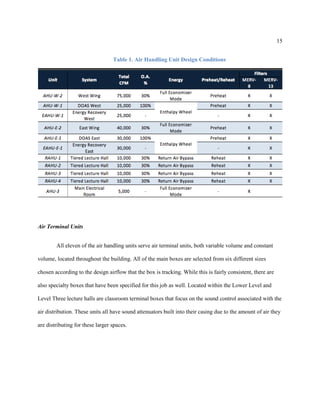
Shown below is a general outline of the eleven air handling units that maintain the airside
distribution and temperature of the Northeast Education Building (see Table 1). The main units within the
building consist of the recirculation and DOAS systems in each respective wing. Both the East and West
Wing units are designed as a typical 30% OA system with a full economizer mode. These units serve the
majority of the support spaces such as all corridors and restrooms in addition to the office and classroom
space distributed across the building. On the other hand, each DOAS system in the two wings of the
building is designed to properly ventilate the main lecture halls on the Ground Level. As mentioned
above, these lecture halls consist of a displacement ventilation system below the seating in each row.
These systems are coupled with the RAHU or reheat systems located beneath each tiered lecture
hall on this level. The reheat system acts as a recirculation device to maintain the proper temperatures in
the space while the DOAS system ventilates based on the 300-person capacity. An additional feature to
each main system in the building wings is the enthalpy wheel energy recovery system that is designated
by the EAHU units in Table 1. These units have a plenum return fan that pulls air from the respective
spaces and extracts the heat that is mixed with the incoming outdoor air. The last note shown below is the
use of pre-filter and after-filters for the air handling units. All of the units utilize the MERV-8 and
MERV-13 filters when conditioning the air except AHU-3, which is only used to condition the Main
Electrical Room.
15
Table 1. Air Handling Unit Design Conditions
Air Terminal Units
All eleven of the air handling units serve air terminal units, both variable volume and constant
volume, located throughout the building. All of the main boxes are selected from six different sizes
chosen according to the design airflow that the box is tracking. While this is fairly consistent, there are
also specialty boxes that have been specified for this job as well. Located within the Lower Level and
Level Three lecture halls are classroom terminal boxes that focus on the sound control associated with the
air distribution. These units all have sound attenuators built into their casing due to the amount of air they
are distributing for these larger spaces.
16
Water Distribution
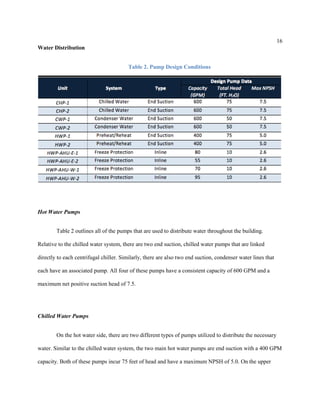
Table 2. Pump Design Conditions
Hot Water Pumps
Table 2 outlines all of the pumps that are used to distribute water throughout the building.
Relative to the chilled water system, there are two end suction, chilled water pumps that are linked
directly to each centrifugal chiller. Similarly, there are also two end suction, condenser water lines that
each have an associated pump. All four of these pumps have a consistent capacity of 600 GPM and a
maximum net positive suction head of 7.5.
Chilled Water Pumps
On the hot water side, there are two different types of pumps utilized to distribute the necessary
water. Similar to the chilled water system, the two main hot water pumps are end suction with a 400 GPM
capacity. Both of these pumps incur 75 feet of head and have a maximum NPSH of 5.0. On the upper
17
levels of the building, there are four different pumps that are associated with the four main air handling
units. These particular pumps are all inline-type with capacity ranging from 55-95 GPM. The main
function of all four of these pumps is to prevent freezing on the cooling coil as the air handling unit
conditions the outdoor air. The associated head with each of these pumps is about 10 feet of head, which
is relatively low comparatively.
System Schematics
Chilled Water Plant
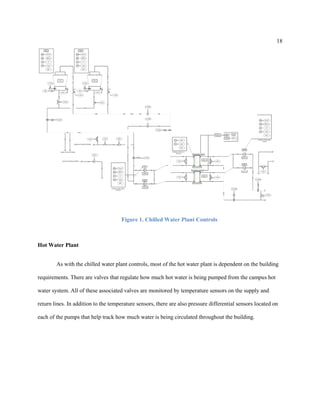
As previously discussed, the building’s chiller plant consists of two cooling tower cells and two
centrifugal chillers. Shown below in Figure 1, each cell has a VFD that is dependent upon the required
airflow needed in the cooling tower. Other sensors located within the cells include a basin temperature
sensor as well as a water level sensor to track the performance of the cooling towers. These sensors will
adjust properly dependent upon the building’s need for chilled water. To help the chillers track their
performance as well, there are pressure sensors on either side of the supply and return lines. Given that
the return water may be cold enough without utilizing the cooling towers, there is a bypass line that is
monitored by a chilled water return temperature sensor.
18
Figure 1. Chilled Water Plant Controls
Hot Water Plant
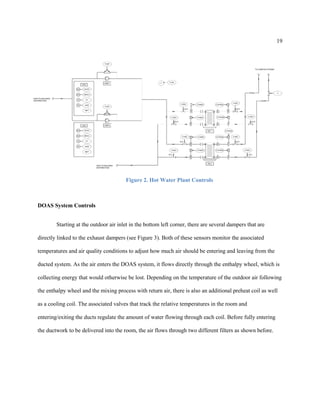
As with the chilled water plant controls, most of the hot water plant is dependent on the building
requirements. There are valves that regulate how much hot water is being pumped from the campus hot
water system. All of these associated valves are monitored by temperature sensors on the supply and
return lines. In addition to the temperature sensors, there are also pressure differential sensors located on
each of the pumps that help track how much water is being circulated throughout the building.
19
Figure 2. Hot Water Plant Controls
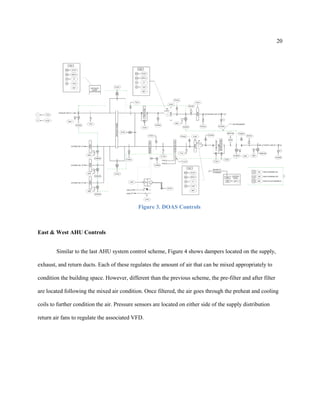
DOAS System Controls
Starting at the outdoor air inlet in the bottom left corner, there are several dampers that are
directly linked to the exhaust dampers (see Figure 3). Both of these sensors monitor the associated
temperatures and air quality conditions to adjust how much air should be entering and leaving from the
ducted system. As the air enters the DOAS system, it flows directly through the enthalpy wheel, which is
collecting energy that would otherwise be lost. Depending on the temperature of the outdoor air following
the enthalpy wheel and the mixing process with return air, there is also an additional preheat coil as well
as a cooling coil. The associated valves that track the relative temperatures in the room and
entering/exiting the ducts regulate the amount of water flowing through each coil. Before fully entering
the ductwork to be delivered into the room, the air flows through two different filters as shown before.
20
Figure 3. DOAS Controls
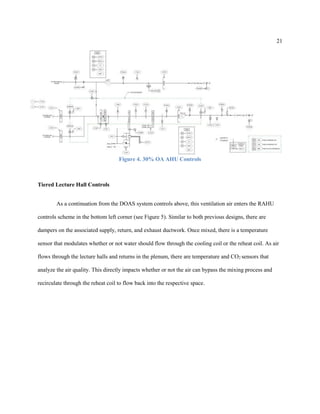
East & West AHU Controls
Similar to the last AHU system control scheme, Figure 4 shows dampers located on the supply,
exhaust, and return ducts. Each of these regulates the amount of air that can be mixed appropriately to
condition the building space. However, different than the previous scheme, the pre-filter and after filter
are located following the mixed air condition. Once filtered, the air goes through the preheat and cooling
coils to further condition the air. Pressure sensors are located on either side of the supply distribution
return air fans to regulate the associated VFD.
21
Figure 4. 30% OA AHU Controls
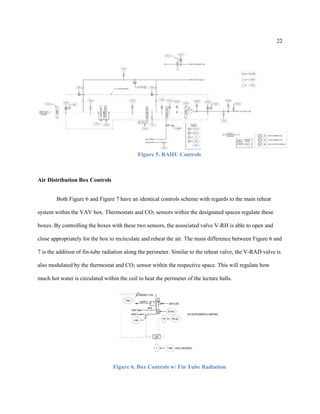
Tiered Lecture Hall Controls
As a continuation from the DOAS system controls above, this ventilation air enters the RAHU
controls scheme in the bottom left corner (see Figure 5). Similar to both previous designs, there are
dampers on the associated supply, return, and exhaust ductwork. Once mixed, there is a temperature
sensor that modulates whether or not water should flow through the cooling coil or the reheat coil. As air
flows through the lecture halls and returns in the plenum, there are temperature and CO2 sensors that
analyze the air quality. This directly impacts whether or not the air can bypass the mixing process and
recirculate through the reheat coil to flow back into the respective space.
22
Figure 5. RAHU Controls
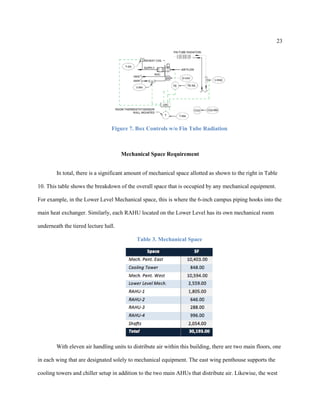
Air Distribution Box Controls
Both Figure 6 and Figure 7 have an identical controls scheme with regards to the main reheat
system within the VAV box. Thermostats and CO2 sensors within the designated spaces regulate these
boxes. By controlling the boxes with these two sensors, the associated valve V-RH is able to open and
close appropriately for the box to recirculate and reheat the air. The main difference between Figure 6 and
7 is the addition of fin-tube radiation along the perimeter. Similar to the reheat valve, the V-RAD valve is
also modulated by the thermostat and CO2 sensor within the respective space. This will regulate how
much hot water is circulated within the coil to heat the perimeter of the lecture halls.
Figure 6. Box Controls w/ Fin Tube Radiation
23
Figure 7. Box Controls w/o Fin Tube Radiation
Mechanical Space Requirement
In total, there is a significant amount of mechanical space allotted as shown to the right in Table
10. This table shows the breakdown of the overall space that is occupied by any mechanical equipment.
For example, in the Lower Level Mechanical space, this is where the 6-inch campus piping hooks into the
main heat exchanger. Similarly, each RAHU located on the Lower Level has its own mechanical room
underneath the tiered lecture hall.
Table 3. Mechanical Space
With eleven air handling units to distribute air within this building, there are two main floors, one
in each wing that are designated solely to mechanical equipment. The east wing penthouse supports the
cooling towers and chiller setup in addition to the two main AHUs that distribute air. Likewise, the west
24
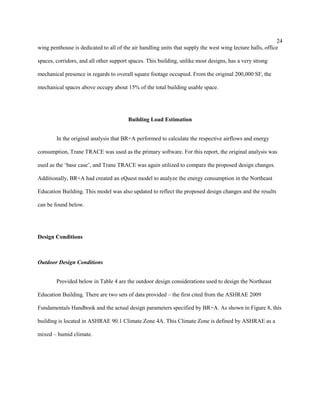
wing penthouse is dedicated to all of the air handling units that supply the west wing lecture halls, office
spaces, corridors, and all other support spaces. This building, unlike most designs, has a very strong
mechanical presence in regards to overall square footage occupied. From the original 200,000 SF, the
mechanical spaces above occupy about 15% of the total building usable space.
Building Load Estimation
In the original analysis that BR+A performed to calculate the respective airflows and energy
consumption, Trane TRACE was used as the primary software. For this report, the original analysis was
used as the ‘base case’, and Trane TRACE was again utilized to compare the proposed design changes.
Additionally, BR+A had created an eQuest model to analyze the energy consumption in the Northeast
Education Building. This model was also updated to reflect the proposed design changes and the results
can be found below.
Design Conditions
Outdoor Design Conditions
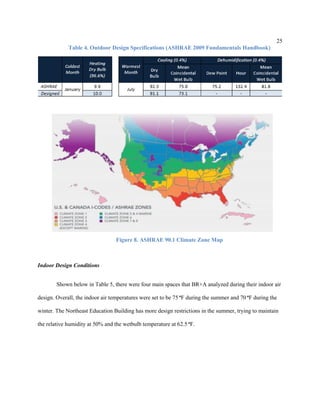
Provided below in Table 4 are the outdoor design considerations used to design the Northeast
Education Building. There are two sets of data provided – the first cited from the ASHRAE 2009
Fundamentals Handbook and the actual design parameters specified by BR+A. As shown in Figure 8, this
building is located in ASHRAE 90.1 Climate Zone 4A. This Climate Zone is defined by ASHRAE as a
mixed – humid climate.
25
Table 4. Outdoor Design Specifications (ASHRAE 2009 Fundamentals Handbook)
Figure 8. ASHRAE 90.1 Climate Zone Map
Indoor Design Conditions
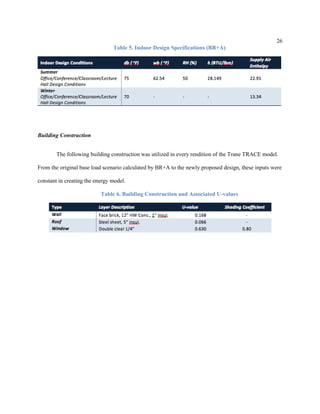
Shown below in Table 5, there were four main spaces that BR+A analyzed during their indoor air
design. Overall, the indoor air temperatures were set to be 75 o
F during the summer and 70 o
F during the
winter. The Northeast Education Building has more design restrictions in the summer, trying to maintain
the relative humidity at 50% and the wetbulb temperature at 62.5 o
F.
26
Table 5. Indoor Design Specifications (BR+A)
Building Construction
The following building construction was utilized in every rendition of the Trane TRACE model.
From the original base load scenario calculated by BR+A to the newly proposed design, these inputs were
constant in creating the energy model.
Table 6. Building Construction and Associated U-values
27
Building Load Assumption
Typical Room Lighting & Miscellaneous Loads
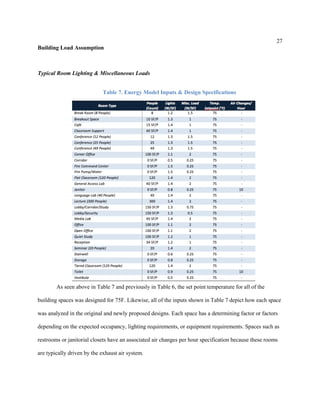
Table 7. Energy Model Inputs & Design Specifications
As seen above in Table 7 and previously in Table 6, the set point temperature for all of the
building spaces was designed for 75F. Likewise, all of the inputs shown in Table 7 depict how each space
was analyzed in the original and newly proposed designs. Each space has a determining factor or factors
depending on the expected occupancy, lighting requirements, or equipment requirements. Spaces such as
restrooms or janitorial closets have an associated air changes per hour specification because these rooms
are typically driven by the exhaust air system.
28
Ventilation Requirements
This building design focuses mainly on lecture halls, classroom, and office space; therefore, there
is a large amount of humidity that this system must condition. Overall, there are four main air handling
units that provide the air distribution across all six occupied floors. Two of these systems, AHU-E-1 and
AHU-W-1, are designated outdoor air systems (DOAS) that serve mainly the larger lecture halls and
classroom spaces. These spaces also have smaller individual recirculating units; however, with a 300-
person capacity for each lecture hall, the indoor air requirements are extremely stringent when it comes to
ventilation.
These two systems strictly ventilate and condition these larger spaces, whereas, the remaining
two units, AHU-E-2 and AHU-W-2, cover the smaller classroom and office spaces in the building. Both
air handling units have a larger air distribution capacity than the DOAS systems and utilize air-side
economizers and an enthalpy wheel to extract some of the exhaust heat. All in all, the building’s
ventilation was designed depending on whether the systems were heating or cooling in the respective
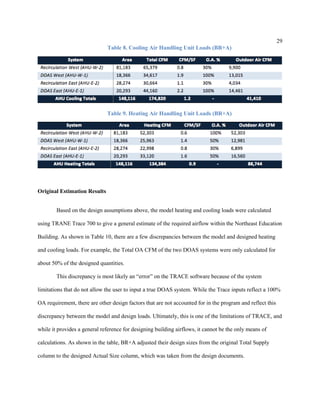
seasons. As seen below in Table 8, both the AHU-E-2 and W-2 were designed with a 30% OA
economizer having both of these units focus primarily on the office spaces, conference rooms, and
corridors. On the other hand, AHU-E-1 and W-1 were designed as 100% OA for the large lecture halls
and classroom spaces. Below this table, however, all of these systems’ OA rates are adjusted for heating.
Table 9 displays a new ventilation scheme for almost every one of the four units. The recirculating unit,
AHU-W-2, has been adjusted from 30% to 100%, but the other respective unit remains at 30% during
heating. Likewise, the DOAS systems have also been adjusted; however, these have been decreased from
100% OA to 50%.
29
Table 8. Cooling Air Handling Unit Loads (BR+A)
Table 9. Heating Air Handling Unit Loads (BR+A)
Original Estimation Results
Based on the design assumptions above, the model heating and cooling loads were calculated
using TRANE Trace 700 to give a general estimate of the required airflow within the Northeast Education
Building. As shown in Table 10, there are a few discrepancies between the model and designed heating
and cooling loads. For example, the Total OA CFM of the two DOAS systems were only calculated for
about 50% of the designed quantities.
This discrepancy is most likely an “error” on the TRACE software because of the system
limitations that do not allow the user to input a true DOAS system. While the Trace inputs reflect a 100%
OA requirement, there are other design factors that are not accounted for in the program and reflect this
discrepancy between the model and design loads. Ultimately, this is one of the limitations of TRACE, and
while it provides a general reference for designing building airflows, it cannot be the only means of
calculations. As shown in the table, BR+A adjusted their design sizes from the original Total Supply
column to the designed Actual Size column, which was taken from the design documents.
30
Table 10. Heating & Cooling Load Comparison (Design Values provided by BR+A)
Energy Consumption & Associated Costs
The following section describes the building’s energy consumption as originally designed based
on the two energy models that were created in eQuest and Trane TRACE 700. In addition to the energy
consumed, this section will outline a monthly and annual utility cost outlining the different electrical and
mechanical systems in the Northeast Education Building. For larger images of the provided graphs, please
see Appendix A.
Building Energy
Sources
The Northeast Education Building has two means of obtaining the energy required to operate the
building. To provide the appropriate heating, the building utilizes the updated university high-temperature
heating system. This central cogeneration plant provides electricity and central heating to two of the five
campuses located within this university. Once piped into the building, there is a water-water heat
exchanger that has a minimum capacity rating of 8,000 MBH.
31
Conversely, while the heating is provided by the campus system, the cooling plant has been
designed within the Northeast Education Building itself. As shown previously in Figure 1: Chilled Water
Plant, the building was designed with a two-cell cooling tower and two centrifugal chillers that have a
600-ton capacity for the overall building needs. All in all, the building design could be altered in which
there is an associated boiler to produce the heat required in the system. However, with the updated
cogeneration plant and high-temperature piping system, this is an unnecessary addition to the building
design. BR+A utilized the campus heating system appropriately while adding the building-generated
cooling plant to save additional energy costs.
Rates
The Northeast Education Building is supplied mainly by a cogeneration plant, which produces the
necessary electricity and hot water for the building. In Table 11 below, the average utility/ energy costs
are listed for the electricity consumed and the cost of purchased hot water from the university. Based on
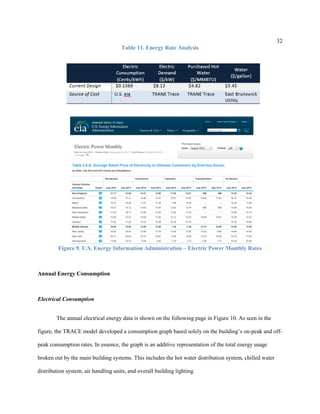
the U.S. Energy Information Administration (eia), the average energy consumption is priced at about
13.69 cents for every kWh used (see Figure 9 below). Some of the required utility cost data is unavailable
currently; therefore, the other two rates were based on TRANE Trace values, which reference the
pertinent city in which the project is located. Lastly, the water rate used in calculations was referenced
from the Water Utility Department in East Brunswick, New Jersey.
32
Table 11. Energy Rate Analysis
Figure 9. U.S. Energy Information Administration – Electric Power Monthly Rates
Annual Energy Consumption
Electrical Consumption
The annual electrical energy data is shown on the following page in Figure 10. As seen in the
figure, the TRACE model developed a consumption graph based solely on the building’s on-peak and off-
peak consumption rates. In essence, the graph is an additive representation of the total energy usage
broken out by the main building systems. This includes the hot water distribution system, chilled water
distribution system, air handling units, and overall building lighting.
33
Figure 10. Baseline Monthly Electrical Consumption
Overall, this graph displays a typical energy trend seen in the northeastern part of the country.
Simply, from a pictorial representation, it is evident that the highest electrical consumption occurs in the
May – August range as the cooling capacity increases and the chiller operation increases as well.
Furthermore, the annual baseline energy consumption is shown below in Figure 11. Unlike Figure
10, the annual report shows the breakdown of each major system as it compares to the overall energy
consumption of the building. The three major energy consumers in the original design are the air handling
units (23%), centrifugal chiller (25%), and lighting system (33%).
Figure 11. Baseline Annual Electrical Consumption
34
Again, these results are pretty standard in the northeast region with a typical VAV air distribution
system. Overall, the lighting system is the largest consumer on an annual basis, staying relatively
consistent each month, which is mainly due to the current lighting controls (see Figure 10). Without
harvesting the natural daylight or utilizing occupancy sensors to control the lighting, there is a consistent
amount of energy expelled to light the Northeast Education Building.
Water Consumption
Another major factor in the building’s energy usage is the annual water consumption for cooling
and heating purposes. Shown below, the monthly water consumption for cooling applications is displayed
in Figure 12 and heating applications in Figure 13. There is a noticeable correlation between the main
water used on a monthly basis between the cooling and heating applications. For example, from June –
September there is a spike in the cooling water used to operate the building chilled water systems. This
directly correlates back to Figure 10 on the previous page in which the chiller and cooling tower electrical
energy usage increases during this time period as well. Similarly, taking a look at Figure 13, there is a
spike in hot water purchased during November – April for all of the building’s hot water systems. Unlike
the monthly water consumption, however, there is minimal hot water purchased during the off-season
(June-September), whereas, the water consumption only decreases to about 20% during the winter
months.
35
Figure 12. Baseline Hot Water Consumption
Figure 13. Baseline Water Consumption
Annual Operating Costs
In total, the Northeast Education Building requires about $615,961 to operate based on the
provided information to the right. The values shown in the above figures are representative of the TRANE
Trace model that has been created for the original project. Shown in Table 12, the Annual Utility Costs
are broken down into similar categories based on the overall electrical and water needs. Primarily,
electricity plays the biggest part in the utility costs for the Northeast Education Building, consuming
36
about 92% of the total cost. Of this 92%, the lighting and chiller systems are the largest consumers at
about 30% and 23% respectively.
Table 12. Energy Rate Analysis
Likewise, shown on the following page in Figure 14, the annual utility costs are broken down into
a monthly graph. From this graph, it is evident that the monthly lighting costs are consistent whereas the
cost of the centrifugal chiller and purchased hot water fluctuates with the respective there is a spike in
energy from December through January with the increase in purchased hot water; however, this energy
increase is about $10,000 less than the spike from June through August. Especially in July and August,
there is a significant increase in chiller energy and water usage in addition to the electricity consumption
by the air handling units. Overall, the peak utility costs for this building occur in July at about $62,380.
37
Figure 14. Monthly Utility Costs
LEED Analysis
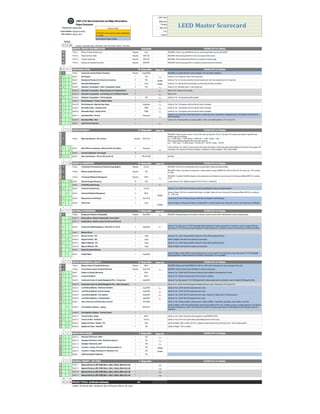
Attached in the Appendix files is the overall LEED Master Scorecard, which defines how many
points are available for each category and how many were obtained through the original design. As noted
in the Master Scorecard, the Northeast Education Building was designed as a LEED Silver project with
the potential of 10 additional points following construction. Outlined below are the specific areas in
which this building was designed to receive credit for the energy efficient design.
Water Efficiency
Water Use Reduction – 20% Minimum
BR+A and TGE were able to reduce the water usage by at least 20% in the overall building and
landscape design. The building’s fixture flow rates were specified as the following: 
 Lavatory = 0.5
GPM, Sinks = 1 GPM, Shower = 2 GPM, WC = 1.6 GPF, Urinals = 1 GPF. 
 Additionally, Sufest using
38
the following flush/flow rates to get >40% reduction: Lavatory = 0.1 GPC, Sinks = 1.5 GPM, Shower =
1.8 GPM, WC = 1.28 GPF, Urinals = .125 GPF.
Water Efficient Landscaping – Reduce by 50%, No Irrigation
Two of the four points available were documented because the shrub lawn area is already
permanently drip irrigated on campus. There is a French drain system being installed and rain sensor to
shut the system off if irrigation is unnecessary. This will provide the 50% reduction needed for this credit.
Energy & Atmosphere
Fundamental & Enhanced Refrigerant Management
The prerequisite for this category was accomplished by BR+A for using compliant HVAC&R
refrigerants defined by ASHRAE. The enhanced refrigerant management category is still considered a
‘Maybe’ until the final design is complete and further site testing can be done.
Optimize Energy Performance
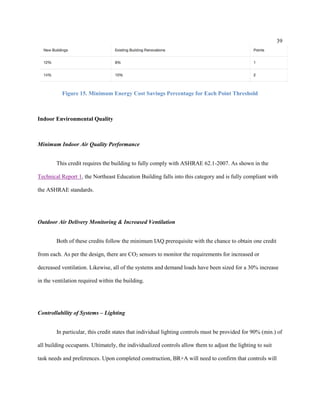
Only two of nineteen credits were documented for this specific criterion. According to the
USGBC, the project team must demonstrate a percentage improvement in the proposed building
performance rating compared with the baseline building performance rating. Calculate the baseline
building performance according to Appendix G of ANSI/ASHRAE/IESNA Standard 90.1-2007 (with
errata but without addenda) using a computer simulation model for the whole building project. By
achieving two points, the Northeast Education Building has provided the following:
39
Figure 15. Minimum Energy Cost Savings Percentage for Each Point Threshold
Indoor Environmental Quality
Minimum Indoor Air Quality Performance
This credit requires the building to fully comply with ASHRAE 62.1-2007. As shown in the
Technical Report 1, the Northeast Education Building falls into this category and is fully compliant with
the ASHRAE standards.
Outdoor Air Delivery Monitoring & Increased Ventilation
Both of these credits follow the minimum IAQ prerequisite with the chance to obtain one credit
from each. As per the design, there are CO2 sensors to monitor the requirements for increased or
decreased ventilation. Likewise, all of the systems and demand loads have been sized for a 30% increase
in the ventilation required within the building.
Controllability of Systems – Lighting
In particular, this credit states that individual lighting controls must be provided for 90% (min.) of
all building occupants. Ultimately, the individualized controls allow them to adjust the lighting to suit
task needs and preferences. Upon completed construction, BR+A will need to confirm that controls will
40
be provided for all of the multi-occupant spaces to enable adjustments that meet group needs and
preferences.
Thermal Comfort – Design
This credit requires the project team to meet the requirements of ASHRAE Standard 55-2004,
Thermal Comfort Conditions for Human Occupancy (with errata but without addenda). Overall, they
must demonstrate design compliance in accordance with the Section 6.1.1 documentation. BR+A has
fully complied with ASHRAE 55-2007, which grants them this credit of one point towards the overall
LEED accreditation.
LEED Analysis Summary
As a whole, this project has been designed from an energy efficiency standpoint; therefore, there
are several elements that have already created a sustainable building. Along with the sustainable design
that has been documented in the LEED certification, the overall project team has worked to comply with
54 credits allowing their building to become LEED Silver certified upon completion.
However, while there are several credits that have been covered in the initial design, the analysis
provided in this report shows that there are other areas that can be improved upon. For instance, the
controllability of the lighting systems is a major category that can be studied. While the larger occupant
spaces have been originally accounted for, there are circulation areas that underutilize the amount of
natural daylight in this building. Optimizing the energy performance of this building and its associated
mechanical systems is another area that was studied heavily in this report. Both of these areas of study
would potentially allow the building to receive a LEED Gold certification if further controllability and
41
system monitoring were implemented. This would allow additional credits to be realized for the overall
building project.
ASHRAE Standard 62.1 Compliance
ASHRAE 62.1 Section 5: Systems and Equipment
5.1 Ventilation Air Distribution
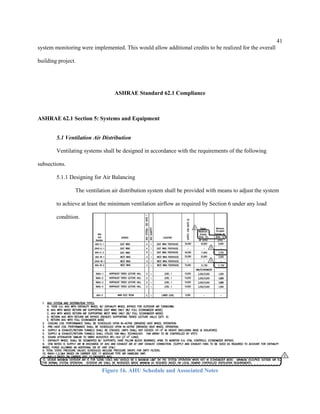
Ventilating systems shall be designed in accordance with the requirements of the following
subsections.
5.1.1 Designing for Air Balancing
The ventilation air distribution system shall be provided with means to adjust the system
to achieve at least the minimum ventilation airflow as required by Section 6 under any load
condition.
Figure 16. AHU Schedule and Associated Notes
42
5.1.2 Plenum Systems
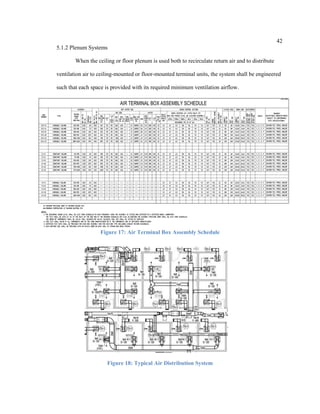
When the ceiling or floor plenum is used both to recirculate return air and to distribute
ventilation air to ceiling-mounted or floor-mounted terminal units, the system shall be engineered
such that each space is provided with its required minimum ventilation airflow.
Figure 17: Air Terminal Box Assembly Schedule
Figure 18: Typical Air Distribution System
43
5.1.3 Documentation
The design documents shall specify minimum requirements for air balance testing or
reference applicable national standards for measuring and balancing airflow. The design
documentation shall state assumptions that were made in the design with respect to ventilation
rates and air distribution. See Table 7: Energy Model Inputs & Design Specifications above.
5.2 Exhaust Duct Location
Exhaust ducts that convey potentially harmful contaminants shall be negatively pressurized
relative to spaces through which they pass, so that exhaust air cannot leak into occupied spaces; supply,
return, or outdoor air ducts; or plenums.
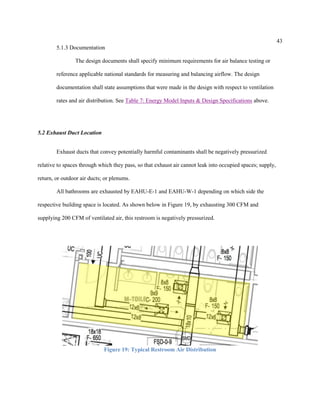
All bathrooms are exhausted by EAHU-E-1 and EAHU-W-1 depending on which side the
respective building space is located. As shown below in Figure 19, by exhausting 300 CFM and
supplying 200 CFM of ventilated air, this restroom is negatively pressurized.
Figure 19: Typical Restroom Air Distribution
44
5.3 Ventilation System Controls
Mechanical ventilation systems shall include controls in accordance with the following
subsections.
5.3.1
All systems shall be provided with manual or automatic controls to maintain no less than
the outdoor air intake flow (Vot) required by Section 6 under all load conditions or dynamic reset
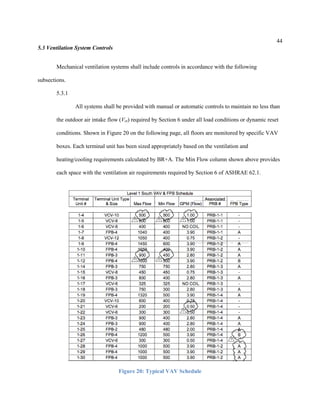
conditions. Shown in Figure 20 on the following page, all floors are monitored by specific VAV
boxes. Each terminal unit has been sized appropriately based on the ventilation and
heating/cooling requirements calculated by BR+A. The Min Flow column shown above provides
each space with the ventilation air requirements required by Section 6 of ASHRAE 62.1.
Figure 20: Typical VAV Schedule
45
5.3.2
Systems with fans supplying variable primary air (Vps), including single-zone VAV and
multiple-zone recirculating VAV systems, shall be provided with one or more of the following:
 Out air intake, return air dampers, or a combination of the two that modulate(s)
to maintain no less than the outdoor air intake flow (Vot)
 Outdoor air injection fans that modulate to maintain no less than the outdoor
air intake flow (Vot)
 Other means of ensuring compliance with Section 5.3.1
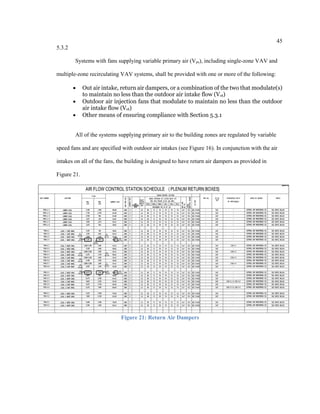
All of the systems supplying primary air to the building zones are regulated by variable
speed fans and are specified with outdoor air intakes (see Figure 16). In conjunction with the air
intakes on all of the fans, the building is designed to have return air dampers as provided in
Figure 21.
Figure 21: Return Air Dampers
46
5.4 Airstream Surfaces
All airstream surfaces in equipment and ducts in the heating, ventilating, and air-conditioning
sys- tem shall be designed and constructed in accordance with the requirements of the following
subsections.
5.4.1 Resistance to Mold Growth
Material surfaces shall be determined to be resistant to mold growth in accordance with a
standardized test method, such as the “Mold Growth and Humidity Test” in UL 181,3
ASTM C
1338,4
or comparable test methods.
Per MEP Specs:
Division 23 – 230713: Duct Insulation
 ASTM G 21 – Standard Practice for Determining Resistance of Synthetic
Polymeric Materials to Fungi.
Division 23 – 233600: Air Terminal Boxes
 Insulation must comply with:
o UL 181
o Bacteriological standard ASTM C 665
5.4.2 Resistance to Erosion
Airstream surface materials shall be evaluated in accordance with the “Erosion Test” in
UL 1813 and shall not break away, crack, peel, flake off, or show evidence of delamination or
continued erosion under test conditions.
5.5 Outdoor Air Intakes
Ventilation system outdoor intakes shall be designed in accordance with the following
subsections.
47
5.5.1 Location
Outdoor air intakes (including openings that are required as part of a natural ventilation
system) shall be located such that the shortest distance from the intake to any specific potential
outdoor contaminant source shall be equal to or greater than the separation distance listed in
Table 5.5.1.
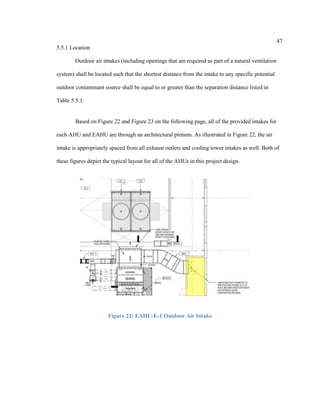
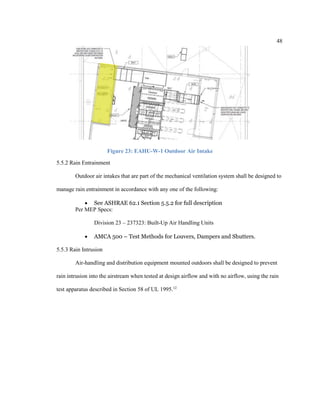
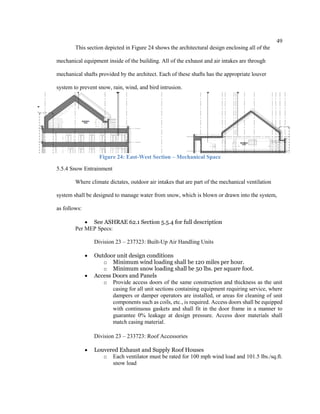
Based on Figure 22 and Figure 23 on the following page, all of the provided intakes for
each AHU and EAHU are through an architectural plenum. As illustrated in Figure 22, the air
intake is appropriately spaced from all exhaust outlets and cooling tower intakes as well. Both of
these figures depict the typical layout for all of the AHUs in this project design.
Figure 22: EAHU-E-1 Outdoor Air Intake
48
Figure 23: EAHU-W-1 Outdoor Air Intake
5.5.2 Rain Entrainment
Outdoor air intakes that are part of the mechanical ventilation system shall be designed to
manage rain entrainment in accordance with any one of the following:
 See ASHRAE 62.1 Section 5.5.2 for full description
Per MEP Specs:
Division 23 – 237323: Built-Up Air Handling Units
 AMCA 500 – Test Methods for Louvers, Dampers and Shutters.
5.5.3 Rain Intrusion
Air-handling and distribution equipment mounted outdoors shall be designed to prevent
rain intrusion into the airstream when tested at design airflow and with no airflow, using the rain
test apparatus described in Section 58 of UL 1995.12
49
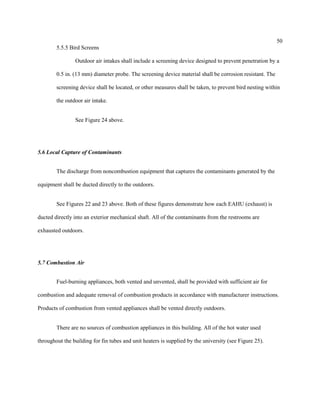
This section depicted in Figure 24 shows the architectural design enclosing all of the
mechanical equipment inside of the building. All of the exhaust and air intakes are through
mechanical shafts provided by the architect. Each of these shafts has the appropriate louver
system to prevent snow, rain, wind, and bird intrusion.
Figure 24: East-West Section – Mechanical Space
5.5.4 Snow Entrainment
Where climate dictates, outdoor air intakes that are part of the mechanical ventilation
system shall be designed to manage water from snow, which is blown or drawn into the system,
as follows:
 See ASHRAE 62.1 Section 5.5.4 for full description
Per MEP Specs:
Division 23 – 237323: Built-Up Air Handling Units
 Outdoor unit design conditions
o Minimum wind loading shall be 120 miles per hour.
o Minimum snow loading shall be 50 lbs. per square foot.
 Access Doors and Panels
o Provide access doors of the same construction and thickness as the unit
casing for all unit sections containing equipment requiring service, where
dampers or damper operators are installed, or areas for cleaning of unit
components such as coils, etc., is required. Access doors shall be equipped
with continuous gaskets and shall fit in the door frame in a manner to
guarantee 0% leakage at design pressure. Access door materials shall
match casing material.
Division 23 – 233723: Roof Accessories
 Louvered Exhaust and Supply Roof Houses
o Each ventilator must be rated for 100 mph wind load and 101.5 lbs./sq.ft.
snow load
50
5.5.5 Bird Screens
Outdoor air intakes shall include a screening device designed to prevent penetration by a
0.5 in. (13 mm) diameter probe. The screening device material shall be corrosion resistant. The
screening device shall be located, or other measures shall be taken, to prevent bird nesting within
the outdoor air intake.
See Figure 24 above.
5.6 Local Capture of Contaminants
The discharge from noncombustion equipment that captures the contaminants generated by the
equipment shall be ducted directly to the outdoors.
See Figures 22 and 23 above. Both of these figures demonstrate how each EAHU (exhaust) is
ducted directly into an exterior mechanical shaft. All of the contaminants from the restrooms are
exhausted outdoors.
5.7 Combustion Air
Fuel-burning appliances, both vented and unvented, shall be provided with sufficient air for
combustion and adequate removal of combustion products in accordance with manufacturer instructions.
Products of combustion from vented appliances shall be vented directly outdoors.
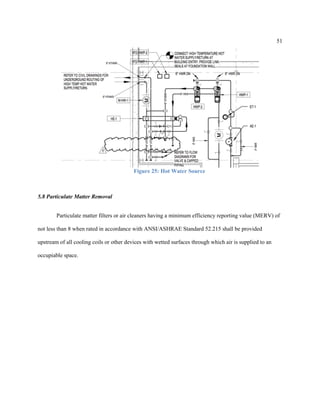
There are no sources of combustion appliances in this building. All of the hot water used
throughout the building for fin tubes and unit heaters is supplied by the university (see Figure 25).
51
Figure 25: Hot Water Source
5.8 Particulate Matter Removal
Particulate matter filters or air cleaners having a minimum efficiency reporting value (MERV) of
not less than 8 when rated in accordance with ANSI/ASHRAE Standard 52.215 shall be provided
upstream of all cooling coils or other devices with wetted surfaces through which air is supplied to an
occupiable space.
52
Figure 26: AHU Filter Schedule
5.9 Dehumidification Systems
Mechanical air-conditioning systems with dehumidification capability shall be designed to
comply with the following subsections.
5.9.1 Relative Humidity
Occupied-space relative humidity shall be limited to 65% or less when system
performance is analyzed with outdoor air at the dehumidification design condition (that is, design
dew-point and mean coincident dry-bulb temperatures) and with the space interior loads (both
sensible and latent) at cooling design values and space solar loads at zero.
See Table 5: Indoor Design Conditions
5.9.2 Exfiltration
For a building, the ventilation system(s) shall be designed to ensure that the minimum
outdoor air intake equals or exceeds the maximum exhaust airflow.
53
See Note 8 in Figure 16. This note explains that both of the AHUs exhausting the
building are also supplying an equal amount of air within the building. Figure 16 also shows that
all of the other AHUs are supplying a minimum of 30,500 CFM OA.
5.10 Drain Pans
Drain pans, including their outlets and seals, shall be designed and constructed in accordance with
this section.
5.10.1 Drain Pan Slope
Pans intended to collect and drain liquid water shall be sloped at least 0.125 in./ft (10
mm/m) from the horizontal toward the drain outlet or shall be other- wise designed to ensure that
water drains freely from the pan whether the fan is on or off.
Per MEP Specs:
Division 23 – 237323: Built-Up Air Handling Units
 Drain Pan Slope
o Pan shall slope at a minimum of 1/8 in. per foot from the horizontal
towards the drain outlet.
5.10.2 Drain Outlet
The drain pan outlet shall be located at the lowest point(s) of the drain pan and shall be of
sufficient diameter to preclude drain pan overflow under any normally expected operating
condition.
Per MEP Specs:
Division 23 – 237323: Built-Up Air Handling Units
 Drain Pan Slope
o Drain pan outlet shall be at the lowest point or points of the pan with
sufficient size to prevent overflow under any normal expected operating
condition.
54
5.10.3 Drain Seal
For configurations that result in negative static pressure at the drain pan relative to the
drain outlet (such as a draw-through unit), the drain line shall include a P- trap or other sealing
device designed to maintain a seal against ingestion of ambient air while allowing complete
drainage of the drain pan under any normally expected operating condition, whether the fan is on
or off.
Per MEP Specs:
Division 23 – 237323: Built-Up Air Handling Units
 Drain Pan Slope
o Unit manufacturer shall provide a drawing indicating the seal trap in
accordance with the contract detail and verify the trap will fit with the unit
sitting on a 4 inch thick house keeping pad. If the trap does not the unit
base shall be increased in height to a point at which the trap will fit.
5.10.4 Pan Size
The drain pan shall be located under the water-producing device. Drain pan width shall
be sufficient to collect water droplets across the entire width of the water-producing device or
assembly. For horizontal airflow configurations, the drain pan length shall begin at the leading
face or edge of the water-producing device or assembly and extend downstream from the leaving
face or edge to a distance of either:
 See ASHRAE 62.1 Section 5.10.4 for full description
Per MEP Specs:
Division 23 – 237323: Built-Up Air Handling Units
 Each cooling coil drain pan including intermediate drain pans shall:
o The minimum drain pan size shall be from the leading face of the coil to a
distance down stream from the leaving face of one half of the total
assembled height of the water producing height or written certified
guarantee verified by testing that the water carryover beyond the drain pan
is less then 0.0044 oz per square foot at the peak design dew point and
peak design air velocity
55
5.11 Finned-Tube Coils and Heat Exchangers
5.11.1 Drain Pans
A drain pan in accordance with Section 5.10 shall be provided beneath all dehumidifying
cooling coil assemblies and all condensate-producing heat exchangers.
Per MEP Specs:
Division 23 – 235700: Heat Exchangers
 Provide water-to-water heat exchangers in accordance with the capacities,
piping and valving arrangements indicated and as scheduled on the
drawings.
o Heat exchangers shall be complete with all necessary outlets for supply
and return primary water, water inlet and outlet, drain and vent
connections, cleanout handholes and tapings for temperature and pressure
gauges. Fouling factors for both tube and shell shall be a minimum of
0.002 unless scheduled otherwise.
Division 23 – 238235: Terminal Heat Transfer Units
 FAN COIL UNITS
o The condensate drain pan shall be fabricated of 18 gauge galvanized steel
with closed cell, fire retardant, foam insulation coating. Removable pan
extension shall be available at the coil header end of the unit to provide
positive control of condensate from valves and controls. This extension,
being easily removable, shall provide ready access to valves and piping
after unit installation.
 FINNED TUBE RADIATION INSTALLATION
o Pitch heating elements in direction of flow. Provide manual air vent at high
point and drain valve at low point.
o Provide access to all valves, vents, drains, etc., for all radiation types as
required. Install control valves in ceilings above radiation where valves do
not fit within enclosure or as indicated on the drawings.
5.11.2 Finned-Tube Coil Selection for Cleaning
Individual finned-tube coils or multiple finned-tube coils in series without intervening
access space(s) of at least 18 in. (457 mm) shall be selected to result in no more than 0.75 in. wc
(187 Pa) combined dry-coil pressure drop at 500 fpm (2.54 m/s) face velocity.
56
Per MEP Specs:
Division 23 – 238235: Terminal Heat Transfer Units
 FAN COIL UNITS
o CLEANING
o After construction is completed, including painting, clean exposed
surfaces of units. Vacuum clean coils and inside of cabinets.
5.12 Humidifiers and Water-Spray Systems
Steam and direct-evaporative humidifiers, air washers, direct-evaporative coolers, and other
water-spray systems shall be designed in accordance with this section.
5.12.1 Water Quality
Water purity shall meet or exceed potable water standards at the point where it enters the
ventilation system, space, or water-vapor generator. Water vapor generated shall contain no
chemical additives other than those chemicals in a potable water system.
Per MEP Specs:
Division 23 – 232500: Chemical Water Treatment
 Chemicals
o Hot Water (for loops operating at temperatures exceeding 120°F)
 Provide a nitrite based program designed to provide metal
corrosion and scale protection. Program must be designed
to provide corrosion rates of not more than 5 mpy for mild
steel and 1 mpy for copper.
o Chilled Water (for loops operating at temperatures below 120°F)
 Provide a molybdenum based program designed to provide
multi- metal corrosion and scale protection. Program must
be designed to provide corrosion rates of not more than 5
mpy for mild steel and 1 mpy for copper.
5.12.2 Obstructions
Air cleaners or ductwork obstructions, such as turning vanes, volume dampers, and duct
off- sets greater than 15 degrees, that are installed downstream of humidifiers or water spray
systems shall be located a distance equal to or greater than the absorption distance recommended
57
by the humidifier or water spray system manufacturer.
As shown in Figure 27, the cooling tower design is not obstructed by any ductwork or
associated equipment.
Figure 27: Cooling Tower Design
5.13 Access for Inspection, Cleaning, and Maintenance
5.13.1 Equipment Clearance
Ventilation equipment shall be installed with sufficient working space for inspection and
routine maintenance (e.g., filter replacement and fan belt adjustment and replacement).
Per MEP Specs:
Division 23 – 237323: Factory Built-Up Air Handling Units
 Space Limitations
o The air handling units shall be designed within the dimensions and space
limitations, as indicated on the drawings and as specified.
o The unit manufacturer shall take these dimensions and space limitations
into consideration for the design required and shall submit dimensional
data on the drawings.
o Advise the Engineer early in the bid process should any problems be
58
detected with existing space limitations.
Figure 28: Ventilation Equipment Clearance
5.13.2 Ventilation Equipment Access
Access doors, panels, or other means shall be provided and sized to allow convenient and
unobstructed access sufficient to inspect, maintain, and calibrate all ventilation system
components for which routine inspection, maintenance, or calibration is necessary. Ventilation
system components comprise, for example, air-handling units, fan-coil units, water-source heat
pumps, other terminal units, controllers, and sensors.
Per MEP Specs:
Division 23 – 237323: Factory Built-Up Air Handling Units
 Access Doors and Panels
o Provide access doors of the same construction and thickness as the unit
casing for all unit sections containing equipment requiring service, where
dampers or damper operators are installed, or areas for cleaning of unit
components such as coils, etc., is required. Access doors shall be equipped
with continuous gaskets and shall fit in the door frame in a manner to
guarantee 0% leakage at design pressure. Access door materials shall
match casing material.
o Each access door shall have a built-in static pressure probe port for ease
of pressure readings across various internal components and to limit
unnecessary or unauthorized access inside the unit.
o Each access door shall be mounted with stainless steel hinges to prevent
door racking and air leakage. At least (2) cast aluminum chrome plated
59
handles operable from either side shall be provided. Other door accessories
shall include handles and stainless steel hardware to ensure long-term,
proper door operation.
o Each door shall contain a thermal window of double pane safety glass at
eye level when the viewer stands on the adjacent floor or grating outside
the unit (coordinate with heights of housekeeping pads, vibration isolators,
etc.), sized at a minimum of 10” round or 12" by 12", properly sealed to
operate safely against the suction or pressure. Windows shall be non-
fogging.
o Removable access panels shall be provided in unit sections where
components are larger than the door opening. Panels shall be of the same
construction as doors.
5.13.3 Air Distribution System
Access doors, panels, or other means shall be provided in ventilation equipment, duct-
work, and plenums, located and sized to allow convenient and unobstructed access for inspection,
cleaning, and routine maintenance of the following:
All AHUs within this project are designed with adequate space for maintenance and
cleaning (see Figure 29). The above Section 5.13.2 Access Doors and Panels can also be
referenced for this section as well.
Figure 29: AHU-W-1 Maintenance Access
60
5.14 Building Envelope and Interior Surfaces
The building envelope and interior surfaces within the building envelope shall be designed in
accordance with the following subsections.
5.14.1 Building Envelope
The building envelope, including roofs, walls, fenestration systems, and foundations,
shall comply with the following:
Figure 30: Upper Levels & Roof Envelope Figure 31: Ground & Lower Level Envelope
61
Figure 32: Section Detail Panel Joint Figure 33: Section Detail Limestone Coping
5.14.2 Condensation on Interior Surfaces
Pipes, ducts, and other surfaces within the building whose surface temperatures are
expected to fall below the surrounding dew-point temperature shall be insulated. The insulation
system thermal resistance and material characteristics shall be sufficient to prevent condensation
from forming on the exposed surface and within the insulating material.
Per MEP Specs:
Division 23 – 230719: HVAC Piping Insulation
 PIPING INSULATION INSTALLATION
o Ensure insulation is continuous through interior walls. Pack around pipes
with fire proof self-supporting insulation material, fully sealed. Insulation
on all cold surfaces where vapor barrier jackets are specified must be
applied with a continuous, unbroken vapor seal. Hangers, supports,
anchors, and other heat conductive parts that are secured directly to cold
surfaces must be adequately insulated and vapor sealed to prevent
condensation.
62
5.15 Buildings with Attached Parking Garages
Does not apply.
5.16 Air Classification and Recirculation
Air shall be classified, and its recirculation shall be limited in accordance with the following
subsections.
5.16.1 Classification
Air (return, transfer, or exhaust air) leaving each space or location shall be designated at
an expected air-quality classification not less than that shown in Tables 5.16.1, 6.2.2.1, or 6.5, or
as approved by the authority having jurisdiction. Air leaving spaces or locations that are not listed
in Table 5.16.1, 6.2.2.1, or 6.5 shall be designated with the same classification as air from the
most similar space or location listed in terms of occupant activities and building construction.
There is no air classification specified within the given drawings. However, as shown
previously in Figure 19, all of the restroom air is directly exhausted to the exterior of the building.
This Class 2 air is the only “contaminated” air within this building; the remaining spaces consist
of offices and classrooms.
5.16.2 Redesignation
5.16.2.1 Air Cleaning. If air leaving a space or location passes through an air-
cleaning system, redesignation of the cleaned air to a cleaner classification shall be
permitted, using the subjective criteria noted above, with the approval of the authority
having jurisdiction.
Does not apply.
63
5.16.2.2 Transfer. A mixture of air that has been transferred through or returned
from spaces or locations with different air classes shall be redesignated with the highest
classification among the air classes mixed.
Does not apply.
5.16.3 Recirculation Limitations
When the Ventilation Rate Procedure of Section 6 is used to determine ventilation
airflow values, recirculation of air shall be limited in accordance with the requirements of this
section.
5.16.3.2.5 Class 2 air shall not be recirculated or transferred to Class 1 spaces.
Exception: When using any energy recovery device, recirculation from
leakage, carryover, or transfer from the exhaust side of the energy recovery
device is permitted. Recirculated Class 2 air shall not exceed 10% of the outdoor
air intake flow.
As shown in Figure 34, the EAHUs from each wing of this building are
utilizing an enthalpy wheel for energy recovery. Note 7 specifies that OA CFM
will be monitored; this will ensure that the Class 2 air does not exceed 10% of the
OA intake.
64
Figure 34: Enthalpy Wheel Schedule
5.17 Requirements for Buildings Containing ETS Areas and ETS-Free Areas
The requirements of this section must be met when a building contains both ETS areas and ETS-
free areas. Such buildings shall be constructed and operated in accordance with Sections 5.17.1 through
5.17.8. This section does not purport to achieve acceptable indoor air quality in ETS areas.
Does not apply.
ASHRAE 62.1 Conclusions
All nine of the building systems were analyzed in Technical Report 1 to provide a full overview
of the ventilation requirements. Being an education building with approximately eight lecture halls, each
having 300 seats, there is a large amount of ventilation air required. Additionally, the third, fourth, and
fifth floors have a significant amount of offices organized in the west wing which require additional
outside air as well.
Through the analysis of the Northeast Education Building, it is evident that ventilation within the
lecture halls was a main focus of BR+A’s mechanical design. All of the ground level lecture halls have
their own recirculating air handling unit beneath the flooring and distribute the air through a plenum
65
under the seating. Likewise, a dedicated outdoor air system has been provided, AHU-W-1 and AHU-E-1,
to supply all of the Seminar, Lecture Hall, and Classroom spaces.
Respective Calculations
Breathing Zone Outdoor Airflow
Vbz = Rp · Pz + Ra · Az
Where:
Vbz = the breathing zone outdoor airflow
Az = zone floor area (net occupiable) [ft.]
Ra = Outdoor airflow rate required per unit area per unit area from ASHRAE
Standards 62.1 Table 6.1 [CFM/ft2
]
Pz = Zone population [persons] Pz
Rp = Outdoor airflow rate required per unit area per person from ASHRAE
Standards 62.1 Table 6.1 [CFM/person]
Zone Outdoor Airflow (VOZ)
VOZ= Vbz/Ez
Zone Air Distribution Effectiveness (Ez) from ASHRAE 62.1 Table 6.2
Ez=1.0
66
ASHRAE Standard 90.1 Compliance
90.1 Section 5: Building Envelope
5.1 General
5.1.4 Climate
Determine the climate zone for the location. For U.S. locations, follow the procedure in
Section 5.1.4.1. For international locations, follow the procedure in Section
5.1.4.2.
Reference Figure 8: ASHRAE 90.1 Climate Zone Map
This particular building is located in the Northeast region of the United States. Figure 8
above, shows that building is in climate zone 4A.
Conditions provided by ASHRAE 90.1
 Mixed-Humid
 Thermal criteria: CDD50ºF≤4500 and 3600<HDD65ºF≤5400
5.5 Prescriptive Building Envelope Option
As seen on the following page, Table 13 and 14, show the compliance data with respect
to vertical fenestrations and overall building insulation. As Table 13 illustrates, the overall
glazing to wall percentage is slightly over the 40% maximum, calculated to be ~45%. Likewise,
Table 14 shows the design parameters that were used to construct all design models for the
Northeast Education Building. Based on ASHRAE Table 5.5-4 Building Envelope Requirements
for Climate Zone 4 (A,B,C), two of the design criteria were not met in the original design (see
Appendix for ASHRAE Table 5.5-4). Based on the given information, it will require further
analysis to determine why these parameters may not have been met in the original design.
67
Table 13: Building Gross Wall Area vs. Fenestration
Table 14: Building & Glazing Material Property Compliance
6.5 Prescriptive Path
6.5.1 Economizers
Each cooling system that has a fan shall include either an air or water economizer
meeting the requirements of Sections 6.5.1.1 through 6.5.1.6.
68
Figure 35: AHU Schedule Prescriptive Path Compliance
6.5.6 Energy Recovery
6.5.6.1 Exhaust Air Energy Recovery. Each fan system shall have an energy
recovery system when the system’s supply airflow rate exceeds the value listed in Tables
6.5.6.1-1 and 6.5.6.1-2, based on the climate zone and percentage of outdoor airflow rate
at design conditions.
As seen on the previous page, Figure 35 explains how the Northeast Education Building
complies with ASHRAE 90.1 Section 6.5. Between all eleven systems, this building has an
economizer on three systems, an enthalpy wheel heat recovery system on four systems, and
thermostatic controls that will help prevent the reheating and recooling of air.
6.7 Submittals
6.7.1 General
The authority having jurisdiction may require submittal of compliance documentation
and supplemental information in accordance with Section 4.2.2 of this standard.
69
Full construction documents, along with operation and maintenance manuals will be
turned over the owner upon completion of the building. Commissioning upon the building is
being and will be completed post construction for LEED certification.
7. Servicewater heating
All hot water is supplied by the local municipality (see Figure 36).
Figure 36: Service Hot Water
90.1 Section 9: Lighting
9.2 Compliance
9.2.2 Prescriptive Requirements
9.2.2.1 Building Area Method. This method for determining the interior lighting
power allowance, described in Section 9.5, is a simplified approach for demonstrating
compliance.
See Table 7: Energy Model Inputs & Design Specifications
70
ASHRAE 90.1 Conclusions
This report outlines the prescriptive requirements of ASHRAE 90.1 and how the Northeast
Education Building was designed in regards to these requirements. As seen above, some aspects of the
building envelope do not comply with the 90.1; however, this building has been modelled extensively in
energy modelling software to be certified as a LEED building. In that respect, the Northeast Education
Building was analyzed further in depth to find why some of these compliances were not met. Overall,
there are many aspects of the mechanical system that are designed well above the ASHRAE criteria.
Mechanical System Evaluation
The overall objective of the Northeast Education Building is to integrate both the north and south
ends of campus through a unique design. As the newest addition to the campus mall, this building allows
students and staff to flow in between the east and west wings as they make their way to class each day.
With four of the newest and largest lecture halls on campus, this building will act as a main educational
hub when completed in 2016. The main objective was not only to connect the north and south ends of
campus, but also to design a comfortable, learning space with a more modern mechanical system.
Utilizing a displacement ventilation design, the main lecture halls are able to operate using less energy
than a typical ceiling distribution system.
One of the major drawbacks that has been realized through each Technical Report is the overall
use of ductwork throughout the building. The two main units, AHU-E-2 and AHU-W-2, consume a large
amount of electricity throughout the year and in total the air handling units use about 23% of the overall
energy needed for the building. While these units are capable of maintaining and supplying the
appropriate building conditions, it is useful to explore other options such as a hydronic system known as
chilled beams or fan coils. This particular study will only affect the office spaces located on Levels 3-5
because that is where they will be most effective. Currently, with the air-driven VAV system that
71
maintains the offices, there is a lot of strain on the air handling units and associated fan energy. Another
major design consideration is the use of displacement ventilation in the upper level lecture halls. The
Northeast Education Building has already been designed with displacement ventilation in the lower level
lecture halls; therefore, the study will revolve around adding these additional spaces to the current design
and analyzing why these spaces may have been designed differently in the first place.
All in all, from a mechanical perspective, the overall design is sustainable and energy efficient.
One of the major areas of concern, however, would be the amount of energy used by the lighting design.
With no daylighting consideration or use of high-tech devices to control the amount of natural light, these
classrooms and offices are consuming unnecessary amounts of electricity. There seems to have been a
greater focus on the mechanical systems in this building, especially with the amount of mechanical space
provided between the Lower Level and the respective Penthouse Mechanical Levels as well. To help the
overall building design, there needs to be a reassessment of the building lighting scheme to see whether or
not daylighting is a feasible possibility. With improvements on the mechanical distribution systems and
lighting controllability, this building design could potentially be LEED Gold certified. The next section
will outline further how these design considerations were evaluated in a newly proposed design.
72
Chapter 2 | Proposed Redesign
System Evaluation
This building, being the first built in the central campus of the respective university in 50 years,
will become a landmark for students and faculty alike. The goal of this project was to introduce a newly
engineered office and classroom design that would reflect new technology while maintaining the
historical aspect of this university. From the previous analysis performed in all three Technical Reports,
the original mechanical design is adequately planned to provide the appropriate heating and cooling
required throughout the year. With the use of displacement ventilation in the Ground Level lecture halls
in combination with a DOAS air system, this design provides an energy efficient solution that can be
expanded upon in the upper levels.
As discussed in the Technical Report 3, a large portion of this building is occupied by mechanical
space. Between duct and piping shafts, two mechanical penthouses, and abundant space provided beneath
the lecture halls for air handling units, there is no shortage of space for the associated equipment. While
this is seen as a positive, there is potential to reduce the space occupied by mechanical work in
researching different alternatives. The design is able to perform by ASHRAE standards and currently
meets LEED Silver requirements. With new considerations taken, this proposal will outline further
investigation into systems that can potentially reduce capital costs and lifecycle costs with the associated
energy reductions.
Alternatives Considered
The list of possible alternatives provided below outlines potential areas of the original design that
can be investigated further. As mentioned previously, the current design already employs several energy-
73
saving systems; however, this report will provide other options that may not have been studied or
designed based on time constraints of the original project.
Alternatives
1. Implement chilled beam system or fan coil units in the office spaces on Levels 3-5 and
evaluate:
a. Energy performance
b. Structural impacts
c. Cost savings
d. Plenum space payback
e. Humidity and condensation constraints
f. Heating/Cooling constraints
g. Air requirements
h. Pump requirements
i. Acoustical implication
2. Expand the displacement ventilation system into the Third Level lecture halls to evaluate:
a. Energy performance
b. Cost savings
c. Humidity constraints
d. Heating/Cooling constraints
e. Air requirements
f. Fan requirements
g. Indoor Air Quality
3. Building envelope analysis to evaluate:
a. Energy performance
b. Thermal properties
c. Potential moisture issues
d. Adequate design for new distribution system
4. Compare current CO2 and occupancy sensor design with demand control ventilation
system
5. Perform a central cooling optimization study
a. Energy performance of design
b. Refrigerant study
6. Investigation of potential on-site renewable energy
7. Implement the use of a thermal storage system for building cooling requirements to
evaluate:
a. Energy performance
b. Cost savings
74
Limitations
While there is a comprehensive list of potential areas to investigate, with limited time and
resources, not every area will be studied at length. To provide a beneficial report to summarize the overall
findings of the future investigation, there will be more attention given to certain topics early on. The
topics provided above all play a crucial part in the overall mechanical and building systems currently
designed for the Northeast Education Building. In some cases, redesigning specific systems such as a new
cooling and heating distribution may have other implications regarding the overall building operation. For
example, by installing chilled beams or a fan coil system, the structural integrity will have to be
investigated, building envelope studied, and overall mechanical structure re-evaluated. Therefore, while
several of these potential areas of interest relate to one another, some may receive more attention than
others. Ultimately, the recommendation report will be based on the each system that has been
comprehensively studied to provide the most benefit to the original project.
Proposed Alternatives
By studying potential systems and alternative means of adequately conditioning this building, in
no way does this report imply that the current design is wrong or needs to be improved upon. Through
value engineering and coordination efforts between all respective design companies, there may have been
certain limitations to the project that did not allow these systems to be studied. Overall, this analysis will
be provided to study whether or not potential energy paybacks are available as well as gain pertinent
educational value through studying some of the newer, innovative mechanical designs.
75
Displacement Ventilation Expansion
In reviewing the construction documents for the Northeast Education Building, there are four
main lecture halls on the Second Level that utilize a displacement ventilation system. While this proves to
be beneficial in conjunction with a DOAS system, there are three remaining lecture spaces on the Third
Level that could also potentially benefit from a similar design. Currently, these three spaces are being
handled by the same two air distribution systems as the lower lecture halls. However, these operate on a
typical ceiling distribution with VAV mixing boxes to condition the classrooms.
In reference to a previously used chart, Figure 37 displays the ~25% of electrical energy that is
consumed by all of the air handling systems. The two pieces that are broken out directly reference the two
units that supply the air to the lecture spaces. While this is only 6% as shown by the graph, by
implementing a newly integrated displacement ventilation system, there could be potential energy savings
regarding fan usage. By utilizing recirculating air handlers, there is not as much strain placed on the
system to ventilate and condition the space appropriately. This system decouples the sensible and latent
load requirements, which will potentially provide a means of reducing energy.
Figure 37: Annual Electricity Consumption
76
To fully examine the potential of replacing the ceiling distribution system with an integrated
underfloor distribution system, there are two major areas of interest:
1. First, research displacement ventilation systems to understand the full design
implications
a. Space requirements
b. Air constraints
c. Humidity constraints
d. Analyse feasibility of space provided on Level Three
2. Given that the system can be redesigned appropriately and implemented correctly,
compare the energy usage and capital cost with the previous distribution.
Impact of Displacement Ventilation Expansion
As a result of implementing a new displacement ventilation system on the Third Level, there are
going to be several areas within the mechanical design that will be impacted. Not only will there be
airside considerations with the ductwork and associated air handling units, but also plenum space will
have to be evaluated to coordinate all of the ducts and pipelines. This newly proposed design has to
accommodate for the same ventilation and conditioning requirements as the current system while also
taking the acoustics into consideration. Because the airflows are reduced in an underfloor distribution
system, the zones will have to be re-evaluated to ensure the correct pressurization on this floor.
Depending on whether or not the same recirculation AHUs on the Ground Level can be used for this
system, the structural integrity of the Third Level floor may have to be redesigned for new units.
Chilled Beam Implementation
Currently, the primary design within the office space on Levels 3-5 is a typical overhead
distribution system with VAV mixing boxes. While this system is a standard in most office buildings,
utilizing a hydronic system such as chilled beams would provide a valid comparison in a further energy
analysis. As discussed on the previous page, Figure 37 displays the overall airside energy usage. This
77
chart shows that 12% of the electricity being used in the building is directly related to the air being
distributed to offices and support spaces as well.
Figure 38: HVAC System Annual Energy Usage
Through previous research that has been conducted, Figure 38 shows that the overall space
cooling needs are decreased with a chilled beam system. As compared to the current VAV system, this
could provide potential energy savings and paybacks through waterside economization. In a journal
article written by Tredinnick [1], he recommends using the DOAS evaporator return water to service a
secondary chilled water loop used as the chilled beam supply water. This waterside economization would
help to minimize the total pumping requirements and chiller electricity requirements as well.
Additionally, by implementing a chilled beam system, this would provide an opportunity to
reduce the amount of ductwork within the plenum space. This new system would allow for smaller ducts
to be routed appropriately throughout the offices while still maintaining the cooling and heating
requirements. Other considerations that would be analysed alongside a chilled beam design include:
1. An acoustical analysis of the hydronic system as compared to the current air driven
system
2. Envelope study to prove that the current design is adequate in maintaining the
appropriate humidity levels within the building
78
3. Central cooling study to see how the current central plant can be optimized as the
need for chilled water increases
4. Researching how thermal storage may benefit the cooling system when more
chilled water is being utilized throughout the building
Impact of Chilled Beam System
While several of the points made above account for potential issues that this new system could
impose, there are other major building impacts that affect the total operation. For example, due to the size
difference between typical air distribution diffusers and chilled beams, a new ceiling layout will have to
be considered. This also implies that a new lighting scheme could be necessary if the chilled beams are
not able to be coordinated in the current ceiling grid. In addition to the ceiling coordination, the structure
will have to be studied to account for these bigger induction units. Lastly and most importantly, the
building envelope will have to be studied extensively where the proposed chilled beams would be
implemented. Because this system has a high potential for humidity issues, the envelope must be able to
maintain the appropriate amount of moisture within the building. When designing a chilled beam system,
humidity constraints are one of the biggest concerns because this system operates on a higher working
temperature.
Breadth Analysis
Construction Analysis
The main focus of this analysis will revolve around the chilled beam design that is going to be
studied as an alternative to the current overhead air distribution. One of the main concerns with chilled
beams in the U.S. market is the installation and capital cost of the system. While this system tends to be
more expensive in the upfront costs, the market is starting to see a decrease in cost as the government
79
regulations are creating a more stringent building energy restriction. Overall, this analysis will use RS
Means to do a cost comparison between the two systems’ installation and lifecycle costs. The payback
period must be considered with the chilled beams because this could have been a deciding factor in the
original design process.
Daylighting Analysis
After the main analysis of energy consumption in the Northeast Education Building in Technical
Report Two, it is evident that the current lighting system uses a large portion of electricity. As shown
above in Figure 37, to light this building, the current system uses ~33% of the total energy. By
performing a daylighting analysis, there is a high potential that this building, based on its current
orientation and location, can utilize the natural light during the day. Essentially, this would help alleviate
the current need of lighting in the building because the daylight would account for the decrease in energy.
By installing occupancy sensing low energy LED lights, there could be a significant decrease in energy
usage from the lighting perspective. Once installed, these LED lights can also be integrated with the
proposed chilled beam system.
Masters Coursework
Along with the analysis of implementing a chilled beam system, an overall central cooling study
will provide beneficial information in optimizing this design. By using the information from Centralized
Cooling Production and Distribution Systems, AE557, a study of the current cooling tower and chillers
will provide a substantial base design. The information from this coursework will help to properly analyze
the current chiller plant within the Northeast Education Building. With the increased need of chilled water
80
distribution around the building, a full analysis of cooling towers, chillers, and distribution pumps will be
beneficial to create a properly designed chilled beam system.
Furthermore, in conjunction with the AE557 coursework, AE559: Computation Fluid Dynamics
will also aid in the analysis of the air distribution of the main lecture spaces within the building. With the
current design of the Lower Level lecture halls utilizing displacement ventilation, this coursework will
help show which distribution system, underfloor or overhead, provides the most beneficial mixing
properties. Due to the size of these lecture spaces and the number of occupants, having the ability to
provide adequate mixed air is essential.
Tools & Methods
Load Simulation
To fully analyse the impact of the proposed mechanical designs, software programs such as Trane
TRACE and eQuest will be utilized. Both programs were used in the initial design phase to model the
current systems and their improvements upon a base model. Trane TRACE will be used more so to
analyse the heating and cooling requirements within each zone. With the potential of mechanical zones
changing, an updated TRACE model will be created to analyse the pertinent adjustments. On the other
hand, the current eQuest model will be modified to reflect any proposed design changes. Therefore, with
the base and current model comparisons already created, the new design will display the energy impact of
potential chilled beam and displacement ventilation systems.
Through previous reports, eQuest has proven to be a more useful energy modelling software,
whereas, TRACE is more beneficial with analysing building loads. To further the analysis of the
Northeast Education Building, both programs will be used to model the capital and lifecycle costs. As
shown in Technical Report 2, these programs currently show a major discrepancy in some of the building
81
systems’ energy usage. Therefore, by gathering as much data from both programs relative to energy
usage, a more accurate comparison will be made from the current building design.
Plan of Action
Attached in the Appendix files is a Proposed Timeline of required tasks that must be completed to
successfully redesign the Northeast Education Building. This plan, while set up to be permanent, is
subject to change over the course of redesign depending on the different design challenges that may
occur. In that same respect, there are other research areas that may be included in the overall redesign if
time permits. Below are the major milestones outlined in the overall timeline:
1. Milestone #1 – January 23, 2015
1. Research complete: enclosure study and displacement ventilation space feasibility
study
2. TRACE model completed with updated systems
2. Milestone #2 – February 13, 2015
1. eQuest model almost complete
2. Chilled beam design underway
3. Displacement ventilation started
3. Milestone #3 – March 6, 2015
1. Wrapping up eQuest simulation
2. Displacement ventilation redesign continuing
3. Construction breadth complete
4. Milestone #4 – April 3, 2015
1. Electrical breadth complete
2. Presentation completed
3. Practicing for final presentation
82
Chapter 3 | Proposed Redesign Analysis
Depth Study 1 | Chilled Beam Implementation
System Definition
Active Chilled Beams (ACB)
Similar to the fan coils explained above, these units are also decoupled from the standard
ductwork design found in most office buildings in the U.S. While most of the technology and
methodology is similar in these designs, chilled beams operate based on natural air induction as opposed
to fan energy in the fan coils units. Active chilled beams are linked to a 100% dedicated outdoor air
system (DOAS) to account for the humidity levels produced in the respective spaces. However, the main
draw in using this technology is the use of higher cooling water temperatures. Unlike the conventional
supply-return water differential found in FCUs, there is no need for a condensate drain pan or return air
filters because this cooling process does not involve dehumidification or condensation.
Initial Research
The technology used in chilled beams has been around since the late 1930s when Carrier
introduced a high-pressure perimeter induction air system suggested by Tredinnick [1]. Most of the
current technology that has been developed follows this original idea by inducing warm, recirculated,
room air with high-velocity, cold air. According to Tredinnick [1], the first use of a chilled beam radiating
system was installed at the Volvo plant in Gothenburg, Sweden in the late 1960s. Since this first
installation, the technology has transformed from a radiating system into a convective system used
frequently throughout Europe and Australia. For the past 15 years, chilled beams have been the most
83
prominent within the European building industry just as air driven systems have been in the U.S. As the
push for ‘green technology’ becomes more widely recognized in the U.S., the transformation has begun
from older techniques into newer ideas and designs such as chilled beams.
Provided by ASHRAE [2], there was a case study conducted in which chilled beams were studied
at Astra Zeneca located in Boston, Massachusetts. With a new technology, it is often difficult to find
pertinent research or practical examples of buildings in the U.S. utilizing the chilled beam system. Astra
Zeneca is an international, research-based pharmaceutical company that is European owned. Prior to
building in the U.S., they had used the chilled beam system and wanted to bring the technology to their
U.S. buildings as well. Since 2000, Astra Zeneca has installed chilled beams in five buildings to serve
offices, laboratories, a cafeteria, and an atrium with south facing glass. Through this study and research of
the installed equipment, it was found that none of the buildings have had condensation issues. Due to the
wide success and ease of use that this system has provided, ASHRAE [2] affirms that Astra Zeneca plans
to build and install another chilled beam system in their newest building design. Their energy model,
based on the performance of the previously studied buildings, shows a $100,000 savings over a
conventional VAV system on a multimillion-dollar project.
Energy Savings
Given today’s industry focus on the energy consumed by buildings, the most pertinent benefit of
implementing the chilled beam system is the associated energy savings potential. Often times, chilled
beams require another specialty system known as a dedicated outdoor air system (DOAS) to manage the
building humidity levels. While this can be seen as a drawback, having to design for an additional system,
the combination of these two technologies meets the requirements of ASHRAE Standard 62.1. This
standard governs the ventilation requirements within commercial buildings, and with the two systems
working together, Roth [3] emphasizes that the required ventilation is actually decreased due to the
84
precision of the DOAS system in delivering the required ventilation air. In conjunction with the benefit
above, by utilizing these two systems together, the sensible cooling load is decoupled from the ventilation
air delivery. Ultimately, by separating the two systems, the building’s fan energy designed to supply the
appropriate ventilation air can be drastically reduced. Alexander [4] also reiterates this point by saying
that there are perpetual fan energy savings by using chilled beams as compared to VAV and other types of
all-air systems.
Continuing with the associated energy savings of chilled beams, the decrease in required
ventilation airflow also decreases the amount of outdoor air that needs to be conditioned (heated or cooled
appropriately) within the building systems. With less air to condition, the building’s chiller and boiler
systems also see a significant decrease in the associated energy used. Likewise, it is shown by Roth [3]
that chilled beams also operate on a higher chilled water temperature than conventional air conditioning
systems. The average operating temperatures range from 55°F - 63°F compared to the standard 39°F -
45°F chilled water requirement. For building chilled water systems, this is a significant benefit to
implementing a chilled beam cooling system. By adding a dedicated chiller for the chilled beam piping,
this system will see a lower temperature lift because it does not have to cool the water to such extreme
temperatures. Therefore, with a higher operating temperature, the associated chiller should operate at 15%
to 20% higher efficiency than a conventional system according to Roth [3]. In addition to these savings,
the associated DOAS system will also provide the appropriate temperature return water to service the
secondary chilled water loop. Demonstrated by Alexander [4], this recirculation, better known as water-
side economization, of the DOAS return water helps to minimize the total pumping requirements.
Building Limitations
Since chilled beams have trickled into the U.S. market, there have been some limitations
presented by the technology, pertaining mostly to the locations and types of buildings in which they can
85
be installed. Chilled beams, like all mechanical systems, have their restrictions in which they function the
most efficiently and provide the comfort desired by the building occupants. Therefore, chilled beams have
been used the most repeatedly in commercial office buildings, educational buildings, and some
laboratories with high sensible loads. While this presents a large majority of the building projects in the
U.S. industry, the technology cannot be used within spaces with high latent loads. Due to the warmer
chilled water used in the system, Tredinnick [1] declares that chilled beams cannot be exposed to humid
conditions or large quantities of unconditioned outside air. These particular spaces and building types
include but are not limited to kitchens, pools, locker rooms, and gymnasiums. Similarly, Roth [3] explains
that the HVAC system must be carefully designed so that high latent loads do not form condensation on
the chilled water supply pipes and cooling coils. In essence, this condensation formed would cause a
raining effect within the building and ruin the interior design elements.
Another limiting factor in the design process is the specific height of the ceiling provided within
the building space. Chilled beams are rated for approximately 14-foot ceilings due to the characteristics of
induced room airflow. Because of the mixing process of conditioned, recirculated air with ventilated air,
there are limitations to which the high density, cold air can reach the floor and appropriately condition the
space. Alexander [4] argues that research and current designs have proven that 14 feet is the maximum
height chilled beams should be designed for to obtain the maximum cooling capabilities provided by this
technology. Additionally, there are certain limitations on specific building types such as hospitals and
certain laboratories. Due to high restrictions on air quality and conditioning within these spaces, chilled
beams are not a plausible option because air is not permitted to be recirculated, but rather directly
exhausted from the building.
86
Spaces Analyzed
From the previous chapters, Chapter 1: Existing Systems Overview and Chapter 2: Proposed
Redesign, one of the main discussions revolved around utilizing chilled beams to replace the air-driven
VAV boxes in the upper level offices. To the right are two typical office layouts in which chilled beams
can be utilized in the spaces on Levels 3-5. In each layout, Option A, which encompasses both the blue
and yellow highlights is the full analysis of the office spaces whereas Option B, in blue only, does not
include any exterior offices. Exterior offices are defined by any space that is directly connected to the
exterior façade by glazing or the exterior wall in general. By providing both layout schemes, each option
has its advantages and disadvantages, which will be discussed further in the following section. To see
these layouts in full rendering, please see Appendix A.
Figure 39: Typ. Office Layout Level 5 Figure 40: Typ. Office Layout Levels 3 & 4
87
System Analysis
Airflow Comparison
One of the major advantages of using chilled beams is the decreased airflow in the provided
ductwork, often times allowing the engineer to downsize the necessary ducts to accommodate the
building spaces. In that sense, one of the major analyses of this report is realizing the potential cost
savings in sheet metal by implementing either chilled beam layout shown previously. This analysis will
be outlined later in the report, Construction Breadth; however, there are also pros and cons to each
scheme as stated previously beyond the cost savings in ductwork. For example, the airflow requirements
of each option provide interesting data that should be analyzed further. Seen to the right in Table 15, is a
basic comparison that was used in the overall analysis of the chilled beam system. While this table does
not include all of the building spaces, it provides a brief overview of the amount of airflow reduction that
is possible for each chilled beam layout.
Table 15: Active Chilled Beam Airflow Comparison
A full analysis of the building airflow reduction can be found in the Appendix B files. From this
brief analysis, it is evident that each option will take some of the strain off of the air handling units as they
88
provide conditioned air to all of the appropriate spaces. Shown in Table 15, Option A is able to reduce the
airflow by about 77% and similarly, Option B reduces the airflow by about 61%. From an initial
standpoint, both chilled beam options seem very plausible and both provide an adequate savings with
regards to the amount of air that is reduced in the building systems. As an energy saving option, this has
the potential to reduce the overall size of the air handling units required to provide adequate air around the
building. In the full analysis of each chilled beam option, there was a total of 78% air reduction (Option
A) and 62% air reduction (Option B). Therefore, by simplifying the analysis in Table 15, this
appropriately outlines the potential savings in each system. In general each interior office space is reduced
by 80% airflow and each exterior space is reduced by ~66-71%.
Heating & Cooling
Another major advantage of the chilled beam system, as discussed above in Benefits of
Technology section, is the overall operating temperature of the chilled beams. By allowing the system to
operate at a temperature range of 55°F - 63°F, the energy requirements to provide chilled water will
hypothetically decrease because the water can be 10°F warmer than the standard 39°F - 45°F. One of the
potential drawbacks to this system, however, is the addition of radiant heating along the exterior glazing.
This is where Option A and Option B differ because Option A substitutes all of the VAV boxes with
chilled beams. Unfortunately, this induction hydronic system does not perform well in heating exterior
building spaces because there is not enough airflow to throw the air far enough and create the appropriate
mixing. Naturally, hot air is less dense than cold air, which is why this system operates well on the air
conditioning side. However, because of this disadvantage, Option A represents the heating requirements
that would be necessary to maintain this office space at a comfortable temperature. On the other hand,
Option B does not include these spaces and instead, utilizes the original VAV design to heat and cool the
exterior offices.
89
Another potential drawback of implementing a chilled beam system in conjunction with the
original design is the mere fact that both the air system and hydronic system are operating on one chiller.
What this means exactly is that while there is potential to increase the operating temperature for a chilled
beam system and save on cooling capacity for the chiller, it is not quite possible when there are still VAV
systems operating on the same system. Unlike the chilled beams, the air-driven system still requires the
chiller to produce 45°F water to effectively throw the cold air into the space and appropriately condition
and dehumidify the air. Even though the offices consume a large majority of the upper level building
spaces, there are still several circulation, seminar, and conference spaces in the lower floors that will
operate on the VAV system as well. Ultimately, this does not allow the chilled beam system to realize its
full potential, and therefore will not allow the chiller to decrease its overall required tonnage or energy
usage.
Depth Study 2 | Fan Coil Implementation
System Definition
Fan Coil Units (FCU)
This system is a compact, heat transfer unit that is mainly comprised of a fan, return air filter,
water coils, and a condensate drain pan. Typically found in residential, commercial, and industrial
buildings, these systems offer a simplistic design that is decoupled from the standard ductwork found in
most U.S. buildings. Having both heating and cooling coils allows this unit to recirculate air in the
summer and winter providing substantial air conditioning for sensible building loads.
90
Initial Research
Comparison of Fan Coils & Active Chilled Beams
The two main mechanical design schemes that are being studied in this report are fan coil units
and active chilled beams. While fan coils have been a U.S. building standard in conjunction with VAV
terminal boxes, chilled beams have started to trickle into the market through major U.K. owners and
designers. Both systems operate on a similar hydronic scheme, providing equal advantages to plenum
design and saving on building space; however, each system works on different physical principles making
each design advantageous in different aspects. Through research of articles in major mechanical
engineering journals such as ASHRAE and ASME, there have been several authors that outline the future
of each technology.
To start, both fan coil units and active chilled beams have different working temperatures that
allow each system to operate in a specific way. Fan coils are designed based on typical U.S. building
water temperatures. Therefore, the standard chiller cools the water to 39°F - 45°F and the fan coil runs on
these temperatures to cool the associated space. Conversely, the chilled beam system is designed on a
different principle where the operating temperatures are 55°F - 63°F. While fan coils have the ability to
operate on a similar temperature differential, The Chilled Beams & Ceilings Association [5] cautions that
the maximum sensible chilled water temperature should only be raised to around 50°F. Anything above
this temperature set point would involve dehumidifying the air at the air-handling unit, which would add
cost to the overall system.
Another major component of the technical design involved in mechanical systems is the fan
requirements to move the air in the appropriate manner. One of the major differences in these systems is
the use of a fan at each individual space or a central fan at the air handling unit. Fan coil units, as the
name suggests, have a built-in fan that moves the air about the space. Utilizing a fan per space in this
manner has different consequences from a technical perspective. Ultimately, this allows each unit to
91
perform in a flexible manner because not only can this system circulate the air, but also can dehumidify
the air within the space. On the other hand, active chilled beams operate on a higher working temperature
so that the system does not condensate and create unwanted moisture within the building plenum.
Therefore, with higher working temperatures, the chilled beam system must be designed in conjunction
with a DOAS system that can actively dehumidify the space as well. This involves a separate unit to pull
outdoor air into the building and ventilate each space with the appropriate conditioned air.
The use of an individualized fan also allows the fan coil units to respond fairly quickly in a
sudden temperature change within the building space. Because chilled beams recirculate air based on
induction properties and rely mostly on the hydronic component of the system, there is slower response
time than the fan coil units. According to Holland [6], chilled beams effectively move 30-40% more air
around the space for the same cooling load as compared to fan coils. He explains that this essentially
limits the cooling capacity of a chilled beam, whereas a fan coil unit can be connected to a more superior
air distribution device that moves the air in a more effective manner. On the other hand, having a fan in
each space also causes unwanted and unnecessary noise that is often associated with older mechanical
systems. Unlike the chilled beam system, a virtually silent system because of the low-velocity air
distribution and induced air recirculation, the fan coils must have a sound attenuator to operate in certain
spaces. The fans may be selected to run at an appropriate background noise level (BNL) for classroom
and office spaces; however, this also requires a higher upkeep and more frequent maintenance. With any
added debris in the system, the increased pressure on the fan will cause a louder, less efficient
performance. On the contrary, Alexander [4] shows that in a properly designed ACB project, the coil
surfaces will not condense and the fins will remain dry. Therefore, maintenance vacuuming can be as
infrequent as once every three to five years.
From the information provided on the technical side, there is evidence in favor of each system
respectively. However, system energy usage and overall building consumption seem to be the driving
factor in today’s mechanical designs. While fan coil units have individualized fans in each space,
92
providing advantages as described above, the active chilled beam system requires a centralized DOAS
unit to provide the adequate ventilation air. Argued by Alexander [4], by decoupling the ventilation load
from the individual space loads, there are perpetual fan energy savings as compared to VAV and other
types of all-air systems.
Figure 41: Annual Cooling Needs (MWh/year)
In Figure 41, provided by Ventura [7], he shows that while each system has its different cooling
requirements based on the technical aspects of design, the total MWh/year is practically identical (see
previous page). Therefore, as described previously, it is not necessarily the total cooling needed in the
building, but more so how the system operates and utilizes the associated energy.
Figure 42: Electrical Annual Consumption (MWh/year)
As argued by Alexander [4], Ventura [7] also offers a similar argument that is shown in Figure
42. This graph easily depicts how most of the associated components of each system are almost identical
MWh/y
MWh/y
93
in electrical energy usage – all except for the terminal unit fans. Ventura [7] states that the chilled beams
help to reduce ventilation energy consumption by ~30%, and the absence of motors in the ACB design
contributes significantly to its decline. Overall, there is approximately a relative difference of 18.5% in
overall electrical consumption.
As demonstrated by the above figures and associated information, energy consumption and
payback potential is extremely significant in mechanical design. Both systems offer equal cooling
requirements; however, it is the way in which the systems consume energy that differentiates chilled
beams and fan coil units. While 18.5% electrical consumption is not ground-breaking, a projected life
cycle cost would outline a substantial difference in each system.
Spaces Analyzed
Different than the previous analysis of the chilled beam redesign, the proposed fan coil redesign
only reflects the spaces in that of Figures 40 and 41, Option A. The reason the fan coils were not split into
two scenarios like the chilled beams is because of how this system works differently than the active
chilled beams. While both hydronic systems, the fan coils have individualized fans in each unit as
described above. This allows the system to operate similarly whether the unit is serving an interior or
exterior space because it has the ability to throw the cold or hot air to condition the space. In that respect,
there would be no real advantage to creating two space analyses because there is no additional equipment
required like the radiant paneling for active chilled beams in exterior spaces.
94
Table 16: Fan Coil Airflow Comparison
System Analysis
Airflow Comparison
Similar to the chilled beam analysis in the previous section, the total airflow for each space has
been analyzed with respect to the original design (See Appendix B for full analysis). Table 16, above,
displays another brief analysis based on the full analysis of each office space on Levels 3-5. Compared to
the original design, the fan coils operate at a lower airflow similar to the chilled beams. On a space-to-
space comparison, the fan coils provide an average savings on the interior office spaces of about 40% and
a savings of about <15% on the exterior spaces. Table 16 represents only a 3% decrease in Room 4181,
but other spaces are more drastically affected by the fan coil redesign. There are also some exterior spaces
such as Room 4182 that are negatively affected by the implementation of fan coils. Unfortunately, the fan
coils actually require an increase of about 18% airflow to accommodate for the appropriate conditioning
of the space. This is not the only room affected in this way, but rather, as can be seen in the full analysis,
95
there are quite a few exterior spaces that require more air with the fan coils than the original VAV design.
Overall, the fan coils offer a 32% reduction in the total airflow of the respective spaces, so despite the
additional airflow in the exterior rooms, there is still a decrease for the system.
Depth Study 1 & 2 Comparison
Airflow Comparison
Table 17: Full System Redesign Airflow Comparison
Depicted in the previous two air analyses, all three of the newly proposed designs offer adequate
air reductions as compared to the original system. Once again, these are outlined above in Table 17 to
show how exactly each system lines up. As stated in the above arguments, Option A for the chilled beam
redesign outweighs Option B by about 16% in the amount of airflow it takes to condition the respective
office spaces. However, now looking at the active chilled beam as compared to the fan coils, there is a
significant jump from 78% savings to 32% savings and even from 62% to 32% for Option B. From an air
savings perspective and analyzing both systems from a potential energy perspective, the chilled beams
96
outperform fan coils in this regard. By providing 60% less airflow to the interior office spaces, chilled
beams are able to drastically cut the overall air needs of the building.
As a whole, the systems were then analyzed looking at the full building once this initial analysis
was completed. Not only does the potential airflow decrease allow the duct sizing to be reduced
drastically, but also the air handling units themselves can also be reduced in this case. Each redesign
allows for a decrease in the air handlings units; however, there are significant differences in the amount of
each decreased unit. In the initial design, these referenced office and support spaces required 21,000 CFM
from the 30% OA AHU-W-2. Now, with the new chilled beam design (Option A), there is only 4,585
CFM requirement to condition these spaces. Likewise, the chilled beam design (Option B) requires 8,030
CFM and fan coil design requires 14,305 CFM. As a whole, each design proposed has been able to
decrease the original 21,000 CFM requirement; however, the original chilled beam proposal is evidently
the most beneficial. Shown on the following page, Table 18 outlines each redesign and the possible air
handling unit that may replace the original. Something to note about each design option is that they all
require a dedicated outdoor air system to properly ventilate the office spaces. Therefore, as seen on the
next page, all of the decreased units, AHU – W2, also involve an increased unit for the DOAS system
AHU-W-1 and its coupled recovery unit EAHU-W-1.
First, taking a look at the reduction of AHU-W-2, Option A is able to decrease the total airflow
by 20,000, downsizing the air handling unit by 27%. Similarly, Option B and Option C are also able to
reduce the original air handling unit size by 17% and 9% respectively. However, analyzing the DOAS
system for each redesign, there is a significant increase between the original design and each option. As
stated before, each of the hydronic systems require the DOAS system to properly ventilate the space.
Therefore, as shown above in Table 18, each AHU-W-1 and its associated recover unit must be upsized to
accommodate for the new airflow design. While an 18% increase for the full chilled beam redesign is not
extremely drastic, the 38% increase for the fan coils would make an interesting case for the associated
ductwork upsizing involved and airflow pressurization that in the building. Additionally, all of these air
97
handling units have an associated cost differential that may affect the project redesign as well. The full
analysis of each air handling unit and cost associated with the system will be analyzed further in the
report (See Construction Breadth).
Table 18: Full System Redesign Airflow Comparison
Depth Study Overview | Cost Analysis
General Overview
This section will outline the overall utility cost comparison between all three hydronic proposals.
The original utility costs were shown previously in Table 12, and this is the baseline cost that each system
will be compared with in this analysis.
Active Chilled Beam: Option A
From an initial comparison to the original data above, it appears that the breakdown of utility
costs is about the same. The electricity, purchased hot water, and water all maintain the same percentage
98
in the overall cost of the Northeast Education Building. However, taking a closer look at Table 19, the
electricity decreases ~$10,000 annually. From the original cost analysis, there is a drastic decrease in the
air handling electricity; however, the HW pump cost approximately doubles. This directly relates back to
the original discussion above in which air flows are able to decrease for this system. Likewise, the amount
of purchased hot water also increases for Option A as described below in the section Hot Water
Requirements. From an overall standpoint, the Option A redesign incurs an annual utility cost of
$608,237.09, which in turn is about $7,800.00 less per year than the original design. These cost savings
will be further analyzed in the Construction Breadth section to determine if the redesign is feasible along
with all of the other design implications.
Table 19: Chilled Beam: Option A Cost Analysis
Active Chilled Beam: Option B
Comparatively, Option B is very similar to Option A in the overall cost analysis. Similar to Table
19, the air handling units take a major cut from the original design – approximately an $8,000 savings.
Likewise, the purchased hot water costs are still increased from the original as well as the HW pump;
however, with less chilled beams to account for, the cost decreases slightly from Option A. Overall, with
99
the slight increase in purchased hot water and the significant decrease in air handling unit electricity,
Option B saves the Northeast Education Building about $6,500 annually.
Table 20: Chilled Beam: Option B Cost Analysis
Fan Coil Units: Option C
From first glance, the annual costs of the fan coil design are very similar to that of the original
and the previous two chilled beam options. Overall, the main difference in Table 21 is the addition of the
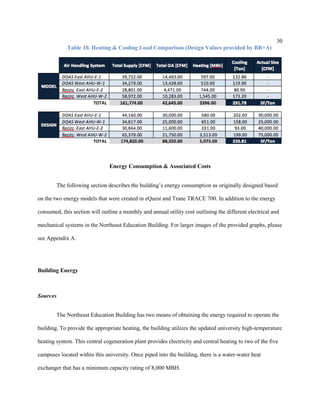
fan coil supply fans. As stated previously above, each zone that the fan coils are responsible for regulating
requires its own supply fan. This is ultimately where the main difference in the hydronic systems lies –
the chilled beams do not have an additional fan supplying the air to the appropriate spaces. Option C,
however, is able to decrease the main air handling costs, but most of that cost is simply transferred into
the fan coil fans. Basically, Table 21 outlines how fan coils are able to take the main fan energy from the
air handling units and disperse it amongst the several units around the building. Similar to the notes above
about chilled beams, the purchased hot water and HW pump costs are directly impacted by the use of a
hydronic system in the building. All in all, there are not many other areas that seem to be impacted by this
system or the previous two. Compared to the original, Option C is able to save about ~$1,100 annually.
100
Table 21: Fan Coil: Option C Cost Analysis
Depth Study 3 | Photocell Implementation
System Definition
Photocell (PC)
A photosensor is an electronic component that detects the presence of visible light, infrared
transmission (IR), and/or ultraviolet (UV) energy. Most photosensors consist of semiconductor having a
property called photoconductivity, in which the electrical conductance varies depending on the intensity
of radiation striking the material.
Spaces Analyzed
Unlike the previous two studies, this study takes a look at the main corridor spaces that allow the
students and professors to transition throughout the building. As stated previously in the Chapter 1, there
101
is a lot of potential to utilize the natural daylight that is already available in the original architectural
design. With curtain wall designs on the East and West corridors throughout the main circulation spaces,
there is potential to reduce the 33% lighting load (see Figure 11) with the addition of photocells.
Figure 43: Typical Photocell Building Space Analysis
Shown in Figure 43 is a typical layout for the area in which photocells will be analyzing the
daylight available in each space. From floor to floor, the main idea behind the control scheme is the same;
the photocells are placed appropriately in the corridors and exterior seminar spaces to control the amount
of light and potentially reduce the amount of electricity used each year. While most of this study falls
under the lighting and electrical analysis detailed later in the report, the full implementation of the
photocell design integrated with the mechanical system is significant. (See Appendix A for all levels of
photocell analysis).
102
Electricity Requirements
To show a brief overview of the photocell implementation, Figure 44 outlines how the addition of
photocells would decrease the monthly electricity consumption. Although, the decrease does not appear to
be extremely significant in the graph, the photocells would decrease the annual electricity consumption by
34,700 kWh. By allowing the building to be monitored on a more sophisticated system, there is less
electricity needed to power the typical fluorescent T8 lighting scheme. This analysis of the lighting and
associated electricity will be shown in more detail in the Lighting Breadth Section of this report.
Figure 44: Electrical Consumption with Photocell Implementation
Depth Study Overview | Utility Analysis
General Overview
This section outlines the utility consumption that was discovered using eQuest energy modelling.
There were three different redesign options including photocells, fan coils, and chilled beams as well as
two combination redesigns that show the potential of combining both the fan coils and chilled beams with
103
the photocell redesign. Different than the studies above, the chilled beams were not explicitly broken out
into Option A and Option B. For the utility distribution graphs, this portion of the report outlines the
general benefits of each technology as opposed to different design scenarios.
Electricity Requirements
The first graph displayed on the following page, Figure 45, depicts the full analysis of each
system and the benefits that each technology provides to the mechanical system. As a whole, it is evident
that each redesign has improvements upon the original VAV design as can be seen in Figure 45. The
graphs following Figure 45 break out the individual and combination redesigns as compared to the
original design in a less cluttered format. Shown in Figure 46, it is evident that the implementation of
chilled beams provides the most beneficial improvement decreasing the peak load in August from
205,500 kWh to 190,900 kWh – a total of 14,600 kWh. While each new system provided in the following
figures outlines the overall improvement in energy efficiency, the more interesting data is shown in
Figure 47. This figure shows the combination of each hydronic system with the photocell technology.
Ultimately, the goal of this study was to improve the overall mechanical system and decrease the
consumption of electricity in the building. By providing a combination of the electrical and mechanical
systems to improve system controllability, Figure 47 shows that both options decrease the annual
electricity consumption.
104
Figure 45: Full Analysis of Electricity Consumption
Figure 46: Individual Feature Electricity Consumption Comparison
105
Figure 47: Combined Feature Electricity Consumption Comparison
Hot Water Requirements
Similar to the electricity requirements, the following three figures outline the hot water that is
required to operate the Northeast Education Building. With the addition of each hydronic system and the
photocell technology, there is an apparent increase in the hot water needed. Most notably during the
winter months (November – March), the amount of hot water needed to heat the building increases.
Shown in Figure 49, there is approximately no change between adding the photocells and the original
design. Similarly, this same figure shows that between the two hydronic systems, there is no significant
difference between the amount of hot water used as well. Overall, it makes sense that both of these
systems would require more heat to operate as compared to the original air system because it is not just
the coils in the air handling units that require heat. With the hydronic systems, there is a significant
increase in piping to accommodate for heating and cooling the spaces appropriately. Therefore, with each
system operating on the same principles, there will certainly be an increase and it is interesting to see that
both of them require about the same amount of heat. This can also be seen in Figure 50 as the
combination of photocells and the hydronic systems causes an increase in hot water consumption through
106
the winter months. However, once again, through the summer months (June – September), the combined
redesigns actually require about the same or even less hot water than the original.
Figure 48: Full Analysis of Hot Water Consumption
Figure 49: Single Feature Hot Water Consumption Comparison
107
Figure 50: Combined Feature Hot Water Consumption Comparison
Master’s Coursework | Displacement Ventilation
General Overview
From the initial design proposal, the other main mechanical design that was analyzed for its
potential energy savings and coordination benefits was the displacement ventilation system in the four
main lecture halls on the Ground Level. All four of these 300-occupant spaces utilized a technology that
is once again not standard in the United States. Displacement ventilation has been prominent in Europe
for about 40 years and has been recently studied in the U.S. as a potentially beneficial mechanical
technology. This study was used to determine why the initial design team for the Northeast Education
Building decided to use displacement ventilation on the lower level lecture halls but an overhead
distribution system on the Third Level lecture halls. From a general standpoint, the energy usage as well
as the overall occupant comfort was studied to show the benefits of each system and why the lecture halls
were designed in this way.
108
System Definition
Displacement Ventilation (UFAD)
A typical displacement ventilation system supplies conditioned cool air from an air handling unit
through a low induction diffuser. The cool air spreads through the floor of the space and then rises as the
air warms due to heat exchange with heat sources in the space such as occupants, computers, and lights.
The warmer air has a lower density than the cool air, and thus creates upward convective flows known as
thermal plumes. The warm air then exits the zone at the ceiling height of the room.
System Considerations
 Underfloor air distribution (UFAD) allows the conditioned air to be supplied at 65F
instead of the typical 55F because of the natural convection that occurs in the space. This
higher temperature supply air being ducted into the room from the floor does not have to
“thrown” as far into the space as with an overhead distribution system.
 Lighting loads can also be decreased in the initial design process of using a UFAD system
because the air does not have to overcome these high temperature luminaires from the
ceiling.
 Supply air should be designed for about 65F not only as an energy savings, but also to
maintain the occupants’ comfort level throughout the space. Because the air is being
supplied towards the ground in this system, it reaches the occupant much faster than an
overhead system. Thus, the air cannot be too cold or this will negatively affect the
occupants as the air is supplied beneath them. Whereas an overhead system mixes the
supply and room air before reaching the occupants, the UFAD system conditions the space
in a different manner and the mixing process only occurs as the air rises from the
respective occupants and heat sources.
 To ensure occupant comfort levels as well, the supply air velocity should be lower than that
of an overhead system. Again, the air does not need to be “thrown” as far inside the room
itself because of the natural convective properties. Therefore, it would be unnecessary to
supply the air at the same velocity as an overhead system. UFAD operates on a much lower
air velocity to ensure that unwanted drafts are not created within the space. The air is
supplied at a higher temperature and lower velocity to condition the space ideally without
the occupants realizing a discomfort or unwanted airflows.
 These design considerations also allow for potential cooling coil savings within the space
as compared to the overhead distribution. Each system has its own energy benefits that
will be discussed in the following section.
109
Energy Calculations
Fan Energy Savings
Given:
 (144) 70 CFM underfloor diffusers in typical Lower Level Lecture Hall
o 10,080 CFM Total
 (20) 300 CFM overhead diffusers in current Third Level Lecture Hall 4225-E
o 6,000 CFM Total
 dpinWG = 6.3
 Energy cost of electricity = $0.1365/ kWh
Assumptions:
 Fan efficiency = 75%
 Motor efficiency = 92%
 Class room spaces occupied for 75% of the year when school is in session for about 12 hours
a day.
 Therefore, 12
ℎ𝑟𝑠.
𝑑𝑎𝑦
∗ 365 𝑑𝑎𝑦𝑠 ∗ 0.75 = 3,285 ℎ𝑟𝑠. 𝑜𝑐𝑐𝑢𝑝𝑖𝑒𝑑
Calculations:
∆PBHP =
(∆q 𝐶𝐹𝑀 ∗ dpinWG)
μ ∗ 6356
∆q 𝐶𝐹𝑀 = 10,080 − 6,000 = 4,080 𝐶𝐹𝑀
𝜇 = 𝜀𝑓𝑎𝑛 ∗ 𝜀 𝑚𝑡𝑟 = 0.75 ∗ 0.92 = 0.69
∆PBHP =
(4080CFM ∗ 6.3)
0.69 ∗ 6356
= 5.86 𝐵𝐻𝑃 ≈ 6 𝐵𝐻𝑃
6 𝐻𝑃 ∗
0.746 𝑘𝑊
𝐻𝑃
∗ 3285 ℎ𝑟𝑠 ∗
$0.1365
𝑘𝑊ℎ
= $1,993.81 ≈ $𝟐, 𝟎𝟎𝟎 𝒇𝒂𝒏 𝒔𝒂𝒗𝒊𝒏𝒈𝒔
110
Cooling Coil Savings
Given:
 Original design of the Third Level Lecture Hall requires 29 tons of cooling to condition the
space (calculated by Trace).
 Redesign of UFAD in Third Level Lecture Hall requires 11 tons of cooling to condition the
space (calculated by Trace).
 Chiller efficiency = 0.56 kW/ ton
 Energy cost of electricity = $0.1365/ kWh
Calculations:
𝑐𝑜𝑖𝑙 𝑠𝑎𝑣𝑖𝑛𝑔𝑠 = ∆ton ∗ 𝜀 𝑐ℎ𝑖𝑙𝑙𝑒𝑟 ∗ 𝑒𝑛𝑒𝑟𝑔𝑦 𝑐𝑜𝑠𝑡
𝑐𝑜𝑖𝑙 𝑠𝑎𝑣𝑖𝑛𝑔𝑠 = (29 − 11 𝑡𝑜𝑛𝑠) ∗ 0.56 (
𝑘𝑊
𝑡𝑜𝑛
) ∗ 3285 ℎ𝑟𝑠.∗
$0.1365
𝑘𝑊ℎ
= $4,519.90 ≈ $𝟒, 𝟓𝟎𝟎 𝒄𝒐𝒊𝒍 𝒔𝒂𝒗𝒊𝒏𝒈𝒔
Energy Comparison
To see the full Trace analysis of each space, reference Appendix B. From the calculations shown
above, it is evident that the displacement ventilation system offers more savings with the cooling coil
requirements than the overhead distribution does with the fan energy. The overhead system benefits from
supplying the air at a colder temperature because it does not need as much airflow to condition the space,
hence the $2,000 fan energy savings. Similarly though, the displacement ventilation system is able to
supply more air at a higher temperature, saving the associated chiller from producing as much cooling
energy. Overall, there is more cost savings potential, about $2,500 from the calculations on the previous
page, in using the UFAD system. By essentially cutting the cooling capacity in half, the UFAD system
sees more of a benefit than the originally designed space, but there are also other design considerations
that were involved in this design process; these will be discussed in the following section.
111
Design Considerations
Shown above is the energy analysis that proves the benefits of utilizing a displacement ventilation
system for the building’s lecture spaces. While this could be viewed as the only valid design
consideration, there are additional analyses that must be weighed as well. In the initial design, there are
recirculating units beneath each of the lecture halls that ultimately supply 70% of the air required. Each
room has been calculated to need about 10,000 CFM based on the 300 occupants and associated building
loads. Therefore, based on the building’s mechanical design, this would be about 20,000 CFM constantly
flowing through the building during typical class hours. From the original design analysis of the
mechanical system, it was shown that all of the respective air handling units are located on the 6th
floor of
the west wing and 4th
floor of the east wing. Realistically, the air for these spaces travels about six stories
to the air handling units, which is an awful lot to be circulating on a constant basis. From the initial
design, implementing these recirculation units saves a substantial amount of ductwork in the building
plenums across the building levels. Each DOAS air handling unit has been rated to supply 10,000 CFM
for each lecture hall, but in actuality, these units supply about 30%, accommodating for the necessary OA
requirements while the recirculation units supply most of the conditioned air.
From an engineer’s standpoint and logically speaking, by implementing the displacement
ventilation system, the original design not only saves on cooling energy, but also saves on the overall
sheet metal cost with the potential ductwork it would take to move the air about the building. In analyzing
these spaces, this mechanical design makes complete sense in every respect. However, the upper level
lecture hall was just proven to be less energy efficient and incur more utility costs on an annual basis.
This may not make sense initially, but taking a look at the original drawings for the Northeast Education
Building, it becomes quite evident why the designers chose the overhead distribution system. The Third
Level Lecture Hall is located on the east wing, which happens to be the lower wing of the building. The
associated DOAS air handling unit is located just above the lecture space, and this provides an easily
accessible route for the associated ductwork. If this space were to be designed similar to the lower level,
112
there would be an unnecessary amount of ductwork needed to route the air underneath the lecture seating
and provide the appropriate air for the recirculation unit. Therefore, this lecture hall saves the additional
cost of an air handling unit and the associated ductwork to apply a simplified design that can be directly
ducted from above. Logically, the original design for this particular lecture space is the better choice.
While each design makes sense with respect to its proximity from the air handling units, there was
another study conducted to show potential benefits of the UFAD system in comparison to the overhead
distribution. This next study was conducted to show different comfort levels and the stratification of the
air distribution using each system in the lecture halls.
Occupant Comfort Levels | Master’s Analysis
Shown on the following pages, Figures 51 and 53, display the two lecture hall geometries that are
discussed in the analysis above. Both lecture hall geometries are identical, however, Figure 51 is
modelled with an overhead distribution system that can be seen with several diffusers on the ceiling.
Conversely, Figure 53 is modelled with the underfloor air distribution system with slot diffusers below
each row in the auditorium seating. Prior to analysis, the hypothesis was that the displacement ventilation
system would produce more beneficial results for the respective occupants in the space. From the
provided results in Figures 52 and 54, it can be seen that this hypothesis is in fact correct. Figure 54,
displaying the displacement ventilation, has a much more fluid distribution within the space and
comparatively, the air velocity distribution is lower than that of the overhead system. More turbulent
airflows can be seen near the occupants in the upper seating of the lecture hall with the overhead system.
Likewise, there is not as much mixing occurring with the overhead system, which can be seen by the
inconsistencies of air velocity around the space. Whereas, looking at the displacement ventilation results,
each occupant in the rows receives an equal amount of airflow including the front of the room as well.
The lowest slot diffuser provides air to the lecturer that would occupy the front space in the room. With
113
this system, the supply air is able to mix equally and efficiently with the current room air. Unfortunately
for the overhead system, each row has a different airflow velocity and thus an unbalanced distribution of
air temperature and pressure within the space.
Figure 51: Overhead Distribution Design Geometry
Figure 52: Overhead Distribution Design Velocity Distribution
114
Figure 53: Displacement Ventilation Design Geometry
Figure 54: Displacement Ventilation Design Velocity Distribution
115
Depth Study Conclusions
There are several aspects to this Depth Study including a full analysis of the hydronic system
redesigns and the implications that each system entails. Taking a look at the natural daylighting available,
a new photocell system was studied to allow the Northeast Education Building to operate on a more
sophisticated level, adjusting to daily conditions. Additionally, there is an associated utility and overall
cost analysis of each system based on its annual usage of electricity, purchased hot water, and domestic
water. From a general standpoint, looking back at the conclusions drawn in the previous section, there are
benefits and drawbacks to each system studied.
From the initial analysis, the chilled beam: Option A redesign showed immense savings with
regards to the overall airflow in the building ductwork and air handling units. While Options B and C also
showed energy savings in this respect, the 78% airflow reduction shown by Option A is much greater
than the other two reductions. The airflow reduction is not the only area of design worth looking at;
however, it presents interesting design implications in the sense that only 20% of the original airflow is
necessary to condition the interior offices. That 80% reduction allows ductwork to be downsized as well
as the air handling units that were shown above. Overall, these air reductions were the basis of proposing
different hydronic designs. Option A and B, both chilled beam schemes, outline the pros and cons of
including exterior spaces in the chilled beam design. Stated previously, when using chilled beams on the
exterior spaces of the building, the engineer must account for radiant panelling as well, which increases
the amount of purchased hot water. On the flip side, however, by allowing the exterior spaces to be
controlled by the original VAV design, there are fewer airflow reductions and in turn less savings on the
air handling units.
Fan coils are an interesting design in that they operate very similarly to chilled beams, but the
slight design principles behind each system cause different utility usage and overall performance
differences as well. Outlined in the first airflow section, one of the more interesting discoveries found was
that the fan coils required more airflow to the exterior spaces than the original VAV design. Although
116
these increases were not drastic, it was interesting to see how all three of these systems compare from this
one perspective. On the other hand, when analyzing the full utility cost for each proposed design, there
were no major differences in the overall breakdown of electricity, hot water, and domestic water. While
the individual system costs were adjusted, the electricity usage never decreased from its original 92% and
likewise for the purchased hot water and domestic water. What is noteworthy between all three cost
analyses, Option A-C, are the consistent decreases in the air handling unit electricity usage and the
increases in the hot water pump electricity consumption. As a whole, these cost differences show the main
functionality of an air-driven versus hydronic system. The original design consumed more fan energy in
the air handling units and needed less hot water to heat the coils and condition the air. Conversely, with
each hydronic option, there is a much more drastic decrease in AHU fan energy and a slight increase in
the hot water consumption. The only exception to the previous statement is the fan coils because while
decreasing the AHU fan energy, they also require a relatively high amount of individual fan energy for
each unit causing the electricity consumption to increase again.
From a different design perspective, the other system that was discussed above was the
implementation of photocells in the circulation and exterior building spaces. Overall, this system is
simple yet sophisticated in the sense that it allows the building to monitor its own electricity usage and
cut back on lighting costs. Generally, lighting costs are some of the most expensive and unnecessary costs
in a building because the natural daylight is underutilized. Shown above in the utility graphs, eQuest has
modelled an overview of the benefits of each individual system: fan coils, chilled beams, and photocells.
More importantly, however, are the combined effects of implementing each hydronic system with the
photocell design as well. All in all, with more control over the circulation spaces and less fan energy
required by the chilled beam design, there is potential to see significant cost savings over the lifecycle of
the building. A further analysis of this lifecycle will be looked at in the Construction Breadth section of
the report.
117
Breadth Analysis 1 | Lighting & Electrical
Photocell Analysis
The amount of natural daylight in the Northeast Education Building has been discussed
previously in this report as a way to save electrical energy. In Depth Study 3 | Photocell Implementation
above, there is a brief discussion about the spaces analyzed in order to properly harvest as much natural
energy as possible. From before, Figure 43 shows that most of the circulation space and exterior seminar
and conference rooms provide an adequate amount of light in the building and show potential benefits
with regards to the overall energy usage. In addition to using eQuest to provide an overview of potential
light available in these spaces, the original lighting design was analyzed to get an overview of the
luminaires used around the building. Shown below in Table 22 is the overview of spaces that would
implement the photocells most appropriately. This table reflects the building lighting plans found in
Appendix A.
118
Table 22: Original Luminaire Schedule
From a brief overview of the table above, all of the suggested luminaires that would be used in
conjunction with the photocell technology are T8 fluorescent lamps. After analyzing the given Lighting
Fixture Schedule in the provided drawing documents, there was no designation that these lamps were
specified with a dimming ballast. These luminaires are designed as shown on the following figure, which
allows a significant amount of light to be saved if these T8 lamps are dimmed or even shut off for part of
the day. As designed, there are several fluorescent luminaires in the corridor in addition to the F5 LED
luminaire that runs along the vertical wall in Figure 55. Between the LED T8 and the other T8 lamps
having more sustainable controllability from the respective photocells, these lighting technologies should
work in conjunction to save energy. One of the biggest concerns with implementing the photocells, as
stated previously, is the compatibility with the current lighting system. To ensure compatibility with the
119
Northeast Education Building, dimming ballasts were analyzed in comparison to the original
specification.
Equipment Specification
From the original drawing set, there was not a specific manufacturer or luminaire selected;
therefore, in order to perform any type of analysis, the Sylvania lighting catalogue was used as a
reference. To start, a typical T8 lamp was selected and is specified in the Appendix C section of this
report. From the original drawing specifications, the lamp selected was a 32W OCTRON 800 XP that is
4’ in length. The original ballasts were assumed to be QUICKTRONIC High Efficiency 32 T8 Instant
Start with a normal ballast factor. These electronic ballasts were again selected based on the original
specifications and reflect the original drawings in order to make an appropriate analysis. For the full
ballast specification, see Appendix C.
Figure 55: Typ. Corridor Lighting Scheme
Equipment Comparison
Following the original analysis of the original system, it was determined that dimming ballast
would be necessary to maintain the current lighting scheme as well as achieve some additional energy
savings. Therefore, Table 23 outlines the main differences between the originally scheduled instant start
120
ballasts with the POWERSENSE dimming system that was then discovered in the Sylvania catalogue as
well. Most of the specifications for each ballast system are very similar such as the input current required
by the system and the rated lumens that each ballast is designed for. The Sylvania catalogue defines that
the POWERSENSE system has a 100-5% dimming range; therefore, the system has two different values
for some of the specifications below. With the ability to dim the current fluorescent system, Table 23
shows that the system lumens can range from 2,640 to 150 with an input voltage of 30 Watts to 8 Watts
respectively. Throughout the day, when the photocells analyze the building spaces as having enough
natural light, there is a potential to only input 27% of the original wattage. Especially in circulation
spaces, there is not necessarily a need to have excessive lighting at full load 24 hours of the day. On the
following page is an example calculation to show how energy can be saved using the photocells and
associated dimming ballasts.
Table 23: Electronic Ballast Comparison
Sample Calculation
Assumptions:
 The available hours of the day in which natural light can be used year round are from
10a.m. to 4p.m. (6 hour window).
 The lights are on for a potential of 12 hours – occupancy sensors are used throughout the
night hours to regulate the amount of electricity from 8p.m. to 8a.m.
121
 Use single lamp ballast to perform the calculation. The input wattage will be based on
dimming ballast values for the part load performance (30/8W) and the instant start ballast
for constant full load performance (28W).
Calculations:
6 Hours (full load lighting)
6 Hours (5% lighting load)
6ℎ𝑟𝑠 ∗ 30𝑊 + 6ℎ𝑟𝑠 ∗ 8𝑊 = 228 [𝑊 − ℎ𝑟𝑠]
12 ℎ𝑟𝑠 ∗ 28𝑊 = 336 [𝑊 − ℎ𝑟𝑠]
1 − (
228
336
) = 𝟑𝟐. 𝟏𝟓% 𝒓𝒆𝒅𝒖𝒄𝒕𝒊𝒐𝒏
Project Compatibility
While not the most technical calculation, this example shows that even with a basic assumption of
full load and 5% part load throughout the average day, there is potential to save 32.15% on the daily
wattage needed to power the luminaires. In that respect, applying the photocells and dimming ballasts
would be a beneficial step towards saving electricity on an annual basis. Overall, the ballasts are
compatible seeing that this analysis uses both Sylvania specified equipment. As of now, another potential
concern would be the placement of each photocell based on the proximity of light available through the
exterior glazing and adapting to the current ceiling plan.
Fortunately, with the specified OSRAM ENCELIUM Ceiling-Mounted Occupancy Sensors
specified in Appendix C, there is a wide range of sensors that can be installed in different size spaces. For
example, displayed below in Figure 56, there are two examples of sensor ranges – 1,500 and 2,000 sq. ft.
The image displayed on the right provides a good explanation of the different capabilities available with
these specific occupancy/photocell sensors. Not only will these specific sensors have the ability read the
available light in the area, but also they are able to detect motion in and out of the space. So
122
hypothetically, during the night-time hours and slower periods of the day when class schedules may not
be as prominent, the lights will be able to turn off completely saving more energy.
Figure 56: Osram Photocell Field of View
Luminaire Alternatives
A second consideration taken with the original lighting design and use of photocell technology
was the replacement of all of the current fluorescent luminaires. From the previous discussion, applying a
dimming ballast to accommodate for the current lighting scheme would be a valid solution to
implementing the photocells. However, taking a step further, there is potential to reduce the overall
electricity consumption by not only having more control over the lighting system, but also using
luminaires that do not require as much power to operate. In that respect, the next area of study is to
consider replacing the current T8 lamps but an LED alternative. Specifically, the new lamp that would be
recommended is a Sylvania SubstiTUBE IS LED T8, which is very closely related to the original design
and one of the main design concerns. By utilizing the same company as originally specified, it creates a
direct comparison in the equipment selection such as ballasts and provides an accurate analysis of the
proposed design.
123
Table 24: T8 Lamp Comparison
From the comparison in Table 24, there is not really a major difference in lamp specifications
alone. The only difference provided by Sylvania is the CRI, which is significant in lighting design;
however, based on the location of these luminaires, it does not seem as if it will make the LED T8 lamps
any less beneficial. In addition to the direct compatibility with the current system, one of the main
benefits of using the Sylvania’s LED T8 is the ability to couple this technology with the
photocell/occupancy sensor as originally proposed. The only difference with these lamps is the specific
ballast that must be used because the LEDs cannot be dimmed like the original design.
According to Sylvania, the LED T8s are engineered to operate on the existing instant start
electronic ballasts that were originally specified for the building. However, unlike the original design,
these T8 lamps will run on less power and provide an energy savings from the newer technology. Shown
below in Table 25 is an overview of the necessary electronic ballasts needed to operate each system.
Analyzing each ballast in comparison with the original design, it is obvious that the LED system will
require about 35% of the original input power and current. Therefore, as a whole, this system has the
potential to reduce the lighting load by 65% in the current design. On the following page is the actual
analysis of the Northeast Education Building’s lighting design load. As seen in the table provided, Table
26, there are circuits that achieve a 20% reduction or greater, and likewise, there are some circuits that
achieve <10% reduction. Overall, there is an average savings of 15% in the lighting load, which is not
extremely significant but does provide a step towards energy savings.
124
Table 25: Ballast Comparison
One factor to consider with regards to this LED redesign is the loss of the original dimming
ballasts. While these particular lamps are able to provide an average of 15% savings in electrical energy,
they are not compatible with dimming ballasts. Therefore, when coupled with the photocell/occupancy
sensors, the only functionality that these luminaires will have is an ‘on/off’ scheme. From a designer’s
perspective, it may not be possible or efficient to implement a control system in which the lights can only
turn on and off.
Another foreseeable issue with using this technology is the system lumen difference (see Table 25
on the previous page). To verify that the LEDs would provide an appropriate light output, further analysis
was completed. Also, because LED T8s are typically used as replacement lamps for existing systems, the
following study was conducted with a new LED luminaire.
125
Table 26: Potential Energy Savings with LED T8 Light System
Light Output Verification
To verify the light output of a newly specified LED luminaire system, Sylvania RLL24 2x4
Recessed Troffers were modelled in AGi32 (See Appendix C for specifications). Two main spaces,
including a typical Seminar room and Gallery corridor, were used to show the target illuminance and
126
average illuminances delivered by the LED system. For this study, the following light loss factors were
accounted for in AGi to model the space:
 Lamp Lumen Depreciation – 0.7
o Based on L70, report states that for LED luminaires LLD = 0.7
 Luminaire Dirt Depreciation – 0.94
o Clean environment
o Closed luminaire
o Direct Distribution
o 12-month cleaning interval
 Total Light Loss Factors – 0.658
For the Gallery corridor, the IES recommendation is 15fc as determined by the transition spaces
definition. As seen below in Figure 57, this lighting layout reflects that of the original design in Figure 55
shown previously. Overall, the luminaires have been spaced 11ft. x 8ft., and the calculated average
illuminance for this design is 21.47fc. While this output may be slightly higher than recommended, it will
provide the appropriate amount of light for this particular space. Additionally, these LED luminaires in
conjunction with the photocell design will allow each corridor to be adequately lit throughout the day.
127
Figure 57: Gallery Corridor AGi Output
With regards to the Seminar room, the IES recommendation is 30fc based on the reading and
writing definition. From the original lighting design, the Sylvania RLL24s were spaced as shown in
Figure 58 on the following page. The average illuminance that was calculated using AGi was 23.48fc,
which does not meet the target illuminance outlined previously. However, taking a look at the contour
images at the bottom of the page, the illuminance is in the low 30s in the middle of the room. Given that
this is a seminar or conference space, another luminaire may be necessary to accommodate for the
appropriate light levels, but overall this luminaire layout is an acceptable replacement.
128
Figure 58: Seminar Room AGi Output
129
Breadth Analysis 2 | Construction
General Overview
As a whole, this report has discussed different design proposals that could potentially save the
Northeast Education Building energy and utility costs on an annual basis. From the original Depth Study,
there were several redesign implications for each hydronic system as these two technologies were
compared with the current VAV air-driven system. Now, taking the energy savings potential into
consideration, this study will dive into more of a realistic business perspective of implementing each
system. More often than not, when handling energy audits and design alternatives, the main concern with
building owners and designers alike are the cost implications. Furthermore, this section will detail the
relative payback period when implementing each system and fully analyze the feasibility of each
proposal.
Redesign Implications
Both of the proposed designs in the original depth study are hydonic systems, and therefore, both
operate differently than the original air-driven design. To start, one of the initial discussions in the
original analysis was the airflow consideration of the chilled beams and fan coil units, and the ability to
drastically reduce each system’s airflow requirements. What this also means for the overall system is a
reduction in ductwork, air handling units, VAV terminal boxes, and any additional equipment that these
water-driven systems may not need to operate. However, as just stated, because these are water-driven
systems, this also introduces new design changes that may require additional piping to be installed. For
example, 4-pipe chilled beams and fan coils need both chilled water supply/return and hot water
supply/return piping, and the current design may not include chilled water supply/return piping
130
throughout the whole building. While these are some of the basic design implications, all three systems
were analyzed with these building factors in mind.
Building System Analysis
Ductwork Calculations
From the original drawing set provided by the design team, each respective office space that
would be affected by the chilled beam or fan coil design was analyzed to acquire the amount of ductwork
the current VAV system needed to operate. (See Appendix A for the full layout of office spaces)
Assumptions:
 The amount of ductwork in the north and south ends of the west wing offices was assumed
to be identical because the space layouts from Levels 3-5 are almost identical.
 Only the south end of Level 5 was accounted to be different because the layout did not
follow the typical design as described in point 1.
 Each ductwork calculation is tabulated in sheet metal weight from a provided spreadsheet
(see Appendix B for details).
On the following page, Table 27 shows the original amount of ductwork that the VAV system was
designed for using the calculated airflows for an air-driven system. In total, there was about 8,225.24 lbs.
of sheet metal required for this design. To calculate the overall weight, each respective duct was measured
from the appropriate VAV box with its height, width, and total length that were then input into a
calculation spreadsheet. These calculations for the original design can be found in Appendix B with the
overall sheet metal weights as well.
131
Table 27: Original Ductwork Total
Table 28 outlines the total sheet metal necessary for each chilled beam design. Option A, requires
approximately 5,817.42 lbs. of sheet metal and Option B about 6,559.74 lbs. – a 30% and 20% reduction
from the original design respectively. From the original analysis, this is what was to be expected because
of the 75% (Option A) and 62% (Option B) reduction in airflow through the ducts. Similarly, Table 29
also outlines the overall duct reduction in the fan coil design, which accurately reflects the original 32%
reduction in airflows. In total, the fan coil redesign accounts for 7,954.79 lbs. of sheet metal, which is a
3% reduction for all of the ductwork.
Table 28: Chilled Beam Ductwork Total
Table 29: Fan Coil Ductwork Total
132
Piping Calculations
Similar to the analysis of each duct system involved in the previous calculations, the piping was
calculated in a similar fashion. By analyzing each respective office space and the current piping design,
there were certain assumptions made in order to accurately portray each mechanical system. To start, as
stated in the design implications section above, the original design does not include chilled water piping
on Levels 3-5. There is a general 8” chilled water supply/return in a centralized location between the
north and south ends of the west wing, and that is where the hypothetical piping design will be connected.
Assumptions:
 The new pipe design that was created for this analysis is based solely off of the current drawings
and the most accurate portrayal of the necessary piping to accommodate each system. (For full
calculation and piping take-offs, see Appendix B).
 Again, all piping in the north and south ends of the west wing offices was assumed to be identical
because the space layouts from Levels 3-5 are almost identical.
 Only the south end of Level 5 was accounted to be different because the layout did not follow the
typical design as described in point 2.
 The chilled beam (Option A) and fan coils were assumed to require the same amount of piping
because both systems require 4-pipe and 2-pipe equipment depending on the location of the office
space.
 All additional piping was assumed to be 1” and ¾” to supply each system
Continuing the above discussion, all of the necessary piping was measured from this centralized
location to make sure that the appropriate length of piping would be calculated. Different than the
ductwork analysis, there is not a current piping layout in which the chilled beams and fan coils can
connect into. Therefore, Table 30 shows all of the additional piping, in linear feet, which would need to
be added to the building design in order to accommodate for the 4-pipe systems.
Table 30: Additional Piping Total
133
Cost Data
Following the initial system analysis and calculating the decreasing ductwork or additional piping
necessary for the hydronic systems, the next step taken was to gather the most relevant cost data. As
displayed in Tables 31 and 32, all of the cost data was gathered from the most up-to-date RS Means
catalogues (to see catalogue information reference Appendix B). There were several catalogues analyzed
during this portion of the data collection because some of the systems and equipment were specifically
included in one book. All of the relative data was collected from these references except for the chilled
beam and fan coil unit estimations. This particular equipment data was referenced from a Price sales
representative to obtain the most accurate data.
Table 31: Cost Analysis – Air Distribution Equipment
134
Table 32: Cost Analysis – Air Handling Units
Individual System Costs
Taking the cost data above, this information was applied to each system in comparison to the
original. The following tables will outline the different aspects of each system design and the respective
costs of each component.
Original Design
As can be seen in Table 33, the base cost, or what has been deemed the base cost for this analysis
is ~$170,000 for the VAV air system. Realistically, this system would include piping cost and other
necessary components as well. However, this analysis has been simplified to look at the discrepancies in
each system, and therefore, the base cost of the piping in the original system is $0.00 because no
additional piping was necessary to implement this design. The VCV boxes are the necessary terminal
boxes to regulate each mechanical zone and similar the ‘FPB’ designation are fan powered terminal
boxes.
135
Table 33: Original Design Costs
Chilled Beam Design
For both chilled beam design options, there are no additional supply diffusers that are needed, and
along the same lines, air diffusers are not necessary for this design. Therefore, as seen on the following
page, the diffusers are actually taken as a deduction in the lifecycle cost analysis. Similarly, there are no
fan powered VAV boxes necessary for Option A and the overall VAV terminal boxes are able to be
downsized significantly as well. Compared to the original design where the terminal boxes ranged from
VCV-8 to 12, Option A does not need higher than VCV-6. On the other hand, Option B still needs the fan
powered VCV boxes because these are used on the exterior office spaces to condition the rooms
effectively. Seen with Option A, the overall VCV terminal boxes can be downsized, and the only other
addition to both chilled beam designs are the chilled beams themselves. Option A, having both interior
and exterior spaces to condition, includes both 4-pipe and 2-pipe units while Option B only includes 2-
pipe units.
136
Table 34: ACB – Option A Design Costs
Table 35: ACB – Option B Design Costs
Analyzing the overall cost of each system and the implied design features, the chilled beam options
appear to be the most expensive. Much of the associated cost with this technology is the actual chilled
beam units because it is a newer technology and not as easily available as the standard VAV boxes. From
a first cost analysis, it is evident that the chilled beams are an expensive building technology; however, it
will be the annual energy savings that determine whether or not it is worth the additional upfront costs.
137
Fan Coils
The fan coil redesign is very similar to the chilled beams in that it includes additional piping as
discussed before and also reduces the overall VAV terminal box size. Unfortunately, it is not able to
downsize the VAVs as significantly as the chilled beams; however, there is certainly some improvement
from the original design. One of the design elements that must remain in the fan coil design and not the
chilled beam design are the supply diffusers. Different than the chilled beam design, fan coils monitor the
offices inside the plenum space and circulate the air through a ducted system. Therefore, the supply
diffusers must remain in each room in order for the fan coils to distribute the air appropriately. And again,
the only other addition to this system that is included in Table 36, are the fan coils units and their
associated cost.
Table 36: Fan Coil Design Costs
Lifecycle Costs
To follow the initial analysis above, the following lifecycle cost analyses were performed to show
the simple payback period for each technology. As seen above in Table 34, there were several benefits to
138
implementing the chilled beam design such as downsizing the overall ductwork from the initial system
and additionally reducing the VAV terminal boxes associated with each zone. Similarly, the supply
diffusers were deemed unnecessary with this new technology, and shown in Table 37 is the full cost
analysis of these savings as well as additional costs outlined above. The most expensive and crucial
addition to this system would be the chilled beams themselves. Because this is still a newer technology in
the U.S., the market has not fully developed a competitive price in comparison to the typical air system
equipment. Therefore, seen in the table, the additional cost of the beams in addition to the required piping
would increase the initial costs by about $185,000. However, as stated previously, there are additional
cost savings associated with this technology as well which can be seen in the adjustment section. The air
handling units that are referenced below are directly related to Table 32 above. Because the chilled beams
require a dedicated outdoor air system (DOAS), there must be an adjustment of which system would be
conditioning the respective air. From the original design, the offices were conditioned by the 75,000 CFM
AHU-W-2. With the appropriate adjustment of airflow reduction and reallocation to the AHU-W-1, 100%
OA system, there are some cost savings as well as cost increases based on the systems needed.
Ultimately, AHU-W-2 would be decreased from a 75,000 CFM unit to one that is rated for 55,000 CFM.
Similarly, AHU-W-1 would be increased from 25,000 CFM unit to 30,000 CFM.
139
Table 37: Cost Analysis ACB – Option A
All in all, with the cost savings from the discussed adjustments and the additional costs associated
with this specific technology, there is about $110,000 of added cost to the original air-driven system.
With the energy savings that were shown above in Depth Study Overview | Cost Analysis, there are
approximately14 years to payback the additional costs of this system.
Similar to the previous analysis of the chilled beam Option A, Table 38 outlines the additional
costs and potential savings of the second layout utilizing chilled beams. With fewer beams involved in
this system, there are less additional costs such as piping, but likewise there are also less cost savings or
adjustments shown as well. Going down the list of adjustments, each component is able to decrease less
and less, and AHU-W-1 must increase from the initial 25,000 CFM to 35,000 CFM. Ultimately, based on
the additional costs and associated adjustments, this version of the chilled beam technology actually costs
about $11,000 more than Option A. These additional costs in conjunction with the energy savings
presented above in the Depth Study Overview allow this proposed design to be paid off in about 18 years.
140
Table 38: Cost Analysis ACB – Option B
Lastly, Option C is outlined in Table 39, and the most notable factor of this design option is that
the material costs of the actual units are not comparable to that of the chilled beam system. From solely a
base equipment standpoint, the fan coils require about 40% of the cost of the chilled beams. As seen in
each table and stated previously, the additional piping for each design was assumed to be the same
because realistically each system would need a similar layout. Therefore, with the lowest additional costs
of the three options, the fan coils are a promising design. However, shown in the adjustments section of
the table, there is a drastic difference in the cost savings of about $76,000 with Option A and paying an
additional $7,800 with Option C. This system, shown in the airflow comparison, does not save nearly as
much on the associated ductwork, VAV terminal boxes, or air handling units. Likewise, this system
requires all of the original supply diffusers and therefore does not benefit from this savings either.
141
Table 39: Cost Analysis Fan Coils – Option C
So, from the analysis shown to the right, there is evidently a price difference in the fan coil versus
chilled beam capital costs. From the originally designed system, the chilled beam Option A design is
calculated to be less expensive than the fan coil design. There is also a significant difference between the
associated energy savings with each technology, and unfortunately, the fan coils receive little
improvement over the original design. With just over $1,000 savings per year, the technology would take
about 113 years to pay back.
142
Chapter 4 | Final Conclusions
Water vs. Air
There is a lot to be drawn from the analysis presented in this study. Of the three proposed designs,
the main question at hand is whether or not the technology is worth the additional costs. Do the pros
outweigh the cons that are associated with each design? If they do and the design requirements are met by
each system, then it does not matter which technology is used in the Northeast Education Building.
However, from the analysis presented throughout this entire report, there are two design options that do
not meet the specified criteria. From a business and engineering standpoint alike, the chilled beam Option
B redesign and the fan coil redesign do not benefit the academic space in an economic or significant
energy-saving manner. While both design options offer reduction in the respective airflow and utility
usage throughout the office spaces, the cost payback period of both seems to be unrealistic in today’s
market. From the overall analysis, the fan coils have proven to be an unrealistic consideration in this
building. Although this technology presents similar benefits to that of the chilled beams, the associated
fan energy with each unit actually prevents energy costs from being reduced. It was stated previously in
the report that the fan coils are taking the main energy away from the air handling units and dispersing
amongst the building units. This certainly has its benefits when air handling units are able to be
decreased; however, in this particular design, the benefits were not seen.
Therefore, this leaves the chilled beam Option A redesign as the only potentially beneficial
system when compared to the original air-driven system. First and foremost, the inclusive analysis has
shown that as studied, Option A is the best choice of the three proposals. While it is deemed as the best
choice, this does not mean that this design is the most beneficial decision for the building owner to
consider. Realistically, given today’s economy and the associated government regulations with green
buildings, owners are becoming more aware of the technology available as well as a realistic payback on
their initial investment. While 14 years is not unrealistic for a building’s lifespan, there are components
143
within the associated chilled beam design that would potentially need to be replaced over the course of
that cost cycle. Ultimately, there is potential for the chilled beam system to save the Northeast Education
Building energy and utility costs over time. However, there are certain modifications in the initial design
proposal that would need to be considered and studied if this chilled beam system was to be approved.
Potential Considerations
Chilled beams work on a higher operating temperature as discussed in the original analysis
section. In doing so, the benefit of utilizing chilled beams is a higher temperature for the desired chilled
water and less demand on the associated chiller. Unfortunately, with the current design proposal mixing
both the air-driven system with the chilled beams, the chiller does not recognize these benefits. With both
systems on one unit, the chiller still operates to produce 45F water whereas if there was a dedicated
chiller for the beams, it could be a smaller unit and produce water that was 60F instead. To improve this
system and see the potential cooling coil benefits that chilled beams offer, there would have to be an
additional study conducted in which a chiller was dedicated to the beams.
Similar to the previous point made, the two studies shown in this report compared the quantity of
chilled beams used in the project. While the beams have a higher capital cost, the overall energy benefit
and annual cost savings were proven to be more beneficial in Option A. This analysis showed that beams
can be placed on interior and exterior spaces to offer more cost savings, and this type of analysis should
be carried throughout the building. One of the potential studies could show a complete overhaul of the
current air system to replace all of the appropriate spaces with the current chilled beam design. With
drastic decreases in ductwork and an increase in piping to accommodate for the new design, there would
still be a cost savings for overall material. To prove the potential benefits, all seminar, lounges, meeting
spaces, and conference rooms should be added to the initial Option A design. This could show much
more energy savings than was realized in the initial design proposal and allow the dedicated chiller to be
144
utilized appropriately. Unfortunately, not all of the corridor and lecture hall spaces can be designed with
chilled beams because of restrictions on the technology. However, these spaces can be designed with their
own chiller that cools to the appropriate temperature for air systems, and both the hydronic and air system
could be conditioned using DOAS air handling units.
Lastly, the proposed overhaul of the original mechanical system should also be coupled with the
photocell technology that was discussed above. Each of these systems operate on completely different
principles and do not directly benefit one another because they are designed for different spaces in the
building. This technology, as shown previously in the report, allows electrical costs to be decreased with
more control over the lighting system. Additionally, this system could show potential benefits in saving
hot water energy throughout the circulation spaces and conference rooms on the exterior. Ultimately, this
is how the two systems could benefit one another because chilled beams require an exterior heating
source such as baseboard heating to help condition the room effectively. Therefore, by allowing the
photocells to track the amount of daylight in these spaces and the corridors as well, this system could also
determine how much heat is being generated in these spaces from the natural light. With more daylight
being utilized to save electrical energy, this would also help heat the building in the winter months when
hot water energy is increased. The conjunction of these two technologies was discussed previously;
however, the study could be furthered to realize the full potential of these systems working together.
145
Appendix A
Building Drawings
Typical Office Layout Levels 3 – 5
Typical Photocell Layout Levels 1 – 5
Proposed Thesis Schedule
LEED Master Scorecard
N O R T H E A S T | U N I T E D S T A T E S
buildinginfo.
electricalsystem.
mechanicalsystem.
lightingdesign. structuralsystem.
architecture.
Southeast View Overall Project Rendering Southwest View
Occupancy: Office | Classroom | Lecture Hall
Size: 200,000 SF
Height: 6 Floors above grade
Project Team: Elkus | Manfredi Architects, Thornton
Tomasetti, BR+A, Convergent Technologies Design
Group, Inc., Joseph Jingoli & Son, Inc., Hargreaves
Associates, PS&S
Schedule: June 2014 (construction begins)
August 2016 (construction ends)
Cost: $75 Million
Delivery Method: Design - Build
Heating: Campus high temperature, hot water is piped directly
into a high pressure water-water heat exchanger which
distributes hot water to fin tube radiation, unit heaters,
and eight air handling units.
Chiller: A chiller plant is located within the penthouse consisting
of two cooling towers and a centrifugal chiller. This
system serves 600 tons of chilled water to nine air
handling units.
Energy: There are four air handling units that incorporate an
enthalpy wheel into the building’s distribution system. A
DOAS is used to efficiently ventilate the main lecture halls
within the building.
Service: Two primary feeders, both 3#500 [5KV each]
Main Distribution: Two main campus feeders supply the
building's electricity. These feeders are brought
directly into the main electrical substation and
emergency substation. The 2,500KVA transformer
and 5KV emergency station distribute power to
eight distibution panels, all of which are 3 phase,
480/277V. These panels supply all of the building's
receptacles and lighting in the classroom and office
spaces.
Main Design: The design of this project resembles classic,
academic architecture with a new spin on the flow
and functionality of the design space. With brick and
limestone facades on the opposing faces of the east
and west wings, the new Education Building will
complement the surrounding buildings that have
defined this institution for over 200 years. On the
interior faces of each wing, a more modern, glazing
system has been chosen in conjunction with the
limestone accents.
Overall System: From floor to floor, there is a consistent
steel framing system that supports a concrete slab
with metal decking. Steel cross bracing is used on
the exterior of the building as well as underneath all
of the mechanical equipment in the penthouse.
Lecture Halls: A lighting consultant designed all of the
lecture halls to be lit from above by recessed 4’ and
8’ linear fixtures. Each hall is equipped with a multi-
scene lighting control station near the podium and a
4-button controller near the entrances.
contact: koffke@psu.edu
website: http://akoffke.wix.com/northeasteducation
advised by: Dr. Rim
A N D R E W K O F F K E M E C H A N I C A L
All images courtesy of Elkus|Manfredi Architects
Technical)Report)Three.)|)Advised)by:)Dr.)Rim)
November)18,)2014)
!
!
LEED!Master!Scorecard!
146
Appendix B
Calculations
Cost Analysis Data
Distribution Equipment
Air Handling Units
Typical Ductwork Take-Off Calculation
Typical Piping Take-Off Calculation
Airflow Redesign Calculations
Lighting Calculations
Energy Analysis Graphics
Utility Cost Calculation
Original Design
Chilled Beam Option A
Chilled Beam Option B
Fan Coil Option C
Room 4225-E Trane TRACE Output
MaterialLaborTotalTotalO&P
SupplyDiffuser9x9161.00$32.00$193.00$226.00$233713.10Mechanical20150530
FPB-2600CFM1,375.00$89.50$1,464.50$1,650.00$233616.10Mechanical20155830FanPoweredVAV
FPB-41,500CFM1,675.00$161.00$1,836.00$2,075.00$233616.10Mechanical20155870FanPoweredVAV
VCV-4200CFM790.00$73.00$863.00$980.00$233616.10Mechanical20155610VAV
VCV-6400CFM800.00$80.50$880.50$1,000.00$233616.10Mechanical20155620VAV
VCV-8600CFM800.00$80.50$880.50$1,000.00$233616.10Mechanical20155630VAV
VCV-101,000CFM820.00$101.00$921.00$1,050.00$233616.10Mechanical20155650VAV
VCV-121,500CFM900.00$134.00$1,034.00$1,200.00$233616.10Mechanical20155670VAV
PipingperLF3.70$8.10$11.80$11.80$D2090810Assemblies201518401/2",3/4",1"
Ductworkperlb1.96$5.35$7.31$10.55$233113.13Facilities201510605,000+lbs.
ABCL-HE4-Pipe---910.00$NAPriceNA4PipeACB
ACBM2-Pipe---735.00$NAPriceNA2PipeACB
FCHCPSize3---760.00$NAPriceNAFanCoils
FCHCPSize6---815.00$NAPriceNAFanCoils
FCHCPSize12---1,485.00$NAPriceNAFanCoils
CatalogNumberNotes
MaterialLaborTotalTotalO&P
AHU20,00066,500.00$3,425.00$69,925.00$77,900.00$237413.10Mechanical20152120
AHU25,00084,075.00$4,150.00$88,225.00$98,325.00$237413.10Mechanical20152140
AHU30,000101,650.00$4,875.00$106,525.00$118,750.00$237413.10Mechanical20152180
AHU35,000109,012.50$5,675.00$114,687.50$128,012.50$237413.10Mechanical20152181
AHU40,000116,375.00$6,475.00$122,850.00$137,275.00$237413.10Mechanical20152200
AHU55,000151,240.00$8,100.00$159,340.00$170,525.00$237413.10Mechanical20152210
AHU60,000152,498.75$8,900.00$161,398.75$177,146.25$237413.10Mechanical20152215
AHU65,000153,757.50$9,700.00$163,457.50$183,767.50$237413.10Mechanical20152217
AHU75,000156,275.00$11,300.00$167,575.00$197,010.00$237433.10Mechanical20152220
NotesTypeUnitSize
Cost
RSMeansSectionCatalogNumber
RSMeans
Manufacturer
CostAnalysis:AirDistributionEquipment
CostAnalysis:AirHandlingUnits
RSMeansSection
Cost
TypeUnitSize[CFM]RSMeans
Terminal Box Duct Width Duct Height Duct Length Sheet Metal Weight (lbs./LF) Total Weight (lbs.) Notes
3-5 12 6 12 3.42 41.04 Exterior
12 6 14 3.42 47.88
3-11 12 6 18 3.42 61.56 Exterior
3-6 12 6 14 3.42 47.88
12 6 20 3.42 68.4
3-9 12 6 21 3.42 71.82
12 6 45 3.42 153.9
3-10 12 6 35 3.42 119.7
12 6 16 3.42 54.72
3-13 12 6 18 3.42 61.56
12 6 27 3.42 92.34
3-12 12 6 22 3.42 75.24
12 6 52 3.42 177.84
3-15 12 6 18 3.42 61.56 Exterior
12 6 6 3.42 20.52
3-28 12 6 22 3.42 75.24 Exterior
12 6 8 3.42 27.36
3-20 12 6 18 3.42 61.56
12 6 20 3.42 68.4
3-19 12 6 18 3.42 61.56
12 6 41 3.42 140.22
3-22 12 6 33 3.42 112.86
12 6 23 3.42 78.66
3-25 12 6 15 3.42 51.3
12 6 24 3.42 82.08
3-23 12 6 10 3.42 34.2
12 6 43 3.42 147.06
Weight Including Ext. Weight Excluding Ext.
2,096.46 2,313.94
5-18 12 6 17 3.42 58.14
12 6 13 3.42 44.46
12 6 27 3.42 92.34
5-23 12 6 40 3.42 136.8 Exterior
12 6 18 3.42 61.56
12 6 12 3.42 41.04
5-22 12 6 16 3.42 54.72
12 6 18 3.42 61.56
Weight Including Ext. Weight Excluding Ext.
550.62 754.90
Including Ext. Excluding Ext.
2,096.46 2,313.94
2,096.46 2,313.94
1,073.88 1,176.96
550.62 754.90
5,817.42 6,559.74Total
Level Three Take OffsNorthSouth
Level Three Totals
Level Five South Take Offs
Level Five South Totals
Building Level
Level Three Totals
Level Four Totals
Level Five North Totals
Level Five South Totals
Sheet Metal Weight [lbs]
Pipe Size Pipe Length Notes
1" 275 Main Run to 8" CHS/R
636 Interior Beams - 2 Pipe
3/4" 600 Interior Beams - 2 Pipe
176 Exterior Beams - 4 Pipe
Pipe Size Pipe Length Notes
1" 80 Interior Beams - 2 Pipe
3/4" 98 Interior Beams - 2 Pipe
228 Exterior Beams - 4 Pipe
Option A/ Fan Coils Option B
1,687.00 1,511.00
1,687.00 1,511.00
1,589.00 1,413.00
504.00 276.00
5,400.00 4,608.00
Piping [LF]
Building Levels
Level Five South Totals
Total
Level Three Take Offs
Level Five South Take Offs
Level Three Totals
Level Four Totals
Level Five North Totals
Building
Proximity
Room Original Airflow
ACB Option A
Airflow
ACB Option B
Airflow
FCU Airflow Original Diffuser Original Terminal Box
Active Chilled
Beam: Option A
ACB Terminal Box: Option A
Active Chilled
Beam: Option B
ACB Terminal Box:
Option B
Fan Coil Terminal
Box
Fan Coils
4181 175 50 175 170 9x9 4B-4P
4182 225 75 225 265 9x9 4B-4P
4179 125 25 25 75 9x9 2VQ-2P 2VQ-2P
4180 125 25 25 75 9x9 2VQ-2P 2VQ-2P
4183 125 25 25 75 9x9 2VQ-2P 2VQ-2P
4184 125 25 25 75 9x9 2VQ-2P 2VQ-2P
4176 125 25 25 75 9x9 2VQ-2P 2VQ-2P
4177 125 25 25 75 9x9 2VQ-2P 2VQ-2P
4178 125 25 25 75 9x9 2VQ-2P 2VQ-2P
4185 125 25 25 75 9x9 2VQ-2P 2VQ-2P
4186 125 25 25 75 9x9 2VQ-2P 2VQ-2P
4187 125 25 25 75 9x9 2VQ-2P 2VQ-2P
4172 125 25 25 75 9x9 2VQ-2P 2VQ-2P
4173 125 25 25 75 9x9 2VQ-2P 2VQ-2P
4174 125 25 25 75 9x9 2VQ-2P 2VQ-2P
4175 125 25 25 75 9x9 2VQ-2P 2VQ-2P
4163 100 10 10 15 9x9 2VQ-2P 2VQ-2P
4164 125 10 10 15 9x9 2VQ-2P 2VQ-2P
4165 125 20 20 55 9x9 2VQ-2P 2VQ-2P
4170 125 25 25 75 9x9 2VQ-2P 2VQ-2P
4171 125 25 25 75 9x9 2VQ-2P 2VQ-2P
4160 125 25 25 75 9x9 2VQ-2P 2VQ-2P
4161 125 25 25 75 9x9 2VQ-2P 2VQ-2P
4162 100 5 5 10 9x9 2VQ-2P 2VQ-2P
4167 125 25 25 75 9x9 2VQ-2P 2VQ-2P
4168 125 25 25 75 9x9 2VQ-2P 2VQ-2P
4169 125 25 25 75 9x9 2VQ-2P 2VQ-2P
4166 175 40 40 135 9x9 4B-4P
4166-1 175 55 55 200 9x9 4B-4P
4130 200 50 50 185 9x9 4B-4P
4130-1 150 50 50 175 9x9 4B-4P
4128 125 25 25 75 9x9 2VQ-2P 2VQ-2P
4129 125 25 25 75 9x9 2VQ-2P 2VQ-2P
4132 125 25 25 75 9x9 2VQ-2P 2VQ-2P
4133 125 25 25 75 9x9 2VQ-2P 2VQ-2P
4125 125 25 25 75 9x9 2VQ-2P 2VQ-2P
4126 125 25 25 75 9x9 2VQ-2P 2VQ-2P
4127 125 25 25 75 9x9 2VQ-2P 2VQ-2P
4134 125 25 25 75 9x9 2VQ-2P 2VQ-2P
4135 125 25 25 75 9x9 2VQ-2P 2VQ-2P
4136 125 25 25 75 9x9 2VQ-2P 2VQ-2P
4120 125 25 25 75 9x9 2VQ-2P 2VQ-2P
4121 125 25 25 75 9x9 2VQ-2P 2VQ-2P
4122 125 25 25 75 9x9 2VQ-2P 2VQ-2P
4123 125 25 25 75 9x9 2VQ-2P 2VQ-2P
4124 125 25 25 75 9x9 2VQ-2P 2VQ-2P
4103 225 70 70 250 9x9 4B-4P
4104 175 30 30 95 9x9 4B-4P
4102 200 65 65 145 9x9 2VQ-2P 2VQ-2P
4105 125 25 25 75 9x9 2VQ-2P 2VQ-2P
4106 125 25 25 75 9x9 2VQ-2P 2VQ-2P
4100 125 25 25 75 9x9 2VQ-2P 2VQ-2P
4101 200 65 65 145 9x9 2VQ-2P 2VQ-2P
4107 125 25 25 75 9x9 2VQ-2P 2VQ-2P
4108 125 25 25 75 9x9 2VQ-2P 2VQ-2P
4109 125 25 25 75 9x9 2VQ-2P 2VQ-2P
5182 175 50 50 170 9x9 4B-4P
5183 225 75 75 265 9x9 4B-4P
5180 125 25 25 75 9x9 2VQ-2P 2VQ-2P
5181 125 25 25 75 9x9 2VQ-2P 2VQ-2P
5184 125 25 25 75 9x9 2VQ-2P 2VQ-2P
5185 125 25 25 75 9x9 2VQ-2P 2VQ-2P
5177 125 25 25 75 9x9 2VQ-2P 2VQ-2P
5178 125 25 25 75 9x9 2VQ-2P 2VQ-2P
5179 125 25 25 75 9x9 2VQ-2P 2VQ-2P
5186 125 25 25 75 9x9 2VQ-2P 2VQ-2P
5187 125 25 25 75 9x9 2VQ-2P 2VQ-2P
5188 125 25 25 75 9x9 2VQ-2P 2VQ-2P
5172 125 25 25 75 9x9 2VQ-2P 2VQ-2P
5173 125 25 25 75 9x9 2VQ-2P 2VQ-2P
5174 125 25 25 75 9x9 2VQ-2P 2VQ-2P
5175 125 25 25 75 9x9 2VQ-2P 2VQ-2P
5176 125 25 25 75 9x9 2VQ-2P 2VQ-2P
5165 175 55 55 205 9x9 4B-4P
5166 175 40 40 135 9x9 4B-4P
5163 125 25 25 75 9x9 2VQ-2P 2VQ-2P
5164 125 25 25 75 9x9 2VQ-2P 2VQ-2P
5167 125 25 25 75 9x9 2VQ-2P 2VQ-2P
5168 125 25 25 75 9x9 2VQ-2P 2VQ-2P
5160 125 25 25 75 9x9 2VQ-2P 2VQ-2P
5161 125 25 25 75 9x9 2VQ-2P 2VQ-2P
5162 125 25 25 75 9x9 2VQ-2P 2VQ-2P
5169 125 25 25 75 9x9 2VQ-2P 2VQ-2P
5170 125 25 25 75 9x9 2VQ-2P 2VQ-2P
5171 125 25 25 75 9x9 2VQ-2P 2VQ-2P
5125 200 50 50 185 9x9 4B-4P
5126 150 45 45 165 9x9 4B-4P
5123 125 25 25 75 9x9 2VQ-2P 2VQ-2P
5124 125 25 25 75 9x9 2VQ-2P 2VQ-2P
5127 125 25 25 75 9x9 2VQ-2P 2VQ-2P
5128 125 25 25 75 9x9 2VQ-2P 2VQ-2P
5120 125 25 25 75 9x9 2VQ-2P 2VQ-2P
5121 125 25 25 75 9x9 2VQ-2P 2VQ-2P
5122 125 25 25 75 9x9 2VQ-2P 2VQ-2P
5129 125 25 25 75 9x9 2VQ-2P 2VQ-2P
5130 125 25 25 75 9x9 2VQ-2P 2VQ-2P
5131 125 25 25 75 9x9 2VQ-2P 2VQ-2P
5112 125 25 25 75 9x9 2VQ-2P 2VQ-2P
5113 125 25 25 75 9x9 2VQ-2P 2VQ-2P
5114 100 25 25 75 9x9 2VQ-2P 2VQ-2P
5115 100 25 25 75 9x9 2VQ-2P 2VQ-2P
5116 125 25 25 75 9x9 2VQ-2P 2VQ-2P
5105 225 70 70 250 9x9 4B-4P
5106 175 30 30 95 9x9 4B-4P
5103 125 25 25 75 9x9 2VQ-2P 2VQ-2P
5104 125 25 25 75 9x9 2VQ-2P 2VQ-2P
5107 125 25 25 75 9x9 2VQ-2P 2VQ-2P
5108 125 25 25 75 9x9 2VQ-2P 2VQ-2P
5100 125 25 25 75 9x9 2VQ-2P 2VQ-2P
5101 125 25 25 75 9x9 2VQ-2P 2VQ-2P
5102 125 25 25 75 9x9 2VQ-2P 2VQ-2P
5109 125 25 25 75 9x9 2VQ-2P 2VQ-2P
5110 125 25 25 75 9x9 2VQ-2P 2VQ-2P
Exterior
Interior
Interior
VCV-6
FPB-2
VCV-4
VCV-6
FPB-2
VCV-4
VCV-6
VCV-4
FPB-2
VCV-4
VCV-6
VCV-4
FPB-2
VCV-4
VCV-6
FPB-2
VCV-4
VCV-6
VCV-4
FPB-2
VCV-4
VCV-6
VCV-4
VCV-4
VCV-4
FPB-2
FPB-2
VCV-4
FPB-2
FPB-2
VCV-8
VCV-10
FPB-2
VCV-8
FPB-2
VCV-10
VCV-10
VCV-10
VCV-10
VCV-12
VCV-10
VCV-10
VCV-10
FPB-2
VCV-8
FPB-2
VCV-10
VCV-8
FPB-2
VCV-4
VCV-4
VCV-6
VCV-4
VCV-4
VCV-4
VCV-4
VCV-8
VCV-10
VCV-10
VCV-8
FPB-2
VCV-10
VCV-10
VCV-6
VCV-4
VCV-4
VCV-6
VCV-4
VCV-4
VCV-4
VCV-4
VCV-6
VCV-4
VCV-4
VCV-4
VCV-6
VCV-4
VCV-6
VCV-4
VCV-4
VCV-6
VCV-4
VCV-8
VCV-6
VCV-6
VCV-6
VCV-8
VCV-8
VCV-8
VCV-6
VCV-8
VCV-6
VCV-6
VCV-8
VCV-6
VCV-6
VCV-6
VCV-4
VCV-4
VCV-6
VCV-6
VCV-8
VCV-6
VCV-6
VCV-6
VCV-6
VCV-8
VCV-6
VCV-6
VCV-6
VCV-8
VCV-8
FC-06
FC-03
FC-06
FC-03
FC-03
FC-06
FC-06
FC-06
FC-03
FC-06
FC-06
FC-06
FC-03
FC-06
FC-06
FC-03
FC-06
FC-06
FC-06
FC-03
FC-06
FC-06
FC-03
FC-06
FC-06
FC-06
FC-03
FC-06
5111 125 25 25 75 9x9 2VQ-2P 2VQ-2P
6183 175 50 50 170 9x9 4B-4P
6184 225 75 75 265 9x9 4B-4P
6181 125 25 25 75 9x9 2VQ-2P 2VQ-2P
6182 125 25 25 75 9x9 2VQ-2P 2VQ-2P
6185 125 25 25 75 9x9 2VQ-2P 2VQ-2P
6186 125 25 25 75 9x9 2VQ-2P 2VQ-2P
6178 125 25 25 75 9x9 2VQ-2P 2VQ-2P
6179 125 25 25 75 9x9 2VQ-2P 2VQ-2P
6180 125 25 25 75 9x9 2VQ-2P 2VQ-2P
6187 125 25 25 75 9x9 2VQ-2P 2VQ-2P
6188 125 25 25 75 9x9 2VQ-2P 2VQ-2P
6189 125 25 25 75 9x9 2VQ-2P 2VQ-2P
6172 125 25 25 75 9x9 2VQ-2P 2VQ-2P
6173 125 25 25 75 9x9 2VQ-2P 2VQ-2P
6174 125 25 25 75 9x9 2VQ-2P 2VQ-2P
6175 125 25 25 75 9x9 2VQ-2P 2VQ-2P
6176 125 25 25 75 9x9 2VQ-2P 2VQ-2P
6165 175 55 55 205 9x9 4B-4P
6166 175 40 40 135 9x9 4B-4P
6163 125 25 25 75 9x9 2VQ-2P 2VQ-2P
6167 125 25 25 75 9x9 2VQ-2P 2VQ-2P
6168 125 25 25 75 9x9 2VQ-2P 2VQ-2P
6160 125 25 25 75 9x9 2VQ-2P 2VQ-2P
6161 125 25 25 75 9x9 2VQ-2P 2VQ-2P
6162 125 25 25 75 9x9 2VQ-2P 2VQ-2P
6169 125 25 25 75 9x9 2VQ-2P 2VQ-2P
6170 125 25 25 75 9x9 2VQ-2P 2VQ-2P
6171 125 25 25 75 9x9 2VQ-2P 2VQ-2P
6109 100 20 20 55 9x9 2VQ-2P 2VQ-2P
6110 100 20 20 55 9x9 2VQ-2P 2VQ-2P
6112 125 20 20 55 9x9 2VQ-2P 2VQ-2P
6113 100 20 20 55 9x9 2VQ-2P 2VQ-2P
6114 100 20 20 55 9x9 2VQ-2P 2VQ-2P
6102 150 45 45 165 9x9 4B-4P
6103 150 45 45 165 9x9 4B-4P
6105 175 45 45 165 9x9 4B-4P
6106 150 45 45 165 9x9 4B-4P
6107 200 45 45 165 9x9 4B-4P
6115 200 50 50 180 9x9 4B-4P
6100 100 20 20 55 9x9 2VQ-2P 2VQ-2P
6101 100 20 20 55 9x9 2VQ-2P 2VQ-2P
6104 100 20 20 55 9x9 2VQ-2P 2VQ-2P
6104-1 100 20 20 55 9x9 2VQ-2P 2VQ-2P
Original Option A Option B Option C
Total Airflow 21,000.00 4,585.00 8,030.00 14,305.00
Option A Reduction 78%
Option B Reduction 62%
Option C Reduction 32%
FPB-4
VCV-4
FPB-2
VCV-4
VCV-6
VCV-4
FPB-2
VCV-4
VCV-6
VCV-4
VCV-8
FPB-4
VCV-10
VCV-10
VCV-8
FPB-2
VCV-10
VCV-10
VCV-8
FPB-2 VCV-4
VCV-4
VCV-6
VCV-4
VCV-4
VCV-4
VCV-4
VCV-6
VCV-4
VCV-6
VCV-6
VCV-8
VCV-6
VCV-12
VCV-6
VCV-8
VCV-6
VCV-8
VCV-8
VCV-6
FC-12
FC-03
FC-06
FC-03
FC-06
FC-06
FC-06
FC-03
FC-06
FC-03
Level
OriginalCircuit
Load[W]
No.ofLampsQuantityInputPower[W]
OriginalLuminaire
Load[W]
RedesignLum.
Load[W]
ΔLoad[W]
RedesignCircuit
Load[W]
AveragePower
Savings
OriginalLuminaire
Current[A]
RedesignLum.
Current[A]
ΔCurrent[A]
RedesignCircuit
Current[A]
4106810706803903.92.51.4
21365536190.20.130.07
700283644028815254822%1.61.040.56
223611072380.40.260.14
25362751809510.650.35
45685353401951.951.250.7
400283644028815224838%1.61.040.56
24004216822471428819158134%8.195.252.94
16002836440288152144810%1.61.040.56
2436220144760.80.520.28
213367154682472.61.690.91
47687494762732.731.750.98
150025362751809514056%10.650.35
16002836440288152144810%1.61.040.56
1400263633021611412868%1.20.780.42
27363852521331.40.910.49
2436220144760.80.520.28
2336165108570.60.390.21
1919252171810.990.630.36
4106810706803903.92.51.4
25362751809510.650.35
1400263633021611412868%1.20.780.42
10002436220144769248%0.80.520.28
1800263633021611416866%1.20.780.42
240023361651085723432%0.60.390.21
2000283644028815218488%1.61.040.56
15%TotalAverageSavings
1
2
3
4
5
1991
2300
2000
1700
147.68
149.3
148.81
17%
16%
30%
12%
9%
21%
147.97
148.25
146.5
146.92
148.81
1672
1404
1491
1462
1815
1600
2400
2000
0.00
50000.00
100000.00
150000.00
200000.00
250000.00
Jan Feb Mar Apr May June July Aug Sept Oct Nov Dec
EnergyConsumption(kWh)
Monthly Electricity Consumption: Full Comparison
Original Photo Cell Fan Coils Chilled Beams FCU | Photo Cell ACB | Photo Cell
0.00
50000.00
100000.00
150000.00
200000.00
250000.00
Jan Feb Mar Apr May June July Aug Sept Oct Nov Dec
ENERGYCONSUMPTION(KWH)
Monthly Electricity Consumption: Individual Feature
Original Photo Cell Fan Coils Chilled Beams
0.00
200.00
400.00
600.00
800.00
1000.00
1200.00
1400.00
Jan Feb Mar Apr May June July Aug Sept Oct Nov Dec
HotWaterEnergy(MMBTU)
Monthly Purchased Hot Water Consumption: Full Comparison
Original Photo Cell Fan Coils Chilled Beams FCU | Photo Cell ACB | Photo Cell
159400.00
152300.00
141500.00
139000.00
156500.00
127300.00
170700.00
205500.00
130500.00
132100.00
137400.00
123000.00
151000.00
145100.00
134400.00
133900.00
148300.00
116000.00
153000.00
186100.00
119800.00
128100.00
133900.00
115500.00
151600.00
145600.00
134900.00
134400.00
149000.00
117400.00
156200.00
189100.00
120500.00
128200.00
134300.00
116200.00
JA N F E B MA R A PR MA Y JU NE JU LY A U G S E PT O C T NO V D E C
ENERGYCONSUMPTION(KWH)
MONTHLY ELECTRICITY CONSUMPTION: COMBINATION FEATURES
Original ACB | Photo Cell FCU | Photo Cell
0.00
200.00
400.00
600.00
800.00
1000.00
1200.00
1400.00
Jan Feb Mar Apr May June July Aug Sept Oct Nov Dec
HotWaterEnergy(MMBTU)
Monthly Purchased Hot Water Consumption: One Feature
Original Photo Cell Fan Coils Chilled Beams
1150.00
900.00
680.00
420.00
120.00
30.00
30.00
30.00
30.00
210.00
540.00
870.00
1260.00
990.00
750.00
470.00
140.00
30.00
20.00
20.00
30.00
240.00
600.00
970.00
1260.00
980.00
750.00
470.00
140.00
30.00
20.00
20.00
30.00
240.00
600.00
970.00
Jan Feb Mar Apr May June July Aug Sept Oct Nov Dec
HotWaterEnergy(MMBTU)
Monthly Purchased Hot Water Consumption: Combination Feature
Original FCU | Photo Cell ACB | Photo Cell
0.00
50000.00
100000.00
150000.00
200000.00
250000.00
Jan Feb Mar Apr May June July Aug Sept Oct Nov Dec
EnergyConsumption(kWh)
Monthly Electricity Consumption | Photocell
Original
Photo Cell
Original Jan Feb Mar Apr May June July Aug Sept Oct Nov Dec Total
Lighting 114878.80 103761.60 114878.60 111173.20 114878.80 111172.90 114879.10 114878.60 111173.20 114879.00 111173.10 114879.00 1352605.90
Centrifugal Chiller 55573.30 52372.90 64454.40 68783.20 85788.10 120979.80 142333.20 138960.20 103524.10 81184.30 69433.80 60012.00 1043399.30
Cooling Tower 14627.70 13572.90 16397.70 18231.90 20198.80 23071.80 25978.90 25498.60 20537.10 19780.00 18381.50 15731.20 232008.10
Chilled Water Pump 18849.20 17025.10 18849.20 18241.20 18849.20 18241.20 18849.20 18849.20 18241.20 18849.30 18241.20 18849.30 221934.50
Condenser Water Pump 18927.30 17095.70 18927.30 18316.80 18927.40 18316.80 18927.30 18927.30 18316.80 18927.30 18316.80 18927.40 222854.20
Hot Water Pump 6158.50 5562.50 6158.50 5959.80 6158.50 5959.80 6158.50 6158.50 5959.80 6158.50 5959.80 6158.50 72511.20
Heat Exchanger 6733.70 5298.40 4156.60 2840.70 1871.30 1226.10 1174.70 1252.40 1490.00 2346.30 3203.60 5691.70 37285.50
AHU-E-1 9534.20 9018.80 10842.90 11259.20 12705.50 13981.30 14960.80 14145.40 12329.60 11544.90 10415.90 9817.40 140555.90
AHU-W-1 9462.80 8751.00 10243.30 10265.60 11233.40 12268.10 13308.10 13023.60 11773.30 11199.70 10197.90 9681.20 131408.00
AHU-E-2 7615.30 7012.10 8208.90 8220.00 9136.40 10477.70 11688.50 11067.60 9517.70 8887.00 8028.80 7737.00 107597.00
AHU-W-2 20352.40 18785.80 22075.80 22702.10 25694.70 29827.20 32721.10 30267.30 25471.80 23493.80 21334.80 20614.80 293341.60
RAHU-1 (SW) 3854.80 3628.50 4011.10 3801.80 3726.30 4041.60 4277.10 4090.10 3577.40 3717.80 3839.90 3897.00 46463.40
RAHU-2 (SE) 6608.90 6157.20 7169.40 7247.80 7882.80 8140.20 8529.50 8318.30 7608.00 7436.50 6925.20 6745.70 88769.50
RAHU-3 (NE) 6148.10 5755.30 6758.40 6876.90 7524.70 7849.10 8257.00 8001.80 7241.90 7021.40 6491.90 6283.60 84210.10
RAHU-4 (NW) 6150.10 5706.10 6682.30 6731.70 7359.30 7711.30 8142.20 7912.60 7159.90 6992.80 6454.00 6272.80 83275.10
Jan Feb Mar Apr May June July Aug Sept Oct Nov Dec
Lights 114878.80 103761.60 114878.60 111173.20 114878.80 111172.90 114879.10 114878.60 111173.20 114879.00 111173.10 114879.00 1352605.90
Centrifugal Chiller 55573.30 52372.90 64454.40 68783.20 85788.10 120979.80 142333.20 138960.20 103524.10 81184.30 69433.80 60012.00 1043399.30
Cooling Tower 14627.70 13572.90 16397.70 18231.90 20198.80 23071.80 25978.90 25498.60 20537.10 19780.00 18381.50 15731.20 232008.10
CHW Pump 18849.20 17025.10 18849.20 18241.20 18849.20 18241.20 18849.20 18849.20 18241.20 18849.30 18241.20 18849.30 221934.50
CW Pump 18927.30 17095.70 18927.30 18316.80 18927.40 18316.80 18927.30 18927.30 18316.80 18927.30 18316.80 18927.40 222854.20
HW Pump 6158.50 5562.50 6158.50 5959.80 6158.50 5959.80 6158.50 6158.50 5959.80 6158.50 5959.80 6158.50 72511.20
HX 6733.70 5298.40 4156.60 2840.70 1871.30 1226.10 1174.70 1252.40 1490.00 2346.30 3203.60 5691.70 37285.50
Air Handling Units 69726.60 64814.80 75992.10 77105.10 85263.10 94296.50 101884.30 96826.70 84679.60 80293.90 73688.40 71049.50 975620.60
Jan Feb Mar Apr May June July Aug Sept Oct Nov Dec Total
Lights 15,726.91$ 14,204.96$ 15,726.88$ 15,219.61$ 15,726.91$ 15,219.57$ 15,726.95$ 15,726.88$ 15,219.61$ 15,726.94$ 15,219.60$ 15,726.94$ 185,171.75$
Centrifugal Chiller 7,607.98$ 7,169.85$ 8,823.81$ 9,416.42$ 11,744.39$ 16,562.13$ 19,485.42$ 19,023.65$ 14,172.45$ 11,114.13$ 9,505.49$ 8,215.64$ 142,841.36$
Cooling Tower 2,002.53$ 1,858.13$ 2,244.85$ 2,495.95$ 2,765.22$ 3,158.53$ 3,556.51$ 3,490.76$ 2,811.53$ 2,707.88$ 2,516.43$ 2,153.60$ 31,761.91$
CHW Pump 2,580.46$ 2,330.74$ 2,580.46$ 2,497.22$ 2,580.46$ 2,497.22$ 2,580.46$ 2,580.46$ 2,497.22$ 2,580.47$ 2,497.22$ 2,580.47$ 30,382.83$
CW Pump 2,591.15$ 2,340.40$ 2,591.15$ 2,507.57$ 2,591.16$ 2,507.57$ 2,591.15$ 2,591.15$ 2,507.57$ 2,591.15$ 2,507.57$ 2,591.16$ 30,508.74$
HW Pump 843.10$ 761.51$ 843.10$ 815.90$ 843.10$ 815.90$ 843.10$ 843.10$ 815.90$ 843.10$ 815.90$ 843.10$ 9,926.78$
HX 921.84$ 725.35$ 569.04$ 388.89$ 256.18$ 167.85$ 160.82$ 171.45$ 203.98$ 321.21$ 438.57$ 779.19$ 5,104.38$
AHU 9,545.57$ 8,873.15$ 10,403.32$ 10,555.69$ 11,672.52$ 12,909.19$ 13,947.96$ 13,255.58$ 11,592.64$ 10,992.23$ 10,087.94$ 9,726.68$ 133,562.46$
Purchased HW 5,543.00$ 4,338.00$ 3,277.60$ 2,024.40$ 578.40$ 144.60$ 144.60$ 144.60$ 144.60$ 1,012.20$ 2,602.80$ 4,193.40$ 24,148.20$
Water 983.25$ 948.75$ 1,245.45$ 1,404.15$ 1,883.70$ 2,832.45$ 3,343.05$ 3,253.35$ 2,380.50$ 1,745.70$ 1,421.40$ 1,110.90$ 22,552.65$
48,345.79$ 43,550.83$ 48,305.64$ 47,325.80$ 50,642.03$ 56,815.01$ 62,380.00$ 61,080.97$ 52,345.99$ 49,635.01$ 47,612.91$ 47,921.08$
Electricity ($/kWh) 0.1369
Hot Water ($/MMBTU) 4.82
Water 3.45
$-
$10,000.00
$20,000.00
$30,000.00
$40,000.00
$50,000.00
$60,000.00
$70,000.00
Jan Feb Mar Apr May June July Aug Sept Oct Nov Dec
UtilityCost($)
Monthly Utility Costs
Water
Purchased HW
AHU
HW Pump
CW Pump
CHW Pump
Cooling Tower
Centrifugal Chiller
Lights
ACB: Option A Jan Feb Mar Apr May June July Aug Sept Oct Nov Dec Total
Lights 114848.00 103733.50 114847.90 111143.20 114847.90 111143.10 114848.00 114847.90 111143.10 114848.00 111143.10 114848.00 1352241.70
Centrifugal Chiller 55470.60 52431.00 64072.60 68102.00 84518.90 119666.40 140924.10 137790.50 102256.10 80111.70 68901.70 60205.80 1034451.40
Cooling Tower 15508.70 14573.20 18299.70 21493.80 24421.40 22787.60 23334.60 23094.40 22627.60 23680.30 21798.00 17139.30 248758.60
CHW Pump 18849.20 17025.10 18849.20 18241.20 18849.20 18241.20 18849.20 18849.20 18241.20 18849.30 18241.20 18849.30 221934.50
CW Pump 18927.30 17095.70 18927.30 18316.80 18927.40 18316.80 18927.30 18927.30 18316.80 18927.30 18316.80 18927.40 222854.20
HW Pump 6302.60 5692.60 6302.60 6099.30 6302.60 6099.30 6302.60 6302.60 6099.30 6302.60 6099.30 6302.60 37711.00
HX 6778.60 5424.50 4234.60 2859.70 1872.30 1226.20 1174.80 1252.50 1490.10 2348.40 3220.00 5829.30 74208.00
AHU-E-1 9534.20 9018.80 10842.90 11259.20 12705.50 13981.30 14960.80 14145.40 12329.60 11544.90 10415.90 9817.40 140555.90
AHU-W-1 9462.80 8751.00 10243.30 10265.60 11233.40 12268.10 13308.10 13023.60 11773.30 11199.70 10197.90 9681.20 131408.00
AHU-E-2 7615.30 7012.10 8208.90 8220.00 9136.40 10477.70 11688.50 11067.60 9517.70 8887.00 8028.80 7737.00 107597.00
AHU-W-2 14547.20 13445.90 15837.20 16346.40 18616.80 22081.20 24393.60 22361.00 18555.10 16911.70 15325.60 14757.40 213179.10
RAHU-1 (SW) 3854.80 3628.50 4011.10 3801.80 3726.30 4041.60 4277.10 4090.10 3577.40 3717.80 3839.90 3897.00 46463.40
RAHU-2 (SE) 6608.90 6157.20 7169.40 7247.80 7882.80 8140.20 8529.50 8318.30 7608.00 7436.50 6925.20 6745.70 88769.50
RAHU-3 (NE) 6148.10 5755.30 6758.40 6876.90 7524.70 7849.10 8257.00 8001.80 7241.90 7021.40 6491.90 6283.60 84210.10
RAHU-4 (NW) 6150.10 5706.10 6682.30 6731.70 7359.30 7711.30 8142.20 7912.60 7159.90 6992.80 6454.00 6272.80 83275.10
Jan Feb Mar Apr May June July Aug Sept Oct Nov Dec
Lights 114848.00 103733.50 114847.90 111143.20 114847.90 111143.10 114848.00 114847.90 111143.10 114848.00 111143.10 114848.00
Centrifugal Chiller 55470.60 52431.00 64072.60 68102.00 84518.90 119666.40 140924.10 137790.50 102256.10 80111.70 68901.70 60205.80
Cooling Tower 15508.70 14573.20 18299.70 21493.80 24421.40 22787.60 23334.60 23094.40 22627.60 23680.30 21798.00 17139.30
CHW Pump 18849.20 17025.10 18849.20 18241.20 18849.20 18241.20 18849.20 18849.20 18241.20 18849.30 18241.20 18849.30
CW Pump 18927.30 17095.70 18927.30 18316.80 18927.40 18316.80 18927.30 18927.30 18316.80 18927.30 18316.80 18927.40
HW Pump 6302.60 5692.60 6302.60 6099.30 6302.60 6099.30 6302.60 6302.60 6099.30 6302.60 6099.30 6302.60
HX 6778.60 5424.50 4234.60 2859.70 1872.30 1226.20 1174.80 1252.50 1490.10 2348.40 3220.00 5829.30
AHU 63921.40 59474.90 69753.50 70749.40 78185.20 86550.50 93556.80 88920.40 77762.90 73711.80 67679.20 65192.10
Total 300606.40 275450.50 315287.40 317005.40 347924.90 384031.10 417917.40 409984.80 357937.10 338779.40 315399.30 307293.80
Jan Feb Mar Apr May June July Aug Sept Oct Nov Dec Total
Lights 15,722.69$ 14,201.12$ 15,722.68$ 15,215.50$ 15,722.68$ 15,215.49$ 15,722.69$ 15,722.68$ 15,215.49$ 15,722.69$ 15,215.49$ 15,722.69$ 185,121.89$
Centrifugal Chiller 7,593.93$ 7,177.80$ 8,771.54$ 9,323.16$ 11,570.64$ 16,382.33$ 19,292.51$ 18,863.52$ 13,998.86$ 10,967.29$ 9,432.64$ 8,242.17$ 141,616.40$
Cooling Tower 2,123.14$ 1,995.07$ 2,505.23$ 2,942.50$ 3,343.29$ 3,119.62$ 3,194.51$ 3,161.62$ 3,097.72$ 3,241.83$ 2,984.15$ 2,346.37$ 34,055.05$
CHW Pump 2,580.46$ 2,330.74$ 2,580.46$ 2,497.22$ 2,580.46$ 2,497.22$ 2,580.46$ 2,580.46$ 2,497.22$ 2,580.47$ 2,497.22$ 2,580.47$ 30,382.83$
CW Pump 2,591.15$ 2,340.40$ 2,591.15$ 2,507.57$ 2,591.16$ 2,507.57$ 2,591.15$ 2,591.15$ 2,507.57$ 2,591.15$ 2,507.57$ 2,591.16$ 30,508.74$
HW Pump 862.83$ 779.32$ 862.83$ 834.99$ 862.83$ 834.99$ 862.83$ 862.83$ 834.99$ 862.83$ 834.99$ 862.83$ 10,159.08$
HX 927.99$ 742.61$ 579.72$ 391.49$ 256.32$ 167.87$ 160.83$ 171.47$ 203.99$ 321.50$ 440.82$ 798.03$ 5,162.64$
AHU 8,750.84$ 8,142.11$ 9,549.25$ 9,685.59$ 10,703.55$ 11,848.76$ 12,807.93$ 12,173.20$ 10,645.74$ 10,091.15$ 9,265.28$ 8,924.80$ 122,588.21$
Purchased HW 6,025.00$ 4,723.60$ 3,566.80$ 2,217.20$ 626.60$ 144.60$ 96.40$ 96.40$ 144.60$ 1,108.60$ 2,892.00$ 4,627.20$ 26,269.00$
Water 1,041.90$ 990.15$ 1,259.25$ 1,383.45$ 1,821.60$ 2,791.05$ 3,329.25$ 3,236.10$ 2,318.40$ 1,683.60$ 1,380.00$ 1,138.50$ 22,373.25$
Electricity ($/kWh) 0.1369
Hot Water ($/MMBTU) 4.82
Water 3.45
$-
$10,000.00
$20,000.00
$30,000.00
$40,000.00
$50,000.00
$60,000.00
$70,000.00
Jan Feb Mar Apr May June July Aug Sept Oct Nov Dec
UtilityCost($)
Monthly Utility Costs
Lights Centrifugal Chiller Cooling Tower CHW Pump CW Pump HW Pump AHU Purchased HW Water HX
ACB: Option B Jan Feb Mar Apr May June July Aug Sept Oct Nov Dec Total
Lights 114848.00 103733.50 114847.90 111143.20 114847.90 111143.10 114848.00 114847.90 111143.10 114848.00 111143.10 114848.00 1352241.70
Centrifugal Chiller 55954.00 52769.90 64341.70 68335.90 84748.60 119883.90 141172.30 138029.40 102443.10 80350.60 69169.80 60580.80 1037780.00
Cooling Tower 15533.40 14595.50 18323.00 21522.60 24455.30 22813.40 23360.50 23119.70 22652.00 23714.00 21832.40 17168.30 249090.10
CHW Pump 18849.20 17025.10 18849.20 18241.20 18849.20 18241.20 18849.20 18849.20 18241.20 18849.30 18241.20 18849.30 221934.50
CW Pump 18927.30 17095.70 18927.30 18316.80 18927.40 18316.80 18927.30 18927.30 18316.80 18927.30 18316.80 18927.40 222854.20
HW Pump 6270.80 5663.90 6270.80 6068.50 6270.80 6068.50 6270.80 6270.80 6068.50 6270.80 6068.50 6270.80 73833.50
HX 6781.70 5429.50 4236.30 2860.00 1872.50 1226.20 1174.80 1252.50 1490.20 2348.60 3220.80 5840.30 37733.40
AHU-E-1 9534.20 9018.80 10842.90 11259.20 12705.50 13981.30 14960.80 14145.40 12329.60 11544.90 10415.90 9817.40 140555.90
AHU-W-1 9462.80 8751.00 10243.30 10265.60 11233.40 12268.10 13308.10 13023.60 11773.30 11199.70 10197.90 9681.20 131408.00
AHU-E-2 7615.30 7012.10 8208.90 8220.00 9136.40 10477.70 11688.50 11067.60 9517.70 8887.00 8028.80 7737.00 107597.00
AHU-W-2 15188.40 14068.40 16689.60 17328.00 19887.30 23756.90 26308.10 24033.70 19790.70 17934.30 16125.30 15415.90 226526.60
RAHU-1 (SW) 3854.80 3628.50 4011.10 3801.80 3726.30 4041.60 4277.10 4090.10 3577.40 3717.80 3839.90 3897.00 46463.40
RAHU-2 (SE) 6608.90 6157.20 7169.40 7247.80 7882.80 8140.20 8529.50 8318.30 7608.00 7436.50 6925.20 6745.70 88769.50
RAHU-3 (NE) 6148.10 5755.30 6758.40 6876.90 7524.70 7849.10 8257.00 8001.80 7241.90 7021.40 6491.90 6283.60 84210.10
RAHU-4 (NW) 6150.10 5706.10 6682.30 6731.70 7359.30 7711.30 8142.20 7912.60 7159.90 6992.80 6454.00 6272.80 83275.10
Jan Feb Mar Apr May June July Aug Sept Oct Nov Dec
Lights 114848.00 103733.50 114847.90 111143.20 114847.90 111143.10 114848.00 114847.90 111143.10 114848.00 111143.10 114848.00
Centrifugal Chiller 55954.00 52769.90 64341.70 68335.90 84748.60 119883.90 141172.30 138029.40 102443.10 80350.60 69169.80 60580.80
Cooling Tower 15533.40 14595.50 18323.00 21522.60 24455.30 22813.40 23360.50 23119.70 22652.00 23714.00 21832.40 17168.30
CHW Pump 18849.20 17025.10 18849.20 18241.20 18849.20 18241.20 18849.20 18849.20 18241.20 18849.30 18241.20 18849.30
CW Pump 18927.30 17095.70 18927.30 18316.80 18927.40 18316.80 18927.30 18927.30 18316.80 18927.30 18316.80 18927.40
HW Pump 6270.80 5663.90 6270.80 6068.50 6270.80 6068.50 6270.80 6270.80 6068.50 6270.80 6068.50 6270.80
HX 6781.70 5429.50 4236.30 2860.00 1872.50 1226.20 1174.80 1252.50 1490.20 2348.60 3220.80 5840.30
AHU 64562.60 60097.40 70605.90 71731.00 79455.70 88226.20 95471.30 90593.10 78998.50 74734.40 68478.90 65850.60
Total 301727.00 276410.50 316402.10 318219.20 349427.40 385919.30 420074.20 411889.90 359353.40 340043.00 316471.50 308335.50
Jan Feb Mar Apr May June July Aug Sept Oct Nov Dec Total
Lights 15,722.69$ 14,201.12$ 15,722.68$ 15,215.50$ 15,722.68$ 15,215.49$ 15,722.69$ 15,722.68$ 15,215.49$ 15,722.69$ 15,215.49$ 15,722.69$ 185,121.89$
Centrifugal Chiller 7,660.10$ 7,224.20$ 8,808.38$ 9,355.18$ 11,602.08$ 16,412.11$ 19,326.49$ 18,896.22$ 14,024.46$ 11,000.00$ 9,469.35$ 8,293.51$ 142,072.08$
Cooling Tower 2,126.52$ 1,998.12$ 2,508.42$ 2,946.44$ 3,347.93$ 3,123.15$ 3,198.05$ 3,165.09$ 3,101.06$ 3,246.45$ 2,988.86$ 2,350.34$ 34,100.43$
CHW Pump 2,580.46$ 2,330.74$ 2,580.46$ 2,497.22$ 2,580.46$ 2,497.22$ 2,580.46$ 2,580.46$ 2,497.22$ 2,580.47$ 2,497.22$ 2,580.47$ 30,382.83$
CW Pump 2,591.15$ 2,340.40$ 2,591.15$ 2,507.57$ 2,591.16$ 2,507.57$ 2,591.15$ 2,591.15$ 2,507.57$ 2,591.15$ 2,507.57$ 2,591.16$ 30,508.74$
HW Pump 858.47$ 775.39$ 858.47$ 830.78$ 858.47$ 830.78$ 858.47$ 858.47$ 830.78$ 858.47$ 830.78$ 858.47$ 10,107.81$
HX 928.41$ 743.30$ 579.95$ 391.53$ 256.35$ 167.87$ 160.83$ 171.47$ 204.01$ 321.52$ 440.93$ 799.54$ 5,165.70$
AHU 8,838.62$ 8,227.33$ 9,665.95$ 9,819.97$ 10,877.49$ 12,078.17$ 13,070.02$ 12,402.20$ 10,814.89$ 10,231.14$ 9,374.76$ 9,014.95$ 124,415.49$
Purchased HW 5,976.80$ 4,675.40$ 3,566.80$ 2,217.20$ 626.60$ 144.60$ 96.40$ 96.40$ 144.60$ 110.86$ 2,843.80$ 4,627.20$ 25,126.66$
Water 1,041.90$ 990.15$ 1,259.25$ 1,383.45$ 1,821.60$ 2,791.05$ 3,329.25$ 3,236.10$ 2,318.40$ 1,683.60$ 1,380.00$ 1,138.50$ 22,373.25$
Electricity ($/kWh) 0.1369
Hot Water ($/MMBTU) 4.82
Water 3.45
$-
$10,000.00
$20,000.00
$30,000.00
$40,000.00
$50,000.00
$60,000.00
$70,000.00
Jan Feb Mar Apr May June July Aug Sept Oct Nov Dec
UtilityCost($)
Monthly Utility Costs
Lights Centrifugal Chiller Cooling Tower CHW Pump CW Pump HW Pump AHU Purchased HW Water HX
Fan Coil Jan Feb Mar Apr May June July Aug Sept Oct Nov Dec Total
Lights 114964.40 103839.00 114964.30 111255.90 114964.40 111255.80 114964.50 114964.30 111256.10 114964.40 111255.90 114964.60 1353613.60
Centrifugal Chiller 54060.20 51237.10 63585.80 67921.60 84749.00 120029.80 141352.30 138001.30 102531.30 80119.20 68364.10 58935.80 1030887.50
Cooling Tower 15436.00 14505.80 18265.40 21482.00 24455.20 22830.60 23379.70 23116.50 22663.50 23684.70 21737.60 17044.20 248601.20
CHW Pump 18849.20 17025.10 18849.20 18241.20 18849.20 18241.20 18849.20 18849.20 18241.20 18849.30 18241.20 18849.30 221934.50
CW Pump 18927.30 17095.70 18927.30 18316.80 18927.40 18316.80 18927.30 18927.30 18316.80 18927.30 18316.80 18927.40 222854.20
HW Pump 6136.20 5542.40 6136.20 5938.30 6136.20 5938.30 6136.20 6136.20 5938.30 6136.20 5938.30 6136.20 72249.00
HX 6755.80 5317.50 4178.90 2858.90 1882.80 1237.40 1186.30 1264.00 1500.40 2365.40 3223.10 5710.10 37480.60
Fan Coils 5289.70 4777.80 5289.70 5119.00 5289.70 5119.00 5289.70 5289.70 5119.10 5289.70 5119.00 5289.70 62281.80
AHU-E-1 9534.20 9018.80 10842.90 11259.20 12705.50 13981.30 14960.80 14145.40 12329.60 11544.90 10415.90 9817.40 140555.90
AHU-W-1 9462.80 8751.00 10243.30 10265.60 11233.40 12268.10 13308.10 13023.60 11773.30 11199.70 10197.90 9681.20 131408.00
AHU-E-2 7615.30 7012.10 8208.90 8220.00 9136.40 10477.70 11688.50 11067.60 9517.70 8887.00 8028.80 7737.00 107597.00
AHU-W-2 13983.60 12929.60 15240.40 15740.80 17946.50 21349.40 23611.00 21614.90 17894.70 16279.80 14741.10 14187.40 205519.20
RAHU-1 (SW) 3854.80 3628.50 4011.10 3801.80 3726.30 4041.60 4277.10 4090.10 3577.40 3717.80 3839.90 3897.00 46463.40
RAHU-2 (SE) 6608.90 6157.20 7169.40 7247.80 7882.80 8140.20 8529.50 8318.30 7608.00 7436.50 6925.20 6745.70 88769.50
RAHU-3 (NE) 6148.10 5755.30 6758.40 6876.90 7524.70 7849.10 8257.00 8001.80 7241.90 7021.40 6491.90 6283.60 84210.10
RAHU-4 (NW) 6150.10 5706.10 6682.30 6731.70 7359.30 7711.30 8142.20 7912.60 7159.90 6992.80 6454.00 6272.80 83275.10
Jan Feb Mar Apr May June July Aug Sept Oct Nov Dec
Lights 114964.40 103839.00 114964.30 111255.90 114964.40 111255.80 114964.50 114964.30 111256.10 114964.40 111255.90 114964.60
Centrifugal Chiller 54060.20 51237.10 63585.80 67921.60 84749.00 120029.80 141352.30 138001.30 102531.30 80119.20 68364.10 58935.80
Cooling Tower 15436.00 14505.80 18265.40 21482.00 24455.20 22830.60 23379.70 23116.50 22663.50 23684.70 21737.60 17044.20
CHW Pump 18849.20 17025.10 18849.20 18241.20 18849.20 18241.20 18849.20 18849.20 18241.20 18849.30 18241.20 18849.30
CW Pump 18927.30 17095.70 18927.30 18316.80 18927.40 18316.80 18927.30 18927.30 18316.80 18927.30 18316.80 18927.40
HW Pump 6136.20 5542.40 6136.20 5938.30 6136.20 5938.30 6136.20 6136.20 5938.30 6136.20 5938.30 6136.20
HX 6755.80 5317.50 4178.90 2858.90 1882.80 1237.40 1186.30 1264.00 1500.40 2365.40 3223.10 5710.10
Fan Coils 5289.70 4777.80 5289.70 5119.00 5289.70 5119.00 5289.70 5289.70 5119.10 5289.70 5119.00 5289.70
AHU 63357.80 58958.60 69156.70 70143.80 77514.90 85818.70 92774.20 88174.30 77102.50 73079.90 67094.70 64622.10
Jan Feb Mar Apr May June July Aug Sept Oct Nov Dec Total
Lights 15,738.63$ 14,215.56$ 15,738.61$ 15,230.93$ 15,738.63$ 15,230.92$ 15,738.64$ 15,738.61$ 15,230.96$ 15,738.63$ 15,230.93$ 15,738.65$ 185,309.70$
Centrifugal Chiller 7,400.84$ 7,014.36$ 8,704.90$ 9,298.47$ 11,602.14$ 16,432.08$ 19,351.13$ 18,892.38$ 14,036.53$ 10,968.32$ 9,359.05$ 8,068.31$ 141,128.50$
Cooling Tower 2,113.19$ 1,985.84$ 2,500.53$ 2,940.89$ 3,347.92$ 3,125.51$ 3,200.68$ 3,164.65$ 3,102.63$ 3,242.44$ 2,975.88$ 2,333.35$ 34,033.50$
CHW Pump 2,580.46$ 2,330.74$ 2,580.46$ 2,497.22$ 2,580.46$ 2,497.22$ 2,580.46$ 2,580.46$ 2,497.22$ 2,580.47$ 2,497.22$ 2,580.47$ 30,382.83$
CW Pump 2,591.15$ 2,340.40$ 2,591.15$ 2,507.57$ 2,591.16$ 2,507.57$ 2,591.15$ 2,591.15$ 2,507.57$ 2,591.15$ 2,507.57$ 2,591.16$ 30,508.74$
HW Pump 840.05$ 758.75$ 840.05$ 812.95$ 840.05$ 812.95$ 840.05$ 840.05$ 812.95$ 840.05$ 812.95$ 840.05$ 9,890.89$
HX 924.87$ 727.97$ 572.09$ 391.38$ 257.76$ 169.40$ 162.40$ 173.04$ 205.40$ 323.82$ 441.24$ 781.71$ 5,131.09$
Fan Coils 724.16$ 654.08$ 724.16$ 700.79$ 724.16$ 700.79$ 724.16$ 724.16$ 700.80$ 724.16$ 700.79$ 724.16$ 8,526.38$
AHU 8,673.68$ 8,071.43$ 9,467.55$ 9,602.69$ 10,611.79$ 11,748.58$ 12,700.79$ 12,071.06$ 10,555.33$ 10,004.64$ 9,185.26$ 8,846.77$ 121,539.57$
Purchased HW 6,025.00$ 4,723.60$ 3,566.80$ 2,217.20$ 626.60$ 144.60$ 96.40$ 96.40$ 144.60$ 1,108.60$ 2,892.00$ 4,627.20$ 26,269.00$
Water 948.75$ 921.15$ 1,221.30$ 1,380.00$ 1,849.20$ 2,804.85$ 3,315.45$ 3,225.75$ 2,349.45$ 1,711.20$ 1,386.90$ 1,079.85$ 22,193.85$
Electricity ($/kWh) 0.1369
Hot Water ($/MMBTU) 4.82
Water 3.45
$-
$10,000.00
$20,000.00
$30,000.00
$40,000.00
$50,000.00
$60,000.00
$70,000.00
Jan Feb Mar Apr May June July Aug Sept Oct Nov Dec
UtilityCost($)
Monthly Utility Costs
Lights Centrifugal Chiller Cooling Tower CHW Pump CW Pump HW Pump Fan Coils AHU Purchased HW Water
RoomChecksums
ByACADEMIC
4225-E
ACADEMIC
USE
ONLY
HEATINGCOILPEAKCLGSPACEPEAKCOOLINGCOILPEAKTEMPERATURES
HeatingDesignMo/Hr:7/10Mo/Hr:7/14Mo/Hr:PeakedatTime:CoolingHeating
SADBOADB:10OADB:88/73/98OADB/WB/HR:OutsideAir:55.081.5
RaPlenum75.174.2
ReturnPercentCoilPeakSpacePeakSpacePercentPercentNetPlenumSpace75.174.2
Ret/OASens.+Lat.OfTotalTotSensSpaceSensOfTotalSensibleOfTotalTotalSens.+Lat10.082.0
0.00.3FnMtrTDBtu/h(%)Btu/hBtu/h(%)Btu/h(%)Btu/hBtu/h
0.00.7FnBldTDEnvelopeLoads
0.02.2FnFrict0SkyliteSolar0.000000000
0SkyliteCond0.000000000
0RoofCond0.000000000
0.0014,911GlassSolar001724,834414,9110
1,992Glass/DoorCond-12,5507.48-12,550027611,9920
AIRFLOWS
HeatingCooling
221WallCond1.97-3,299-77302180950729
0Partition/Door0.00000000
0Floor0.0000000
SecFan0.000Infiltration000000
1,9761,976MinStop/Rh
9.4417,124SubTotal==>-15,850-13,3231725,328517,853729
6,585Return1,976
InternalLoads
1,9763,237Exhaust
19,113Lights0.00001319,113519,1130
00RmExh
135,000People0.0005175,00039
00Auxiliary
27,304Misc0.00001927,304827,3040
181,417SubTotal==>0.000083121,41752181,4170
124CeilingLoad0.000-1,052012100-124
0VentilationLoad85.31-143,19400037127,8970
Sup.FanHeat622,107
ENGINEERINGCKS
HeatingCooling
Ret.FanHeat000%OA100.049.2
DuctHeatPkup0000.491.65cfm/ft²
0Ov/UndrSizing
0.0000
0000
226.48cfm/ton
ExhaustHeat
-1.091,829
0-352
137.57ft²/ton
-54.1087.23Btu/hr·ft²
300No.People198,665GrandTotal==>100.00-167,854-14,375100.00146,866100.00348,921253
AREASHEATINGCOILSELECTIONCOOLINGCOILSELECTION
TotalCapacitySensCap.CoilAirflowEnterDB/WB/HRLeaveDB/WB/HRGrossTotalGlassCoilAirflowEntLvgCapacity
tonMBhMBhcfm°F°Fgr/lb°F°Fgr/lbft²(%)°F°FcfmMBh
Floor4,000MainHtg-65.51,97651.881.529.1348.9209.46,21882.068.181.151.849.749.5MainClg
Part0AuxHtg0.00.00.000.00.00.000.00.00.00.00.00.0AuxClg
ExFlr0
-150.9Preheat10.051.83,2370.00.00.000.00.00.00.00.00.0OptVent
Roof000
Reheat-51.175.051.81,976
Wall1,22042635
Humidif0.000.00.029.1348.9Total
OptVent0.00.00.00
-216.4Total
EnvelopeLoads
SkyliteSolar
SkyliteCond
RoofCond
GlassSolar
Glass/DoorCond
WallCond
Partition/Door
Floor
Infiltration
SubTotal==>
Lights
People
Misc
SubTotal==>
CeilingLoad
VentilationLoad
SystemPlenumHeat
AdditionalReheat
OAPreheatDiff.
Ov/UndrSizing
ExhaustHeat
RAPreheatDiff.
GrandTotal==>
InternalLoads
0
-355
-58,813
0
35.04
0.21
0.00
0.00
-352
SupplyAirLeakage
78
Dehumid.OvSizing00
AdjAirTransHeat00000AdjAirTransHeat000
LeakageUps
LeakageDwn
00Infil
AHUVent
NomVent
MainFan
Terminal
AdjacentFloor
Diffuser
SupplyAirLeakage
UnderflrSupHtPkupUnderflrSupHtPkup
AdjacentFloor0000
00
000
0
0
0000.00
48,529-28.91
00.00
6,585
6,585
6,585
0
3,237
3,237
0
0
1,976
1,976
1,976
0
1,976
1,976
0
0
0135,0000
IntDoor0
ExtDoor000
TRACE®700v6.3calculatedat07:57PMon03/16/2015ProjectName:1360000
DatasetName:Alternative-1SystemChecksumsReportPage83of967LOADCALCS_REDESIGN_1.TRC
RoomChecksums
ByACADEMIC
4225-E
ACADEMIC
USE
ONLY
HEATINGCOILPEAKCLGSPACEPEAKCOOLINGCOILPEAKTEMPERATURES
HeatingDesignMo/Hr:7/10Mo/Hr:7/11Mo/Hr:PeakedatTime:CoolingHeating
SADBOADB:10OADB:81/69/86OADB/WB/HR:OutsideAir:65.075.0
RaPlenum76.474.5
ReturnPercentCoilPeakSpacePeakSpacePercentPercentNetPlenumSpace76.474.5
Ret/OASens.+Lat.OfTotalTotSensSpaceSensOfTotalSensibleOfTotalTotalSens.+Lat55.069.6
0.00.3FnMtrTDBtu/h(%)Btu/hBtu/h(%)Btu/h(%)Btu/hBtu/h
0.00.6FnBldTDEnvelopeLoads
0.01.8FnFrict0SkyliteSolar0.000000000
0SkyliteCond0.000000000
0RoofCond0.000000000
0.0023,435GlassSolar002224,8341723,4350
683Glass/DoorCond-12,5505.13-12,55002411783100
AIRFLOWS
HeatingCooling
162WallCond1.18-2,887-67401661745583
0Partition/Door0.00000000
-17,617Floor4.42-10,821-10,821-16-13-17,617
SecFan0.000Infiltration000000
3,0563,056MinStop/Rh
10.736,663SubTotal==>-26,258-24,04577,52957,346683
10,179Return3,056
InternalLoads
3,0563,237Exhaust
16,677Lights0.00001516,6731419,1132,436
00RmExh
125,442People0.0005865,428100
00Auxiliary
23,824Misc0.00002123,8192027,3043,480
165,943SubTotal==>0.000093105,920135181,41715,474
57CeilingLoad0.000-60005800-57
0VentilationLoad27.84-68,150000-72-97,1350
Sup.FanHeat2229,913
ENGINEERINGCKS
HeatingCooling
Ret.FanHeat000%OA100.031.8
DuctHeatPkup0000.762.54cfm/ft²
0Ov/UndrSizing
0.0000
0000
367.17cfm/ton
ExhaustHeat
-0.661,613
-4-5,159
144.28ft²/ton
-64.0983.17Btu/hr·ft²
300No.People172,663GrandTotal==>100.00-244,778-24,645100.00113,508100.00134,40910,941
AREASHEATINGCOILSELECTIONCOOLINGCOILSELECTION
TotalCapacitySensCap.CoilAirflowEnterDB/WB/HRLeaveDB/WB/HRGrossTotalGlassCoilAirflowEntLvgCapacity
tonMBhMBhcfm°F°Fgr/lb°F°Fgr/lbft²(%)°F°FcfmMBh
Floor4,000MainHtg-73.200.00.011.2134.499.410,09669.662.171.860.757.866.9MainClg
Part0AuxHtg0.00.00.000.00.00.000.00.00.00.00.00.0AuxClg
ExFlr0
-20.7Preheat55.060.73,23716.5198.3120.53,23788.473.097.955.054.964.4OptVent
Roof000
Reheat-48.675.062.33,056
Wall1,22042635
Humidif0.000.00.027.7332.7Total
OptVent-162.455.010.03,237
-256.4Total
EnvelopeLoads
SkyliteSolar
SkyliteCond
RoofCond
GlassSolar
Glass/DoorCond
WallCond
Partition/Door
Floor
Infiltration
SubTotal==>
Lights
People
Misc
SubTotal==>
CeilingLoad
VentilationLoad
SystemPlenumHeat
AdditionalReheat
OAPreheatDiff.
Ov/UndrSizing
ExhaustHeat
RAPreheatDiff.
GrandTotal==>
InternalLoads
0
0
-162,433
0
66.36
0.00
0.00
0.00
-5,159
SupplyAirLeakage
78
Dehumid.OvSizing00
AdjAirTransHeat00000AdjAirTransHeat000
LeakageUps
LeakageDwn
00Infil
AHUVent
NomVent
MainFan
Terminal
AdjacentFloor
Diffuser
SupplyAirLeakage
UnderflrSupHtPkupUnderflrSupHtPkup
AdjacentFloor0000
18,02713
000
0
-17,711
0000.00
10,450-4.27
00.00
10,179
10,179
10,179
0
3,237
3,237
0
0
3,056
3,056
3,056
0
3,056
3,056
0
0
9,558135,0000
IntDoor0
ExtDoor000
TRACE®700v6.3calculatedat07:57PMon03/16/2015ProjectName:1360000
DatasetName:Alternative-2SystemChecksumsReportPage406of967LOADCALCS_REDESIGN_1.TRC
147
Appendix C
Equipment Specifications
Price ACBM: Modular Active Beam (2-Pipe System)
Price ACBL-HE: Linear High Efficiency Active Beam (4-Pipe System)
Price Fan Coil
Sylvania OCTRON 800 XP Lamps
LED T8 Lamps Commercial Grade
Electronic Fluorescent Ballasts
OSRAM Ceiling Mounted Wireless Sensor with Photocell
Electronic Fluorescent Ballasts – Dimming Systems
Sylvania RLL24 Fixture and Retrofit Kit
sizes. The ACBM provides high transfer efficiencies, allowing the designer to maximize the beam capacity
while minimizing the primary air flow rate. Typical application includes office spaces (both private and open
environments), patient rooms, classrooms, and laboratory alcoves.
ACBM
Modular Active Beam
www.price-hvac.com for additional product
information, including product videos and brochures.
ACBM ACBM air flow pattern
Ideal for Private Offices
The ACBM is a perfect application for private offices.
advantage over similarly sized linear active beams
due to the reduction in throw.
Easy Installation
The ACBM can be easily integrated in standard or
tegular T-bar ceilings due to its compact design.
If no ceiling is used, an exposed casing option is
available.
Great for Classrooms
The ACBM is well suited to classroom environments
due to its modular design. The ACBM provides a more
traditional aesthetic while also offering an efficient
and comfortable alternative to fan coil systems and
requiring less maintenance.
PersonPPerPerPerssosonn
Modular
Beam
Window
Classroom mockup - Price Technical Center Atlanta
T-bar ceiling installation
Modular air pattern
All Metric dimensions ( ) are soft conversion. © Copyright Price Industries Limited 2011.
Imperial dimensions are converted to metric and rounded to the nearest millimeter.L-98
ACTIVEANDPASSIVEBEAMS
ACBM
Product Information
Models
ACBM
ACBM,
Features
of installation
to allow easy room side access for
internal beam elements
Casing Construction
Water Coil Construction
Water ConnectionType
Air flow Pattern
ACBM
Room Air
Nozzles
Plenum
Primary Air
© Copyright Price Industries Limited 2011. All Metric dimensions ( ) are soft conversion.
Imperial dimensions are converted to metric and rounded to the nearest millimeter. L-99
ACTIVEANDPASSIVEBEAMS
ACBM
Product Options
hides air duct and water connections
insulation for thermal barrier and
sound attenuation
Perforated Face
Exposed Casing Tegular Mounting
Beam Options
Grille Face Wings No Wings
Opening with KO for Water
and Electrical Connections
Nom.
12.000 L
Damper w/ 24vac
Floating Point Actuator
Damper w/ manual
Locking Quadrant
Air Diffuser Section
Nom. 12” or 24”
W + 12"
W + 12"
10”
Tegular Mounting:
9/16" wide x 5/16" high
15/16" wide x 5/16" high
Tegular
T-Bar
Height
Width
ACBL - Exposed Casing
Enclosure Opening
ACBL - Wing Extensions
Return/Exhaust Box
Nom. 12”
Ø 7.875”
Exposed Casing
All Metric dimensions ( ) are soft conversion. © Copyright Price Industries Limited 2011.
Imperial dimensions are converted to metric and rounded to the nearest millimeter.L-100
ACTIVEANDPASSIVEBEAMS
Dimensional Data
ACBM
ACBM
Integrated 1/4" Pressure Port
(Balancing/commissioning)
(Accessible From Face Side)
4 Way Air Discharge
Removable Face
(Perforated Or Grille)
Adjustable Mounting
Brackets (Lockable)
Heating Water Connections
(Not Supplied On 2 Pipe)
Primary Air Connection
(D - 1/8")
Cooling Water
Connections
Use 3/8" Threaded Rods
To Suspend To Ceiling.
L/2W/2
1.500
7.000
LW
Dimensional Data - Imperial (inches) Metric (mm)
Imperial Metric
Nominal Size Actual Size (W) Nominal Size Actual Size (W)
Width 24 23.750 (603) 600 23.386 (594)
Nominal Size Actual Size (L) Nominal Size Actual Size (L)
Length 24 23.750 (603) 600 23.386 (594)
Length 48 47.750 (1213) 1200 47.008 (1194)
© Copyright Price Industries Limited 2011. All Metric dimensions ( ) are soft conversion.
Imperial dimensions are converted to metric and rounded to the nearest millimeter. L-101
ACTIVEANDPASSIVEBEAMS
Performance Data
ACBM
ACBM (2 Pipe) Cooling
Performance Notes:
1. Operating Conditions are:
a.75°Fdb,50%relativehumidityroomdesigntemperature.
b.57°Fdb,90%relativehumidityprimaryairtemperature.
c. 57°F entering chilled water temperature for cooling.
d. 120°F entering hot water temperature for heating.
e. 1 gpm water flow rate.
2. Primary Air Capacity in BTU/hr is based on 18°F tempera-
ture difference between the primary air and the Room air.
3. Blanks (--) indicate a sound level less than 15 NC.
4. Sound data NC values are based on a room absorption
of -10db, re 10-12
watts.
5. Throwdatafor150,100and50fpmisbasedonisothermal
conditions.
6. Active beam capacity is tested in accordance with EN
standard 15116.
7. Activebeamthrowandnoisecriterioninaccordancewith
Ashrae Standard 70.
Unit
Length
ft
Inlet
Size
Nozzle
Size
Airflow
CFM Total
(Primary)
Plenum
Static
Pressure
in.
Sound
NC
Capacity - 2 Pipe
Induction
Ratio
Throw
150-100-50 fpm ftCooling
Coil Btu/h
Transfer
Efficiency
Btu/h cfm Total Btu/h
Head Loss
ft H2O A B
2x2 ft
5 8 0.20 -- 568 71 724
2.0
3.7 0-0-2
5 0.125 14 0.50 -- 890 65 1158 3.7 1-1-5
5 (20) 18 0.80 -- 1113 62 1464 3.7 1-2-6
5 13 0.20 -- 732 56 985 3.2 0-1-3
5 0.160 22 0.50 -- 1087 50 1507 3.2 1-2-6
5 (30) 28 0.80 19 1328 48 1872 3.2 2-4-8
5 20 0.20 -- 894 45 1276 2.8 1-2-5
5 0.188 32 0.50 19 1242 39 1860 2.8 2-4-8
5 (40) 41 0.80 26 1464 36 2255 2.8 3-5-10
5 31 0.20 -- 1018 33 1617 1.8 1-2-6
5 0.250 51 0.50 24 1413 28 2412 1.8 3-5-10
5 (50) 67 0.80 31 1667 25 2966 1.8 4-7-11
5 48 0.20 19 1137 24 2072 1.5 2-4-8
5 0.300 78 0.50 32 1568 20 3082 1.5 5-7-11
8 (60) 100 0.80 35 1841 18 3780 1.5 6-9-13
5 74 0.20 29 1323 18 2763 1.2 3-6-10
6 0.350 114 0.50 37 1772 15 3999 1.2 6-9-13
8 (70) 143 0.80 41 2050 14 4837 1.2 7-10-14
2x4 ft
5 14 0.20 -- 1133 80 1408
3.1
4.2 0-0-2 0-1-3
5 0.125 23 0.50 -- 1713 74 2167 4.2 0-1-4 1-2-8
5 (20) 30 0.80 15 2112 70 2699 4.2 1-2-6 2-4-10
5 23 0.20 -- 1378 60 1822 3.3 0-1-3 1-1-6
5 0.160 38 0.50 -- 2002 53 2733 3.3 1-2-6 2-4-11
5 (30) 48 0.80 21 2411 50 3355 3.3 1-3-8 3-7-13
5 34 0.20 -- 1657 49 2311 2.8 1-1-5 1-2-8
5 0.188 54 0.50 20 2271 42 3324 2.8 1-3-8 3-6-13
5 (40) 69 0.80 27 2653 38 3998 2.8 2-5-10 5-9-15
5 59 0.20 16 2003 34 3159 2.3 1-3-7 3-6-13
5 0.250 96 0.50 29 2673 28 4543 2.3 3-6-11 7-11-16
5 (50) 123 0.80 35 3084 25 5478 2.3 5-7-12 9-13-19
5 84 0.20 28 1924 23 3559 1.2 1-3-7 2-5-12
8 0.300 139 0.50 33 2722 20 5431 1.2 3-6-11 6-10-16
8 (60) 179 0.80 40 3214 18 6701 1.2 5-7-12 9-13-18
5 121 0.20 34 2275 19 4629 1.3 3-5-10 5-9-15
8 0.350 190 0.50 37 3061 16 6760 1.3 5-8-13 10-14-19
8 (70) 239 0.80 43 3537 15 8199 1.3 7-10-14 12-15-22
All Metric dimensions ( ) are soft conversion. © Copyright Price Industries Limited 2011.
Imperial dimensions are converted to metric and rounded to the nearest millimeter.L-102
ACTIVEANDPASSIVEBEAMS
Performance Data
ACBM
ACBM (2 Pipe) Heating
Performance Notes:
1. Operating Conditions are:
a.75°Fdb,50%relativehumidityroomdesigntemperature.
b.57°Fdb,90%relativehumidityprimaryairtemperature.
c. 57°F entering chilled water temperature for cooling.
d. 120°F entering hot water temperature for heating.
e. 1 gpm water flow rate.
2. Primary Air Capacity in BTU/hr is based on 18°F tempera-
ture difference between the primary air and the Room air.
3. Blanks (--) indicate a sound level less than 15 NC.
4. Sound data NC values are based on a room absorption
of -10db, re 10-12
watts.
5. Throwdatafor150,100and50fpmisbasedonisothermal
conditions.
6. Active beam capacity is tested in accordance with EN
standard 15116.
7. Activebeamthrowandnoisecriterioninaccordancewith
Ashrae Standard 70.
Unit
Length
ft
Inlet
Size
Nozzle
Size
Airflow
CFM Total
(Primary)
Plenum
Static
Pressure
in.
Sound
NC
Capacity - 2 Pipe
Induction
Ratio
Throw
150-100-50 fpm ftHeating
Coil Btu/h
Transfer
Efficiency
Btu/h cfm Total Btu/h
Head Loss
ft H2O A B
2x2 ft
5 8 0.20 -- 1624 203 1624
2.0
3.7 0-0-2
5 0.125 14 0.50 -- 2541 185 2541 3.7 1-1-5
5 (20) 18 0.80 -- 3175 176 3175 3.7 1-2-6
5 13 0.20 -- 2000 154 2000 3.2 0-1-3
5 0.160 22 0.50 -- 2970 138 2970 3.2 1-2-6
5 (30) 28 0.80 19 3627 130 3627 3.2 2-4-8
5 20 0.20 -- 2430 124 2430 2.8 1-2-5
5 0.188 32 0.50 19 3376 106 3376 2.8 2-4-8
5 (40) 41 0.80 26 3979 98 3979 2.8 3-5-10
5 31 0.20 -- 2761 90 2761 1.8 1-2-6
5 0.250 51 0.50 24 3830 75 3830 1.8 3-5-10
5 (50) 67 0.80 31 4517 68 4517 1.8 4-7-11
5 48 0.20 19 3100 65 3100 1.5 2-4-8
5 0.300 78 0.50 32 4274 55 4274 1.5 5-7-11
8 (60) 100 0.80 35 5018 50 5018 1.5 6-9-13
5 74 0.20 29 3409 46 3409 1.2 3-6-10
6 0.350 114 0.50 37 4570 40 4570 1.2 6-9-13
8 (70) 143 0.80 41 5294 37 5294 1.2 7-10-14
2x4 ft
5 14 0.20 -- 3100 220 3100
3.1
4.2 0-0-2 0-1-3
5 0.125 23 0.50 -- 4684 201 4684 4.2 0-1-4 1-2-8
5 (20) 30 0.80 15 5772 191 5772 4.2 1-2-6 2-4-10
5 23 0.20 -- 3775 165 3775 3.3 0-1-3 1-1-6
5 0.160 38 0.50 -- 5483 146 5483 3.3 1-2-6 2-4-11
5 (30) 48 0.80 21 6599 136 6599 3.3 1-3-8 3-7-13
5 34 0.20 -- 4472 133 4472 2.8 1-1-5 1-2-8
5 0.188 54 0.50 20 6126 113 6126 2.8 1-3-8 3-6-13
5 (40) 69 0.80 27 7157 104 7157 2.8 2-5-10 5-9-15
5 59 0.20 16 5373 91 5373 2.3 1-3-7 3-6-13
5 0.250 96 0.50 29 7172 75 7172 2.3 3-6-11 7-11-16
5 (50) 123 0.80 35 8276 67 8276 2.3 5-7-12 9-13-19
5 84 0.20 28 5245 62 5245 1.2 1-3-7 2-5-12
8 0.300 139 0.50 33 7418 53 7418 1.2 3-6-11 6-10-16
8 (60) 179 0.80 40 8753 49 8753 1.2 5-7-12 9-13-18
5 121 0.20 34 5981 49 5981 1.3 3-5-10 5-9-15
8 0.350 190 0.50 37 8058 42 8058 1.3 5-8-13 10-14-19
8 (70) 239 0.80 43 9320 39 9320 1.3 7-10-14 12-15-22
© Copyright Price Industries Limited 2011. All Metric dimensions ( ) are soft conversion.
Imperial dimensions are converted to metric and rounded to the nearest millimeter. L-103
ACTIVEANDPASSIVEBEAMS
Performance Data
ACBM
ACBM (4 Pipe) Cooling
Performance Notes:
1. Operating Conditions are:
a.75°Fdb,50%relativehumidityroomdesigntemperature.
b.57°Fdb,90%relativehumidityprimaryairtemperature.
c. 57°F entering chilled water temperature for cooling.
d. 120°F entering hot water temperature for heating.
e. 1 gpm water flow rate.
2. Primary Air Capacity in BTU/hr is based on 18°F tempera-
ture difference between the primary air and the Room air.
3. Blanks (--) indicate a sound level less than 15 NC.
4. Sound data NC values are based on a room absorption
of -10db, re 10-12
watts.
5. Throwdatafor150,100and50fpmisbasedonisothermal
conditions.
6. Active beam capacity is tested in accordance with EN
standard 15116.
7. Activebeamthrowandnoisecriterioninaccordancewith
Ashrae Standard 70.
Unit
Length
ft
Inlet
Size
Nozzle
Size
Airflow
CFM Total
(Primary)
Plenum
Static
Pressure
in.
Sound
NC
Capacity - 4 Pipe
Induction
Ratio
Throw
150-100-50 fpm ftCooling
Coil Btu/h
Transfer
Efficiency
Btu/h cfm Total Btu/h
Head Loss
ft H2O A B
2x2 ft
5 8 0.20 -- 568 71 724
2.0
3.7 0-0-2
5 0.125 14 0.50 -- 890 65 1158 3.7 1-1-5
5 (20) 18 0.80 -- 1113 62 1464 3.7 1-2-6
5 13 0.20 -- 732 56 985 3.2 0-1-3
5 0.160 22 0.50 -- 1087 50 1507 3.2 1-2-6
5 (30) 28 0.80 19 1328 48 1872 3.2 2-4-8
5 20 0.20 -- 894 45 1276 2.8 1-2-5
5 0.188 32 0.50 19 1242 39 1860 2.8 2-4-8
5 (40) 41 0.80 26 1464 36 2255 2.8 3-5-10
5 31 0.20 -- 1018 33 1617 1.8 1-2-6
5 0.250 51 0.50 24 1413 28 2412 1.8 3-5-10
5 (50) 67 0.80 31 1667 25 2966 1.8 4-7-11
5 48 0.20 19 1137 24 2072 1.5 2-4-8
5 0.300 78 0.50 32 1568 20 3082 1.5 5-7-11
8 (60) 100 0.80 35 1841 18 3780 1.5 6-9-13
5 74 0.20 29 1323 18 2763 1.2 3-6-10
6 0.350 114 0.50 37 1772 15 3999 1.2 6-9-13
8 (70) 143 0.80 41 2050 14 4837 1.2 7-10-14
2x4 ft
5 14 0.20 -- 1133 80 1408
3.1
4.2 0-0-2 0-1-3
5 0.125 23 0.50 -- 1713 74 2167 4.2 0-1-4 1-2-8
5 (20) 30 0.80 15 2112 70 2699 4.2 1-2-6 2-4-10
5 23 0.20 -- 1378 60 1822 3.3 0-1-3 1-1-6
5 0.160 38 0.50 -- 2002 53 2733 3.3 1-2-6 2-4-11
5 (30) 48 0.80 21 2411 50 3355 3.3 1-3-8 3-7-13
5 34 0.20 -- 1657 49 2311 2.8 1-1-5 1-2-8
5 0.188 54 0.50 20 2271 42 3324 2.8 1-3-8 3-6-13
5 (40) 69 0.80 27 2653 38 3998 2.8 2-5-10 5-9-15
5 59 0.20 16 2003 34 3159 2.3 1-3-7 3-6-13
5 0.250 96 0.50 29 2673 28 4543 2.3 3-6-11 7-11-16
5 (50) 123 0.80 35 3084 25 5478 2.3 5-7-12 9-13-19
5 84 0.20 28 1924 23 3559 1.2 1-3-7 2-5-12
8 0.300 139 0.50 33 2722 20 5431 1.2 3-6-11 6-10-16
8 (60) 179 0.80 40 3214 18 6701 1.2 5-7-12 9-13-18
5 121 0.20 34 2275 19 4629 1.3 3-5-10 5-9-15
8 0.350 190 0.50 37 3061 16 6760 1.3 5-8-13 10-14-19
8 (70) 239 0.80 43 3537 15 8199 1.3 7-10-14 12-15-22
All Metric dimensions ( ) are soft conversion. © Copyright Price Industries Limited 2011.
Imperial dimensions are converted to metric and rounded to the nearest millimeter.L-104
ACTIVEANDPASSIVEBEAMS
Performance Data
ACBM
ACBM (4 Pipe) Heating
Performance Notes:
1. Operating Conditions are:
a.75°Fdb,50%relativehumidityroomdesigntemperature.
b.57°Fdb,90%relativehumidityprimaryairtemperature.
c. 57°F entering chilled water temperature for cooling.
d. 120°F entering hot water temperature for heating.
e. 1 gpm water flow rate.
2. Primary Air Capacity in BTU/hr is based on 18°F tempera-
ture difference between the primary air and the Room air.
3. Blanks (--) indicate a sound level less than 15 NC.
4. Sound data NC values are based on a room absorption
of -10db, re 10-12
watts.
5. Throwdatafor150,100and50fpmisbasedonisothermal
conditions.
6. Active beam capacity is tested in accordance with EN
standard 15116.
7. Activebeamthrowandnoisecriterioninaccordancewith
Ashrae Standard 70.
Unit
Length
ft
Inlet
Size
Nozzle
Size
Airflow
CFM Total
(Primary)
Plenum
Static
Pressure
in.
Sound
NC
Capacity - 4 Pipe
Induction
Ratio
Throw
150-100-50 fpm ftHeating
Coil Btu/h
Transfer
Efficiency
Btu/h cfm Total Btu/h
Head Loss
ft H2O A B
2x2 ft
5 8 0.20 -- 1380 172 1380
1.3
3.7 0-0-2
5 0.125 14 0.50 -- 2090 152 2090 3.7 1-1-5
5 (20) 18 0.80 -- 2571 143 2571 3.7 1-2-6
5 13 0.20 -- 1701 131 1701 3.2 0-1-3
5 0.160 22 0.50 -- 2360 110 2360 3.2 1-2-6
5 (30) 28 0.80 19 2788 100 2788 3.2 2-4-8
5 20 0.20 -- 1952 99 1952 2.8 1-2-5
5 0.188 32 0.50 19 2550 80 2550 2.8 2-4-8
5 (40) 41 0.80 26 2919 72 2919 2.8 3-5-10
5 31 0.20 -- 2220 72 2220 1.8 1-2-6
5 0.250 51 0.50 24 2916 57 2916 1.8 3-5-10
5 (50) 67 0.80 31 3348 50 3348 1.8 4-7-11
5 48 0.20 19 2597 54 2597 1.5 2-4-8
5 0.300 78 0.50 32 3273 42 3273 1.5 5-7-11
8 (60) 100 0.80 35 3679 37 3679 1.5 6-9-13
5 74 0.20 29 2696 36 2696 1.2 3-6-10
6 0.350 114 0.50 37 3407 30 3407 1.2 6-9-13
8 (70) 143 0.80 41 3836 27 3836 1.2 7-10-14
2x4 ft
5 14 0.20 -- 2711 192 2711
2.0
4.2 0-0-2 0-1-3
5 0.125 23 0.50 -- 3801 163 3801 4.2 0-1-4 1-2-8
5 (20) 30 0.80 15 4515 150 4515 4.2 1-2-6 2-4-10
5 23 0.20 -- 3241 142 3241 3.3 0-1-3 1-1-6
5 0.160 38 0.50 -- 4523 121 4523 3.3 1-2-6 2-4-11
5 (30) 48 0.80 21 5345 110 5345 3.3 1-3-8 3-7-13
5 34 0.20 -- 3908 116 3908 2.8 1-1-5 1-2-8
5 0.188 54 0.50 20 5289 98 5289 2.8 1-3-8 3-6-13
5 (40) 69 0.80 27 6146 89 6146 2.8 2-5-10 5-9-15
5 59 0.20 16 4373 74 4373 2.3 1-3-7 3-6-13
5 0.250 96 0.50 29 5714 59 5714 2.3 3-6-11 7-11-16
5 (50) 123 0.80 35 6531 53 6531 2.3 5-7-12 9-13-19
5 84 0.20 28 4347 52 4347 1.2 1-3-7 2-5-12
8 0.300 139 0.50 33 5805 42 5805 1.2 3-6-11 6-10-16
8 (60) 179 0.80 40 6681 37 6681 1.2 5-7-12 9-13-18
5 121 0.20 34 4726 39 4726 1.3 3-5-10 5-9-15
8 0.350 190 0.50 37 6109 32 6109 1.3 5-8-13 10-14-19
8 (70) 239 0.80 43 6940 29 6940 1.3 7-10-14 12-15-22
© Copyright Price Industries Limited 2011. All Metric dimensions ( ) are soft conversion.
Imperial dimensions are converted to metric and rounded to the nearest millimeter. L-105
ACTIVEANDPASSIVEBEAMS
ACBM
Coil Connection Location
ACBM 2 pipe
ACBM 4 pipe
Cold
Water
Cold
Water
Cold
Water
Cold
Water
Hot
Water
Hot
Water
All Metric dimensions ( ) are soft conversion. © Copyright Price Industries Limited 2011.
Imperial dimensions are converted to metric and rounded to the nearest millimeter.L-136
ACTIVEANDPASSIVEBEAMS
Installation
Installation
ACBL-HE
the beam.
Connection to the water coil can be made
ACBM
Connection to the water coil can be made
ACBH
instructions.
Connection to the water coil can be made
ACBL-HE
ACBM
ACBH
© Copyright Price Industries Limited 2011. All Metric dimensions ( ) are soft conversion.
Imperial dimensions are converted to metric and rounded to the nearest millimeter. L-137
ACTIVEANDPASSIVEBEAMS
Installation
Installation
ACBV
to installation.
instructions.
Connection to the water coil can be made
ACBR
to installation.
instructions.
Connection to the water coil can be made
ACBC
Connection to the water coil can be made
ACBV
ACBR
ACBC
ACBL-HE 2 way air flow patternACBL-HE 2 way
The Price Linear High Efficiency Active Beam, ACBL-HE, is designed to provide high cooling and heating
capacities while simultaneously supplying fresh air to the occupied area. The most common and flexible of
all the active beams, the ACBL-HE has a wide array of options and can be installed in suspended ceilings or
T-bar ceilings, as well as exposed mounted. Typical applications include commercial buildings, hospitals,
schools (K-12 and post secondary), laboratories, and historical retrofits.
ACBL-HE
Linear High Efficiency Active Beam
www.price-hvac.com for additional product
information, including product videos and brochures.
Most Versatile Active Beam
The versatility of the ACBL-HE enables it to be used
in many applications, whether it is located along a
perimeter or within the internal zone. An abundance
of standard options make the unit adaptable to any
design condition.
Multitude of Add-ons
In addition to the standard options, there are several
add-ons available for the ACBL-HE. These add-
ons allow for the seamless integration of different
components in the same space, contributing to a
uniform look or providing accessibility to controls
and valves.
Customized Solutions
The ACBL-HE can be easily tailored to fit your needs.
Whether you’re looking to adapt to an architectural
feature or match an architectural color, Price has
the capabilites to go above and beyond using our
state-of-the-art testing facilities and manufacturing
capabilities.
Room-side access to controls enclosure
ACBL-HE installed in an internal zone
Custom wings
All Metric dimensions ( ) are soft conversion. © Copyright Price Industries Limited 2011.
Imperial dimensions are converted to metric and rounded to the nearest millimeter.L-58
ACTIVEANDPASSIVEBEAMS
ACBL-HE
Product Overview
ACBL-
HE
ACBL-HE
Beam, ACBL-HE
as well.
ACBL-HE 12” 1 Way
ACBL-HE 1 Way
ACBL-HE - 2-Way
ACBL-HE 12” 2 Way
Nozzles
Plenum
Primary Air
Room Air
Primary Air
Room Air
© Copyright Price Industries Limited 2011. All Metric dimensions ( ) are soft conversion.
Imperial dimensions are converted to metric and rounded to the nearest millimeter. L-59
ACTIVEANDPASSIVEBEAMS
ACBL-HE
Product Information
Models
ACBL-HE
ACBL-HE, features increased efficiency
allows for ease of installation and minimum
lends itself to many different installation
it suitable in both new and refurbished
metric 600mm widths.
Features
side access to the coil and any control com
nal beam elements
Casing Construction
Water Coil Construction
Water ConnectionType
ACBL-HE 12” 1 Way
ACBL-HE 1 Way
ACBL-HE - 2-Way
ACBL-HE 12” 2 Way
Nozzles
Plenum
Primary Air
Room Air
Primary Air
Room Air
All Metric dimensions ( ) are soft conversion. © Copyright Price Industries Limited 2011.
Imperial dimensions are converted to metric and rounded to the nearest millimeter.L-60
ACTIVEANDPASSIVEBEAMS
ACBL-HE
Product Options
Product Options
section for room side access to water
connections and enclosure for controls
to an air handler
uncommon and not recommended to
return connections. Connection and
connection. This allows coordination of
for comfort concerns.
Perforated Face
Exposed Casing
Factory Mounted Hose
and Valve Packages
Adjustable Pattern Controllers
Slimline Coupling
Drainpan
Access Blank Section
Face Options
Grille Face Wings No Wings
© Copyright Price Industries Limited 2011. All Metric dimensions ( ) are soft conversion.
Imperial dimensions are converted to metric and rounded to the nearest millimeter. L-61
ACTIVEANDPASSIVEBEAMS
ACBL-HE
Product Options
Damper w/ 24vac
Floating Point Actuator
Damper w/ manual
Locking Quadrant
Air Diffuser Section
Nom. 12” or 24”
Seismic Mounting:Return/Exhaust Box
Nom. 12”
Ø 7.875”
Screw to secure braket to rail
(1 per side)
Screw to secure braket to rail
(1 per side)
lation for thermal barrier and sound
attenuation
water connections to be hidden
below
All Metric dimensions ( ) are soft conversion. © Copyright Price Industries Limited 2011.
Imperial dimensions are converted to metric and rounded to the nearest millimeter.L-62
ACTIVEANDPASSIVEBEAMS
Dimensional Data
ACBL-HE
ACBL-HE
Dimensional Data - Imperial (inches) Metric (mm)
Imperial Metric
Weight (lbs)
for 24” Width
Weight (lbs)
for 12” Width
Nominal Size Actual Size (W) Nominal Size Actual Width (W)
Width 12 11.750 (298) 300 11.575 (294)
Width 24 23.750 (603) 600 23.386 (594)
Nominal Size Active Coil Length (L) Nominal Size Active Coil Length (L) Dry Wet Dry Wet
Length 24 23.750 (603) 600 23.386 (594) 25 27 17 19
Length 36 35.750 (908) 900 35.197 (894) 38 41 26 29
Length 48 47.750 (1213) 1200 47.008 (1194) 50 55 35 39
Length 60 59.750 (1518) 1500 58.819 (1494) 63 68 43 48
Length 72 71.750 (1822) 1800 70.630 (1794) 75 82 52 58
Length 84 83.750 (2127) 2100 82.441 (2094) 88 95 60 67
Length 96 95.750 (2432) 2400 94.252 (2394) 100 109 69 77
Length 108 107.750 (2737) 2700 106.063 (2694) 113 123 78 87
Length 120 119.750 (3042) 3000 117.874 (2994) 125 136 86 96
Mounting Detail
Nominal Beam Length X Y
Length 24 3 1
Length 36 6 1
Length 48 12 4.25
Length 60 12 4.25
Length 72 12 4.25
Length 84 12 4.25
Length 96 36 4.25
Length 108 36 4.25
Length 120 36 4.25
24” Width, 2 Way Beam 12” Width, 2 Way Beam
Discharge Direction
Use 3/8” (10) threaded rods to suspend to ceiling
{x L = 24” (600 to 72” (1800)}
{x L = 84” (2100 to 120” (3000)}
Integrated 1/4" (6) Pressure Port
(Balancing/Commissioning)
91/2” (241)
175/16” (440)
(Face Width)
171/2” (445) ± 21/2” (52)
(Mounting Bracket Span)
Actual Width (W)
Active Coil Length (L)
Y
Primary Air Connection D - 1/8” (3)
111/16” (43) ± 1/4” (6)
Water Coil
Connections
Adjustable Mounting
Brackets Secured
by #10-24 Screws
(screws provided by others)
Hinged Face
(Perforated or Grille)
Door can hinge
both sides
(Removable)
811/16” (297)
(Face Width)
103/16”
55/8”
Actual Width (W)
113/16” (284) ± 1” (52)
(Mounting Bracket Span)
X
93/8” (238) Cooling
61/4” (159) Heating
© Copyright Price Industries Limited 2011. All Metric dimensions ( ) are soft conversion.
Imperial dimensions are converted to metric and rounded to the nearest millimeter. L-67
ACTIVEANDPASSIVEBEAMS
Performance Data -
ACBL-HE - 2-way 24”
ACBL-HE, 2-way 24” - (4 Pipe) Cooling
Performance Notes:
1. Operating Conditions are:
a.75°Fdb,50%relativehumidityroomdesigntemperature.
b.57°Fdb,90%relativehumidityprimaryairtemperature.
c. 57°F entering chilled water temperature for cooling.
d. 120°F entering hot water temperature for heating.
e. 1 gpm water flow rate.
2. Primary Air Capacity in BTU/hr is based on 18°F
temperature difference between the primary air and
the Room air.
3. Blanks (--) indicate a sound level less than 15 NC.
4. Sound data NC values are based on a room absorption
of -10db, re 10-12
watts.
5. Throwdatafor150,100and50fpmisbasedonisothermal
conditions.
6. Active beam capacity is tested in accordance with EN
standard 15116.
7. Activebeamthrowandnoisecriterioninaccordancewith
Ashrae Standard 70.
Unit
Length
ft
Inlet
Size
Nozzle
Size
Nozzle
Dia.
Airflow
CFM Total
(Primary)
Plenum
Static
Pressure
in.
Sound
NC
Capacity - 4 Pipe
Induction
Ratio
Throw
150-100-50
fpm ft
Cooling
Coil Btu/h
Transfer
Efficiency
Btu/h cfm Total Btu/h
Head Loss
ft H2O
4 FT
5
10 0.188
15 0.20 -- 1519 103 1806
2.00
6.2 1-1-5
5 24 0.50 -- 2003 83 2471 6.2 1-3-9
5 31 0.80 -- 2301 75 2902 6.2 2-5-12
5
20 0.25
15 0.20 -- 1349 87 1651 5.7 0-1-4
5 27 0.50 -- 2001 74 2526 5.7 1-3-9
5 36 0.80 17 2434 68 3131 5.7 3-6-13
5
30 0.25
22 0.20 -- 1521 68 1956 5.3 1-2-7
5 36 0.50 16 2222 62 2920 5.3 2-5-12
5 46 0.80 21 2672 59 3560 5.3 4-8-14
5
40 0.3
35 0.20 -- 1903 55 2576 4.5 2-4-10
5 55 0.50 23 2616 47 3693 4.5 4-8-15
5 71 0.80 28 3055 43 4428 4.5 7-10-16
5
50 0.3
41 0.20 -- 1900 46 2699 3.6 2-4-10
5 67 0.50 23 2643 40 3939 3.6 4-8-15
5 85 0.80 29 3109 36 4771 3.6 7-10-17
5
60 0.35
55 0.20 17 2203 40 3275 3.3 3-6-12
5 89 0.50 28 2906 33 4632 3.3 7-10-16
5 113 0.80 33 3325 29 5526 3.3 8-13-18
5
70 0.35
68 0.20 19 2223 33 3550 2.7 3-6-13
5 110 0.50 30 2930 27 5064 2.7 7-11-17
5 140 0.80 35 3356 24 6077 2.7 9-13-19
5
80 0.35
88 0.20 21 2307 26 4026 2 3-7-14
5 142 0.50 31 3117 22 5872 2 7-11-17
4x10 180 0.80 34 3601 20 7104 2 9-14-19
6 ft
5
10 0.188
22 0.20 -- 2301 104 2732
2.80
6.2 1-1-5
5 36 0.50 15 2987 83 3688 6.2 1-3-11
5 46 0.80 21 3393 73 4294 6.2 2-6-14
5
20 0.25
23 0.20 -- 2077 90 2528 5.7 1-1-5
5 40 0.50 16 3008 74 3795 5.7 2-4-12
5 54 0.80 23 3601 67 4647 5.7 3-6-16
5
30 0.25
34 0.20 -- 2260 67 2914 5.3 1-2-9
5 54 0.50 21 3213 60 4258 5.3 3-6-15
5 68 0.80 27 3811 56 5142 5.3 4-9-17
5
40 0.3
52 0.20 17 2785 54 3794 4.5 2-4-12
5 83 0.50 28 3734 45 5350 4.5 5-10-18
4x10 106 0.80 30 4297 41 6356 4.5 7-13-20
5
50 0.3
62 0.20 17 2843 46 4040 3.6 2-4-12
5 100 0.50 28 3858 39 5803 3.6 5-10-18
5 128 0.80 34 4466 35 6959 3.6 8-13-20
5
60 0.35
83 0.20 22 3011 36 4619 3.3 3-6-15
5 133 0.50 33 3908 29 6495 3.3 7-12-20
4x7 170 0.80 38 4437 26 7738 3.3 11-16-23
5
70 0.35
102 0.20 24 3347 33 5338 2.7 3-7-16
5 164 0.50 35 4301 26 7503 2.7 8-13-21
4x10 210 0.80 37 4840 23 8921 2.7 11-16-23
5
80 0.35
133 0.20 27 3312 25 5892 2 3-8-17
4x10 212 0.50 34 4375 21 8508 2 9-14-21
4x10 270 0.80 39 4980 18 10236 2 12-17-24
OF REV
ALL METRIC DIMENSIONS ( ) ARE SOFT CONVERTED. IMPERIAL DIMENSIONS ARE CONVERTED TO METRIC AND ROUNDED TO THE NEAREST MILLIMETER.
SHEET
SolidEdge
1 1 J
FAN COIL
2011/10/31
243642
PROJECT:
ENGINEER:
CUSTOMER:
SUBMITTAL DATE: SPEC. SYMBOL:
© Copyright PRICE INDUSTRIES 2011
Submittal Sheet
HORIZONTAL CONCEALED
WITH PLENUM
FC - H - C - P
A
SIZE 02-12
DRAIN PAN
SLOPED
TOWARD
DRAIN
FITTING
PIPE
SYSTEM C in.(mm) D in.(mm) E in.(mm)
1 OR 2 ROW
2 PIPE 16.2 (412) 20 (508) 24.6 (625)
3 OR 4 ROW
2 PIPE 21.2 (539) 25 (635) 29.6(752)
4 PIPE 24.8 (630) 28.6 (726) 33.2 (843)
FC-PSC3 CONTROLS
ENCLOSURE
!
PIC-FC CONTROLS
ENCLOSURE
!
STANDARD CONSTRUCTION:
• 20ga. GALVANIZED STEEL CASING
• GALVANIZED HARDWARE
• COOLING COIL EQUIPPED WITH
GALVANIZED STEEL DRAIN PAN EXTERNALLY
INSULATED WITH FOAM
• 3/4" NPT DRAIN CONNECTION
• PSC ELECTRIC MOTORS WITH 3 SPEEDS
• COILS - 1/2" O.D. COPPER TUBES, ALUMINUM
SINE WAVE FINS, 5/8" OD CONNECTIONS
• 1" THICK THROWAWAY FILTER WITH FIBERGLASS
MESH MEDIA
• INTERNAL INSULATION - FIBERGLASS 1/2" (13mm)
THICK
OPTIONS:
! STAINLESS STEEL INSULATED DRAIN PAN
! SECONDARY DRAIN
! DISCONNECT SWITCH
! MOTOR FUSE
!115V 50-60Hz/1PH MOTOR WITH 3 SPEED
!208-240V/50-60Hz/1PH MOTOR WITH 3 SPEED
! 277V/60Hz/1PH MOTOR WITH 3 SPEED
! HANGER BRACKETS
! THERMOSTAT - SHIPPED LOOSE
! FF50 (FIBERFREE), LINER 1/2" THICK
! FB FOIL FACED FIBERGLASS LINER 5/8" THICK
! AUXILARY DRAIN PAN
! MOTOR QUICK CONN. WIRE HARNESS
! 2 PIPE SYSTEM
! 1 - ROW ! 2 - ROW ! 3 - ROW ! 4 - ROW
! 4 PIPE SYSTEM
! W/ PREHEAT (HEATING/COOLING)
! 1/3 - ROW ! 2/3 - ROW ! 1/4 - ROW ! 2/4 - ROW
! W/ REHEAT (COOLING/HEATING)
! 3/1 - ROW ! 3/2 - ROW ! 4/1 - ROW !4/2 - ROW
C
8.0
202
C
D E
10.6
270
CFM l/s 115V 208/240V 277V
02 200 94 16.0 (406) 28.1 (714) 1 1/30 0.7 0.5 0.5
03 300 142 25.0 (635) 37.4 (950) 1 1/30 0.7 0.5 0.5
06 600 283 30.0 (762) 42.1 (1069) 2 1/10 1.8 0.7 0.64
08 800 378 40.0 (1016) 52.1 (1323) 2 1/10 1.8 0.7 0.64
10 1000 472 50.0 (1270) 62.1 (1577) 3 1/10, 1/30 2.5 1.2 1.14
12 1200 566 60.0 (1524) 71.8 (1824) 4 1/10, 1/10 3.28 1.4 1.28
TOTAL AMPS
SIZE
NOMINAL A
in. (mm)
B
in. (mm)
# OF
BLOWERS MOTORS (HP)
NOTE:
TOTAL UNIT AMPS SHOWN
ARE BASED ON MOTOR
SPECIFICATIONS. ACTUAL
PERFORMANCE WILL VARY
WITH THE APPLICATION
8
[202]
A
AIR
FLOW
AUXILARY DRAIN PANOPTIONAL
B
13.8
352
RH CONFIGURATION
SHOWN
HANDING
DETERMINED BY
LOOKING AT INLET
OF REV
ALL METRIC DIMENSIONS ( ) ARE SOFT CONVERTED. IMPERIAL DIMENSIONS ARE CONVERTED TO METRIC AND ROUNDED TO THE NEAREST MILLIMETER.
SHEET
SolidEdge
1 1 J
FAN COIL
2011/10/31
246798
PROJECT:
ENGINEER:
CUSTOMER:
SUBMITTAL DATE: SPEC. SYMBOL:
Submittal Sheet
© Copyright PRICE INDUSTRIES 2011
10.6
269
8.0
202
A
HORIZONTAL CONCEALED
W/OUT PLENUM
FC - H - C - B
STANDARD CONSTRUCTION:
• 20ga. GALVANIZED STEEL CASING
• GALVANIZED HARDWARE
• COOLING COIL EQUIPPED WITH
GALVANIZED STEEL DRAIN PAN EXTERNALLY
INSULATED WITH FOAM
• 3/4" NPT DRAIN CONNECTION
• PSC ELECTRIC MOTORS WITH 3 SPEEDS
• COILS - 1/2" O.D. COPPER TUBES,
ALUMINUM SINE WAVE FINS, 5/8" OD
CONNECTIONS
SIZE 02-12
DRAIN PAN
SLOPED
TOWARD
DRAIN
FITTING
OPTIONS:
! STAINLESS STEEL INSULATED DRAIN PAN
! SECONDARY DRAIN
! DISCONNECT SWITCH
! MOTOR FUSE
! THERMOSTAT - SHIPPED LOOSE
! 115V/50-60Hz/1PH MOTOR WITH 3 SPEEDS
! 208-240V/50-60Hz/1PH MOTOR WITH 3 SPEEDS
! 277V/60Hz/1PH MOTOR WITH 3 SPEEDS
! HANGER BRACKETS
! AUXILARY DRAIN PAN
! MOTOR QUICK CONN. WIRE HARNESS
! 2 PIPE SYSTEM
! 1 - ROW ! 2 - ROW ! 3 - ROW ! 4 - ROW
! 4 PIPE SYSTEM
! W/ PREHEAT (HEATING/COOLING)
! 1/3 - ROW ! 2/3 - ROW ! 1/4 - ROW ! 2/4 - ROW
! W/ REHEAT (COOLING/HEATING)
! 3/1 - ROW ! 3/2 - ROW ! 4/1 - ROW !4/2 - ROW
FC-PSC3 CONTROLS
ENCLOSURE
!
PIC-FC CONTROLS
ENCLOSURE
!
D E
C
C C
PIPE SYSTEM C in.(mm) D in.(mm) E in.(mm)
1 OR 2 ROW
2 PIPE 13.9 (353) 20 (508) 24.4 (620)
3 OR 4 ROW
2 PIPE 18.9 (480) 25 (635) 29.4 (747)
4 PIPE 22.5 (571) 28.6 (726) 33 (838)
CFM l/s 115V 208/240V 277V
02 200 94 16.0 (406) 28.1 (714) 1 1/30 0.7 0.5 0.5
03 300 142 25.0 (635) 37.4 (950) 1 1/30 0.7 0.5 0.5
06 600 283 30.0 (762) 42.1 (1069) 2 1/10 1.8 0.7 0.64
08 800 378 40.0 (1016) 52.1 (1323) 2 1/10 1.8 0.7 0.64
10 1000 472 50.0 (1270) 62.1 (1577) 3 1/10, 1/30 2.5 1.2 1.14
12 1200 566 60.0 (1524) 71.8 (1824) 4 1/10, 1/10 3.28 1.4 1.28
TOTAL AMPS
SIZE
NOMINAL A
in. (mm)
B
in. (mm)
# OF
BLOWERS MOTORS (HP)
NOTE:
TOTAL UNIT AMPS SHOWN
ARE BASED ON MOTOR
SPECIFICATIONS. ACTUAL
PERFORMANCE WILL
VARY WITH THE
APPLICATION
8
[202]
A
AUXILARY DRAIN PANOPTIONAL
B
13.8
352
RH CONFIGURATION
SHOWN
HANDING
DETERMINED BY
LOOKING AT INLET
OF REV
ALL METRIC DIMENSIONS ( ) ARE SOFT CONVERTED. IMPERIAL DIMENSIONS ARE CONVERTED TO METRIC AND ROUNDED TO THE NEAREST MILLIMETER.
SHEET
SolidEdge
1 2 E
FAN COIL
2011/10/31
253391
PROJECT:
ENGINEER:
CUSTOMER:
SUBMITTAL DATE: SPEC. SYMBOL:
© Copyright PRICE INDUSTRIES 2011
Submittal Sheet
FAN COIL HORIZONTAL
EXPOSED
FC - H - E
STANDARD CONSTRUCTION:
• FCHCB UNIT ENCASED IN CABINET
• 18 GAUGE PAINTED CABINET
CONSTRUCTION
• DURABLE POWDER COAT WHITE/IVORY
PAINT
• FULLY INSULATED CASING - FIBERGLASS
1/2" THICK, MIN. 1.5# DENSITY WITH MEETS
NFPA 90A AND UL181
• REMOVABLE BOTTOM ACCESS PANELS
• 1/2" HANGER ROD "THROUGH BOLT"
HOLES FOR SUSPENSION
• TWO 7/8 K.O. FOR ELECTRICAL ENTRY
• ELECTRICAL JUNCTION BOX
• FIVE 1-1.25" K.O. FOR WATER PIPE ENTRY
AND DRAIN TUBE EXIT
• 1" THROW-AWAY FILTER, MOUNTED ON
HINGED REMOVABLE BOTTOM ACCESS
PANEL
SIZE 10-50
A
12.0
306
30.0
762
2.6
65
1.8
46
1.6
41
BLOWERS
MOTORS
DRAIN PAN COILS
O 1/2" MOUNTING KO
X4
STANDARD STAMPED LOUVER
SUPPLY/INLET
REMOVABLE BOTTOM PANEL
REMOVABLE HINGED
INLET PANEL W/ QUARTER
TURN FASTENERS
13.0
330
MERV 3
FILTER
CFM l/s
10 200 94 36 (914) 1 1/30
20 300 142 45 (1143) 1 1/30
30 600 283 50 (1270) 2 1/10
40 800 378 70 (1778) 3 1/10, 1/30
50 1000 472 80 (2032) 4 1/10, 1/10
SIZE
NOMINAL A
in. (mm)
# OF
BLOWERS
MOTORS
(HP)
RH CONFIGURATION SHOWN
HANDING DETERMINED BY LOOKING AT INLET
OF REV
ALL METRIC DIMENSIONS ( ) ARE SOFT CONVERTED. IMPERIAL DIMENSIONS ARE CONVERTED TO METRIC AND ROUNDED TO THE NEAREST MILLIMETER.
SHEET
SolidEdge
2 2 E
FAN COIL
2011/10/31
253391
PROJECT:
ENGINEER:
CUSTOMER:
SUBMITTAL DATE: SPEC. SYMBOL:
© Copyright PRICE INDUSTRIES 2011
Submittal Sheet
FAN COIL HORIZONTAL
EXPOSED
FC - H - E
SIZE 10-50
COILS & DRAIN PAN:
• COILS - 1/2" O.D. COPPER TUBES, ALUMINUM SINE WAVE FINS,
5/8" OD CONNECTIONS
• COOLING COIL EQUIPPED WITH GALVANIZED STEEL DRAIN
PAN EXTERNALLY INSULATED WITH FOAM
• 3/4" NPT DRAIN CONNECTION
OPTIONS:
! STAINLESS STEEL INSULATED DRAIN PAN
! SECONDARY DRAIN
! DISCONNECT SWITCH
! MOTOR FUSE
! THERMOSTAT - SHIPPED LOOSE
! FF50 (FIBERFREE), LINER 1/2" THICK
! FB FOIL FACED FIBERGLASS LINER 5/8" THICK
! MOTOR QUICK CONN. WIRE HARNESS
MOTOR VOLTAGE:
• PSC ELECTRIC MOTORS WITH 3 SPEEDS
! 115V 50-60Hz ! 208-240V 50-60Hz ! 277V 60Hz
! 2 PIPE SYSTEM
! 1 - ROW ! 2 - ROW ! 3 - ROW ! 4 - ROW
! 4 PIPE SYSTEM
! W/ PREHEAT (HEATING/COOLING)
! 1/3 - ROW ! 2/3 - ROW ! 1/4 - ROW ! 2/4 - ROW
! W/ REHEAT (COOLING/HEATING)
! 3/1 - ROW ! 3/2 - ROW ! 4/1 - ROW !4/2 - ROW
INLET/OUTLET CONFIGURATION:
! STAMPED LOUVERS
! GRILLES
INLET
! SINGLE DEFLECTION (530 SERIES)
OUTLET
! SINGLE DEFLECTION (510 SERIES)
! DOUBLE DEFLECTION (520 SERIES)
! OPEN INLET & OUTLET WITH FLANGES
FLOW CONFIGURATION:
STAMPED LOUVERS OR GRILLES ON INLET OPEN INLET & OUTLET
NOTE:
DATA IS BASED ON MOTOR SPECIFICATIONS. ACTUAL PERFORMANCE WILL VARY
WITH THE APPLICATION
1.0
25 FLANGES
Amps Watts Amps Watts Amps Watts
High 0.68 75 0.49 84 0.51 113
Medium 0.54 58 0.31 68 0.29 77
low 0.43 46 0.23 53 0.2 55
High 0.68 75 0.49 84 0.51 113
Medium 0.54 58 0.31 68 0.29 77
low 0.43 46 0.23 53 0.2 55
High 1.76 172 0.69 166 0.65 178
Medium 1.28 126 0.47 109 0.43 116
low 0.95 91 0.34 76 0.28 74
High 2.44 247 1.18 250 1.16 291
Medium 1.82 184 0.78 177 0.72 193
low 1.38 137 0.57 129 0.48 129
High 3.28 344 1.38 332 1.3 356
Medium 2.56 252 0.94 218 0.86 232
low 1.9 182 0.68 152 0.56 148
277V
10
20
30
50
Units Size Fan Speed
40
115V 208-240V
T8MedBipin
For more complete product information visit www.sylvania.com Symbols/Footnotes on page 160-165
136
OCTRON®
AND OCTRON®
CURVALUME®
FLUORESCENT LAMPS
OCTRON®
800 XP®
4 Foot SUPERSAVER®
Lamps
40 Nominal Avg Rated Life Approx Lumens |Nominal Length MOL Product Pkg @3hrs/start CCT Initial Mean Symbols & |Wattage Bulb (in) (in) Base Number Ordering Abbreviation Qty (@12hrs/start) (K) CRI @25°C/77°F Footnotes |
30 T8 48 47.78 Med Bipin 22063 FO30/830/XP/SS/ECO 30 36000 3000 85 2850 2710 9,16,20,23,
(42000) 31,33,76,94,95
22060 FO30/835/XP/SS/ECO 30 36000 3500 85 2850 2710 9,16,20,23,
(42000) 31,33,76,94,95
22062 FO30/841/XP/SS/ECO 30 36000 4100 85 2850 2710 9,16,20,23,
(42000) 31,33,76,87,95
22202 FO30/850/XP/SS/ECO 30 36000 5000 85 2800 2660 9,16,20,23,
(42000) 31,33,76,94,95
OCTRON®
800 XP®
Lamps
40 Nominal Avg Rated Life Approx Lumens |Nominal Length MOL Product Pkg @3hrs/start CCT Initial Mean Symbols & |Wattage Bulb (in) (in) Base Number Ordering Abbreviation Qty (@12hrs/start) (K) CRI @25°C/77°F Footnotes |
32 T8 48 47.78 Med Bipin 22039 FO32/827/XP/ECO 30 36000 2700 85 3000 2850 20,31,33,48,
(42000) 52,76,94
21759 FO32/830/XP/ECO 30 36000 3000 85 3000 2850 20,31,33,48,
(42000) 52,76,94
21763 FO32/835/XP/ECO 30 36000 3500 85 3000 2850 20,31,33,48,
(42000) 52,76,94
21767 FO32/841/XP/ECO 30 36000 4100 85 3000 2850 20,31,33,48,
(42000) 52,76,94
22026 FO32/850/XP/ECO 30 36000 5000 85 3000 2850 20,31,33,48,
(42000) 52,76,94
21720 FO32/865/XP/ECO 30 36000 6500 85 2850 2708 20,31,33,48,
(42000) 52,76,94
22594 FO32/SKYWHITE/XP/ECO 30 36000 8000 88 2650 2518 20,31,33,48,
(42000) 52,76,94
41 Nominal Approx Lumens |Nominal Length MOL Product Pkg Avg Rated Life CCT Initial Mean Symbols & |Wattage Bulb (in) (in) Base Number Ordering Abbreviation Qty @3hrs/start (K) CRI @25°C/77°F Footnotes |
17 T8 24 23.78 Med Bipin 21587 FO17/827/XP/ECO 30 24000 2700 85 1375 1305 31,33,44,48,
52,76,87
21785 FO17/830/XP/ECO 30 24000 3000 85 1375 1305 31,33,44,48,
52,76,87
21778 FO17/835/XP/ECO 30 24000 3500 85 1375 1305 31,33,44,48,
52,76,87
21907 FO17/841/XP/ECO 30 24000 4100 85 1375 1305 31,33,44,48,
52,76,87
22193 FO17/850/XP/ECO 30 24000 5000 85 1375 1305 31,33,44,48,
52,76,87
21718 FO17/865/XP/ECO 30 24000 6500 85 1250 1188 31,33,44,48,
52,76,87
25 T8 36 35.78 Med Bipin 21586 FO25/827/XP/ECO 30 24000 2700 85 2175 2065 31,33,44,48,
52,76,87
21910 FO25/830/XP/ECO 30 24000 3000 85 2175 2065 31,33,44,48,
52,76,87
21776 FO25/835/XP/ECO 30 24000 3500 85 2175 2065 31,33,44,48,
52,76,87
21774 FO25/841/XP/ECO 30 24000 4100 85 2175 2065 31,33,44,48,
52,76,87
F
L
U
O
R
E
S
C
E
N
T
055_FL_print.qxd 12/12/07 3:39 PM Page 136
The SYLVANIA Commercial Grade LED T8 replacement lamps are an
energy saving LED alternative to traditional T12 or T8 fluorescent lamps.
This lamp combines innovative optical and mechanical design features to
achieve a light distribution similar to traditional fluorescent lamps
consuming less electrical power.
The Commercial Grade LED T8 replacement lamp has a dedicated internal
driver and is designed to be a direct fluorescent replacement.
Quick & easy four step installation for retrofit installs:
1. Remove fluorescent tube / disconnect ballast.
2. Replace lamp holders with provided non-shunted G13 medium bi-pin.
3. Rewire input leads to lamp holders.
4. Plug-in LED tubes.
Applications
Application Information
LED T8 Lamps Commercial Grade
www.sylvania.com
LED219R4 9-12
Key Features & Benefits
Product Offering
Ordering Color
Abbreviation Wattage Temperature CRI
LED10T8L24/827/120/120-277V 10 2700K 84
LED10T8L24/830/120/120-277V 10 3000K 84
LED10T8L24/835/120/120-277V 10 3500K 85
LED10T8L24/841/120/120-277V 10 4100K 85
LED10T8L24/850/120/120-277V 10 5000K 88
LED20T8L48/827/120/120-277V 20 2700K 84
LED20T8L48/830/120/120-277V 20 3000K 84
LED20T8L48/835/120/120-277V 20 3500K 85
LED20T8L48/841/120/120-277V 20 4100K 85
LED20T8L48/850/120/120-277V 20 5000K 87
Specifications and Certifications
LED 10 T8 L 24 / 8 27 / 120 / 120-277V
LED Wattage Replacement L = Length 24 inches CRI>80 Color Beam angle Universal
Lamp overall Temperature voltage
length 27 = 2700K
30 = 3000K
35 = 3500K
41 = 4100K
50 = 5000K
Ordering Guide
Mechanical Diagram
Catalog # Type
Project
Comments
Prepared by Date
Specification Data
L3
L2
L1
L4
Ordering Information
Input
Item Ordering Length Power Voltage Current Color Beam
Number Abbreviation (in.) (W) (VAC) @ 120VAC Temperature Lumens* CRI Angle LPW Watts/ft. Lens Finish
70678 LED10T8L24/827/120/120-277V 24 10 120-277 0.08 2700K 750 84 120° 75 5 Polycarbonate Diffusing Lens
70679 LED10T8L24/830/120/120-277V 24 10 120-277 0.08 3000K 800 84 120° 80 5 Polycarbonate Diffusing Lens
70680 LED10T8L24/835/120/120-277V 24 10 120-277 0.08 3500K 800 85 120° 80 5 Polycarbonate Diffusing Lens
70681 LED10T8L24/841/120/120-277V 24 10 120-277 0.08 4100K 850 85 120° 85 5 Polycarbonate Diffusing Lens
70682 LED10T8L24/850/120/120-277V 24 10 120-277 0.08 5000K 850 88 120° 85 5 Polycarbonate Diffusing Lens
70683 LED20T8L48/827/120/120-277V 48 20 120-277 0.17 2700K 1500 84 120° 75 5 Polycarbonate Diffusing Lens
70684 LED20T8L48/830/120/120-277V 48 20 120-277 0.17 3000K 1600 84 120° 80 5 Polycarbonate Diffusing Lens
70685 LED20T8L48/835/120/120-277V 48 20 120-277 0.17 3500K 1700 85 120° 85 5 Polycarbonate Diffusing Lens
70686 LED20T8L48/841/120/120-277V 48 20 120-277 0.17 4100K 1700 85 120° 85 5 Polycarbonate Diffusing Lens
70687 LED20T8L48/850/120/120-277V 48 20 120-277 0.17 5000K 1750 87 120° 88 5 Polycarbonate Diffusing Lens
* Margin ±10%
Product Description L1 (in) L2 (in) L3 (in) L4 (mm)
LED10T8L24 23.75 23.45 23.20 27.9
LED20T8L48 47.75 47.44 47.12 27.9
Wiring Diagram
L
L N
NAC
~
Mains
SYLVANIA T8 LED
Photometric Information
Polar Chart
0°
90°
30°
60°
Zonal Lumen Distribution
Illuminance at a Distance
Maximum Intensity: 451 cd
2 ft
4 ft
6 ft
8 ft
10 ft
12 ft
Beam Width
5.3 ft
21.3 ft
10. 6 ft
26.6 ft
3.1 fc
16.0 ft
Center Beam Illuminance
7.0 fc
4.5 fc
29.8 ft
12.5 fc
28.2 fc
112.8 fc
31.9 ft
7.4 ft
14.9 ft
22.3 ft
37.2 ft
44.7 ft
Zone Lumens % Fixture
0-30 346 24
0-40 566 39
0-60 1006 70
60-90 362 25
0-90 1368 95
90-180 69 4.8
0-180 1437 100
451
338
226
113
Across , beam angle 124°
Across
Along , beam angle 106°
Along
120-277VAC
Photometric information relative to LED18T8L48/835/120/120-277V
QUICKTRONIC® HIGH EFFICIENCY 32 T8 INSTANT START UNIVERSAL VOLTAGE SYSTEMS
LOW BALLAST FACTOR
Input Input Rated Ballast Input System
Item OSRAM SYLVANIA Voltage Current Lamp Lumens No. of Factor System Mean Wattage Efficacy
Number Description (VAC) (AMPS) Type (lm) Lamps (BF) Lumens Lumens1 (W) (lm/W)
QHE 1X32T8/UNV ISL-SC 0.21/0.09 FO32/700 2800 1 0.78 2185 1965 25 87
49837 Banded Pack 0.21/0.09 FO32/XP 3000 1 0.78 2340 2225 25 94
49861 10-Pack 120-277 0.20/0.09 FO30/SS 2850 1 0.78 2220 2110 24 93
49862 Pallet Pack 0.19/0.08 FO28/SS 2725 1 0.78 2125 2020 22 97
0.17/0.08 FO25/SS 2475 1 0.78 1930 1835 20 97
QHE 2X32T8/UNV ISL-SC 0.41/0.18 FO32/700 2800 2 0.78 4370 3930 48 91
49838 Banded Pack 0.41/0.18 FO32/XP 3000 2 0.78 4680 4445 48 98
49863 10-Pack 120-277 0.38/0.16 FO30/SS 2850 2 0.78 4445 4225 45 99
49864 Pallet Pack 0.35/0.15 FO28/SS 2725 2 0.78 4250 4040 42 101
0.32/0.14 FO25/SS 2475 2 0.78 3860 3665 37 104
QHE 3X32T8/UNV ISL-SC 0.61/0.27 FO32/700 2800 3 0.78 6550 5895 71 92
49839 Banded Pack 0.61/0.27 FO32/XP 3000 3 0.78 7020 6670 71 99
49865 10-Pack 120-277 0.58/0.25 FO30/SS 2850 3 0.78 6670 6335 68 98
49866 Pallet Pack 0.53/0.23 FO28/SS 2725 3 0.78 6380 6060 63 101
0.48/0.21 FO25/SS 2475 3 0.78 5790 5500 55 105
QHE 4X32T8/UNV ISL-SC 0.80/0.35 FO32/700 2800 4 0.78 8735 7860 95 92
49840 Banded Pack 0.80/0.35 FO32/XP 3000 4 0.78 9360 8890 95 99
49867 10-Pack 120-277 0.75/0.32 FO30/SS 2850 4 0.78 8890 8445 89 100
49868 Pallet Pack 0.71/0.31 FO28/SS 2725 4 0.78 8500 8075 84 101
0.62/0.27 FO25/SS 2475 4 0.78 7720 7335 74 104
NORMAL BALLAST FACTOR
QHE 1X32T8/UNV ISN-SC 0.25/0.11 FO32/700 2800 1 0.88 2465 2220 28 88
49968 Banded Pack 0.25/0.11 FO32/XP 3000 1 0.88 2640 2510 28 94
49851 10-Pack 120-277 0.22/0.09 FO30/SS 2850 1 0.88 2510 2385 26 97
49852 Pallet Pack 0.21/0.09 FO28/SS 2725 1 0.88 2400 2280 25 96
0.19/0.09 FO25/SS 2475 1 0.88 2175 2065 22 99
QHE 2X32T8/UNV ISN-SC 0.47/0.20 FO32/700 2800 2 0.88 4925 4430 55 90
49969 Banded Pack 0.47/0.20 FO32/XP 3000 2 0.88 5280 5015 55 96
49853 10-Pack 120-277 0.44/0.19 FO30/SS 2850 2 0.88 5015 4765 52 96
49854 Pallet Pack 0.40/0.18 FO28/SS 2725 2 0.88 4800 4560 48 100
0.36/0.16 FO25/SS 2475 2 0.88 4355 4135 43 101
QHE 3X32T8/UNV ISN-SC 0.69/0.30 FO32/700 2800 3 0.88 7390 6650 83/82 89/90
49970 Banded Pack 0.69/0.30 FO32/XP 3000 3 0.88 7920 7525 83/82 95/97
49855 10-Pack 120-277 0.66/0.28 FO30/SS 2850 3 0.88 7525 7150 78/77 96/98
49856 Pallet Pack 0.61/0.26 FO28/SS 2725 3 0.88 7195 6835 72 100
0.55/0.23 FO25/SS 2475 3 0.88 6530 6205 65/64 101/102
QHE 4X32T8/UNV ISN-SC 0.91/0.39 FO32/700 2800 4 0.88 9855 8870 108/107 91/92
49971 Banded Pack 0.91/0.39 FO32/XP 3000 4 0.88 10560 10030 108/107 98/99
49857 10-Pack 120-277 0.86/0.37 FO30/SS 2850 4 0.88 10030 9530 102/101 98/99
49858 Pallet Pack 0.80/0.35 FO28/SS 2725 4 0.88 9590 9110 95 101
0.71/0.30 FO25/SS 2475 4 0.88 8710 8275 85 102
Instant Start QHE ISL and ISN models above also operate these lamps: FBO32, FBO31, FO25, FBO24, FO17, FBO16, FBO30/SS (30W), FBO29/SS (29W) & FO40T8
HIGH BALLAST FACTOR
QHE 1X32T8/UNV ISH-SC 0.32/0.14 FO32/700 2800 1 1.20 3360 3025 38 88
49919 Banded Pack 0.32/0.14 FO32/XP 3000 1 1.20 3600 3420 38 95
49871 10-Pack 120-277 0.30/0.13 FO30SS 2850 1 1.20 3420 3250 36 95
49872 Pallet Pack 0.27/0.12 FO28SS 2725 1 1.20 3270 3105 33 99
0.26/0.12 FO25/SS 2475 1 1.20 2970 2820 30 99
QHE 2X32T8/UNV ISH-SC 0.65/0.28 FO32/700 2800 2 1.20 6720 6050 74/73 91/92
49920 Banded Pack 0.65/0.28 FO32/XP 3000 2 1.20 7200 6840 74/73 97/99
49873 10-Pack 120-277 0.59/0.25 FO30SS 2850 2 1.20 6840 6500 70/69 98/99
49874 Pallet Pack 0.55/0.23 FO28SS 2725 2 1.20 6540 6210 65/64 101/102
0.50/0.22 FO25/SS 2475 2 1.20 5940 5640 58/57 102/104
QHE 3X32T8/UNV ISH-SC 0.93/0.40 FO32/700 2800 3 1.18 9910 8920 111/109 89/90
49921 Banded Pack 0.93/0.40 FO32/XP 3000 3 1.18 10620 10090 111/109 96/97
49875 10-Pack 120-277 0.87/0.38 FO30SS 2850 3 1.18 10090 9585 104/103 97/98
49876 Pallet Pack 0.82/0.35 FO28SS 2725 3 1.18 9650 9170 98/96 98/101
0.72/0.31 FO25/SS 2475 3 1.18 8760 8320 87/86 101/102
QHE 4X32T8/UNV ISH 1.21/0.52 FO32/700 2800 4 1.15 12880 11590 144/141 89/91
49922 Banded Pack 1.21/0.52 FO32/XP 3000 4 1.15 13800 13110 144/141 96/98
49877 10-Pack 120-277 1.13/0.49 FO30SS 2850 4 1.15 13110 12455 135/133 97/99
49878 Pallet Pack 1.06/0.46 FO28SS 2725 4 1.15 12535 11910 127/124 99/101
0.94/0.41 FO25/SS 2475 4 1.15 11385 10815 112/111 102/103
Instant Start QHE ISH models above also operate these lamps: FBO32, FBO31, FBO30/SS (30W) & FBO29/SS (29W)
1: Mean Lumens @ 8000 hoursOSRAM SYLVANIA National Customer Service and Sales Center
1-800-LIGHTBULB (1-800-544-4828) or www.sylvania.com176
E
L
E
C
T
R
O
N
I
C
B
A
L
L
A
S
T
S
Electronic Fluorescent Ballasts
All data shown is for primary lamp types only. Complete performance data is available in the
SYLVANIA QUICKTRONIC® Electronic Ballast Technology & Specification Guide and at www.sylvania.com
PLG_graycale_2008_FINAL.qxd:Empty 12/18/07 10:43 AM Page 176
Key Features & Benefits
— Award-winning Sensors:
Passive Infra-Red (PIR) sensor with
integral photosensor offers two
coverage options:
– 450 sq ft with micro-motion
sensitivity
– 1500 sq ft long range with high
sensitivity core
— Simple Installation: 3 Easy
tool-less mounting options with
360° directional flexibility
– Ability to reposition sensor with
no noticeable marks
— Flexible Timer Settings:
Unlimited timer settings with
Polaris 3D Software
— Integrated Photosensor for
daylight harvesting applications
— 10 Year Battery Life with
monitoring in software
The Wireless Sensors are an integral part of the ENCELIUM Energy
Management System and offer both Passive Infra Red (PIR) occupancy
sensing as well as daylight sensing. They are available in two configura-
tions for up to 450 square feet or 1500 square feet. These award
winning wireless sensors are battery powered and the smallest wireless
occupancy sensors with photocontrol on the market. The sensors
operate on a mesh network based on ZigBee®
standards.
The sensors offer three tool-less mounting options for easy installation.
They also offer masking options to maximize control flexibility.
These sensors in combination with the Polaris 3D®
Software allow you
to gain considerable energy savings from occupancy sensing as well as
daylight harvesting. The software allows you to map the sensor to any
zone and set the time-out to any level.
www.osram-americas.com/ENCELIUM
LMS104 2-15
ENCELIUM Wireless
Communication Network
Ceiling Mounted Wireless Sensor
with Photocell
ENCELIUM®
Energy Management System – Hardware
UL USC
WCM
Light
Fixture
Wall Station
PoE Switch
ENCELIUMEthernetNetwork
Sensor
Polaris 3D®
/PCS/PCW
FLOOR1FLOOR2
Light
Fixture
SSU
WCM
Sensor
Router
WM
WM
Polaris 3D
Tenant Ethernet
Network
System Architecture
This illustration shows how each component is easily integrated into the ENCELIUM
Wireless Energy Management System (EMS). The ENCELIUM Wireless system commu-
nicates via a mesh network based on ZigBee standards. The sensor is powered
by two AA Alkaline batteries. Each WCM, sensor, and wallstation operates in conjunc-
tion with the Wireless Manager (WM). Sensors are available in coverage areas of 450 or
1500 square feet. Internet or LAN connection allow floorplan based control software to
be operated anywhere on the network. For reference, the component shown on this data
sheet is highlighted.
ENCELIUM®
Energy Management System Architecture
Ordering Information
Item Ordering Sensing Sensing Angle Coverage
Number Description Technology(ies) (degrees) (ft2
)
45571 EN-SCPPH-0450-ZB PIR 360 450
45570 EN-SCPPH-1500-ZB PIR 360 1500
Sensor Specifications
— Light Sensor: 0 to 1,000 Lux.
— Shields included: No opening of sensor required
— Batteries:
– 2-AA Alkaline batteries provided
– Exchangeable and readily accessible
– 10 Year life
— Software Specifications:
– Any number of sensors can be mapped to any number of zones
– Walk-test functionality without opening covers
– Timeout settings fully configurable
Environmental Specifications:
— Operating Temperature Range: 32°F to 104°F (0°C to 40°C)
— Relative Humidity: 0% to 95% non-condensing, for indoor use only
Physical Specifications:
— Size: Base Diameter: 3.37" (85.49mm);
Height: 1.13" (28.6mm) Standard Range Sensor
0.98" (25mm) Long Range Sensor
— Weight: 3.88 oz (110g))
— Color: Matte White
— Housing: UV stabilized plastic
Other Specifications:
— Mounting Height: 8-12 feet
— Listings: cULus Certified, meets ASHRAE Standard 90.1
and CEC Title 24 requirements
— Additional mounting accessory kit available
Field-of-View
12
12
8
0
5
5
579 3 3 7 90 5 1212
Feet
SIDE VIEW
ENCELIUM Standard Range
TOP VIEW
Feet
20
20
8
0
10
10
5.691115 3 3 9 15110 5.6 2020
Feet
SIDE VIEW
ENCELIUM Extended Range
TOP VIEW
Feet
Mounting Accessory
Item Ordering
Number Description
45584 EN-SCPPH-MK-ZB
Dimensions
3.37”
(85.5mm)
1.13”
(28.6mm)
Standard Range Sensor
0.98”
(25.0mm)
Long Range Sensor
3.37”
(85.5mm)
Warranty
ENCELIUM®
Occupancy Sensors and Power Packs are covered by the ENCELIUM Energy Management System Limited Warranty. For the full text of the limited warranty,
or to download the warranty registration form, refer to the limited warranty which is available in the Tools & Resources section of www.osram-americas.com.
Installation
* Use either the supplied thumb screw or helical screw to
secure the mounting plate to the ceiling tile
Slightly rotate the main sensor assembly until it snaps in
with the mounting plate
Americas Headquarters
OSRAM SYLVANIA Inc.
100 Endicott Street
Danvers, MA 01923 USA
Phone 1-800-LIGHTBULB (1-800-544-4828)
www.osram-americas.com
OSRAM and Logo are registered trademarks of OSRAM GmbH.
ENCELIUM and Polaris 3D are registered trademarks of OSRAM SYLVANIA Inc.
ZigBee is a registered trademark of ZigBee Alliance.
Specifications subject to change without notice..
© 2015 OSRAM
51818 ❂ QTP 1/2x13CF/UNV
120-277
13W DD/E,T/E 900 1 1.00 900 16 56
51850 ❂ QTP 1/2x13CF/UNV-KIT ▲ 0.25/0.11 13W DD/E,T/E 900 2 1.00 1800 29 62
51823 ❂ QTP 1/2x18CF/UNV
120-277
18W DD/E,T/E 1200 1 1.00 1200 20 60
51851 ❂ QTP 1/2x18CF/UNV-KIT ▲ 0.32/0.14 18W DD/E,T/E 1200 2 1.00 2400 38 63
26W DD/E,T/E 1800 1 1.00 1800 28 6451833 ❂ QTP 2x26CF/UNV
120-277 0.50/0.22 26W DD/E,T/E 1800 2 1.00 3600 54 6751852 ❂ QTP 2x26CF/UNV-KIT ▲
32W DT/E 2400 1 0.98 2350 35 6751898 QTP 2x26CF/UNV PEM
42W DT/E 3200 1 1.00 3200 45 71
26W DT/E 1800 2 1.02 3670 54 68
51843 QTP 2x26/32/42CF/UNV M 32W DT/E 2400 2 0.96 4600 69 67
51853 ❂ QTP 2x26/32/42CF/UNV M-KIT ▲ 120-277 0.90/0.40 42W DT/E 3200 2 0.95 6080 94 65
51863 QTP 2x26/32/42CF/UNV M PEM 0.53/0.23 57W DT/E 4300 1 1.00 4300 62 69
0.57/0.25 70W DT/E 5200 1 0.92 4780 71 67
Also operates: see Ballast Technology & Specification Guide for additional lamp types. ▲CF Kits include a ballast, screws, wire, mounting bracket, an instruction sheet and a wire removal tool.
NORMAL BALLAST FACTOR - QTP CF models above replace shaded item numbers below
51718 QTP 1/2x13CF/UNV BS
120-277
13W DD/E,T/E 900 1 1.00 900 16 56
51748 QTP 1/2x13CF/UNV TS 0.25/0.11 13W DD/E,T/E 900 2 1.00 1800 29 62
51723 QTP 1/2x18CF/UNV BS
120-277
18W DD/E,T/E 1200 1 1.00 1200 20 60
51753 QTP 1/2x18CF/UNV TS 0.32/0.14 18W DD/E,T/E 1200 2 1.00 2400 38 63
26W DD/E,T/E 1800 1 1.00 1800 28 64
51733 QTP 2x26CF/UNV BS
120-277
0.50/0.22 26W DD/E,T/E 1800 2 1.00 3600 54 67
51763 QTP 2x26CF/UNV TS 32W DT/E 2400 1 0.98 2350 35 67
42W DT/E 3200 1 1.00 3200 45 71
51738 QTP 1/2xCF/UNV BM 26W DD/E,T/E 1800 1 1.02 1830 28 65
51798 QTP 1/2xCF/UNV PM
120-277
0.57/0.25 26W DD/E,T/E 1800 2 1.02 3670 57 64
51768 QTP 1/2xCF/UNV TM 32W DT/E 2400 1 0.97 2330 36 65
42W DT/E 3200 1 1.00 3200 46 70
51743 QTP 2x26/32/42CF/UNV BM 26W DT/E 1800 2 1.02 3670 54 68
51803 QTP 2x26/32/42CF/UNV PM 32W DT/E 2400 2 0.96 4600 69 67
51773 QTP 2x26/32/42CF/UNV TM 120-277 0.90/0.40 42W DT/E 3200 2 0.95 6080 94 65
Also operates one 57W or 70W 0.53/0.23 57W DT/E 4300 1 1.00 4300 62 69
CFL lamps 0.57/0.25 70W DT/E 5200 1 0.92 4780 71 67
50705 QTP 1x32T8/UNV DIM-TC 120-277 0.27/0.12 FO32XP 3000 1 0.88 2640 30 88
0.05 150 8
50707 QTP 2x32T8/UNV DIM-TC 120-277 0.54/0.24 FO32XP 3000 2 0.88 5280 60/58 88/91
0.05 300 15
50714 QTP 3x32T8/UNV DIM-TCL 120-277 0.73/0.30 FO32XP 3000 3 0.88 7920 87/84 91/94
0.05 450 20
50716 QTP 4x32T8/UNV DIM-TCL 120-277 0.96/0.40 FO32XP 3000 4 0.88 10560 114/110 92/96
0.05 600 27
POWERSENSE™ QTP models above also operate these lamps: FO25, FO17 & FBO32. POWERSENSE T8 replaces former Helios T8 dimming products.
50718 ❂ QTP 4x32T8/277 DIM PLUS-TCL 277 0.53 FO32XP 3000 4 1.20 14400 145 99
0.05 600 28
50726 ❂ QTP 2x28T5/UNV DIM-TCL 120-277 0.53/0.23 FP28 2900 2 1.00 5800 63/62 92/94
0.01 58 10
POWERSENSE™ QTP model above also operate these lamps: FP35, FP21 & FP14
49671 QT1x54/120PHO-DIM 120 0.54 FP54T5HO 5000 1 1.00 5000 62 81
0.01 50 8
49672 QT1x54/277PHO-DIM 277 0.23 FP54T5HO 5000 1 1.00 5000 61 82
0.01 50 8
49673 QT2x54/120PHO-DIM 120 1.07 FP54T5HO 5000 2 1.00 10000 120 83
0.01 100 18
49674 QT2x54/277PHO-DIM 277 0.45 FP54T5HO 5000 2 1.00 10000 117 85
0.01 100 18
HELIOS QT models above also operate these lamps: FT55DL & FPC55
Input Input Rated Ballast Input System
Item OSRAM SYLVANIA Voltage Current Lamp Lumens No. of Factor System Wattage Efficacy
Number Description (VAC) (AMPS) Type (lm) Lamps (BF) Lumens (W) (lm/W)
QUICKTRONIC® PROFESSIONAL PROStart® COMPACT FLUORESCENT - UNIVERSAL VOLTAGE DUAL ENTRY5,6
NORMAL BALLAST FACTOR
QUICKTRONIC HIGH EFFICIENCY POWERSENSE® 32 T8 DIMMING SYSTEMS - A list of controllers is available from OSRAM SYLVANIA
Power-line control (2-wire) or 0-10Vdc control (4-wire) - 100-5% Dimming Range - <10% THD
QUICKTRONIC HIGH EFFICIENCY HELIOS™ 32 T8 DIMMING SYSTEMS - A list of controllers is available from OSRAM SYLVANIA
High Ballast Factor - “PLUS” High Light Output System - For 277V, 0-10Vdc Control Applications Only
QUICKTRONIC HIGH EFFICIENCY POWERSENSE 28 T5 DIMMING SYSTEMS - A list of controllers is available from OSRAM SYLVANIA
Power-line control (2-wire) or 0-10Vdc control (4-wire) - 100-1% Dimming Range - <10% THD
QUICKTRONIC PROFESSIONAL HELIOS 54 T5 HO DIMMING SYSTEMS3 - A list of controllers is available from OSRAM SYLVANIA
(0-10Vdc control) - 100-1% Dimming Range - <10% THD
3: Rated lamp lumens and performance data based on PENTRON®
HO lamps. Rated lumens at 35°C lamp ambient temperature,
5: Rated lamp lumens and performance data based on DULUX T/E series 4 pin lamps. 6: Data is for all models within the brackets.
The maximum input current is shown for maximum input power. ❂ New Product. Contact OSRAM SYLVANIA for product availability.
OSRAM SYLVANIA National Customer Service and Sales Center
1-800-LIGHTBULB (1-800-544-4828) or www.sylvania.com182
E
L
E
C
T
R
O
N
I
C
B
A
L
L
A
S
T
S
Electronic Fluorescent Ballasts
23.88
4.59
47.82
RLL24 Fixture and Retrofit Kit
2x4 Recessed Troffers
Specifications
Weight: Retrofit Kit: 5.00 lbs Fixture: 10.00 lbs
Construction: Lightweight Non-IC fixture; Class 2 compliant; diffused curved lens;
clean ceiling appearance.
LED System: LED system with a life rating at 50,000 hours at L70
. Luminaire
efficacy up to 100 LPW.
Electrical: The OSRAM RLL24 Fixture and Retrofit Kit feature typical efficacies of up
to 100 lumens per watt, depending on lumen level and CCT. The 42 and 44 Watt,
low voltage, long life Fixture and Retrofit Kit are Class 2 and 0-10V dimmable (down
to 10%). The retrofit driver is UL8750 recognized, RoHS Compliant and passes FCC
Part 15 Class B for both conducted and radiated emissions. The driver has a high
power factor (>0.90) for maximum power utilization and a low THD (<20%). The
retrofit kit includes output protection, auto recovery output short circuit protection
and over temperature protection. The LED driver is a constant current device with
high power factor correction to maximize power utilization. The driver meets
UL1310 and UL48 Class 2 with built in over temperature protection. The fixture
power factor is ≥90% and THD is ≤20%.
Color Characteristics: CRI 85; CCT of 3000K, 3500K and 4000K
Installation: Luminaire is designed to be recessed in T-bar grid ceiling. Designed
with a hanging bracket feature that allows the luminaire to be suspended during
installation, which allows both hands to be free for wiring.
Listings: UL1598 Classified Retrofit Kit for the US and Canada (UL#E350359) and
UL Listed Fixture for US and Canada, RoHS Compliant.
Warranty: The RLL24 Fixture and Retrofit Kit are covered by the standard
OSRAM 5 year warranty (LED284).
Note: Specifications subject to change without notice. IES files available online.
LED359 7-13
Dimensions
Product Features
The OSRAM RLL24 Fixture and Retrofit Kit yield up to 30-50% energy savings
when compared to traditional fluorescent 2x4 systems. These 42 and 44W
long-life, dimmable, LED lighting solutions are available as finished fixtures for
new construction or retrofit kits which facilitate reuse of the existing luminaire
housing. The retrofit kit installs quickly and easily from below the ceiling plane,
eliminating the need to access the ceiling plenum while performing the retrofit.
The architectural styling is combined with good fit and finish to provide a
modern aesthetic. The design incorporates an optical system that provides a
carefully controlled amount of high angle lighting, which improves vertical
illuminance, making the room appear brighter and more spacious without
creating unwanted glare.
The very long 50,000 hour rated life (L70
) minimizes outages and results in
significant maintenance cost savings. A 0-10V dimming power supply capable
of continuous dimming (100-10%) is standard. This Retrofit Kit and luminaire
are UL Listed/Classified, dry location rated and backed by a 5 year warranty.
Ordering Guide
Part Number:
Dimensions in inches (mm)
www.sylvania.com
Catalog #
Type
Project
Notes
Date
LED 2x4 XX 8 XX UNV Lumen Packages
LED 2x4 Wattage CRI Color Temp Input Voltage 4000
42=42 Watts1
8=85+ 30=3000K2
UNV=120-277V 4200
44=44 Watts 35=3500K3
40=4000K3
Fixture Dimensions
Retrofit Dimensions
1 available in 3500K and 4000K
2 Available at 4000 lumens
3 Available at 4200 lumens
Photometric Data
www.sylvania.com
1-800-LIGHTBULB2
Intensity Candlepower Summary
Angle 0 90
0 1506 1506
5 1501 1500
15 1437 1454
25 1308 1348
35 1132 1208
45 918 1012
55 681 791
65 441 588
75 211 363
85 34 66
90 0 0
Zonal Lumen Summary
Zone Lumens %Luminaire
0-30 1161 27.7
0-40 1890 45.1
0-60 3286 72.4
60-90 903.3 21.6
0-90 4189 100
90-180 0 0
0-180 4189 100
page 6 of 8 Date: April 17, 2013
– Distribution Method
put
age
ac)
Input
Current
(mA)
Input
Power
(Watts)
Input
Power
Factor
Absolute
Luminous
Flux
(Lumens)
Lumen
Efficacy
(Lumens
Per Watt)
0.0 433.6 51.78 0.994 4872 94.09
- Candelas
90
1761
1752
1730
1695
1649
1582
1506
1414
1303
1181
1050
916
796
683
562
435
283
93
0
Product Name: 2x4 Fixture and Retrofit Kit, 4000K
Delivered lumens: 4251
Watts: 41.69
LPW: 102.0
CRI: 83.5
LM79 report number
01101173CRT-009
Ordering Information
Item Ordering System Color Temp Input
Number Abbreviation Wattage (W) CRI (CCT) Lumens LPW Voltage
71121 LED/2x4/Retrofit/830 42 85+ 3000K 4000 95 120-277V
71122 LED/2x4/Retrofit/835 44 85+ 3500K 4200 95 120-277V
71123 LED/2x4/Retrofit/840 42 85+ 4000K 4200 100 120-277V
71124 LED/2x4/Fixture/830 42 85+ 3000K 4000 95 120-277V
71125 LED/2x4/Fixture/835 44 85+ 3500K 4200 95 120-277V
71126 LED/2x4/Fixture/840 42 85+ 4000K 4200 100 120-277V
Note: (+/- 10% variance)
OSRAM is a registered trademark of OSRAM GmbH.
SEE THE WORLD IN A NEW LIGHT is a trademark of OSRAM SYLVANIA Inc.
Specifications subject to change without notice.
©2013OSRAMSYLVANIA7-13
Intensity Candlepower Summary
Angle 0 22.5 45 67.5 90
0 1526 1526 1526 1526 1526
5 1520 1520 1524 1518 1521
10 1496 1497 1503 1502 1506
15 1454 1456 1468 1472 1479
20 1392 1397 1415 1426 1433
25 1318 1325 1346 1361 1370
30 1231 1241 1270 1293 1305
35 1136 1148 1182 1213 1230
40 1031 1046 1084 1120 1137
45 919 936 976 1015 1034
50 803 820 858 901 925
55 683 700 741 796 818
60 563 579 628 703 720
65 443 460 533 605 615
70 324 347 442 496 502
75 212 250 340 383 389
80 113 163 230 250 251
85 33 71 91 87 88
90 0 0 0 0 0
Product Name: 2x4 Fixture and Retrofit Kit, 3500K
Delivered lumens: 4291
Watts: 44.74
LPW: 95.391
CRI: 83.5
LM79 report number
01101173CRT-011
Zonal Lumen Summary
Zone Lumens %Luminaire
0-30 1177 27.4
0-40 1915 44.6
0-60 3336 77.8
60-90 954.5 22.2
0-90 4291 100
90-180 0 0
0-180 4291 100
148
BIBLIOGRAPHY
[1] Tredinnick, S., 2009, “Chilled Beams: Not your everyday weapon against heat,” Inside
Insights: International District Energy Assocation, pp. 77-79.
[2] Pope, K. and Leffingwell, J., n.d., “Chilled Beams: The new system of choice?,” ASHRAE
Journal, pp. 26-27.
[3] Roth, K. 2007, “Emerging Technologies: Chilled Beam Cooling,” ASHRAE Journal, pp. 84-
86.
[4] Alexander, D. 2008, “Design Considerations For Active Chilled Beams,” ASHRAE Journal,
pp. 50-59.
[5] Jackson, A., 2013, “Tas Study Takes a Close Look at Chilled Beams,” Modern Building
Services, pp. 1-4.
[6] Holland, M., 2010, “Chilled Beams Versus Fan Coils,” Building Services & Environmental
Engineer, p. 30.
[7] Ventura, F. 2013, “Comparative study of HVAC systems in hospitals: chilled beams and fan
coils,” REHVA Journal, pp. 19-22.
Academic Vita
Andrew S. Koffke
koffke@psu.edu
EDUCATION Master of Architectural Engineering | Mechanical Focus
Bachelor of Architectural Engineering
Schreyer Honors College
The Pennsylvania State University, University Park, PA
Anticipated Graduation: Spring 2015
The Pantheon Institute, Rome, Italy
7 week, 12 credit Study Abroad May-June 2014
WORK
EXPERIENCE
Engineering Intern
BR+A Consulting Engineers Watertown, MA Summer 2013, 2014
Calculated total airflow and pressure drops to size correct piping and ductwork
Used Revit MEP to analyze and fix any clash issues between mechanical equipment
Calculated and adjusted VAV box schedules to create the correct building pressurization
Laid out preliminary ductwork system for pharmaceutical and educational buildings
Engineering Intern
Michael Norris & Assoc. State College, PA Sep 2013 – May 2014
Performed energy simulations using eQuest to find the most economical mechanical
system for current projects
Researched building code to ensure that new projects were up to date and being
implemented correctly
Used AutoCAD to coordinate mechanical systems with other employees
Engineering Intern
John Schade Engineering Chalfont, PA May 2011 – Dec 2012
Trained in AutoCAD to reproduce schematics, details, and floor plans
Used AutoCAD to model MEP floor plans for residential and commercial buildings
SPECIAL SKILLS Revit MEP | Revit Architecture | AutoCAD | eQuest | Trane TRACE | MS Office | Bluebeam
LEADERSHIP &
ACTIVITIES
OPPerations Director
Penn State IFC/Panhellenic Dance Marathon 2015
Actively communicate on behalf of THON with the Bryce Jordan Center Managerial
Staff in preparation for the year’s events
Oversee 21 OPPerations Captains and 750 Committee volunteers in their efforts to
collectively plan and execute the logistics of the THON 5K, Family Carnival, and
THON Weekend
Collaborate with the Executive Committee to ensure professionalism of THON both
internally and externally
OPPerations Captain: Supply Logistics Liaison
Penn State IFC/Panhellenic Dance Marathon 2014
Communicated with the OPPerations Director to coordinate supply requests for all
events
Worked with the Supply Logistics Committee to request and acquire all supply needs
Logistically planned and managed transportation of all supplies to and from each event

Koffke_Thesis (1)

  • 1.
    THE PENNSYLVANIA STATEUNIVERSITY SCHREYER HONORS COLLEGE DEPARTMENT OF ARCHITECTURAL ENGINEERING RUTGERS ACADEMIC BUILDING ANDREW KOFFKE SPRING 2015 A thesis submitted in partial fulfillment of the requirements for a baccalaureate degree in Architectural Engineering with honors in Architectural Engineering Reviewed and approved* by the following: Donghyun Rim Assistant Professor Thesis Supervisor Richard G. Mistrick Associate Professor of Architectural Engineering Honors Adviser * Signatures are on file in the Schreyer Honors College.
  • 2.
    i ABSTRACT This report analyzesthe Northeast Education Building, which is a new university building project consisting of office space as well as several lecture halls. As a new icon on this university’s campus, the building was originally designed with energy in mind striving for a LEED Silver rating. From a mechanical perspective, this thesis report studies the current design to see where potential improvements could be made, ultimately providing an alternative solution to the original project. Overall, the alternative design proposal is analyzed to see whether there are potential benefits to the new system and to understand why the design team may have chosen the original system. For this report, the main study revolves around an analysis of the building’s heating and cooling system in the office spaces on the upper levels. As designed, the offices are conditioned utilizing a standard air-driven system with VAV terminal units. While this system is fully capable of conditioning the rooms appropriately, the newly proposed design involves two different hydronic systems – active chilled beams and fan coil units. In general, the main study of this report analyzes whether an air or water driven system operates more effectively and efficiently to heat and cool each space. As stated, the original engineers designed this building with energy in mind; therefore, one of the main goals of the redesign system was to enhance this project with an energy efficient system that would offer future payback in both utility costs and energy usage. The other main component of this thesis report was to analyze the potential daylighting benefits in conjunction with the proposed mechanical design. Currently, the architecture of the Northeast Education Building is underutilized with respect to daylighting. As one system, the mechanical and electrical designs should utilize more natural light in the building to improve the
  • 3.
    ii cost reduction benefitsand provide a more aesthetically pleasing environment for the students and professors alike. By implementing a photocell design in the circulation spaces in addition to providing new LED luminaires, the building realizes potential energy benefits with this newly specified equipment. Given the analysis provided by both the mechanical and electrical system redesigns, this report also shows the difference in upfront capital costs in addition to potential pay back periods. While saving energy is a beneficial part of new building designs, owners will not realistically consider the more expensive technology if it does not prove to be cost effective. This report shows how each redesign compares when new equipment is specified as well as the potential cost savings on downsized equipment and materials. Ultimately, between all three major studies, the Northeast Education Building is redesigned in a logical, energy efficient manner. And while some of the hypothesized studies did not prove to be as beneficial as originally thought, there are several design considerations and further studies that would benefit the original design. This report shows the following information: Hydronic System Study Mechanical | Construction Option A: Chilled Beams Option B: Chilled Beams Option C: Fan Coils 78% air savings Annual energy savings: $7,800 Capital Costs: $282,000 (14 yrs.) 62% air savings Annual energy savings: $6,500 Capital Costs: $270,000 (18 yrs.) 32% air savings Annual energy savings: $1,100 Capital Costs: $268,000 (N/A) Electrical System Study Electrical Breadth Photocells w/ Dimming Ballasts Energy savings: 32.15% T8 LED Luminaire Energy savings: 15%
  • 4.
    iii TABLE OF CONTENTS LISTOF FIGURES .....................................................................................................vi LIST OF TABLES.......................................................................................................ix ACKNOWLEDGEMENTS.........................................................................................xi Chapter 1 | Existing Systems Overview.......................................................................12 Equipment........................................................................................................................12 Heating Equipment...................................................................................................12 Cooling Equipment ..................................................................................................13 Airside Distribution..................................................................................................14 Water Distribution....................................................................................................16 System Schematics...........................................................................................................17 Chilled Water Plant ..................................................................................................17 Hot Water Plant........................................................................................................18 DOAS System Controls ...........................................................................................19 East & West AHU Controls .....................................................................................20 Tiered Lecture Hall Controls....................................................................................21 Air Distribution Box Controls..................................................................................22 Mechanical Space Requirement.......................................................................................23 Building Load Estimation ................................................................................................24 Design Conditions....................................................................................................24 Building Load Assumption ......................................................................................27 Original Estimation Results .....................................................................................29 Energy Consumption & Associated Costs .......................................................................30 Building Energy .......................................................................................................30 Annual Energy Consumption...................................................................................32 Annual Operating Costs ...........................................................................................35 LEED Analysis ................................................................................................................37 Water Efficiency ......................................................................................................37 Energy & Atmosphere..............................................................................................38 Indoor Environmental Quality..................................................................................39 LEED Analysis Summary ........................................................................................40 ASHRAE Standard 62.1 Compliance ..............................................................................41 ASHRAE 62.1 Section 5: Systems and Equipment .................................................41 ASHRAE 62.1 Conclusions .....................................................................................64 ASHRAE Standard 90.1 Compliance ..............................................................................66 90.1 Section 5: Building Envelope...........................................................................66 90.1 Section 9: Lighting...........................................................................................69 ASHRAE 90.1 Conclusions .....................................................................................70 Mechanical System Evaluation........................................................................................70 Chapter 2 | Proposed Redesign ....................................................................................72
  • 5.
    iv System Evaluation............................................................................................................72 Alternatives Considered...................................................................................................72 Alternatives..............................................................................................................73 Limitations ...............................................................................................................74 Proposed Alternatives ......................................................................................................74 Displacement Ventilation Expansion .......................................................................75 Impact of Displacement Ventilation Expansion.......................................................76 Chilled Beam Implementation..................................................................................76 Impact of Chilled Beam System...............................................................................78 Breadth Analysis..............................................................................................................78 Construction Analysis ..............................................................................................78 Daylighting Analysis................................................................................................79 Masters Coursework.........................................................................................................79 Tools & Methods .............................................................................................................80 Load Simulation.......................................................................................................80 Plan of Action ..................................................................................................................81 Chapter 3 | Proposed Redesign Analysis .....................................................................82 Depth Study 1 | Chilled Beam Implementation................................................................82 System Definition.....................................................................................................82 Initial Research.........................................................................................................82 Spaces Analyzed ......................................................................................................86 System Analysis.......................................................................................................87 Depth Study 2 | Fan Coil Implementation........................................................................89 System Definition.....................................................................................................89 Initial Research.........................................................................................................90 Spaces Analyzed ......................................................................................................93 System Analysis.......................................................................................................94 Depth Study 1 & 2 Comparison.......................................................................................95 Airflow Comparison.................................................................................................95 Depth Study Overview | Cost Analysis............................................................................97 General Overview ....................................................................................................97 Active Chilled Beam: Option A...............................................................................97 Active Chilled Beam: Option B ...............................................................................98 Fan Coil Units: Option C .........................................................................................99 Depth Study 3 | Photocell Implementation ......................................................................100 System Definition.....................................................................................................100 Spaces Analyzed ......................................................................................................100 Electricity Requirements..........................................................................................102 Depth Study Overview | Utility Analysis.........................................................................102 General Overview ....................................................................................................102 Electricity Requirements..........................................................................................103 Hot Water Requirements..........................................................................................105 Master’s Coursework | Displacement Ventilation............................................................107 General Overview ....................................................................................................107 System Definition.....................................................................................................108 System Considerations.............................................................................................108 Energy Calculations .................................................................................................109
  • 6.
    v Design Considerations..............................................................................................111 Occupant ComfortLevels | Master’s Analysis.........................................................112 Depth Study Conclusions.................................................................................................115 Breadth Analysis 1 | Lighting & Electrical ......................................................................117 Photocell Analysis....................................................................................................117 Equipment Specification ..........................................................................................119 119 Equipment Comparison............................................................................................119 Sample Calculation ..................................................................................................120 Project Compatibility ...............................................................................................121 Luminaire Alternatives.............................................................................................122 Breadth Analysis 2 | Construction....................................................................................129 General Overview ....................................................................................................129 Redesign Implications..............................................................................................129 Building System Analysis ........................................................................................130 Cost Data..................................................................................................................133 Individual System Costs...........................................................................................134 Lifecycle Costs.........................................................................................................137 Chapter 4 | Final Conclusions......................................................................................142 Water vs. Air....................................................................................................................142 Potential Considerations...........................................................................................143 Appendix A Building Drawings .................................................................................145 Appendix B Calculations............................................................................................146 Appendix C Equipment Specifications.......................................................................147 BIBLIOGRAPHY........................................................................................................148
  • 7.
    vi LIST OF FIGURES Figure1. Chilled Water Plant Controls....................................................................................18 Figure 2. Hot Water Plant Controls .........................................................................................19 Figure 3. DOAS Controls ........................................................................................................20 Figure 4. 30% OA AHU Controls............................................................................................21 Figure 5. RAHU Controls........................................................................................................22 Figure 6. Box Controls w/ Fin Tube Radiation........................................................................22 Figure 7. Box Controls w/o Fin Tube Radiation......................................................................23 Figure 8. ASHRAE 90.1 Climate Zone Map...........................................................................25 Figure 9. U.S. Energy Information Administration – Electric Power Monthly Rates .............32 Figure 10. Baseline Monthly Electrical Consumption.............................................................33 Figure 11. Baseline Annual Electrical Consumption...............................................................33 Figure 12. Baseline Hot Water Consumption ..........................................................................35 Figure 13. Baseline Water Consumption .................................................................................35 Figure 14. Monthly Utility Costs.............................................................................................37 Figure 15. Minimum Energy Cost Savings Percentage for Each Point Threshold..................39 Figure 16. AHU Schedule and Associated Notes ....................................................................41 Figure 17: Air Terminal Box Assembly Schedule...................................................................42 Figure 18: Typical Air Distribution System ............................................................................42 Figure 19: Typical Restroom Air Distribution.........................................................................43 Figure 20: Typical VAV Schedule...........................................................................................44 Figure 21: Return Air Dampers ..............................................................................................45 Figure 22: EAHU-E-1 Outdoor Air Intake ..............................................................................47 Figure 23: EAHU-W-1 Outdoor Air Intake.............................................................................48 Figure 24: East-West Section – Mechanical Space..................................................................49
  • 8.
    vii Figure 25: HotWater Source ...................................................................................................51 Figure 26: AHU Filter Schedule..............................................................................................52 Figure 27: Cooling Tower Design ...........................................................................................57 Figure 28: Ventilation Equipment Clearance...........................................................................58 Figure 29: AHU-W-1 Maintenance Access.............................................................................59 Figure 30: Upper Levels & Roof Envelope ............................................................................................. Figure 31: Ground & Lower Level Envelope ..................................................................60 Figure 32: Section Detail Panel Joint......................................................................................................... Figure 33: Section Detail Limestone Coping...................................................................61 Figure 34: Enthalpy Wheel Schedule.......................................................................................64 Figure 35: AHU Schedule Prescriptive Path Compliance .......................................................68 Figure 36: Service Hot Water ..................................................................................................69 Figure 37: Annual Electricity Consumption ............................................................................75 Figure 38: HVAC System Annual Energy Usage....................................................................77 Figure 39: Typ. Office Layout Level 5...................................................................................................... Figure 40: Typ. Office Layout Levels 3 & 4....................................................................86 Figure 41: Annual Cooling Needs (MWh/year).......................................................................92 Figure 42: Electrical Annual Consumption (MWh/year).........................................................92 Figure 43: Typical Photocell Building Space Analysis ...........................................................101 Figure 44: Electrical Consumption with Photocell Implementation........................................102 Figure 45: Full Analysis of Electricity Consumption ..............................................................104 Figure 46: Individual Feature Electricity Consumption Comparison......................................104 Figure 47: Combined Feature Electricity Consumption Comparison......................................105 Figure 48: Full Analysis of Hot Water Consumption..............................................................106 Figure 49: Single Feature Hot Water Consumption Comparison ...........................................106 Figure 50: Combined Feature Hot Water Consumption Comparison.....................................107 Figure 51: Overhead Distribution Design Geometry..............................................................113
  • 9.
    viii Figure 52: OverheadDistribution Design Velocity Distribution............................................113 Figure 53: Displacement Ventilation Design Geometry.........................................................114 Figure 54: Displacement Ventilation Design Velocity Distribution.......................................114 Figure 55: Typ. Corridor Lighting Scheme ............................................................................119 Figure 56: Osram Photocell Field of View .............................................................................122 Figure 57: Gallery Corridor AGi Output .................................................................................127 Figure 58: Seminar Room AGi Output....................................................................................128
  • 10.
    ix LIST OF TABLES Table1. Air Handling Unit Design Conditions .......................................................................15 Table 2. Pump Design Conditions ...........................................................................................16 Table 3. Mechanical Space ......................................................................................................23 Table 4. Outdoor Design Specifications (ASHRAE 2009 Fundamentals Handbook).............25 Table 5. Indoor Design Specifications (BR+A).......................................................................26 Table 6. Building Construction and Associated U-values .......................................................26 Table 7. Energy Model Inputs & Design Specifications..........................................................27 Table 8. Cooling Air Handling Unit Loads (BR+A) ...............................................................29 Table 9. Heating Air Handling Unit Loads (BR+A)................................................................29 Table 10. Heating & Cooling Load Comparison (Design Values provided by BR+A)...........30 Table 11. Energy Rate Analysis...............................................................................................32 Table 12. Energy Rate Analysis...............................................................................................36 Table 13: Building Gross Wall Area vs. Fenestration .............................................................67 Table 14: Building & Glazing Material Property Compliance ................................................67 Table 15: Active Chilled Beam Airflow Comparison..............................................................87 Table 16: Fan Coil Airflow Comparison .................................................................................94 Table 17: Full System Redesign Airflow Comparison ............................................................95 Table 18: Full System Redesign Airflow Comparison ............................................................97 Table 19: Chilled Beam: Option A Cost Analysis...................................................................98 Table 20: Chilled Beam: Option B Cost Analysis ...................................................................99 Table 21: Fan Coil: Option C Cost Analysis ...........................................................................100 Table 22: Original Luminaire Schedule...................................................................................118 Table 23: Electronic Ballast Comparison ................................................................................120 Table 24: T8 Lamp Comparison..............................................................................................123
  • 11.
    x Table 25: BallastComparison..................................................................................................124 Table 26: Potential Energy Savings with LED T8 Light System ............................................125 Table 27: Original Ductwork Total..........................................................................................131 Table 28: Chilled Beam Ductwork Total.................................................................................131 Table 29: Fan Coil Ductwork Total.........................................................................................131 Table 30: Additional Piping Total ...........................................................................................132 Table 31: Cost Analysis – Air Distribution Equipment...........................................................133 Table 32: Cost Analysis – Air Handling Units ........................................................................134 Table 33: Original Design Costs..............................................................................................135 Table 34: ACB – Option A Design Costs................................................................................136 Table 35: ACB – Option B Design Costs ................................................................................136 Table 36: Fan Coil Design Costs .............................................................................................137 Table 37: Cost Analysis ACB – Option A...............................................................................139 Table 38: Cost Analysis ACB – Option B...............................................................................140 Table 39: Cost Analysis Fan Coils – Option C........................................................................141
  • 12.
    xi ACKNOWLEDGEMENTS I would liketo personally thank every individual for helping me through each aspect of my senior thesis project. All of these individuals have enhanced my project in different aspects. By offering their extensive knowledge, field experience, and sound advice, I was able to complete this project. Patrick Duffy Associate Principal | BR+A Consulting Engineers Project Team Architecture Elkus | Manfredi Architects MEP Bard, Rao + Athanas Consulting Engineers Ryan Diaz Sales Engineer | Del-Ren HVAC, Inc. Dr. Donghyun Rim Assistant Professor | Penn State AE Department Bill Pawlak Chief Estimator | Southland Industries Penn State Architectural Engineering Department Faculty & Staff Cover Image © Project Developer
  • 13.
    12 Chapter 1 |Existing Systems Overview Equipment Heating Equipment Campus Central Heating Plant This campus consists of five central heating plants to maintain all of the buildings at the appropriate condition during the winter months. Of the five heating plants, the one that supplies the hot water for the Northeast Education Building has the capacity to produce 85 million BTU/hour. Heat Exchanger With the newly implemented high temperature hot water distribution piping, the central plant is able to deliver the appropriate water to the Northeast Education Building. Located within the building in the Lower Level Mechanical Room, there is a water-water heat exchanger. This particular heat exchanger supplies all of the hot water for the entire building and is piped into the building through 6-inch pipes. Overall, this heat exchanger (HE-1) consists of four tube passes with the capacity to handle 325°F water at 215 GPM. Piping in this high temperature hot water allows the water-water heat exchanger to produce a minimum of 8,000 MBH for use throughout the building.
  • 14.
    13 Equipment Throughout the building,there are several types of equipment that are utilized to heat the spaces. More specifically, finned tube radiation is used within the two lecture halls located on the third floor. The four main lecture halls in the building were designed with a displacement ventilation or floor distribution system, which accounts for the cooling and heating of the daily occupants. Because the upper lecture halls were not designed in this fashion, but rather have a typical ceiling distribution system, there is a need for finned tube radiation on the perimeter of the building spaces. Located on the east wing, the radiant tubing is all Type A specified by BR+A. In essence, each tube has a minimum of 650 BTUH per foot with an average temperature of 170°F. Other equipment used within the building consists of hot water unit and cabinet heaters. The cabinet heaters are located within the stairwells as an easy way to displace the colder air in the winter months. These are primarily utilized to aid in the building envelope air infiltration within the stairwell shafts. On the other hand, the hot water unit heaters are connected to the air handling unit water lines. These heaters are designed to help in the preheat process of the air entering the DOAS systems; there are several of them along the pipeline into the units. For the majority of the office and classroom spaces, air terminal boxes are used to control the conditioning of the room. Cooling Equipment Chiller Plant The Northeast Education Building has its own chiller plant located within the Level Four East Penthouse. This plant consists of two cooling tower cells and two centrifugal chillers. In total, this system serves 600 tons of chilled water to nine air handling units that distribute air across the building. Each chiller has a 12°F differential with a leaving water temperature of 45°F. Both centrifugal units have been specified to have a NPLV equal to 0.406 and a 188.3 kW compressor. Similarly, each cooling tower cell
  • 15.
    14 is designed fora 300-ton capacity with a 600 GPM rating. Both are equipped with 10MPH, VFD motors that account for the 15°F range and 7°F approach to deliver the correct water temperature to the chillers. Airside Distribution Air Handling Units Shown below is a general outline of the eleven air handling units that maintain the airside distribution and temperature of the Northeast Education Building (see Table 1). The main units within the building consist of the recirculation and DOAS systems in each respective wing. Both the East and West Wing units are designed as a typical 30% OA system with a full economizer mode. These units serve the majority of the support spaces such as all corridors and restrooms in addition to the office and classroom space distributed across the building. On the other hand, each DOAS system in the two wings of the building is designed to properly ventilate the main lecture halls on the Ground Level. As mentioned above, these lecture halls consist of a displacement ventilation system below the seating in each row. These systems are coupled with the RAHU or reheat systems located beneath each tiered lecture hall on this level. The reheat system acts as a recirculation device to maintain the proper temperatures in the space while the DOAS system ventilates based on the 300-person capacity. An additional feature to each main system in the building wings is the enthalpy wheel energy recovery system that is designated by the EAHU units in Table 1. These units have a plenum return fan that pulls air from the respective spaces and extracts the heat that is mixed with the incoming outdoor air. The last note shown below is the use of pre-filter and after-filters for the air handling units. All of the units utilize the MERV-8 and MERV-13 filters when conditioning the air except AHU-3, which is only used to condition the Main Electrical Room.
  • 16.
    15 Table 1. AirHandling Unit Design Conditions Air Terminal Units All eleven of the air handling units serve air terminal units, both variable volume and constant volume, located throughout the building. All of the main boxes are selected from six different sizes chosen according to the design airflow that the box is tracking. While this is fairly consistent, there are also specialty boxes that have been specified for this job as well. Located within the Lower Level and Level Three lecture halls are classroom terminal boxes that focus on the sound control associated with the air distribution. These units all have sound attenuators built into their casing due to the amount of air they are distributing for these larger spaces.
  • 17.
    16 Water Distribution Table 2.Pump Design Conditions Hot Water Pumps Table 2 outlines all of the pumps that are used to distribute water throughout the building. Relative to the chilled water system, there are two end suction, chilled water pumps that are linked directly to each centrifugal chiller. Similarly, there are also two end suction, condenser water lines that each have an associated pump. All four of these pumps have a consistent capacity of 600 GPM and a maximum net positive suction head of 7.5. Chilled Water Pumps On the hot water side, there are two different types of pumps utilized to distribute the necessary water. Similar to the chilled water system, the two main hot water pumps are end suction with a 400 GPM capacity. Both of these pumps incur 75 feet of head and have a maximum NPSH of 5.0. On the upper
  • 18.
    17 levels of thebuilding, there are four different pumps that are associated with the four main air handling units. These particular pumps are all inline-type with capacity ranging from 55-95 GPM. The main function of all four of these pumps is to prevent freezing on the cooling coil as the air handling unit conditions the outdoor air. The associated head with each of these pumps is about 10 feet of head, which is relatively low comparatively. System Schematics Chilled Water Plant As previously discussed, the building’s chiller plant consists of two cooling tower cells and two centrifugal chillers. Shown below in Figure 1, each cell has a VFD that is dependent upon the required airflow needed in the cooling tower. Other sensors located within the cells include a basin temperature sensor as well as a water level sensor to track the performance of the cooling towers. These sensors will adjust properly dependent upon the building’s need for chilled water. To help the chillers track their performance as well, there are pressure sensors on either side of the supply and return lines. Given that the return water may be cold enough without utilizing the cooling towers, there is a bypass line that is monitored by a chilled water return temperature sensor.
  • 19.
    18 Figure 1. ChilledWater Plant Controls Hot Water Plant As with the chilled water plant controls, most of the hot water plant is dependent on the building requirements. There are valves that regulate how much hot water is being pumped from the campus hot water system. All of these associated valves are monitored by temperature sensors on the supply and return lines. In addition to the temperature sensors, there are also pressure differential sensors located on each of the pumps that help track how much water is being circulated throughout the building.
  • 20.
    19 Figure 2. HotWater Plant Controls DOAS System Controls Starting at the outdoor air inlet in the bottom left corner, there are several dampers that are directly linked to the exhaust dampers (see Figure 3). Both of these sensors monitor the associated temperatures and air quality conditions to adjust how much air should be entering and leaving from the ducted system. As the air enters the DOAS system, it flows directly through the enthalpy wheel, which is collecting energy that would otherwise be lost. Depending on the temperature of the outdoor air following the enthalpy wheel and the mixing process with return air, there is also an additional preheat coil as well as a cooling coil. The associated valves that track the relative temperatures in the room and entering/exiting the ducts regulate the amount of water flowing through each coil. Before fully entering the ductwork to be delivered into the room, the air flows through two different filters as shown before.
  • 21.
    20 Figure 3. DOASControls East & West AHU Controls Similar to the last AHU system control scheme, Figure 4 shows dampers located on the supply, exhaust, and return ducts. Each of these regulates the amount of air that can be mixed appropriately to condition the building space. However, different than the previous scheme, the pre-filter and after filter are located following the mixed air condition. Once filtered, the air goes through the preheat and cooling coils to further condition the air. Pressure sensors are located on either side of the supply distribution return air fans to regulate the associated VFD.
  • 22.
    21 Figure 4. 30%OA AHU Controls Tiered Lecture Hall Controls As a continuation from the DOAS system controls above, this ventilation air enters the RAHU controls scheme in the bottom left corner (see Figure 5). Similar to both previous designs, there are dampers on the associated supply, return, and exhaust ductwork. Once mixed, there is a temperature sensor that modulates whether or not water should flow through the cooling coil or the reheat coil. As air flows through the lecture halls and returns in the plenum, there are temperature and CO2 sensors that analyze the air quality. This directly impacts whether or not the air can bypass the mixing process and recirculate through the reheat coil to flow back into the respective space.
  • 23.
    22 Figure 5. RAHUControls Air Distribution Box Controls Both Figure 6 and Figure 7 have an identical controls scheme with regards to the main reheat system within the VAV box. Thermostats and CO2 sensors within the designated spaces regulate these boxes. By controlling the boxes with these two sensors, the associated valve V-RH is able to open and close appropriately for the box to recirculate and reheat the air. The main difference between Figure 6 and 7 is the addition of fin-tube radiation along the perimeter. Similar to the reheat valve, the V-RAD valve is also modulated by the thermostat and CO2 sensor within the respective space. This will regulate how much hot water is circulated within the coil to heat the perimeter of the lecture halls. Figure 6. Box Controls w/ Fin Tube Radiation
  • 24.
    23 Figure 7. BoxControls w/o Fin Tube Radiation Mechanical Space Requirement In total, there is a significant amount of mechanical space allotted as shown to the right in Table 10. This table shows the breakdown of the overall space that is occupied by any mechanical equipment. For example, in the Lower Level Mechanical space, this is where the 6-inch campus piping hooks into the main heat exchanger. Similarly, each RAHU located on the Lower Level has its own mechanical room underneath the tiered lecture hall. Table 3. Mechanical Space With eleven air handling units to distribute air within this building, there are two main floors, one in each wing that are designated solely to mechanical equipment. The east wing penthouse supports the cooling towers and chiller setup in addition to the two main AHUs that distribute air. Likewise, the west
  • 25.
    24 wing penthouse isdedicated to all of the air handling units that supply the west wing lecture halls, office spaces, corridors, and all other support spaces. This building, unlike most designs, has a very strong mechanical presence in regards to overall square footage occupied. From the original 200,000 SF, the mechanical spaces above occupy about 15% of the total building usable space. Building Load Estimation In the original analysis that BR+A performed to calculate the respective airflows and energy consumption, Trane TRACE was used as the primary software. For this report, the original analysis was used as the ‘base case’, and Trane TRACE was again utilized to compare the proposed design changes. Additionally, BR+A had created an eQuest model to analyze the energy consumption in the Northeast Education Building. This model was also updated to reflect the proposed design changes and the results can be found below. Design Conditions Outdoor Design Conditions Provided below in Table 4 are the outdoor design considerations used to design the Northeast Education Building. There are two sets of data provided – the first cited from the ASHRAE 2009 Fundamentals Handbook and the actual design parameters specified by BR+A. As shown in Figure 8, this building is located in ASHRAE 90.1 Climate Zone 4A. This Climate Zone is defined by ASHRAE as a mixed – humid climate.
  • 26.
    25 Table 4. OutdoorDesign Specifications (ASHRAE 2009 Fundamentals Handbook) Figure 8. ASHRAE 90.1 Climate Zone Map Indoor Design Conditions Shown below in Table 5, there were four main spaces that BR+A analyzed during their indoor air design. Overall, the indoor air temperatures were set to be 75 o F during the summer and 70 o F during the winter. The Northeast Education Building has more design restrictions in the summer, trying to maintain the relative humidity at 50% and the wetbulb temperature at 62.5 o F.
  • 27.
    26 Table 5. IndoorDesign Specifications (BR+A) Building Construction The following building construction was utilized in every rendition of the Trane TRACE model. From the original base load scenario calculated by BR+A to the newly proposed design, these inputs were constant in creating the energy model. Table 6. Building Construction and Associated U-values
  • 28.
    27 Building Load Assumption TypicalRoom Lighting & Miscellaneous Loads Table 7. Energy Model Inputs & Design Specifications As seen above in Table 7 and previously in Table 6, the set point temperature for all of the building spaces was designed for 75F. Likewise, all of the inputs shown in Table 7 depict how each space was analyzed in the original and newly proposed designs. Each space has a determining factor or factors depending on the expected occupancy, lighting requirements, or equipment requirements. Spaces such as restrooms or janitorial closets have an associated air changes per hour specification because these rooms are typically driven by the exhaust air system.
  • 29.
    28 Ventilation Requirements This buildingdesign focuses mainly on lecture halls, classroom, and office space; therefore, there is a large amount of humidity that this system must condition. Overall, there are four main air handling units that provide the air distribution across all six occupied floors. Two of these systems, AHU-E-1 and AHU-W-1, are designated outdoor air systems (DOAS) that serve mainly the larger lecture halls and classroom spaces. These spaces also have smaller individual recirculating units; however, with a 300- person capacity for each lecture hall, the indoor air requirements are extremely stringent when it comes to ventilation. These two systems strictly ventilate and condition these larger spaces, whereas, the remaining two units, AHU-E-2 and AHU-W-2, cover the smaller classroom and office spaces in the building. Both air handling units have a larger air distribution capacity than the DOAS systems and utilize air-side economizers and an enthalpy wheel to extract some of the exhaust heat. All in all, the building’s ventilation was designed depending on whether the systems were heating or cooling in the respective seasons. As seen below in Table 8, both the AHU-E-2 and W-2 were designed with a 30% OA economizer having both of these units focus primarily on the office spaces, conference rooms, and corridors. On the other hand, AHU-E-1 and W-1 were designed as 100% OA for the large lecture halls and classroom spaces. Below this table, however, all of these systems’ OA rates are adjusted for heating. Table 9 displays a new ventilation scheme for almost every one of the four units. The recirculating unit, AHU-W-2, has been adjusted from 30% to 100%, but the other respective unit remains at 30% during heating. Likewise, the DOAS systems have also been adjusted; however, these have been decreased from 100% OA to 50%.
  • 30.
    29 Table 8. CoolingAir Handling Unit Loads (BR+A) Table 9. Heating Air Handling Unit Loads (BR+A) Original Estimation Results Based on the design assumptions above, the model heating and cooling loads were calculated using TRANE Trace 700 to give a general estimate of the required airflow within the Northeast Education Building. As shown in Table 10, there are a few discrepancies between the model and designed heating and cooling loads. For example, the Total OA CFM of the two DOAS systems were only calculated for about 50% of the designed quantities. This discrepancy is most likely an “error” on the TRACE software because of the system limitations that do not allow the user to input a true DOAS system. While the Trace inputs reflect a 100% OA requirement, there are other design factors that are not accounted for in the program and reflect this discrepancy between the model and design loads. Ultimately, this is one of the limitations of TRACE, and while it provides a general reference for designing building airflows, it cannot be the only means of calculations. As shown in the table, BR+A adjusted their design sizes from the original Total Supply column to the designed Actual Size column, which was taken from the design documents.
  • 31.
    30 Table 10. Heating& Cooling Load Comparison (Design Values provided by BR+A) Energy Consumption & Associated Costs The following section describes the building’s energy consumption as originally designed based on the two energy models that were created in eQuest and Trane TRACE 700. In addition to the energy consumed, this section will outline a monthly and annual utility cost outlining the different electrical and mechanical systems in the Northeast Education Building. For larger images of the provided graphs, please see Appendix A. Building Energy Sources The Northeast Education Building has two means of obtaining the energy required to operate the building. To provide the appropriate heating, the building utilizes the updated university high-temperature heating system. This central cogeneration plant provides electricity and central heating to two of the five campuses located within this university. Once piped into the building, there is a water-water heat exchanger that has a minimum capacity rating of 8,000 MBH.
  • 32.
    31 Conversely, while theheating is provided by the campus system, the cooling plant has been designed within the Northeast Education Building itself. As shown previously in Figure 1: Chilled Water Plant, the building was designed with a two-cell cooling tower and two centrifugal chillers that have a 600-ton capacity for the overall building needs. All in all, the building design could be altered in which there is an associated boiler to produce the heat required in the system. However, with the updated cogeneration plant and high-temperature piping system, this is an unnecessary addition to the building design. BR+A utilized the campus heating system appropriately while adding the building-generated cooling plant to save additional energy costs. Rates The Northeast Education Building is supplied mainly by a cogeneration plant, which produces the necessary electricity and hot water for the building. In Table 11 below, the average utility/ energy costs are listed for the electricity consumed and the cost of purchased hot water from the university. Based on the U.S. Energy Information Administration (eia), the average energy consumption is priced at about 13.69 cents for every kWh used (see Figure 9 below). Some of the required utility cost data is unavailable currently; therefore, the other two rates were based on TRANE Trace values, which reference the pertinent city in which the project is located. Lastly, the water rate used in calculations was referenced from the Water Utility Department in East Brunswick, New Jersey.
  • 33.
    32 Table 11. EnergyRate Analysis Figure 9. U.S. Energy Information Administration – Electric Power Monthly Rates Annual Energy Consumption Electrical Consumption The annual electrical energy data is shown on the following page in Figure 10. As seen in the figure, the TRACE model developed a consumption graph based solely on the building’s on-peak and off- peak consumption rates. In essence, the graph is an additive representation of the total energy usage broken out by the main building systems. This includes the hot water distribution system, chilled water distribution system, air handling units, and overall building lighting.
  • 34.
    33 Figure 10. BaselineMonthly Electrical Consumption Overall, this graph displays a typical energy trend seen in the northeastern part of the country. Simply, from a pictorial representation, it is evident that the highest electrical consumption occurs in the May – August range as the cooling capacity increases and the chiller operation increases as well. Furthermore, the annual baseline energy consumption is shown below in Figure 11. Unlike Figure 10, the annual report shows the breakdown of each major system as it compares to the overall energy consumption of the building. The three major energy consumers in the original design are the air handling units (23%), centrifugal chiller (25%), and lighting system (33%). Figure 11. Baseline Annual Electrical Consumption
  • 35.
    34 Again, these resultsare pretty standard in the northeast region with a typical VAV air distribution system. Overall, the lighting system is the largest consumer on an annual basis, staying relatively consistent each month, which is mainly due to the current lighting controls (see Figure 10). Without harvesting the natural daylight or utilizing occupancy sensors to control the lighting, there is a consistent amount of energy expelled to light the Northeast Education Building. Water Consumption Another major factor in the building’s energy usage is the annual water consumption for cooling and heating purposes. Shown below, the monthly water consumption for cooling applications is displayed in Figure 12 and heating applications in Figure 13. There is a noticeable correlation between the main water used on a monthly basis between the cooling and heating applications. For example, from June – September there is a spike in the cooling water used to operate the building chilled water systems. This directly correlates back to Figure 10 on the previous page in which the chiller and cooling tower electrical energy usage increases during this time period as well. Similarly, taking a look at Figure 13, there is a spike in hot water purchased during November – April for all of the building’s hot water systems. Unlike the monthly water consumption, however, there is minimal hot water purchased during the off-season (June-September), whereas, the water consumption only decreases to about 20% during the winter months.
  • 36.
    35 Figure 12. BaselineHot Water Consumption Figure 13. Baseline Water Consumption Annual Operating Costs In total, the Northeast Education Building requires about $615,961 to operate based on the provided information to the right. The values shown in the above figures are representative of the TRANE Trace model that has been created for the original project. Shown in Table 12, the Annual Utility Costs are broken down into similar categories based on the overall electrical and water needs. Primarily, electricity plays the biggest part in the utility costs for the Northeast Education Building, consuming
  • 37.
    36 about 92% ofthe total cost. Of this 92%, the lighting and chiller systems are the largest consumers at about 30% and 23% respectively. Table 12. Energy Rate Analysis Likewise, shown on the following page in Figure 14, the annual utility costs are broken down into a monthly graph. From this graph, it is evident that the monthly lighting costs are consistent whereas the cost of the centrifugal chiller and purchased hot water fluctuates with the respective there is a spike in energy from December through January with the increase in purchased hot water; however, this energy increase is about $10,000 less than the spike from June through August. Especially in July and August, there is a significant increase in chiller energy and water usage in addition to the electricity consumption by the air handling units. Overall, the peak utility costs for this building occur in July at about $62,380.
  • 38.
    37 Figure 14. MonthlyUtility Costs LEED Analysis Attached in the Appendix files is the overall LEED Master Scorecard, which defines how many points are available for each category and how many were obtained through the original design. As noted in the Master Scorecard, the Northeast Education Building was designed as a LEED Silver project with the potential of 10 additional points following construction. Outlined below are the specific areas in which this building was designed to receive credit for the energy efficient design. Water Efficiency Water Use Reduction – 20% Minimum BR+A and TGE were able to reduce the water usage by at least 20% in the overall building and landscape design. The building’s fixture flow rates were specified as the following: 
 Lavatory = 0.5 GPM, Sinks = 1 GPM, Shower = 2 GPM, WC = 1.6 GPF, Urinals = 1 GPF. 
 Additionally, Sufest using
  • 39.
    38 the following flush/flowrates to get >40% reduction: Lavatory = 0.1 GPC, Sinks = 1.5 GPM, Shower = 1.8 GPM, WC = 1.28 GPF, Urinals = .125 GPF. Water Efficient Landscaping – Reduce by 50%, No Irrigation Two of the four points available were documented because the shrub lawn area is already permanently drip irrigated on campus. There is a French drain system being installed and rain sensor to shut the system off if irrigation is unnecessary. This will provide the 50% reduction needed for this credit. Energy & Atmosphere Fundamental & Enhanced Refrigerant Management The prerequisite for this category was accomplished by BR+A for using compliant HVAC&R refrigerants defined by ASHRAE. The enhanced refrigerant management category is still considered a ‘Maybe’ until the final design is complete and further site testing can be done. Optimize Energy Performance Only two of nineteen credits were documented for this specific criterion. According to the USGBC, the project team must demonstrate a percentage improvement in the proposed building performance rating compared with the baseline building performance rating. Calculate the baseline building performance according to Appendix G of ANSI/ASHRAE/IESNA Standard 90.1-2007 (with errata but without addenda) using a computer simulation model for the whole building project. By achieving two points, the Northeast Education Building has provided the following:
  • 40.
    39 Figure 15. MinimumEnergy Cost Savings Percentage for Each Point Threshold Indoor Environmental Quality Minimum Indoor Air Quality Performance This credit requires the building to fully comply with ASHRAE 62.1-2007. As shown in the Technical Report 1, the Northeast Education Building falls into this category and is fully compliant with the ASHRAE standards. Outdoor Air Delivery Monitoring & Increased Ventilation Both of these credits follow the minimum IAQ prerequisite with the chance to obtain one credit from each. As per the design, there are CO2 sensors to monitor the requirements for increased or decreased ventilation. Likewise, all of the systems and demand loads have been sized for a 30% increase in the ventilation required within the building. Controllability of Systems – Lighting In particular, this credit states that individual lighting controls must be provided for 90% (min.) of all building occupants. Ultimately, the individualized controls allow them to adjust the lighting to suit task needs and preferences. Upon completed construction, BR+A will need to confirm that controls will
  • 41.
    40 be provided forall of the multi-occupant spaces to enable adjustments that meet group needs and preferences. Thermal Comfort – Design This credit requires the project team to meet the requirements of ASHRAE Standard 55-2004, Thermal Comfort Conditions for Human Occupancy (with errata but without addenda). Overall, they must demonstrate design compliance in accordance with the Section 6.1.1 documentation. BR+A has fully complied with ASHRAE 55-2007, which grants them this credit of one point towards the overall LEED accreditation. LEED Analysis Summary As a whole, this project has been designed from an energy efficiency standpoint; therefore, there are several elements that have already created a sustainable building. Along with the sustainable design that has been documented in the LEED certification, the overall project team has worked to comply with 54 credits allowing their building to become LEED Silver certified upon completion. However, while there are several credits that have been covered in the initial design, the analysis provided in this report shows that there are other areas that can be improved upon. For instance, the controllability of the lighting systems is a major category that can be studied. While the larger occupant spaces have been originally accounted for, there are circulation areas that underutilize the amount of natural daylight in this building. Optimizing the energy performance of this building and its associated mechanical systems is another area that was studied heavily in this report. Both of these areas of study would potentially allow the building to receive a LEED Gold certification if further controllability and
  • 42.
    41 system monitoring wereimplemented. This would allow additional credits to be realized for the overall building project. ASHRAE Standard 62.1 Compliance ASHRAE 62.1 Section 5: Systems and Equipment 5.1 Ventilation Air Distribution Ventilating systems shall be designed in accordance with the requirements of the following subsections. 5.1.1 Designing for Air Balancing The ventilation air distribution system shall be provided with means to adjust the system to achieve at least the minimum ventilation airflow as required by Section 6 under any load condition. Figure 16. AHU Schedule and Associated Notes
  • 43.
    42 5.1.2 Plenum Systems Whenthe ceiling or floor plenum is used both to recirculate return air and to distribute ventilation air to ceiling-mounted or floor-mounted terminal units, the system shall be engineered such that each space is provided with its required minimum ventilation airflow. Figure 17: Air Terminal Box Assembly Schedule Figure 18: Typical Air Distribution System
  • 44.
    43 5.1.3 Documentation The designdocuments shall specify minimum requirements for air balance testing or reference applicable national standards for measuring and balancing airflow. The design documentation shall state assumptions that were made in the design with respect to ventilation rates and air distribution. See Table 7: Energy Model Inputs & Design Specifications above. 5.2 Exhaust Duct Location Exhaust ducts that convey potentially harmful contaminants shall be negatively pressurized relative to spaces through which they pass, so that exhaust air cannot leak into occupied spaces; supply, return, or outdoor air ducts; or plenums. All bathrooms are exhausted by EAHU-E-1 and EAHU-W-1 depending on which side the respective building space is located. As shown below in Figure 19, by exhausting 300 CFM and supplying 200 CFM of ventilated air, this restroom is negatively pressurized. Figure 19: Typical Restroom Air Distribution
  • 45.
    44 5.3 Ventilation SystemControls Mechanical ventilation systems shall include controls in accordance with the following subsections. 5.3.1 All systems shall be provided with manual or automatic controls to maintain no less than the outdoor air intake flow (Vot) required by Section 6 under all load conditions or dynamic reset conditions. Shown in Figure 20 on the following page, all floors are monitored by specific VAV boxes. Each terminal unit has been sized appropriately based on the ventilation and heating/cooling requirements calculated by BR+A. The Min Flow column shown above provides each space with the ventilation air requirements required by Section 6 of ASHRAE 62.1. Figure 20: Typical VAV Schedule
  • 46.
    45 5.3.2 Systems with fanssupplying variable primary air (Vps), including single-zone VAV and multiple-zone recirculating VAV systems, shall be provided with one or more of the following:  Out air intake, return air dampers, or a combination of the two that modulate(s) to maintain no less than the outdoor air intake flow (Vot)  Outdoor air injection fans that modulate to maintain no less than the outdoor air intake flow (Vot)  Other means of ensuring compliance with Section 5.3.1 All of the systems supplying primary air to the building zones are regulated by variable speed fans and are specified with outdoor air intakes (see Figure 16). In conjunction with the air intakes on all of the fans, the building is designed to have return air dampers as provided in Figure 21. Figure 21: Return Air Dampers
  • 47.
    46 5.4 Airstream Surfaces Allairstream surfaces in equipment and ducts in the heating, ventilating, and air-conditioning sys- tem shall be designed and constructed in accordance with the requirements of the following subsections. 5.4.1 Resistance to Mold Growth Material surfaces shall be determined to be resistant to mold growth in accordance with a standardized test method, such as the “Mold Growth and Humidity Test” in UL 181,3 ASTM C 1338,4 or comparable test methods. Per MEP Specs: Division 23 – 230713: Duct Insulation  ASTM G 21 – Standard Practice for Determining Resistance of Synthetic Polymeric Materials to Fungi. Division 23 – 233600: Air Terminal Boxes  Insulation must comply with: o UL 181 o Bacteriological standard ASTM C 665 5.4.2 Resistance to Erosion Airstream surface materials shall be evaluated in accordance with the “Erosion Test” in UL 1813 and shall not break away, crack, peel, flake off, or show evidence of delamination or continued erosion under test conditions. 5.5 Outdoor Air Intakes Ventilation system outdoor intakes shall be designed in accordance with the following subsections.
  • 48.
    47 5.5.1 Location Outdoor airintakes (including openings that are required as part of a natural ventilation system) shall be located such that the shortest distance from the intake to any specific potential outdoor contaminant source shall be equal to or greater than the separation distance listed in Table 5.5.1. Based on Figure 22 and Figure 23 on the following page, all of the provided intakes for each AHU and EAHU are through an architectural plenum. As illustrated in Figure 22, the air intake is appropriately spaced from all exhaust outlets and cooling tower intakes as well. Both of these figures depict the typical layout for all of the AHUs in this project design. Figure 22: EAHU-E-1 Outdoor Air Intake
  • 49.
    48 Figure 23: EAHU-W-1Outdoor Air Intake 5.5.2 Rain Entrainment Outdoor air intakes that are part of the mechanical ventilation system shall be designed to manage rain entrainment in accordance with any one of the following:  See ASHRAE 62.1 Section 5.5.2 for full description Per MEP Specs: Division 23 – 237323: Built-Up Air Handling Units  AMCA 500 – Test Methods for Louvers, Dampers and Shutters. 5.5.3 Rain Intrusion Air-handling and distribution equipment mounted outdoors shall be designed to prevent rain intrusion into the airstream when tested at design airflow and with no airflow, using the rain test apparatus described in Section 58 of UL 1995.12
  • 50.
    49 This section depictedin Figure 24 shows the architectural design enclosing all of the mechanical equipment inside of the building. All of the exhaust and air intakes are through mechanical shafts provided by the architect. Each of these shafts has the appropriate louver system to prevent snow, rain, wind, and bird intrusion. Figure 24: East-West Section – Mechanical Space 5.5.4 Snow Entrainment Where climate dictates, outdoor air intakes that are part of the mechanical ventilation system shall be designed to manage water from snow, which is blown or drawn into the system, as follows:  See ASHRAE 62.1 Section 5.5.4 for full description Per MEP Specs: Division 23 – 237323: Built-Up Air Handling Units  Outdoor unit design conditions o Minimum wind loading shall be 120 miles per hour. o Minimum snow loading shall be 50 lbs. per square foot.  Access Doors and Panels o Provide access doors of the same construction and thickness as the unit casing for all unit sections containing equipment requiring service, where dampers or damper operators are installed, or areas for cleaning of unit components such as coils, etc., is required. Access doors shall be equipped with continuous gaskets and shall fit in the door frame in a manner to guarantee 0% leakage at design pressure. Access door materials shall match casing material. Division 23 – 233723: Roof Accessories  Louvered Exhaust and Supply Roof Houses o Each ventilator must be rated for 100 mph wind load and 101.5 lbs./sq.ft. snow load
  • 51.
    50 5.5.5 Bird Screens Outdoorair intakes shall include a screening device designed to prevent penetration by a 0.5 in. (13 mm) diameter probe. The screening device material shall be corrosion resistant. The screening device shall be located, or other measures shall be taken, to prevent bird nesting within the outdoor air intake. See Figure 24 above. 5.6 Local Capture of Contaminants The discharge from noncombustion equipment that captures the contaminants generated by the equipment shall be ducted directly to the outdoors. See Figures 22 and 23 above. Both of these figures demonstrate how each EAHU (exhaust) is ducted directly into an exterior mechanical shaft. All of the contaminants from the restrooms are exhausted outdoors. 5.7 Combustion Air Fuel-burning appliances, both vented and unvented, shall be provided with sufficient air for combustion and adequate removal of combustion products in accordance with manufacturer instructions. Products of combustion from vented appliances shall be vented directly outdoors. There are no sources of combustion appliances in this building. All of the hot water used throughout the building for fin tubes and unit heaters is supplied by the university (see Figure 25).
  • 52.
    51 Figure 25: HotWater Source 5.8 Particulate Matter Removal Particulate matter filters or air cleaners having a minimum efficiency reporting value (MERV) of not less than 8 when rated in accordance with ANSI/ASHRAE Standard 52.215 shall be provided upstream of all cooling coils or other devices with wetted surfaces through which air is supplied to an occupiable space.
  • 53.
    52 Figure 26: AHUFilter Schedule 5.9 Dehumidification Systems Mechanical air-conditioning systems with dehumidification capability shall be designed to comply with the following subsections. 5.9.1 Relative Humidity Occupied-space relative humidity shall be limited to 65% or less when system performance is analyzed with outdoor air at the dehumidification design condition (that is, design dew-point and mean coincident dry-bulb temperatures) and with the space interior loads (both sensible and latent) at cooling design values and space solar loads at zero. See Table 5: Indoor Design Conditions 5.9.2 Exfiltration For a building, the ventilation system(s) shall be designed to ensure that the minimum outdoor air intake equals or exceeds the maximum exhaust airflow.
  • 54.
    53 See Note 8in Figure 16. This note explains that both of the AHUs exhausting the building are also supplying an equal amount of air within the building. Figure 16 also shows that all of the other AHUs are supplying a minimum of 30,500 CFM OA. 5.10 Drain Pans Drain pans, including their outlets and seals, shall be designed and constructed in accordance with this section. 5.10.1 Drain Pan Slope Pans intended to collect and drain liquid water shall be sloped at least 0.125 in./ft (10 mm/m) from the horizontal toward the drain outlet or shall be other- wise designed to ensure that water drains freely from the pan whether the fan is on or off. Per MEP Specs: Division 23 – 237323: Built-Up Air Handling Units  Drain Pan Slope o Pan shall slope at a minimum of 1/8 in. per foot from the horizontal towards the drain outlet. 5.10.2 Drain Outlet The drain pan outlet shall be located at the lowest point(s) of the drain pan and shall be of sufficient diameter to preclude drain pan overflow under any normally expected operating condition. Per MEP Specs: Division 23 – 237323: Built-Up Air Handling Units  Drain Pan Slope o Drain pan outlet shall be at the lowest point or points of the pan with sufficient size to prevent overflow under any normal expected operating condition.
  • 55.
    54 5.10.3 Drain Seal Forconfigurations that result in negative static pressure at the drain pan relative to the drain outlet (such as a draw-through unit), the drain line shall include a P- trap or other sealing device designed to maintain a seal against ingestion of ambient air while allowing complete drainage of the drain pan under any normally expected operating condition, whether the fan is on or off. Per MEP Specs: Division 23 – 237323: Built-Up Air Handling Units  Drain Pan Slope o Unit manufacturer shall provide a drawing indicating the seal trap in accordance with the contract detail and verify the trap will fit with the unit sitting on a 4 inch thick house keeping pad. If the trap does not the unit base shall be increased in height to a point at which the trap will fit. 5.10.4 Pan Size The drain pan shall be located under the water-producing device. Drain pan width shall be sufficient to collect water droplets across the entire width of the water-producing device or assembly. For horizontal airflow configurations, the drain pan length shall begin at the leading face or edge of the water-producing device or assembly and extend downstream from the leaving face or edge to a distance of either:  See ASHRAE 62.1 Section 5.10.4 for full description Per MEP Specs: Division 23 – 237323: Built-Up Air Handling Units  Each cooling coil drain pan including intermediate drain pans shall: o The minimum drain pan size shall be from the leading face of the coil to a distance down stream from the leaving face of one half of the total assembled height of the water producing height or written certified guarantee verified by testing that the water carryover beyond the drain pan is less then 0.0044 oz per square foot at the peak design dew point and peak design air velocity
  • 56.
    55 5.11 Finned-Tube Coilsand Heat Exchangers 5.11.1 Drain Pans A drain pan in accordance with Section 5.10 shall be provided beneath all dehumidifying cooling coil assemblies and all condensate-producing heat exchangers. Per MEP Specs: Division 23 – 235700: Heat Exchangers  Provide water-to-water heat exchangers in accordance with the capacities, piping and valving arrangements indicated and as scheduled on the drawings. o Heat exchangers shall be complete with all necessary outlets for supply and return primary water, water inlet and outlet, drain and vent connections, cleanout handholes and tapings for temperature and pressure gauges. Fouling factors for both tube and shell shall be a minimum of 0.002 unless scheduled otherwise. Division 23 – 238235: Terminal Heat Transfer Units  FAN COIL UNITS o The condensate drain pan shall be fabricated of 18 gauge galvanized steel with closed cell, fire retardant, foam insulation coating. Removable pan extension shall be available at the coil header end of the unit to provide positive control of condensate from valves and controls. This extension, being easily removable, shall provide ready access to valves and piping after unit installation.  FINNED TUBE RADIATION INSTALLATION o Pitch heating elements in direction of flow. Provide manual air vent at high point and drain valve at low point. o Provide access to all valves, vents, drains, etc., for all radiation types as required. Install control valves in ceilings above radiation where valves do not fit within enclosure or as indicated on the drawings. 5.11.2 Finned-Tube Coil Selection for Cleaning Individual finned-tube coils or multiple finned-tube coils in series without intervening access space(s) of at least 18 in. (457 mm) shall be selected to result in no more than 0.75 in. wc (187 Pa) combined dry-coil pressure drop at 500 fpm (2.54 m/s) face velocity.
  • 57.
    56 Per MEP Specs: Division23 – 238235: Terminal Heat Transfer Units  FAN COIL UNITS o CLEANING o After construction is completed, including painting, clean exposed surfaces of units. Vacuum clean coils and inside of cabinets. 5.12 Humidifiers and Water-Spray Systems Steam and direct-evaporative humidifiers, air washers, direct-evaporative coolers, and other water-spray systems shall be designed in accordance with this section. 5.12.1 Water Quality Water purity shall meet or exceed potable water standards at the point where it enters the ventilation system, space, or water-vapor generator. Water vapor generated shall contain no chemical additives other than those chemicals in a potable water system. Per MEP Specs: Division 23 – 232500: Chemical Water Treatment  Chemicals o Hot Water (for loops operating at temperatures exceeding 120°F)  Provide a nitrite based program designed to provide metal corrosion and scale protection. Program must be designed to provide corrosion rates of not more than 5 mpy for mild steel and 1 mpy for copper. o Chilled Water (for loops operating at temperatures below 120°F)  Provide a molybdenum based program designed to provide multi- metal corrosion and scale protection. Program must be designed to provide corrosion rates of not more than 5 mpy for mild steel and 1 mpy for copper. 5.12.2 Obstructions Air cleaners or ductwork obstructions, such as turning vanes, volume dampers, and duct off- sets greater than 15 degrees, that are installed downstream of humidifiers or water spray systems shall be located a distance equal to or greater than the absorption distance recommended
  • 58.
    57 by the humidifieror water spray system manufacturer. As shown in Figure 27, the cooling tower design is not obstructed by any ductwork or associated equipment. Figure 27: Cooling Tower Design 5.13 Access for Inspection, Cleaning, and Maintenance 5.13.1 Equipment Clearance Ventilation equipment shall be installed with sufficient working space for inspection and routine maintenance (e.g., filter replacement and fan belt adjustment and replacement). Per MEP Specs: Division 23 – 237323: Factory Built-Up Air Handling Units  Space Limitations o The air handling units shall be designed within the dimensions and space limitations, as indicated on the drawings and as specified. o The unit manufacturer shall take these dimensions and space limitations into consideration for the design required and shall submit dimensional data on the drawings. o Advise the Engineer early in the bid process should any problems be
  • 59.
    58 detected with existingspace limitations. Figure 28: Ventilation Equipment Clearance 5.13.2 Ventilation Equipment Access Access doors, panels, or other means shall be provided and sized to allow convenient and unobstructed access sufficient to inspect, maintain, and calibrate all ventilation system components for which routine inspection, maintenance, or calibration is necessary. Ventilation system components comprise, for example, air-handling units, fan-coil units, water-source heat pumps, other terminal units, controllers, and sensors. Per MEP Specs: Division 23 – 237323: Factory Built-Up Air Handling Units  Access Doors and Panels o Provide access doors of the same construction and thickness as the unit casing for all unit sections containing equipment requiring service, where dampers or damper operators are installed, or areas for cleaning of unit components such as coils, etc., is required. Access doors shall be equipped with continuous gaskets and shall fit in the door frame in a manner to guarantee 0% leakage at design pressure. Access door materials shall match casing material. o Each access door shall have a built-in static pressure probe port for ease of pressure readings across various internal components and to limit unnecessary or unauthorized access inside the unit. o Each access door shall be mounted with stainless steel hinges to prevent door racking and air leakage. At least (2) cast aluminum chrome plated
  • 60.
    59 handles operable fromeither side shall be provided. Other door accessories shall include handles and stainless steel hardware to ensure long-term, proper door operation. o Each door shall contain a thermal window of double pane safety glass at eye level when the viewer stands on the adjacent floor or grating outside the unit (coordinate with heights of housekeeping pads, vibration isolators, etc.), sized at a minimum of 10” round or 12" by 12", properly sealed to operate safely against the suction or pressure. Windows shall be non- fogging. o Removable access panels shall be provided in unit sections where components are larger than the door opening. Panels shall be of the same construction as doors. 5.13.3 Air Distribution System Access doors, panels, or other means shall be provided in ventilation equipment, duct- work, and plenums, located and sized to allow convenient and unobstructed access for inspection, cleaning, and routine maintenance of the following: All AHUs within this project are designed with adequate space for maintenance and cleaning (see Figure 29). The above Section 5.13.2 Access Doors and Panels can also be referenced for this section as well. Figure 29: AHU-W-1 Maintenance Access
  • 61.
    60 5.14 Building Envelopeand Interior Surfaces The building envelope and interior surfaces within the building envelope shall be designed in accordance with the following subsections. 5.14.1 Building Envelope The building envelope, including roofs, walls, fenestration systems, and foundations, shall comply with the following: Figure 30: Upper Levels & Roof Envelope Figure 31: Ground & Lower Level Envelope
  • 62.
    61 Figure 32: SectionDetail Panel Joint Figure 33: Section Detail Limestone Coping 5.14.2 Condensation on Interior Surfaces Pipes, ducts, and other surfaces within the building whose surface temperatures are expected to fall below the surrounding dew-point temperature shall be insulated. The insulation system thermal resistance and material characteristics shall be sufficient to prevent condensation from forming on the exposed surface and within the insulating material. Per MEP Specs: Division 23 – 230719: HVAC Piping Insulation  PIPING INSULATION INSTALLATION o Ensure insulation is continuous through interior walls. Pack around pipes with fire proof self-supporting insulation material, fully sealed. Insulation on all cold surfaces where vapor barrier jackets are specified must be applied with a continuous, unbroken vapor seal. Hangers, supports, anchors, and other heat conductive parts that are secured directly to cold surfaces must be adequately insulated and vapor sealed to prevent condensation.
  • 63.
    62 5.15 Buildings withAttached Parking Garages Does not apply. 5.16 Air Classification and Recirculation Air shall be classified, and its recirculation shall be limited in accordance with the following subsections. 5.16.1 Classification Air (return, transfer, or exhaust air) leaving each space or location shall be designated at an expected air-quality classification not less than that shown in Tables 5.16.1, 6.2.2.1, or 6.5, or as approved by the authority having jurisdiction. Air leaving spaces or locations that are not listed in Table 5.16.1, 6.2.2.1, or 6.5 shall be designated with the same classification as air from the most similar space or location listed in terms of occupant activities and building construction. There is no air classification specified within the given drawings. However, as shown previously in Figure 19, all of the restroom air is directly exhausted to the exterior of the building. This Class 2 air is the only “contaminated” air within this building; the remaining spaces consist of offices and classrooms. 5.16.2 Redesignation 5.16.2.1 Air Cleaning. If air leaving a space or location passes through an air- cleaning system, redesignation of the cleaned air to a cleaner classification shall be permitted, using the subjective criteria noted above, with the approval of the authority having jurisdiction. Does not apply.
  • 64.
    63 5.16.2.2 Transfer. Amixture of air that has been transferred through or returned from spaces or locations with different air classes shall be redesignated with the highest classification among the air classes mixed. Does not apply. 5.16.3 Recirculation Limitations When the Ventilation Rate Procedure of Section 6 is used to determine ventilation airflow values, recirculation of air shall be limited in accordance with the requirements of this section. 5.16.3.2.5 Class 2 air shall not be recirculated or transferred to Class 1 spaces. Exception: When using any energy recovery device, recirculation from leakage, carryover, or transfer from the exhaust side of the energy recovery device is permitted. Recirculated Class 2 air shall not exceed 10% of the outdoor air intake flow. As shown in Figure 34, the EAHUs from each wing of this building are utilizing an enthalpy wheel for energy recovery. Note 7 specifies that OA CFM will be monitored; this will ensure that the Class 2 air does not exceed 10% of the OA intake.
  • 65.
    64 Figure 34: EnthalpyWheel Schedule 5.17 Requirements for Buildings Containing ETS Areas and ETS-Free Areas The requirements of this section must be met when a building contains both ETS areas and ETS- free areas. Such buildings shall be constructed and operated in accordance with Sections 5.17.1 through 5.17.8. This section does not purport to achieve acceptable indoor air quality in ETS areas. Does not apply. ASHRAE 62.1 Conclusions All nine of the building systems were analyzed in Technical Report 1 to provide a full overview of the ventilation requirements. Being an education building with approximately eight lecture halls, each having 300 seats, there is a large amount of ventilation air required. Additionally, the third, fourth, and fifth floors have a significant amount of offices organized in the west wing which require additional outside air as well. Through the analysis of the Northeast Education Building, it is evident that ventilation within the lecture halls was a main focus of BR+A’s mechanical design. All of the ground level lecture halls have their own recirculating air handling unit beneath the flooring and distribute the air through a plenum
  • 66.
    65 under the seating.Likewise, a dedicated outdoor air system has been provided, AHU-W-1 and AHU-E-1, to supply all of the Seminar, Lecture Hall, and Classroom spaces. Respective Calculations Breathing Zone Outdoor Airflow Vbz = Rp · Pz + Ra · Az Where: Vbz = the breathing zone outdoor airflow Az = zone floor area (net occupiable) [ft.] Ra = Outdoor airflow rate required per unit area per unit area from ASHRAE Standards 62.1 Table 6.1 [CFM/ft2 ] Pz = Zone population [persons] Pz Rp = Outdoor airflow rate required per unit area per person from ASHRAE Standards 62.1 Table 6.1 [CFM/person] Zone Outdoor Airflow (VOZ) VOZ= Vbz/Ez Zone Air Distribution Effectiveness (Ez) from ASHRAE 62.1 Table 6.2 Ez=1.0
  • 67.
    66 ASHRAE Standard 90.1Compliance 90.1 Section 5: Building Envelope 5.1 General 5.1.4 Climate Determine the climate zone for the location. For U.S. locations, follow the procedure in Section 5.1.4.1. For international locations, follow the procedure in Section 5.1.4.2. Reference Figure 8: ASHRAE 90.1 Climate Zone Map This particular building is located in the Northeast region of the United States. Figure 8 above, shows that building is in climate zone 4A. Conditions provided by ASHRAE 90.1  Mixed-Humid  Thermal criteria: CDD50ºF≤4500 and 3600<HDD65ºF≤5400 5.5 Prescriptive Building Envelope Option As seen on the following page, Table 13 and 14, show the compliance data with respect to vertical fenestrations and overall building insulation. As Table 13 illustrates, the overall glazing to wall percentage is slightly over the 40% maximum, calculated to be ~45%. Likewise, Table 14 shows the design parameters that were used to construct all design models for the Northeast Education Building. Based on ASHRAE Table 5.5-4 Building Envelope Requirements for Climate Zone 4 (A,B,C), two of the design criteria were not met in the original design (see Appendix for ASHRAE Table 5.5-4). Based on the given information, it will require further analysis to determine why these parameters may not have been met in the original design.
  • 68.
    67 Table 13: BuildingGross Wall Area vs. Fenestration Table 14: Building & Glazing Material Property Compliance 6.5 Prescriptive Path 6.5.1 Economizers Each cooling system that has a fan shall include either an air or water economizer meeting the requirements of Sections 6.5.1.1 through 6.5.1.6.
  • 69.
    68 Figure 35: AHUSchedule Prescriptive Path Compliance 6.5.6 Energy Recovery 6.5.6.1 Exhaust Air Energy Recovery. Each fan system shall have an energy recovery system when the system’s supply airflow rate exceeds the value listed in Tables 6.5.6.1-1 and 6.5.6.1-2, based on the climate zone and percentage of outdoor airflow rate at design conditions. As seen on the previous page, Figure 35 explains how the Northeast Education Building complies with ASHRAE 90.1 Section 6.5. Between all eleven systems, this building has an economizer on three systems, an enthalpy wheel heat recovery system on four systems, and thermostatic controls that will help prevent the reheating and recooling of air. 6.7 Submittals 6.7.1 General The authority having jurisdiction may require submittal of compliance documentation and supplemental information in accordance with Section 4.2.2 of this standard.
  • 70.
    69 Full construction documents,along with operation and maintenance manuals will be turned over the owner upon completion of the building. Commissioning upon the building is being and will be completed post construction for LEED certification. 7. Servicewater heating All hot water is supplied by the local municipality (see Figure 36). Figure 36: Service Hot Water 90.1 Section 9: Lighting 9.2 Compliance 9.2.2 Prescriptive Requirements 9.2.2.1 Building Area Method. This method for determining the interior lighting power allowance, described in Section 9.5, is a simplified approach for demonstrating compliance. See Table 7: Energy Model Inputs & Design Specifications
  • 71.
    70 ASHRAE 90.1 Conclusions Thisreport outlines the prescriptive requirements of ASHRAE 90.1 and how the Northeast Education Building was designed in regards to these requirements. As seen above, some aspects of the building envelope do not comply with the 90.1; however, this building has been modelled extensively in energy modelling software to be certified as a LEED building. In that respect, the Northeast Education Building was analyzed further in depth to find why some of these compliances were not met. Overall, there are many aspects of the mechanical system that are designed well above the ASHRAE criteria. Mechanical System Evaluation The overall objective of the Northeast Education Building is to integrate both the north and south ends of campus through a unique design. As the newest addition to the campus mall, this building allows students and staff to flow in between the east and west wings as they make their way to class each day. With four of the newest and largest lecture halls on campus, this building will act as a main educational hub when completed in 2016. The main objective was not only to connect the north and south ends of campus, but also to design a comfortable, learning space with a more modern mechanical system. Utilizing a displacement ventilation design, the main lecture halls are able to operate using less energy than a typical ceiling distribution system. One of the major drawbacks that has been realized through each Technical Report is the overall use of ductwork throughout the building. The two main units, AHU-E-2 and AHU-W-2, consume a large amount of electricity throughout the year and in total the air handling units use about 23% of the overall energy needed for the building. While these units are capable of maintaining and supplying the appropriate building conditions, it is useful to explore other options such as a hydronic system known as chilled beams or fan coils. This particular study will only affect the office spaces located on Levels 3-5 because that is where they will be most effective. Currently, with the air-driven VAV system that
  • 72.
    71 maintains the offices,there is a lot of strain on the air handling units and associated fan energy. Another major design consideration is the use of displacement ventilation in the upper level lecture halls. The Northeast Education Building has already been designed with displacement ventilation in the lower level lecture halls; therefore, the study will revolve around adding these additional spaces to the current design and analyzing why these spaces may have been designed differently in the first place. All in all, from a mechanical perspective, the overall design is sustainable and energy efficient. One of the major areas of concern, however, would be the amount of energy used by the lighting design. With no daylighting consideration or use of high-tech devices to control the amount of natural light, these classrooms and offices are consuming unnecessary amounts of electricity. There seems to have been a greater focus on the mechanical systems in this building, especially with the amount of mechanical space provided between the Lower Level and the respective Penthouse Mechanical Levels as well. To help the overall building design, there needs to be a reassessment of the building lighting scheme to see whether or not daylighting is a feasible possibility. With improvements on the mechanical distribution systems and lighting controllability, this building design could potentially be LEED Gold certified. The next section will outline further how these design considerations were evaluated in a newly proposed design.
  • 73.
    72 Chapter 2 |Proposed Redesign System Evaluation This building, being the first built in the central campus of the respective university in 50 years, will become a landmark for students and faculty alike. The goal of this project was to introduce a newly engineered office and classroom design that would reflect new technology while maintaining the historical aspect of this university. From the previous analysis performed in all three Technical Reports, the original mechanical design is adequately planned to provide the appropriate heating and cooling required throughout the year. With the use of displacement ventilation in the Ground Level lecture halls in combination with a DOAS air system, this design provides an energy efficient solution that can be expanded upon in the upper levels. As discussed in the Technical Report 3, a large portion of this building is occupied by mechanical space. Between duct and piping shafts, two mechanical penthouses, and abundant space provided beneath the lecture halls for air handling units, there is no shortage of space for the associated equipment. While this is seen as a positive, there is potential to reduce the space occupied by mechanical work in researching different alternatives. The design is able to perform by ASHRAE standards and currently meets LEED Silver requirements. With new considerations taken, this proposal will outline further investigation into systems that can potentially reduce capital costs and lifecycle costs with the associated energy reductions. Alternatives Considered The list of possible alternatives provided below outlines potential areas of the original design that can be investigated further. As mentioned previously, the current design already employs several energy-
  • 74.
    73 saving systems; however,this report will provide other options that may not have been studied or designed based on time constraints of the original project. Alternatives 1. Implement chilled beam system or fan coil units in the office spaces on Levels 3-5 and evaluate: a. Energy performance b. Structural impacts c. Cost savings d. Plenum space payback e. Humidity and condensation constraints f. Heating/Cooling constraints g. Air requirements h. Pump requirements i. Acoustical implication 2. Expand the displacement ventilation system into the Third Level lecture halls to evaluate: a. Energy performance b. Cost savings c. Humidity constraints d. Heating/Cooling constraints e. Air requirements f. Fan requirements g. Indoor Air Quality 3. Building envelope analysis to evaluate: a. Energy performance b. Thermal properties c. Potential moisture issues d. Adequate design for new distribution system 4. Compare current CO2 and occupancy sensor design with demand control ventilation system 5. Perform a central cooling optimization study a. Energy performance of design b. Refrigerant study 6. Investigation of potential on-site renewable energy 7. Implement the use of a thermal storage system for building cooling requirements to evaluate: a. Energy performance b. Cost savings
  • 75.
    74 Limitations While there isa comprehensive list of potential areas to investigate, with limited time and resources, not every area will be studied at length. To provide a beneficial report to summarize the overall findings of the future investigation, there will be more attention given to certain topics early on. The topics provided above all play a crucial part in the overall mechanical and building systems currently designed for the Northeast Education Building. In some cases, redesigning specific systems such as a new cooling and heating distribution may have other implications regarding the overall building operation. For example, by installing chilled beams or a fan coil system, the structural integrity will have to be investigated, building envelope studied, and overall mechanical structure re-evaluated. Therefore, while several of these potential areas of interest relate to one another, some may receive more attention than others. Ultimately, the recommendation report will be based on the each system that has been comprehensively studied to provide the most benefit to the original project. Proposed Alternatives By studying potential systems and alternative means of adequately conditioning this building, in no way does this report imply that the current design is wrong or needs to be improved upon. Through value engineering and coordination efforts between all respective design companies, there may have been certain limitations to the project that did not allow these systems to be studied. Overall, this analysis will be provided to study whether or not potential energy paybacks are available as well as gain pertinent educational value through studying some of the newer, innovative mechanical designs.
  • 76.
    75 Displacement Ventilation Expansion Inreviewing the construction documents for the Northeast Education Building, there are four main lecture halls on the Second Level that utilize a displacement ventilation system. While this proves to be beneficial in conjunction with a DOAS system, there are three remaining lecture spaces on the Third Level that could also potentially benefit from a similar design. Currently, these three spaces are being handled by the same two air distribution systems as the lower lecture halls. However, these operate on a typical ceiling distribution with VAV mixing boxes to condition the classrooms. In reference to a previously used chart, Figure 37 displays the ~25% of electrical energy that is consumed by all of the air handling systems. The two pieces that are broken out directly reference the two units that supply the air to the lecture spaces. While this is only 6% as shown by the graph, by implementing a newly integrated displacement ventilation system, there could be potential energy savings regarding fan usage. By utilizing recirculating air handlers, there is not as much strain placed on the system to ventilate and condition the space appropriately. This system decouples the sensible and latent load requirements, which will potentially provide a means of reducing energy. Figure 37: Annual Electricity Consumption
  • 77.
    76 To fully examinethe potential of replacing the ceiling distribution system with an integrated underfloor distribution system, there are two major areas of interest: 1. First, research displacement ventilation systems to understand the full design implications a. Space requirements b. Air constraints c. Humidity constraints d. Analyse feasibility of space provided on Level Three 2. Given that the system can be redesigned appropriately and implemented correctly, compare the energy usage and capital cost with the previous distribution. Impact of Displacement Ventilation Expansion As a result of implementing a new displacement ventilation system on the Third Level, there are going to be several areas within the mechanical design that will be impacted. Not only will there be airside considerations with the ductwork and associated air handling units, but also plenum space will have to be evaluated to coordinate all of the ducts and pipelines. This newly proposed design has to accommodate for the same ventilation and conditioning requirements as the current system while also taking the acoustics into consideration. Because the airflows are reduced in an underfloor distribution system, the zones will have to be re-evaluated to ensure the correct pressurization on this floor. Depending on whether or not the same recirculation AHUs on the Ground Level can be used for this system, the structural integrity of the Third Level floor may have to be redesigned for new units. Chilled Beam Implementation Currently, the primary design within the office space on Levels 3-5 is a typical overhead distribution system with VAV mixing boxes. While this system is a standard in most office buildings, utilizing a hydronic system such as chilled beams would provide a valid comparison in a further energy analysis. As discussed on the previous page, Figure 37 displays the overall airside energy usage. This
  • 78.
    77 chart shows that12% of the electricity being used in the building is directly related to the air being distributed to offices and support spaces as well. Figure 38: HVAC System Annual Energy Usage Through previous research that has been conducted, Figure 38 shows that the overall space cooling needs are decreased with a chilled beam system. As compared to the current VAV system, this could provide potential energy savings and paybacks through waterside economization. In a journal article written by Tredinnick [1], he recommends using the DOAS evaporator return water to service a secondary chilled water loop used as the chilled beam supply water. This waterside economization would help to minimize the total pumping requirements and chiller electricity requirements as well. Additionally, by implementing a chilled beam system, this would provide an opportunity to reduce the amount of ductwork within the plenum space. This new system would allow for smaller ducts to be routed appropriately throughout the offices while still maintaining the cooling and heating requirements. Other considerations that would be analysed alongside a chilled beam design include: 1. An acoustical analysis of the hydronic system as compared to the current air driven system 2. Envelope study to prove that the current design is adequate in maintaining the appropriate humidity levels within the building
  • 79.
    78 3. Central coolingstudy to see how the current central plant can be optimized as the need for chilled water increases 4. Researching how thermal storage may benefit the cooling system when more chilled water is being utilized throughout the building Impact of Chilled Beam System While several of the points made above account for potential issues that this new system could impose, there are other major building impacts that affect the total operation. For example, due to the size difference between typical air distribution diffusers and chilled beams, a new ceiling layout will have to be considered. This also implies that a new lighting scheme could be necessary if the chilled beams are not able to be coordinated in the current ceiling grid. In addition to the ceiling coordination, the structure will have to be studied to account for these bigger induction units. Lastly and most importantly, the building envelope will have to be studied extensively where the proposed chilled beams would be implemented. Because this system has a high potential for humidity issues, the envelope must be able to maintain the appropriate amount of moisture within the building. When designing a chilled beam system, humidity constraints are one of the biggest concerns because this system operates on a higher working temperature. Breadth Analysis Construction Analysis The main focus of this analysis will revolve around the chilled beam design that is going to be studied as an alternative to the current overhead air distribution. One of the main concerns with chilled beams in the U.S. market is the installation and capital cost of the system. While this system tends to be more expensive in the upfront costs, the market is starting to see a decrease in cost as the government
  • 80.
    79 regulations are creatinga more stringent building energy restriction. Overall, this analysis will use RS Means to do a cost comparison between the two systems’ installation and lifecycle costs. The payback period must be considered with the chilled beams because this could have been a deciding factor in the original design process. Daylighting Analysis After the main analysis of energy consumption in the Northeast Education Building in Technical Report Two, it is evident that the current lighting system uses a large portion of electricity. As shown above in Figure 37, to light this building, the current system uses ~33% of the total energy. By performing a daylighting analysis, there is a high potential that this building, based on its current orientation and location, can utilize the natural light during the day. Essentially, this would help alleviate the current need of lighting in the building because the daylight would account for the decrease in energy. By installing occupancy sensing low energy LED lights, there could be a significant decrease in energy usage from the lighting perspective. Once installed, these LED lights can also be integrated with the proposed chilled beam system. Masters Coursework Along with the analysis of implementing a chilled beam system, an overall central cooling study will provide beneficial information in optimizing this design. By using the information from Centralized Cooling Production and Distribution Systems, AE557, a study of the current cooling tower and chillers will provide a substantial base design. The information from this coursework will help to properly analyze the current chiller plant within the Northeast Education Building. With the increased need of chilled water
  • 81.
    80 distribution around thebuilding, a full analysis of cooling towers, chillers, and distribution pumps will be beneficial to create a properly designed chilled beam system. Furthermore, in conjunction with the AE557 coursework, AE559: Computation Fluid Dynamics will also aid in the analysis of the air distribution of the main lecture spaces within the building. With the current design of the Lower Level lecture halls utilizing displacement ventilation, this coursework will help show which distribution system, underfloor or overhead, provides the most beneficial mixing properties. Due to the size of these lecture spaces and the number of occupants, having the ability to provide adequate mixed air is essential. Tools & Methods Load Simulation To fully analyse the impact of the proposed mechanical designs, software programs such as Trane TRACE and eQuest will be utilized. Both programs were used in the initial design phase to model the current systems and their improvements upon a base model. Trane TRACE will be used more so to analyse the heating and cooling requirements within each zone. With the potential of mechanical zones changing, an updated TRACE model will be created to analyse the pertinent adjustments. On the other hand, the current eQuest model will be modified to reflect any proposed design changes. Therefore, with the base and current model comparisons already created, the new design will display the energy impact of potential chilled beam and displacement ventilation systems. Through previous reports, eQuest has proven to be a more useful energy modelling software, whereas, TRACE is more beneficial with analysing building loads. To further the analysis of the Northeast Education Building, both programs will be used to model the capital and lifecycle costs. As shown in Technical Report 2, these programs currently show a major discrepancy in some of the building
  • 82.
    81 systems’ energy usage.Therefore, by gathering as much data from both programs relative to energy usage, a more accurate comparison will be made from the current building design. Plan of Action Attached in the Appendix files is a Proposed Timeline of required tasks that must be completed to successfully redesign the Northeast Education Building. This plan, while set up to be permanent, is subject to change over the course of redesign depending on the different design challenges that may occur. In that same respect, there are other research areas that may be included in the overall redesign if time permits. Below are the major milestones outlined in the overall timeline: 1. Milestone #1 – January 23, 2015 1. Research complete: enclosure study and displacement ventilation space feasibility study 2. TRACE model completed with updated systems 2. Milestone #2 – February 13, 2015 1. eQuest model almost complete 2. Chilled beam design underway 3. Displacement ventilation started 3. Milestone #3 – March 6, 2015 1. Wrapping up eQuest simulation 2. Displacement ventilation redesign continuing 3. Construction breadth complete 4. Milestone #4 – April 3, 2015 1. Electrical breadth complete 2. Presentation completed 3. Practicing for final presentation
  • 83.
    82 Chapter 3 |Proposed Redesign Analysis Depth Study 1 | Chilled Beam Implementation System Definition Active Chilled Beams (ACB) Similar to the fan coils explained above, these units are also decoupled from the standard ductwork design found in most office buildings in the U.S. While most of the technology and methodology is similar in these designs, chilled beams operate based on natural air induction as opposed to fan energy in the fan coils units. Active chilled beams are linked to a 100% dedicated outdoor air system (DOAS) to account for the humidity levels produced in the respective spaces. However, the main draw in using this technology is the use of higher cooling water temperatures. Unlike the conventional supply-return water differential found in FCUs, there is no need for a condensate drain pan or return air filters because this cooling process does not involve dehumidification or condensation. Initial Research The technology used in chilled beams has been around since the late 1930s when Carrier introduced a high-pressure perimeter induction air system suggested by Tredinnick [1]. Most of the current technology that has been developed follows this original idea by inducing warm, recirculated, room air with high-velocity, cold air. According to Tredinnick [1], the first use of a chilled beam radiating system was installed at the Volvo plant in Gothenburg, Sweden in the late 1960s. Since this first installation, the technology has transformed from a radiating system into a convective system used frequently throughout Europe and Australia. For the past 15 years, chilled beams have been the most
  • 84.
    83 prominent within theEuropean building industry just as air driven systems have been in the U.S. As the push for ‘green technology’ becomes more widely recognized in the U.S., the transformation has begun from older techniques into newer ideas and designs such as chilled beams. Provided by ASHRAE [2], there was a case study conducted in which chilled beams were studied at Astra Zeneca located in Boston, Massachusetts. With a new technology, it is often difficult to find pertinent research or practical examples of buildings in the U.S. utilizing the chilled beam system. Astra Zeneca is an international, research-based pharmaceutical company that is European owned. Prior to building in the U.S., they had used the chilled beam system and wanted to bring the technology to their U.S. buildings as well. Since 2000, Astra Zeneca has installed chilled beams in five buildings to serve offices, laboratories, a cafeteria, and an atrium with south facing glass. Through this study and research of the installed equipment, it was found that none of the buildings have had condensation issues. Due to the wide success and ease of use that this system has provided, ASHRAE [2] affirms that Astra Zeneca plans to build and install another chilled beam system in their newest building design. Their energy model, based on the performance of the previously studied buildings, shows a $100,000 savings over a conventional VAV system on a multimillion-dollar project. Energy Savings Given today’s industry focus on the energy consumed by buildings, the most pertinent benefit of implementing the chilled beam system is the associated energy savings potential. Often times, chilled beams require another specialty system known as a dedicated outdoor air system (DOAS) to manage the building humidity levels. While this can be seen as a drawback, having to design for an additional system, the combination of these two technologies meets the requirements of ASHRAE Standard 62.1. This standard governs the ventilation requirements within commercial buildings, and with the two systems working together, Roth [3] emphasizes that the required ventilation is actually decreased due to the
  • 85.
    84 precision of theDOAS system in delivering the required ventilation air. In conjunction with the benefit above, by utilizing these two systems together, the sensible cooling load is decoupled from the ventilation air delivery. Ultimately, by separating the two systems, the building’s fan energy designed to supply the appropriate ventilation air can be drastically reduced. Alexander [4] also reiterates this point by saying that there are perpetual fan energy savings by using chilled beams as compared to VAV and other types of all-air systems. Continuing with the associated energy savings of chilled beams, the decrease in required ventilation airflow also decreases the amount of outdoor air that needs to be conditioned (heated or cooled appropriately) within the building systems. With less air to condition, the building’s chiller and boiler systems also see a significant decrease in the associated energy used. Likewise, it is shown by Roth [3] that chilled beams also operate on a higher chilled water temperature than conventional air conditioning systems. The average operating temperatures range from 55°F - 63°F compared to the standard 39°F - 45°F chilled water requirement. For building chilled water systems, this is a significant benefit to implementing a chilled beam cooling system. By adding a dedicated chiller for the chilled beam piping, this system will see a lower temperature lift because it does not have to cool the water to such extreme temperatures. Therefore, with a higher operating temperature, the associated chiller should operate at 15% to 20% higher efficiency than a conventional system according to Roth [3]. In addition to these savings, the associated DOAS system will also provide the appropriate temperature return water to service the secondary chilled water loop. Demonstrated by Alexander [4], this recirculation, better known as water- side economization, of the DOAS return water helps to minimize the total pumping requirements. Building Limitations Since chilled beams have trickled into the U.S. market, there have been some limitations presented by the technology, pertaining mostly to the locations and types of buildings in which they can
  • 86.
    85 be installed. Chilledbeams, like all mechanical systems, have their restrictions in which they function the most efficiently and provide the comfort desired by the building occupants. Therefore, chilled beams have been used the most repeatedly in commercial office buildings, educational buildings, and some laboratories with high sensible loads. While this presents a large majority of the building projects in the U.S. industry, the technology cannot be used within spaces with high latent loads. Due to the warmer chilled water used in the system, Tredinnick [1] declares that chilled beams cannot be exposed to humid conditions or large quantities of unconditioned outside air. These particular spaces and building types include but are not limited to kitchens, pools, locker rooms, and gymnasiums. Similarly, Roth [3] explains that the HVAC system must be carefully designed so that high latent loads do not form condensation on the chilled water supply pipes and cooling coils. In essence, this condensation formed would cause a raining effect within the building and ruin the interior design elements. Another limiting factor in the design process is the specific height of the ceiling provided within the building space. Chilled beams are rated for approximately 14-foot ceilings due to the characteristics of induced room airflow. Because of the mixing process of conditioned, recirculated air with ventilated air, there are limitations to which the high density, cold air can reach the floor and appropriately condition the space. Alexander [4] argues that research and current designs have proven that 14 feet is the maximum height chilled beams should be designed for to obtain the maximum cooling capabilities provided by this technology. Additionally, there are certain limitations on specific building types such as hospitals and certain laboratories. Due to high restrictions on air quality and conditioning within these spaces, chilled beams are not a plausible option because air is not permitted to be recirculated, but rather directly exhausted from the building.
  • 87.
    86 Spaces Analyzed From theprevious chapters, Chapter 1: Existing Systems Overview and Chapter 2: Proposed Redesign, one of the main discussions revolved around utilizing chilled beams to replace the air-driven VAV boxes in the upper level offices. To the right are two typical office layouts in which chilled beams can be utilized in the spaces on Levels 3-5. In each layout, Option A, which encompasses both the blue and yellow highlights is the full analysis of the office spaces whereas Option B, in blue only, does not include any exterior offices. Exterior offices are defined by any space that is directly connected to the exterior façade by glazing or the exterior wall in general. By providing both layout schemes, each option has its advantages and disadvantages, which will be discussed further in the following section. To see these layouts in full rendering, please see Appendix A. Figure 39: Typ. Office Layout Level 5 Figure 40: Typ. Office Layout Levels 3 & 4
  • 88.
    87 System Analysis Airflow Comparison Oneof the major advantages of using chilled beams is the decreased airflow in the provided ductwork, often times allowing the engineer to downsize the necessary ducts to accommodate the building spaces. In that sense, one of the major analyses of this report is realizing the potential cost savings in sheet metal by implementing either chilled beam layout shown previously. This analysis will be outlined later in the report, Construction Breadth; however, there are also pros and cons to each scheme as stated previously beyond the cost savings in ductwork. For example, the airflow requirements of each option provide interesting data that should be analyzed further. Seen to the right in Table 15, is a basic comparison that was used in the overall analysis of the chilled beam system. While this table does not include all of the building spaces, it provides a brief overview of the amount of airflow reduction that is possible for each chilled beam layout. Table 15: Active Chilled Beam Airflow Comparison A full analysis of the building airflow reduction can be found in the Appendix B files. From this brief analysis, it is evident that each option will take some of the strain off of the air handling units as they
  • 89.
    88 provide conditioned airto all of the appropriate spaces. Shown in Table 15, Option A is able to reduce the airflow by about 77% and similarly, Option B reduces the airflow by about 61%. From an initial standpoint, both chilled beam options seem very plausible and both provide an adequate savings with regards to the amount of air that is reduced in the building systems. As an energy saving option, this has the potential to reduce the overall size of the air handling units required to provide adequate air around the building. In the full analysis of each chilled beam option, there was a total of 78% air reduction (Option A) and 62% air reduction (Option B). Therefore, by simplifying the analysis in Table 15, this appropriately outlines the potential savings in each system. In general each interior office space is reduced by 80% airflow and each exterior space is reduced by ~66-71%. Heating & Cooling Another major advantage of the chilled beam system, as discussed above in Benefits of Technology section, is the overall operating temperature of the chilled beams. By allowing the system to operate at a temperature range of 55°F - 63°F, the energy requirements to provide chilled water will hypothetically decrease because the water can be 10°F warmer than the standard 39°F - 45°F. One of the potential drawbacks to this system, however, is the addition of radiant heating along the exterior glazing. This is where Option A and Option B differ because Option A substitutes all of the VAV boxes with chilled beams. Unfortunately, this induction hydronic system does not perform well in heating exterior building spaces because there is not enough airflow to throw the air far enough and create the appropriate mixing. Naturally, hot air is less dense than cold air, which is why this system operates well on the air conditioning side. However, because of this disadvantage, Option A represents the heating requirements that would be necessary to maintain this office space at a comfortable temperature. On the other hand, Option B does not include these spaces and instead, utilizes the original VAV design to heat and cool the exterior offices.
  • 90.
    89 Another potential drawbackof implementing a chilled beam system in conjunction with the original design is the mere fact that both the air system and hydronic system are operating on one chiller. What this means exactly is that while there is potential to increase the operating temperature for a chilled beam system and save on cooling capacity for the chiller, it is not quite possible when there are still VAV systems operating on the same system. Unlike the chilled beams, the air-driven system still requires the chiller to produce 45°F water to effectively throw the cold air into the space and appropriately condition and dehumidify the air. Even though the offices consume a large majority of the upper level building spaces, there are still several circulation, seminar, and conference spaces in the lower floors that will operate on the VAV system as well. Ultimately, this does not allow the chilled beam system to realize its full potential, and therefore will not allow the chiller to decrease its overall required tonnage or energy usage. Depth Study 2 | Fan Coil Implementation System Definition Fan Coil Units (FCU) This system is a compact, heat transfer unit that is mainly comprised of a fan, return air filter, water coils, and a condensate drain pan. Typically found in residential, commercial, and industrial buildings, these systems offer a simplistic design that is decoupled from the standard ductwork found in most U.S. buildings. Having both heating and cooling coils allows this unit to recirculate air in the summer and winter providing substantial air conditioning for sensible building loads.
  • 91.
    90 Initial Research Comparison ofFan Coils & Active Chilled Beams The two main mechanical design schemes that are being studied in this report are fan coil units and active chilled beams. While fan coils have been a U.S. building standard in conjunction with VAV terminal boxes, chilled beams have started to trickle into the market through major U.K. owners and designers. Both systems operate on a similar hydronic scheme, providing equal advantages to plenum design and saving on building space; however, each system works on different physical principles making each design advantageous in different aspects. Through research of articles in major mechanical engineering journals such as ASHRAE and ASME, there have been several authors that outline the future of each technology. To start, both fan coil units and active chilled beams have different working temperatures that allow each system to operate in a specific way. Fan coils are designed based on typical U.S. building water temperatures. Therefore, the standard chiller cools the water to 39°F - 45°F and the fan coil runs on these temperatures to cool the associated space. Conversely, the chilled beam system is designed on a different principle where the operating temperatures are 55°F - 63°F. While fan coils have the ability to operate on a similar temperature differential, The Chilled Beams & Ceilings Association [5] cautions that the maximum sensible chilled water temperature should only be raised to around 50°F. Anything above this temperature set point would involve dehumidifying the air at the air-handling unit, which would add cost to the overall system. Another major component of the technical design involved in mechanical systems is the fan requirements to move the air in the appropriate manner. One of the major differences in these systems is the use of a fan at each individual space or a central fan at the air handling unit. Fan coil units, as the name suggests, have a built-in fan that moves the air about the space. Utilizing a fan per space in this manner has different consequences from a technical perspective. Ultimately, this allows each unit to
  • 92.
    91 perform in aflexible manner because not only can this system circulate the air, but also can dehumidify the air within the space. On the other hand, active chilled beams operate on a higher working temperature so that the system does not condensate and create unwanted moisture within the building plenum. Therefore, with higher working temperatures, the chilled beam system must be designed in conjunction with a DOAS system that can actively dehumidify the space as well. This involves a separate unit to pull outdoor air into the building and ventilate each space with the appropriate conditioned air. The use of an individualized fan also allows the fan coil units to respond fairly quickly in a sudden temperature change within the building space. Because chilled beams recirculate air based on induction properties and rely mostly on the hydronic component of the system, there is slower response time than the fan coil units. According to Holland [6], chilled beams effectively move 30-40% more air around the space for the same cooling load as compared to fan coils. He explains that this essentially limits the cooling capacity of a chilled beam, whereas a fan coil unit can be connected to a more superior air distribution device that moves the air in a more effective manner. On the other hand, having a fan in each space also causes unwanted and unnecessary noise that is often associated with older mechanical systems. Unlike the chilled beam system, a virtually silent system because of the low-velocity air distribution and induced air recirculation, the fan coils must have a sound attenuator to operate in certain spaces. The fans may be selected to run at an appropriate background noise level (BNL) for classroom and office spaces; however, this also requires a higher upkeep and more frequent maintenance. With any added debris in the system, the increased pressure on the fan will cause a louder, less efficient performance. On the contrary, Alexander [4] shows that in a properly designed ACB project, the coil surfaces will not condense and the fins will remain dry. Therefore, maintenance vacuuming can be as infrequent as once every three to five years. From the information provided on the technical side, there is evidence in favor of each system respectively. However, system energy usage and overall building consumption seem to be the driving factor in today’s mechanical designs. While fan coil units have individualized fans in each space,
  • 93.
    92 providing advantages asdescribed above, the active chilled beam system requires a centralized DOAS unit to provide the adequate ventilation air. Argued by Alexander [4], by decoupling the ventilation load from the individual space loads, there are perpetual fan energy savings as compared to VAV and other types of all-air systems. Figure 41: Annual Cooling Needs (MWh/year) In Figure 41, provided by Ventura [7], he shows that while each system has its different cooling requirements based on the technical aspects of design, the total MWh/year is practically identical (see previous page). Therefore, as described previously, it is not necessarily the total cooling needed in the building, but more so how the system operates and utilizes the associated energy. Figure 42: Electrical Annual Consumption (MWh/year) As argued by Alexander [4], Ventura [7] also offers a similar argument that is shown in Figure 42. This graph easily depicts how most of the associated components of each system are almost identical MWh/y MWh/y
  • 94.
    93 in electrical energyusage – all except for the terminal unit fans. Ventura [7] states that the chilled beams help to reduce ventilation energy consumption by ~30%, and the absence of motors in the ACB design contributes significantly to its decline. Overall, there is approximately a relative difference of 18.5% in overall electrical consumption. As demonstrated by the above figures and associated information, energy consumption and payback potential is extremely significant in mechanical design. Both systems offer equal cooling requirements; however, it is the way in which the systems consume energy that differentiates chilled beams and fan coil units. While 18.5% electrical consumption is not ground-breaking, a projected life cycle cost would outline a substantial difference in each system. Spaces Analyzed Different than the previous analysis of the chilled beam redesign, the proposed fan coil redesign only reflects the spaces in that of Figures 40 and 41, Option A. The reason the fan coils were not split into two scenarios like the chilled beams is because of how this system works differently than the active chilled beams. While both hydronic systems, the fan coils have individualized fans in each unit as described above. This allows the system to operate similarly whether the unit is serving an interior or exterior space because it has the ability to throw the cold or hot air to condition the space. In that respect, there would be no real advantage to creating two space analyses because there is no additional equipment required like the radiant paneling for active chilled beams in exterior spaces.
  • 95.
    94 Table 16: FanCoil Airflow Comparison System Analysis Airflow Comparison Similar to the chilled beam analysis in the previous section, the total airflow for each space has been analyzed with respect to the original design (See Appendix B for full analysis). Table 16, above, displays another brief analysis based on the full analysis of each office space on Levels 3-5. Compared to the original design, the fan coils operate at a lower airflow similar to the chilled beams. On a space-to- space comparison, the fan coils provide an average savings on the interior office spaces of about 40% and a savings of about <15% on the exterior spaces. Table 16 represents only a 3% decrease in Room 4181, but other spaces are more drastically affected by the fan coil redesign. There are also some exterior spaces such as Room 4182 that are negatively affected by the implementation of fan coils. Unfortunately, the fan coils actually require an increase of about 18% airflow to accommodate for the appropriate conditioning of the space. This is not the only room affected in this way, but rather, as can be seen in the full analysis,
  • 96.
    95 there are quitea few exterior spaces that require more air with the fan coils than the original VAV design. Overall, the fan coils offer a 32% reduction in the total airflow of the respective spaces, so despite the additional airflow in the exterior rooms, there is still a decrease for the system. Depth Study 1 & 2 Comparison Airflow Comparison Table 17: Full System Redesign Airflow Comparison Depicted in the previous two air analyses, all three of the newly proposed designs offer adequate air reductions as compared to the original system. Once again, these are outlined above in Table 17 to show how exactly each system lines up. As stated in the above arguments, Option A for the chilled beam redesign outweighs Option B by about 16% in the amount of airflow it takes to condition the respective office spaces. However, now looking at the active chilled beam as compared to the fan coils, there is a significant jump from 78% savings to 32% savings and even from 62% to 32% for Option B. From an air savings perspective and analyzing both systems from a potential energy perspective, the chilled beams
  • 97.
    96 outperform fan coilsin this regard. By providing 60% less airflow to the interior office spaces, chilled beams are able to drastically cut the overall air needs of the building. As a whole, the systems were then analyzed looking at the full building once this initial analysis was completed. Not only does the potential airflow decrease allow the duct sizing to be reduced drastically, but also the air handling units themselves can also be reduced in this case. Each redesign allows for a decrease in the air handlings units; however, there are significant differences in the amount of each decreased unit. In the initial design, these referenced office and support spaces required 21,000 CFM from the 30% OA AHU-W-2. Now, with the new chilled beam design (Option A), there is only 4,585 CFM requirement to condition these spaces. Likewise, the chilled beam design (Option B) requires 8,030 CFM and fan coil design requires 14,305 CFM. As a whole, each design proposed has been able to decrease the original 21,000 CFM requirement; however, the original chilled beam proposal is evidently the most beneficial. Shown on the following page, Table 18 outlines each redesign and the possible air handling unit that may replace the original. Something to note about each design option is that they all require a dedicated outdoor air system to properly ventilate the office spaces. Therefore, as seen on the next page, all of the decreased units, AHU – W2, also involve an increased unit for the DOAS system AHU-W-1 and its coupled recovery unit EAHU-W-1. First, taking a look at the reduction of AHU-W-2, Option A is able to decrease the total airflow by 20,000, downsizing the air handling unit by 27%. Similarly, Option B and Option C are also able to reduce the original air handling unit size by 17% and 9% respectively. However, analyzing the DOAS system for each redesign, there is a significant increase between the original design and each option. As stated before, each of the hydronic systems require the DOAS system to properly ventilate the space. Therefore, as shown above in Table 18, each AHU-W-1 and its associated recover unit must be upsized to accommodate for the new airflow design. While an 18% increase for the full chilled beam redesign is not extremely drastic, the 38% increase for the fan coils would make an interesting case for the associated ductwork upsizing involved and airflow pressurization that in the building. Additionally, all of these air
  • 98.
    97 handling units havean associated cost differential that may affect the project redesign as well. The full analysis of each air handling unit and cost associated with the system will be analyzed further in the report (See Construction Breadth). Table 18: Full System Redesign Airflow Comparison Depth Study Overview | Cost Analysis General Overview This section will outline the overall utility cost comparison between all three hydronic proposals. The original utility costs were shown previously in Table 12, and this is the baseline cost that each system will be compared with in this analysis. Active Chilled Beam: Option A From an initial comparison to the original data above, it appears that the breakdown of utility costs is about the same. The electricity, purchased hot water, and water all maintain the same percentage
  • 99.
    98 in the overallcost of the Northeast Education Building. However, taking a closer look at Table 19, the electricity decreases ~$10,000 annually. From the original cost analysis, there is a drastic decrease in the air handling electricity; however, the HW pump cost approximately doubles. This directly relates back to the original discussion above in which air flows are able to decrease for this system. Likewise, the amount of purchased hot water also increases for Option A as described below in the section Hot Water Requirements. From an overall standpoint, the Option A redesign incurs an annual utility cost of $608,237.09, which in turn is about $7,800.00 less per year than the original design. These cost savings will be further analyzed in the Construction Breadth section to determine if the redesign is feasible along with all of the other design implications. Table 19: Chilled Beam: Option A Cost Analysis Active Chilled Beam: Option B Comparatively, Option B is very similar to Option A in the overall cost analysis. Similar to Table 19, the air handling units take a major cut from the original design – approximately an $8,000 savings. Likewise, the purchased hot water costs are still increased from the original as well as the HW pump; however, with less chilled beams to account for, the cost decreases slightly from Option A. Overall, with
  • 100.
    99 the slight increasein purchased hot water and the significant decrease in air handling unit electricity, Option B saves the Northeast Education Building about $6,500 annually. Table 20: Chilled Beam: Option B Cost Analysis Fan Coil Units: Option C From first glance, the annual costs of the fan coil design are very similar to that of the original and the previous two chilled beam options. Overall, the main difference in Table 21 is the addition of the fan coil supply fans. As stated previously above, each zone that the fan coils are responsible for regulating requires its own supply fan. This is ultimately where the main difference in the hydronic systems lies – the chilled beams do not have an additional fan supplying the air to the appropriate spaces. Option C, however, is able to decrease the main air handling costs, but most of that cost is simply transferred into the fan coil fans. Basically, Table 21 outlines how fan coils are able to take the main fan energy from the air handling units and disperse it amongst the several units around the building. Similar to the notes above about chilled beams, the purchased hot water and HW pump costs are directly impacted by the use of a hydronic system in the building. All in all, there are not many other areas that seem to be impacted by this system or the previous two. Compared to the original, Option C is able to save about ~$1,100 annually.
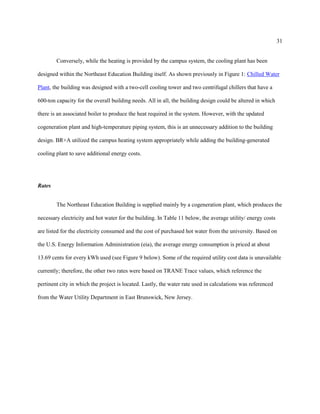
  • 101.
    100 Table 21: FanCoil: Option C Cost Analysis Depth Study 3 | Photocell Implementation System Definition Photocell (PC) A photosensor is an electronic component that detects the presence of visible light, infrared transmission (IR), and/or ultraviolet (UV) energy. Most photosensors consist of semiconductor having a property called photoconductivity, in which the electrical conductance varies depending on the intensity of radiation striking the material. Spaces Analyzed Unlike the previous two studies, this study takes a look at the main corridor spaces that allow the students and professors to transition throughout the building. As stated previously in the Chapter 1, there
  • 102.
    101 is a lotof potential to utilize the natural daylight that is already available in the original architectural design. With curtain wall designs on the East and West corridors throughout the main circulation spaces, there is potential to reduce the 33% lighting load (see Figure 11) with the addition of photocells. Figure 43: Typical Photocell Building Space Analysis Shown in Figure 43 is a typical layout for the area in which photocells will be analyzing the daylight available in each space. From floor to floor, the main idea behind the control scheme is the same; the photocells are placed appropriately in the corridors and exterior seminar spaces to control the amount of light and potentially reduce the amount of electricity used each year. While most of this study falls under the lighting and electrical analysis detailed later in the report, the full implementation of the photocell design integrated with the mechanical system is significant. (See Appendix A for all levels of photocell analysis).
  • 103.
    102 Electricity Requirements To showa brief overview of the photocell implementation, Figure 44 outlines how the addition of photocells would decrease the monthly electricity consumption. Although, the decrease does not appear to be extremely significant in the graph, the photocells would decrease the annual electricity consumption by 34,700 kWh. By allowing the building to be monitored on a more sophisticated system, there is less electricity needed to power the typical fluorescent T8 lighting scheme. This analysis of the lighting and associated electricity will be shown in more detail in the Lighting Breadth Section of this report. Figure 44: Electrical Consumption with Photocell Implementation Depth Study Overview | Utility Analysis General Overview This section outlines the utility consumption that was discovered using eQuest energy modelling. There were three different redesign options including photocells, fan coils, and chilled beams as well as two combination redesigns that show the potential of combining both the fan coils and chilled beams with
  • 104.
    103 the photocell redesign.Different than the studies above, the chilled beams were not explicitly broken out into Option A and Option B. For the utility distribution graphs, this portion of the report outlines the general benefits of each technology as opposed to different design scenarios. Electricity Requirements The first graph displayed on the following page, Figure 45, depicts the full analysis of each system and the benefits that each technology provides to the mechanical system. As a whole, it is evident that each redesign has improvements upon the original VAV design as can be seen in Figure 45. The graphs following Figure 45 break out the individual and combination redesigns as compared to the original design in a less cluttered format. Shown in Figure 46, it is evident that the implementation of chilled beams provides the most beneficial improvement decreasing the peak load in August from 205,500 kWh to 190,900 kWh – a total of 14,600 kWh. While each new system provided in the following figures outlines the overall improvement in energy efficiency, the more interesting data is shown in Figure 47. This figure shows the combination of each hydronic system with the photocell technology. Ultimately, the goal of this study was to improve the overall mechanical system and decrease the consumption of electricity in the building. By providing a combination of the electrical and mechanical systems to improve system controllability, Figure 47 shows that both options decrease the annual electricity consumption.
  • 105.
    104 Figure 45: FullAnalysis of Electricity Consumption Figure 46: Individual Feature Electricity Consumption Comparison
  • 106.
    105 Figure 47: CombinedFeature Electricity Consumption Comparison Hot Water Requirements Similar to the electricity requirements, the following three figures outline the hot water that is required to operate the Northeast Education Building. With the addition of each hydronic system and the photocell technology, there is an apparent increase in the hot water needed. Most notably during the winter months (November – March), the amount of hot water needed to heat the building increases. Shown in Figure 49, there is approximately no change between adding the photocells and the original design. Similarly, this same figure shows that between the two hydronic systems, there is no significant difference between the amount of hot water used as well. Overall, it makes sense that both of these systems would require more heat to operate as compared to the original air system because it is not just the coils in the air handling units that require heat. With the hydronic systems, there is a significant increase in piping to accommodate for heating and cooling the spaces appropriately. Therefore, with each system operating on the same principles, there will certainly be an increase and it is interesting to see that both of them require about the same amount of heat. This can also be seen in Figure 50 as the combination of photocells and the hydronic systems causes an increase in hot water consumption through
  • 107.
    106 the winter months.However, once again, through the summer months (June – September), the combined redesigns actually require about the same or even less hot water than the original. Figure 48: Full Analysis of Hot Water Consumption Figure 49: Single Feature Hot Water Consumption Comparison
  • 108.
    107 Figure 50: CombinedFeature Hot Water Consumption Comparison Master’s Coursework | Displacement Ventilation General Overview From the initial design proposal, the other main mechanical design that was analyzed for its potential energy savings and coordination benefits was the displacement ventilation system in the four main lecture halls on the Ground Level. All four of these 300-occupant spaces utilized a technology that is once again not standard in the United States. Displacement ventilation has been prominent in Europe for about 40 years and has been recently studied in the U.S. as a potentially beneficial mechanical technology. This study was used to determine why the initial design team for the Northeast Education Building decided to use displacement ventilation on the lower level lecture halls but an overhead distribution system on the Third Level lecture halls. From a general standpoint, the energy usage as well as the overall occupant comfort was studied to show the benefits of each system and why the lecture halls were designed in this way.
  • 109.
    108 System Definition Displacement Ventilation(UFAD) A typical displacement ventilation system supplies conditioned cool air from an air handling unit through a low induction diffuser. The cool air spreads through the floor of the space and then rises as the air warms due to heat exchange with heat sources in the space such as occupants, computers, and lights. The warmer air has a lower density than the cool air, and thus creates upward convective flows known as thermal plumes. The warm air then exits the zone at the ceiling height of the room. System Considerations  Underfloor air distribution (UFAD) allows the conditioned air to be supplied at 65F instead of the typical 55F because of the natural convection that occurs in the space. This higher temperature supply air being ducted into the room from the floor does not have to “thrown” as far into the space as with an overhead distribution system.  Lighting loads can also be decreased in the initial design process of using a UFAD system because the air does not have to overcome these high temperature luminaires from the ceiling.  Supply air should be designed for about 65F not only as an energy savings, but also to maintain the occupants’ comfort level throughout the space. Because the air is being supplied towards the ground in this system, it reaches the occupant much faster than an overhead system. Thus, the air cannot be too cold or this will negatively affect the occupants as the air is supplied beneath them. Whereas an overhead system mixes the supply and room air before reaching the occupants, the UFAD system conditions the space in a different manner and the mixing process only occurs as the air rises from the respective occupants and heat sources.  To ensure occupant comfort levels as well, the supply air velocity should be lower than that of an overhead system. Again, the air does not need to be “thrown” as far inside the room itself because of the natural convective properties. Therefore, it would be unnecessary to supply the air at the same velocity as an overhead system. UFAD operates on a much lower air velocity to ensure that unwanted drafts are not created within the space. The air is supplied at a higher temperature and lower velocity to condition the space ideally without the occupants realizing a discomfort or unwanted airflows.  These design considerations also allow for potential cooling coil savings within the space as compared to the overhead distribution. Each system has its own energy benefits that will be discussed in the following section.
  • 110.
    109 Energy Calculations Fan EnergySavings Given:  (144) 70 CFM underfloor diffusers in typical Lower Level Lecture Hall o 10,080 CFM Total  (20) 300 CFM overhead diffusers in current Third Level Lecture Hall 4225-E o 6,000 CFM Total  dpinWG = 6.3  Energy cost of electricity = $0.1365/ kWh Assumptions:  Fan efficiency = 75%  Motor efficiency = 92%  Class room spaces occupied for 75% of the year when school is in session for about 12 hours a day.  Therefore, 12 ℎ𝑟𝑠. 𝑑𝑎𝑦 ∗ 365 𝑑𝑎𝑦𝑠 ∗ 0.75 = 3,285 ℎ𝑟𝑠. 𝑜𝑐𝑐𝑢𝑝𝑖𝑒𝑑 Calculations: ∆PBHP = (∆q 𝐶𝐹𝑀 ∗ dpinWG) μ ∗ 6356 ∆q 𝐶𝐹𝑀 = 10,080 − 6,000 = 4,080 𝐶𝐹𝑀 𝜇 = 𝜀𝑓𝑎𝑛 ∗ 𝜀 𝑚𝑡𝑟 = 0.75 ∗ 0.92 = 0.69 ∆PBHP = (4080CFM ∗ 6.3) 0.69 ∗ 6356 = 5.86 𝐵𝐻𝑃 ≈ 6 𝐵𝐻𝑃 6 𝐻𝑃 ∗ 0.746 𝑘𝑊 𝐻𝑃 ∗ 3285 ℎ𝑟𝑠 ∗ $0.1365 𝑘𝑊ℎ = $1,993.81 ≈ $𝟐, 𝟎𝟎𝟎 𝒇𝒂𝒏 𝒔𝒂𝒗𝒊𝒏𝒈𝒔
  • 111.
    110 Cooling Coil Savings Given: Original design of the Third Level Lecture Hall requires 29 tons of cooling to condition the space (calculated by Trace).  Redesign of UFAD in Third Level Lecture Hall requires 11 tons of cooling to condition the space (calculated by Trace).  Chiller efficiency = 0.56 kW/ ton  Energy cost of electricity = $0.1365/ kWh Calculations: 𝑐𝑜𝑖𝑙 𝑠𝑎𝑣𝑖𝑛𝑔𝑠 = ∆ton ∗ 𝜀 𝑐ℎ𝑖𝑙𝑙𝑒𝑟 ∗ 𝑒𝑛𝑒𝑟𝑔𝑦 𝑐𝑜𝑠𝑡 𝑐𝑜𝑖𝑙 𝑠𝑎𝑣𝑖𝑛𝑔𝑠 = (29 − 11 𝑡𝑜𝑛𝑠) ∗ 0.56 ( 𝑘𝑊 𝑡𝑜𝑛 ) ∗ 3285 ℎ𝑟𝑠.∗ $0.1365 𝑘𝑊ℎ = $4,519.90 ≈ $𝟒, 𝟓𝟎𝟎 𝒄𝒐𝒊𝒍 𝒔𝒂𝒗𝒊𝒏𝒈𝒔 Energy Comparison To see the full Trace analysis of each space, reference Appendix B. From the calculations shown above, it is evident that the displacement ventilation system offers more savings with the cooling coil requirements than the overhead distribution does with the fan energy. The overhead system benefits from supplying the air at a colder temperature because it does not need as much airflow to condition the space, hence the $2,000 fan energy savings. Similarly though, the displacement ventilation system is able to supply more air at a higher temperature, saving the associated chiller from producing as much cooling energy. Overall, there is more cost savings potential, about $2,500 from the calculations on the previous page, in using the UFAD system. By essentially cutting the cooling capacity in half, the UFAD system sees more of a benefit than the originally designed space, but there are also other design considerations that were involved in this design process; these will be discussed in the following section.
  • 112.
    111 Design Considerations Shown aboveis the energy analysis that proves the benefits of utilizing a displacement ventilation system for the building’s lecture spaces. While this could be viewed as the only valid design consideration, there are additional analyses that must be weighed as well. In the initial design, there are recirculating units beneath each of the lecture halls that ultimately supply 70% of the air required. Each room has been calculated to need about 10,000 CFM based on the 300 occupants and associated building loads. Therefore, based on the building’s mechanical design, this would be about 20,000 CFM constantly flowing through the building during typical class hours. From the original design analysis of the mechanical system, it was shown that all of the respective air handling units are located on the 6th floor of the west wing and 4th floor of the east wing. Realistically, the air for these spaces travels about six stories to the air handling units, which is an awful lot to be circulating on a constant basis. From the initial design, implementing these recirculation units saves a substantial amount of ductwork in the building plenums across the building levels. Each DOAS air handling unit has been rated to supply 10,000 CFM for each lecture hall, but in actuality, these units supply about 30%, accommodating for the necessary OA requirements while the recirculation units supply most of the conditioned air. From an engineer’s standpoint and logically speaking, by implementing the displacement ventilation system, the original design not only saves on cooling energy, but also saves on the overall sheet metal cost with the potential ductwork it would take to move the air about the building. In analyzing these spaces, this mechanical design makes complete sense in every respect. However, the upper level lecture hall was just proven to be less energy efficient and incur more utility costs on an annual basis. This may not make sense initially, but taking a look at the original drawings for the Northeast Education Building, it becomes quite evident why the designers chose the overhead distribution system. The Third Level Lecture Hall is located on the east wing, which happens to be the lower wing of the building. The associated DOAS air handling unit is located just above the lecture space, and this provides an easily accessible route for the associated ductwork. If this space were to be designed similar to the lower level,
  • 113.
    112 there would bean unnecessary amount of ductwork needed to route the air underneath the lecture seating and provide the appropriate air for the recirculation unit. Therefore, this lecture hall saves the additional cost of an air handling unit and the associated ductwork to apply a simplified design that can be directly ducted from above. Logically, the original design for this particular lecture space is the better choice. While each design makes sense with respect to its proximity from the air handling units, there was another study conducted to show potential benefits of the UFAD system in comparison to the overhead distribution. This next study was conducted to show different comfort levels and the stratification of the air distribution using each system in the lecture halls. Occupant Comfort Levels | Master’s Analysis Shown on the following pages, Figures 51 and 53, display the two lecture hall geometries that are discussed in the analysis above. Both lecture hall geometries are identical, however, Figure 51 is modelled with an overhead distribution system that can be seen with several diffusers on the ceiling. Conversely, Figure 53 is modelled with the underfloor air distribution system with slot diffusers below each row in the auditorium seating. Prior to analysis, the hypothesis was that the displacement ventilation system would produce more beneficial results for the respective occupants in the space. From the provided results in Figures 52 and 54, it can be seen that this hypothesis is in fact correct. Figure 54, displaying the displacement ventilation, has a much more fluid distribution within the space and comparatively, the air velocity distribution is lower than that of the overhead system. More turbulent airflows can be seen near the occupants in the upper seating of the lecture hall with the overhead system. Likewise, there is not as much mixing occurring with the overhead system, which can be seen by the inconsistencies of air velocity around the space. Whereas, looking at the displacement ventilation results, each occupant in the rows receives an equal amount of airflow including the front of the room as well. The lowest slot diffuser provides air to the lecturer that would occupy the front space in the room. With
  • 114.
    113 this system, thesupply air is able to mix equally and efficiently with the current room air. Unfortunately for the overhead system, each row has a different airflow velocity and thus an unbalanced distribution of air temperature and pressure within the space. Figure 51: Overhead Distribution Design Geometry Figure 52: Overhead Distribution Design Velocity Distribution
  • 115.
    114 Figure 53: DisplacementVentilation Design Geometry Figure 54: Displacement Ventilation Design Velocity Distribution
  • 116.
    115 Depth Study Conclusions Thereare several aspects to this Depth Study including a full analysis of the hydronic system redesigns and the implications that each system entails. Taking a look at the natural daylighting available, a new photocell system was studied to allow the Northeast Education Building to operate on a more sophisticated level, adjusting to daily conditions. Additionally, there is an associated utility and overall cost analysis of each system based on its annual usage of electricity, purchased hot water, and domestic water. From a general standpoint, looking back at the conclusions drawn in the previous section, there are benefits and drawbacks to each system studied. From the initial analysis, the chilled beam: Option A redesign showed immense savings with regards to the overall airflow in the building ductwork and air handling units. While Options B and C also showed energy savings in this respect, the 78% airflow reduction shown by Option A is much greater than the other two reductions. The airflow reduction is not the only area of design worth looking at; however, it presents interesting design implications in the sense that only 20% of the original airflow is necessary to condition the interior offices. That 80% reduction allows ductwork to be downsized as well as the air handling units that were shown above. Overall, these air reductions were the basis of proposing different hydronic designs. Option A and B, both chilled beam schemes, outline the pros and cons of including exterior spaces in the chilled beam design. Stated previously, when using chilled beams on the exterior spaces of the building, the engineer must account for radiant panelling as well, which increases the amount of purchased hot water. On the flip side, however, by allowing the exterior spaces to be controlled by the original VAV design, there are fewer airflow reductions and in turn less savings on the air handling units. Fan coils are an interesting design in that they operate very similarly to chilled beams, but the slight design principles behind each system cause different utility usage and overall performance differences as well. Outlined in the first airflow section, one of the more interesting discoveries found was that the fan coils required more airflow to the exterior spaces than the original VAV design. Although
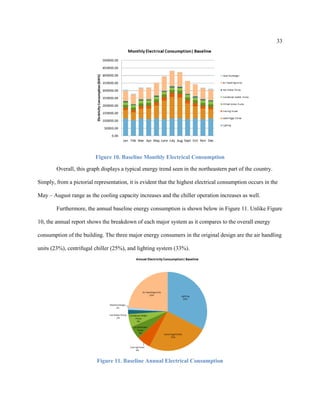
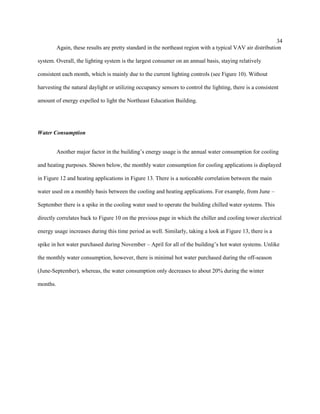
  • 117.
    116 these increases werenot drastic, it was interesting to see how all three of these systems compare from this one perspective. On the other hand, when analyzing the full utility cost for each proposed design, there were no major differences in the overall breakdown of electricity, hot water, and domestic water. While the individual system costs were adjusted, the electricity usage never decreased from its original 92% and likewise for the purchased hot water and domestic water. What is noteworthy between all three cost analyses, Option A-C, are the consistent decreases in the air handling unit electricity usage and the increases in the hot water pump electricity consumption. As a whole, these cost differences show the main functionality of an air-driven versus hydronic system. The original design consumed more fan energy in the air handling units and needed less hot water to heat the coils and condition the air. Conversely, with each hydronic option, there is a much more drastic decrease in AHU fan energy and a slight increase in the hot water consumption. The only exception to the previous statement is the fan coils because while decreasing the AHU fan energy, they also require a relatively high amount of individual fan energy for each unit causing the electricity consumption to increase again. From a different design perspective, the other system that was discussed above was the implementation of photocells in the circulation and exterior building spaces. Overall, this system is simple yet sophisticated in the sense that it allows the building to monitor its own electricity usage and cut back on lighting costs. Generally, lighting costs are some of the most expensive and unnecessary costs in a building because the natural daylight is underutilized. Shown above in the utility graphs, eQuest has modelled an overview of the benefits of each individual system: fan coils, chilled beams, and photocells. More importantly, however, are the combined effects of implementing each hydronic system with the photocell design as well. All in all, with more control over the circulation spaces and less fan energy required by the chilled beam design, there is potential to see significant cost savings over the lifecycle of the building. A further analysis of this lifecycle will be looked at in the Construction Breadth section of the report.
  • 118.
    117 Breadth Analysis 1| Lighting & Electrical Photocell Analysis The amount of natural daylight in the Northeast Education Building has been discussed previously in this report as a way to save electrical energy. In Depth Study 3 | Photocell Implementation above, there is a brief discussion about the spaces analyzed in order to properly harvest as much natural energy as possible. From before, Figure 43 shows that most of the circulation space and exterior seminar and conference rooms provide an adequate amount of light in the building and show potential benefits with regards to the overall energy usage. In addition to using eQuest to provide an overview of potential light available in these spaces, the original lighting design was analyzed to get an overview of the luminaires used around the building. Shown below in Table 22 is the overview of spaces that would implement the photocells most appropriately. This table reflects the building lighting plans found in Appendix A.
  • 119.
    118 Table 22: OriginalLuminaire Schedule From a brief overview of the table above, all of the suggested luminaires that would be used in conjunction with the photocell technology are T8 fluorescent lamps. After analyzing the given Lighting Fixture Schedule in the provided drawing documents, there was no designation that these lamps were specified with a dimming ballast. These luminaires are designed as shown on the following figure, which allows a significant amount of light to be saved if these T8 lamps are dimmed or even shut off for part of the day. As designed, there are several fluorescent luminaires in the corridor in addition to the F5 LED luminaire that runs along the vertical wall in Figure 55. Between the LED T8 and the other T8 lamps having more sustainable controllability from the respective photocells, these lighting technologies should work in conjunction to save energy. One of the biggest concerns with implementing the photocells, as stated previously, is the compatibility with the current lighting system. To ensure compatibility with the
  • 120.
    119 Northeast Education Building,dimming ballasts were analyzed in comparison to the original specification. Equipment Specification From the original drawing set, there was not a specific manufacturer or luminaire selected; therefore, in order to perform any type of analysis, the Sylvania lighting catalogue was used as a reference. To start, a typical T8 lamp was selected and is specified in the Appendix C section of this report. From the original drawing specifications, the lamp selected was a 32W OCTRON 800 XP that is 4’ in length. The original ballasts were assumed to be QUICKTRONIC High Efficiency 32 T8 Instant Start with a normal ballast factor. These electronic ballasts were again selected based on the original specifications and reflect the original drawings in order to make an appropriate analysis. For the full ballast specification, see Appendix C. Figure 55: Typ. Corridor Lighting Scheme Equipment Comparison Following the original analysis of the original system, it was determined that dimming ballast would be necessary to maintain the current lighting scheme as well as achieve some additional energy savings. Therefore, Table 23 outlines the main differences between the originally scheduled instant start
  • 121.
    120 ballasts with thePOWERSENSE dimming system that was then discovered in the Sylvania catalogue as well. Most of the specifications for each ballast system are very similar such as the input current required by the system and the rated lumens that each ballast is designed for. The Sylvania catalogue defines that the POWERSENSE system has a 100-5% dimming range; therefore, the system has two different values for some of the specifications below. With the ability to dim the current fluorescent system, Table 23 shows that the system lumens can range from 2,640 to 150 with an input voltage of 30 Watts to 8 Watts respectively. Throughout the day, when the photocells analyze the building spaces as having enough natural light, there is a potential to only input 27% of the original wattage. Especially in circulation spaces, there is not necessarily a need to have excessive lighting at full load 24 hours of the day. On the following page is an example calculation to show how energy can be saved using the photocells and associated dimming ballasts. Table 23: Electronic Ballast Comparison Sample Calculation Assumptions:  The available hours of the day in which natural light can be used year round are from 10a.m. to 4p.m. (6 hour window).  The lights are on for a potential of 12 hours – occupancy sensors are used throughout the night hours to regulate the amount of electricity from 8p.m. to 8a.m.
  • 122.
    121  Use singlelamp ballast to perform the calculation. The input wattage will be based on dimming ballast values for the part load performance (30/8W) and the instant start ballast for constant full load performance (28W). Calculations: 6 Hours (full load lighting) 6 Hours (5% lighting load) 6ℎ𝑟𝑠 ∗ 30𝑊 + 6ℎ𝑟𝑠 ∗ 8𝑊 = 228 [𝑊 − ℎ𝑟𝑠] 12 ℎ𝑟𝑠 ∗ 28𝑊 = 336 [𝑊 − ℎ𝑟𝑠] 1 − ( 228 336 ) = 𝟑𝟐. 𝟏𝟓% 𝒓𝒆𝒅𝒖𝒄𝒕𝒊𝒐𝒏 Project Compatibility While not the most technical calculation, this example shows that even with a basic assumption of full load and 5% part load throughout the average day, there is potential to save 32.15% on the daily wattage needed to power the luminaires. In that respect, applying the photocells and dimming ballasts would be a beneficial step towards saving electricity on an annual basis. Overall, the ballasts are compatible seeing that this analysis uses both Sylvania specified equipment. As of now, another potential concern would be the placement of each photocell based on the proximity of light available through the exterior glazing and adapting to the current ceiling plan. Fortunately, with the specified OSRAM ENCELIUM Ceiling-Mounted Occupancy Sensors specified in Appendix C, there is a wide range of sensors that can be installed in different size spaces. For example, displayed below in Figure 56, there are two examples of sensor ranges – 1,500 and 2,000 sq. ft. The image displayed on the right provides a good explanation of the different capabilities available with these specific occupancy/photocell sensors. Not only will these specific sensors have the ability read the available light in the area, but also they are able to detect motion in and out of the space. So
  • 123.
    122 hypothetically, during thenight-time hours and slower periods of the day when class schedules may not be as prominent, the lights will be able to turn off completely saving more energy. Figure 56: Osram Photocell Field of View Luminaire Alternatives A second consideration taken with the original lighting design and use of photocell technology was the replacement of all of the current fluorescent luminaires. From the previous discussion, applying a dimming ballast to accommodate for the current lighting scheme would be a valid solution to implementing the photocells. However, taking a step further, there is potential to reduce the overall electricity consumption by not only having more control over the lighting system, but also using luminaires that do not require as much power to operate. In that respect, the next area of study is to consider replacing the current T8 lamps but an LED alternative. Specifically, the new lamp that would be recommended is a Sylvania SubstiTUBE IS LED T8, which is very closely related to the original design and one of the main design concerns. By utilizing the same company as originally specified, it creates a direct comparison in the equipment selection such as ballasts and provides an accurate analysis of the proposed design.
  • 124.
    123 Table 24: T8Lamp Comparison From the comparison in Table 24, there is not really a major difference in lamp specifications alone. The only difference provided by Sylvania is the CRI, which is significant in lighting design; however, based on the location of these luminaires, it does not seem as if it will make the LED T8 lamps any less beneficial. In addition to the direct compatibility with the current system, one of the main benefits of using the Sylvania’s LED T8 is the ability to couple this technology with the photocell/occupancy sensor as originally proposed. The only difference with these lamps is the specific ballast that must be used because the LEDs cannot be dimmed like the original design. According to Sylvania, the LED T8s are engineered to operate on the existing instant start electronic ballasts that were originally specified for the building. However, unlike the original design, these T8 lamps will run on less power and provide an energy savings from the newer technology. Shown below in Table 25 is an overview of the necessary electronic ballasts needed to operate each system. Analyzing each ballast in comparison with the original design, it is obvious that the LED system will require about 35% of the original input power and current. Therefore, as a whole, this system has the potential to reduce the lighting load by 65% in the current design. On the following page is the actual analysis of the Northeast Education Building’s lighting design load. As seen in the table provided, Table 26, there are circuits that achieve a 20% reduction or greater, and likewise, there are some circuits that achieve <10% reduction. Overall, there is an average savings of 15% in the lighting load, which is not extremely significant but does provide a step towards energy savings.
  • 125.
    124 Table 25: BallastComparison One factor to consider with regards to this LED redesign is the loss of the original dimming ballasts. While these particular lamps are able to provide an average of 15% savings in electrical energy, they are not compatible with dimming ballasts. Therefore, when coupled with the photocell/occupancy sensors, the only functionality that these luminaires will have is an ‘on/off’ scheme. From a designer’s perspective, it may not be possible or efficient to implement a control system in which the lights can only turn on and off. Another foreseeable issue with using this technology is the system lumen difference (see Table 25 on the previous page). To verify that the LEDs would provide an appropriate light output, further analysis was completed. Also, because LED T8s are typically used as replacement lamps for existing systems, the following study was conducted with a new LED luminaire.
  • 126.
    125 Table 26: PotentialEnergy Savings with LED T8 Light System Light Output Verification To verify the light output of a newly specified LED luminaire system, Sylvania RLL24 2x4 Recessed Troffers were modelled in AGi32 (See Appendix C for specifications). Two main spaces, including a typical Seminar room and Gallery corridor, were used to show the target illuminance and
  • 127.
    126 average illuminances deliveredby the LED system. For this study, the following light loss factors were accounted for in AGi to model the space:  Lamp Lumen Depreciation – 0.7 o Based on L70, report states that for LED luminaires LLD = 0.7  Luminaire Dirt Depreciation – 0.94 o Clean environment o Closed luminaire o Direct Distribution o 12-month cleaning interval  Total Light Loss Factors – 0.658 For the Gallery corridor, the IES recommendation is 15fc as determined by the transition spaces definition. As seen below in Figure 57, this lighting layout reflects that of the original design in Figure 55 shown previously. Overall, the luminaires have been spaced 11ft. x 8ft., and the calculated average illuminance for this design is 21.47fc. While this output may be slightly higher than recommended, it will provide the appropriate amount of light for this particular space. Additionally, these LED luminaires in conjunction with the photocell design will allow each corridor to be adequately lit throughout the day.
  • 128.
    127 Figure 57: GalleryCorridor AGi Output With regards to the Seminar room, the IES recommendation is 30fc based on the reading and writing definition. From the original lighting design, the Sylvania RLL24s were spaced as shown in Figure 58 on the following page. The average illuminance that was calculated using AGi was 23.48fc, which does not meet the target illuminance outlined previously. However, taking a look at the contour images at the bottom of the page, the illuminance is in the low 30s in the middle of the room. Given that this is a seminar or conference space, another luminaire may be necessary to accommodate for the appropriate light levels, but overall this luminaire layout is an acceptable replacement.
  • 129.
    128 Figure 58: SeminarRoom AGi Output
  • 130.
    129 Breadth Analysis 2| Construction General Overview As a whole, this report has discussed different design proposals that could potentially save the Northeast Education Building energy and utility costs on an annual basis. From the original Depth Study, there were several redesign implications for each hydronic system as these two technologies were compared with the current VAV air-driven system. Now, taking the energy savings potential into consideration, this study will dive into more of a realistic business perspective of implementing each system. More often than not, when handling energy audits and design alternatives, the main concern with building owners and designers alike are the cost implications. Furthermore, this section will detail the relative payback period when implementing each system and fully analyze the feasibility of each proposal. Redesign Implications Both of the proposed designs in the original depth study are hydonic systems, and therefore, both operate differently than the original air-driven design. To start, one of the initial discussions in the original analysis was the airflow consideration of the chilled beams and fan coil units, and the ability to drastically reduce each system’s airflow requirements. What this also means for the overall system is a reduction in ductwork, air handling units, VAV terminal boxes, and any additional equipment that these water-driven systems may not need to operate. However, as just stated, because these are water-driven systems, this also introduces new design changes that may require additional piping to be installed. For example, 4-pipe chilled beams and fan coils need both chilled water supply/return and hot water supply/return piping, and the current design may not include chilled water supply/return piping
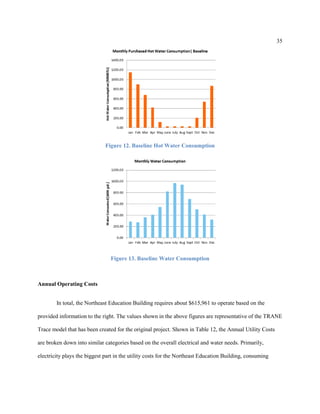
  • 131.
    130 throughout the wholebuilding. While these are some of the basic design implications, all three systems were analyzed with these building factors in mind. Building System Analysis Ductwork Calculations From the original drawing set provided by the design team, each respective office space that would be affected by the chilled beam or fan coil design was analyzed to acquire the amount of ductwork the current VAV system needed to operate. (See Appendix A for the full layout of office spaces) Assumptions:  The amount of ductwork in the north and south ends of the west wing offices was assumed to be identical because the space layouts from Levels 3-5 are almost identical.  Only the south end of Level 5 was accounted to be different because the layout did not follow the typical design as described in point 1.  Each ductwork calculation is tabulated in sheet metal weight from a provided spreadsheet (see Appendix B for details). On the following page, Table 27 shows the original amount of ductwork that the VAV system was designed for using the calculated airflows for an air-driven system. In total, there was about 8,225.24 lbs. of sheet metal required for this design. To calculate the overall weight, each respective duct was measured from the appropriate VAV box with its height, width, and total length that were then input into a calculation spreadsheet. These calculations for the original design can be found in Appendix B with the overall sheet metal weights as well.
  • 132.
    131 Table 27: OriginalDuctwork Total Table 28 outlines the total sheet metal necessary for each chilled beam design. Option A, requires approximately 5,817.42 lbs. of sheet metal and Option B about 6,559.74 lbs. – a 30% and 20% reduction from the original design respectively. From the original analysis, this is what was to be expected because of the 75% (Option A) and 62% (Option B) reduction in airflow through the ducts. Similarly, Table 29 also outlines the overall duct reduction in the fan coil design, which accurately reflects the original 32% reduction in airflows. In total, the fan coil redesign accounts for 7,954.79 lbs. of sheet metal, which is a 3% reduction for all of the ductwork. Table 28: Chilled Beam Ductwork Total Table 29: Fan Coil Ductwork Total
  • 133.
    132 Piping Calculations Similar tothe analysis of each duct system involved in the previous calculations, the piping was calculated in a similar fashion. By analyzing each respective office space and the current piping design, there were certain assumptions made in order to accurately portray each mechanical system. To start, as stated in the design implications section above, the original design does not include chilled water piping on Levels 3-5. There is a general 8” chilled water supply/return in a centralized location between the north and south ends of the west wing, and that is where the hypothetical piping design will be connected. Assumptions:  The new pipe design that was created for this analysis is based solely off of the current drawings and the most accurate portrayal of the necessary piping to accommodate each system. (For full calculation and piping take-offs, see Appendix B).  Again, all piping in the north and south ends of the west wing offices was assumed to be identical because the space layouts from Levels 3-5 are almost identical.  Only the south end of Level 5 was accounted to be different because the layout did not follow the typical design as described in point 2.  The chilled beam (Option A) and fan coils were assumed to require the same amount of piping because both systems require 4-pipe and 2-pipe equipment depending on the location of the office space.  All additional piping was assumed to be 1” and ¾” to supply each system Continuing the above discussion, all of the necessary piping was measured from this centralized location to make sure that the appropriate length of piping would be calculated. Different than the ductwork analysis, there is not a current piping layout in which the chilled beams and fan coils can connect into. Therefore, Table 30 shows all of the additional piping, in linear feet, which would need to be added to the building design in order to accommodate for the 4-pipe systems. Table 30: Additional Piping Total
  • 134.
    133 Cost Data Following theinitial system analysis and calculating the decreasing ductwork or additional piping necessary for the hydronic systems, the next step taken was to gather the most relevant cost data. As displayed in Tables 31 and 32, all of the cost data was gathered from the most up-to-date RS Means catalogues (to see catalogue information reference Appendix B). There were several catalogues analyzed during this portion of the data collection because some of the systems and equipment were specifically included in one book. All of the relative data was collected from these references except for the chilled beam and fan coil unit estimations. This particular equipment data was referenced from a Price sales representative to obtain the most accurate data. Table 31: Cost Analysis – Air Distribution Equipment
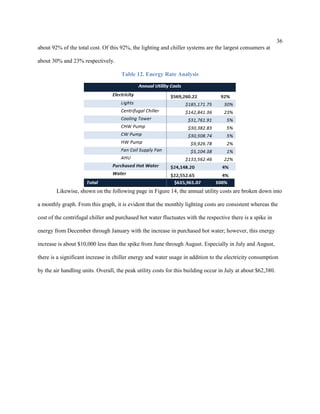
  • 135.
    134 Table 32: CostAnalysis – Air Handling Units Individual System Costs Taking the cost data above, this information was applied to each system in comparison to the original. The following tables will outline the different aspects of each system design and the respective costs of each component. Original Design As can be seen in Table 33, the base cost, or what has been deemed the base cost for this analysis is ~$170,000 for the VAV air system. Realistically, this system would include piping cost and other necessary components as well. However, this analysis has been simplified to look at the discrepancies in each system, and therefore, the base cost of the piping in the original system is $0.00 because no additional piping was necessary to implement this design. The VCV boxes are the necessary terminal boxes to regulate each mechanical zone and similar the ‘FPB’ designation are fan powered terminal boxes.
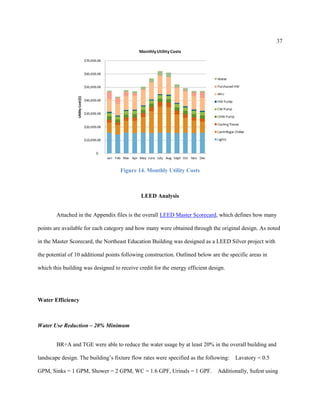
  • 136.

    135 Table 33: OriginalDesign Costs Chilled Beam Design For both chilled beam design options, there are no additional supply diffusers that are needed, and along the same lines, air diffusers are not necessary for this design. Therefore, as seen on the following page, the diffusers are actually taken as a deduction in the lifecycle cost analysis. Similarly, there are no fan powered VAV boxes necessary for Option A and the overall VAV terminal boxes are able to be downsized significantly as well. Compared to the original design where the terminal boxes ranged from VCV-8 to 12, Option A does not need higher than VCV-6. On the other hand, Option B still needs the fan powered VCV boxes because these are used on the exterior office spaces to condition the rooms effectively. Seen with Option A, the overall VCV terminal boxes can be downsized, and the only other addition to both chilled beam designs are the chilled beams themselves. Option A, having both interior and exterior spaces to condition, includes both 4-pipe and 2-pipe units while Option B only includes 2- pipe units.
  • 137.
    136 Table 34: ACB– Option A Design Costs Table 35: ACB – Option B Design Costs Analyzing the overall cost of each system and the implied design features, the chilled beam options appear to be the most expensive. Much of the associated cost with this technology is the actual chilled beam units because it is a newer technology and not as easily available as the standard VAV boxes. From a first cost analysis, it is evident that the chilled beams are an expensive building technology; however, it will be the annual energy savings that determine whether or not it is worth the additional upfront costs.
  • 138.
    137 Fan Coils The fancoil redesign is very similar to the chilled beams in that it includes additional piping as discussed before and also reduces the overall VAV terminal box size. Unfortunately, it is not able to downsize the VAVs as significantly as the chilled beams; however, there is certainly some improvement from the original design. One of the design elements that must remain in the fan coil design and not the chilled beam design are the supply diffusers. Different than the chilled beam design, fan coils monitor the offices inside the plenum space and circulate the air through a ducted system. Therefore, the supply diffusers must remain in each room in order for the fan coils to distribute the air appropriately. And again, the only other addition to this system that is included in Table 36, are the fan coils units and their associated cost. Table 36: Fan Coil Design Costs Lifecycle Costs To follow the initial analysis above, the following lifecycle cost analyses were performed to show the simple payback period for each technology. As seen above in Table 34, there were several benefits to
  • 139.
    138 implementing the chilledbeam design such as downsizing the overall ductwork from the initial system and additionally reducing the VAV terminal boxes associated with each zone. Similarly, the supply diffusers were deemed unnecessary with this new technology, and shown in Table 37 is the full cost analysis of these savings as well as additional costs outlined above. The most expensive and crucial addition to this system would be the chilled beams themselves. Because this is still a newer technology in the U.S., the market has not fully developed a competitive price in comparison to the typical air system equipment. Therefore, seen in the table, the additional cost of the beams in addition to the required piping would increase the initial costs by about $185,000. However, as stated previously, there are additional cost savings associated with this technology as well which can be seen in the adjustment section. The air handling units that are referenced below are directly related to Table 32 above. Because the chilled beams require a dedicated outdoor air system (DOAS), there must be an adjustment of which system would be conditioning the respective air. From the original design, the offices were conditioned by the 75,000 CFM AHU-W-2. With the appropriate adjustment of airflow reduction and reallocation to the AHU-W-1, 100% OA system, there are some cost savings as well as cost increases based on the systems needed. Ultimately, AHU-W-2 would be decreased from a 75,000 CFM unit to one that is rated for 55,000 CFM. Similarly, AHU-W-1 would be increased from 25,000 CFM unit to 30,000 CFM.
  • 140.
    139 Table 37: CostAnalysis ACB – Option A All in all, with the cost savings from the discussed adjustments and the additional costs associated with this specific technology, there is about $110,000 of added cost to the original air-driven system. With the energy savings that were shown above in Depth Study Overview | Cost Analysis, there are approximately14 years to payback the additional costs of this system. Similar to the previous analysis of the chilled beam Option A, Table 38 outlines the additional costs and potential savings of the second layout utilizing chilled beams. With fewer beams involved in this system, there are less additional costs such as piping, but likewise there are also less cost savings or adjustments shown as well. Going down the list of adjustments, each component is able to decrease less and less, and AHU-W-1 must increase from the initial 25,000 CFM to 35,000 CFM. Ultimately, based on the additional costs and associated adjustments, this version of the chilled beam technology actually costs about $11,000 more than Option A. These additional costs in conjunction with the energy savings presented above in the Depth Study Overview allow this proposed design to be paid off in about 18 years.
  • 141.
    140 Table 38: CostAnalysis ACB – Option B Lastly, Option C is outlined in Table 39, and the most notable factor of this design option is that the material costs of the actual units are not comparable to that of the chilled beam system. From solely a base equipment standpoint, the fan coils require about 40% of the cost of the chilled beams. As seen in each table and stated previously, the additional piping for each design was assumed to be the same because realistically each system would need a similar layout. Therefore, with the lowest additional costs of the three options, the fan coils are a promising design. However, shown in the adjustments section of the table, there is a drastic difference in the cost savings of about $76,000 with Option A and paying an additional $7,800 with Option C. This system, shown in the airflow comparison, does not save nearly as much on the associated ductwork, VAV terminal boxes, or air handling units. Likewise, this system requires all of the original supply diffusers and therefore does not benefit from this savings either.
  • 142.
    141 Table 39: CostAnalysis Fan Coils – Option C So, from the analysis shown to the right, there is evidently a price difference in the fan coil versus chilled beam capital costs. From the originally designed system, the chilled beam Option A design is calculated to be less expensive than the fan coil design. There is also a significant difference between the associated energy savings with each technology, and unfortunately, the fan coils receive little improvement over the original design. With just over $1,000 savings per year, the technology would take about 113 years to pay back.
  • 143.
    142 Chapter 4 |Final Conclusions Water vs. Air There is a lot to be drawn from the analysis presented in this study. Of the three proposed designs, the main question at hand is whether or not the technology is worth the additional costs. Do the pros outweigh the cons that are associated with each design? If they do and the design requirements are met by each system, then it does not matter which technology is used in the Northeast Education Building. However, from the analysis presented throughout this entire report, there are two design options that do not meet the specified criteria. From a business and engineering standpoint alike, the chilled beam Option B redesign and the fan coil redesign do not benefit the academic space in an economic or significant energy-saving manner. While both design options offer reduction in the respective airflow and utility usage throughout the office spaces, the cost payback period of both seems to be unrealistic in today’s market. From the overall analysis, the fan coils have proven to be an unrealistic consideration in this building. Although this technology presents similar benefits to that of the chilled beams, the associated fan energy with each unit actually prevents energy costs from being reduced. It was stated previously in the report that the fan coils are taking the main energy away from the air handling units and dispersing amongst the building units. This certainly has its benefits when air handling units are able to be decreased; however, in this particular design, the benefits were not seen. Therefore, this leaves the chilled beam Option A redesign as the only potentially beneficial system when compared to the original air-driven system. First and foremost, the inclusive analysis has shown that as studied, Option A is the best choice of the three proposals. While it is deemed as the best choice, this does not mean that this design is the most beneficial decision for the building owner to consider. Realistically, given today’s economy and the associated government regulations with green buildings, owners are becoming more aware of the technology available as well as a realistic payback on their initial investment. While 14 years is not unrealistic for a building’s lifespan, there are components
  • 144.
    143 within the associatedchilled beam design that would potentially need to be replaced over the course of that cost cycle. Ultimately, there is potential for the chilled beam system to save the Northeast Education Building energy and utility costs over time. However, there are certain modifications in the initial design proposal that would need to be considered and studied if this chilled beam system was to be approved. Potential Considerations Chilled beams work on a higher operating temperature as discussed in the original analysis section. In doing so, the benefit of utilizing chilled beams is a higher temperature for the desired chilled water and less demand on the associated chiller. Unfortunately, with the current design proposal mixing both the air-driven system with the chilled beams, the chiller does not recognize these benefits. With both systems on one unit, the chiller still operates to produce 45F water whereas if there was a dedicated chiller for the beams, it could be a smaller unit and produce water that was 60F instead. To improve this system and see the potential cooling coil benefits that chilled beams offer, there would have to be an additional study conducted in which a chiller was dedicated to the beams. Similar to the previous point made, the two studies shown in this report compared the quantity of chilled beams used in the project. While the beams have a higher capital cost, the overall energy benefit and annual cost savings were proven to be more beneficial in Option A. This analysis showed that beams can be placed on interior and exterior spaces to offer more cost savings, and this type of analysis should be carried throughout the building. One of the potential studies could show a complete overhaul of the current air system to replace all of the appropriate spaces with the current chilled beam design. With drastic decreases in ductwork and an increase in piping to accommodate for the new design, there would still be a cost savings for overall material. To prove the potential benefits, all seminar, lounges, meeting spaces, and conference rooms should be added to the initial Option A design. This could show much more energy savings than was realized in the initial design proposal and allow the dedicated chiller to be
  • 145.
    144 utilized appropriately. Unfortunately,not all of the corridor and lecture hall spaces can be designed with chilled beams because of restrictions on the technology. However, these spaces can be designed with their own chiller that cools to the appropriate temperature for air systems, and both the hydronic and air system could be conditioned using DOAS air handling units. Lastly, the proposed overhaul of the original mechanical system should also be coupled with the photocell technology that was discussed above. Each of these systems operate on completely different principles and do not directly benefit one another because they are designed for different spaces in the building. This technology, as shown previously in the report, allows electrical costs to be decreased with more control over the lighting system. Additionally, this system could show potential benefits in saving hot water energy throughout the circulation spaces and conference rooms on the exterior. Ultimately, this is how the two systems could benefit one another because chilled beams require an exterior heating source such as baseboard heating to help condition the room effectively. Therefore, by allowing the photocells to track the amount of daylight in these spaces and the corridors as well, this system could also determine how much heat is being generated in these spaces from the natural light. With more daylight being utilized to save electrical energy, this would also help heat the building in the winter months when hot water energy is increased. The conjunction of these two technologies was discussed previously; however, the study could be furthered to realize the full potential of these systems working together.
  • 146.
    145 Appendix A Building Drawings TypicalOffice Layout Levels 3 – 5 Typical Photocell Layout Levels 1 – 5 Proposed Thesis Schedule LEED Master Scorecard
  • 155.
    N O RT H E A S T | U N I T E D S T A T E S buildinginfo. electricalsystem. mechanicalsystem. lightingdesign. structuralsystem. architecture. Southeast View Overall Project Rendering Southwest View Occupancy: Office | Classroom | Lecture Hall Size: 200,000 SF Height: 6 Floors above grade Project Team: Elkus | Manfredi Architects, Thornton Tomasetti, BR+A, Convergent Technologies Design Group, Inc., Joseph Jingoli & Son, Inc., Hargreaves Associates, PS&S Schedule: June 2014 (construction begins) August 2016 (construction ends) Cost: $75 Million Delivery Method: Design - Build Heating: Campus high temperature, hot water is piped directly into a high pressure water-water heat exchanger which distributes hot water to fin tube radiation, unit heaters, and eight air handling units. Chiller: A chiller plant is located within the penthouse consisting of two cooling towers and a centrifugal chiller. This system serves 600 tons of chilled water to nine air handling units. Energy: There are four air handling units that incorporate an enthalpy wheel into the building’s distribution system. A DOAS is used to efficiently ventilate the main lecture halls within the building. Service: Two primary feeders, both 3#500 [5KV each] Main Distribution: Two main campus feeders supply the building's electricity. These feeders are brought directly into the main electrical substation and emergency substation. The 2,500KVA transformer and 5KV emergency station distribute power to eight distibution panels, all of which are 3 phase, 480/277V. These panels supply all of the building's receptacles and lighting in the classroom and office spaces. Main Design: The design of this project resembles classic, academic architecture with a new spin on the flow and functionality of the design space. With brick and limestone facades on the opposing faces of the east and west wings, the new Education Building will complement the surrounding buildings that have defined this institution for over 200 years. On the interior faces of each wing, a more modern, glazing system has been chosen in conjunction with the limestone accents. Overall System: From floor to floor, there is a consistent steel framing system that supports a concrete slab with metal decking. Steel cross bracing is used on the exterior of the building as well as underneath all of the mechanical equipment in the penthouse. Lecture Halls: A lighting consultant designed all of the lecture halls to be lit from above by recessed 4’ and 8’ linear fixtures. Each hall is equipped with a multi- scene lighting control station near the podium and a 4-button controller near the entrances. contact: koffke@psu.edu website: http://akoffke.wix.com/northeasteducation advised by: Dr. Rim A N D R E W K O F F K E M E C H A N I C A L All images courtesy of Elkus|Manfredi Architects
  • 157.
  • 158.
    146 Appendix B Calculations Cost AnalysisData Distribution Equipment Air Handling Units Typical Ductwork Take-Off Calculation Typical Piping Take-Off Calculation Airflow Redesign Calculations Lighting Calculations Energy Analysis Graphics Utility Cost Calculation Original Design Chilled Beam Option A Chilled Beam Option B Fan Coil Option C Room 4225-E Trane TRACE Output
  • 159.
    MaterialLaborTotalTotalO&P SupplyDiffuser9x9161.00$32.00$193.00$226.00$233713.10Mechanical20150530 FPB-2600CFM1,375.00$89.50$1,464.50$1,650.00$233616.10Mechanical20155830FanPoweredVAV FPB-41,500CFM1,675.00$161.00$1,836.00$2,075.00$233616.10Mechanical20155870FanPoweredVAV VCV-4200CFM790.00$73.00$863.00$980.00$233616.10Mechanical20155610VAV VCV-6400CFM800.00$80.50$880.50$1,000.00$233616.10Mechanical20155620VAV VCV-8600CFM800.00$80.50$880.50$1,000.00$233616.10Mechanical20155630VAV VCV-101,000CFM820.00$101.00$921.00$1,050.00$233616.10Mechanical20155650VAV VCV-121,500CFM900.00$134.00$1,034.00$1,200.00$233616.10Mechanical20155670VAV PipingperLF3.70$8.10$11.80$11.80$D2090810Assemblies201518401/2",3/4",1" Ductworkperlb1.96$5.35$7.31$10.55$233113.13Facilities201510605,000+lbs. ABCL-HE4-Pipe---910.00$NAPriceNA4PipeACB ACBM2-Pipe---735.00$NAPriceNA2PipeACB FCHCPSize3---760.00$NAPriceNAFanCoils FCHCPSize6---815.00$NAPriceNAFanCoils FCHCPSize12---1,485.00$NAPriceNAFanCoils CatalogNumberNotes MaterialLaborTotalTotalO&P AHU20,00066,500.00$3,425.00$69,925.00$77,900.00$237413.10Mechanical20152120 AHU25,00084,075.00$4,150.00$88,225.00$98,325.00$237413.10Mechanical20152140 AHU30,000101,650.00$4,875.00$106,525.00$118,750.00$237413.10Mechanical20152180 AHU35,000109,012.50$5,675.00$114,687.50$128,012.50$237413.10Mechanical20152181 AHU40,000116,375.00$6,475.00$122,850.00$137,275.00$237413.10Mechanical20152200 AHU55,000151,240.00$8,100.00$159,340.00$170,525.00$237413.10Mechanical20152210 AHU60,000152,498.75$8,900.00$161,398.75$177,146.25$237413.10Mechanical20152215 AHU65,000153,757.50$9,700.00$163,457.50$183,767.50$237413.10Mechanical20152217 AHU75,000156,275.00$11,300.00$167,575.00$197,010.00$237433.10Mechanical20152220 NotesTypeUnitSize Cost RSMeansSectionCatalogNumber RSMeans Manufacturer CostAnalysis:AirDistributionEquipment CostAnalysis:AirHandlingUnits RSMeansSection Cost TypeUnitSize[CFM]RSMeans
  • 160.
    Terminal Box DuctWidth Duct Height Duct Length Sheet Metal Weight (lbs./LF) Total Weight (lbs.) Notes 3-5 12 6 12 3.42 41.04 Exterior 12 6 14 3.42 47.88 3-11 12 6 18 3.42 61.56 Exterior 3-6 12 6 14 3.42 47.88 12 6 20 3.42 68.4 3-9 12 6 21 3.42 71.82 12 6 45 3.42 153.9 3-10 12 6 35 3.42 119.7 12 6 16 3.42 54.72 3-13 12 6 18 3.42 61.56 12 6 27 3.42 92.34 3-12 12 6 22 3.42 75.24 12 6 52 3.42 177.84 3-15 12 6 18 3.42 61.56 Exterior 12 6 6 3.42 20.52 3-28 12 6 22 3.42 75.24 Exterior 12 6 8 3.42 27.36 3-20 12 6 18 3.42 61.56 12 6 20 3.42 68.4 3-19 12 6 18 3.42 61.56 12 6 41 3.42 140.22 3-22 12 6 33 3.42 112.86 12 6 23 3.42 78.66 3-25 12 6 15 3.42 51.3 12 6 24 3.42 82.08 3-23 12 6 10 3.42 34.2 12 6 43 3.42 147.06 Weight Including Ext. Weight Excluding Ext. 2,096.46 2,313.94 5-18 12 6 17 3.42 58.14 12 6 13 3.42 44.46 12 6 27 3.42 92.34 5-23 12 6 40 3.42 136.8 Exterior 12 6 18 3.42 61.56 12 6 12 3.42 41.04 5-22 12 6 16 3.42 54.72 12 6 18 3.42 61.56 Weight Including Ext. Weight Excluding Ext. 550.62 754.90 Including Ext. Excluding Ext. 2,096.46 2,313.94 2,096.46 2,313.94 1,073.88 1,176.96 550.62 754.90 5,817.42 6,559.74Total Level Three Take OffsNorthSouth Level Three Totals Level Five South Take Offs Level Five South Totals Building Level Level Three Totals Level Four Totals Level Five North Totals Level Five South Totals Sheet Metal Weight [lbs]
  • 161.
    Pipe Size PipeLength Notes 1" 275 Main Run to 8" CHS/R 636 Interior Beams - 2 Pipe 3/4" 600 Interior Beams - 2 Pipe 176 Exterior Beams - 4 Pipe Pipe Size Pipe Length Notes 1" 80 Interior Beams - 2 Pipe 3/4" 98 Interior Beams - 2 Pipe 228 Exterior Beams - 4 Pipe Option A/ Fan Coils Option B 1,687.00 1,511.00 1,687.00 1,511.00 1,589.00 1,413.00 504.00 276.00 5,400.00 4,608.00 Piping [LF] Building Levels Level Five South Totals Total Level Three Take Offs Level Five South Take Offs Level Three Totals Level Four Totals Level Five North Totals
  • 162.
    Building Proximity Room Original Airflow ACBOption A Airflow ACB Option B Airflow FCU Airflow Original Diffuser Original Terminal Box Active Chilled Beam: Option A ACB Terminal Box: Option A Active Chilled Beam: Option B ACB Terminal Box: Option B Fan Coil Terminal Box Fan Coils 4181 175 50 175 170 9x9 4B-4P 4182 225 75 225 265 9x9 4B-4P 4179 125 25 25 75 9x9 2VQ-2P 2VQ-2P 4180 125 25 25 75 9x9 2VQ-2P 2VQ-2P 4183 125 25 25 75 9x9 2VQ-2P 2VQ-2P 4184 125 25 25 75 9x9 2VQ-2P 2VQ-2P 4176 125 25 25 75 9x9 2VQ-2P 2VQ-2P 4177 125 25 25 75 9x9 2VQ-2P 2VQ-2P 4178 125 25 25 75 9x9 2VQ-2P 2VQ-2P 4185 125 25 25 75 9x9 2VQ-2P 2VQ-2P 4186 125 25 25 75 9x9 2VQ-2P 2VQ-2P 4187 125 25 25 75 9x9 2VQ-2P 2VQ-2P 4172 125 25 25 75 9x9 2VQ-2P 2VQ-2P 4173 125 25 25 75 9x9 2VQ-2P 2VQ-2P 4174 125 25 25 75 9x9 2VQ-2P 2VQ-2P 4175 125 25 25 75 9x9 2VQ-2P 2VQ-2P 4163 100 10 10 15 9x9 2VQ-2P 2VQ-2P 4164 125 10 10 15 9x9 2VQ-2P 2VQ-2P 4165 125 20 20 55 9x9 2VQ-2P 2VQ-2P 4170 125 25 25 75 9x9 2VQ-2P 2VQ-2P 4171 125 25 25 75 9x9 2VQ-2P 2VQ-2P 4160 125 25 25 75 9x9 2VQ-2P 2VQ-2P 4161 125 25 25 75 9x9 2VQ-2P 2VQ-2P 4162 100 5 5 10 9x9 2VQ-2P 2VQ-2P 4167 125 25 25 75 9x9 2VQ-2P 2VQ-2P 4168 125 25 25 75 9x9 2VQ-2P 2VQ-2P 4169 125 25 25 75 9x9 2VQ-2P 2VQ-2P 4166 175 40 40 135 9x9 4B-4P 4166-1 175 55 55 200 9x9 4B-4P 4130 200 50 50 185 9x9 4B-4P 4130-1 150 50 50 175 9x9 4B-4P 4128 125 25 25 75 9x9 2VQ-2P 2VQ-2P 4129 125 25 25 75 9x9 2VQ-2P 2VQ-2P 4132 125 25 25 75 9x9 2VQ-2P 2VQ-2P 4133 125 25 25 75 9x9 2VQ-2P 2VQ-2P 4125 125 25 25 75 9x9 2VQ-2P 2VQ-2P 4126 125 25 25 75 9x9 2VQ-2P 2VQ-2P 4127 125 25 25 75 9x9 2VQ-2P 2VQ-2P 4134 125 25 25 75 9x9 2VQ-2P 2VQ-2P 4135 125 25 25 75 9x9 2VQ-2P 2VQ-2P 4136 125 25 25 75 9x9 2VQ-2P 2VQ-2P 4120 125 25 25 75 9x9 2VQ-2P 2VQ-2P 4121 125 25 25 75 9x9 2VQ-2P 2VQ-2P 4122 125 25 25 75 9x9 2VQ-2P 2VQ-2P 4123 125 25 25 75 9x9 2VQ-2P 2VQ-2P 4124 125 25 25 75 9x9 2VQ-2P 2VQ-2P 4103 225 70 70 250 9x9 4B-4P 4104 175 30 30 95 9x9 4B-4P 4102 200 65 65 145 9x9 2VQ-2P 2VQ-2P 4105 125 25 25 75 9x9 2VQ-2P 2VQ-2P 4106 125 25 25 75 9x9 2VQ-2P 2VQ-2P 4100 125 25 25 75 9x9 2VQ-2P 2VQ-2P 4101 200 65 65 145 9x9 2VQ-2P 2VQ-2P 4107 125 25 25 75 9x9 2VQ-2P 2VQ-2P 4108 125 25 25 75 9x9 2VQ-2P 2VQ-2P 4109 125 25 25 75 9x9 2VQ-2P 2VQ-2P 5182 175 50 50 170 9x9 4B-4P 5183 225 75 75 265 9x9 4B-4P 5180 125 25 25 75 9x9 2VQ-2P 2VQ-2P 5181 125 25 25 75 9x9 2VQ-2P 2VQ-2P 5184 125 25 25 75 9x9 2VQ-2P 2VQ-2P 5185 125 25 25 75 9x9 2VQ-2P 2VQ-2P 5177 125 25 25 75 9x9 2VQ-2P 2VQ-2P 5178 125 25 25 75 9x9 2VQ-2P 2VQ-2P 5179 125 25 25 75 9x9 2VQ-2P 2VQ-2P 5186 125 25 25 75 9x9 2VQ-2P 2VQ-2P 5187 125 25 25 75 9x9 2VQ-2P 2VQ-2P 5188 125 25 25 75 9x9 2VQ-2P 2VQ-2P 5172 125 25 25 75 9x9 2VQ-2P 2VQ-2P 5173 125 25 25 75 9x9 2VQ-2P 2VQ-2P 5174 125 25 25 75 9x9 2VQ-2P 2VQ-2P 5175 125 25 25 75 9x9 2VQ-2P 2VQ-2P 5176 125 25 25 75 9x9 2VQ-2P 2VQ-2P 5165 175 55 55 205 9x9 4B-4P 5166 175 40 40 135 9x9 4B-4P 5163 125 25 25 75 9x9 2VQ-2P 2VQ-2P 5164 125 25 25 75 9x9 2VQ-2P 2VQ-2P 5167 125 25 25 75 9x9 2VQ-2P 2VQ-2P 5168 125 25 25 75 9x9 2VQ-2P 2VQ-2P 5160 125 25 25 75 9x9 2VQ-2P 2VQ-2P 5161 125 25 25 75 9x9 2VQ-2P 2VQ-2P 5162 125 25 25 75 9x9 2VQ-2P 2VQ-2P 5169 125 25 25 75 9x9 2VQ-2P 2VQ-2P 5170 125 25 25 75 9x9 2VQ-2P 2VQ-2P 5171 125 25 25 75 9x9 2VQ-2P 2VQ-2P 5125 200 50 50 185 9x9 4B-4P 5126 150 45 45 165 9x9 4B-4P 5123 125 25 25 75 9x9 2VQ-2P 2VQ-2P 5124 125 25 25 75 9x9 2VQ-2P 2VQ-2P 5127 125 25 25 75 9x9 2VQ-2P 2VQ-2P 5128 125 25 25 75 9x9 2VQ-2P 2VQ-2P 5120 125 25 25 75 9x9 2VQ-2P 2VQ-2P 5121 125 25 25 75 9x9 2VQ-2P 2VQ-2P 5122 125 25 25 75 9x9 2VQ-2P 2VQ-2P 5129 125 25 25 75 9x9 2VQ-2P 2VQ-2P 5130 125 25 25 75 9x9 2VQ-2P 2VQ-2P 5131 125 25 25 75 9x9 2VQ-2P 2VQ-2P 5112 125 25 25 75 9x9 2VQ-2P 2VQ-2P 5113 125 25 25 75 9x9 2VQ-2P 2VQ-2P 5114 100 25 25 75 9x9 2VQ-2P 2VQ-2P 5115 100 25 25 75 9x9 2VQ-2P 2VQ-2P 5116 125 25 25 75 9x9 2VQ-2P 2VQ-2P 5105 225 70 70 250 9x9 4B-4P 5106 175 30 30 95 9x9 4B-4P 5103 125 25 25 75 9x9 2VQ-2P 2VQ-2P 5104 125 25 25 75 9x9 2VQ-2P 2VQ-2P 5107 125 25 25 75 9x9 2VQ-2P 2VQ-2P 5108 125 25 25 75 9x9 2VQ-2P 2VQ-2P 5100 125 25 25 75 9x9 2VQ-2P 2VQ-2P 5101 125 25 25 75 9x9 2VQ-2P 2VQ-2P 5102 125 25 25 75 9x9 2VQ-2P 2VQ-2P 5109 125 25 25 75 9x9 2VQ-2P 2VQ-2P 5110 125 25 25 75 9x9 2VQ-2P 2VQ-2P Exterior Interior Interior VCV-6 FPB-2 VCV-4 VCV-6 FPB-2 VCV-4 VCV-6 VCV-4 FPB-2 VCV-4 VCV-6 VCV-4 FPB-2 VCV-4 VCV-6 FPB-2 VCV-4 VCV-6 VCV-4 FPB-2 VCV-4 VCV-6 VCV-4 VCV-4 VCV-4 FPB-2 FPB-2 VCV-4 FPB-2 FPB-2 VCV-8 VCV-10 FPB-2 VCV-8 FPB-2 VCV-10 VCV-10 VCV-10 VCV-10 VCV-12 VCV-10 VCV-10 VCV-10 FPB-2 VCV-8 FPB-2 VCV-10 VCV-8 FPB-2 VCV-4 VCV-4 VCV-6 VCV-4 VCV-4 VCV-4 VCV-4 VCV-8 VCV-10 VCV-10 VCV-8 FPB-2 VCV-10 VCV-10 VCV-6 VCV-4 VCV-4 VCV-6 VCV-4 VCV-4 VCV-4 VCV-4 VCV-6 VCV-4 VCV-4 VCV-4 VCV-6 VCV-4 VCV-6 VCV-4 VCV-4 VCV-6 VCV-4 VCV-8 VCV-6 VCV-6 VCV-6 VCV-8 VCV-8 VCV-8 VCV-6 VCV-8 VCV-6 VCV-6 VCV-8 VCV-6 VCV-6 VCV-6 VCV-4 VCV-4 VCV-6 VCV-6 VCV-8 VCV-6 VCV-6 VCV-6 VCV-6 VCV-8 VCV-6 VCV-6 VCV-6 VCV-8 VCV-8 FC-06 FC-03 FC-06 FC-03 FC-03 FC-06 FC-06 FC-06 FC-03 FC-06 FC-06 FC-06 FC-03 FC-06 FC-06 FC-03 FC-06 FC-06 FC-06 FC-03 FC-06 FC-06 FC-03 FC-06 FC-06 FC-06 FC-03 FC-06
  • 163.
    5111 125 2525 75 9x9 2VQ-2P 2VQ-2P 6183 175 50 50 170 9x9 4B-4P 6184 225 75 75 265 9x9 4B-4P 6181 125 25 25 75 9x9 2VQ-2P 2VQ-2P 6182 125 25 25 75 9x9 2VQ-2P 2VQ-2P 6185 125 25 25 75 9x9 2VQ-2P 2VQ-2P 6186 125 25 25 75 9x9 2VQ-2P 2VQ-2P 6178 125 25 25 75 9x9 2VQ-2P 2VQ-2P 6179 125 25 25 75 9x9 2VQ-2P 2VQ-2P 6180 125 25 25 75 9x9 2VQ-2P 2VQ-2P 6187 125 25 25 75 9x9 2VQ-2P 2VQ-2P 6188 125 25 25 75 9x9 2VQ-2P 2VQ-2P 6189 125 25 25 75 9x9 2VQ-2P 2VQ-2P 6172 125 25 25 75 9x9 2VQ-2P 2VQ-2P 6173 125 25 25 75 9x9 2VQ-2P 2VQ-2P 6174 125 25 25 75 9x9 2VQ-2P 2VQ-2P 6175 125 25 25 75 9x9 2VQ-2P 2VQ-2P 6176 125 25 25 75 9x9 2VQ-2P 2VQ-2P 6165 175 55 55 205 9x9 4B-4P 6166 175 40 40 135 9x9 4B-4P 6163 125 25 25 75 9x9 2VQ-2P 2VQ-2P 6167 125 25 25 75 9x9 2VQ-2P 2VQ-2P 6168 125 25 25 75 9x9 2VQ-2P 2VQ-2P 6160 125 25 25 75 9x9 2VQ-2P 2VQ-2P 6161 125 25 25 75 9x9 2VQ-2P 2VQ-2P 6162 125 25 25 75 9x9 2VQ-2P 2VQ-2P 6169 125 25 25 75 9x9 2VQ-2P 2VQ-2P 6170 125 25 25 75 9x9 2VQ-2P 2VQ-2P 6171 125 25 25 75 9x9 2VQ-2P 2VQ-2P 6109 100 20 20 55 9x9 2VQ-2P 2VQ-2P 6110 100 20 20 55 9x9 2VQ-2P 2VQ-2P 6112 125 20 20 55 9x9 2VQ-2P 2VQ-2P 6113 100 20 20 55 9x9 2VQ-2P 2VQ-2P 6114 100 20 20 55 9x9 2VQ-2P 2VQ-2P 6102 150 45 45 165 9x9 4B-4P 6103 150 45 45 165 9x9 4B-4P 6105 175 45 45 165 9x9 4B-4P 6106 150 45 45 165 9x9 4B-4P 6107 200 45 45 165 9x9 4B-4P 6115 200 50 50 180 9x9 4B-4P 6100 100 20 20 55 9x9 2VQ-2P 2VQ-2P 6101 100 20 20 55 9x9 2VQ-2P 2VQ-2P 6104 100 20 20 55 9x9 2VQ-2P 2VQ-2P 6104-1 100 20 20 55 9x9 2VQ-2P 2VQ-2P Original Option A Option B Option C Total Airflow 21,000.00 4,585.00 8,030.00 14,305.00 Option A Reduction 78% Option B Reduction 62% Option C Reduction 32% FPB-4 VCV-4 FPB-2 VCV-4 VCV-6 VCV-4 FPB-2 VCV-4 VCV-6 VCV-4 VCV-8 FPB-4 VCV-10 VCV-10 VCV-8 FPB-2 VCV-10 VCV-10 VCV-8 FPB-2 VCV-4 VCV-4 VCV-6 VCV-4 VCV-4 VCV-4 VCV-4 VCV-6 VCV-4 VCV-6 VCV-6 VCV-8 VCV-6 VCV-12 VCV-6 VCV-8 VCV-6 VCV-8 VCV-8 VCV-6 FC-12 FC-03 FC-06 FC-03 FC-06 FC-06 FC-06 FC-03 FC-06 FC-03
  • 164.
    Level OriginalCircuit Load[W] No.ofLampsQuantityInputPower[W] OriginalLuminaire Load[W] RedesignLum. Load[W] ΔLoad[W] RedesignCircuit Load[W] AveragePower Savings OriginalLuminaire Current[A] RedesignLum. Current[A] ΔCurrent[A] RedesignCircuit Current[A] 4106810706803903.92.51.4 21365536190.20.130.07 700283644028815254822%1.61.040.56 223611072380.40.260.14 25362751809510.650.35 45685353401951.951.250.7 400283644028815224838%1.61.040.56 24004216822471428819158134%8.195.252.94 16002836440288152144810%1.61.040.56 2436220144760.80.520.28 213367154682472.61.690.91 47687494762732.731.750.98 150025362751809514056%10.650.35 16002836440288152144810%1.61.040.56 1400263633021611412868%1.20.780.42 27363852521331.40.910.49 2436220144760.80.520.28 2336165108570.60.390.21 1919252171810.990.630.36 4106810706803903.92.51.4 25362751809510.650.35 1400263633021611412868%1.20.780.42 10002436220144769248%0.80.520.28 1800263633021611416866%1.20.780.42 240023361651085723432%0.60.390.21 2000283644028815218488%1.61.040.56 15%TotalAverageSavings 1 2 3 4 5 1991 2300 2000 1700 147.68 149.3 148.81 17% 16% 30% 12% 9% 21% 147.97 148.25 146.5 146.92 148.81 1672 1404 1491 1462 1815 1600 2400 2000
  • 165.
    0.00 50000.00 100000.00 150000.00 200000.00 250000.00 Jan Feb MarApr May June July Aug Sept Oct Nov Dec EnergyConsumption(kWh) Monthly Electricity Consumption: Full Comparison Original Photo Cell Fan Coils Chilled Beams FCU | Photo Cell ACB | Photo Cell 0.00 50000.00 100000.00 150000.00 200000.00 250000.00 Jan Feb Mar Apr May June July Aug Sept Oct Nov Dec ENERGYCONSUMPTION(KWH) Monthly Electricity Consumption: Individual Feature Original Photo Cell Fan Coils Chilled Beams
  • 166.
    0.00 200.00 400.00 600.00 800.00 1000.00 1200.00 1400.00 Jan Feb MarApr May June July Aug Sept Oct Nov Dec HotWaterEnergy(MMBTU) Monthly Purchased Hot Water Consumption: Full Comparison Original Photo Cell Fan Coils Chilled Beams FCU | Photo Cell ACB | Photo Cell 159400.00 152300.00 141500.00 139000.00 156500.00 127300.00 170700.00 205500.00 130500.00 132100.00 137400.00 123000.00 151000.00 145100.00 134400.00 133900.00 148300.00 116000.00 153000.00 186100.00 119800.00 128100.00 133900.00 115500.00 151600.00 145600.00 134900.00 134400.00 149000.00 117400.00 156200.00 189100.00 120500.00 128200.00 134300.00 116200.00 JA N F E B MA R A PR MA Y JU NE JU LY A U G S E PT O C T NO V D E C ENERGYCONSUMPTION(KWH) MONTHLY ELECTRICITY CONSUMPTION: COMBINATION FEATURES Original ACB | Photo Cell FCU | Photo Cell
  • 167.
    0.00 200.00 400.00 600.00 800.00 1000.00 1200.00 1400.00 Jan Feb MarApr May June July Aug Sept Oct Nov Dec HotWaterEnergy(MMBTU) Monthly Purchased Hot Water Consumption: One Feature Original Photo Cell Fan Coils Chilled Beams 1150.00 900.00 680.00 420.00 120.00 30.00 30.00 30.00 30.00 210.00 540.00 870.00 1260.00 990.00 750.00 470.00 140.00 30.00 20.00 20.00 30.00 240.00 600.00 970.00 1260.00 980.00 750.00 470.00 140.00 30.00 20.00 20.00 30.00 240.00 600.00 970.00 Jan Feb Mar Apr May June July Aug Sept Oct Nov Dec HotWaterEnergy(MMBTU) Monthly Purchased Hot Water Consumption: Combination Feature Original FCU | Photo Cell ACB | Photo Cell
  • 168.
    0.00 50000.00 100000.00 150000.00 200000.00 250000.00 Jan Feb MarApr May June July Aug Sept Oct Nov Dec EnergyConsumption(kWh) Monthly Electricity Consumption | Photocell Original Photo Cell
  • 169.
    Original Jan FebMar Apr May June July Aug Sept Oct Nov Dec Total Lighting 114878.80 103761.60 114878.60 111173.20 114878.80 111172.90 114879.10 114878.60 111173.20 114879.00 111173.10 114879.00 1352605.90 Centrifugal Chiller 55573.30 52372.90 64454.40 68783.20 85788.10 120979.80 142333.20 138960.20 103524.10 81184.30 69433.80 60012.00 1043399.30 Cooling Tower 14627.70 13572.90 16397.70 18231.90 20198.80 23071.80 25978.90 25498.60 20537.10 19780.00 18381.50 15731.20 232008.10 Chilled Water Pump 18849.20 17025.10 18849.20 18241.20 18849.20 18241.20 18849.20 18849.20 18241.20 18849.30 18241.20 18849.30 221934.50 Condenser Water Pump 18927.30 17095.70 18927.30 18316.80 18927.40 18316.80 18927.30 18927.30 18316.80 18927.30 18316.80 18927.40 222854.20 Hot Water Pump 6158.50 5562.50 6158.50 5959.80 6158.50 5959.80 6158.50 6158.50 5959.80 6158.50 5959.80 6158.50 72511.20 Heat Exchanger 6733.70 5298.40 4156.60 2840.70 1871.30 1226.10 1174.70 1252.40 1490.00 2346.30 3203.60 5691.70 37285.50 AHU-E-1 9534.20 9018.80 10842.90 11259.20 12705.50 13981.30 14960.80 14145.40 12329.60 11544.90 10415.90 9817.40 140555.90 AHU-W-1 9462.80 8751.00 10243.30 10265.60 11233.40 12268.10 13308.10 13023.60 11773.30 11199.70 10197.90 9681.20 131408.00 AHU-E-2 7615.30 7012.10 8208.90 8220.00 9136.40 10477.70 11688.50 11067.60 9517.70 8887.00 8028.80 7737.00 107597.00 AHU-W-2 20352.40 18785.80 22075.80 22702.10 25694.70 29827.20 32721.10 30267.30 25471.80 23493.80 21334.80 20614.80 293341.60 RAHU-1 (SW) 3854.80 3628.50 4011.10 3801.80 3726.30 4041.60 4277.10 4090.10 3577.40 3717.80 3839.90 3897.00 46463.40 RAHU-2 (SE) 6608.90 6157.20 7169.40 7247.80 7882.80 8140.20 8529.50 8318.30 7608.00 7436.50 6925.20 6745.70 88769.50 RAHU-3 (NE) 6148.10 5755.30 6758.40 6876.90 7524.70 7849.10 8257.00 8001.80 7241.90 7021.40 6491.90 6283.60 84210.10 RAHU-4 (NW) 6150.10 5706.10 6682.30 6731.70 7359.30 7711.30 8142.20 7912.60 7159.90 6992.80 6454.00 6272.80 83275.10 Jan Feb Mar Apr May June July Aug Sept Oct Nov Dec Lights 114878.80 103761.60 114878.60 111173.20 114878.80 111172.90 114879.10 114878.60 111173.20 114879.00 111173.10 114879.00 1352605.90 Centrifugal Chiller 55573.30 52372.90 64454.40 68783.20 85788.10 120979.80 142333.20 138960.20 103524.10 81184.30 69433.80 60012.00 1043399.30 Cooling Tower 14627.70 13572.90 16397.70 18231.90 20198.80 23071.80 25978.90 25498.60 20537.10 19780.00 18381.50 15731.20 232008.10 CHW Pump 18849.20 17025.10 18849.20 18241.20 18849.20 18241.20 18849.20 18849.20 18241.20 18849.30 18241.20 18849.30 221934.50 CW Pump 18927.30 17095.70 18927.30 18316.80 18927.40 18316.80 18927.30 18927.30 18316.80 18927.30 18316.80 18927.40 222854.20 HW Pump 6158.50 5562.50 6158.50 5959.80 6158.50 5959.80 6158.50 6158.50 5959.80 6158.50 5959.80 6158.50 72511.20 HX 6733.70 5298.40 4156.60 2840.70 1871.30 1226.10 1174.70 1252.40 1490.00 2346.30 3203.60 5691.70 37285.50 Air Handling Units 69726.60 64814.80 75992.10 77105.10 85263.10 94296.50 101884.30 96826.70 84679.60 80293.90 73688.40 71049.50 975620.60 Jan Feb Mar Apr May June July Aug Sept Oct Nov Dec Total Lights 15,726.91$ 14,204.96$ 15,726.88$ 15,219.61$ 15,726.91$ 15,219.57$ 15,726.95$ 15,726.88$ 15,219.61$ 15,726.94$ 15,219.60$ 15,726.94$ 185,171.75$ Centrifugal Chiller 7,607.98$ 7,169.85$ 8,823.81$ 9,416.42$ 11,744.39$ 16,562.13$ 19,485.42$ 19,023.65$ 14,172.45$ 11,114.13$ 9,505.49$ 8,215.64$ 142,841.36$ Cooling Tower 2,002.53$ 1,858.13$ 2,244.85$ 2,495.95$ 2,765.22$ 3,158.53$ 3,556.51$ 3,490.76$ 2,811.53$ 2,707.88$ 2,516.43$ 2,153.60$ 31,761.91$ CHW Pump 2,580.46$ 2,330.74$ 2,580.46$ 2,497.22$ 2,580.46$ 2,497.22$ 2,580.46$ 2,580.46$ 2,497.22$ 2,580.47$ 2,497.22$ 2,580.47$ 30,382.83$ CW Pump 2,591.15$ 2,340.40$ 2,591.15$ 2,507.57$ 2,591.16$ 2,507.57$ 2,591.15$ 2,591.15$ 2,507.57$ 2,591.15$ 2,507.57$ 2,591.16$ 30,508.74$ HW Pump 843.10$ 761.51$ 843.10$ 815.90$ 843.10$ 815.90$ 843.10$ 843.10$ 815.90$ 843.10$ 815.90$ 843.10$ 9,926.78$ HX 921.84$ 725.35$ 569.04$ 388.89$ 256.18$ 167.85$ 160.82$ 171.45$ 203.98$ 321.21$ 438.57$ 779.19$ 5,104.38$ AHU 9,545.57$ 8,873.15$ 10,403.32$ 10,555.69$ 11,672.52$ 12,909.19$ 13,947.96$ 13,255.58$ 11,592.64$ 10,992.23$ 10,087.94$ 9,726.68$ 133,562.46$ Purchased HW 5,543.00$ 4,338.00$ 3,277.60$ 2,024.40$ 578.40$ 144.60$ 144.60$ 144.60$ 144.60$ 1,012.20$ 2,602.80$ 4,193.40$ 24,148.20$ Water 983.25$ 948.75$ 1,245.45$ 1,404.15$ 1,883.70$ 2,832.45$ 3,343.05$ 3,253.35$ 2,380.50$ 1,745.70$ 1,421.40$ 1,110.90$ 22,552.65$ 48,345.79$ 43,550.83$ 48,305.64$ 47,325.80$ 50,642.03$ 56,815.01$ 62,380.00$ 61,080.97$ 52,345.99$ 49,635.01$ 47,612.91$ 47,921.08$ Electricity ($/kWh) 0.1369 Hot Water ($/MMBTU) 4.82 Water 3.45 $- $10,000.00 $20,000.00 $30,000.00 $40,000.00 $50,000.00 $60,000.00 $70,000.00 Jan Feb Mar Apr May June July Aug Sept Oct Nov Dec UtilityCost($) Monthly Utility Costs Water Purchased HW AHU HW Pump CW Pump CHW Pump Cooling Tower Centrifugal Chiller Lights
  • 170.
    ACB: Option AJan Feb Mar Apr May June July Aug Sept Oct Nov Dec Total Lights 114848.00 103733.50 114847.90 111143.20 114847.90 111143.10 114848.00 114847.90 111143.10 114848.00 111143.10 114848.00 1352241.70 Centrifugal Chiller 55470.60 52431.00 64072.60 68102.00 84518.90 119666.40 140924.10 137790.50 102256.10 80111.70 68901.70 60205.80 1034451.40 Cooling Tower 15508.70 14573.20 18299.70 21493.80 24421.40 22787.60 23334.60 23094.40 22627.60 23680.30 21798.00 17139.30 248758.60 CHW Pump 18849.20 17025.10 18849.20 18241.20 18849.20 18241.20 18849.20 18849.20 18241.20 18849.30 18241.20 18849.30 221934.50 CW Pump 18927.30 17095.70 18927.30 18316.80 18927.40 18316.80 18927.30 18927.30 18316.80 18927.30 18316.80 18927.40 222854.20 HW Pump 6302.60 5692.60 6302.60 6099.30 6302.60 6099.30 6302.60 6302.60 6099.30 6302.60 6099.30 6302.60 37711.00 HX 6778.60 5424.50 4234.60 2859.70 1872.30 1226.20 1174.80 1252.50 1490.10 2348.40 3220.00 5829.30 74208.00 AHU-E-1 9534.20 9018.80 10842.90 11259.20 12705.50 13981.30 14960.80 14145.40 12329.60 11544.90 10415.90 9817.40 140555.90 AHU-W-1 9462.80 8751.00 10243.30 10265.60 11233.40 12268.10 13308.10 13023.60 11773.30 11199.70 10197.90 9681.20 131408.00 AHU-E-2 7615.30 7012.10 8208.90 8220.00 9136.40 10477.70 11688.50 11067.60 9517.70 8887.00 8028.80 7737.00 107597.00 AHU-W-2 14547.20 13445.90 15837.20 16346.40 18616.80 22081.20 24393.60 22361.00 18555.10 16911.70 15325.60 14757.40 213179.10 RAHU-1 (SW) 3854.80 3628.50 4011.10 3801.80 3726.30 4041.60 4277.10 4090.10 3577.40 3717.80 3839.90 3897.00 46463.40 RAHU-2 (SE) 6608.90 6157.20 7169.40 7247.80 7882.80 8140.20 8529.50 8318.30 7608.00 7436.50 6925.20 6745.70 88769.50 RAHU-3 (NE) 6148.10 5755.30 6758.40 6876.90 7524.70 7849.10 8257.00 8001.80 7241.90 7021.40 6491.90 6283.60 84210.10 RAHU-4 (NW) 6150.10 5706.10 6682.30 6731.70 7359.30 7711.30 8142.20 7912.60 7159.90 6992.80 6454.00 6272.80 83275.10 Jan Feb Mar Apr May June July Aug Sept Oct Nov Dec Lights 114848.00 103733.50 114847.90 111143.20 114847.90 111143.10 114848.00 114847.90 111143.10 114848.00 111143.10 114848.00 Centrifugal Chiller 55470.60 52431.00 64072.60 68102.00 84518.90 119666.40 140924.10 137790.50 102256.10 80111.70 68901.70 60205.80 Cooling Tower 15508.70 14573.20 18299.70 21493.80 24421.40 22787.60 23334.60 23094.40 22627.60 23680.30 21798.00 17139.30 CHW Pump 18849.20 17025.10 18849.20 18241.20 18849.20 18241.20 18849.20 18849.20 18241.20 18849.30 18241.20 18849.30 CW Pump 18927.30 17095.70 18927.30 18316.80 18927.40 18316.80 18927.30 18927.30 18316.80 18927.30 18316.80 18927.40 HW Pump 6302.60 5692.60 6302.60 6099.30 6302.60 6099.30 6302.60 6302.60 6099.30 6302.60 6099.30 6302.60 HX 6778.60 5424.50 4234.60 2859.70 1872.30 1226.20 1174.80 1252.50 1490.10 2348.40 3220.00 5829.30 AHU 63921.40 59474.90 69753.50 70749.40 78185.20 86550.50 93556.80 88920.40 77762.90 73711.80 67679.20 65192.10 Total 300606.40 275450.50 315287.40 317005.40 347924.90 384031.10 417917.40 409984.80 357937.10 338779.40 315399.30 307293.80 Jan Feb Mar Apr May June July Aug Sept Oct Nov Dec Total Lights 15,722.69$ 14,201.12$ 15,722.68$ 15,215.50$ 15,722.68$ 15,215.49$ 15,722.69$ 15,722.68$ 15,215.49$ 15,722.69$ 15,215.49$ 15,722.69$ 185,121.89$ Centrifugal Chiller 7,593.93$ 7,177.80$ 8,771.54$ 9,323.16$ 11,570.64$ 16,382.33$ 19,292.51$ 18,863.52$ 13,998.86$ 10,967.29$ 9,432.64$ 8,242.17$ 141,616.40$ Cooling Tower 2,123.14$ 1,995.07$ 2,505.23$ 2,942.50$ 3,343.29$ 3,119.62$ 3,194.51$ 3,161.62$ 3,097.72$ 3,241.83$ 2,984.15$ 2,346.37$ 34,055.05$ CHW Pump 2,580.46$ 2,330.74$ 2,580.46$ 2,497.22$ 2,580.46$ 2,497.22$ 2,580.46$ 2,580.46$ 2,497.22$ 2,580.47$ 2,497.22$ 2,580.47$ 30,382.83$ CW Pump 2,591.15$ 2,340.40$ 2,591.15$ 2,507.57$ 2,591.16$ 2,507.57$ 2,591.15$ 2,591.15$ 2,507.57$ 2,591.15$ 2,507.57$ 2,591.16$ 30,508.74$ HW Pump 862.83$ 779.32$ 862.83$ 834.99$ 862.83$ 834.99$ 862.83$ 862.83$ 834.99$ 862.83$ 834.99$ 862.83$ 10,159.08$ HX 927.99$ 742.61$ 579.72$ 391.49$ 256.32$ 167.87$ 160.83$ 171.47$ 203.99$ 321.50$ 440.82$ 798.03$ 5,162.64$ AHU 8,750.84$ 8,142.11$ 9,549.25$ 9,685.59$ 10,703.55$ 11,848.76$ 12,807.93$ 12,173.20$ 10,645.74$ 10,091.15$ 9,265.28$ 8,924.80$ 122,588.21$ Purchased HW 6,025.00$ 4,723.60$ 3,566.80$ 2,217.20$ 626.60$ 144.60$ 96.40$ 96.40$ 144.60$ 1,108.60$ 2,892.00$ 4,627.20$ 26,269.00$ Water 1,041.90$ 990.15$ 1,259.25$ 1,383.45$ 1,821.60$ 2,791.05$ 3,329.25$ 3,236.10$ 2,318.40$ 1,683.60$ 1,380.00$ 1,138.50$ 22,373.25$ Electricity ($/kWh) 0.1369 Hot Water ($/MMBTU) 4.82 Water 3.45 $- $10,000.00 $20,000.00 $30,000.00 $40,000.00 $50,000.00 $60,000.00 $70,000.00 Jan Feb Mar Apr May June July Aug Sept Oct Nov Dec UtilityCost($) Monthly Utility Costs Lights Centrifugal Chiller Cooling Tower CHW Pump CW Pump HW Pump AHU Purchased HW Water HX
  • 171.
    ACB: Option BJan Feb Mar Apr May June July Aug Sept Oct Nov Dec Total Lights 114848.00 103733.50 114847.90 111143.20 114847.90 111143.10 114848.00 114847.90 111143.10 114848.00 111143.10 114848.00 1352241.70 Centrifugal Chiller 55954.00 52769.90 64341.70 68335.90 84748.60 119883.90 141172.30 138029.40 102443.10 80350.60 69169.80 60580.80 1037780.00 Cooling Tower 15533.40 14595.50 18323.00 21522.60 24455.30 22813.40 23360.50 23119.70 22652.00 23714.00 21832.40 17168.30 249090.10 CHW Pump 18849.20 17025.10 18849.20 18241.20 18849.20 18241.20 18849.20 18849.20 18241.20 18849.30 18241.20 18849.30 221934.50 CW Pump 18927.30 17095.70 18927.30 18316.80 18927.40 18316.80 18927.30 18927.30 18316.80 18927.30 18316.80 18927.40 222854.20 HW Pump 6270.80 5663.90 6270.80 6068.50 6270.80 6068.50 6270.80 6270.80 6068.50 6270.80 6068.50 6270.80 73833.50 HX 6781.70 5429.50 4236.30 2860.00 1872.50 1226.20 1174.80 1252.50 1490.20 2348.60 3220.80 5840.30 37733.40 AHU-E-1 9534.20 9018.80 10842.90 11259.20 12705.50 13981.30 14960.80 14145.40 12329.60 11544.90 10415.90 9817.40 140555.90 AHU-W-1 9462.80 8751.00 10243.30 10265.60 11233.40 12268.10 13308.10 13023.60 11773.30 11199.70 10197.90 9681.20 131408.00 AHU-E-2 7615.30 7012.10 8208.90 8220.00 9136.40 10477.70 11688.50 11067.60 9517.70 8887.00 8028.80 7737.00 107597.00 AHU-W-2 15188.40 14068.40 16689.60 17328.00 19887.30 23756.90 26308.10 24033.70 19790.70 17934.30 16125.30 15415.90 226526.60 RAHU-1 (SW) 3854.80 3628.50 4011.10 3801.80 3726.30 4041.60 4277.10 4090.10 3577.40 3717.80 3839.90 3897.00 46463.40 RAHU-2 (SE) 6608.90 6157.20 7169.40 7247.80 7882.80 8140.20 8529.50 8318.30 7608.00 7436.50 6925.20 6745.70 88769.50 RAHU-3 (NE) 6148.10 5755.30 6758.40 6876.90 7524.70 7849.10 8257.00 8001.80 7241.90 7021.40 6491.90 6283.60 84210.10 RAHU-4 (NW) 6150.10 5706.10 6682.30 6731.70 7359.30 7711.30 8142.20 7912.60 7159.90 6992.80 6454.00 6272.80 83275.10 Jan Feb Mar Apr May June July Aug Sept Oct Nov Dec Lights 114848.00 103733.50 114847.90 111143.20 114847.90 111143.10 114848.00 114847.90 111143.10 114848.00 111143.10 114848.00 Centrifugal Chiller 55954.00 52769.90 64341.70 68335.90 84748.60 119883.90 141172.30 138029.40 102443.10 80350.60 69169.80 60580.80 Cooling Tower 15533.40 14595.50 18323.00 21522.60 24455.30 22813.40 23360.50 23119.70 22652.00 23714.00 21832.40 17168.30 CHW Pump 18849.20 17025.10 18849.20 18241.20 18849.20 18241.20 18849.20 18849.20 18241.20 18849.30 18241.20 18849.30 CW Pump 18927.30 17095.70 18927.30 18316.80 18927.40 18316.80 18927.30 18927.30 18316.80 18927.30 18316.80 18927.40 HW Pump 6270.80 5663.90 6270.80 6068.50 6270.80 6068.50 6270.80 6270.80 6068.50 6270.80 6068.50 6270.80 HX 6781.70 5429.50 4236.30 2860.00 1872.50 1226.20 1174.80 1252.50 1490.20 2348.60 3220.80 5840.30 AHU 64562.60 60097.40 70605.90 71731.00 79455.70 88226.20 95471.30 90593.10 78998.50 74734.40 68478.90 65850.60 Total 301727.00 276410.50 316402.10 318219.20 349427.40 385919.30 420074.20 411889.90 359353.40 340043.00 316471.50 308335.50 Jan Feb Mar Apr May June July Aug Sept Oct Nov Dec Total Lights 15,722.69$ 14,201.12$ 15,722.68$ 15,215.50$ 15,722.68$ 15,215.49$ 15,722.69$ 15,722.68$ 15,215.49$ 15,722.69$ 15,215.49$ 15,722.69$ 185,121.89$ Centrifugal Chiller 7,660.10$ 7,224.20$ 8,808.38$ 9,355.18$ 11,602.08$ 16,412.11$ 19,326.49$ 18,896.22$ 14,024.46$ 11,000.00$ 9,469.35$ 8,293.51$ 142,072.08$ Cooling Tower 2,126.52$ 1,998.12$ 2,508.42$ 2,946.44$ 3,347.93$ 3,123.15$ 3,198.05$ 3,165.09$ 3,101.06$ 3,246.45$ 2,988.86$ 2,350.34$ 34,100.43$ CHW Pump 2,580.46$ 2,330.74$ 2,580.46$ 2,497.22$ 2,580.46$ 2,497.22$ 2,580.46$ 2,580.46$ 2,497.22$ 2,580.47$ 2,497.22$ 2,580.47$ 30,382.83$ CW Pump 2,591.15$ 2,340.40$ 2,591.15$ 2,507.57$ 2,591.16$ 2,507.57$ 2,591.15$ 2,591.15$ 2,507.57$ 2,591.15$ 2,507.57$ 2,591.16$ 30,508.74$ HW Pump 858.47$ 775.39$ 858.47$ 830.78$ 858.47$ 830.78$ 858.47$ 858.47$ 830.78$ 858.47$ 830.78$ 858.47$ 10,107.81$ HX 928.41$ 743.30$ 579.95$ 391.53$ 256.35$ 167.87$ 160.83$ 171.47$ 204.01$ 321.52$ 440.93$ 799.54$ 5,165.70$ AHU 8,838.62$ 8,227.33$ 9,665.95$ 9,819.97$ 10,877.49$ 12,078.17$ 13,070.02$ 12,402.20$ 10,814.89$ 10,231.14$ 9,374.76$ 9,014.95$ 124,415.49$ Purchased HW 5,976.80$ 4,675.40$ 3,566.80$ 2,217.20$ 626.60$ 144.60$ 96.40$ 96.40$ 144.60$ 110.86$ 2,843.80$ 4,627.20$ 25,126.66$ Water 1,041.90$ 990.15$ 1,259.25$ 1,383.45$ 1,821.60$ 2,791.05$ 3,329.25$ 3,236.10$ 2,318.40$ 1,683.60$ 1,380.00$ 1,138.50$ 22,373.25$ Electricity ($/kWh) 0.1369 Hot Water ($/MMBTU) 4.82 Water 3.45 $- $10,000.00 $20,000.00 $30,000.00 $40,000.00 $50,000.00 $60,000.00 $70,000.00 Jan Feb Mar Apr May June July Aug Sept Oct Nov Dec UtilityCost($) Monthly Utility Costs Lights Centrifugal Chiller Cooling Tower CHW Pump CW Pump HW Pump AHU Purchased HW Water HX
  • 172.
    Fan Coil JanFeb Mar Apr May June July Aug Sept Oct Nov Dec Total Lights 114964.40 103839.00 114964.30 111255.90 114964.40 111255.80 114964.50 114964.30 111256.10 114964.40 111255.90 114964.60 1353613.60 Centrifugal Chiller 54060.20 51237.10 63585.80 67921.60 84749.00 120029.80 141352.30 138001.30 102531.30 80119.20 68364.10 58935.80 1030887.50 Cooling Tower 15436.00 14505.80 18265.40 21482.00 24455.20 22830.60 23379.70 23116.50 22663.50 23684.70 21737.60 17044.20 248601.20 CHW Pump 18849.20 17025.10 18849.20 18241.20 18849.20 18241.20 18849.20 18849.20 18241.20 18849.30 18241.20 18849.30 221934.50 CW Pump 18927.30 17095.70 18927.30 18316.80 18927.40 18316.80 18927.30 18927.30 18316.80 18927.30 18316.80 18927.40 222854.20 HW Pump 6136.20 5542.40 6136.20 5938.30 6136.20 5938.30 6136.20 6136.20 5938.30 6136.20 5938.30 6136.20 72249.00 HX 6755.80 5317.50 4178.90 2858.90 1882.80 1237.40 1186.30 1264.00 1500.40 2365.40 3223.10 5710.10 37480.60 Fan Coils 5289.70 4777.80 5289.70 5119.00 5289.70 5119.00 5289.70 5289.70 5119.10 5289.70 5119.00 5289.70 62281.80 AHU-E-1 9534.20 9018.80 10842.90 11259.20 12705.50 13981.30 14960.80 14145.40 12329.60 11544.90 10415.90 9817.40 140555.90 AHU-W-1 9462.80 8751.00 10243.30 10265.60 11233.40 12268.10 13308.10 13023.60 11773.30 11199.70 10197.90 9681.20 131408.00 AHU-E-2 7615.30 7012.10 8208.90 8220.00 9136.40 10477.70 11688.50 11067.60 9517.70 8887.00 8028.80 7737.00 107597.00 AHU-W-2 13983.60 12929.60 15240.40 15740.80 17946.50 21349.40 23611.00 21614.90 17894.70 16279.80 14741.10 14187.40 205519.20 RAHU-1 (SW) 3854.80 3628.50 4011.10 3801.80 3726.30 4041.60 4277.10 4090.10 3577.40 3717.80 3839.90 3897.00 46463.40 RAHU-2 (SE) 6608.90 6157.20 7169.40 7247.80 7882.80 8140.20 8529.50 8318.30 7608.00 7436.50 6925.20 6745.70 88769.50 RAHU-3 (NE) 6148.10 5755.30 6758.40 6876.90 7524.70 7849.10 8257.00 8001.80 7241.90 7021.40 6491.90 6283.60 84210.10 RAHU-4 (NW) 6150.10 5706.10 6682.30 6731.70 7359.30 7711.30 8142.20 7912.60 7159.90 6992.80 6454.00 6272.80 83275.10 Jan Feb Mar Apr May June July Aug Sept Oct Nov Dec Lights 114964.40 103839.00 114964.30 111255.90 114964.40 111255.80 114964.50 114964.30 111256.10 114964.40 111255.90 114964.60 Centrifugal Chiller 54060.20 51237.10 63585.80 67921.60 84749.00 120029.80 141352.30 138001.30 102531.30 80119.20 68364.10 58935.80 Cooling Tower 15436.00 14505.80 18265.40 21482.00 24455.20 22830.60 23379.70 23116.50 22663.50 23684.70 21737.60 17044.20 CHW Pump 18849.20 17025.10 18849.20 18241.20 18849.20 18241.20 18849.20 18849.20 18241.20 18849.30 18241.20 18849.30 CW Pump 18927.30 17095.70 18927.30 18316.80 18927.40 18316.80 18927.30 18927.30 18316.80 18927.30 18316.80 18927.40 HW Pump 6136.20 5542.40 6136.20 5938.30 6136.20 5938.30 6136.20 6136.20 5938.30 6136.20 5938.30 6136.20 HX 6755.80 5317.50 4178.90 2858.90 1882.80 1237.40 1186.30 1264.00 1500.40 2365.40 3223.10 5710.10 Fan Coils 5289.70 4777.80 5289.70 5119.00 5289.70 5119.00 5289.70 5289.70 5119.10 5289.70 5119.00 5289.70 AHU 63357.80 58958.60 69156.70 70143.80 77514.90 85818.70 92774.20 88174.30 77102.50 73079.90 67094.70 64622.10 Jan Feb Mar Apr May June July Aug Sept Oct Nov Dec Total Lights 15,738.63$ 14,215.56$ 15,738.61$ 15,230.93$ 15,738.63$ 15,230.92$ 15,738.64$ 15,738.61$ 15,230.96$ 15,738.63$ 15,230.93$ 15,738.65$ 185,309.70$ Centrifugal Chiller 7,400.84$ 7,014.36$ 8,704.90$ 9,298.47$ 11,602.14$ 16,432.08$ 19,351.13$ 18,892.38$ 14,036.53$ 10,968.32$ 9,359.05$ 8,068.31$ 141,128.50$ Cooling Tower 2,113.19$ 1,985.84$ 2,500.53$ 2,940.89$ 3,347.92$ 3,125.51$ 3,200.68$ 3,164.65$ 3,102.63$ 3,242.44$ 2,975.88$ 2,333.35$ 34,033.50$ CHW Pump 2,580.46$ 2,330.74$ 2,580.46$ 2,497.22$ 2,580.46$ 2,497.22$ 2,580.46$ 2,580.46$ 2,497.22$ 2,580.47$ 2,497.22$ 2,580.47$ 30,382.83$ CW Pump 2,591.15$ 2,340.40$ 2,591.15$ 2,507.57$ 2,591.16$ 2,507.57$ 2,591.15$ 2,591.15$ 2,507.57$ 2,591.15$ 2,507.57$ 2,591.16$ 30,508.74$ HW Pump 840.05$ 758.75$ 840.05$ 812.95$ 840.05$ 812.95$ 840.05$ 840.05$ 812.95$ 840.05$ 812.95$ 840.05$ 9,890.89$ HX 924.87$ 727.97$ 572.09$ 391.38$ 257.76$ 169.40$ 162.40$ 173.04$ 205.40$ 323.82$ 441.24$ 781.71$ 5,131.09$ Fan Coils 724.16$ 654.08$ 724.16$ 700.79$ 724.16$ 700.79$ 724.16$ 724.16$ 700.80$ 724.16$ 700.79$ 724.16$ 8,526.38$ AHU 8,673.68$ 8,071.43$ 9,467.55$ 9,602.69$ 10,611.79$ 11,748.58$ 12,700.79$ 12,071.06$ 10,555.33$ 10,004.64$ 9,185.26$ 8,846.77$ 121,539.57$ Purchased HW 6,025.00$ 4,723.60$ 3,566.80$ 2,217.20$ 626.60$ 144.60$ 96.40$ 96.40$ 144.60$ 1,108.60$ 2,892.00$ 4,627.20$ 26,269.00$ Water 948.75$ 921.15$ 1,221.30$ 1,380.00$ 1,849.20$ 2,804.85$ 3,315.45$ 3,225.75$ 2,349.45$ 1,711.20$ 1,386.90$ 1,079.85$ 22,193.85$ Electricity ($/kWh) 0.1369 Hot Water ($/MMBTU) 4.82 Water 3.45 $- $10,000.00 $20,000.00 $30,000.00 $40,000.00 $50,000.00 $60,000.00 $70,000.00 Jan Feb Mar Apr May June July Aug Sept Oct Nov Dec UtilityCost($) Monthly Utility Costs Lights Centrifugal Chiller Cooling Tower CHW Pump CW Pump HW Pump Fan Coils AHU Purchased HW Water
  • 173.
    RoomChecksums ByACADEMIC 4225-E ACADEMIC USE ONLY HEATINGCOILPEAKCLGSPACEPEAKCOOLINGCOILPEAKTEMPERATURES HeatingDesignMo/Hr:7/10Mo/Hr:7/14Mo/Hr:PeakedatTime:CoolingHeating SADBOADB:10OADB:88/73/98OADB/WB/HR:OutsideAir:55.081.5 RaPlenum75.174.2 ReturnPercentCoilPeakSpacePeakSpacePercentPercentNetPlenumSpace75.174.2 Ret/OASens.+Lat.OfTotalTotSensSpaceSensOfTotalSensibleOfTotalTotalSens.+Lat10.082.0 0.00.3FnMtrTDBtu/h(%)Btu/hBtu/h(%)Btu/h(%)Btu/hBtu/h 0.00.7FnBldTDEnvelopeLoads 0.02.2FnFrict0SkyliteSolar0.000000000 0SkyliteCond0.000000000 0RoofCond0.000000000 0.0014,911GlassSolar001724,834414,9110 1,992Glass/DoorCond-12,5507.48-12,550027611,9920 AIRFLOWS HeatingCooling 221WallCond1.97-3,299-77302180950729 0Partition/Door0.00000000 0Floor0.0000000 SecFan0.000Infiltration000000 1,9761,976MinStop/Rh 9.4417,124SubTotal==>-15,850-13,3231725,328517,853729 6,585Return1,976 InternalLoads 1,9763,237Exhaust 19,113Lights0.00001319,113519,1130 00RmExh 135,000People0.0005175,00039 00Auxiliary 27,304Misc0.00001927,304827,3040 181,417SubTotal==>0.000083121,41752181,4170 124CeilingLoad0.000-1,052012100-124 0VentilationLoad85.31-143,19400037127,8970 Sup.FanHeat622,107 ENGINEERINGCKS HeatingCooling Ret.FanHeat000%OA100.049.2 DuctHeatPkup0000.491.65cfm/ft² 0Ov/UndrSizing 0.0000 0000 226.48cfm/ton ExhaustHeat -1.091,829 0-352 137.57ft²/ton -54.1087.23Btu/hr·ft² 300No.People198,665GrandTotal==>100.00-167,854-14,375100.00146,866100.00348,921253 AREASHEATINGCOILSELECTIONCOOLINGCOILSELECTION TotalCapacitySensCap.CoilAirflowEnterDB/WB/HRLeaveDB/WB/HRGrossTotalGlassCoilAirflowEntLvgCapacity tonMBhMBhcfm°F°Fgr/lb°F°Fgr/lbft²(%)°F°FcfmMBh Floor4,000MainHtg-65.51,97651.881.529.1348.9209.46,21882.068.181.151.849.749.5MainClg Part0AuxHtg0.00.00.000.00.00.000.00.00.00.00.00.0AuxClg ExFlr0 -150.9Preheat10.051.83,2370.00.00.000.00.00.00.00.00.0OptVent Roof000 Reheat-51.175.051.81,976 Wall1,22042635 Humidif0.000.00.029.1348.9Total OptVent0.00.00.00 -216.4Total EnvelopeLoads SkyliteSolar SkyliteCond RoofCond GlassSolar Glass/DoorCond WallCond Partition/Door Floor Infiltration SubTotal==> Lights People Misc SubTotal==> CeilingLoad VentilationLoad SystemPlenumHeat AdditionalReheat OAPreheatDiff. Ov/UndrSizing ExhaustHeat RAPreheatDiff. GrandTotal==> InternalLoads 0 -355 -58,813 0 35.04 0.21 0.00 0.00 -352 SupplyAirLeakage 78 Dehumid.OvSizing00 AdjAirTransHeat00000AdjAirTransHeat000 LeakageUps LeakageDwn 00Infil AHUVent NomVent MainFan Terminal AdjacentFloor Diffuser SupplyAirLeakage UnderflrSupHtPkupUnderflrSupHtPkup AdjacentFloor0000 00 000 0 0 0000.00 48,529-28.91 00.00 6,585 6,585 6,585 0 3,237 3,237 0 0 1,976 1,976 1,976 0 1,976 1,976 0 0 0135,0000 IntDoor0 ExtDoor000 TRACE®700v6.3calculatedat07:57PMon03/16/2015ProjectName:1360000 DatasetName:Alternative-1SystemChecksumsReportPage83of967LOADCALCS_REDESIGN_1.TRC
  • 174.
    RoomChecksums ByACADEMIC 4225-E ACADEMIC USE ONLY HEATINGCOILPEAKCLGSPACEPEAKCOOLINGCOILPEAKTEMPERATURES HeatingDesignMo/Hr:7/10Mo/Hr:7/11Mo/Hr:PeakedatTime:CoolingHeating SADBOADB:10OADB:81/69/86OADB/WB/HR:OutsideAir:65.075.0 RaPlenum76.474.5 ReturnPercentCoilPeakSpacePeakSpacePercentPercentNetPlenumSpace76.474.5 Ret/OASens.+Lat.OfTotalTotSensSpaceSensOfTotalSensibleOfTotalTotalSens.+Lat55.069.6 0.00.3FnMtrTDBtu/h(%)Btu/hBtu/h(%)Btu/h(%)Btu/hBtu/h 0.00.6FnBldTDEnvelopeLoads 0.01.8FnFrict0SkyliteSolar0.000000000 0SkyliteCond0.000000000 0RoofCond0.000000000 0.0023,435GlassSolar002224,8341723,4350 683Glass/DoorCond-12,5505.13-12,55002411783100 AIRFLOWS HeatingCooling 162WallCond1.18-2,887-67401661745583 0Partition/Door0.00000000 -17,617Floor4.42-10,821-10,821-16-13-17,617 SecFan0.000Infiltration000000 3,0563,056MinStop/Rh 10.736,663SubTotal==>-26,258-24,04577,52957,346683 10,179Return3,056 InternalLoads 3,0563,237Exhaust 16,677Lights0.00001516,6731419,1132,436 00RmExh 125,442People0.0005865,428100 00Auxiliary 23,824Misc0.00002123,8192027,3043,480 165,943SubTotal==>0.000093105,920135181,41715,474 57CeilingLoad0.000-60005800-57 0VentilationLoad27.84-68,150000-72-97,1350 Sup.FanHeat2229,913 ENGINEERINGCKS HeatingCooling Ret.FanHeat000%OA100.031.8 DuctHeatPkup0000.762.54cfm/ft² 0Ov/UndrSizing 0.0000 0000 367.17cfm/ton ExhaustHeat -0.661,613 -4-5,159 144.28ft²/ton -64.0983.17Btu/hr·ft² 300No.People172,663GrandTotal==>100.00-244,778-24,645100.00113,508100.00134,40910,941 AREASHEATINGCOILSELECTIONCOOLINGCOILSELECTION TotalCapacitySensCap.CoilAirflowEnterDB/WB/HRLeaveDB/WB/HRGrossTotalGlassCoilAirflowEntLvgCapacity tonMBhMBhcfm°F°Fgr/lb°F°Fgr/lbft²(%)°F°FcfmMBh Floor4,000MainHtg-73.200.00.011.2134.499.410,09669.662.171.860.757.866.9MainClg Part0AuxHtg0.00.00.000.00.00.000.00.00.00.00.00.0AuxClg ExFlr0 -20.7Preheat55.060.73,23716.5198.3120.53,23788.473.097.955.054.964.4OptVent Roof000 Reheat-48.675.062.33,056 Wall1,22042635 Humidif0.000.00.027.7332.7Total OptVent-162.455.010.03,237 -256.4Total EnvelopeLoads SkyliteSolar SkyliteCond RoofCond GlassSolar Glass/DoorCond WallCond Partition/Door Floor Infiltration SubTotal==> Lights People Misc SubTotal==> CeilingLoad VentilationLoad SystemPlenumHeat AdditionalReheat OAPreheatDiff. Ov/UndrSizing ExhaustHeat RAPreheatDiff. GrandTotal==> InternalLoads 0 0 -162,433 0 66.36 0.00 0.00 0.00 -5,159 SupplyAirLeakage 78 Dehumid.OvSizing00 AdjAirTransHeat00000AdjAirTransHeat000 LeakageUps LeakageDwn 00Infil AHUVent NomVent MainFan Terminal AdjacentFloor Diffuser SupplyAirLeakage UnderflrSupHtPkupUnderflrSupHtPkup AdjacentFloor0000 18,02713 000 0 -17,711 0000.00 10,450-4.27 00.00 10,179 10,179 10,179 0 3,237 3,237 0 0 3,056 3,056 3,056 0 3,056 3,056 0 0 9,558135,0000 IntDoor0 ExtDoor000 TRACE®700v6.3calculatedat07:57PMon03/16/2015ProjectName:1360000 DatasetName:Alternative-2SystemChecksumsReportPage406of967LOADCALCS_REDESIGN_1.TRC
  • 175.
    147 Appendix C Equipment Specifications PriceACBM: Modular Active Beam (2-Pipe System) Price ACBL-HE: Linear High Efficiency Active Beam (4-Pipe System) Price Fan Coil Sylvania OCTRON 800 XP Lamps LED T8 Lamps Commercial Grade Electronic Fluorescent Ballasts OSRAM Ceiling Mounted Wireless Sensor with Photocell Electronic Fluorescent Ballasts – Dimming Systems Sylvania RLL24 Fixture and Retrofit Kit
  • 176.
    sizes. The ACBMprovides high transfer efficiencies, allowing the designer to maximize the beam capacity while minimizing the primary air flow rate. Typical application includes office spaces (both private and open environments), patient rooms, classrooms, and laboratory alcoves. ACBM Modular Active Beam www.price-hvac.com for additional product information, including product videos and brochures. ACBM ACBM air flow pattern
  • 177.
    Ideal for PrivateOffices The ACBM is a perfect application for private offices. advantage over similarly sized linear active beams due to the reduction in throw. Easy Installation The ACBM can be easily integrated in standard or tegular T-bar ceilings due to its compact design. If no ceiling is used, an exposed casing option is available. Great for Classrooms The ACBM is well suited to classroom environments due to its modular design. The ACBM provides a more traditional aesthetic while also offering an efficient and comfortable alternative to fan coil systems and requiring less maintenance. PersonPPerPerPerssosonn Modular Beam Window Classroom mockup - Price Technical Center Atlanta T-bar ceiling installation Modular air pattern
  • 178.
    All Metric dimensions( ) are soft conversion. © Copyright Price Industries Limited 2011. Imperial dimensions are converted to metric and rounded to the nearest millimeter.L-98 ACTIVEANDPASSIVEBEAMS ACBM Product Information Models ACBM ACBM, Features of installation to allow easy room side access for internal beam elements Casing Construction Water Coil Construction Water ConnectionType Air flow Pattern ACBM Room Air Nozzles Plenum Primary Air
  • 179.
    © Copyright PriceIndustries Limited 2011. All Metric dimensions ( ) are soft conversion. Imperial dimensions are converted to metric and rounded to the nearest millimeter. L-99 ACTIVEANDPASSIVEBEAMS ACBM Product Options hides air duct and water connections insulation for thermal barrier and sound attenuation Perforated Face Exposed Casing Tegular Mounting Beam Options Grille Face Wings No Wings Opening with KO for Water and Electrical Connections Nom. 12.000 L Damper w/ 24vac Floating Point Actuator Damper w/ manual Locking Quadrant Air Diffuser Section Nom. 12” or 24” W + 12" W + 12" 10” Tegular Mounting: 9/16" wide x 5/16" high 15/16" wide x 5/16" high Tegular T-Bar Height Width ACBL - Exposed Casing Enclosure Opening ACBL - Wing Extensions Return/Exhaust Box Nom. 12” Ø 7.875” Exposed Casing
  • 180.
    All Metric dimensions( ) are soft conversion. © Copyright Price Industries Limited 2011. Imperial dimensions are converted to metric and rounded to the nearest millimeter.L-100 ACTIVEANDPASSIVEBEAMS Dimensional Data ACBM ACBM Integrated 1/4" Pressure Port (Balancing/commissioning) (Accessible From Face Side) 4 Way Air Discharge Removable Face (Perforated Or Grille) Adjustable Mounting Brackets (Lockable) Heating Water Connections (Not Supplied On 2 Pipe) Primary Air Connection (D - 1/8") Cooling Water Connections Use 3/8" Threaded Rods To Suspend To Ceiling. L/2W/2 1.500 7.000 LW Dimensional Data - Imperial (inches) Metric (mm) Imperial Metric Nominal Size Actual Size (W) Nominal Size Actual Size (W) Width 24 23.750 (603) 600 23.386 (594) Nominal Size Actual Size (L) Nominal Size Actual Size (L) Length 24 23.750 (603) 600 23.386 (594) Length 48 47.750 (1213) 1200 47.008 (1194)
  • 181.
    © Copyright PriceIndustries Limited 2011. All Metric dimensions ( ) are soft conversion. Imperial dimensions are converted to metric and rounded to the nearest millimeter. L-101 ACTIVEANDPASSIVEBEAMS Performance Data ACBM ACBM (2 Pipe) Cooling Performance Notes: 1. Operating Conditions are: a.75°Fdb,50%relativehumidityroomdesigntemperature. b.57°Fdb,90%relativehumidityprimaryairtemperature. c. 57°F entering chilled water temperature for cooling. d. 120°F entering hot water temperature for heating. e. 1 gpm water flow rate. 2. Primary Air Capacity in BTU/hr is based on 18°F tempera- ture difference between the primary air and the Room air. 3. Blanks (--) indicate a sound level less than 15 NC. 4. Sound data NC values are based on a room absorption of -10db, re 10-12 watts. 5. Throwdatafor150,100and50fpmisbasedonisothermal conditions. 6. Active beam capacity is tested in accordance with EN standard 15116. 7. Activebeamthrowandnoisecriterioninaccordancewith Ashrae Standard 70. Unit Length ft Inlet Size Nozzle Size Airflow CFM Total (Primary) Plenum Static Pressure in. Sound NC Capacity - 2 Pipe Induction Ratio Throw 150-100-50 fpm ftCooling Coil Btu/h Transfer Efficiency Btu/h cfm Total Btu/h Head Loss ft H2O A B 2x2 ft 5 8 0.20 -- 568 71 724 2.0 3.7 0-0-2 5 0.125 14 0.50 -- 890 65 1158 3.7 1-1-5 5 (20) 18 0.80 -- 1113 62 1464 3.7 1-2-6 5 13 0.20 -- 732 56 985 3.2 0-1-3 5 0.160 22 0.50 -- 1087 50 1507 3.2 1-2-6 5 (30) 28 0.80 19 1328 48 1872 3.2 2-4-8 5 20 0.20 -- 894 45 1276 2.8 1-2-5 5 0.188 32 0.50 19 1242 39 1860 2.8 2-4-8 5 (40) 41 0.80 26 1464 36 2255 2.8 3-5-10 5 31 0.20 -- 1018 33 1617 1.8 1-2-6 5 0.250 51 0.50 24 1413 28 2412 1.8 3-5-10 5 (50) 67 0.80 31 1667 25 2966 1.8 4-7-11 5 48 0.20 19 1137 24 2072 1.5 2-4-8 5 0.300 78 0.50 32 1568 20 3082 1.5 5-7-11 8 (60) 100 0.80 35 1841 18 3780 1.5 6-9-13 5 74 0.20 29 1323 18 2763 1.2 3-6-10 6 0.350 114 0.50 37 1772 15 3999 1.2 6-9-13 8 (70) 143 0.80 41 2050 14 4837 1.2 7-10-14 2x4 ft 5 14 0.20 -- 1133 80 1408 3.1 4.2 0-0-2 0-1-3 5 0.125 23 0.50 -- 1713 74 2167 4.2 0-1-4 1-2-8 5 (20) 30 0.80 15 2112 70 2699 4.2 1-2-6 2-4-10 5 23 0.20 -- 1378 60 1822 3.3 0-1-3 1-1-6 5 0.160 38 0.50 -- 2002 53 2733 3.3 1-2-6 2-4-11 5 (30) 48 0.80 21 2411 50 3355 3.3 1-3-8 3-7-13 5 34 0.20 -- 1657 49 2311 2.8 1-1-5 1-2-8 5 0.188 54 0.50 20 2271 42 3324 2.8 1-3-8 3-6-13 5 (40) 69 0.80 27 2653 38 3998 2.8 2-5-10 5-9-15 5 59 0.20 16 2003 34 3159 2.3 1-3-7 3-6-13 5 0.250 96 0.50 29 2673 28 4543 2.3 3-6-11 7-11-16 5 (50) 123 0.80 35 3084 25 5478 2.3 5-7-12 9-13-19 5 84 0.20 28 1924 23 3559 1.2 1-3-7 2-5-12 8 0.300 139 0.50 33 2722 20 5431 1.2 3-6-11 6-10-16 8 (60) 179 0.80 40 3214 18 6701 1.2 5-7-12 9-13-18 5 121 0.20 34 2275 19 4629 1.3 3-5-10 5-9-15 8 0.350 190 0.50 37 3061 16 6760 1.3 5-8-13 10-14-19 8 (70) 239 0.80 43 3537 15 8199 1.3 7-10-14 12-15-22
  • 182.
    All Metric dimensions( ) are soft conversion. © Copyright Price Industries Limited 2011. Imperial dimensions are converted to metric and rounded to the nearest millimeter.L-102 ACTIVEANDPASSIVEBEAMS Performance Data ACBM ACBM (2 Pipe) Heating Performance Notes: 1. Operating Conditions are: a.75°Fdb,50%relativehumidityroomdesigntemperature. b.57°Fdb,90%relativehumidityprimaryairtemperature. c. 57°F entering chilled water temperature for cooling. d. 120°F entering hot water temperature for heating. e. 1 gpm water flow rate. 2. Primary Air Capacity in BTU/hr is based on 18°F tempera- ture difference between the primary air and the Room air. 3. Blanks (--) indicate a sound level less than 15 NC. 4. Sound data NC values are based on a room absorption of -10db, re 10-12 watts. 5. Throwdatafor150,100and50fpmisbasedonisothermal conditions. 6. Active beam capacity is tested in accordance with EN standard 15116. 7. Activebeamthrowandnoisecriterioninaccordancewith Ashrae Standard 70. Unit Length ft Inlet Size Nozzle Size Airflow CFM Total (Primary) Plenum Static Pressure in. Sound NC Capacity - 2 Pipe Induction Ratio Throw 150-100-50 fpm ftHeating Coil Btu/h Transfer Efficiency Btu/h cfm Total Btu/h Head Loss ft H2O A B 2x2 ft 5 8 0.20 -- 1624 203 1624 2.0 3.7 0-0-2 5 0.125 14 0.50 -- 2541 185 2541 3.7 1-1-5 5 (20) 18 0.80 -- 3175 176 3175 3.7 1-2-6 5 13 0.20 -- 2000 154 2000 3.2 0-1-3 5 0.160 22 0.50 -- 2970 138 2970 3.2 1-2-6 5 (30) 28 0.80 19 3627 130 3627 3.2 2-4-8 5 20 0.20 -- 2430 124 2430 2.8 1-2-5 5 0.188 32 0.50 19 3376 106 3376 2.8 2-4-8 5 (40) 41 0.80 26 3979 98 3979 2.8 3-5-10 5 31 0.20 -- 2761 90 2761 1.8 1-2-6 5 0.250 51 0.50 24 3830 75 3830 1.8 3-5-10 5 (50) 67 0.80 31 4517 68 4517 1.8 4-7-11 5 48 0.20 19 3100 65 3100 1.5 2-4-8 5 0.300 78 0.50 32 4274 55 4274 1.5 5-7-11 8 (60) 100 0.80 35 5018 50 5018 1.5 6-9-13 5 74 0.20 29 3409 46 3409 1.2 3-6-10 6 0.350 114 0.50 37 4570 40 4570 1.2 6-9-13 8 (70) 143 0.80 41 5294 37 5294 1.2 7-10-14 2x4 ft 5 14 0.20 -- 3100 220 3100 3.1 4.2 0-0-2 0-1-3 5 0.125 23 0.50 -- 4684 201 4684 4.2 0-1-4 1-2-8 5 (20) 30 0.80 15 5772 191 5772 4.2 1-2-6 2-4-10 5 23 0.20 -- 3775 165 3775 3.3 0-1-3 1-1-6 5 0.160 38 0.50 -- 5483 146 5483 3.3 1-2-6 2-4-11 5 (30) 48 0.80 21 6599 136 6599 3.3 1-3-8 3-7-13 5 34 0.20 -- 4472 133 4472 2.8 1-1-5 1-2-8 5 0.188 54 0.50 20 6126 113 6126 2.8 1-3-8 3-6-13 5 (40) 69 0.80 27 7157 104 7157 2.8 2-5-10 5-9-15 5 59 0.20 16 5373 91 5373 2.3 1-3-7 3-6-13 5 0.250 96 0.50 29 7172 75 7172 2.3 3-6-11 7-11-16 5 (50) 123 0.80 35 8276 67 8276 2.3 5-7-12 9-13-19 5 84 0.20 28 5245 62 5245 1.2 1-3-7 2-5-12 8 0.300 139 0.50 33 7418 53 7418 1.2 3-6-11 6-10-16 8 (60) 179 0.80 40 8753 49 8753 1.2 5-7-12 9-13-18 5 121 0.20 34 5981 49 5981 1.3 3-5-10 5-9-15 8 0.350 190 0.50 37 8058 42 8058 1.3 5-8-13 10-14-19 8 (70) 239 0.80 43 9320 39 9320 1.3 7-10-14 12-15-22
  • 183.
    © Copyright PriceIndustries Limited 2011. All Metric dimensions ( ) are soft conversion. Imperial dimensions are converted to metric and rounded to the nearest millimeter. L-103 ACTIVEANDPASSIVEBEAMS Performance Data ACBM ACBM (4 Pipe) Cooling Performance Notes: 1. Operating Conditions are: a.75°Fdb,50%relativehumidityroomdesigntemperature. b.57°Fdb,90%relativehumidityprimaryairtemperature. c. 57°F entering chilled water temperature for cooling. d. 120°F entering hot water temperature for heating. e. 1 gpm water flow rate. 2. Primary Air Capacity in BTU/hr is based on 18°F tempera- ture difference between the primary air and the Room air. 3. Blanks (--) indicate a sound level less than 15 NC. 4. Sound data NC values are based on a room absorption of -10db, re 10-12 watts. 5. Throwdatafor150,100and50fpmisbasedonisothermal conditions. 6. Active beam capacity is tested in accordance with EN standard 15116. 7. Activebeamthrowandnoisecriterioninaccordancewith Ashrae Standard 70. Unit Length ft Inlet Size Nozzle Size Airflow CFM Total (Primary) Plenum Static Pressure in. Sound NC Capacity - 4 Pipe Induction Ratio Throw 150-100-50 fpm ftCooling Coil Btu/h Transfer Efficiency Btu/h cfm Total Btu/h Head Loss ft H2O A B 2x2 ft 5 8 0.20 -- 568 71 724 2.0 3.7 0-0-2 5 0.125 14 0.50 -- 890 65 1158 3.7 1-1-5 5 (20) 18 0.80 -- 1113 62 1464 3.7 1-2-6 5 13 0.20 -- 732 56 985 3.2 0-1-3 5 0.160 22 0.50 -- 1087 50 1507 3.2 1-2-6 5 (30) 28 0.80 19 1328 48 1872 3.2 2-4-8 5 20 0.20 -- 894 45 1276 2.8 1-2-5 5 0.188 32 0.50 19 1242 39 1860 2.8 2-4-8 5 (40) 41 0.80 26 1464 36 2255 2.8 3-5-10 5 31 0.20 -- 1018 33 1617 1.8 1-2-6 5 0.250 51 0.50 24 1413 28 2412 1.8 3-5-10 5 (50) 67 0.80 31 1667 25 2966 1.8 4-7-11 5 48 0.20 19 1137 24 2072 1.5 2-4-8 5 0.300 78 0.50 32 1568 20 3082 1.5 5-7-11 8 (60) 100 0.80 35 1841 18 3780 1.5 6-9-13 5 74 0.20 29 1323 18 2763 1.2 3-6-10 6 0.350 114 0.50 37 1772 15 3999 1.2 6-9-13 8 (70) 143 0.80 41 2050 14 4837 1.2 7-10-14 2x4 ft 5 14 0.20 -- 1133 80 1408 3.1 4.2 0-0-2 0-1-3 5 0.125 23 0.50 -- 1713 74 2167 4.2 0-1-4 1-2-8 5 (20) 30 0.80 15 2112 70 2699 4.2 1-2-6 2-4-10 5 23 0.20 -- 1378 60 1822 3.3 0-1-3 1-1-6 5 0.160 38 0.50 -- 2002 53 2733 3.3 1-2-6 2-4-11 5 (30) 48 0.80 21 2411 50 3355 3.3 1-3-8 3-7-13 5 34 0.20 -- 1657 49 2311 2.8 1-1-5 1-2-8 5 0.188 54 0.50 20 2271 42 3324 2.8 1-3-8 3-6-13 5 (40) 69 0.80 27 2653 38 3998 2.8 2-5-10 5-9-15 5 59 0.20 16 2003 34 3159 2.3 1-3-7 3-6-13 5 0.250 96 0.50 29 2673 28 4543 2.3 3-6-11 7-11-16 5 (50) 123 0.80 35 3084 25 5478 2.3 5-7-12 9-13-19 5 84 0.20 28 1924 23 3559 1.2 1-3-7 2-5-12 8 0.300 139 0.50 33 2722 20 5431 1.2 3-6-11 6-10-16 8 (60) 179 0.80 40 3214 18 6701 1.2 5-7-12 9-13-18 5 121 0.20 34 2275 19 4629 1.3 3-5-10 5-9-15 8 0.350 190 0.50 37 3061 16 6760 1.3 5-8-13 10-14-19 8 (70) 239 0.80 43 3537 15 8199 1.3 7-10-14 12-15-22
  • 184.
    All Metric dimensions( ) are soft conversion. © Copyright Price Industries Limited 2011. Imperial dimensions are converted to metric and rounded to the nearest millimeter.L-104 ACTIVEANDPASSIVEBEAMS Performance Data ACBM ACBM (4 Pipe) Heating Performance Notes: 1. Operating Conditions are: a.75°Fdb,50%relativehumidityroomdesigntemperature. b.57°Fdb,90%relativehumidityprimaryairtemperature. c. 57°F entering chilled water temperature for cooling. d. 120°F entering hot water temperature for heating. e. 1 gpm water flow rate. 2. Primary Air Capacity in BTU/hr is based on 18°F tempera- ture difference between the primary air and the Room air. 3. Blanks (--) indicate a sound level less than 15 NC. 4. Sound data NC values are based on a room absorption of -10db, re 10-12 watts. 5. Throwdatafor150,100and50fpmisbasedonisothermal conditions. 6. Active beam capacity is tested in accordance with EN standard 15116. 7. Activebeamthrowandnoisecriterioninaccordancewith Ashrae Standard 70. Unit Length ft Inlet Size Nozzle Size Airflow CFM Total (Primary) Plenum Static Pressure in. Sound NC Capacity - 4 Pipe Induction Ratio Throw 150-100-50 fpm ftHeating Coil Btu/h Transfer Efficiency Btu/h cfm Total Btu/h Head Loss ft H2O A B 2x2 ft 5 8 0.20 -- 1380 172 1380 1.3 3.7 0-0-2 5 0.125 14 0.50 -- 2090 152 2090 3.7 1-1-5 5 (20) 18 0.80 -- 2571 143 2571 3.7 1-2-6 5 13 0.20 -- 1701 131 1701 3.2 0-1-3 5 0.160 22 0.50 -- 2360 110 2360 3.2 1-2-6 5 (30) 28 0.80 19 2788 100 2788 3.2 2-4-8 5 20 0.20 -- 1952 99 1952 2.8 1-2-5 5 0.188 32 0.50 19 2550 80 2550 2.8 2-4-8 5 (40) 41 0.80 26 2919 72 2919 2.8 3-5-10 5 31 0.20 -- 2220 72 2220 1.8 1-2-6 5 0.250 51 0.50 24 2916 57 2916 1.8 3-5-10 5 (50) 67 0.80 31 3348 50 3348 1.8 4-7-11 5 48 0.20 19 2597 54 2597 1.5 2-4-8 5 0.300 78 0.50 32 3273 42 3273 1.5 5-7-11 8 (60) 100 0.80 35 3679 37 3679 1.5 6-9-13 5 74 0.20 29 2696 36 2696 1.2 3-6-10 6 0.350 114 0.50 37 3407 30 3407 1.2 6-9-13 8 (70) 143 0.80 41 3836 27 3836 1.2 7-10-14 2x4 ft 5 14 0.20 -- 2711 192 2711 2.0 4.2 0-0-2 0-1-3 5 0.125 23 0.50 -- 3801 163 3801 4.2 0-1-4 1-2-8 5 (20) 30 0.80 15 4515 150 4515 4.2 1-2-6 2-4-10 5 23 0.20 -- 3241 142 3241 3.3 0-1-3 1-1-6 5 0.160 38 0.50 -- 4523 121 4523 3.3 1-2-6 2-4-11 5 (30) 48 0.80 21 5345 110 5345 3.3 1-3-8 3-7-13 5 34 0.20 -- 3908 116 3908 2.8 1-1-5 1-2-8 5 0.188 54 0.50 20 5289 98 5289 2.8 1-3-8 3-6-13 5 (40) 69 0.80 27 6146 89 6146 2.8 2-5-10 5-9-15 5 59 0.20 16 4373 74 4373 2.3 1-3-7 3-6-13 5 0.250 96 0.50 29 5714 59 5714 2.3 3-6-11 7-11-16 5 (50) 123 0.80 35 6531 53 6531 2.3 5-7-12 9-13-19 5 84 0.20 28 4347 52 4347 1.2 1-3-7 2-5-12 8 0.300 139 0.50 33 5805 42 5805 1.2 3-6-11 6-10-16 8 (60) 179 0.80 40 6681 37 6681 1.2 5-7-12 9-13-18 5 121 0.20 34 4726 39 4726 1.3 3-5-10 5-9-15 8 0.350 190 0.50 37 6109 32 6109 1.3 5-8-13 10-14-19 8 (70) 239 0.80 43 6940 29 6940 1.3 7-10-14 12-15-22
  • 185.
    © Copyright PriceIndustries Limited 2011. All Metric dimensions ( ) are soft conversion. Imperial dimensions are converted to metric and rounded to the nearest millimeter. L-105 ACTIVEANDPASSIVEBEAMS ACBM Coil Connection Location ACBM 2 pipe ACBM 4 pipe Cold Water Cold Water Cold Water Cold Water Hot Water Hot Water
  • 186.
    All Metric dimensions( ) are soft conversion. © Copyright Price Industries Limited 2011. Imperial dimensions are converted to metric and rounded to the nearest millimeter.L-136 ACTIVEANDPASSIVEBEAMS Installation Installation ACBL-HE the beam. Connection to the water coil can be made ACBM Connection to the water coil can be made ACBH instructions. Connection to the water coil can be made ACBL-HE ACBM ACBH
  • 187.
    © Copyright PriceIndustries Limited 2011. All Metric dimensions ( ) are soft conversion. Imperial dimensions are converted to metric and rounded to the nearest millimeter. L-137 ACTIVEANDPASSIVEBEAMS Installation Installation ACBV to installation. instructions. Connection to the water coil can be made ACBR to installation. instructions. Connection to the water coil can be made ACBC Connection to the water coil can be made ACBV ACBR ACBC
  • 188.
    ACBL-HE 2 wayair flow patternACBL-HE 2 way The Price Linear High Efficiency Active Beam, ACBL-HE, is designed to provide high cooling and heating capacities while simultaneously supplying fresh air to the occupied area. The most common and flexible of all the active beams, the ACBL-HE has a wide array of options and can be installed in suspended ceilings or T-bar ceilings, as well as exposed mounted. Typical applications include commercial buildings, hospitals, schools (K-12 and post secondary), laboratories, and historical retrofits. ACBL-HE Linear High Efficiency Active Beam www.price-hvac.com for additional product information, including product videos and brochures.
  • 189.
    Most Versatile ActiveBeam The versatility of the ACBL-HE enables it to be used in many applications, whether it is located along a perimeter or within the internal zone. An abundance of standard options make the unit adaptable to any design condition. Multitude of Add-ons In addition to the standard options, there are several add-ons available for the ACBL-HE. These add- ons allow for the seamless integration of different components in the same space, contributing to a uniform look or providing accessibility to controls and valves. Customized Solutions The ACBL-HE can be easily tailored to fit your needs. Whether you’re looking to adapt to an architectural feature or match an architectural color, Price has the capabilites to go above and beyond using our state-of-the-art testing facilities and manufacturing capabilities. Room-side access to controls enclosure ACBL-HE installed in an internal zone Custom wings
  • 190.
    All Metric dimensions( ) are soft conversion. © Copyright Price Industries Limited 2011. Imperial dimensions are converted to metric and rounded to the nearest millimeter.L-58 ACTIVEANDPASSIVEBEAMS ACBL-HE Product Overview ACBL- HE ACBL-HE Beam, ACBL-HE as well. ACBL-HE 12” 1 Way ACBL-HE 1 Way ACBL-HE - 2-Way ACBL-HE 12” 2 Way Nozzles Plenum Primary Air Room Air Primary Air Room Air
  • 191.
    © Copyright PriceIndustries Limited 2011. All Metric dimensions ( ) are soft conversion. Imperial dimensions are converted to metric and rounded to the nearest millimeter. L-59 ACTIVEANDPASSIVEBEAMS ACBL-HE Product Information Models ACBL-HE ACBL-HE, features increased efficiency allows for ease of installation and minimum lends itself to many different installation it suitable in both new and refurbished metric 600mm widths. Features side access to the coil and any control com nal beam elements Casing Construction Water Coil Construction Water ConnectionType ACBL-HE 12” 1 Way ACBL-HE 1 Way ACBL-HE - 2-Way ACBL-HE 12” 2 Way Nozzles Plenum Primary Air Room Air Primary Air Room Air
  • 192.
    All Metric dimensions( ) are soft conversion. © Copyright Price Industries Limited 2011. Imperial dimensions are converted to metric and rounded to the nearest millimeter.L-60 ACTIVEANDPASSIVEBEAMS ACBL-HE Product Options Product Options section for room side access to water connections and enclosure for controls to an air handler uncommon and not recommended to return connections. Connection and connection. This allows coordination of for comfort concerns. Perforated Face Exposed Casing Factory Mounted Hose and Valve Packages Adjustable Pattern Controllers Slimline Coupling Drainpan Access Blank Section Face Options Grille Face Wings No Wings
  • 193.
    © Copyright PriceIndustries Limited 2011. All Metric dimensions ( ) are soft conversion. Imperial dimensions are converted to metric and rounded to the nearest millimeter. L-61 ACTIVEANDPASSIVEBEAMS ACBL-HE Product Options Damper w/ 24vac Floating Point Actuator Damper w/ manual Locking Quadrant Air Diffuser Section Nom. 12” or 24” Seismic Mounting:Return/Exhaust Box Nom. 12” Ø 7.875” Screw to secure braket to rail (1 per side) Screw to secure braket to rail (1 per side) lation for thermal barrier and sound attenuation water connections to be hidden below
  • 194.
    All Metric dimensions( ) are soft conversion. © Copyright Price Industries Limited 2011. Imperial dimensions are converted to metric and rounded to the nearest millimeter.L-62 ACTIVEANDPASSIVEBEAMS Dimensional Data ACBL-HE ACBL-HE Dimensional Data - Imperial (inches) Metric (mm) Imperial Metric Weight (lbs) for 24” Width Weight (lbs) for 12” Width Nominal Size Actual Size (W) Nominal Size Actual Width (W) Width 12 11.750 (298) 300 11.575 (294) Width 24 23.750 (603) 600 23.386 (594) Nominal Size Active Coil Length (L) Nominal Size Active Coil Length (L) Dry Wet Dry Wet Length 24 23.750 (603) 600 23.386 (594) 25 27 17 19 Length 36 35.750 (908) 900 35.197 (894) 38 41 26 29 Length 48 47.750 (1213) 1200 47.008 (1194) 50 55 35 39 Length 60 59.750 (1518) 1500 58.819 (1494) 63 68 43 48 Length 72 71.750 (1822) 1800 70.630 (1794) 75 82 52 58 Length 84 83.750 (2127) 2100 82.441 (2094) 88 95 60 67 Length 96 95.750 (2432) 2400 94.252 (2394) 100 109 69 77 Length 108 107.750 (2737) 2700 106.063 (2694) 113 123 78 87 Length 120 119.750 (3042) 3000 117.874 (2994) 125 136 86 96 Mounting Detail Nominal Beam Length X Y Length 24 3 1 Length 36 6 1 Length 48 12 4.25 Length 60 12 4.25 Length 72 12 4.25 Length 84 12 4.25 Length 96 36 4.25 Length 108 36 4.25 Length 120 36 4.25 24” Width, 2 Way Beam 12” Width, 2 Way Beam Discharge Direction Use 3/8” (10) threaded rods to suspend to ceiling {x L = 24” (600 to 72” (1800)} {x L = 84” (2100 to 120” (3000)} Integrated 1/4" (6) Pressure Port (Balancing/Commissioning) 91/2” (241) 175/16” (440) (Face Width) 171/2” (445) ± 21/2” (52) (Mounting Bracket Span) Actual Width (W) Active Coil Length (L) Y Primary Air Connection D - 1/8” (3) 111/16” (43) ± 1/4” (6) Water Coil Connections Adjustable Mounting Brackets Secured by #10-24 Screws (screws provided by others) Hinged Face (Perforated or Grille) Door can hinge both sides (Removable) 811/16” (297) (Face Width) 103/16” 55/8” Actual Width (W) 113/16” (284) ± 1” (52) (Mounting Bracket Span) X 93/8” (238) Cooling 61/4” (159) Heating
  • 195.
    © Copyright PriceIndustries Limited 2011. All Metric dimensions ( ) are soft conversion. Imperial dimensions are converted to metric and rounded to the nearest millimeter. L-67 ACTIVEANDPASSIVEBEAMS Performance Data - ACBL-HE - 2-way 24” ACBL-HE, 2-way 24” - (4 Pipe) Cooling Performance Notes: 1. Operating Conditions are: a.75°Fdb,50%relativehumidityroomdesigntemperature. b.57°Fdb,90%relativehumidityprimaryairtemperature. c. 57°F entering chilled water temperature for cooling. d. 120°F entering hot water temperature for heating. e. 1 gpm water flow rate. 2. Primary Air Capacity in BTU/hr is based on 18°F temperature difference between the primary air and the Room air. 3. Blanks (--) indicate a sound level less than 15 NC. 4. Sound data NC values are based on a room absorption of -10db, re 10-12 watts. 5. Throwdatafor150,100and50fpmisbasedonisothermal conditions. 6. Active beam capacity is tested in accordance with EN standard 15116. 7. Activebeamthrowandnoisecriterioninaccordancewith Ashrae Standard 70. Unit Length ft Inlet Size Nozzle Size Nozzle Dia. Airflow CFM Total (Primary) Plenum Static Pressure in. Sound NC Capacity - 4 Pipe Induction Ratio Throw 150-100-50 fpm ft Cooling Coil Btu/h Transfer Efficiency Btu/h cfm Total Btu/h Head Loss ft H2O 4 FT 5 10 0.188 15 0.20 -- 1519 103 1806 2.00 6.2 1-1-5 5 24 0.50 -- 2003 83 2471 6.2 1-3-9 5 31 0.80 -- 2301 75 2902 6.2 2-5-12 5 20 0.25 15 0.20 -- 1349 87 1651 5.7 0-1-4 5 27 0.50 -- 2001 74 2526 5.7 1-3-9 5 36 0.80 17 2434 68 3131 5.7 3-6-13 5 30 0.25 22 0.20 -- 1521 68 1956 5.3 1-2-7 5 36 0.50 16 2222 62 2920 5.3 2-5-12 5 46 0.80 21 2672 59 3560 5.3 4-8-14 5 40 0.3 35 0.20 -- 1903 55 2576 4.5 2-4-10 5 55 0.50 23 2616 47 3693 4.5 4-8-15 5 71 0.80 28 3055 43 4428 4.5 7-10-16 5 50 0.3 41 0.20 -- 1900 46 2699 3.6 2-4-10 5 67 0.50 23 2643 40 3939 3.6 4-8-15 5 85 0.80 29 3109 36 4771 3.6 7-10-17 5 60 0.35 55 0.20 17 2203 40 3275 3.3 3-6-12 5 89 0.50 28 2906 33 4632 3.3 7-10-16 5 113 0.80 33 3325 29 5526 3.3 8-13-18 5 70 0.35 68 0.20 19 2223 33 3550 2.7 3-6-13 5 110 0.50 30 2930 27 5064 2.7 7-11-17 5 140 0.80 35 3356 24 6077 2.7 9-13-19 5 80 0.35 88 0.20 21 2307 26 4026 2 3-7-14 5 142 0.50 31 3117 22 5872 2 7-11-17 4x10 180 0.80 34 3601 20 7104 2 9-14-19 6 ft 5 10 0.188 22 0.20 -- 2301 104 2732 2.80 6.2 1-1-5 5 36 0.50 15 2987 83 3688 6.2 1-3-11 5 46 0.80 21 3393 73 4294 6.2 2-6-14 5 20 0.25 23 0.20 -- 2077 90 2528 5.7 1-1-5 5 40 0.50 16 3008 74 3795 5.7 2-4-12 5 54 0.80 23 3601 67 4647 5.7 3-6-16 5 30 0.25 34 0.20 -- 2260 67 2914 5.3 1-2-9 5 54 0.50 21 3213 60 4258 5.3 3-6-15 5 68 0.80 27 3811 56 5142 5.3 4-9-17 5 40 0.3 52 0.20 17 2785 54 3794 4.5 2-4-12 5 83 0.50 28 3734 45 5350 4.5 5-10-18 4x10 106 0.80 30 4297 41 6356 4.5 7-13-20 5 50 0.3 62 0.20 17 2843 46 4040 3.6 2-4-12 5 100 0.50 28 3858 39 5803 3.6 5-10-18 5 128 0.80 34 4466 35 6959 3.6 8-13-20 5 60 0.35 83 0.20 22 3011 36 4619 3.3 3-6-15 5 133 0.50 33 3908 29 6495 3.3 7-12-20 4x7 170 0.80 38 4437 26 7738 3.3 11-16-23 5 70 0.35 102 0.20 24 3347 33 5338 2.7 3-7-16 5 164 0.50 35 4301 26 7503 2.7 8-13-21 4x10 210 0.80 37 4840 23 8921 2.7 11-16-23 5 80 0.35 133 0.20 27 3312 25 5892 2 3-8-17 4x10 212 0.50 34 4375 21 8508 2 9-14-21 4x10 270 0.80 39 4980 18 10236 2 12-17-24
  • 196.
    OF REV ALL METRICDIMENSIONS ( ) ARE SOFT CONVERTED. IMPERIAL DIMENSIONS ARE CONVERTED TO METRIC AND ROUNDED TO THE NEAREST MILLIMETER. SHEET SolidEdge 1 1 J FAN COIL 2011/10/31 243642 PROJECT: ENGINEER: CUSTOMER: SUBMITTAL DATE: SPEC. SYMBOL: © Copyright PRICE INDUSTRIES 2011 Submittal Sheet HORIZONTAL CONCEALED WITH PLENUM FC - H - C - P A SIZE 02-12 DRAIN PAN SLOPED TOWARD DRAIN FITTING PIPE SYSTEM C in.(mm) D in.(mm) E in.(mm) 1 OR 2 ROW 2 PIPE 16.2 (412) 20 (508) 24.6 (625) 3 OR 4 ROW 2 PIPE 21.2 (539) 25 (635) 29.6(752) 4 PIPE 24.8 (630) 28.6 (726) 33.2 (843) FC-PSC3 CONTROLS ENCLOSURE ! PIC-FC CONTROLS ENCLOSURE ! STANDARD CONSTRUCTION: • 20ga. GALVANIZED STEEL CASING • GALVANIZED HARDWARE • COOLING COIL EQUIPPED WITH GALVANIZED STEEL DRAIN PAN EXTERNALLY INSULATED WITH FOAM • 3/4" NPT DRAIN CONNECTION • PSC ELECTRIC MOTORS WITH 3 SPEEDS • COILS - 1/2" O.D. COPPER TUBES, ALUMINUM SINE WAVE FINS, 5/8" OD CONNECTIONS • 1" THICK THROWAWAY FILTER WITH FIBERGLASS MESH MEDIA • INTERNAL INSULATION - FIBERGLASS 1/2" (13mm) THICK OPTIONS: ! STAINLESS STEEL INSULATED DRAIN PAN ! SECONDARY DRAIN ! DISCONNECT SWITCH ! MOTOR FUSE !115V 50-60Hz/1PH MOTOR WITH 3 SPEED !208-240V/50-60Hz/1PH MOTOR WITH 3 SPEED ! 277V/60Hz/1PH MOTOR WITH 3 SPEED ! HANGER BRACKETS ! THERMOSTAT - SHIPPED LOOSE ! FF50 (FIBERFREE), LINER 1/2" THICK ! FB FOIL FACED FIBERGLASS LINER 5/8" THICK ! AUXILARY DRAIN PAN ! MOTOR QUICK CONN. WIRE HARNESS ! 2 PIPE SYSTEM ! 1 - ROW ! 2 - ROW ! 3 - ROW ! 4 - ROW ! 4 PIPE SYSTEM ! W/ PREHEAT (HEATING/COOLING) ! 1/3 - ROW ! 2/3 - ROW ! 1/4 - ROW ! 2/4 - ROW ! W/ REHEAT (COOLING/HEATING) ! 3/1 - ROW ! 3/2 - ROW ! 4/1 - ROW !4/2 - ROW C 8.0 202 C D E 10.6 270 CFM l/s 115V 208/240V 277V 02 200 94 16.0 (406) 28.1 (714) 1 1/30 0.7 0.5 0.5 03 300 142 25.0 (635) 37.4 (950) 1 1/30 0.7 0.5 0.5 06 600 283 30.0 (762) 42.1 (1069) 2 1/10 1.8 0.7 0.64 08 800 378 40.0 (1016) 52.1 (1323) 2 1/10 1.8 0.7 0.64 10 1000 472 50.0 (1270) 62.1 (1577) 3 1/10, 1/30 2.5 1.2 1.14 12 1200 566 60.0 (1524) 71.8 (1824) 4 1/10, 1/10 3.28 1.4 1.28 TOTAL AMPS SIZE NOMINAL A in. (mm) B in. (mm) # OF BLOWERS MOTORS (HP) NOTE: TOTAL UNIT AMPS SHOWN ARE BASED ON MOTOR SPECIFICATIONS. ACTUAL PERFORMANCE WILL VARY WITH THE APPLICATION 8 [202] A AIR FLOW AUXILARY DRAIN PANOPTIONAL B 13.8 352 RH CONFIGURATION SHOWN HANDING DETERMINED BY LOOKING AT INLET
  • 197.
    OF REV ALL METRICDIMENSIONS ( ) ARE SOFT CONVERTED. IMPERIAL DIMENSIONS ARE CONVERTED TO METRIC AND ROUNDED TO THE NEAREST MILLIMETER. SHEET SolidEdge 1 1 J FAN COIL 2011/10/31 246798 PROJECT: ENGINEER: CUSTOMER: SUBMITTAL DATE: SPEC. SYMBOL: Submittal Sheet © Copyright PRICE INDUSTRIES 2011 10.6 269 8.0 202 A HORIZONTAL CONCEALED W/OUT PLENUM FC - H - C - B STANDARD CONSTRUCTION: • 20ga. GALVANIZED STEEL CASING • GALVANIZED HARDWARE • COOLING COIL EQUIPPED WITH GALVANIZED STEEL DRAIN PAN EXTERNALLY INSULATED WITH FOAM • 3/4" NPT DRAIN CONNECTION • PSC ELECTRIC MOTORS WITH 3 SPEEDS • COILS - 1/2" O.D. COPPER TUBES, ALUMINUM SINE WAVE FINS, 5/8" OD CONNECTIONS SIZE 02-12 DRAIN PAN SLOPED TOWARD DRAIN FITTING OPTIONS: ! STAINLESS STEEL INSULATED DRAIN PAN ! SECONDARY DRAIN ! DISCONNECT SWITCH ! MOTOR FUSE ! THERMOSTAT - SHIPPED LOOSE ! 115V/50-60Hz/1PH MOTOR WITH 3 SPEEDS ! 208-240V/50-60Hz/1PH MOTOR WITH 3 SPEEDS ! 277V/60Hz/1PH MOTOR WITH 3 SPEEDS ! HANGER BRACKETS ! AUXILARY DRAIN PAN ! MOTOR QUICK CONN. WIRE HARNESS ! 2 PIPE SYSTEM ! 1 - ROW ! 2 - ROW ! 3 - ROW ! 4 - ROW ! 4 PIPE SYSTEM ! W/ PREHEAT (HEATING/COOLING) ! 1/3 - ROW ! 2/3 - ROW ! 1/4 - ROW ! 2/4 - ROW ! W/ REHEAT (COOLING/HEATING) ! 3/1 - ROW ! 3/2 - ROW ! 4/1 - ROW !4/2 - ROW FC-PSC3 CONTROLS ENCLOSURE ! PIC-FC CONTROLS ENCLOSURE ! D E C C C PIPE SYSTEM C in.(mm) D in.(mm) E in.(mm) 1 OR 2 ROW 2 PIPE 13.9 (353) 20 (508) 24.4 (620) 3 OR 4 ROW 2 PIPE 18.9 (480) 25 (635) 29.4 (747) 4 PIPE 22.5 (571) 28.6 (726) 33 (838) CFM l/s 115V 208/240V 277V 02 200 94 16.0 (406) 28.1 (714) 1 1/30 0.7 0.5 0.5 03 300 142 25.0 (635) 37.4 (950) 1 1/30 0.7 0.5 0.5 06 600 283 30.0 (762) 42.1 (1069) 2 1/10 1.8 0.7 0.64 08 800 378 40.0 (1016) 52.1 (1323) 2 1/10 1.8 0.7 0.64 10 1000 472 50.0 (1270) 62.1 (1577) 3 1/10, 1/30 2.5 1.2 1.14 12 1200 566 60.0 (1524) 71.8 (1824) 4 1/10, 1/10 3.28 1.4 1.28 TOTAL AMPS SIZE NOMINAL A in. (mm) B in. (mm) # OF BLOWERS MOTORS (HP) NOTE: TOTAL UNIT AMPS SHOWN ARE BASED ON MOTOR SPECIFICATIONS. ACTUAL PERFORMANCE WILL VARY WITH THE APPLICATION 8 [202] A AUXILARY DRAIN PANOPTIONAL B 13.8 352 RH CONFIGURATION SHOWN HANDING DETERMINED BY LOOKING AT INLET
  • 198.
    OF REV ALL METRICDIMENSIONS ( ) ARE SOFT CONVERTED. IMPERIAL DIMENSIONS ARE CONVERTED TO METRIC AND ROUNDED TO THE NEAREST MILLIMETER. SHEET SolidEdge 1 2 E FAN COIL 2011/10/31 253391 PROJECT: ENGINEER: CUSTOMER: SUBMITTAL DATE: SPEC. SYMBOL: © Copyright PRICE INDUSTRIES 2011 Submittal Sheet FAN COIL HORIZONTAL EXPOSED FC - H - E STANDARD CONSTRUCTION: • FCHCB UNIT ENCASED IN CABINET • 18 GAUGE PAINTED CABINET CONSTRUCTION • DURABLE POWDER COAT WHITE/IVORY PAINT • FULLY INSULATED CASING - FIBERGLASS 1/2" THICK, MIN. 1.5# DENSITY WITH MEETS NFPA 90A AND UL181 • REMOVABLE BOTTOM ACCESS PANELS • 1/2" HANGER ROD "THROUGH BOLT" HOLES FOR SUSPENSION • TWO 7/8 K.O. FOR ELECTRICAL ENTRY • ELECTRICAL JUNCTION BOX • FIVE 1-1.25" K.O. FOR WATER PIPE ENTRY AND DRAIN TUBE EXIT • 1" THROW-AWAY FILTER, MOUNTED ON HINGED REMOVABLE BOTTOM ACCESS PANEL SIZE 10-50 A 12.0 306 30.0 762 2.6 65 1.8 46 1.6 41 BLOWERS MOTORS DRAIN PAN COILS O 1/2" MOUNTING KO X4 STANDARD STAMPED LOUVER SUPPLY/INLET REMOVABLE BOTTOM PANEL REMOVABLE HINGED INLET PANEL W/ QUARTER TURN FASTENERS 13.0 330 MERV 3 FILTER CFM l/s 10 200 94 36 (914) 1 1/30 20 300 142 45 (1143) 1 1/30 30 600 283 50 (1270) 2 1/10 40 800 378 70 (1778) 3 1/10, 1/30 50 1000 472 80 (2032) 4 1/10, 1/10 SIZE NOMINAL A in. (mm) # OF BLOWERS MOTORS (HP) RH CONFIGURATION SHOWN HANDING DETERMINED BY LOOKING AT INLET
  • 199.
    OF REV ALL METRICDIMENSIONS ( ) ARE SOFT CONVERTED. IMPERIAL DIMENSIONS ARE CONVERTED TO METRIC AND ROUNDED TO THE NEAREST MILLIMETER. SHEET SolidEdge 2 2 E FAN COIL 2011/10/31 253391 PROJECT: ENGINEER: CUSTOMER: SUBMITTAL DATE: SPEC. SYMBOL: © Copyright PRICE INDUSTRIES 2011 Submittal Sheet FAN COIL HORIZONTAL EXPOSED FC - H - E SIZE 10-50 COILS & DRAIN PAN: • COILS - 1/2" O.D. COPPER TUBES, ALUMINUM SINE WAVE FINS, 5/8" OD CONNECTIONS • COOLING COIL EQUIPPED WITH GALVANIZED STEEL DRAIN PAN EXTERNALLY INSULATED WITH FOAM • 3/4" NPT DRAIN CONNECTION OPTIONS: ! STAINLESS STEEL INSULATED DRAIN PAN ! SECONDARY DRAIN ! DISCONNECT SWITCH ! MOTOR FUSE ! THERMOSTAT - SHIPPED LOOSE ! FF50 (FIBERFREE), LINER 1/2" THICK ! FB FOIL FACED FIBERGLASS LINER 5/8" THICK ! MOTOR QUICK CONN. WIRE HARNESS MOTOR VOLTAGE: • PSC ELECTRIC MOTORS WITH 3 SPEEDS ! 115V 50-60Hz ! 208-240V 50-60Hz ! 277V 60Hz ! 2 PIPE SYSTEM ! 1 - ROW ! 2 - ROW ! 3 - ROW ! 4 - ROW ! 4 PIPE SYSTEM ! W/ PREHEAT (HEATING/COOLING) ! 1/3 - ROW ! 2/3 - ROW ! 1/4 - ROW ! 2/4 - ROW ! W/ REHEAT (COOLING/HEATING) ! 3/1 - ROW ! 3/2 - ROW ! 4/1 - ROW !4/2 - ROW INLET/OUTLET CONFIGURATION: ! STAMPED LOUVERS ! GRILLES INLET ! SINGLE DEFLECTION (530 SERIES) OUTLET ! SINGLE DEFLECTION (510 SERIES) ! DOUBLE DEFLECTION (520 SERIES) ! OPEN INLET & OUTLET WITH FLANGES FLOW CONFIGURATION: STAMPED LOUVERS OR GRILLES ON INLET OPEN INLET & OUTLET NOTE: DATA IS BASED ON MOTOR SPECIFICATIONS. ACTUAL PERFORMANCE WILL VARY WITH THE APPLICATION 1.0 25 FLANGES Amps Watts Amps Watts Amps Watts High 0.68 75 0.49 84 0.51 113 Medium 0.54 58 0.31 68 0.29 77 low 0.43 46 0.23 53 0.2 55 High 0.68 75 0.49 84 0.51 113 Medium 0.54 58 0.31 68 0.29 77 low 0.43 46 0.23 53 0.2 55 High 1.76 172 0.69 166 0.65 178 Medium 1.28 126 0.47 109 0.43 116 low 0.95 91 0.34 76 0.28 74 High 2.44 247 1.18 250 1.16 291 Medium 1.82 184 0.78 177 0.72 193 low 1.38 137 0.57 129 0.48 129 High 3.28 344 1.38 332 1.3 356 Medium 2.56 252 0.94 218 0.86 232 low 1.9 182 0.68 152 0.56 148 277V 10 20 30 50 Units Size Fan Speed 40 115V 208-240V
  • 200.
    T8MedBipin For more completeproduct information visit www.sylvania.com Symbols/Footnotes on page 160-165 136 OCTRON® AND OCTRON® CURVALUME® FLUORESCENT LAMPS OCTRON® 800 XP® 4 Foot SUPERSAVER® Lamps 40 Nominal Avg Rated Life Approx Lumens |Nominal Length MOL Product Pkg @3hrs/start CCT Initial Mean Symbols & |Wattage Bulb (in) (in) Base Number Ordering Abbreviation Qty (@12hrs/start) (K) CRI @25°C/77°F Footnotes | 30 T8 48 47.78 Med Bipin 22063 FO30/830/XP/SS/ECO 30 36000 3000 85 2850 2710 9,16,20,23, (42000) 31,33,76,94,95 22060 FO30/835/XP/SS/ECO 30 36000 3500 85 2850 2710 9,16,20,23, (42000) 31,33,76,94,95 22062 FO30/841/XP/SS/ECO 30 36000 4100 85 2850 2710 9,16,20,23, (42000) 31,33,76,87,95 22202 FO30/850/XP/SS/ECO 30 36000 5000 85 2800 2660 9,16,20,23, (42000) 31,33,76,94,95 OCTRON® 800 XP® Lamps 40 Nominal Avg Rated Life Approx Lumens |Nominal Length MOL Product Pkg @3hrs/start CCT Initial Mean Symbols & |Wattage Bulb (in) (in) Base Number Ordering Abbreviation Qty (@12hrs/start) (K) CRI @25°C/77°F Footnotes | 32 T8 48 47.78 Med Bipin 22039 FO32/827/XP/ECO 30 36000 2700 85 3000 2850 20,31,33,48, (42000) 52,76,94 21759 FO32/830/XP/ECO 30 36000 3000 85 3000 2850 20,31,33,48, (42000) 52,76,94 21763 FO32/835/XP/ECO 30 36000 3500 85 3000 2850 20,31,33,48, (42000) 52,76,94 21767 FO32/841/XP/ECO 30 36000 4100 85 3000 2850 20,31,33,48, (42000) 52,76,94 22026 FO32/850/XP/ECO 30 36000 5000 85 3000 2850 20,31,33,48, (42000) 52,76,94 21720 FO32/865/XP/ECO 30 36000 6500 85 2850 2708 20,31,33,48, (42000) 52,76,94 22594 FO32/SKYWHITE/XP/ECO 30 36000 8000 88 2650 2518 20,31,33,48, (42000) 52,76,94 41 Nominal Approx Lumens |Nominal Length MOL Product Pkg Avg Rated Life CCT Initial Mean Symbols & |Wattage Bulb (in) (in) Base Number Ordering Abbreviation Qty @3hrs/start (K) CRI @25°C/77°F Footnotes | 17 T8 24 23.78 Med Bipin 21587 FO17/827/XP/ECO 30 24000 2700 85 1375 1305 31,33,44,48, 52,76,87 21785 FO17/830/XP/ECO 30 24000 3000 85 1375 1305 31,33,44,48, 52,76,87 21778 FO17/835/XP/ECO 30 24000 3500 85 1375 1305 31,33,44,48, 52,76,87 21907 FO17/841/XP/ECO 30 24000 4100 85 1375 1305 31,33,44,48, 52,76,87 22193 FO17/850/XP/ECO 30 24000 5000 85 1375 1305 31,33,44,48, 52,76,87 21718 FO17/865/XP/ECO 30 24000 6500 85 1250 1188 31,33,44,48, 52,76,87 25 T8 36 35.78 Med Bipin 21586 FO25/827/XP/ECO 30 24000 2700 85 2175 2065 31,33,44,48, 52,76,87 21910 FO25/830/XP/ECO 30 24000 3000 85 2175 2065 31,33,44,48, 52,76,87 21776 FO25/835/XP/ECO 30 24000 3500 85 2175 2065 31,33,44,48, 52,76,87 21774 FO25/841/XP/ECO 30 24000 4100 85 2175 2065 31,33,44,48, 52,76,87 F L U O R E S C E N T 055_FL_print.qxd 12/12/07 3:39 PM Page 136
  • 201.
    The SYLVANIA CommercialGrade LED T8 replacement lamps are an energy saving LED alternative to traditional T12 or T8 fluorescent lamps. This lamp combines innovative optical and mechanical design features to achieve a light distribution similar to traditional fluorescent lamps consuming less electrical power. The Commercial Grade LED T8 replacement lamp has a dedicated internal driver and is designed to be a direct fluorescent replacement. Quick & easy four step installation for retrofit installs: 1. Remove fluorescent tube / disconnect ballast. 2. Replace lamp holders with provided non-shunted G13 medium bi-pin. 3. Rewire input leads to lamp holders. 4. Plug-in LED tubes. Applications Application Information LED T8 Lamps Commercial Grade www.sylvania.com LED219R4 9-12 Key Features & Benefits Product Offering Ordering Color Abbreviation Wattage Temperature CRI LED10T8L24/827/120/120-277V 10 2700K 84 LED10T8L24/830/120/120-277V 10 3000K 84 LED10T8L24/835/120/120-277V 10 3500K 85 LED10T8L24/841/120/120-277V 10 4100K 85 LED10T8L24/850/120/120-277V 10 5000K 88 LED20T8L48/827/120/120-277V 20 2700K 84 LED20T8L48/830/120/120-277V 20 3000K 84 LED20T8L48/835/120/120-277V 20 3500K 85 LED20T8L48/841/120/120-277V 20 4100K 85 LED20T8L48/850/120/120-277V 20 5000K 87 Specifications and Certifications
  • 202.
    LED 10 T8L 24 / 8 27 / 120 / 120-277V LED Wattage Replacement L = Length 24 inches CRI>80 Color Beam angle Universal Lamp overall Temperature voltage length 27 = 2700K 30 = 3000K 35 = 3500K 41 = 4100K 50 = 5000K Ordering Guide Mechanical Diagram Catalog # Type Project Comments Prepared by Date Specification Data L3 L2 L1 L4 Ordering Information Input Item Ordering Length Power Voltage Current Color Beam Number Abbreviation (in.) (W) (VAC) @ 120VAC Temperature Lumens* CRI Angle LPW Watts/ft. Lens Finish 70678 LED10T8L24/827/120/120-277V 24 10 120-277 0.08 2700K 750 84 120° 75 5 Polycarbonate Diffusing Lens 70679 LED10T8L24/830/120/120-277V 24 10 120-277 0.08 3000K 800 84 120° 80 5 Polycarbonate Diffusing Lens 70680 LED10T8L24/835/120/120-277V 24 10 120-277 0.08 3500K 800 85 120° 80 5 Polycarbonate Diffusing Lens 70681 LED10T8L24/841/120/120-277V 24 10 120-277 0.08 4100K 850 85 120° 85 5 Polycarbonate Diffusing Lens 70682 LED10T8L24/850/120/120-277V 24 10 120-277 0.08 5000K 850 88 120° 85 5 Polycarbonate Diffusing Lens 70683 LED20T8L48/827/120/120-277V 48 20 120-277 0.17 2700K 1500 84 120° 75 5 Polycarbonate Diffusing Lens 70684 LED20T8L48/830/120/120-277V 48 20 120-277 0.17 3000K 1600 84 120° 80 5 Polycarbonate Diffusing Lens 70685 LED20T8L48/835/120/120-277V 48 20 120-277 0.17 3500K 1700 85 120° 85 5 Polycarbonate Diffusing Lens 70686 LED20T8L48/841/120/120-277V 48 20 120-277 0.17 4100K 1700 85 120° 85 5 Polycarbonate Diffusing Lens 70687 LED20T8L48/850/120/120-277V 48 20 120-277 0.17 5000K 1750 87 120° 88 5 Polycarbonate Diffusing Lens * Margin ±10% Product Description L1 (in) L2 (in) L3 (in) L4 (mm) LED10T8L24 23.75 23.45 23.20 27.9 LED20T8L48 47.75 47.44 47.12 27.9
  • 203.
    Wiring Diagram L L N NAC ~ Mains SYLVANIAT8 LED Photometric Information Polar Chart 0° 90° 30° 60° Zonal Lumen Distribution Illuminance at a Distance Maximum Intensity: 451 cd 2 ft 4 ft 6 ft 8 ft 10 ft 12 ft Beam Width 5.3 ft 21.3 ft 10. 6 ft 26.6 ft 3.1 fc 16.0 ft Center Beam Illuminance 7.0 fc 4.5 fc 29.8 ft 12.5 fc 28.2 fc 112.8 fc 31.9 ft 7.4 ft 14.9 ft 22.3 ft 37.2 ft 44.7 ft Zone Lumens % Fixture 0-30 346 24 0-40 566 39 0-60 1006 70 60-90 362 25 0-90 1368 95 90-180 69 4.8 0-180 1437 100 451 338 226 113 Across , beam angle 124° Across Along , beam angle 106° Along 120-277VAC Photometric information relative to LED18T8L48/835/120/120-277V
  • 204.
    QUICKTRONIC® HIGH EFFICIENCY32 T8 INSTANT START UNIVERSAL VOLTAGE SYSTEMS LOW BALLAST FACTOR Input Input Rated Ballast Input System Item OSRAM SYLVANIA Voltage Current Lamp Lumens No. of Factor System Mean Wattage Efficacy Number Description (VAC) (AMPS) Type (lm) Lamps (BF) Lumens Lumens1 (W) (lm/W) QHE 1X32T8/UNV ISL-SC 0.21/0.09 FO32/700 2800 1 0.78 2185 1965 25 87 49837 Banded Pack 0.21/0.09 FO32/XP 3000 1 0.78 2340 2225 25 94 49861 10-Pack 120-277 0.20/0.09 FO30/SS 2850 1 0.78 2220 2110 24 93 49862 Pallet Pack 0.19/0.08 FO28/SS 2725 1 0.78 2125 2020 22 97 0.17/0.08 FO25/SS 2475 1 0.78 1930 1835 20 97 QHE 2X32T8/UNV ISL-SC 0.41/0.18 FO32/700 2800 2 0.78 4370 3930 48 91 49838 Banded Pack 0.41/0.18 FO32/XP 3000 2 0.78 4680 4445 48 98 49863 10-Pack 120-277 0.38/0.16 FO30/SS 2850 2 0.78 4445 4225 45 99 49864 Pallet Pack 0.35/0.15 FO28/SS 2725 2 0.78 4250 4040 42 101 0.32/0.14 FO25/SS 2475 2 0.78 3860 3665 37 104 QHE 3X32T8/UNV ISL-SC 0.61/0.27 FO32/700 2800 3 0.78 6550 5895 71 92 49839 Banded Pack 0.61/0.27 FO32/XP 3000 3 0.78 7020 6670 71 99 49865 10-Pack 120-277 0.58/0.25 FO30/SS 2850 3 0.78 6670 6335 68 98 49866 Pallet Pack 0.53/0.23 FO28/SS 2725 3 0.78 6380 6060 63 101 0.48/0.21 FO25/SS 2475 3 0.78 5790 5500 55 105 QHE 4X32T8/UNV ISL-SC 0.80/0.35 FO32/700 2800 4 0.78 8735 7860 95 92 49840 Banded Pack 0.80/0.35 FO32/XP 3000 4 0.78 9360 8890 95 99 49867 10-Pack 120-277 0.75/0.32 FO30/SS 2850 4 0.78 8890 8445 89 100 49868 Pallet Pack 0.71/0.31 FO28/SS 2725 4 0.78 8500 8075 84 101 0.62/0.27 FO25/SS 2475 4 0.78 7720 7335 74 104 NORMAL BALLAST FACTOR QHE 1X32T8/UNV ISN-SC 0.25/0.11 FO32/700 2800 1 0.88 2465 2220 28 88 49968 Banded Pack 0.25/0.11 FO32/XP 3000 1 0.88 2640 2510 28 94 49851 10-Pack 120-277 0.22/0.09 FO30/SS 2850 1 0.88 2510 2385 26 97 49852 Pallet Pack 0.21/0.09 FO28/SS 2725 1 0.88 2400 2280 25 96 0.19/0.09 FO25/SS 2475 1 0.88 2175 2065 22 99 QHE 2X32T8/UNV ISN-SC 0.47/0.20 FO32/700 2800 2 0.88 4925 4430 55 90 49969 Banded Pack 0.47/0.20 FO32/XP 3000 2 0.88 5280 5015 55 96 49853 10-Pack 120-277 0.44/0.19 FO30/SS 2850 2 0.88 5015 4765 52 96 49854 Pallet Pack 0.40/0.18 FO28/SS 2725 2 0.88 4800 4560 48 100 0.36/0.16 FO25/SS 2475 2 0.88 4355 4135 43 101 QHE 3X32T8/UNV ISN-SC 0.69/0.30 FO32/700 2800 3 0.88 7390 6650 83/82 89/90 49970 Banded Pack 0.69/0.30 FO32/XP 3000 3 0.88 7920 7525 83/82 95/97 49855 10-Pack 120-277 0.66/0.28 FO30/SS 2850 3 0.88 7525 7150 78/77 96/98 49856 Pallet Pack 0.61/0.26 FO28/SS 2725 3 0.88 7195 6835 72 100 0.55/0.23 FO25/SS 2475 3 0.88 6530 6205 65/64 101/102 QHE 4X32T8/UNV ISN-SC 0.91/0.39 FO32/700 2800 4 0.88 9855 8870 108/107 91/92 49971 Banded Pack 0.91/0.39 FO32/XP 3000 4 0.88 10560 10030 108/107 98/99 49857 10-Pack 120-277 0.86/0.37 FO30/SS 2850 4 0.88 10030 9530 102/101 98/99 49858 Pallet Pack 0.80/0.35 FO28/SS 2725 4 0.88 9590 9110 95 101 0.71/0.30 FO25/SS 2475 4 0.88 8710 8275 85 102 Instant Start QHE ISL and ISN models above also operate these lamps: FBO32, FBO31, FO25, FBO24, FO17, FBO16, FBO30/SS (30W), FBO29/SS (29W) & FO40T8 HIGH BALLAST FACTOR QHE 1X32T8/UNV ISH-SC 0.32/0.14 FO32/700 2800 1 1.20 3360 3025 38 88 49919 Banded Pack 0.32/0.14 FO32/XP 3000 1 1.20 3600 3420 38 95 49871 10-Pack 120-277 0.30/0.13 FO30SS 2850 1 1.20 3420 3250 36 95 49872 Pallet Pack 0.27/0.12 FO28SS 2725 1 1.20 3270 3105 33 99 0.26/0.12 FO25/SS 2475 1 1.20 2970 2820 30 99 QHE 2X32T8/UNV ISH-SC 0.65/0.28 FO32/700 2800 2 1.20 6720 6050 74/73 91/92 49920 Banded Pack 0.65/0.28 FO32/XP 3000 2 1.20 7200 6840 74/73 97/99 49873 10-Pack 120-277 0.59/0.25 FO30SS 2850 2 1.20 6840 6500 70/69 98/99 49874 Pallet Pack 0.55/0.23 FO28SS 2725 2 1.20 6540 6210 65/64 101/102 0.50/0.22 FO25/SS 2475 2 1.20 5940 5640 58/57 102/104 QHE 3X32T8/UNV ISH-SC 0.93/0.40 FO32/700 2800 3 1.18 9910 8920 111/109 89/90 49921 Banded Pack 0.93/0.40 FO32/XP 3000 3 1.18 10620 10090 111/109 96/97 49875 10-Pack 120-277 0.87/0.38 FO30SS 2850 3 1.18 10090 9585 104/103 97/98 49876 Pallet Pack 0.82/0.35 FO28SS 2725 3 1.18 9650 9170 98/96 98/101 0.72/0.31 FO25/SS 2475 3 1.18 8760 8320 87/86 101/102 QHE 4X32T8/UNV ISH 1.21/0.52 FO32/700 2800 4 1.15 12880 11590 144/141 89/91 49922 Banded Pack 1.21/0.52 FO32/XP 3000 4 1.15 13800 13110 144/141 96/98 49877 10-Pack 120-277 1.13/0.49 FO30SS 2850 4 1.15 13110 12455 135/133 97/99 49878 Pallet Pack 1.06/0.46 FO28SS 2725 4 1.15 12535 11910 127/124 99/101 0.94/0.41 FO25/SS 2475 4 1.15 11385 10815 112/111 102/103 Instant Start QHE ISH models above also operate these lamps: FBO32, FBO31, FBO30/SS (30W) & FBO29/SS (29W) 1: Mean Lumens @ 8000 hoursOSRAM SYLVANIA National Customer Service and Sales Center 1-800-LIGHTBULB (1-800-544-4828) or www.sylvania.com176 E L E C T R O N I C B A L L A S T S Electronic Fluorescent Ballasts All data shown is for primary lamp types only. Complete performance data is available in the SYLVANIA QUICKTRONIC® Electronic Ballast Technology & Specification Guide and at www.sylvania.com PLG_graycale_2008_FINAL.qxd:Empty 12/18/07 10:43 AM Page 176
  • 205.
    Key Features &Benefits — Award-winning Sensors: Passive Infra-Red (PIR) sensor with integral photosensor offers two coverage options: – 450 sq ft with micro-motion sensitivity – 1500 sq ft long range with high sensitivity core — Simple Installation: 3 Easy tool-less mounting options with 360° directional flexibility – Ability to reposition sensor with no noticeable marks — Flexible Timer Settings: Unlimited timer settings with Polaris 3D Software — Integrated Photosensor for daylight harvesting applications — 10 Year Battery Life with monitoring in software The Wireless Sensors are an integral part of the ENCELIUM Energy Management System and offer both Passive Infra Red (PIR) occupancy sensing as well as daylight sensing. They are available in two configura- tions for up to 450 square feet or 1500 square feet. These award winning wireless sensors are battery powered and the smallest wireless occupancy sensors with photocontrol on the market. The sensors operate on a mesh network based on ZigBee® standards. The sensors offer three tool-less mounting options for easy installation. They also offer masking options to maximize control flexibility. These sensors in combination with the Polaris 3D® Software allow you to gain considerable energy savings from occupancy sensing as well as daylight harvesting. The software allows you to map the sensor to any zone and set the time-out to any level. www.osram-americas.com/ENCELIUM LMS104 2-15 ENCELIUM Wireless Communication Network Ceiling Mounted Wireless Sensor with Photocell ENCELIUM® Energy Management System – Hardware UL USC WCM Light Fixture Wall Station PoE Switch ENCELIUMEthernetNetwork Sensor Polaris 3D® /PCS/PCW FLOOR1FLOOR2 Light Fixture SSU WCM Sensor Router WM WM Polaris 3D Tenant Ethernet Network System Architecture This illustration shows how each component is easily integrated into the ENCELIUM Wireless Energy Management System (EMS). The ENCELIUM Wireless system commu- nicates via a mesh network based on ZigBee standards. The sensor is powered by two AA Alkaline batteries. Each WCM, sensor, and wallstation operates in conjunc- tion with the Wireless Manager (WM). Sensors are available in coverage areas of 450 or 1500 square feet. Internet or LAN connection allow floorplan based control software to be operated anywhere on the network. For reference, the component shown on this data sheet is highlighted. ENCELIUM® Energy Management System Architecture
  • 206.
    Ordering Information Item OrderingSensing Sensing Angle Coverage Number Description Technology(ies) (degrees) (ft2 ) 45571 EN-SCPPH-0450-ZB PIR 360 450 45570 EN-SCPPH-1500-ZB PIR 360 1500 Sensor Specifications — Light Sensor: 0 to 1,000 Lux. — Shields included: No opening of sensor required — Batteries: – 2-AA Alkaline batteries provided – Exchangeable and readily accessible – 10 Year life — Software Specifications: – Any number of sensors can be mapped to any number of zones – Walk-test functionality without opening covers – Timeout settings fully configurable Environmental Specifications: — Operating Temperature Range: 32°F to 104°F (0°C to 40°C) — Relative Humidity: 0% to 95% non-condensing, for indoor use only Physical Specifications: — Size: Base Diameter: 3.37" (85.49mm); Height: 1.13" (28.6mm) Standard Range Sensor 0.98" (25mm) Long Range Sensor — Weight: 3.88 oz (110g)) — Color: Matte White — Housing: UV stabilized plastic Other Specifications: — Mounting Height: 8-12 feet — Listings: cULus Certified, meets ASHRAE Standard 90.1 and CEC Title 24 requirements — Additional mounting accessory kit available Field-of-View 12 12 8 0 5 5 579 3 3 7 90 5 1212 Feet SIDE VIEW ENCELIUM Standard Range TOP VIEW Feet 20 20 8 0 10 10 5.691115 3 3 9 15110 5.6 2020 Feet SIDE VIEW ENCELIUM Extended Range TOP VIEW Feet Mounting Accessory Item Ordering Number Description 45584 EN-SCPPH-MK-ZB
  • 207.
    Dimensions 3.37” (85.5mm) 1.13” (28.6mm) Standard Range Sensor 0.98” (25.0mm) LongRange Sensor 3.37” (85.5mm) Warranty ENCELIUM® Occupancy Sensors and Power Packs are covered by the ENCELIUM Energy Management System Limited Warranty. For the full text of the limited warranty, or to download the warranty registration form, refer to the limited warranty which is available in the Tools & Resources section of www.osram-americas.com. Installation * Use either the supplied thumb screw or helical screw to secure the mounting plate to the ceiling tile Slightly rotate the main sensor assembly until it snaps in with the mounting plate Americas Headquarters OSRAM SYLVANIA Inc. 100 Endicott Street Danvers, MA 01923 USA Phone 1-800-LIGHTBULB (1-800-544-4828) www.osram-americas.com OSRAM and Logo are registered trademarks of OSRAM GmbH. ENCELIUM and Polaris 3D are registered trademarks of OSRAM SYLVANIA Inc. ZigBee is a registered trademark of ZigBee Alliance. Specifications subject to change without notice.. © 2015 OSRAM
  • 208.
    51818 ❂ QTP1/2x13CF/UNV 120-277 13W DD/E,T/E 900 1 1.00 900 16 56 51850 ❂ QTP 1/2x13CF/UNV-KIT ▲ 0.25/0.11 13W DD/E,T/E 900 2 1.00 1800 29 62 51823 ❂ QTP 1/2x18CF/UNV 120-277 18W DD/E,T/E 1200 1 1.00 1200 20 60 51851 ❂ QTP 1/2x18CF/UNV-KIT ▲ 0.32/0.14 18W DD/E,T/E 1200 2 1.00 2400 38 63 26W DD/E,T/E 1800 1 1.00 1800 28 6451833 ❂ QTP 2x26CF/UNV 120-277 0.50/0.22 26W DD/E,T/E 1800 2 1.00 3600 54 6751852 ❂ QTP 2x26CF/UNV-KIT ▲ 32W DT/E 2400 1 0.98 2350 35 6751898 QTP 2x26CF/UNV PEM 42W DT/E 3200 1 1.00 3200 45 71 26W DT/E 1800 2 1.02 3670 54 68 51843 QTP 2x26/32/42CF/UNV M 32W DT/E 2400 2 0.96 4600 69 67 51853 ❂ QTP 2x26/32/42CF/UNV M-KIT ▲ 120-277 0.90/0.40 42W DT/E 3200 2 0.95 6080 94 65 51863 QTP 2x26/32/42CF/UNV M PEM 0.53/0.23 57W DT/E 4300 1 1.00 4300 62 69 0.57/0.25 70W DT/E 5200 1 0.92 4780 71 67 Also operates: see Ballast Technology & Specification Guide for additional lamp types. ▲CF Kits include a ballast, screws, wire, mounting bracket, an instruction sheet and a wire removal tool. NORMAL BALLAST FACTOR - QTP CF models above replace shaded item numbers below 51718 QTP 1/2x13CF/UNV BS 120-277 13W DD/E,T/E 900 1 1.00 900 16 56 51748 QTP 1/2x13CF/UNV TS 0.25/0.11 13W DD/E,T/E 900 2 1.00 1800 29 62 51723 QTP 1/2x18CF/UNV BS 120-277 18W DD/E,T/E 1200 1 1.00 1200 20 60 51753 QTP 1/2x18CF/UNV TS 0.32/0.14 18W DD/E,T/E 1200 2 1.00 2400 38 63 26W DD/E,T/E 1800 1 1.00 1800 28 64 51733 QTP 2x26CF/UNV BS 120-277 0.50/0.22 26W DD/E,T/E 1800 2 1.00 3600 54 67 51763 QTP 2x26CF/UNV TS 32W DT/E 2400 1 0.98 2350 35 67 42W DT/E 3200 1 1.00 3200 45 71 51738 QTP 1/2xCF/UNV BM 26W DD/E,T/E 1800 1 1.02 1830 28 65 51798 QTP 1/2xCF/UNV PM 120-277 0.57/0.25 26W DD/E,T/E 1800 2 1.02 3670 57 64 51768 QTP 1/2xCF/UNV TM 32W DT/E 2400 1 0.97 2330 36 65 42W DT/E 3200 1 1.00 3200 46 70 51743 QTP 2x26/32/42CF/UNV BM 26W DT/E 1800 2 1.02 3670 54 68 51803 QTP 2x26/32/42CF/UNV PM 32W DT/E 2400 2 0.96 4600 69 67 51773 QTP 2x26/32/42CF/UNV TM 120-277 0.90/0.40 42W DT/E 3200 2 0.95 6080 94 65 Also operates one 57W or 70W 0.53/0.23 57W DT/E 4300 1 1.00 4300 62 69 CFL lamps 0.57/0.25 70W DT/E 5200 1 0.92 4780 71 67 50705 QTP 1x32T8/UNV DIM-TC 120-277 0.27/0.12 FO32XP 3000 1 0.88 2640 30 88 0.05 150 8 50707 QTP 2x32T8/UNV DIM-TC 120-277 0.54/0.24 FO32XP 3000 2 0.88 5280 60/58 88/91 0.05 300 15 50714 QTP 3x32T8/UNV DIM-TCL 120-277 0.73/0.30 FO32XP 3000 3 0.88 7920 87/84 91/94 0.05 450 20 50716 QTP 4x32T8/UNV DIM-TCL 120-277 0.96/0.40 FO32XP 3000 4 0.88 10560 114/110 92/96 0.05 600 27 POWERSENSE™ QTP models above also operate these lamps: FO25, FO17 & FBO32. POWERSENSE T8 replaces former Helios T8 dimming products. 50718 ❂ QTP 4x32T8/277 DIM PLUS-TCL 277 0.53 FO32XP 3000 4 1.20 14400 145 99 0.05 600 28 50726 ❂ QTP 2x28T5/UNV DIM-TCL 120-277 0.53/0.23 FP28 2900 2 1.00 5800 63/62 92/94 0.01 58 10 POWERSENSE™ QTP model above also operate these lamps: FP35, FP21 & FP14 49671 QT1x54/120PHO-DIM 120 0.54 FP54T5HO 5000 1 1.00 5000 62 81 0.01 50 8 49672 QT1x54/277PHO-DIM 277 0.23 FP54T5HO 5000 1 1.00 5000 61 82 0.01 50 8 49673 QT2x54/120PHO-DIM 120 1.07 FP54T5HO 5000 2 1.00 10000 120 83 0.01 100 18 49674 QT2x54/277PHO-DIM 277 0.45 FP54T5HO 5000 2 1.00 10000 117 85 0.01 100 18 HELIOS QT models above also operate these lamps: FT55DL & FPC55 Input Input Rated Ballast Input System Item OSRAM SYLVANIA Voltage Current Lamp Lumens No. of Factor System Wattage Efficacy Number Description (VAC) (AMPS) Type (lm) Lamps (BF) Lumens (W) (lm/W) QUICKTRONIC® PROFESSIONAL PROStart® COMPACT FLUORESCENT - UNIVERSAL VOLTAGE DUAL ENTRY5,6 NORMAL BALLAST FACTOR QUICKTRONIC HIGH EFFICIENCY POWERSENSE® 32 T8 DIMMING SYSTEMS - A list of controllers is available from OSRAM SYLVANIA Power-line control (2-wire) or 0-10Vdc control (4-wire) - 100-5% Dimming Range - <10% THD QUICKTRONIC HIGH EFFICIENCY HELIOS™ 32 T8 DIMMING SYSTEMS - A list of controllers is available from OSRAM SYLVANIA High Ballast Factor - “PLUS” High Light Output System - For 277V, 0-10Vdc Control Applications Only QUICKTRONIC HIGH EFFICIENCY POWERSENSE 28 T5 DIMMING SYSTEMS - A list of controllers is available from OSRAM SYLVANIA Power-line control (2-wire) or 0-10Vdc control (4-wire) - 100-1% Dimming Range - <10% THD QUICKTRONIC PROFESSIONAL HELIOS 54 T5 HO DIMMING SYSTEMS3 - A list of controllers is available from OSRAM SYLVANIA (0-10Vdc control) - 100-1% Dimming Range - <10% THD 3: Rated lamp lumens and performance data based on PENTRON® HO lamps. Rated lumens at 35°C lamp ambient temperature, 5: Rated lamp lumens and performance data based on DULUX T/E series 4 pin lamps. 6: Data is for all models within the brackets. The maximum input current is shown for maximum input power. ❂ New Product. Contact OSRAM SYLVANIA for product availability. OSRAM SYLVANIA National Customer Service and Sales Center 1-800-LIGHTBULB (1-800-544-4828) or www.sylvania.com182 E L E C T R O N I C B A L L A S T S Electronic Fluorescent Ballasts
  • 209.
    23.88 4.59 47.82 RLL24 Fixture andRetrofit Kit 2x4 Recessed Troffers Specifications Weight: Retrofit Kit: 5.00 lbs Fixture: 10.00 lbs Construction: Lightweight Non-IC fixture; Class 2 compliant; diffused curved lens; clean ceiling appearance. LED System: LED system with a life rating at 50,000 hours at L70 . Luminaire efficacy up to 100 LPW. Electrical: The OSRAM RLL24 Fixture and Retrofit Kit feature typical efficacies of up to 100 lumens per watt, depending on lumen level and CCT. The 42 and 44 Watt, low voltage, long life Fixture and Retrofit Kit are Class 2 and 0-10V dimmable (down to 10%). The retrofit driver is UL8750 recognized, RoHS Compliant and passes FCC Part 15 Class B for both conducted and radiated emissions. The driver has a high power factor (>0.90) for maximum power utilization and a low THD (<20%). The retrofit kit includes output protection, auto recovery output short circuit protection and over temperature protection. The LED driver is a constant current device with high power factor correction to maximize power utilization. The driver meets UL1310 and UL48 Class 2 with built in over temperature protection. The fixture power factor is ≥90% and THD is ≤20%. Color Characteristics: CRI 85; CCT of 3000K, 3500K and 4000K Installation: Luminaire is designed to be recessed in T-bar grid ceiling. Designed with a hanging bracket feature that allows the luminaire to be suspended during installation, which allows both hands to be free for wiring. Listings: UL1598 Classified Retrofit Kit for the US and Canada (UL#E350359) and UL Listed Fixture for US and Canada, RoHS Compliant. Warranty: The RLL24 Fixture and Retrofit Kit are covered by the standard OSRAM 5 year warranty (LED284). Note: Specifications subject to change without notice. IES files available online. LED359 7-13 Dimensions Product Features The OSRAM RLL24 Fixture and Retrofit Kit yield up to 30-50% energy savings when compared to traditional fluorescent 2x4 systems. These 42 and 44W long-life, dimmable, LED lighting solutions are available as finished fixtures for new construction or retrofit kits which facilitate reuse of the existing luminaire housing. The retrofit kit installs quickly and easily from below the ceiling plane, eliminating the need to access the ceiling plenum while performing the retrofit. The architectural styling is combined with good fit and finish to provide a modern aesthetic. The design incorporates an optical system that provides a carefully controlled amount of high angle lighting, which improves vertical illuminance, making the room appear brighter and more spacious without creating unwanted glare. The very long 50,000 hour rated life (L70 ) minimizes outages and results in significant maintenance cost savings. A 0-10V dimming power supply capable of continuous dimming (100-10%) is standard. This Retrofit Kit and luminaire are UL Listed/Classified, dry location rated and backed by a 5 year warranty. Ordering Guide Part Number: Dimensions in inches (mm) www.sylvania.com Catalog # Type Project Notes Date LED 2x4 XX 8 XX UNV Lumen Packages LED 2x4 Wattage CRI Color Temp Input Voltage 4000 42=42 Watts1 8=85+ 30=3000K2 UNV=120-277V 4200 44=44 Watts 35=3500K3 40=4000K3 Fixture Dimensions Retrofit Dimensions 1 available in 3500K and 4000K 2 Available at 4000 lumens 3 Available at 4200 lumens
  • 210.
    Photometric Data www.sylvania.com 1-800-LIGHTBULB2 Intensity CandlepowerSummary Angle 0 90 0 1506 1506 5 1501 1500 15 1437 1454 25 1308 1348 35 1132 1208 45 918 1012 55 681 791 65 441 588 75 211 363 85 34 66 90 0 0 Zonal Lumen Summary Zone Lumens %Luminaire 0-30 1161 27.7 0-40 1890 45.1 0-60 3286 72.4 60-90 903.3 21.6 0-90 4189 100 90-180 0 0 0-180 4189 100 page 6 of 8 Date: April 17, 2013 – Distribution Method put age ac) Input Current (mA) Input Power (Watts) Input Power Factor Absolute Luminous Flux (Lumens) Lumen Efficacy (Lumens Per Watt) 0.0 433.6 51.78 0.994 4872 94.09 - Candelas 90 1761 1752 1730 1695 1649 1582 1506 1414 1303 1181 1050 916 796 683 562 435 283 93 0 Product Name: 2x4 Fixture and Retrofit Kit, 4000K Delivered lumens: 4251 Watts: 41.69 LPW: 102.0 CRI: 83.5 LM79 report number 01101173CRT-009 Ordering Information Item Ordering System Color Temp Input Number Abbreviation Wattage (W) CRI (CCT) Lumens LPW Voltage 71121 LED/2x4/Retrofit/830 42 85+ 3000K 4000 95 120-277V 71122 LED/2x4/Retrofit/835 44 85+ 3500K 4200 95 120-277V 71123 LED/2x4/Retrofit/840 42 85+ 4000K 4200 100 120-277V 71124 LED/2x4/Fixture/830 42 85+ 3000K 4000 95 120-277V 71125 LED/2x4/Fixture/835 44 85+ 3500K 4200 95 120-277V 71126 LED/2x4/Fixture/840 42 85+ 4000K 4200 100 120-277V Note: (+/- 10% variance) OSRAM is a registered trademark of OSRAM GmbH. SEE THE WORLD IN A NEW LIGHT is a trademark of OSRAM SYLVANIA Inc. Specifications subject to change without notice. ©2013OSRAMSYLVANIA7-13 Intensity Candlepower Summary Angle 0 22.5 45 67.5 90 0 1526 1526 1526 1526 1526 5 1520 1520 1524 1518 1521 10 1496 1497 1503 1502 1506 15 1454 1456 1468 1472 1479 20 1392 1397 1415 1426 1433 25 1318 1325 1346 1361 1370 30 1231 1241 1270 1293 1305 35 1136 1148 1182 1213 1230 40 1031 1046 1084 1120 1137 45 919 936 976 1015 1034 50 803 820 858 901 925 55 683 700 741 796 818 60 563 579 628 703 720 65 443 460 533 605 615 70 324 347 442 496 502 75 212 250 340 383 389 80 113 163 230 250 251 85 33 71 91 87 88 90 0 0 0 0 0 Product Name: 2x4 Fixture and Retrofit Kit, 3500K Delivered lumens: 4291 Watts: 44.74 LPW: 95.391 CRI: 83.5 LM79 report number 01101173CRT-011 Zonal Lumen Summary Zone Lumens %Luminaire 0-30 1177 27.4 0-40 1915 44.6 0-60 3336 77.8 60-90 954.5 22.2 0-90 4291 100 90-180 0 0 0-180 4291 100
  • 211.
    148 BIBLIOGRAPHY [1] Tredinnick, S.,2009, “Chilled Beams: Not your everyday weapon against heat,” Inside Insights: International District Energy Assocation, pp. 77-79. [2] Pope, K. and Leffingwell, J., n.d., “Chilled Beams: The new system of choice?,” ASHRAE Journal, pp. 26-27. [3] Roth, K. 2007, “Emerging Technologies: Chilled Beam Cooling,” ASHRAE Journal, pp. 84- 86. [4] Alexander, D. 2008, “Design Considerations For Active Chilled Beams,” ASHRAE Journal, pp. 50-59. [5] Jackson, A., 2013, “Tas Study Takes a Close Look at Chilled Beams,” Modern Building Services, pp. 1-4. [6] Holland, M., 2010, “Chilled Beams Versus Fan Coils,” Building Services & Environmental Engineer, p. 30. [7] Ventura, F. 2013, “Comparative study of HVAC systems in hospitals: chilled beams and fan coils,” REHVA Journal, pp. 19-22.
  • 212.
    Academic Vita Andrew S.Koffke koffke@psu.edu EDUCATION Master of Architectural Engineering | Mechanical Focus Bachelor of Architectural Engineering Schreyer Honors College The Pennsylvania State University, University Park, PA Anticipated Graduation: Spring 2015 The Pantheon Institute, Rome, Italy 7 week, 12 credit Study Abroad May-June 2014 WORK EXPERIENCE Engineering Intern BR+A Consulting Engineers Watertown, MA Summer 2013, 2014 Calculated total airflow and pressure drops to size correct piping and ductwork Used Revit MEP to analyze and fix any clash issues between mechanical equipment Calculated and adjusted VAV box schedules to create the correct building pressurization Laid out preliminary ductwork system for pharmaceutical and educational buildings Engineering Intern Michael Norris & Assoc. State College, PA Sep 2013 – May 2014 Performed energy simulations using eQuest to find the most economical mechanical system for current projects Researched building code to ensure that new projects were up to date and being implemented correctly Used AutoCAD to coordinate mechanical systems with other employees Engineering Intern John Schade Engineering Chalfont, PA May 2011 – Dec 2012 Trained in AutoCAD to reproduce schematics, details, and floor plans Used AutoCAD to model MEP floor plans for residential and commercial buildings SPECIAL SKILLS Revit MEP | Revit Architecture | AutoCAD | eQuest | Trane TRACE | MS Office | Bluebeam LEADERSHIP & ACTIVITIES OPPerations Director Penn State IFC/Panhellenic Dance Marathon 2015 Actively communicate on behalf of THON with the Bryce Jordan Center Managerial Staff in preparation for the year’s events Oversee 21 OPPerations Captains and 750 Committee volunteers in their efforts to collectively plan and execute the logistics of the THON 5K, Family Carnival, and THON Weekend Collaborate with the Executive Committee to ensure professionalism of THON both internally and externally OPPerations Captain: Supply Logistics Liaison Penn State IFC/Panhellenic Dance Marathon 2014 Communicated with the OPPerations Director to coordinate supply requests for all events Worked with the Supply Logistics Committee to request and acquire all supply needs Logistically planned and managed transportation of all supplies to and from each event