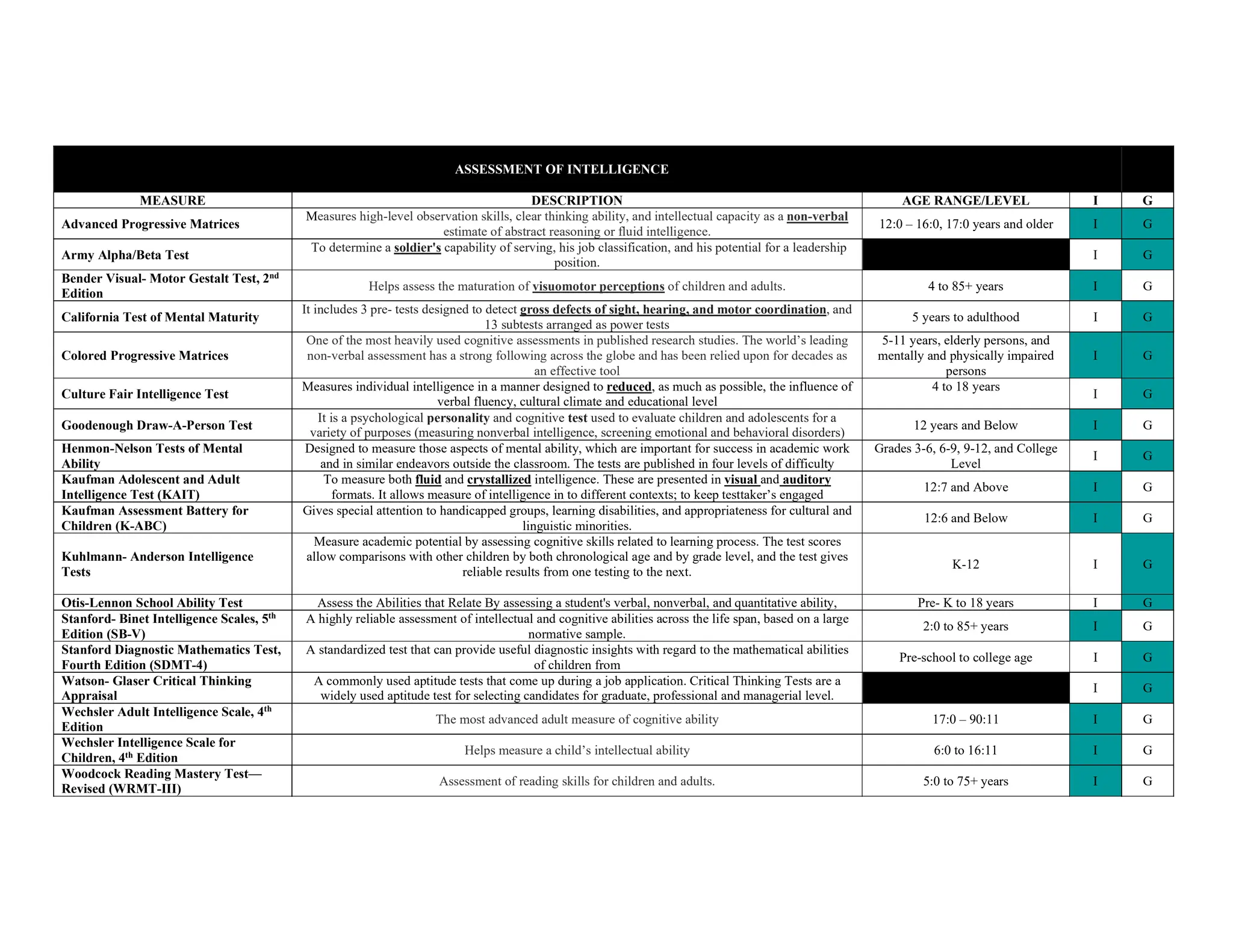
ASSESSMENT OF INTELLIGENCE
MEASURE DESCRIPTION AGE RANGE/LEVEL I G
Advanced Progressive Matrices
Measures high-level observation skills, clear thinking ability, and intellectual capacity as a non-verbal
estimate of abstract reasoning or fluid intelligence.
12:0 – 16:0, 17:0 years and older I G
Army Alpha/Beta Test
To determine a soldier's capability of serving, his job classification, and his potential for a leadership
position.
I G
Bender Visual- Motor Gestalt Test, 2nd
Edition
Helps assess the maturation of visuomotor perceptions of children and adults. 4 to 85+ years I G
California Test of Mental Maturity
It includes 3 pre- tests designed to detect gross defects of sight, hearing, and motor coordination, and
13 subtests arranged as power tests
5 years to adulthood I G
Colored Progressive Matrices
One of the most heavily used cognitive assessments in published research studies. The world’s leading
non-verbal assessment has a strong following across the globe and has been relied upon for decades as
an effective tool
5-11 years, elderly persons, and
mentally and physically impaired
persons
I G
Culture Fair Intelligence Test
Measures individual intelligence in a manner designed to reduced, as much as possible, the influence of
verbal fluency, cultural climate and educational level
4 to 18 years
I G
Goodenough Draw-A-Person Test
It is a psychological personality and cognitive test used to evaluate children and adolescents for a
variety of purposes (measuring nonverbal intelligence, screening emotional and behavioral disorders)
12 years and Below I G
Henmon-Nelson Tests of Mental
Ability
Designed to measure those aspects of mental ability, which are important for success in academic work
and in similar endeavors outside the classroom. The tests are published in four levels of difficulty
Grades 3-6, 6-9, 9-12, and College
Level
I G
Kaufman Adolescent and Adult
Intelligence Test (KAIT)
To measure both fluid and crystallized intelligence. These are presented in visual and auditory
formats. It allows measure of intelligence in to different contexts; to keep testtaker’s engaged
12:7 and Above I G
Kaufman Assessment Battery for
Children (K-ABC)
Gives special attention to handicapped groups, learning disabilities, and appropriateness for cultural and
linguistic minorities.
12:6 and Below I G
Kuhlmann- Anderson Intelligence
Tests
Measure academic potential by assessing cognitive skills related to learning process. The test scores
allow comparisons with other children by both chronological age and by grade level, and the test gives
reliable results from one testing to the next.
K-12 I G
Otis-Lennon School Ability Test Assess the Abilities that Relate By assessing a student's verbal, nonverbal, and quantitative ability, Pre- K to 18 years I G
Stanford- Binet Intelligence Scales, 5th
Edition (SB-V)
A highly reliable assessment of intellectual and cognitive abilities across the life span, based on a large
normative sample.
2:0 to 85+ years I G
Stanford Diagnostic Mathematics Test,
Fourth Edition (SDMT-4)
A standardized test that can provide useful diagnostic insights with regard to the mathematical abilities
of children from
Pre-school to college age I G
Watson- Glaser Critical Thinking
Appraisal
A commonly used aptitude tests that come up during a job application. Critical Thinking Tests are a
widely used aptitude test for selecting candidates for graduate, professional and managerial level.
I G
Wechsler Adult Intelligence Scale, 4th
Edition
The most advanced adult measure of cognitive ability 17:0 – 90:11 I G
Wechsler Intelligence Scale for
Children, 4th Edition
Helps measure a child’s intellectual ability 6:0 to 16:11 I G
Woodcock Reading Mastery Test—
Revised (WRMT-III)
Assessment of reading skills for children and adults. 5:0 to 75+ years I G
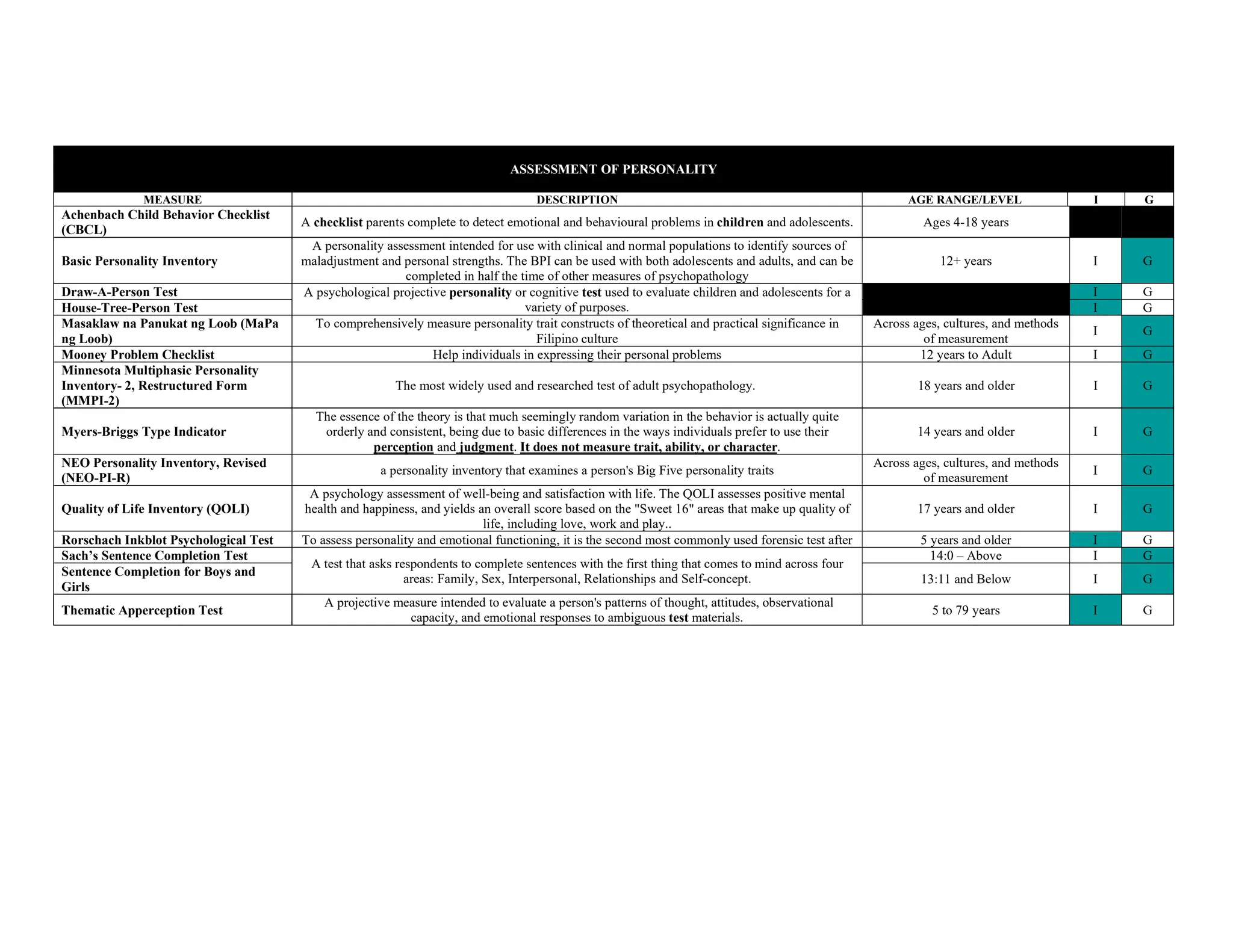
ASSESSMENT OF PERSONALITY
MEASURE DESCRIPTION AGE RANGE/LEVEL I G
Achenbach Child Behavior Checklist
(CBCL)
A checklist parents complete to detect emotional and behavioural problems in children and adolescents. Ages 4-18 years I G
Basic Personality Inventory
A personality assessment intended for use with clinical and normal populations to identify sources of
maladjustment and personal strengths. The BPI can be used with both adolescents and adults, and can be
completed in half the time of other measures of psychopathology
12+ years I G
Draw-A-Person Test A psychological projective personality or cognitive test used to evaluate children and adolescents for a
variety of purposes.
I G
House-Tree-Person Test I G
Masaklaw na Panukat ng Loob (MaPa
ng Loob)
To comprehensively measure personality trait constructs of theoretical and practical significance in
Filipino culture
Across ages, cultures, and methods
of measurement
I G
Mooney Problem Checklist Help individuals in expressing their personal problems 12 years to Adult I G
Minnesota Multiphasic Personality
Inventory- 2, Restructured Form
(MMPI-2)
The most widely used and researched test of adult psychopathology. 18 years and older I G
Myers-Briggs Type Indicator
The essence of the theory is that much seemingly random variation in the behavior is actually quite
orderly and consistent, being due to basic differences in the ways individuals prefer to use their
perception and judgment. It does not measure trait, ability, or character.
14 years and older I G
NEO Personality Inventory, Revised
(NEO-PI-R)
a personality inventory that examines a person's Big Five personality traits
Across ages, cultures, and methods
of measurement
I G
Quality of Life Inventory (QOLI)
A psychology assessment of well-being and satisfaction with life. The QOLI assesses positive mental
health and happiness, and yields an overall score based on the "Sweet 16" areas that make up quality of
life, including love, work and play..
17 years and older I G
Rorschach Inkblot Psychological Test To assess personality and emotional functioning, it is the second most commonly used forensic test after 5 years and older I G
Sach’s Sentence Completion Test
A test that asks respondents to complete sentences with the first thing that comes to mind across four
areas: Family, Sex, Interpersonal, Relationships and Self-concept.
14:0 – Above I G
Sentence Completion for Boys and
Girls
13:11 and Below I G
Thematic Apperception Test
A projective measure intended to evaluate a person's patterns of thought, attitudes, observational
capacity, and emotional responses to ambiguous test materials.
5 to 79 years I G

Assessment of Intelligence and Personality.pdf

  • 1.
    ASSESSMENT OF INTELLIGENCE MEASUREDESCRIPTION AGE RANGE/LEVEL I G Advanced Progressive Matrices Measures high-level observation skills, clear thinking ability, and intellectual capacity as a non-verbal estimate of abstract reasoning or fluid intelligence. 12:0 – 16:0, 17:0 years and older I G Army Alpha/Beta Test To determine a soldier's capability of serving, his job classification, and his potential for a leadership position. I G Bender Visual- Motor Gestalt Test, 2nd Edition Helps assess the maturation of visuomotor perceptions of children and adults. 4 to 85+ years I G California Test of Mental Maturity It includes 3 pre- tests designed to detect gross defects of sight, hearing, and motor coordination, and 13 subtests arranged as power tests 5 years to adulthood I G Colored Progressive Matrices One of the most heavily used cognitive assessments in published research studies. The world’s leading non-verbal assessment has a strong following across the globe and has been relied upon for decades as an effective tool 5-11 years, elderly persons, and mentally and physically impaired persons I G Culture Fair Intelligence Test Measures individual intelligence in a manner designed to reduced, as much as possible, the influence of verbal fluency, cultural climate and educational level 4 to 18 years I G Goodenough Draw-A-Person Test It is a psychological personality and cognitive test used to evaluate children and adolescents for a variety of purposes (measuring nonverbal intelligence, screening emotional and behavioral disorders) 12 years and Below I G Henmon-Nelson Tests of Mental Ability Designed to measure those aspects of mental ability, which are important for success in academic work and in similar endeavors outside the classroom. The tests are published in four levels of difficulty Grades 3-6, 6-9, 9-12, and College Level I G Kaufman Adolescent and Adult Intelligence Test (KAIT) To measure both fluid and crystallized intelligence. These are presented in visual and auditory formats. It allows measure of intelligence in to different contexts; to keep testtaker’s engaged 12:7 and Above I G Kaufman Assessment Battery for Children (K-ABC) Gives special attention to handicapped groups, learning disabilities, and appropriateness for cultural and linguistic minorities. 12:6 and Below I G Kuhlmann- Anderson Intelligence Tests Measure academic potential by assessing cognitive skills related to learning process. The test scores allow comparisons with other children by both chronological age and by grade level, and the test gives reliable results from one testing to the next. K-12 I G Otis-Lennon School Ability Test Assess the Abilities that Relate By assessing a student's verbal, nonverbal, and quantitative ability, Pre- K to 18 years I G Stanford- Binet Intelligence Scales, 5th Edition (SB-V) A highly reliable assessment of intellectual and cognitive abilities across the life span, based on a large normative sample. 2:0 to 85+ years I G Stanford Diagnostic Mathematics Test, Fourth Edition (SDMT-4) A standardized test that can provide useful diagnostic insights with regard to the mathematical abilities of children from Pre-school to college age I G Watson- Glaser Critical Thinking Appraisal A commonly used aptitude tests that come up during a job application. Critical Thinking Tests are a widely used aptitude test for selecting candidates for graduate, professional and managerial level. I G Wechsler Adult Intelligence Scale, 4th Edition The most advanced adult measure of cognitive ability 17:0 – 90:11 I G Wechsler Intelligence Scale for Children, 4th Edition Helps measure a child’s intellectual ability 6:0 to 16:11 I G Woodcock Reading Mastery Test— Revised (WRMT-III) Assessment of reading skills for children and adults. 5:0 to 75+ years I G
  • 2.
    ASSESSMENT OF PERSONALITY MEASUREDESCRIPTION AGE RANGE/LEVEL I G Achenbach Child Behavior Checklist (CBCL) A checklist parents complete to detect emotional and behavioural problems in children and adolescents. Ages 4-18 years I G Basic Personality Inventory A personality assessment intended for use with clinical and normal populations to identify sources of maladjustment and personal strengths. The BPI can be used with both adolescents and adults, and can be completed in half the time of other measures of psychopathology 12+ years I G Draw-A-Person Test A psychological projective personality or cognitive test used to evaluate children and adolescents for a variety of purposes. I G House-Tree-Person Test I G Masaklaw na Panukat ng Loob (MaPa ng Loob) To comprehensively measure personality trait constructs of theoretical and practical significance in Filipino culture Across ages, cultures, and methods of measurement I G Mooney Problem Checklist Help individuals in expressing their personal problems 12 years to Adult I G Minnesota Multiphasic Personality Inventory- 2, Restructured Form (MMPI-2) The most widely used and researched test of adult psychopathology. 18 years and older I G Myers-Briggs Type Indicator The essence of the theory is that much seemingly random variation in the behavior is actually quite orderly and consistent, being due to basic differences in the ways individuals prefer to use their perception and judgment. It does not measure trait, ability, or character. 14 years and older I G NEO Personality Inventory, Revised (NEO-PI-R) a personality inventory that examines a person's Big Five personality traits Across ages, cultures, and methods of measurement I G Quality of Life Inventory (QOLI) A psychology assessment of well-being and satisfaction with life. The QOLI assesses positive mental health and happiness, and yields an overall score based on the "Sweet 16" areas that make up quality of life, including love, work and play.. 17 years and older I G Rorschach Inkblot Psychological Test To assess personality and emotional functioning, it is the second most commonly used forensic test after 5 years and older I G Sach’s Sentence Completion Test A test that asks respondents to complete sentences with the first thing that comes to mind across four areas: Family, Sex, Interpersonal, Relationships and Self-concept. 14:0 – Above I G Sentence Completion for Boys and Girls 13:11 and Below I G Thematic Apperception Test A projective measure intended to evaluate a person's patterns of thought, attitudes, observational capacity, and emotional responses to ambiguous test materials. 5 to 79 years I G