•
It feels like a fever. Or maybe a cold. When you look in the mirror
and see spots you know it’s not a game of connect-the-dots. It’s
Varicell
a
OBJECTIVES
• Define Varicella.
• Discuss epidemiological triad of chicken pox.
• Explain clinical features, sign and symptoms
of chicken pox.
• Discuss the diagnostic tests.
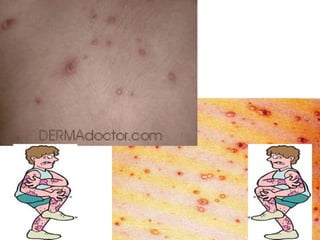
• Identify the possible complication of chicken
pox.
• Explain the possible prevention and treatment
of chicken pox.
Description
Chicken pox is a common disease caused by the
varicella zoster virus (VZV) which is a
member of the herpes virus family.
 It is very contagious and usually occurs during
childhood (normally 5-9) , but you can get it at
any time in your life.
It is most common at the end of winter and the
beginning of Spring
Varicella Epidemiology
• Reservoir Human
• Transmission Airborne droplet
Direct contact with lesions
• Temporal pattern Peak in winter–early
spring.
• Communicability 1-2 days before to 4-5
days after onset of rash
May be longer in
immunocompromised
0
5
10
15
20
25
30
<1 1-14 15-19 20-29 30+
Age group (yrs)
RateVaricella Fatality Rate in
Healthy Persons
*Deaths per 100,000 cases
Varicella Clinical Features
• Incubation period 14-16 days (range 10-21
days)
• Mild prodrome for 1-2 days
• Generally appear first on head; most
concentrated on trunk
• Successive crops (2-4 days) of pruritic
vesicles
Symptoms
Chicken pox often begins with a small
fever, body aches and loss of appetite.
Within 1 or 2 days, the rash appears,
normally starting on the chest or back.
At first the rash begins as red spots which
then form blisters and spreads to the rest of
the body.
Symptoms continued
• The blisters open and form a scab within a few
days.
• The rash can continue to break out for 4-5 days
as older lesions crust and heal.
• Itching can accompany the rash along with
fever, swollen lymph nodes, sore throat and
general body aches.
Varicella Complications
•Bacterial infection of lesions
•CNS manifestations
•Pneumonia (rare in children)
•Hospitalization ~3 per 1,000 cases
•Death ~1 per 60,000 cases
So…What Do These Pox
Look Like??
Are You Sure You Wanna Know?
Positive???
Ok, You Asked For It!
Varicella Laboratory Diagnosis
• Isolation of varicella virus from clinical
specimen
• Rapid varicella virus identification using
direct fluorescent antibody (DFA) testing
• Significant rise in varicella IgG by any
standard serologic assay (e.g., enzyme
immunoassay)
Treatment
• Isolate the diseased until the rash crusts.
• Keep skin clean by frequent baths or, once the fever
has subsided, showers. Cool, wet compresses or
tepid water baths help to relieve itching.
Complications are treated according to symptoms;
Secondary bacterial pneumonia is treated with
antibiotics.
• Antihistamines may be used to help relieve the
itching.
• Acyclovir is used for severe Varicella infections
Prevention
Children between 12 and 18 months
should receive a dose of
chickenpox vaccine, Varicella-
zoster immune globulin.
Autosomal Issue
If a pregnant woman contracts chickenpox
during the first or second trimester, there is a
small risk that her child will be born with a
congenital malformation. When a pregnant
woman contracts the disease within 5 days of
delivery, there is a high risk of the newborn
having serious disease.
PrameGel and Polysoporin may
be used to rub on pox to help
decrease the itchiness.
Benedryl is used to control fever
and cold-like symptoms while
Aveeno bath treatment also helps
alleviate that nasty, unbearable
itch.
Common Medication
Any Questions?
Thank
you
I would like to thanks to u.

Chicken poox

  • 2.
    • It feels likea fever. Or maybe a cold. When you look in the mirror and see spots you know it’s not a game of connect-the-dots. It’s Varicell a
  • 3.
    OBJECTIVES • Define Varicella. •Discuss epidemiological triad of chicken pox. • Explain clinical features, sign and symptoms of chicken pox. • Discuss the diagnostic tests. • Identify the possible complication of chicken pox. • Explain the possible prevention and treatment of chicken pox.
  • 4.
    Description Chicken pox isa common disease caused by the varicella zoster virus (VZV) which is a member of the herpes virus family.  It is very contagious and usually occurs during childhood (normally 5-9) , but you can get it at any time in your life. It is most common at the end of winter and the beginning of Spring
  • 5.
    Varicella Epidemiology • ReservoirHuman • Transmission Airborne droplet Direct contact with lesions • Temporal pattern Peak in winter–early spring. • Communicability 1-2 days before to 4-5 days after onset of rash May be longer in immunocompromised
  • 6.
    0 5 10 15 20 25 30 <1 1-14 15-1920-29 30+ Age group (yrs) RateVaricella Fatality Rate in Healthy Persons *Deaths per 100,000 cases
  • 7.
    Varicella Clinical Features •Incubation period 14-16 days (range 10-21 days) • Mild prodrome for 1-2 days • Generally appear first on head; most concentrated on trunk • Successive crops (2-4 days) of pruritic vesicles
  • 8.
    Symptoms Chicken pox oftenbegins with a small fever, body aches and loss of appetite. Within 1 or 2 days, the rash appears, normally starting on the chest or back. At first the rash begins as red spots which then form blisters and spreads to the rest of the body.
  • 9.
    Symptoms continued • Theblisters open and form a scab within a few days. • The rash can continue to break out for 4-5 days as older lesions crust and heal. • Itching can accompany the rash along with fever, swollen lymph nodes, sore throat and general body aches.
  • 10.
    Varicella Complications •Bacterial infectionof lesions •CNS manifestations •Pneumonia (rare in children) •Hospitalization ~3 per 1,000 cases •Death ~1 per 60,000 cases
  • 11.
    So…What Do ThesePox Look Like??
  • 12.
    Are You SureYou Wanna Know? Positive??? Ok, You Asked For It!
  • 16.
    Varicella Laboratory Diagnosis •Isolation of varicella virus from clinical specimen • Rapid varicella virus identification using direct fluorescent antibody (DFA) testing • Significant rise in varicella IgG by any standard serologic assay (e.g., enzyme immunoassay)
  • 17.
    Treatment • Isolate thediseased until the rash crusts. • Keep skin clean by frequent baths or, once the fever has subsided, showers. Cool, wet compresses or tepid water baths help to relieve itching. Complications are treated according to symptoms; Secondary bacterial pneumonia is treated with antibiotics. • Antihistamines may be used to help relieve the itching. • Acyclovir is used for severe Varicella infections
  • 18.
    Prevention Children between 12and 18 months should receive a dose of chickenpox vaccine, Varicella- zoster immune globulin.
  • 19.
    Autosomal Issue If apregnant woman contracts chickenpox during the first or second trimester, there is a small risk that her child will be born with a congenital malformation. When a pregnant woman contracts the disease within 5 days of delivery, there is a high risk of the newborn having serious disease.
  • 20.
    PrameGel and Polysoporinmay be used to rub on pox to help decrease the itchiness. Benedryl is used to control fever and cold-like symptoms while Aveeno bath treatment also helps alleviate that nasty, unbearable itch. Common Medication
  • 21.
  • 22.
    Thank you I would liketo thanks to u.