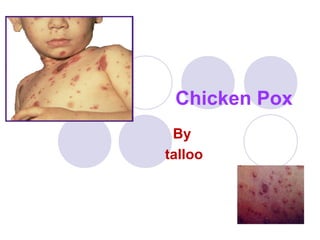
Chicken Pox
By
talloo
Description
Chicken pox is a common disease
caused by the varicella zoster virus
(VZV) which is a member of the herpes
virus family.
 It is very contagious and usually
occurs during childhood (normally 5-
9) , but you can get it at any time in
your life.
It is most common at the end of winter
and the beginning of Spring
Chicken Pox
Source: primary secretions of
respiratory tract of infected persons; to
a lesser degree, skin lesions.
Transmissions: direct contact, droplet
(airborne) spread and contaminated
objects.
Incubation period: 2-3 weeks, usually
14-16 days.
Chicken Pox
Period of communicability:
Probably 1 day before eruption of
lesions (prodromal period) to 6 days
after first crop of vesicles when crusts
have formed.
Note: communicability period
the time during which an infectious
agent may be transferred directly or
indirectly from an infected person to
another person, from an infected
animal to humans, or from an infected
person to animals, including
arthropods ‫.المفصليات‬
Symptoms
Prodromal stage:
Chicken pox often begins with a slight
fever, malaise and loss of appetite.
Within 1or 2 days, the rash appears,
normally starting on the chest or back
and highly pruritic.
At first the rash begins areas of red spots
which then form blisters and spreads to
the rest of the body (papule, vesicle,
crust)
Symptoms continued
The blisters open and form a outside
within a few days.
The rash can continue to break out for
4-5 days as older lesions crust and
heal.
Itching can accompany the rash along
with fever, swollen lymph nodes, sore
throat and general body aches.
Cures and treatments
Cures
There are no actual cures for it ,but you can get a
vaccine shot to help prevent it.
Treatments
Baths with uncooked oatmeal, cornstarch can help
relieve itching.
Tylenol is used for fever or pain relief. (Aspirin should be
avoided.)
Antiviral drugs such as Acyclovir may be prescribed.
You can put Calamine lotion on the pocks to help stop
the itching.
Nursing considerations
Maintain strict isolation in hospital.
Isolate child in home until vesicles
have dried (usually 1 week after onset
of disease) and isolate high –risk
children from infected children.
Nursing considerations
Administer skin care: give bath and
change clothes and linens daily;
Apply mittens if child scratches.
Keep child cool (may decrease number
of lesions).
 Lessen pruritus; keep child occupied.
 Remove loose crusts that rub and
irritate skin
Nursing considerations
Teach child to apply pressure to
pruritic area rather than scratching it.
If older child, reason with child
regarding danger of scar formation
from scratching.
 Avoid use of aspirin.
    chicken pox

chicken pox

  • 1.
  • 2.
    Description Chicken pox isa common disease caused by the varicella zoster virus (VZV) which is a member of the herpes virus family.  It is very contagious and usually occurs during childhood (normally 5- 9) , but you can get it at any time in your life. It is most common at the end of winter and the beginning of Spring
  • 3.
    Chicken Pox Source: primarysecretions of respiratory tract of infected persons; to a lesser degree, skin lesions. Transmissions: direct contact, droplet (airborne) spread and contaminated objects. Incubation period: 2-3 weeks, usually 14-16 days.
  • 4.
    Chicken Pox Period ofcommunicability: Probably 1 day before eruption of lesions (prodromal period) to 6 days after first crop of vesicles when crusts have formed.
  • 5.
    Note: communicability period thetime during which an infectious agent may be transferred directly or indirectly from an infected person to another person, from an infected animal to humans, or from an infected person to animals, including arthropods ‫.المفصليات‬
  • 6.
    Symptoms Prodromal stage: Chicken poxoften begins with a slight fever, malaise and loss of appetite. Within 1or 2 days, the rash appears, normally starting on the chest or back and highly pruritic. At first the rash begins areas of red spots which then form blisters and spreads to the rest of the body (papule, vesicle, crust)
  • 7.
    Symptoms continued The blistersopen and form a outside within a few days. The rash can continue to break out for 4-5 days as older lesions crust and heal. Itching can accompany the rash along with fever, swollen lymph nodes, sore throat and general body aches.
  • 8.
    Cures and treatments Cures Thereare no actual cures for it ,but you can get a vaccine shot to help prevent it. Treatments Baths with uncooked oatmeal, cornstarch can help relieve itching. Tylenol is used for fever or pain relief. (Aspirin should be avoided.) Antiviral drugs such as Acyclovir may be prescribed. You can put Calamine lotion on the pocks to help stop the itching.
  • 9.
    Nursing considerations Maintain strictisolation in hospital. Isolate child in home until vesicles have dried (usually 1 week after onset of disease) and isolate high –risk children from infected children.
  • 10.
    Nursing considerations Administer skincare: give bath and change clothes and linens daily; Apply mittens if child scratches. Keep child cool (may decrease number of lesions).  Lessen pruritus; keep child occupied.  Remove loose crusts that rub and irritate skin
  • 11.
    Nursing considerations Teach childto apply pressure to pruritic area rather than scratching it. If older child, reason with child regarding danger of scar formation from scratching.  Avoid use of aspirin.