Advanced Concept in
Nursing
CONCEPTUAL FOUNDATIONS IN
CRITICAL CARE NURSING
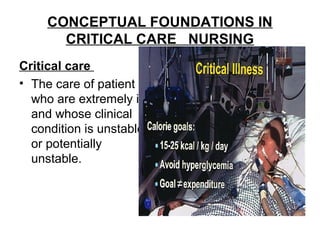
Critical care
• The care of patient
who are extremely ill
and whose clinical
condition is unstable
or potentially
unstable.
Definition of a Critically Ill
Patient
• Critically ill patients are defined as those patients
who are at high risk for actual or potential life-
threatening health problems.
• The more critically ill the patient is, the more
likely he or she is to be highly vulnerable,
unstable and complex, thereby requiring intense
(strong) and vigilant (alert) nursing care.
Critical care nursing
• Is the field of nursing with a focus on the
care of the critically ill or unstable patients.
Critical care nurses can be found working
in a wide variety of environments and
specialties, such as:
• Emergency departments.
• Intensive care units ( ICU)
Intensive Care Units
• ICU is a place where skilled nurses,
doctors, technologists, respiratory
therapists, and others competently care
for the sickest clients in the hospital.
• Intensive care nurses are also required to
be comfortable with a wide variety of
technology and its uses in the critical care
setting.
Technological Equipments of ICU
• This technology includes such equipment as:
– Hemodynamic and cardiac monitoring systems,
– Mechanical ventilator therapy,
– Intra-aortic balloon pumps (IABP),
– Ventricular assist devices (LVAD and RVAD),
– Continuous renal replacement equipment
(CRRT/CVVHDF),
– Extracorporeal membrane oxygenation circuits
(ECMO) and many other advanced life support
devices.
History of Critical Care Nursing
o The first intensive care units emerged in
the 1950s to provide care to very ill
patients who needed one-to-one care from
a nurse.
Reasons for admission to the
intensive care unit
1. Respiratory difficulties
2. Circulatory problems
(Hemodynamic unstable)
3. Neuralgic changes
4. Life – threatening infections or
risk of infection
5. Metabolic problems
6. Surgeries
Respiratory difficulties
• Pneumonia
• Pulmonary embolism
• Drug overdose
• Respiratory distress
Device used: ventilators/ respirators
2. Circulatory problems
(Hemodynamic unstable)
• Hypotension (low blood pressure)
• Myocardial infarction (heart attack)
• Bleeding from internal or external wound
• Required sophisticated
monitoring of cardiac out put and
pressure within the heart.
3. Neuralgic changes
• Loss of consciousness or changes in
mental status
• Head injury
• Brain surgery
• Stroke
• Spinal cord injury
4. Life – threatening infections or
risk of infection
• Burn wound or sepsis
• Requires very intensive care for
medication administration and fluid
management
5. Metabolic problems
• Abnormal electrolytes from diabetes
• Renal failure
• Acid base imbalance
6. Surgeries
• Open heart surgery
• Thoracic surgery
• Brain surgery
• Extensive abdominal surgery or
orthopedic surgery
Needs of critically ill client and
family
Needs
• Physical,
• Emotional,
• Psychological,
• Social,
• Environmental
Problems
• Pain
• Immobility
• Disorientation
• Sleep deprivation
• Powerlessness
• Hopelessness
• Delirium (ICU psychosis)
Feelings
• Isolated
• Anxious
• Depressed
• Fear about their treatment
• The unknown
Stress producing things
• Unusual machines
• Loud noises
• Equipment alarms
• Constant light
• Constant attention
• Staff conversations
• Physical restraints
• Lack of privacy
• Inadequate control of pain and anxiety
• Separation from significant others
Alteration in sleep
• Impaired immunity and healing
• Increased in oxygen consumption
• Carbon dioxide production
• Negative nitrogen balance
• Stimulation of fight or flight response of
the sympathetic nervous system

Advanced concept in nursing

  • 1.
  • 2.
    CONCEPTUAL FOUNDATIONS IN CRITICALCARE NURSING Critical care • The care of patient who are extremely ill and whose clinical condition is unstable or potentially unstable.
  • 3.
    Definition of aCritically Ill Patient • Critically ill patients are defined as those patients who are at high risk for actual or potential life- threatening health problems. • The more critically ill the patient is, the more likely he or she is to be highly vulnerable, unstable and complex, thereby requiring intense (strong) and vigilant (alert) nursing care.
  • 4.
    Critical care nursing •Is the field of nursing with a focus on the care of the critically ill or unstable patients. Critical care nurses can be found working in a wide variety of environments and specialties, such as: • Emergency departments. • Intensive care units ( ICU)
  • 5.
    Intensive Care Units •ICU is a place where skilled nurses, doctors, technologists, respiratory therapists, and others competently care for the sickest clients in the hospital. • Intensive care nurses are also required to be comfortable with a wide variety of technology and its uses in the critical care setting.
  • 6.
    Technological Equipments ofICU • This technology includes such equipment as: – Hemodynamic and cardiac monitoring systems, – Mechanical ventilator therapy, – Intra-aortic balloon pumps (IABP), – Ventricular assist devices (LVAD and RVAD), – Continuous renal replacement equipment (CRRT/CVVHDF), – Extracorporeal membrane oxygenation circuits (ECMO) and many other advanced life support devices.
  • 7.
    History of CriticalCare Nursing o The first intensive care units emerged in the 1950s to provide care to very ill patients who needed one-to-one care from a nurse.
  • 8.
    Reasons for admissionto the intensive care unit 1. Respiratory difficulties 2. Circulatory problems (Hemodynamic unstable) 3. Neuralgic changes 4. Life – threatening infections or risk of infection 5. Metabolic problems 6. Surgeries
  • 9.
    Respiratory difficulties • Pneumonia •Pulmonary embolism • Drug overdose • Respiratory distress Device used: ventilators/ respirators
  • 10.
    2. Circulatory problems (Hemodynamicunstable) • Hypotension (low blood pressure) • Myocardial infarction (heart attack) • Bleeding from internal or external wound • Required sophisticated monitoring of cardiac out put and pressure within the heart.
  • 11.
    3. Neuralgic changes •Loss of consciousness or changes in mental status • Head injury • Brain surgery • Stroke • Spinal cord injury
  • 12.
    4. Life –threatening infections or risk of infection • Burn wound or sepsis • Requires very intensive care for medication administration and fluid management
  • 13.
    5. Metabolic problems •Abnormal electrolytes from diabetes • Renal failure • Acid base imbalance
  • 14.
    6. Surgeries • Openheart surgery • Thoracic surgery • Brain surgery • Extensive abdominal surgery or orthopedic surgery
  • 15.
    Needs of criticallyill client and family Needs • Physical, • Emotional, • Psychological, • Social, • Environmental
  • 16.
    Problems • Pain • Immobility •Disorientation • Sleep deprivation • Powerlessness • Hopelessness • Delirium (ICU psychosis)
  • 17.
    Feelings • Isolated • Anxious •Depressed • Fear about their treatment • The unknown
  • 18.
    Stress producing things •Unusual machines • Loud noises • Equipment alarms • Constant light • Constant attention • Staff conversations • Physical restraints • Lack of privacy • Inadequate control of pain and anxiety • Separation from significant others
  • 19.
    Alteration in sleep •Impaired immunity and healing • Increased in oxygen consumption • Carbon dioxide production • Negative nitrogen balance • Stimulation of fight or flight response of the sympathetic nervous system