1
sujeevine
Introduction
 Food color is any substance that is added to
food to change or enhance its color.
1) Natural colors
2) Synthetic colors
3) Lakes and dyes
 The FDA calculated estimated intake of the
colorants in 2010 to be roughly 45mg per
person per day (Carol.C.B,2013).
 The nutrition foundation believed
- For children 27mg per day to be average daily
intake (Carol.C.B,2013).2
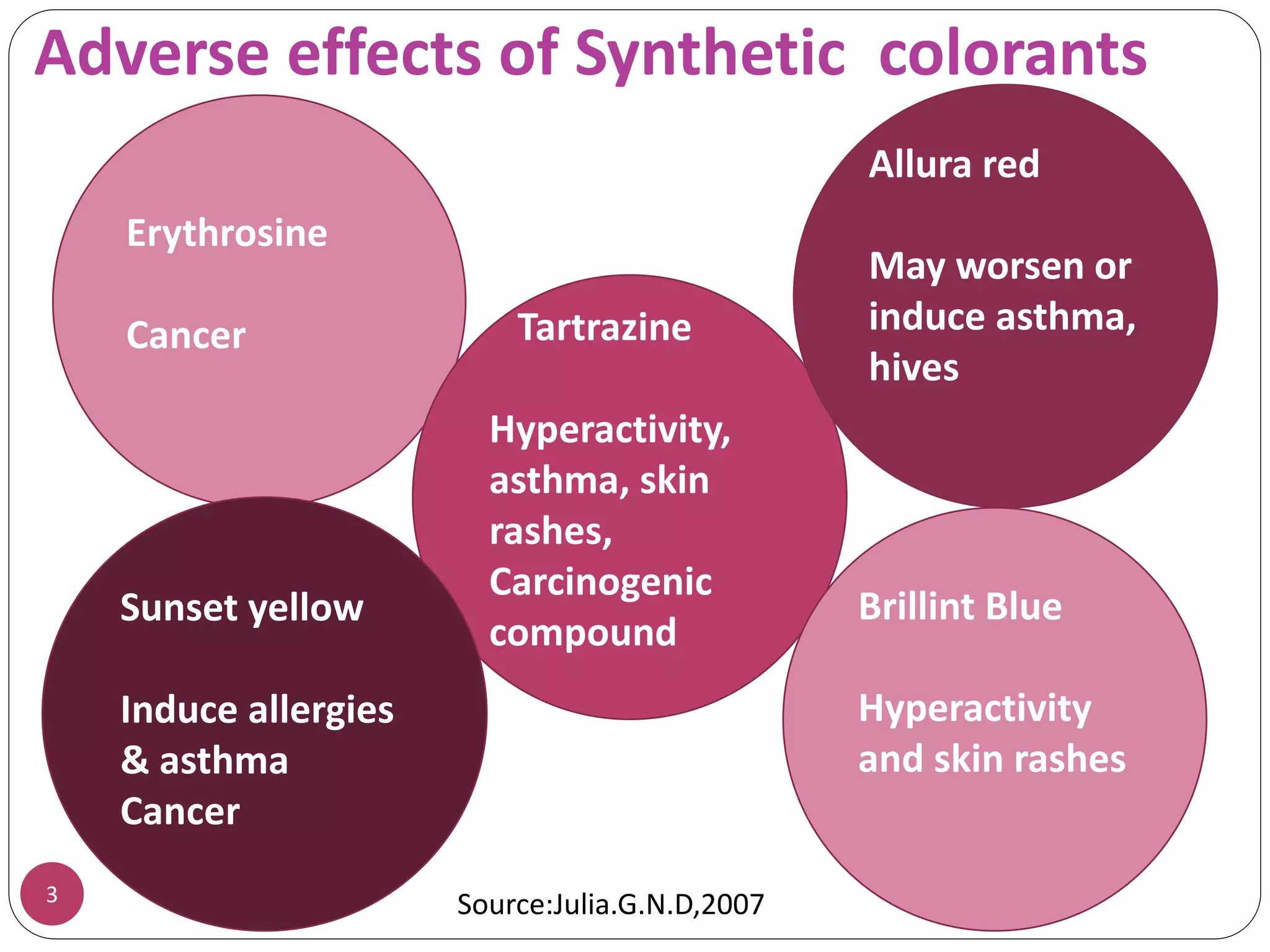
Erythrosine
Cancer
3
Tartrazine
Hyperactivity,
asthma, skin
rashes,
Carcinogenic
compound
Sunset yellow
Induce allergies
& asthma
Cancer
Brillint Blue
Hyperactivity
and skin rashes
Adverse effects of Synthetic colorants
Allura red
May worsen or
induce asthma,
hives
Source:Julia.G.N.D,2007
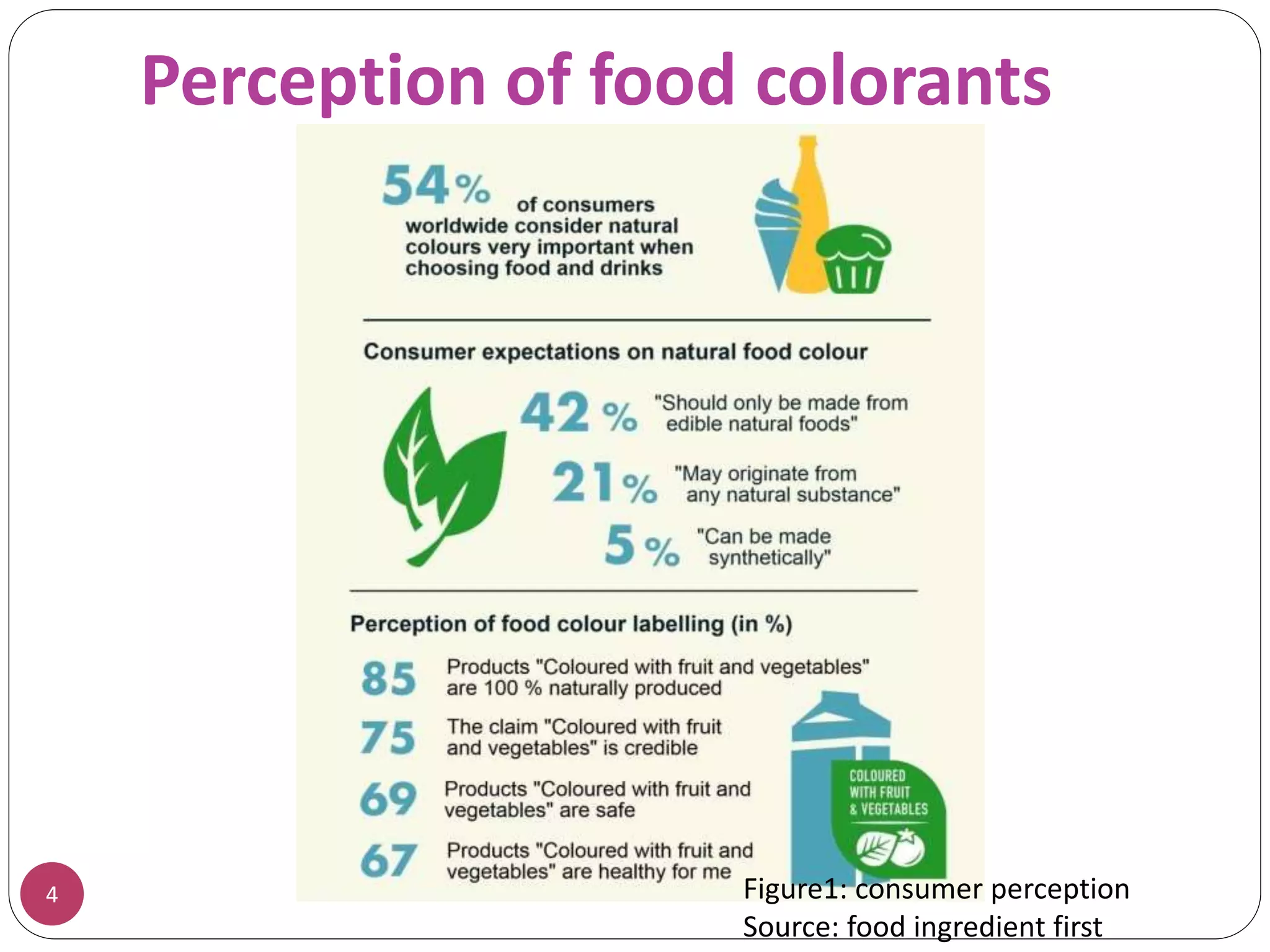
Perception of food colorants
4 Figure1: consumer perception
Source: food ingredient first
Natural Food Colorants
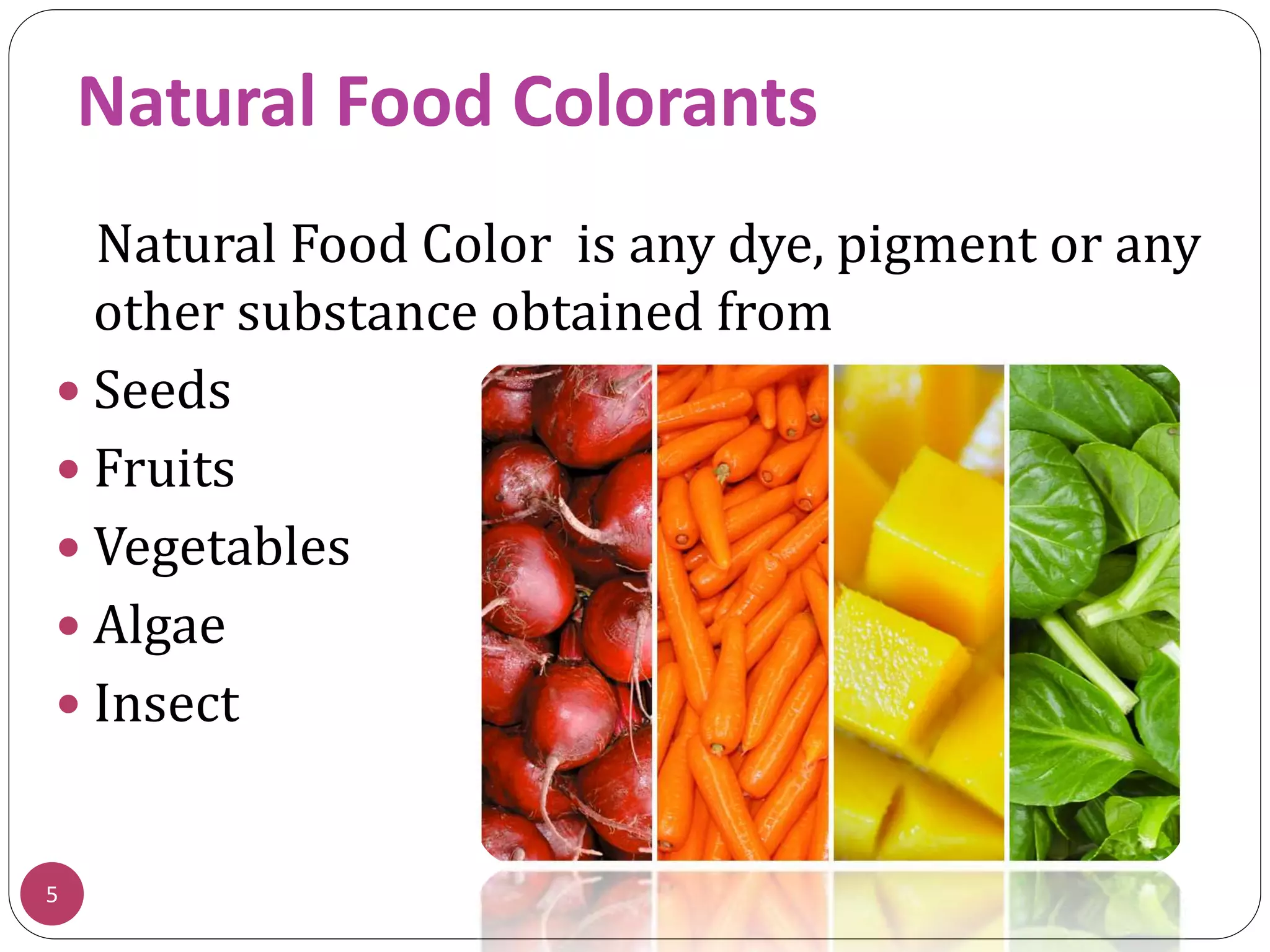
Natural Food Color is any dye, pigment or any
other substance obtained from
 Seeds
 Fruits
 Vegetables
 Algae
 Insect
5
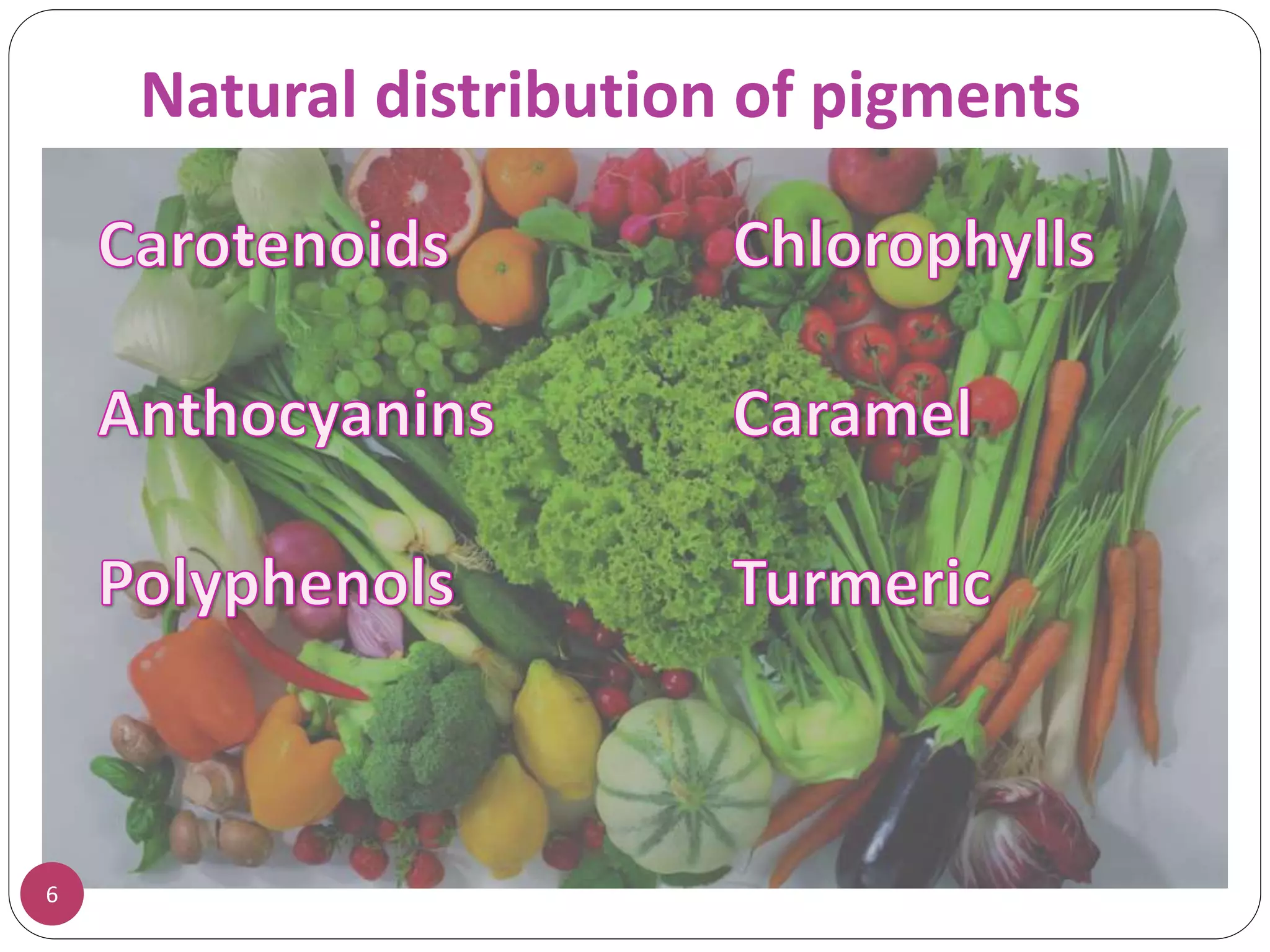
Natural distribution of pigments
6
CAROTENOIDS
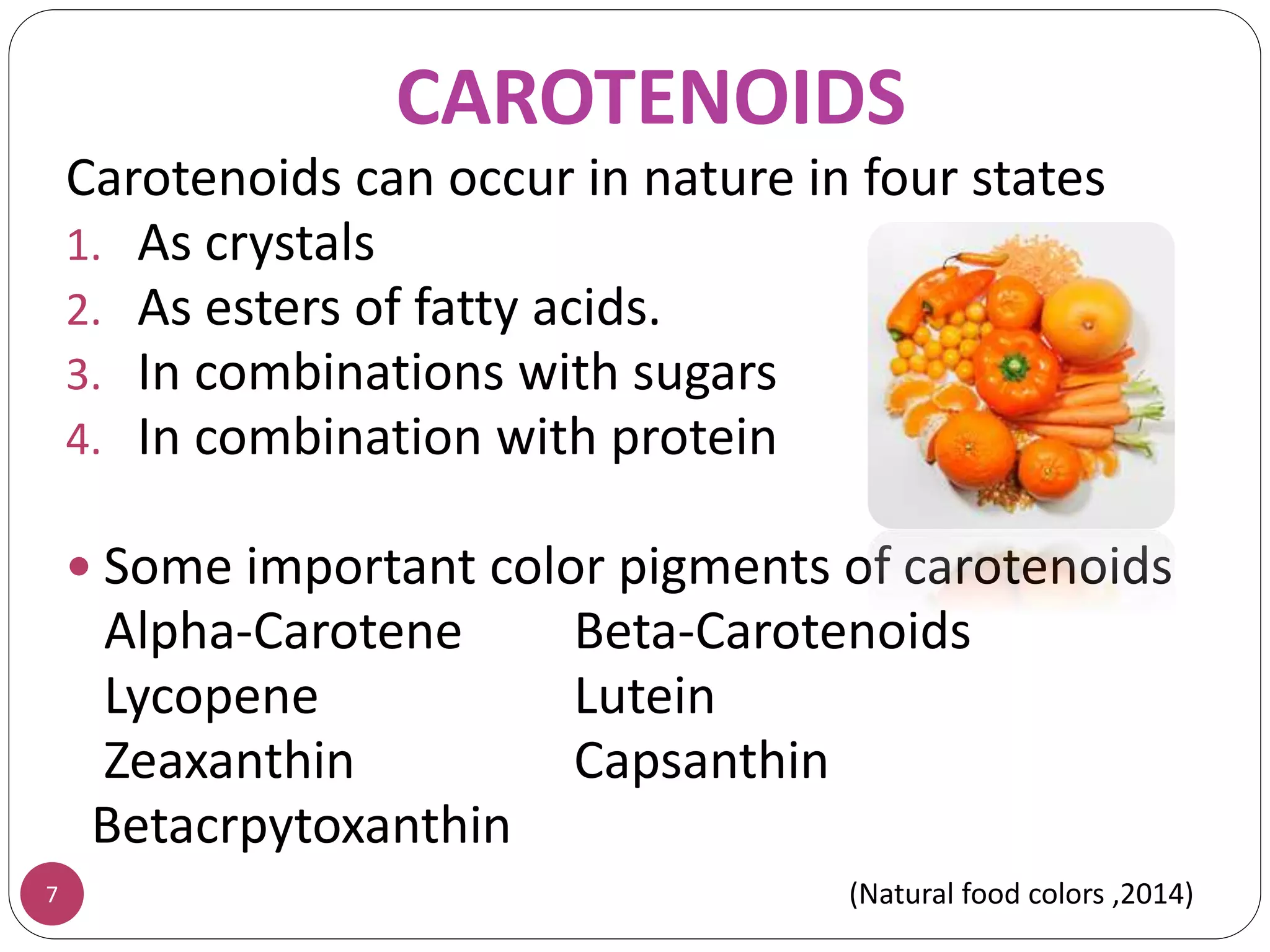
Carotenoids can occur in nature in four states
1. As crystals
2. As esters of fatty acids.
3. In combinations with sugars
4. In combination with protein
 Some important color pigments of carotenoids
Alpha-Carotene Beta-Carotenoids
Lycopene Lutein
Zeaxanthin Capsanthin
Betacrpytoxanthin
7 (Natural food colors ,2014)
Extraction
8
Applications
sorbets
beverages
Confectionery
sauces
Fruits or seeds extracted from them are
crushed. It is extracted using organic solution
ANNATTO
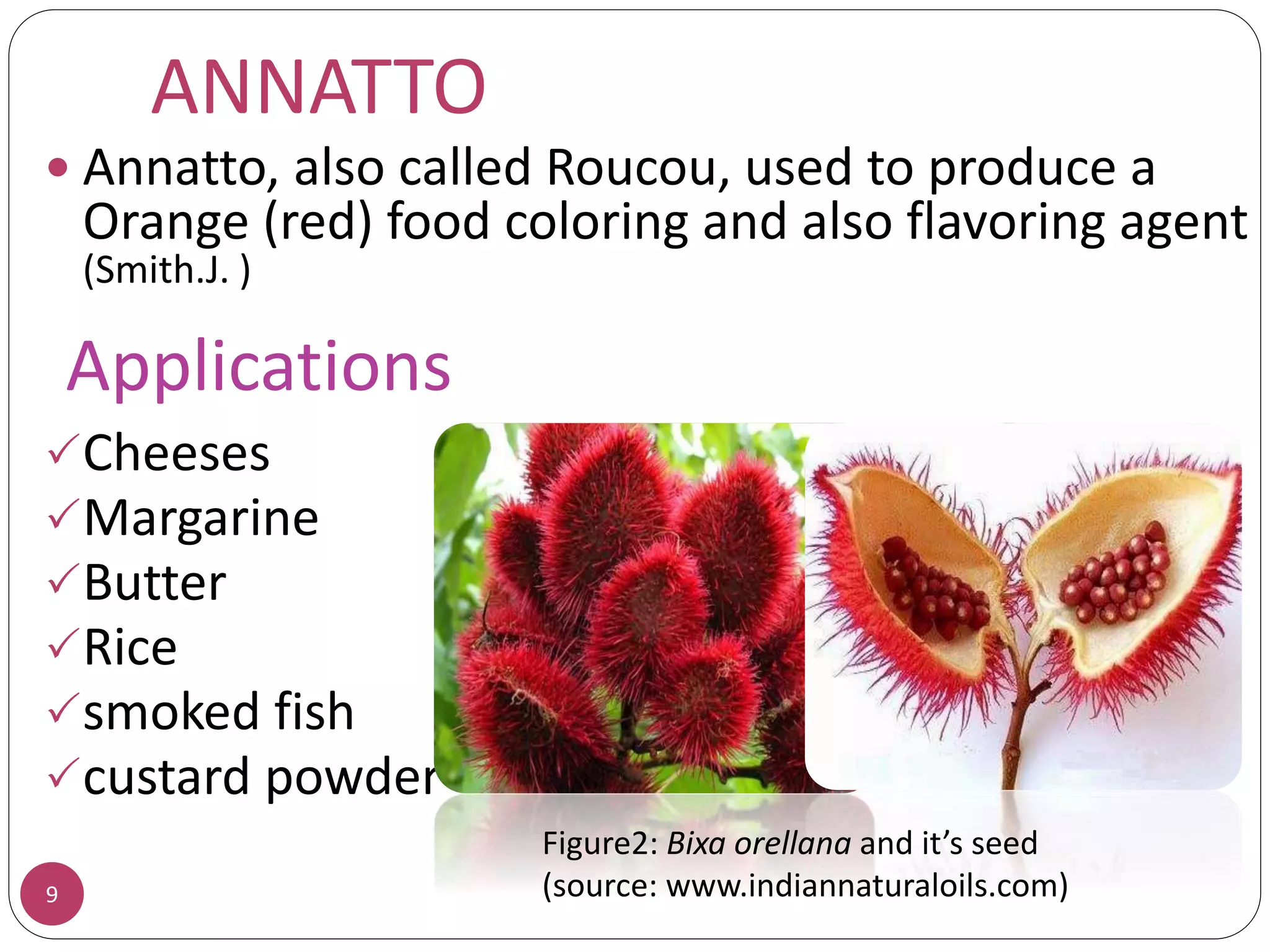
 Annatto, also called Roucou, used to produce a
Orange (red) food coloring and also flavoring agent
(Smith.J. )
Cheeses
Margarine
Butter
Rice
smoked fish
custard powder
9
Figure2: Bixa orellana and it’s seed
(source: www.indiannaturaloils.com)
Applications
PAPRIKA
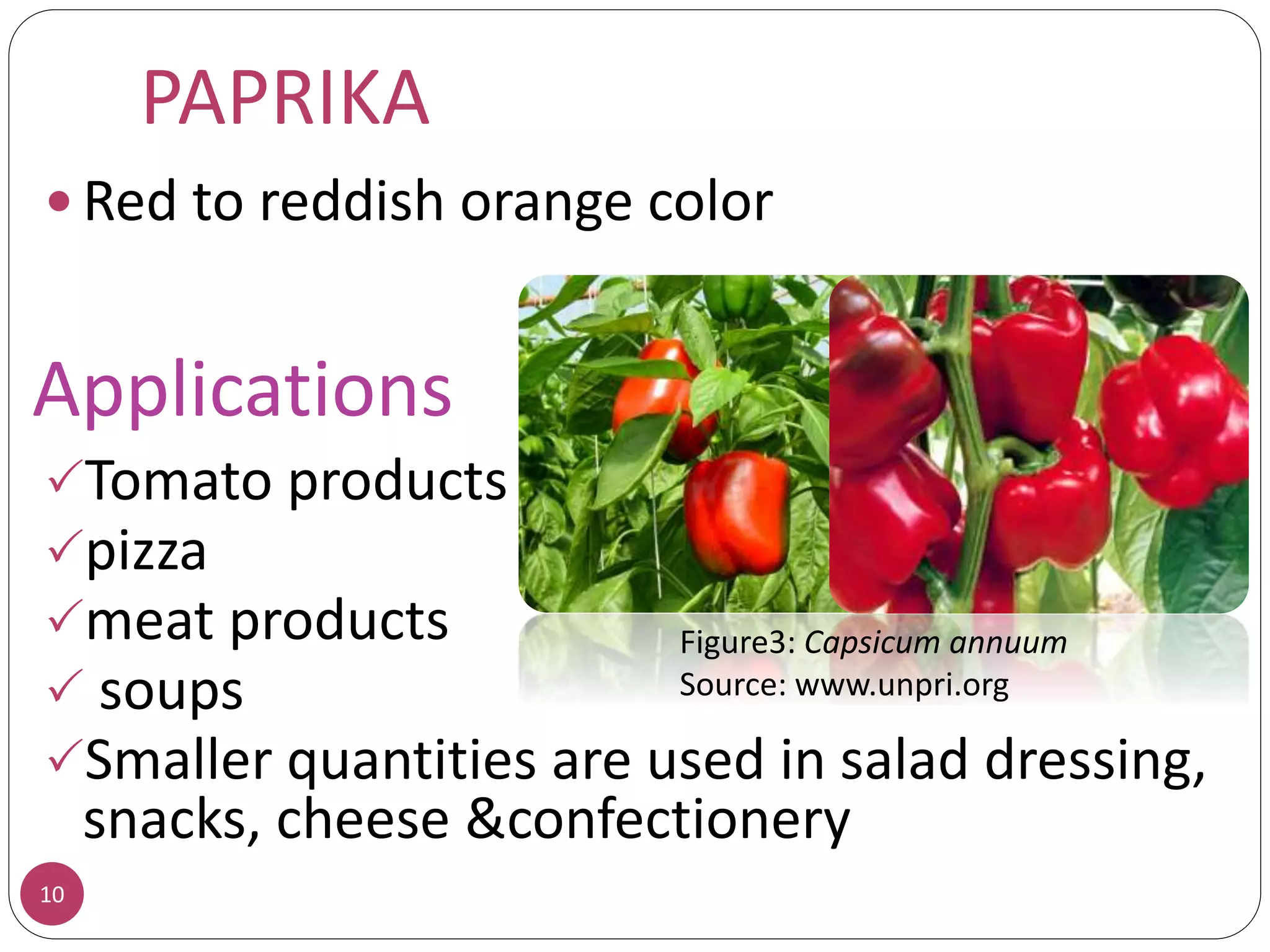
 Red to reddish orange color
Tomato products
pizza
meat products
 soups
Smaller quantities are used in salad dressing,
snacks, cheese &confectionery
10
Figure3: Capsicum annuum
Source: www.unpri.org
Applications
Saffron
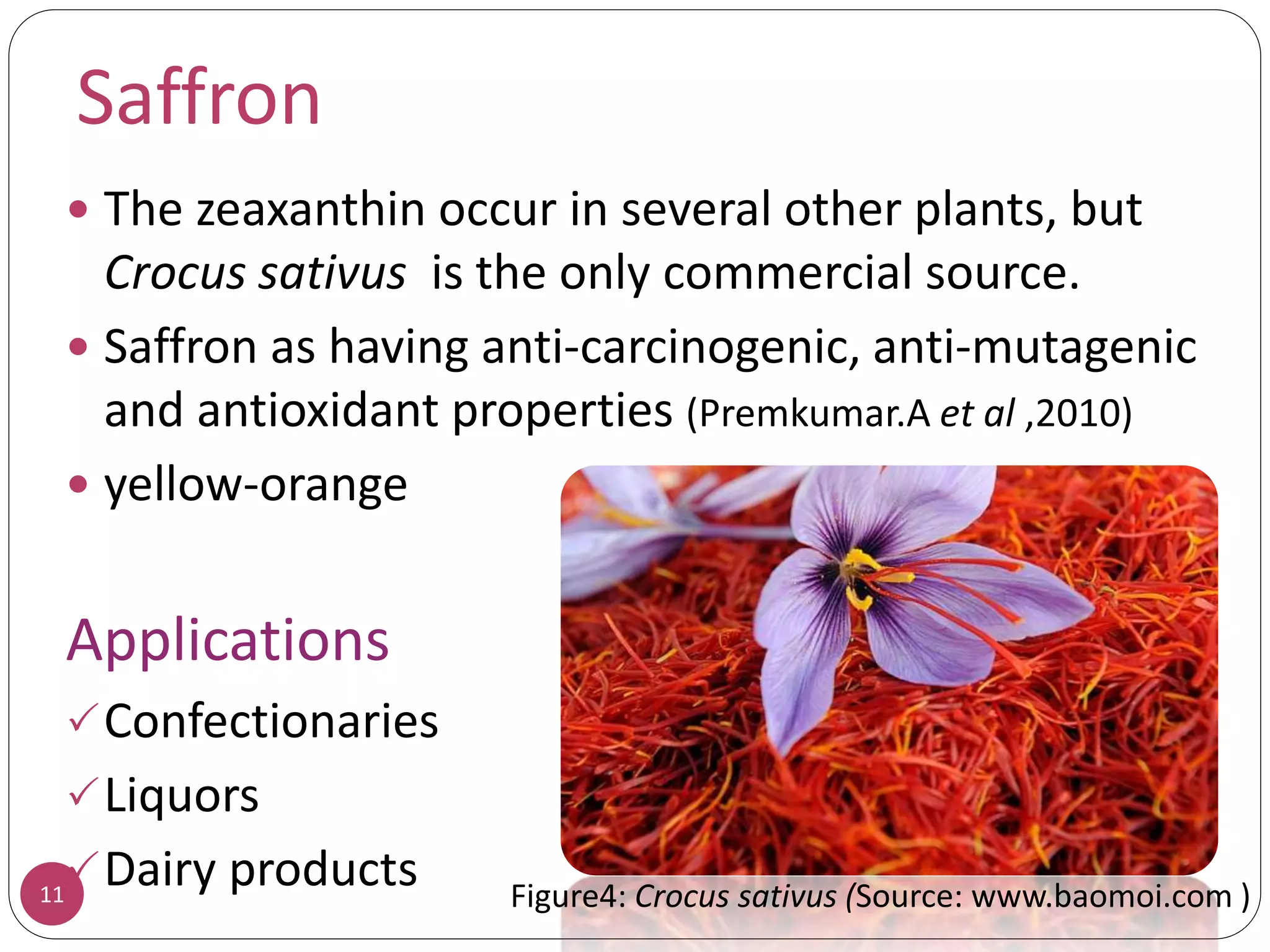
 The zeaxanthin occur in several other plants, but
Crocus sativus is the only commercial source.
 Saffron as having anti-carcinogenic, anti-mutagenic
and antioxidant properties (Premkumar.A et al ,2010)
 yellow-orange
Applications
Confectionaries
Liquors
Dairy products11 Figure4: Crocus sativus (Source: www.baomoi.com )
LYCOPENE
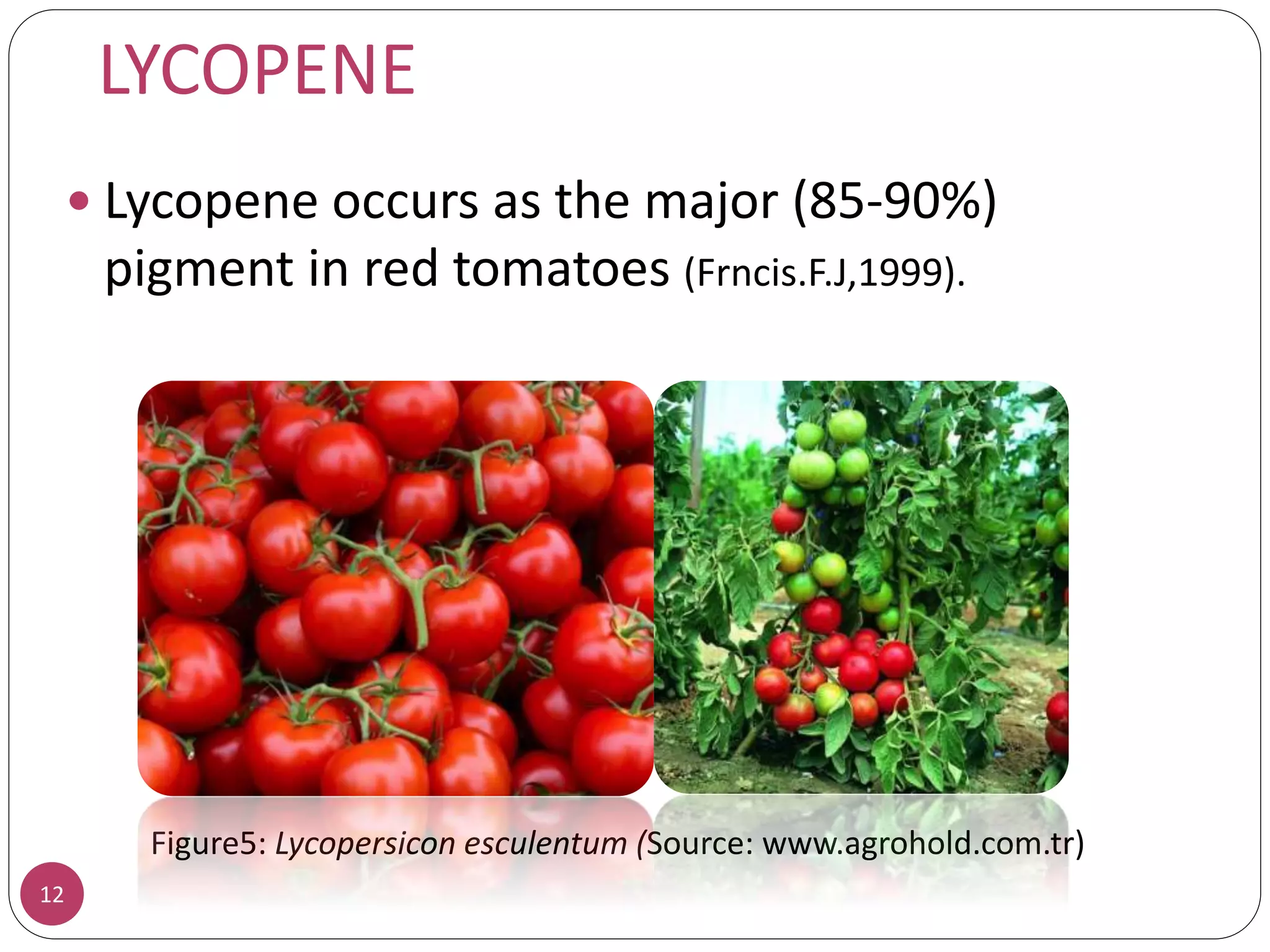
 Lycopene occurs as the major (85-90%)
pigment in red tomatoes (Frncis.F.J,1999).
12
Figure5: Lycopersicon esculentum (Source: www.agrohold.com.tr)
Anthocyanins
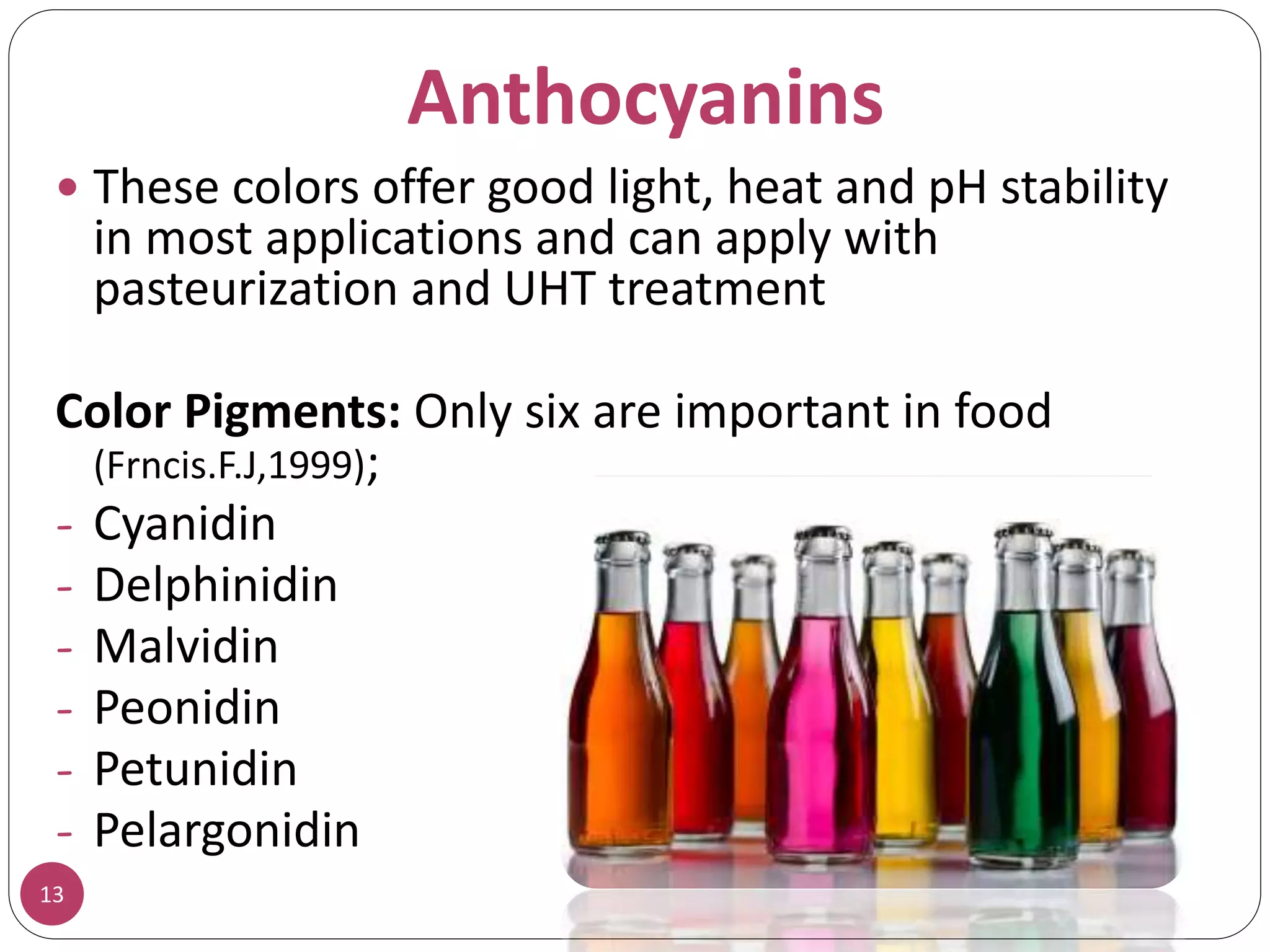
 These colors offer good light, heat and pH stability
in most applications and can apply with
pasteurization and UHT treatment
Color Pigments: Only six are important in food
(Frncis.F.J,1999);
- Cyanidin
- Delphinidin
- Malvidin
- Peonidin
- Petunidin
- Pelargonidin
13
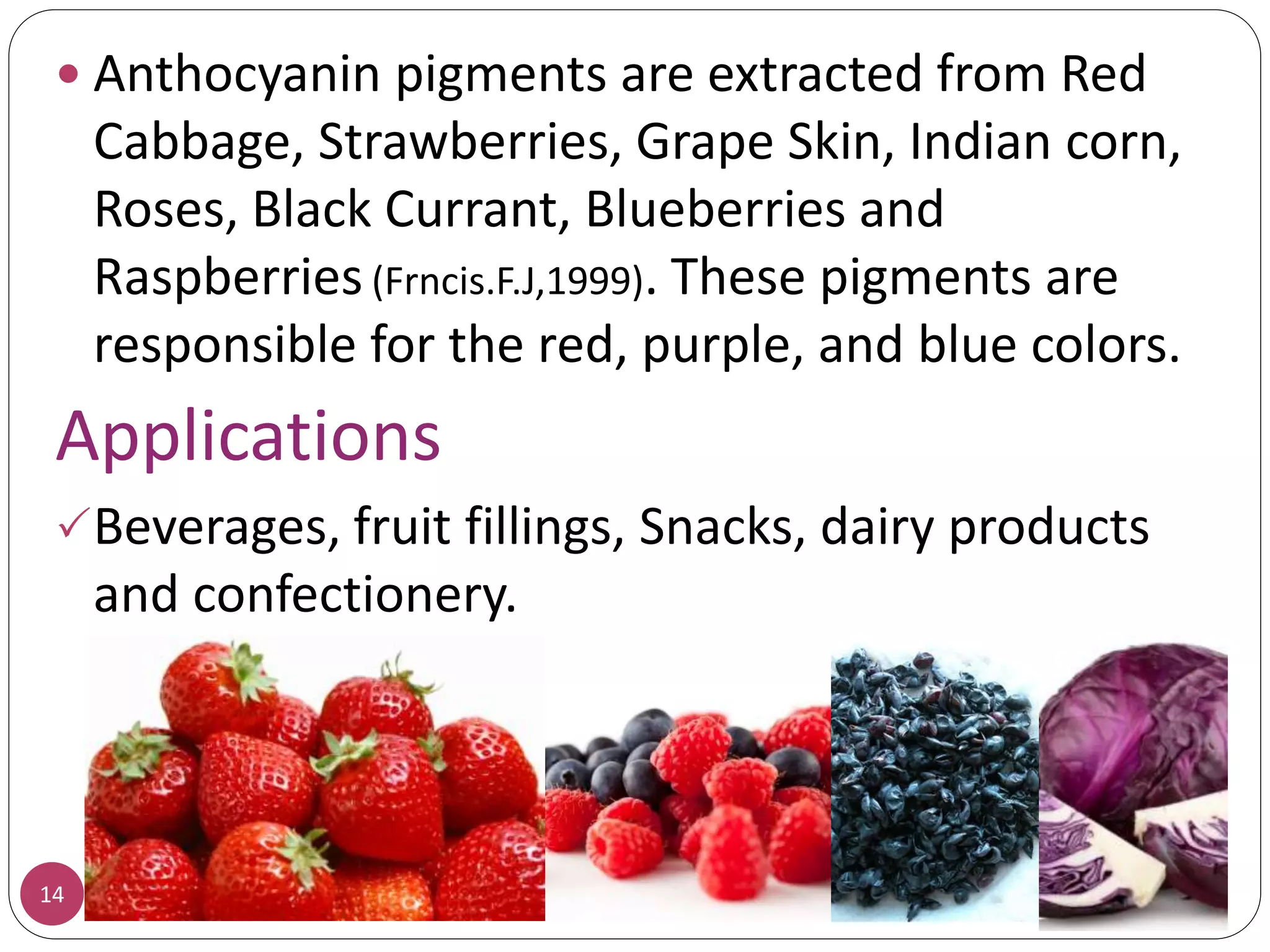
 Anthocyanin pigments are extracted from Red
Cabbage, Strawberries, Grape Skin, Indian corn,
Roses, Black Currant, Blueberries and
Raspberries (Frncis.F.J,1999). These pigments are
responsible for the red, purple, and blue colors.
Applications
Beverages, fruit fillings, Snacks, dairy products
and confectionery.
14
Extraction
15
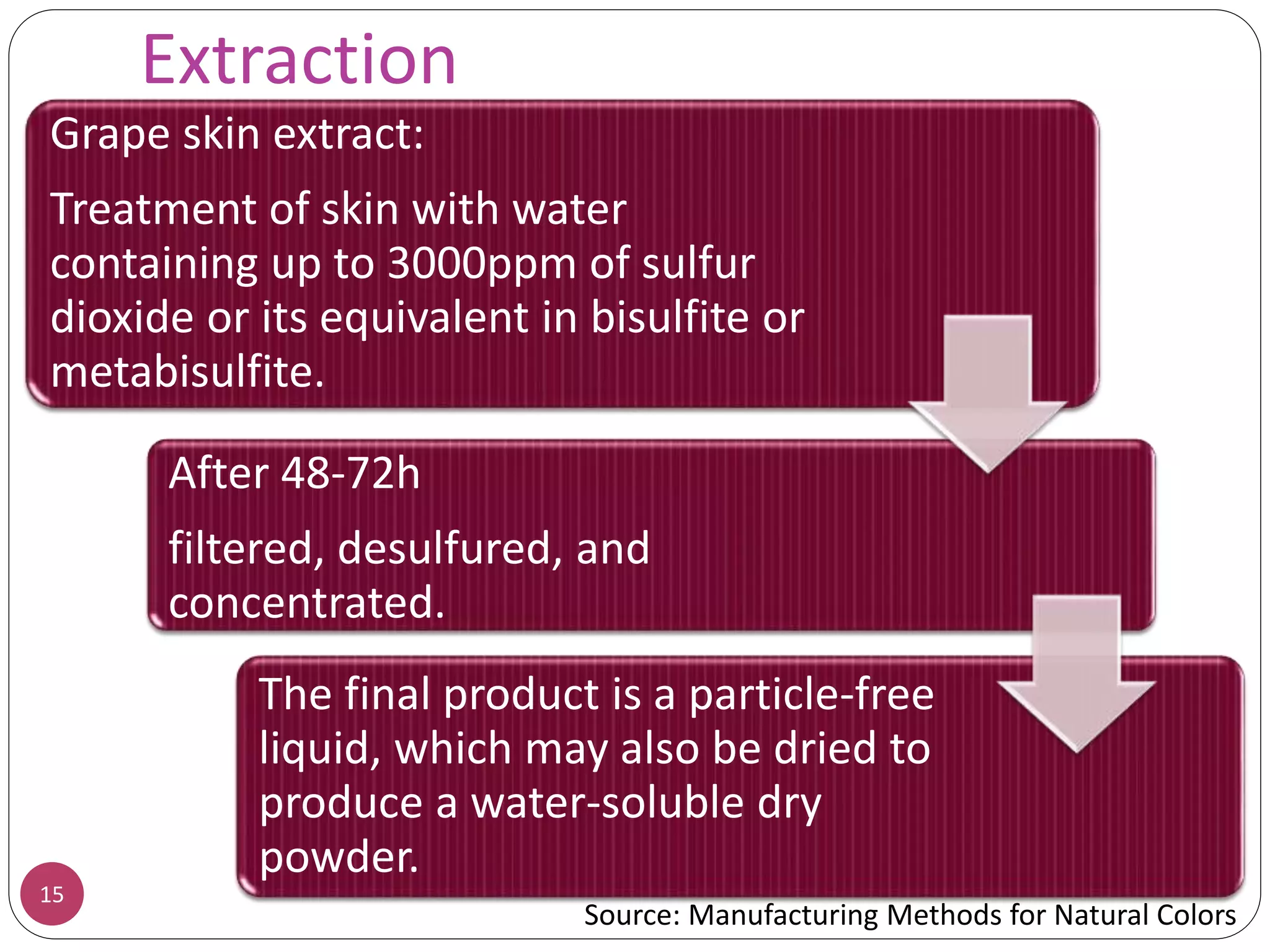
Grape skin extract:
Treatment of skin with water
containing up to 3000ppm of sulfur
dioxide or its equivalent in bisulfite or
metabisulfite.
After 48-72h
filtered, desulfured, and
concentrated.
The final product is a particle-free
liquid, which may also be dried to
produce a water-soluble dry
powder.
Source: Manufacturing Methods for Natural Colors
16
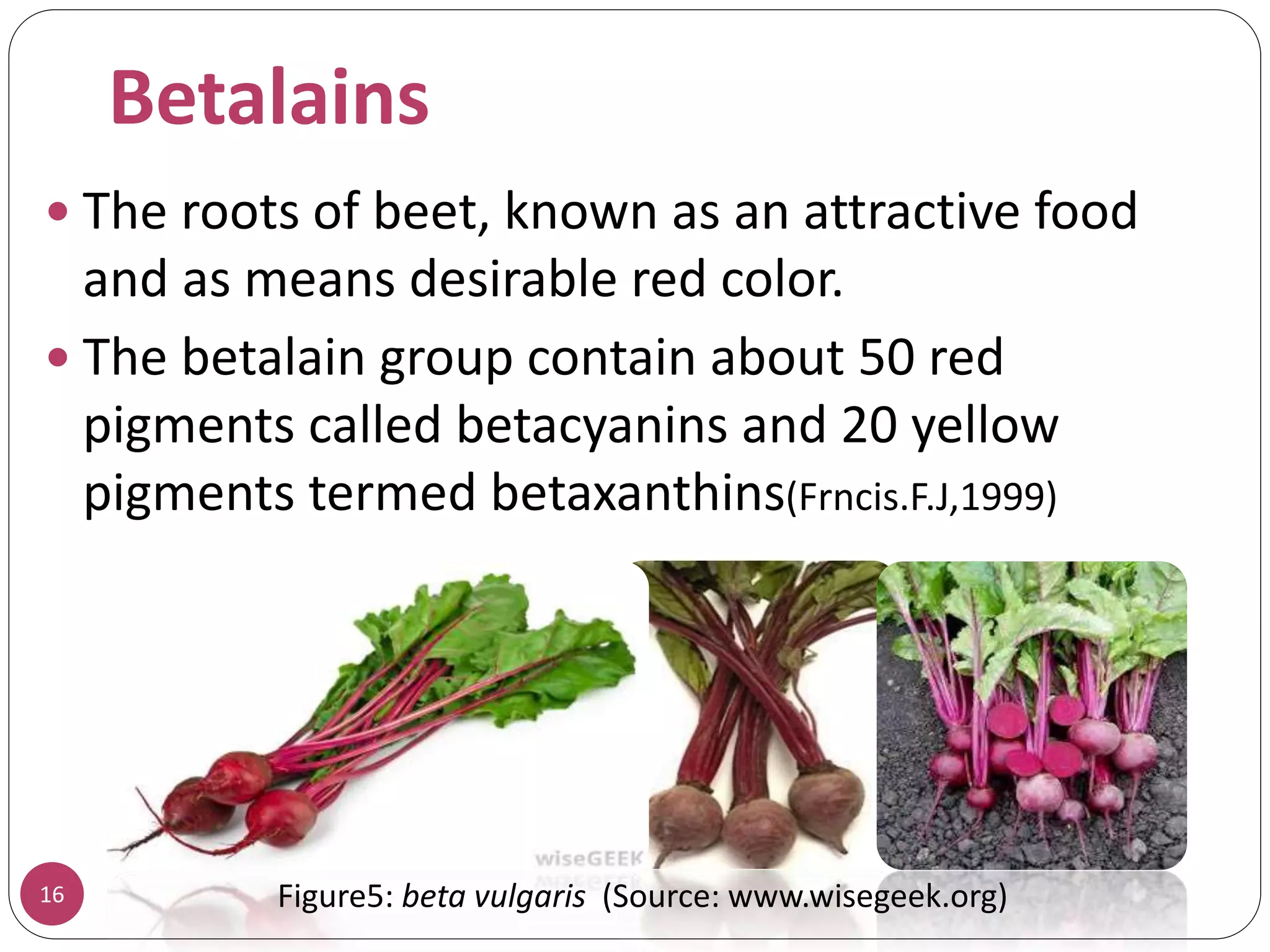
 The roots of beet, known as an attractive food
and as means desirable red color.
 The betalain group contain about 50 red
pigments called betacyanins and 20 yellow
pigments termed betaxanthins(Frncis.F.J,1999)
Figure5: beta vulgaris (Source: www.wisegeek.org)
Betalains
Extraction
17
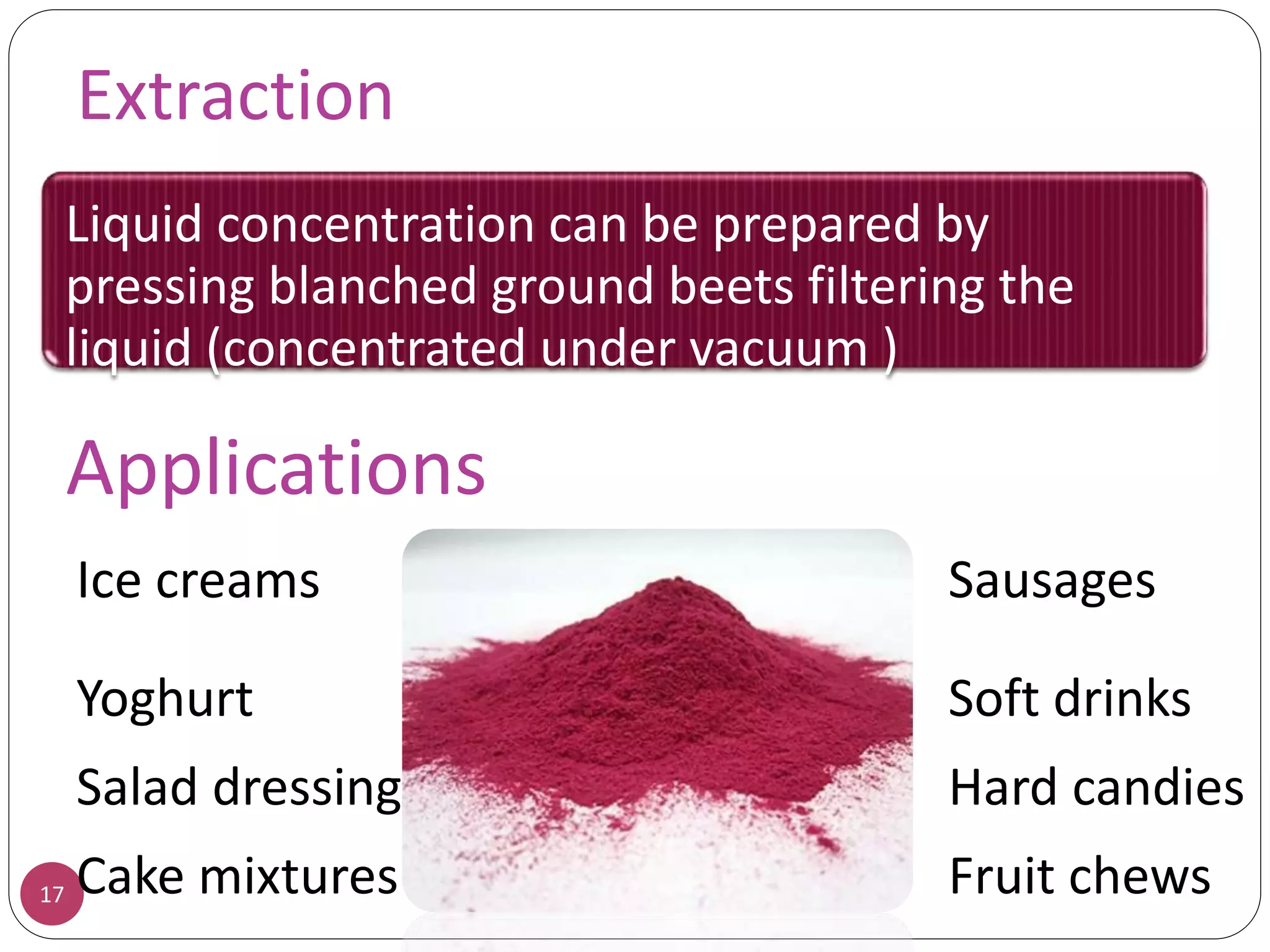
Liquid concentration can be prepared by
pressing blanched ground beets filtering the
liquid (concentrated under vacuum )
Applications
Ice creams Sausages
Yoghurt Soft drinks
Salad dressing Hard candies
Cake mixtures Fruit chews
Chlorophylls
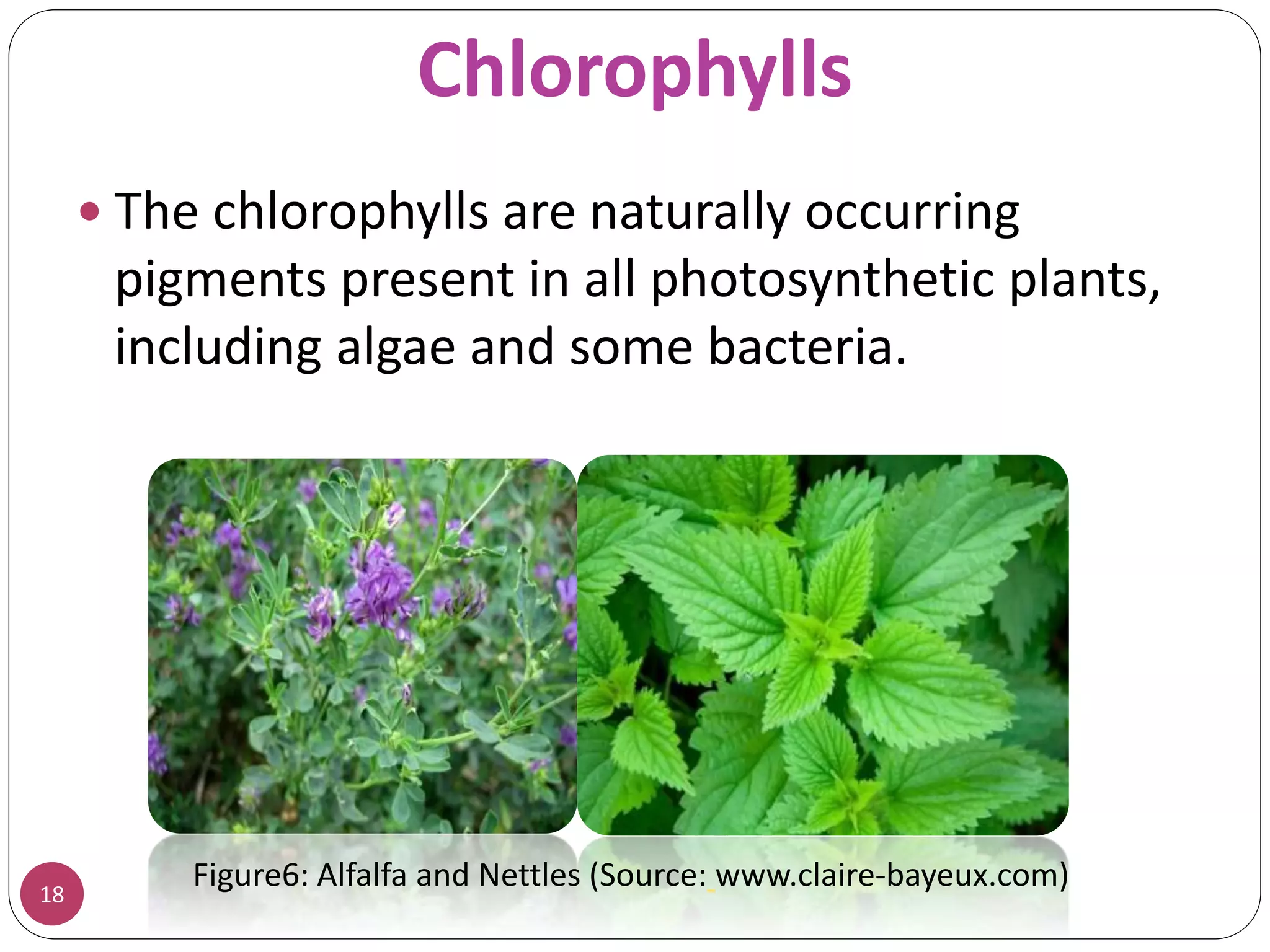
 The chlorophylls are naturally occurring
pigments present in all photosynthetic plants,
including algae and some bacteria.
18
Figure6: Alfalfa and Nettles (Source: www.claire-bayeux.com)
Extraction
19
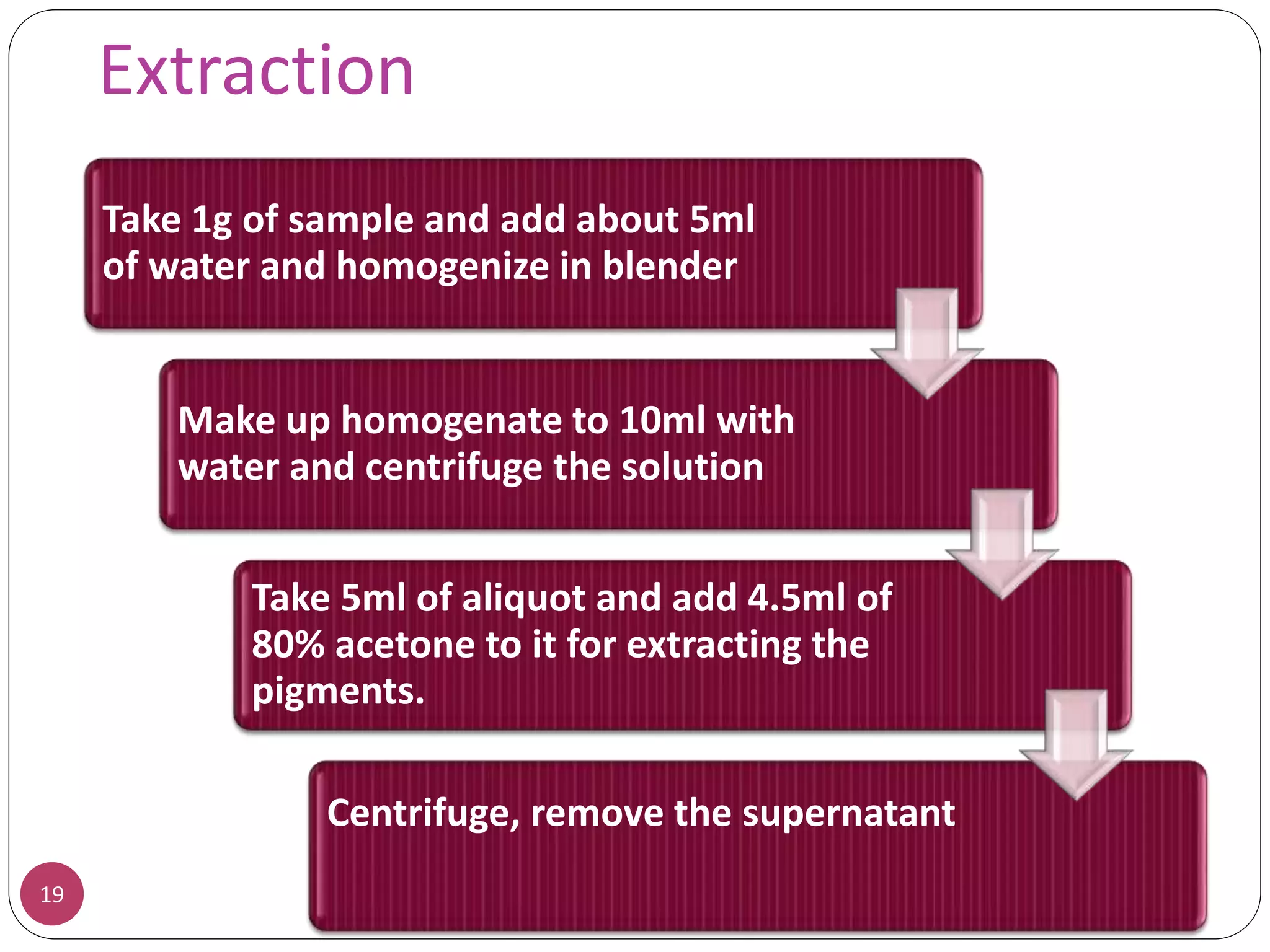
Take 1g of sample and add about 5ml
of water and homogenize in blender
Make up homogenate to 10ml with
water and centrifuge the solution
Take 5ml of aliquot and add 4.5ml of
80% acetone to it for extracting the
pigments.
Centrifuge, remove the supernatant
Applications
20
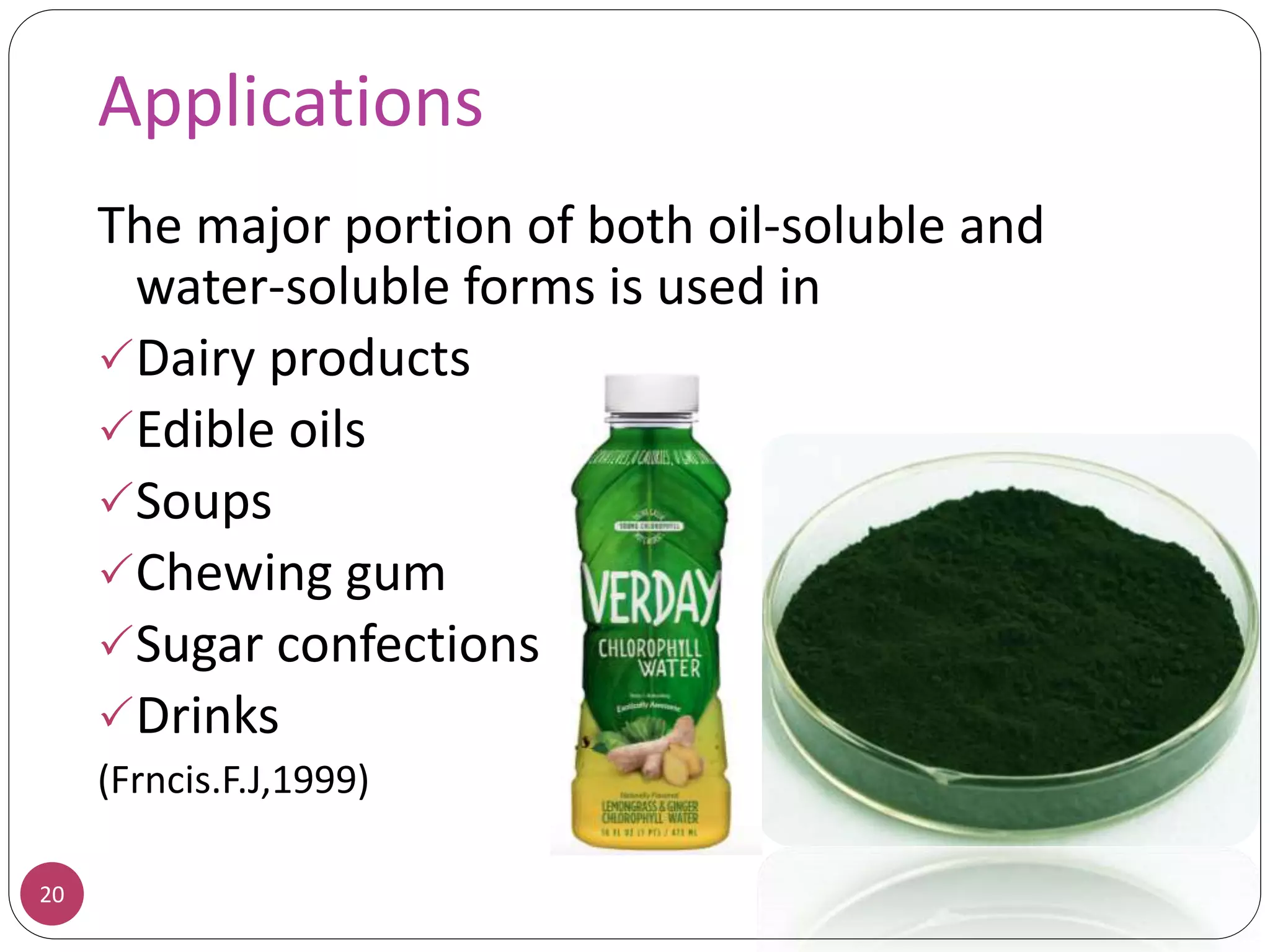
The major portion of both oil-soluble and
water-soluble forms is used in
Dairy products
Edible oils
Soups
Chewing gum
Sugar confections
Drinks
(Frncis.F.J,1999)
Phycobilins
21
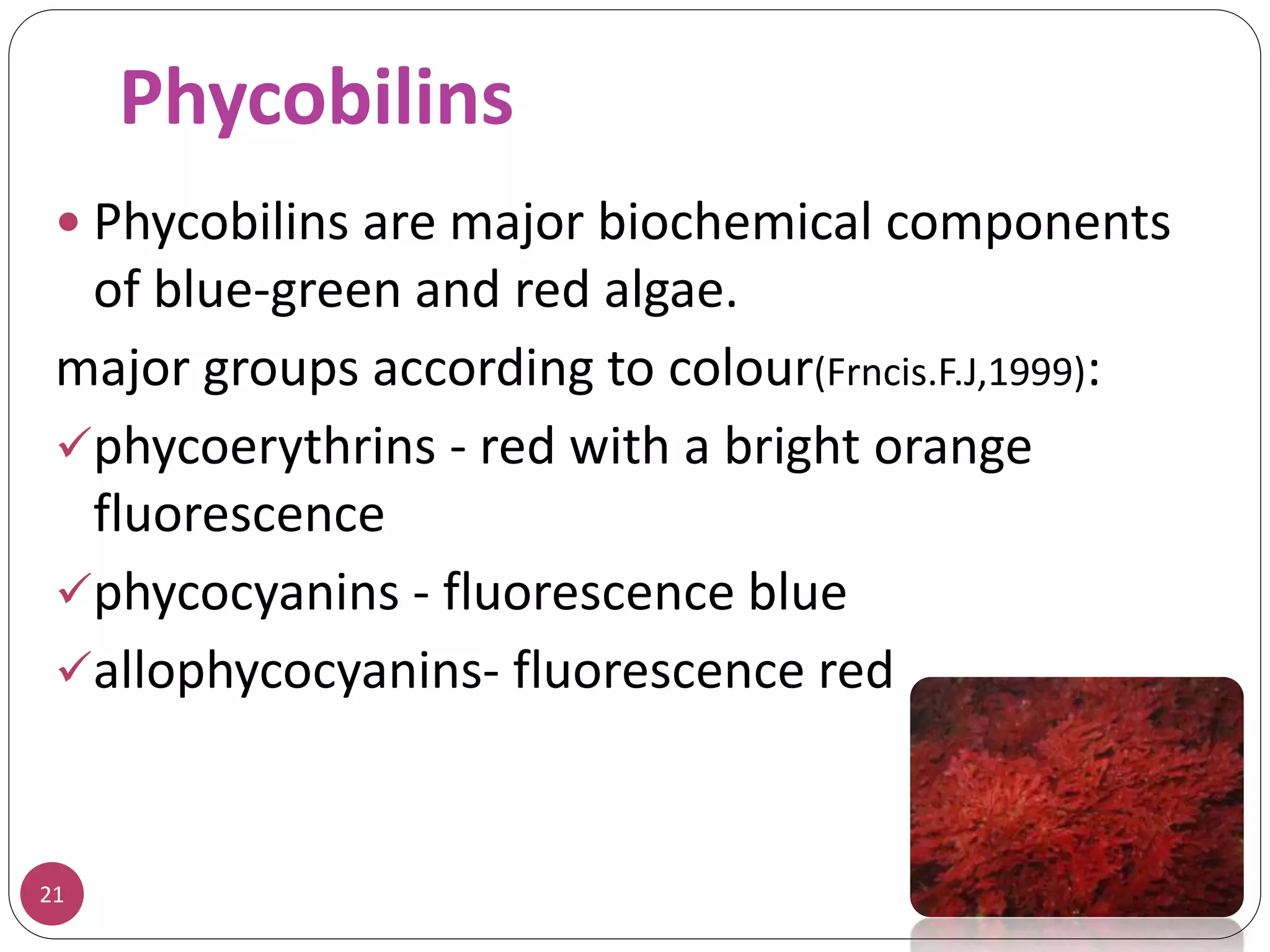
 Phycobilins are major biochemical components
of blue-green and red algae.
major groups according to colour(Frncis.F.J,1999):
phycoerythrins - red with a bright orange
fluorescence
phycocyanins - fluorescence blue
allophycocyanins- fluorescence red
Extraction
22
Freeze drying
Centrifuged for removal of
chlorophyll and carotene
-Ammonium sulfate
-ion exchange
Application
Chewing gum
Soft drinks
Ice creams
Anthraquinones
23
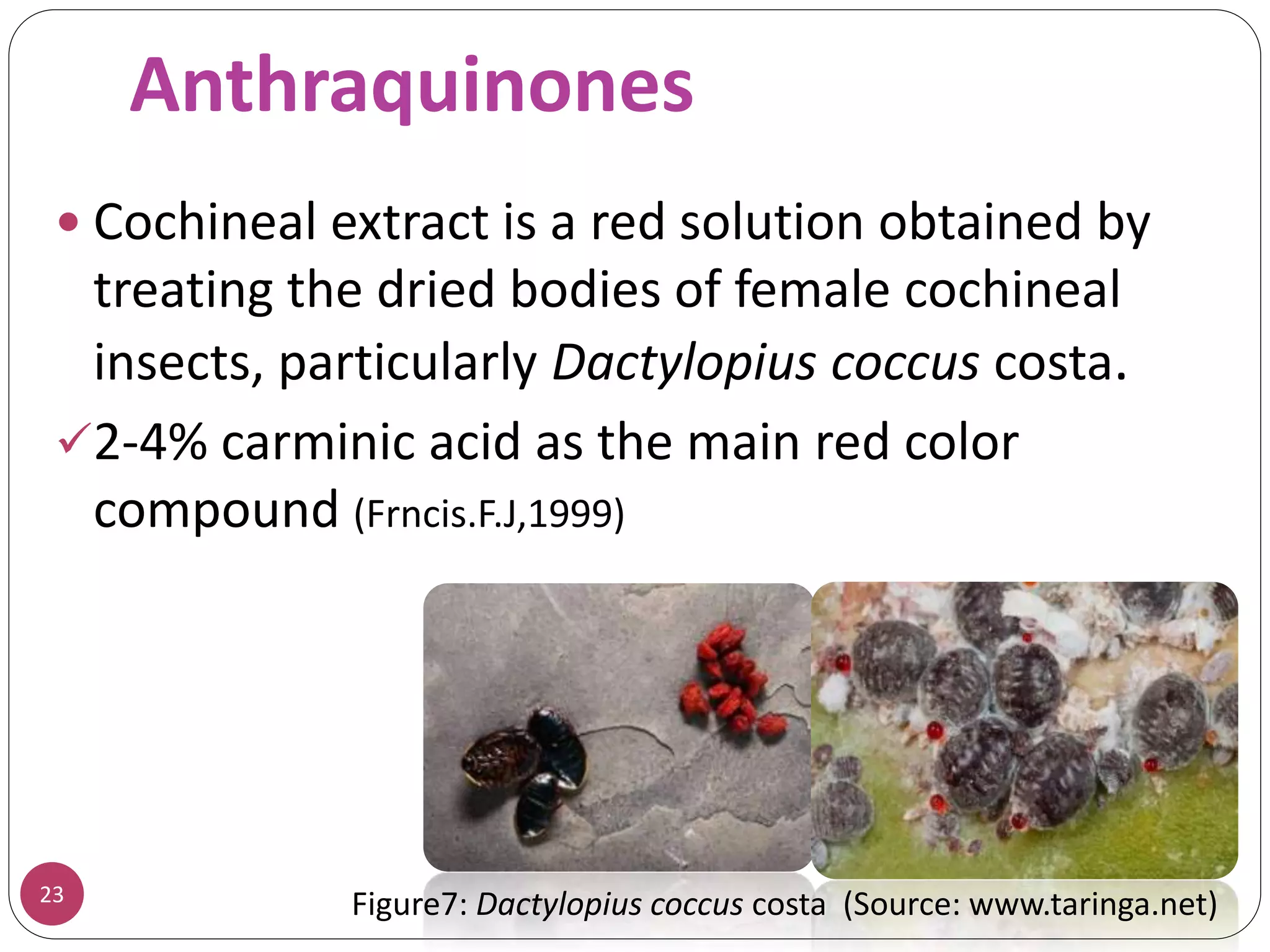
 Cochineal extract is a red solution obtained by
treating the dried bodies of female cochineal
insects, particularly Dactylopius coccus costa.
2-4% carminic acid as the main red color
compound (Frncis.F.J,1999)
Figure7: Dactylopius coccus costa (Source: www.taringa.net)
Applications
24
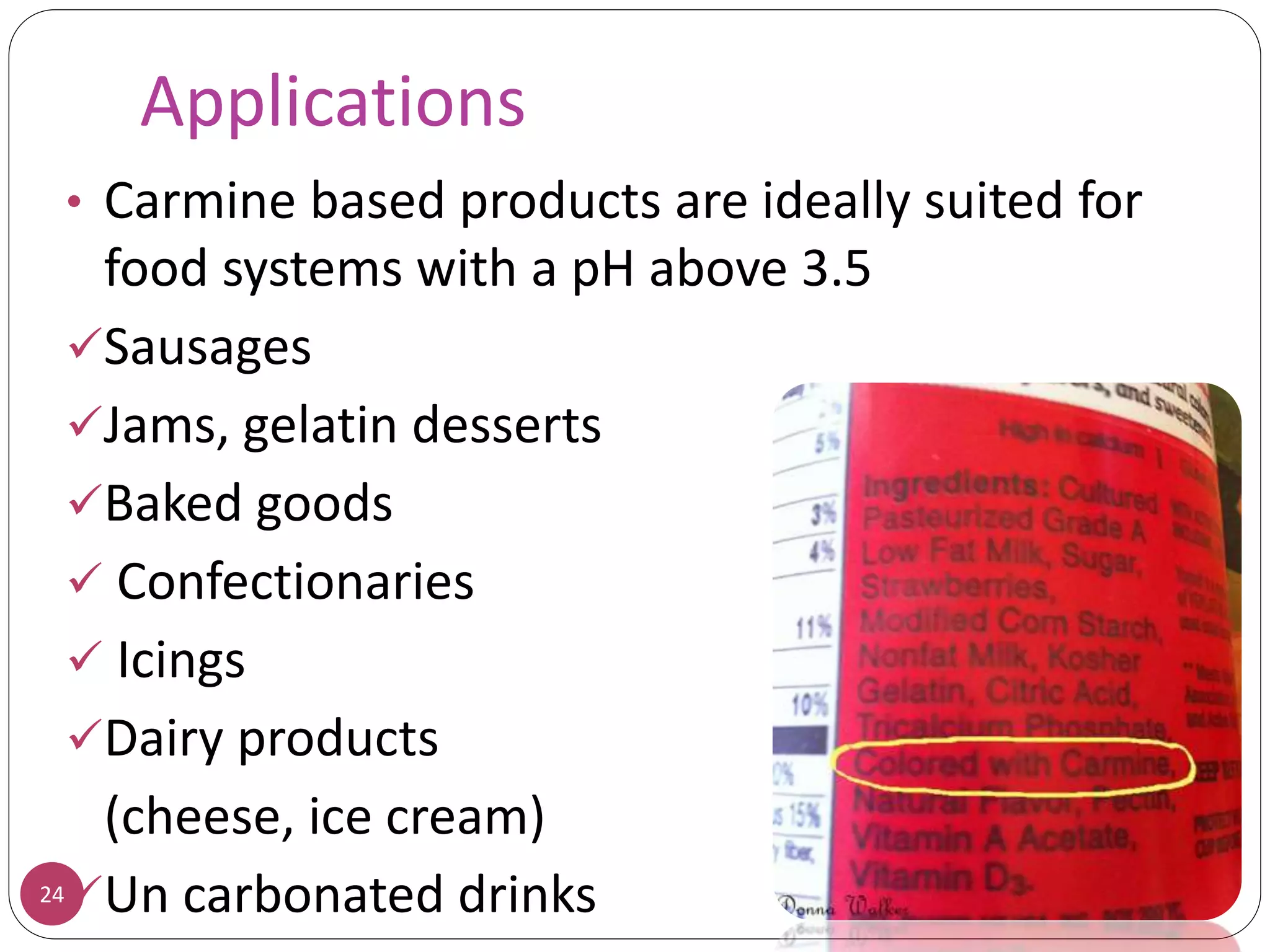
• Carmine based products are ideally suited for
food systems with a pH above 3.5
Sausages
Jams, gelatin desserts
Baked goods
 Confectionaries
 Icings
Dairy products
(cheese, ice cream)
Un carbonated drinks
Turmeric
25
 Turmeric is the dried ground rhizomes of several
spices of curcuma longa
 The dried rhizome is ground and curcumin is
extracted using a solvent
 Turmeric is a bright yellow powder with a
characteristics odor and taste
Figure8: curcuma longa & turmeric (Souece: www.toxicologycentre.com)
26
Applications
 curcuminto be de-flavored before use in
certain applications.
Ice cream and yougurt, cheeses,
Backed goods,
Confectionery,
Cooking oils,
Sauce,
Salad dressing
pickles
 It is also used alone or in combination with
other colorants such as annatto in spices
Caramel
27
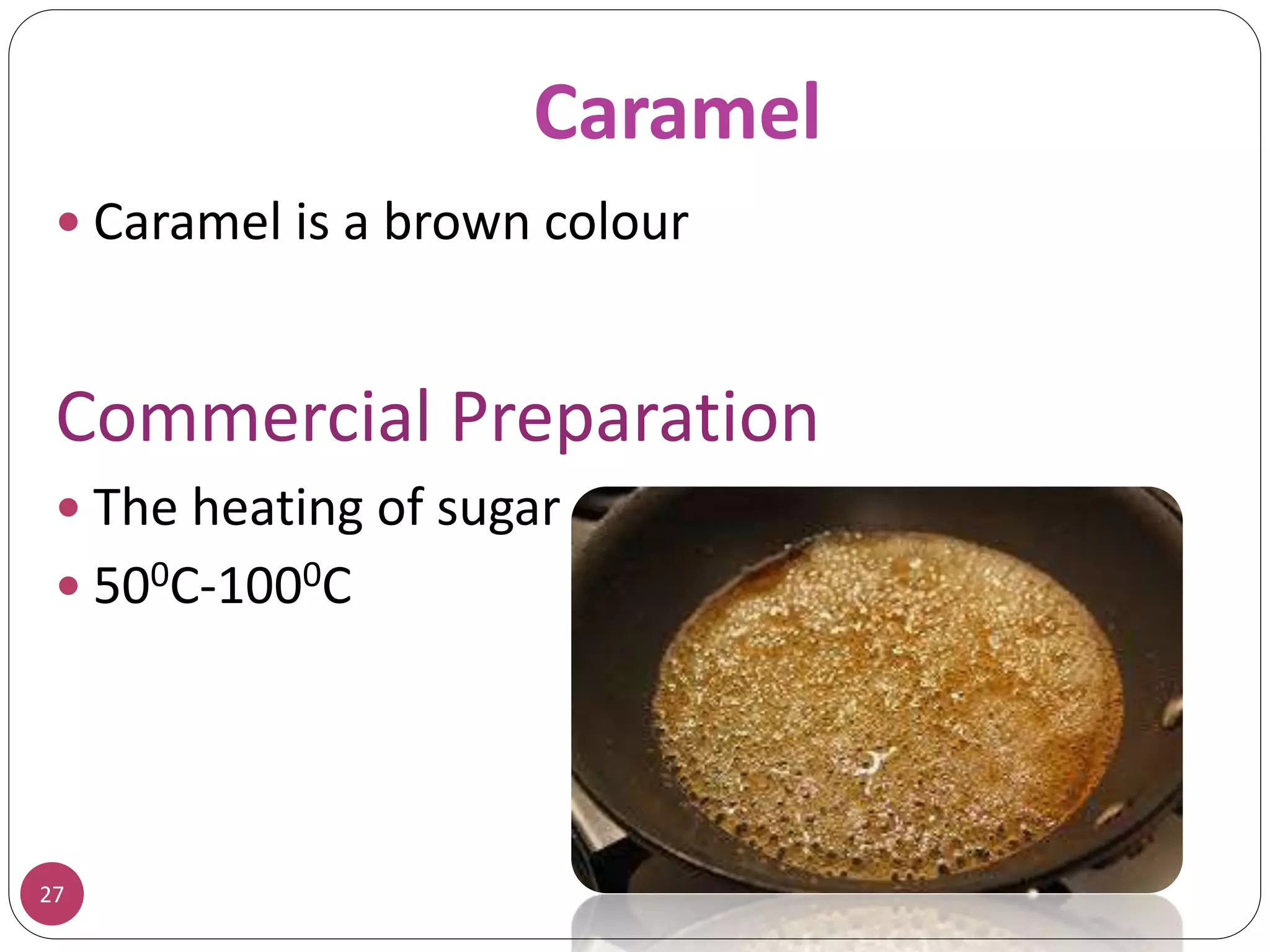
 Caramel is a brown colour
Commercial Preparation
 The heating of sugar
 500C-1000C
28
Class Reactants Applications
I. No ammonium or sulfite
compounds
Distilled spirits,
Spirits, Desserts,
Spice blends
II. Sulfite compound Liquors
III. Ammonium compound Backed goods, beer,
gravies
IV. Both sulfite and
ammonium compounds
Soft drinks, pet
foods, Soups
Table1: Class of Caramel Formulations
Source:Frncis.F.J,1999
Brown Polyphenols
29
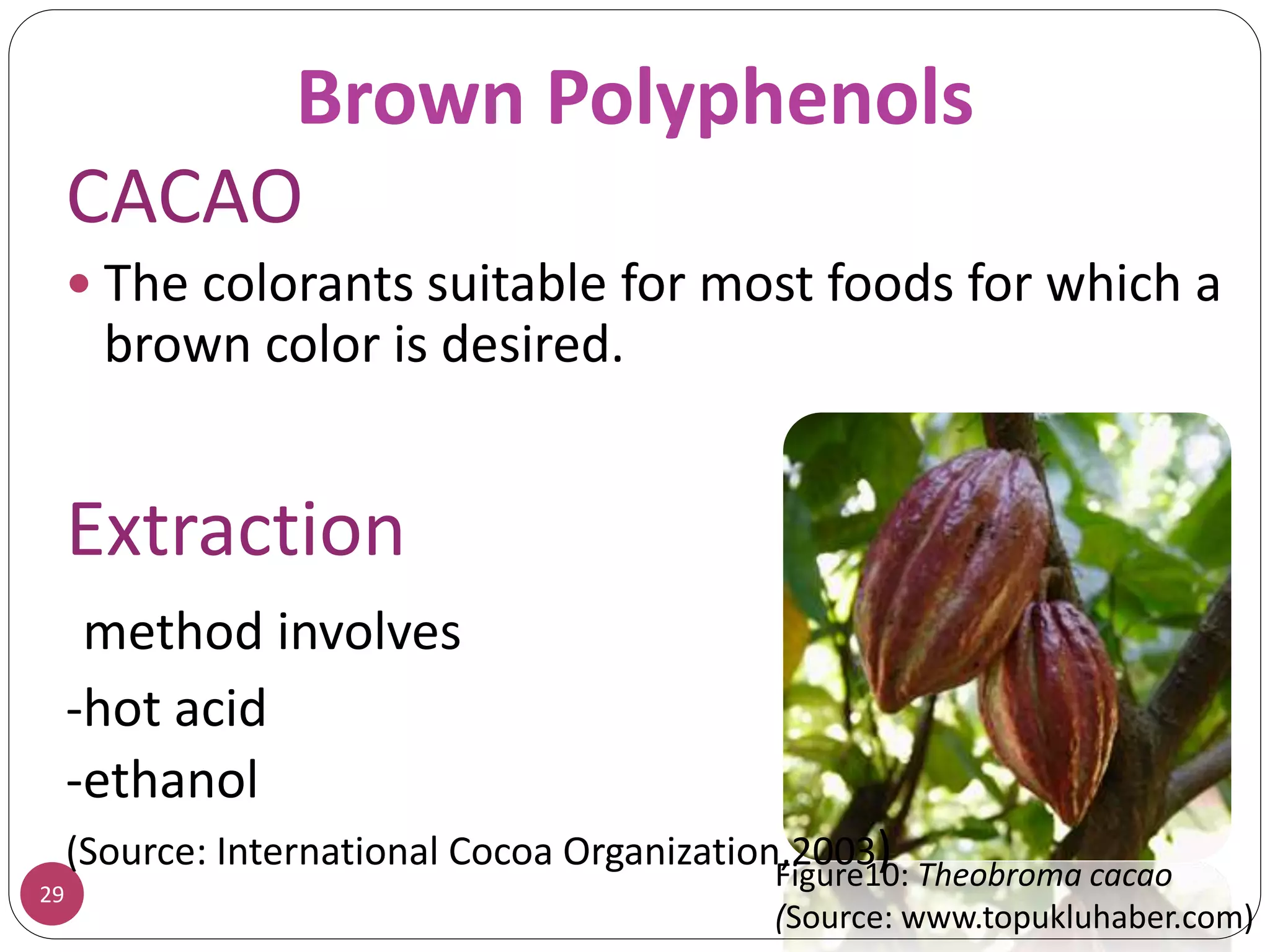
CACAO
 The colorants suitable for most foods for which a
brown color is desired.
Extraction
method involves
-hot acid
-ethanol
(Source: International Cocoa Organization,2003)Figure10: Theobroma cacao
(Source: www.topukluhaber.com)
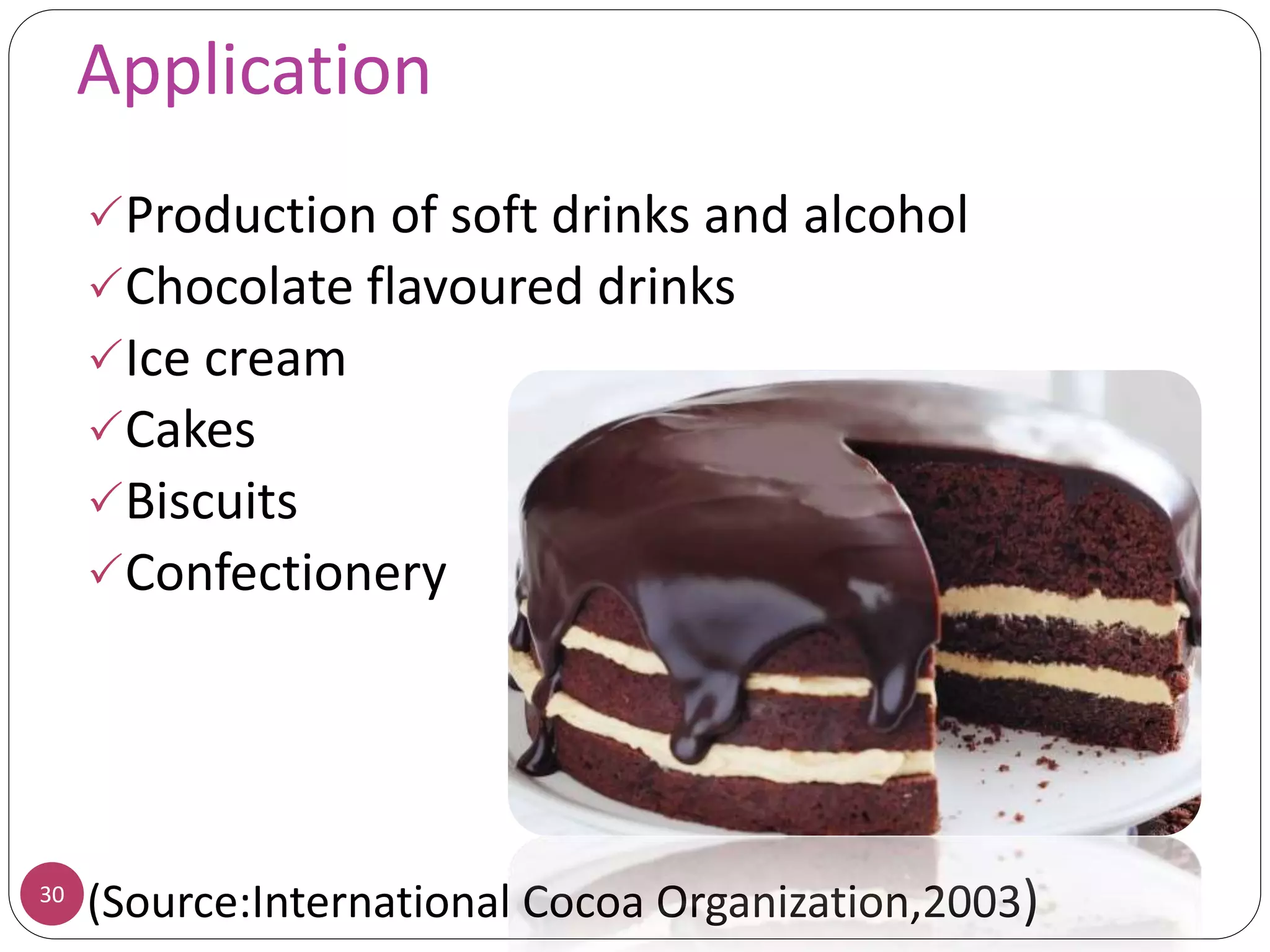
Application
30
Production of soft drinks and alcohol
Chocolate flavoured drinks
Ice cream
Cakes
Biscuits
Confectionery
(Source:International Cocoa Organization,2003)
31
Tea
 Preparation of extracts of tea is usually a
simple extraction of the leaves and steams
with warm water or ethanol, followed by
filtration and concentration.
Application
Ready-to-eat meals
Meat products
Margarines
Spreads
Figure11: Thea sinensis (Source: www.tetosene.no)
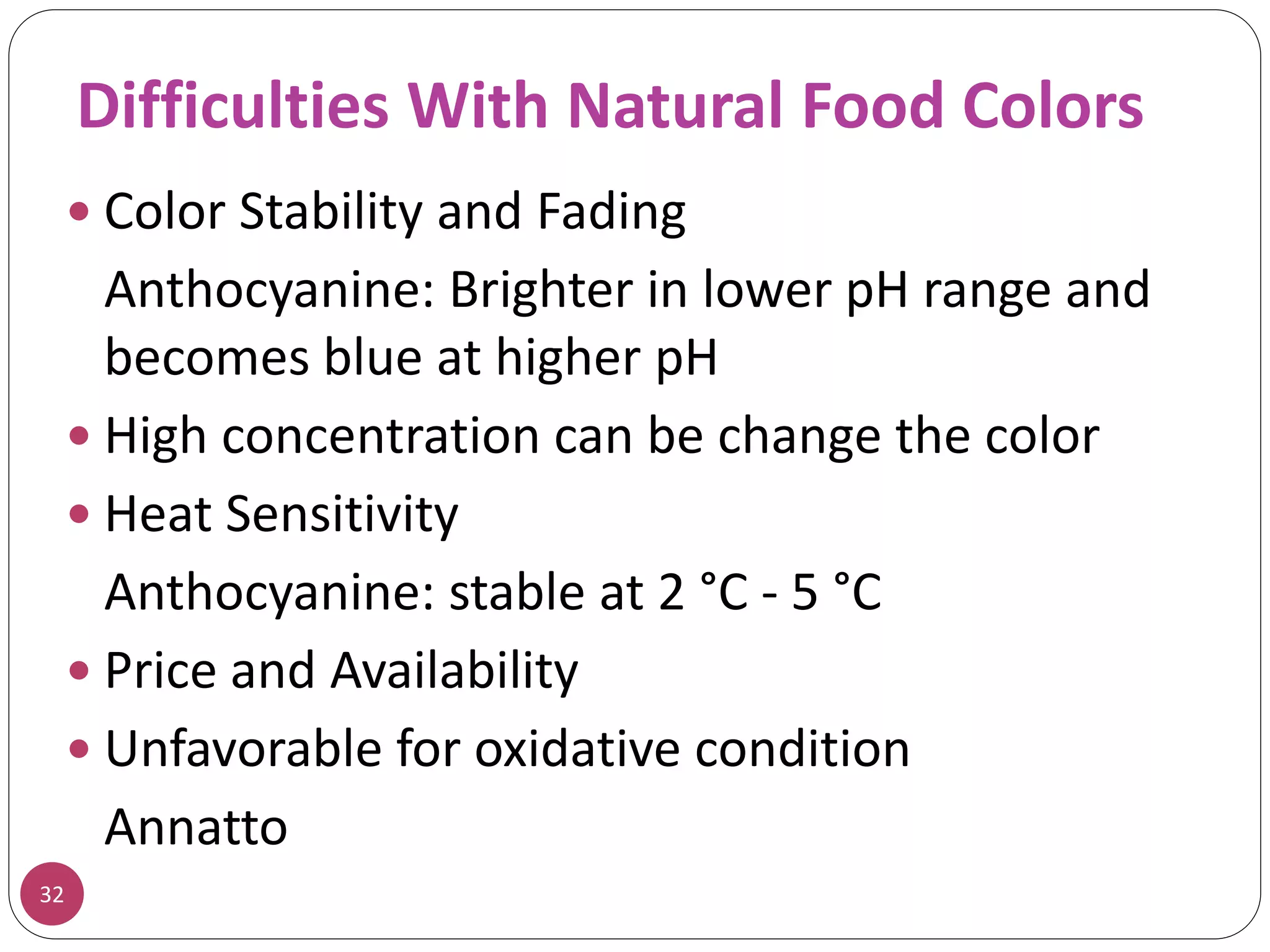
Difficulties With Natural Food Colors
32
 Color Stability and Fading
Anthocyanine: Brighter in lower pH range and
becomes blue at higher pH
 High concentration can be change the color
 Heat Sensitivity
Anthocyanine: stable at 2 °C - 5 °C
 Price and Availability
 Unfavorable for oxidative condition
Annatto
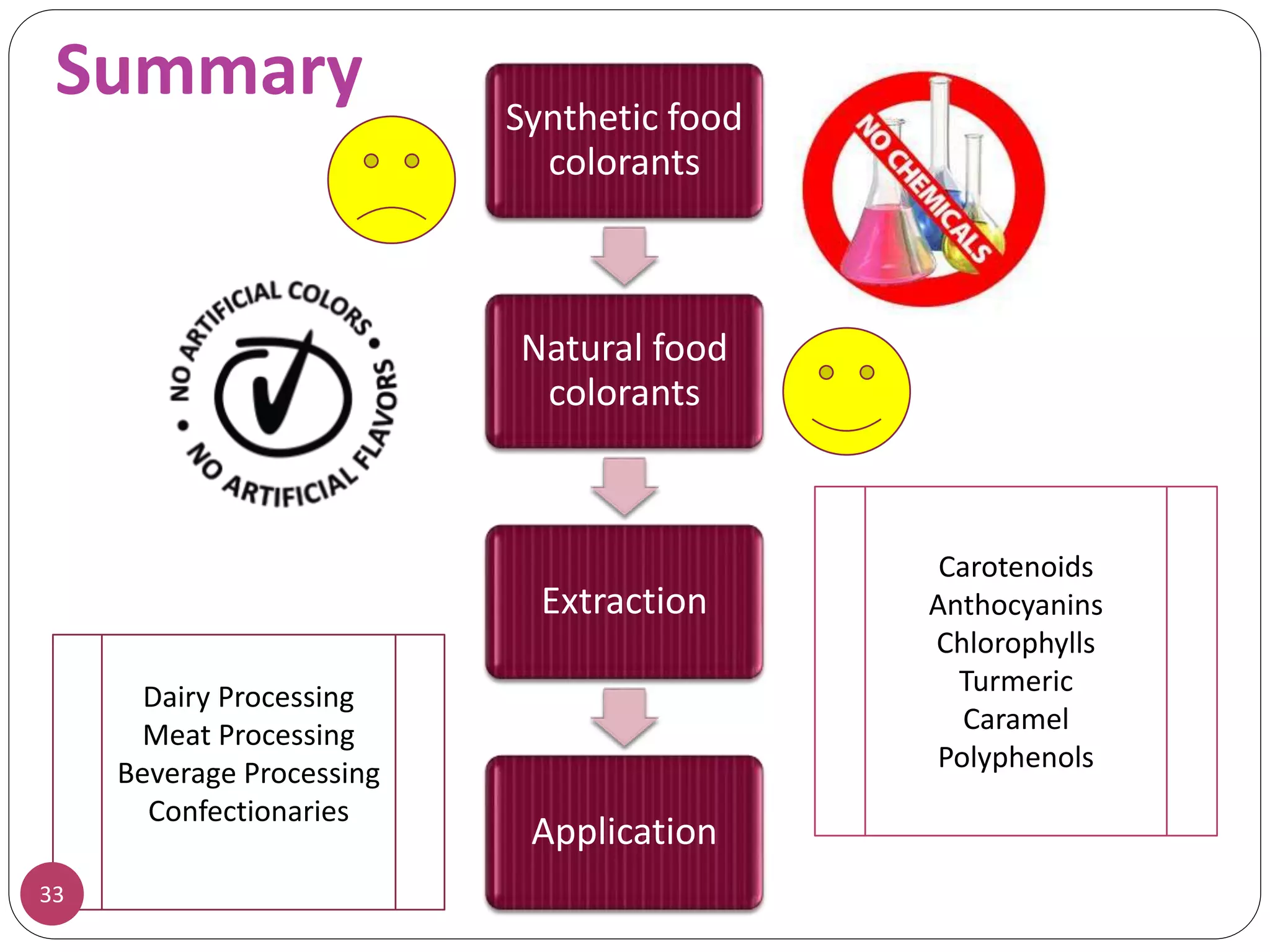
Dairy Processing
Meat Processing
Beverage Processing
Confectionaries
Summary
33
Synthetic food
colorants
Natural food
colorants
Extraction
Application
Carotenoids
Anthocyanins
Chlorophylls
Turmeric
Caramel
Polyphenols
References
34
 Ahmed.A, Food chemistry [pdf] Available at
<http://www.feingold.org/Research/PDFstudies/colors.pdf> [Accessed
on 6th December 2016]
 Bechtold.T, Mussak.R(1998); Hand book of naturl colorants; John wiley &
sons ltd; west sussex; united kingdom; pp 65-147
 Carol.C.B(2013); A comparison of daily consumption of artificial dye-
containing food by American children and adult[pdf] Available at
<http://commons.emich.edu/cgi/viewcontent.cgi?article=1839&context
=theses> [Accessed on 2th April 2016]
 Chitany Laksmi.G(2014); Food colouring: the natural way[pdf] Available
at <http://www.isca.in/rjcs/Archives/v4/i2/15.ISCA-RJCS-2014-007.pdf >
[Accessed on 18th March 2016]
 Francisco, Octavio (2002); Natural colorants for food and Nutraceutical uses;
CRC press; London; pp 7-59
 Frncis.F.J(1999); Colorants; Eagan press; United states of America; pp 43-
124.
 Julia.G.N.D(2007); Food additives; [pdf] Available at
http://www.juliagonen.com/docs/Food-additives.pdf [Accessed
date: 14th February 2016].
35
 Premkumar.A, Ramesh.A(2010), Anti-carcinogenic,
antimutagenic and antioxidant potential of saffron[pdf]
Available at
<http://www.globalsciencebooks.info/Online/GSBOnline/
images/2010/FPSB_4(SI2)/FPSB_4(SI2)91-97o.pdf >
[Accessed on 18th March 2016]
 Smith.J; Annato Extraction [pdf] Available at
<http://ftp.fao.org/ag/agn/jecfa/cta_annatto.pdf>
[Accessed on 20th February 2016]
 Manufacturing Methods for Natural Colors, [online]
[Accessed on 26th January 2016] Available from:
http://www.ddwcolor.com/manufacturing-methods-for-
natural-colors/
 International Cocoa Organization(2003), [online]
[Accessed on 18th march 2016]
Available from: http://www.icco.org/faq/52-by-
products/115-products-that-can-be-made-from-
cocoa.html
36
 Natural food dyes, [online] [Accessed on 26th January 2016]
Available from:
http://www.ebooklibrary.org/articles/Food_color
 Colorants, [online] [Accessed on 26th January 2016]
Available from:
http://web.ist.utl.pt/ist11061/fidel/flaves/sec4/sec4.html
 food ingredient first [pdf] Available at
http://www.foodingredientsfirst.com/news/54-Percent-of-
Global-Consumers-Want-Products-With-Only-Natural-
Colors-Claims-Study?type=article [Accessed on 2nd April
2016]
 Natural food colors (2014), [online] [Accessed on 26th
January 2016]
Available from:
http://foodscintech.blogspot.com/2014/10/natural-food-
colors_29.html
37 Sujeevine…….

Extraction and application of natural food colorants

  • 1.
  • 2.
    Introduction  Food coloris any substance that is added to food to change or enhance its color. 1) Natural colors 2) Synthetic colors 3) Lakes and dyes  The FDA calculated estimated intake of the colorants in 2010 to be roughly 45mg per person per day (Carol.C.B,2013).  The nutrition foundation believed - For children 27mg per day to be average daily intake (Carol.C.B,2013).2
  • 3.
    Erythrosine Cancer 3 Tartrazine Hyperactivity, asthma, skin rashes, Carcinogenic compound Sunset yellow Induceallergies & asthma Cancer Brillint Blue Hyperactivity and skin rashes Adverse effects of Synthetic colorants Allura red May worsen or induce asthma, hives Source:Julia.G.N.D,2007
  • 4.
    Perception of foodcolorants 4 Figure1: consumer perception Source: food ingredient first
  • 5.
    Natural Food Colorants NaturalFood Color is any dye, pigment or any other substance obtained from  Seeds  Fruits  Vegetables  Algae  Insect 5
  • 6.
  • 7.
    CAROTENOIDS Carotenoids can occurin nature in four states 1. As crystals 2. As esters of fatty acids. 3. In combinations with sugars 4. In combination with protein  Some important color pigments of carotenoids Alpha-Carotene Beta-Carotenoids Lycopene Lutein Zeaxanthin Capsanthin Betacrpytoxanthin 7 (Natural food colors ,2014)
  • 8.
    Extraction 8 Applications sorbets beverages Confectionery sauces Fruits or seedsextracted from them are crushed. It is extracted using organic solution
  • 9.
    ANNATTO  Annatto, alsocalled Roucou, used to produce a Orange (red) food coloring and also flavoring agent (Smith.J. ) Cheeses Margarine Butter Rice smoked fish custard powder 9 Figure2: Bixa orellana and it’s seed (source: www.indiannaturaloils.com) Applications
  • 10.
    PAPRIKA  Red toreddish orange color Tomato products pizza meat products  soups Smaller quantities are used in salad dressing, snacks, cheese &confectionery 10 Figure3: Capsicum annuum Source: www.unpri.org Applications
  • 11.
    Saffron  The zeaxanthinoccur in several other plants, but Crocus sativus is the only commercial source.  Saffron as having anti-carcinogenic, anti-mutagenic and antioxidant properties (Premkumar.A et al ,2010)  yellow-orange Applications Confectionaries Liquors Dairy products11 Figure4: Crocus sativus (Source: www.baomoi.com )
  • 12.
    LYCOPENE  Lycopene occursas the major (85-90%) pigment in red tomatoes (Frncis.F.J,1999). 12 Figure5: Lycopersicon esculentum (Source: www.agrohold.com.tr)
  • 13.
    Anthocyanins  These colorsoffer good light, heat and pH stability in most applications and can apply with pasteurization and UHT treatment Color Pigments: Only six are important in food (Frncis.F.J,1999); - Cyanidin - Delphinidin - Malvidin - Peonidin - Petunidin - Pelargonidin 13
  • 14.
     Anthocyanin pigmentsare extracted from Red Cabbage, Strawberries, Grape Skin, Indian corn, Roses, Black Currant, Blueberries and Raspberries (Frncis.F.J,1999). These pigments are responsible for the red, purple, and blue colors. Applications Beverages, fruit fillings, Snacks, dairy products and confectionery. 14
  • 15.
    Extraction 15 Grape skin extract: Treatmentof skin with water containing up to 3000ppm of sulfur dioxide or its equivalent in bisulfite or metabisulfite. After 48-72h filtered, desulfured, and concentrated. The final product is a particle-free liquid, which may also be dried to produce a water-soluble dry powder. Source: Manufacturing Methods for Natural Colors
  • 16.
    16  The rootsof beet, known as an attractive food and as means desirable red color.  The betalain group contain about 50 red pigments called betacyanins and 20 yellow pigments termed betaxanthins(Frncis.F.J,1999) Figure5: beta vulgaris (Source: www.wisegeek.org) Betalains
  • 17.
    Extraction 17 Liquid concentration canbe prepared by pressing blanched ground beets filtering the liquid (concentrated under vacuum ) Applications Ice creams Sausages Yoghurt Soft drinks Salad dressing Hard candies Cake mixtures Fruit chews
  • 18.
    Chlorophylls  The chlorophyllsare naturally occurring pigments present in all photosynthetic plants, including algae and some bacteria. 18 Figure6: Alfalfa and Nettles (Source: www.claire-bayeux.com)
  • 19.
    Extraction 19 Take 1g ofsample and add about 5ml of water and homogenize in blender Make up homogenate to 10ml with water and centrifuge the solution Take 5ml of aliquot and add 4.5ml of 80% acetone to it for extracting the pigments. Centrifuge, remove the supernatant
  • 20.
    Applications 20 The major portionof both oil-soluble and water-soluble forms is used in Dairy products Edible oils Soups Chewing gum Sugar confections Drinks (Frncis.F.J,1999)
  • 21.
    Phycobilins 21  Phycobilins aremajor biochemical components of blue-green and red algae. major groups according to colour(Frncis.F.J,1999): phycoerythrins - red with a bright orange fluorescence phycocyanins - fluorescence blue allophycocyanins- fluorescence red
  • 22.
    Extraction 22 Freeze drying Centrifuged forremoval of chlorophyll and carotene -Ammonium sulfate -ion exchange Application Chewing gum Soft drinks Ice creams
  • 23.
    Anthraquinones 23  Cochineal extractis a red solution obtained by treating the dried bodies of female cochineal insects, particularly Dactylopius coccus costa. 2-4% carminic acid as the main red color compound (Frncis.F.J,1999) Figure7: Dactylopius coccus costa (Source: www.taringa.net)
  • 24.
    Applications 24 • Carmine basedproducts are ideally suited for food systems with a pH above 3.5 Sausages Jams, gelatin desserts Baked goods  Confectionaries  Icings Dairy products (cheese, ice cream) Un carbonated drinks
  • 25.
    Turmeric 25  Turmeric isthe dried ground rhizomes of several spices of curcuma longa  The dried rhizome is ground and curcumin is extracted using a solvent  Turmeric is a bright yellow powder with a characteristics odor and taste Figure8: curcuma longa & turmeric (Souece: www.toxicologycentre.com)
  • 26.
    26 Applications  curcuminto bede-flavored before use in certain applications. Ice cream and yougurt, cheeses, Backed goods, Confectionery, Cooking oils, Sauce, Salad dressing pickles  It is also used alone or in combination with other colorants such as annatto in spices
  • 27.
    Caramel 27  Caramel isa brown colour Commercial Preparation  The heating of sugar  500C-1000C
  • 28.
    28 Class Reactants Applications I.No ammonium or sulfite compounds Distilled spirits, Spirits, Desserts, Spice blends II. Sulfite compound Liquors III. Ammonium compound Backed goods, beer, gravies IV. Both sulfite and ammonium compounds Soft drinks, pet foods, Soups Table1: Class of Caramel Formulations Source:Frncis.F.J,1999
  • 29.
    Brown Polyphenols 29 CACAO  Thecolorants suitable for most foods for which a brown color is desired. Extraction method involves -hot acid -ethanol (Source: International Cocoa Organization,2003)Figure10: Theobroma cacao (Source: www.topukluhaber.com)
  • 30.
    Application 30 Production of softdrinks and alcohol Chocolate flavoured drinks Ice cream Cakes Biscuits Confectionery (Source:International Cocoa Organization,2003)
  • 31.
    31 Tea  Preparation ofextracts of tea is usually a simple extraction of the leaves and steams with warm water or ethanol, followed by filtration and concentration. Application Ready-to-eat meals Meat products Margarines Spreads Figure11: Thea sinensis (Source: www.tetosene.no)
  • 32.
    Difficulties With NaturalFood Colors 32  Color Stability and Fading Anthocyanine: Brighter in lower pH range and becomes blue at higher pH  High concentration can be change the color  Heat Sensitivity Anthocyanine: stable at 2 °C - 5 °C  Price and Availability  Unfavorable for oxidative condition Annatto
  • 33.
    Dairy Processing Meat Processing BeverageProcessing Confectionaries Summary 33 Synthetic food colorants Natural food colorants Extraction Application Carotenoids Anthocyanins Chlorophylls Turmeric Caramel Polyphenols
  • 34.
    References 34  Ahmed.A, Foodchemistry [pdf] Available at <http://www.feingold.org/Research/PDFstudies/colors.pdf> [Accessed on 6th December 2016]  Bechtold.T, Mussak.R(1998); Hand book of naturl colorants; John wiley & sons ltd; west sussex; united kingdom; pp 65-147  Carol.C.B(2013); A comparison of daily consumption of artificial dye- containing food by American children and adult[pdf] Available at <http://commons.emich.edu/cgi/viewcontent.cgi?article=1839&context =theses> [Accessed on 2th April 2016]  Chitany Laksmi.G(2014); Food colouring: the natural way[pdf] Available at <http://www.isca.in/rjcs/Archives/v4/i2/15.ISCA-RJCS-2014-007.pdf > [Accessed on 18th March 2016]  Francisco, Octavio (2002); Natural colorants for food and Nutraceutical uses; CRC press; London; pp 7-59  Frncis.F.J(1999); Colorants; Eagan press; United states of America; pp 43- 124.  Julia.G.N.D(2007); Food additives; [pdf] Available at http://www.juliagonen.com/docs/Food-additives.pdf [Accessed date: 14th February 2016].
  • 35.
    35  Premkumar.A, Ramesh.A(2010),Anti-carcinogenic, antimutagenic and antioxidant potential of saffron[pdf] Available at <http://www.globalsciencebooks.info/Online/GSBOnline/ images/2010/FPSB_4(SI2)/FPSB_4(SI2)91-97o.pdf > [Accessed on 18th March 2016]  Smith.J; Annato Extraction [pdf] Available at <http://ftp.fao.org/ag/agn/jecfa/cta_annatto.pdf> [Accessed on 20th February 2016]  Manufacturing Methods for Natural Colors, [online] [Accessed on 26th January 2016] Available from: http://www.ddwcolor.com/manufacturing-methods-for- natural-colors/  International Cocoa Organization(2003), [online] [Accessed on 18th march 2016] Available from: http://www.icco.org/faq/52-by- products/115-products-that-can-be-made-from- cocoa.html
  • 36.
    36  Natural fooddyes, [online] [Accessed on 26th January 2016] Available from: http://www.ebooklibrary.org/articles/Food_color  Colorants, [online] [Accessed on 26th January 2016] Available from: http://web.ist.utl.pt/ist11061/fidel/flaves/sec4/sec4.html  food ingredient first [pdf] Available at http://www.foodingredientsfirst.com/news/54-Percent-of- Global-Consumers-Want-Products-With-Only-Natural- Colors-Claims-Study?type=article [Accessed on 2nd April 2016]  Natural food colors (2014), [online] [Accessed on 26th January 2016] Available from: http://foodscintech.blogspot.com/2014/10/natural-food- colors_29.html
  • 37.

Editor's Notes

  • #4 The demand of natural food colors is increasing as compared to synthetic colors the consumers feel safer and thus recognition and acceptance are easier.
  • #6 The demands on the natural colors industry will not only be for organic colors but also for a generally higher level of information with regard to production methods, specifically HACCP, as well as traceability of all ingredients. FAO is responsible for regulating the natural food colors to ensure that foods containing color additives are safe to eat. So the quality criterion is an important factor for using natural food colors
  • #8 The carotenoids are probably the best known of the food colorants and certainly are one of the largest group of pigments produced in nature. Most of this amount is in the form of fucoxanthin in algae in the ocean and the three main carotenoids of green leaves: lutein, violaxanthin, and neoxanthin. Other pigments predominate in certain plants, such as lycopene in tomatoes, capsanthin and capsorubin in red peppers, and bixin in annatto
  • #10 The concentration of the color is expressed as a percentage of these compounds and the content varies with the extraction method. Oil soluble annattos have a brighter hue. 
  • #14 Anthocyanins are probably the best known of the natural pigments. Ubiquitous in the plant kingdom, the are responsible for many of the orange, red, blue, violet, and magenta colors in plants. Anthocyanins are also polyphenols and are usually classified within the flavonoid group. The only difference is that the anthocyanins are usually orange to red, whereas the other flavonoids are usually colorless or yellow.
  • #17 Red beet contin 75-95% betanin. Beet generally contain both the red betacyanins and low betaxanthins.
  • #18 Dehydrated and ground. Approximately 80% of beetroot juice solids are carbohydrate and nitrogenous compounds. Fermentation of this juice using Candida utilis under partial anaerobic conditions reduced solids substantially, giving five- to sevenfold increase in pigment content on a dry weight basis[4]
  • #19 The plants currently being used to produce chlorophyll colorants include alfalfa (lucerne, Medicago sativa), nettles (urtica dioica), and a series of pasture grasses such as fescue.
  • #20 a portion of a larger whole, especially a sample taken for chemical analysis or other treatment.
  • #24 by treating the dried bodies of female cochineal insects, with aqueous ethanol. After removal of the alcohol, the preparation, called cochineal extract, contains approximately 2-4% carminic acid as the main colorant compound. Cochineal extract or carmine must be declared on the label of all food products intended for human use, including butter, cheese, and ice cream, when present in the food
  • #26 It has been used as a food colorant, as an antioxidant and as an antiseptic in the early civilization. It is considered a representation of prosperity. Many other medicinal qualities have also been identified.