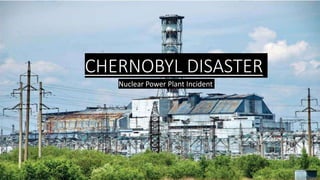
CHERNOBYL DISASTER
Nuclear Power Plant Incident
• Intriduction
• History
• How and Why?
• Disasterous effects
• Management
• Conclusion
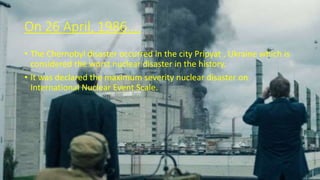
On 26 April, 1986….
• The Chernobyl disaster occurred in the city Pripyat , Ukraine which is
considered the worst nuclear disaster in the history.
• It was declared the maximum severity nuclear disaster on
International Nuclear Event Scale.
History
• In 1970’s
 this was the time when cold war was
going between USSR & USA (1947-91)
 this time was important for USSR as USA
was growing typically, economically and
and in national growth.
Policy makers of USSR decided to make a
new city so they choose one place of USSR
which is in Ukraine and they built a
modern city.
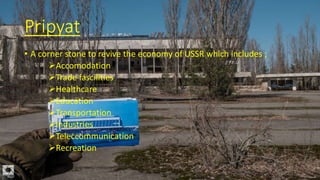
Pripyat
• A corner stone to revive the economy of USSR which includes ;
Accomodation
Trade fascilities
Healthcare
Education
Transportation
Industries
Teleccommunication
Recreation
Since they built a modern city so to fulfill
the electricity requirements , they decided
to built a nuclear power plant in a small
town Chernobyl, in Pripyat.
Thus they gave name to power plant as
Chernobyl Power Plant which has official
name as V.I Lenin atomic power plant.
HOW and WHY ?
• The incident occurred during a safety test of Nuclear reactor.
• The test was basically a simulation of an electrical power outage to
aid the development of procedure for maintaining cooling water
circulation until the back-up generations could provide the power.
• Three such tests have been conducted in 1982 but all failed to
provide the solution.
• This fourth attempt was delayed for 10 hours ,so the operating shift
which had been prepared was not present and thus they failed to
follow procedure.
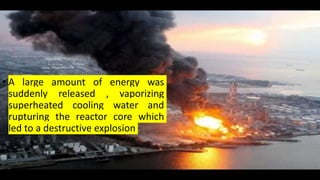
• A large amount of energy was
suddenly released , vaporizing
superheated cooling water and
rupturing the reactor core which
led to a destructive explosion
EFFECTS
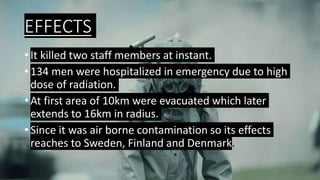
• It killed two staff members at instant.
• 134 men were hospitalized in emergency due to high
dose of radiation.
• At first area of 10km were evacuated which later
extends to 16km in radius.
• Since it was air borne contamination so its effects
reaches to Sweden, Finland and Denmark.
• Air contamination causes diseases like downs
syndrome, chromosomal disorder, mutations and
thyroid cancer.
• Over 7 million peoples got affected by it.
• The extent of radiations was 400 times more than the
explosion of atomic bomb on Heroshima.
To minimize the effect of radiations, the protective
Chernobyl Power plant sarcophagus was formed in
1986 which further enclosed environment safety in
2017. The whole cleanup process is further planned up
to 2065.
CONCLUSION
• Professionally, in each case specially while dealing with
nuclear energy safety must be considered most prior and
government must impose rules of law to save labors working
at such sites.
• Nuclear radiations are highly toxic to human s and
environment , to deal with it the individuals should be
properly trained and experiments should be organized.
THANK YOU!

Chernobyl

  • 1.
  • 2.
    • Intriduction • History •How and Why? • Disasterous effects • Management • Conclusion
  • 3.
    On 26 April,1986…. • The Chernobyl disaster occurred in the city Pripyat , Ukraine which is considered the worst nuclear disaster in the history. • It was declared the maximum severity nuclear disaster on International Nuclear Event Scale.
  • 4.
    History • In 1970’s this was the time when cold war was going between USSR & USA (1947-91)  this time was important for USSR as USA was growing typically, economically and and in national growth. Policy makers of USSR decided to make a new city so they choose one place of USSR which is in Ukraine and they built a modern city.
  • 5.
    Pripyat • A cornerstone to revive the economy of USSR which includes ; Accomodation Trade fascilities Healthcare Education Transportation Industries Teleccommunication Recreation
  • 6.
    Since they builta modern city so to fulfill the electricity requirements , they decided to built a nuclear power plant in a small town Chernobyl, in Pripyat. Thus they gave name to power plant as Chernobyl Power Plant which has official name as V.I Lenin atomic power plant.
  • 7.
    HOW and WHY? • The incident occurred during a safety test of Nuclear reactor. • The test was basically a simulation of an electrical power outage to aid the development of procedure for maintaining cooling water circulation until the back-up generations could provide the power. • Three such tests have been conducted in 1982 but all failed to provide the solution. • This fourth attempt was delayed for 10 hours ,so the operating shift which had been prepared was not present and thus they failed to follow procedure.
  • 8.
    • A largeamount of energy was suddenly released , vaporizing superheated cooling water and rupturing the reactor core which led to a destructive explosion
  • 9.
    EFFECTS • It killedtwo staff members at instant. • 134 men were hospitalized in emergency due to high dose of radiation. • At first area of 10km were evacuated which later extends to 16km in radius. • Since it was air borne contamination so its effects reaches to Sweden, Finland and Denmark.
  • 10.
    • Air contaminationcauses diseases like downs syndrome, chromosomal disorder, mutations and thyroid cancer. • Over 7 million peoples got affected by it. • The extent of radiations was 400 times more than the explosion of atomic bomb on Heroshima.
  • 11.
    To minimize theeffect of radiations, the protective Chernobyl Power plant sarcophagus was formed in 1986 which further enclosed environment safety in 2017. The whole cleanup process is further planned up to 2065.
  • 12.
    CONCLUSION • Professionally, ineach case specially while dealing with nuclear energy safety must be considered most prior and government must impose rules of law to save labors working at such sites. • Nuclear radiations are highly toxic to human s and environment , to deal with it the individuals should be properly trained and experiments should be organized.
  • 13.