How one video changed a life.
Domingo’s classroom goes flat and he goes in a
new direction.
Domingo’s Story
P 293-294
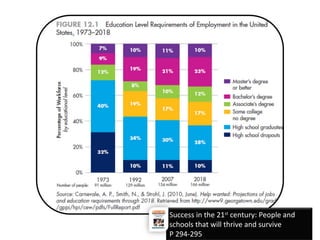
Success in the 21st
century: People and
schools that will thrive and survive
P 294-295
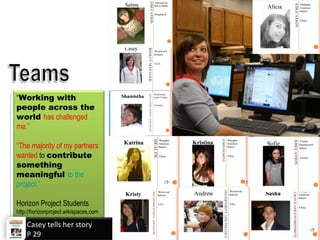
“Working with
people across the
world has challenged
me.”
“The majority of my partners
wanted to contribute
something
meaningful to the
project.”
Horizon Project Students
http://horizonproject.wikispaces.com
Casey tells her story
P 29
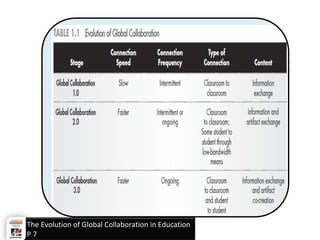
The Evolution of Global Collaboration in Education
P 7
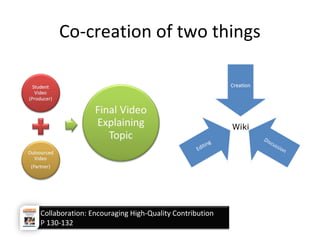
Wiki
Co-creation of two things
Collaboration: Encouraging High-Quality Contribution
P 130-132
Collaborative Project
Contest First Place
2007
ISTE SIGTel
Online Learning Award
Winner 2007www.flatclassroomproject.net
Net Gen
Education
(with Don Tapscott)
Eracism Project
Flat Classroom™
Conference
www.flatclassroomproject.net
Net Gen
Education
(with Don Tapscott)
Eracism Project
Flat Classroom™
Conference
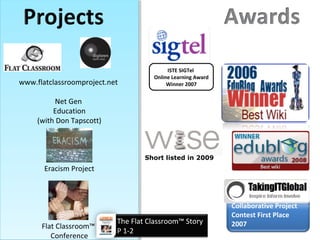
The Flat Classroom™ Story
P 1-2
Short listed in 2009
Flat Classroom™Flat Classroom™
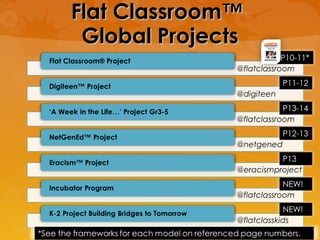
Global ProjectsGlobal Projects
@flatclassroom
@digiteen
@netgened
@eracismproject
@flatclassroom
@flatclasskids
@flatclassroom
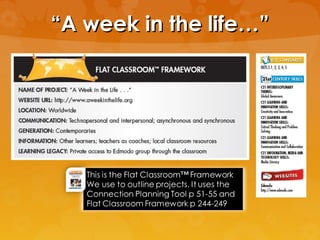
““A week in the life…”A week in the life…”
The Internet
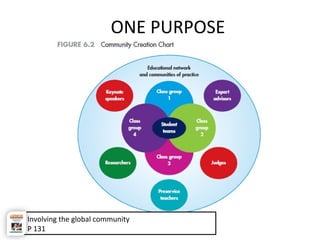
ONE PURPOSE
Involving the global community
P 131
Your Classroom
1.CONNECT
2.COMMUNICA
TE
3.CITIZENSHI
P
4.CONTRIBUT
E &
COLLABORA
TE
5.CHOICE
6.CREATE
Part II of the Book covers the steps, p 31
“Pull is the ability to
attract people and
resources to you that
are relevant and
valuable, even if you
were not even aware
before that they
existed.”
Brown, J. S., Davidson, L., & Hagel III, J.
(2010). The Power of Pull (Kindle Edition ed.).
USA: Basic Books. Loc. 172-73, 183-85.
“Pull is the ability to
attract people and
resources to you that
are relevant and
valuable, even if you
were not even aware
before that they
existed.”
Brown, J. S., Davidson, L., & Hagel III, J.
(2010). The Power of Pull (Kindle Edition ed.).
USA: Basic Books. Loc. 172-73, 183-85.
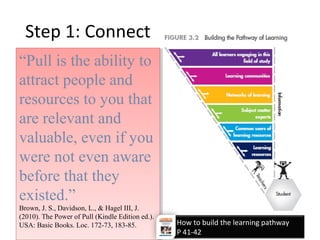
Step 1: Connect
How to build the learning pathway
P 41-42
Personal Learning Network (PLN)
• Classroom Monitoring Portal (CMP)
• Brand Monitoring Portal (BMP)
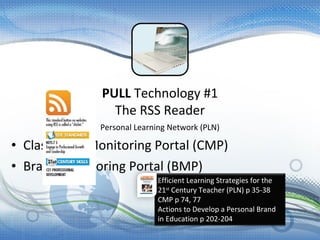
PULL Technology #1
The RSS Reader
Efficient Learning Strategies for the
21st
Century Teacher (PLN) p 35-38
CMP p 74, 77
Actions to Develop a Personal Brand
in Education p 202-204
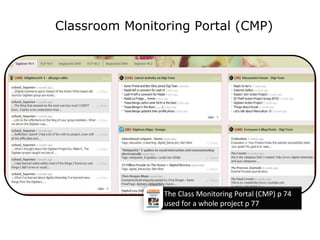
Classroom Monitoring Portal (CMP)
The Class Monitoring Portal (CMP) p 74
used for a whole project p 77
7 Pull Technologies
1. RSS Reader
2. Tablet-Sized Devices
3. Handheld Devices
4. Social Bookmarking
5. Joining Online Conversations
6. Networking Organizations
7. Location Based Apps
Pull Learning to help you
easily embed learning in
your weekly schedule
p 36-41
Teacherpreneurship
“Finnish teachers pick bookspick books and customize lessonscustomize lessons as they
shape students to national standards… ‘. In Finland, the
teachers are the entrepreneurs," says Mr. Schleicher, of
the Paris-based OECD, which began the international
student test in 2000.’
“What Makes Finnish Kids So Smart”
The Wall Street Journal
By ELLEN GAMERMAN
February 2008
http://online.wsj.com/public/article/SB12042535506560199
7.html
Teacherpreneurship: Boost
learning in the classroom
p 45-47
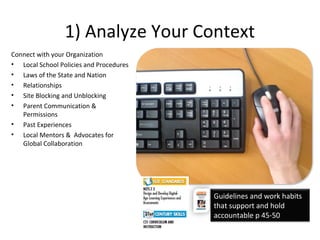
1) Analyze Your Context
Connect with your Organization
• Local School Policies and Procedures
• Laws of the State and Nation
• Relationships
• Site Blocking and Unblocking
• Parent Communication &
Permissions
• Past Experiences
• Local Mentors & Advocates for
Global Collaboration
Guidelines and work habits
that support and hold
accountable p 45-50
2) Coordinate with Curriculum
• Project Organizers:
– Agree on mandatory
outcomes and
cooperation aspects
• Local Curriculum
– Standards Alignment
– Augmentation of Project
on Customized Basis
Guidelines and work habits
that support and hold
accountable p 45-50
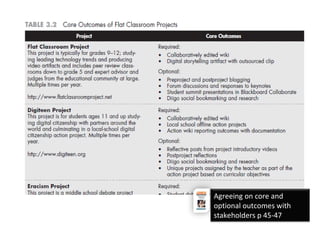
Agreeing on core and
optional outcomes with
stakeholders p 45-47
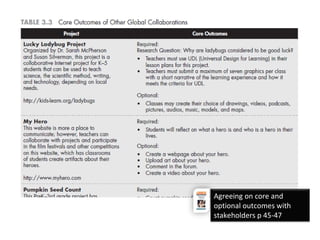
Agreeing on core and
optional outcomes with
stakeholders p 45-47
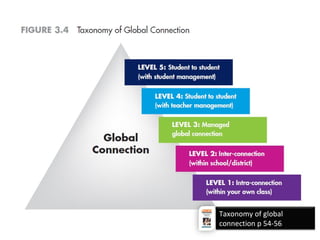
©Vicki Davis and Julie Lindsay
Taxonomy of global
connection p 54-56
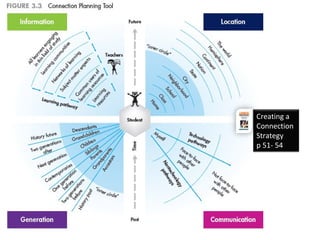
Creating a
Connection
Strategy
p 51- 54
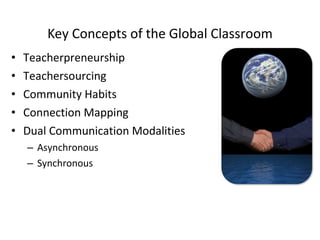
Key Concepts of the Global Classroom
• Teacherpreneurship
• Teachersourcing
• Community Habits
• Connection Mapping
• Dual Communication Modalities
– Asynchronous
– Synchronous
P 10-11
P 41
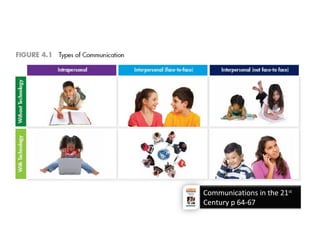
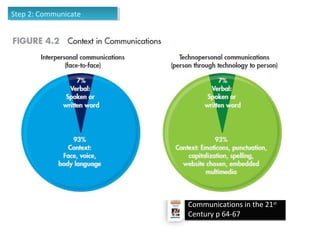
Communications in the 21st
Century p 64-67
Step 2: CommunicateStep 2: Communicate
Communications in the 21st
Century p 64-67
Digital Citizenship
“…the norms of behavior with
regard to technology use”
Ribble and Bailey
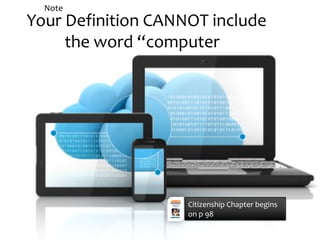
Your Definition CANNOT include
the word “computer”
Note
Citizenship Chapter begins
on p 98
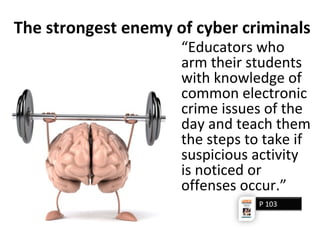
The strongest enemy of cyber criminals
“Educators who
arm their students
with knowledge of
common electronic
crime issues of the
day and teach them
the steps to take if
suspicious activity
is noticed or
offenses occur.”
P 103
Citizenship Chapter begins
on p 98
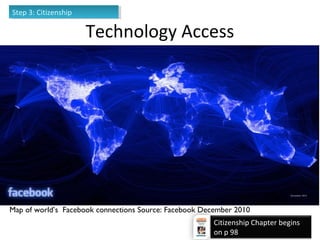
Map of world’s Facebook connections Source: Facebook December 2010
Step 3: CitizenshipStep 3: Citizenship
Technology Access
Citizenship Chapter begins
on p 98
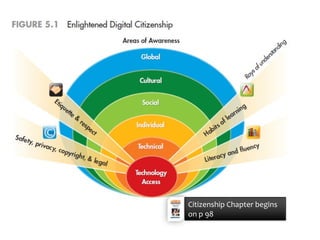
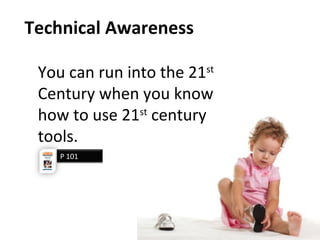
Technical Awareness
You can run into the 21st
Century when you know
how to use 21st
century
tools.
P 101
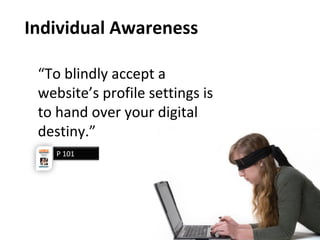
Individual Awareness
“To blindly accept a
website’s profile settings is
to hand over your digital
destiny.”
P 101
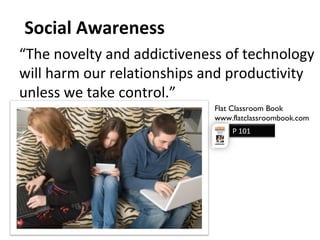
Social Awareness
“The novelty and addictiveness of technology
will harm our relationships and productivity
unless we take control.”
Flat Classroom Book
www.flatclassroombook.com
P 101
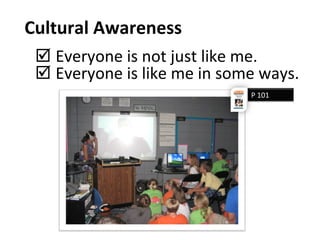
Cultural Awareness
 Everyone is not just like me.
 Everyone is like me in some ways.
P 101
Global Awareness
• Different countries have different laws
– Copyright, legal
– Taboo subjects
• Nationality transcends culture
– Every nation has multiple cultures
– Never stereotype a nation
P 101
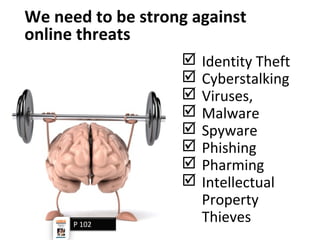
We need to be strong against
online threats
 Identity Theft
 Cyberstalking
 Viruses,
 Malware
 Spyware
 Phishing
 Pharming
 Intellectual
Property
ThievesP 102
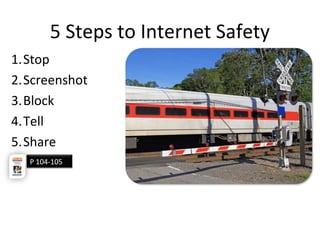
5 Steps to Internet Safety
1.Stop
2.Screenshot
3.Block
4.Tell
5.Share
P 104-105
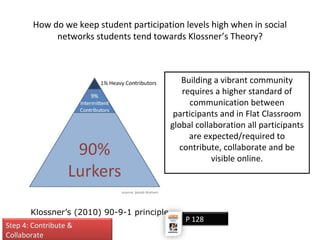
Building a vibrant community
requires a higher standard of
communication between
participants and in Flat Classroom
global collaboration all participants
are expected/required to
contribute, collaborate and be
visible online.
Klossner’s (2010) 90-9-1 principle
Step 4: Contribute &
Collaborate
How do we keep student participation levels high when in social
networks students tend towards Klossner’s Theory?
P 128
What is co-creation?
Can you have co-creation without the 3 R’s of global collaboration?
•Receive
•Read
•Respond
P 128-130
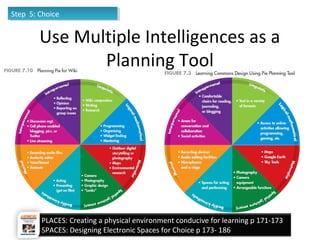
Use Multiple Intelligences as a
Planning Tool
06/16/13
Vicki A Davis, Cool Cat Teacher -
http://coolcatteacher.blogspot.com
42
Step 5: ChoiceStep 5: Choice
PLACES: Creating a physical environment conducive for learning p 171-173
SPACES: Designing Electronic Spaces for Choice p 173- 186
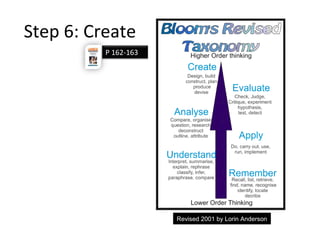
Revised 2001 by Lorin Anderson
Step 6: Create
P 162-163
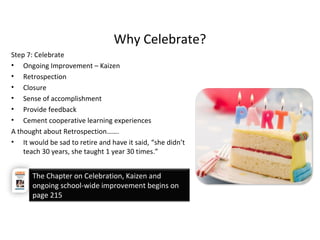
Why Celebrate?
Step 7: Celebrate
• Ongoing Improvement – Kaizen
• Retrospection
• Closure
• Sense of accomplishment
• Provide feedback
• Cement cooperative learning experiences
A thought about Retrospection…….
• It would be sad to retire and have it said, “she didn’t
teach 30 years, she taught 1 year 30 times.”
The Chapter on Celebration, Kaizen and
ongoing school-wide improvement begins on
page 215
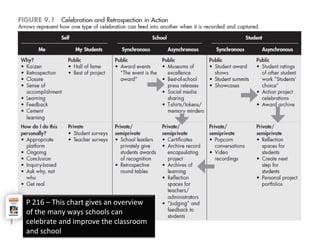
P 216 – This chart gives an overview
of the many ways schools can
celebrate and improve the classroom
and school
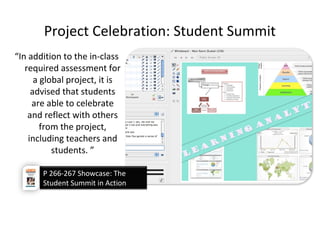
Project Celebration: Student Summit
“In addition to the in-class
required assessment for
a global project, it is
advised that students
are able to celebrate
and reflect with others
from the project,
including teachers and
students. ”
P 266-267 Showcase: The
Student Summit in Action
Am I willing to redesign my curriculum to embed a global
project into what my class does?
“Designing a global collaborative
experience involves
transcending the obvious real
time linkup, fostering higher
order thinking and providing
opportunities for cultural
understanding while usually
making a product that impacts
others in a positive way. ”
Overview of Designing and Managing
a Global Collaborative project begins
on p 236
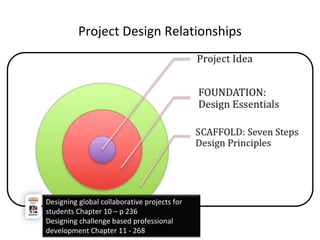
Project Design Relationships
Designing global collaborative projects for
students Chapter 10 – p 236
Designing challenge based professional
development Chapter 11 - 268
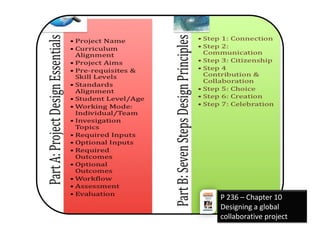
P 236 – Chapter 10
Designing a global
collaborative project
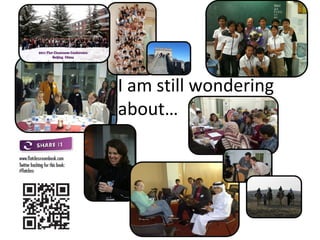
I am still wondering
about…
Visit our
Flat Classrooms Website!
(Links to Projects)
http://flatclassroomproject.net
Join our Ning!
http://flatclassrooms.ning.com/
Join our Conference!
http://flatclassroomconference.com
Join the Global Book
Club – March 2012
www.flatclassroombook.com

7 Steps to Flatten Your Classroom: East Noble 2013

  • 2.
    How one videochanged a life. Domingo’s classroom goes flat and he goes in a new direction. Domingo’s Story P 293-294
  • 3.
    Success in the21st century: People and schools that will thrive and survive P 294-295
  • 4.
    “Working with people acrossthe world has challenged me.” “The majority of my partners wanted to contribute something meaningful to the project.” Horizon Project Students http://horizonproject.wikispaces.com Casey tells her story P 29
  • 5.
    The Evolution ofGlobal Collaboration in Education P 7
  • 6.
    Wiki Co-creation of twothings Collaboration: Encouraging High-Quality Contribution P 130-132
  • 7.
    Collaborative Project Contest FirstPlace 2007 ISTE SIGTel Online Learning Award Winner 2007www.flatclassroomproject.net Net Gen Education (with Don Tapscott) Eracism Project Flat Classroom™ Conference www.flatclassroomproject.net Net Gen Education (with Don Tapscott) Eracism Project Flat Classroom™ Conference The Flat Classroom™ Story P 1-2 Short listed in 2009
  • 8.
    Flat Classroom™Flat Classroom™ GlobalProjectsGlobal Projects @flatclassroom @digiteen @netgened @eracismproject @flatclassroom @flatclasskids @flatclassroom
  • 9.
    ““A week inthe life…”A week in the life…”
  • 10.
    The Internet ONE PURPOSE Involvingthe global community P 131
  • 11.
  • 12.
    “Pull is theability to attract people and resources to you that are relevant and valuable, even if you were not even aware before that they existed.” Brown, J. S., Davidson, L., & Hagel III, J. (2010). The Power of Pull (Kindle Edition ed.). USA: Basic Books. Loc. 172-73, 183-85. “Pull is the ability to attract people and resources to you that are relevant and valuable, even if you were not even aware before that they existed.” Brown, J. S., Davidson, L., & Hagel III, J. (2010). The Power of Pull (Kindle Edition ed.). USA: Basic Books. Loc. 172-73, 183-85. Step 1: Connect How to build the learning pathway P 41-42
  • 13.
    Personal Learning Network(PLN) • Classroom Monitoring Portal (CMP) • Brand Monitoring Portal (BMP) PULL Technology #1 The RSS Reader Efficient Learning Strategies for the 21st Century Teacher (PLN) p 35-38 CMP p 74, 77 Actions to Develop a Personal Brand in Education p 202-204
  • 14.
    Classroom Monitoring Portal(CMP) The Class Monitoring Portal (CMP) p 74 used for a whole project p 77
  • 15.
    7 Pull Technologies 1.RSS Reader 2. Tablet-Sized Devices 3. Handheld Devices 4. Social Bookmarking 5. Joining Online Conversations 6. Networking Organizations 7. Location Based Apps Pull Learning to help you easily embed learning in your weekly schedule p 36-41
  • 16.
    Teacherpreneurship “Finnish teachers pickbookspick books and customize lessonscustomize lessons as they shape students to national standards… ‘. In Finland, the teachers are the entrepreneurs," says Mr. Schleicher, of the Paris-based OECD, which began the international student test in 2000.’ “What Makes Finnish Kids So Smart” The Wall Street Journal By ELLEN GAMERMAN February 2008 http://online.wsj.com/public/article/SB12042535506560199 7.html Teacherpreneurship: Boost learning in the classroom p 45-47
  • 17.
    1) Analyze YourContext Connect with your Organization • Local School Policies and Procedures • Laws of the State and Nation • Relationships • Site Blocking and Unblocking • Parent Communication & Permissions • Past Experiences • Local Mentors & Advocates for Global Collaboration Guidelines and work habits that support and hold accountable p 45-50
  • 18.
    2) Coordinate withCurriculum • Project Organizers: – Agree on mandatory outcomes and cooperation aspects • Local Curriculum – Standards Alignment – Augmentation of Project on Customized Basis Guidelines and work habits that support and hold accountable p 45-50
  • 19.
    Agreeing on coreand optional outcomes with stakeholders p 45-47
  • 20.
    Agreeing on coreand optional outcomes with stakeholders p 45-47
  • 21.
    ©Vicki Davis andJulie Lindsay Taxonomy of global connection p 54-56
  • 22.
  • 23.
    Key Concepts ofthe Global Classroom • Teacherpreneurship • Teachersourcing • Community Habits • Connection Mapping • Dual Communication Modalities – Asynchronous – Synchronous
  • 24.
  • 25.
  • 26.
    Communications in the21st Century p 64-67
  • 27.
    Step 2: CommunicateStep2: Communicate Communications in the 21st Century p 64-67
  • 28.
    Digital Citizenship “…the normsof behavior with regard to technology use” Ribble and Bailey
  • 29.
    Your Definition CANNOTinclude the word “computer” Note Citizenship Chapter begins on p 98
  • 30.
    The strongest enemyof cyber criminals “Educators who arm their students with knowledge of common electronic crime issues of the day and teach them the steps to take if suspicious activity is noticed or offenses occur.” P 103
  • 31.
  • 32.
    Map of world’sFacebook connections Source: Facebook December 2010 Step 3: CitizenshipStep 3: Citizenship Technology Access Citizenship Chapter begins on p 98
  • 33.
    Technical Awareness You canrun into the 21st Century when you know how to use 21st century tools. P 101
  • 34.
    Individual Awareness “To blindlyaccept a website’s profile settings is to hand over your digital destiny.” P 101
  • 35.
    Social Awareness “The noveltyand addictiveness of technology will harm our relationships and productivity unless we take control.” Flat Classroom Book www.flatclassroombook.com P 101
  • 36.
    Cultural Awareness  Everyoneis not just like me.  Everyone is like me in some ways. P 101
  • 37.
    Global Awareness • Differentcountries have different laws – Copyright, legal – Taboo subjects • Nationality transcends culture – Every nation has multiple cultures – Never stereotype a nation P 101
  • 38.
    We need tobe strong against online threats  Identity Theft  Cyberstalking  Viruses,  Malware  Spyware  Phishing  Pharming  Intellectual Property ThievesP 102
  • 39.
    5 Steps toInternet Safety 1.Stop 2.Screenshot 3.Block 4.Tell 5.Share P 104-105
  • 40.
    Building a vibrantcommunity requires a higher standard of communication between participants and in Flat Classroom global collaboration all participants are expected/required to contribute, collaborate and be visible online. Klossner’s (2010) 90-9-1 principle Step 4: Contribute & Collaborate How do we keep student participation levels high when in social networks students tend towards Klossner’s Theory? P 128
  • 41.
    What is co-creation? Canyou have co-creation without the 3 R’s of global collaboration? •Receive •Read •Respond P 128-130
  • 42.
    Use Multiple Intelligencesas a Planning Tool 06/16/13 Vicki A Davis, Cool Cat Teacher - http://coolcatteacher.blogspot.com 42 Step 5: ChoiceStep 5: Choice PLACES: Creating a physical environment conducive for learning p 171-173 SPACES: Designing Electronic Spaces for Choice p 173- 186
  • 43.
    Revised 2001 byLorin Anderson Step 6: Create P 162-163
  • 44.
    Why Celebrate? Step 7:Celebrate • Ongoing Improvement – Kaizen • Retrospection • Closure • Sense of accomplishment • Provide feedback • Cement cooperative learning experiences A thought about Retrospection……. • It would be sad to retire and have it said, “she didn’t teach 30 years, she taught 1 year 30 times.” The Chapter on Celebration, Kaizen and ongoing school-wide improvement begins on page 215
  • 45.
    P 216 –This chart gives an overview of the many ways schools can celebrate and improve the classroom and school
  • 46.
    Project Celebration: StudentSummit “In addition to the in-class required assessment for a global project, it is advised that students are able to celebrate and reflect with others from the project, including teachers and students. ” P 266-267 Showcase: The Student Summit in Action
  • 47.
    Am I willingto redesign my curriculum to embed a global project into what my class does? “Designing a global collaborative experience involves transcending the obvious real time linkup, fostering higher order thinking and providing opportunities for cultural understanding while usually making a product that impacts others in a positive way. ” Overview of Designing and Managing a Global Collaborative project begins on p 236
  • 48.
    Project Design Relationships Designingglobal collaborative projects for students Chapter 10 – p 236 Designing challenge based professional development Chapter 11 - 268
  • 49.
    P 236 –Chapter 10 Designing a global collaborative project
  • 50.
    I am stillwondering about…
  • 51.
    Visit our Flat ClassroomsWebsite! (Links to Projects) http://flatclassroomproject.net Join our Ning! http://flatclassrooms.ning.com/ Join our Conference! http://flatclassroomconference.com Join the Global Book Club – March 2012 www.flatclassroombook.com

Editor's Notes

  • #2 7 Steps to Flatten Your Classroom Vicki Davis 5010 Spotlight Connecting your classroom to other classrooms in the world need not be overwhelming. Learn the seven steps to successfully and safely connect your classroom in meaningful ways that will enhance your curriculum and excite your students. Madera Wyndham Hotel
  • #3 Vicki – talks about Domingo Julie – talks about how this book is a journey and full of stories from classrooms around the world
  • #4 Vicki -
  • #5 Julie: as the students worked in teams with others throughout the world. Vicki:
  • #6 Julie: We describe global collaboration in stages. GC 3.0 = more emphasis on co-created multimedia products, use of social media tools for communication, high expectations to connect in an ongoing manner, student-centered learning
  • #7 Vicki: and the students produced multimedia while outsourcing a clip to their partner in another part of the world…
  • #8 Julie: Flat classroom projects have been acknowledged over the past 5 years with awards and listed as exemplary
  • #9 Julie: Our aim is to create projects and opportunities across all levels of education. Right now we have FCP and NetGenEd for high school, Digiteen for upper ES, MS and HS, AWL for upper ES, Eracism for MS HS and our new pilot this semester is Building Bridges to Tomorrow for K-2 level – over 40 classrooms from about more than 10 countries
  • #10 Vicki:
  • #11 Julie: And it is more than just students, it is about educators, preservice teachers, and experts merging together in a flattened learning environment Vicki: Where students and educators work together as one with mutually beneficial outcomes for all. Literally, the classroom has become…
  • #12 Julie: Seven chapters in the book cover our 7-steps pedagogy to flatten your classroom. These steps have been literally well walked in over the last 5 years. We speak and share not from a theoretical point of view but from the trenches – from years of experience implementing global projects alongside other educators
  • #13 Vicki:
  • #14 Vicki: Did you know that you are here because of Web 2.0?
  • #15 Julie: ?
  • #16 Vicki:
  • #17 Vicki: If we look at arguably the best education system in the world, the Finnish teachers pick books and customize lessons as they shape students to national standards. "In most countries, education feels like a car factory. In Finland, the teachers are the entrepreneurs," says Mr. Schleicher, of the Paris-based OECD, which began the international student test in 2000.
  • #18 Vicki:
  • #19 Julie: Good teacherprenuers are not renegades, they are connectors. They connect curriculum and connect with their administrators.
  • #20 Vicki:?
  • #22 Vicki:
  • #23 Vicki: Julie:?
  • #24 Vicki: Julie:
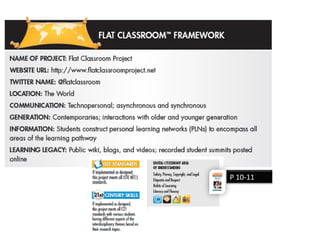
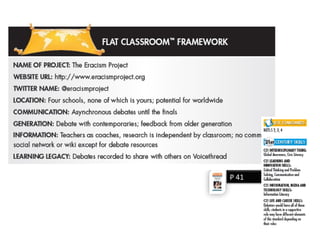
  • #25 Julie: The Flat Classroom Project Framework shows the essential construct of this global collaborative project
  • #26 Vicki:
  • #27 Vicki:
  • #28 Vicki:
  • #29 Julie: Ribble and Bailey define……..thanks to Mike Ribble for providing a workable entry into digital citizenship in the classroom
  • #30 Julie: Today, citizenship needs to extended and expanded to include norms of behaviour that are expected for when people connect, communicate and work together in any way.
  • #31 Vicki:
  • #32 Vicki: - talk about Areas of Awareness Julie: Cover Rays of Understanding
  • #33 Vicki:
  • #34 Vicki:
  • #35 Julie:
  • #36 Vicki:
  • #37 Julie:
  • #38 Julie:
  • #39 Vicki:
  • #40 Vicki: The classroom teacher decides the appropriate action, which may include asking the student to apologize to the educational network or, in some cases, suspending or even banning the student from the network. One of the advantages of working as a global team on these projects is that the networks are monitored 24 hours a day, and RSS feeds make it easy to see new content as soon as it ’s posted. It is very rare that a student deliberately or maliciously sets out to be offensive when collaborating online as part of a project. In fact, we’ve suspended or banned fewer than 10 out of 3,000 students in more than three years.
  • #41 Vicki:
  • #42 Julie: The 3R’s – without these there is no true collaboration or co-creation
  • #43 Vicki:
  • #44 Julie:
  • #45 Julie:
  • #46 Vicki:
  • #47 Julie:
  • #48 Julie:
  • #49 Vicki:
  • #50 Vicki:
  • #52 Simplified slide for access to resources