3D PRINTING TECHNOLOGY
IN AEROSPACE INDUSTRY AAE 454 – Prof. Grandt
March/08/2016
YI-TSUNG (ERIC)
CHEN
OUTLINE
ADDITIVE MANUFACTURING
• Technology Objective
• General Principle
• History
• Additive Manufacturing Process
• Distinction between AM and CNC Machining
• Classification of Additive Manufacturing Processes
• Aerospace Applications
• Technology Maturity
• Moving Forward
• Future Potential
• Conclusion
• References
TECHNOLOGY OBJECTIVE
ADDITIVE MANUFACTURING
• Additive manufacturing
• also known as 3D printing
• formalized term for what
used to be called rapid
prototyping
• Utilize computerized numerical
control (CNC)
• Software such as CATIA or
Solidworks
• Successive layers of materials
• The printer usually contains a range
of motion of at least two axis if not
all three axis
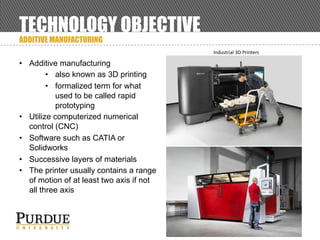
Industrial	3D	Printers
GENERAL PRINCIPLE
ADDITIVE MANUFACTURING
• A model, initially generated using
CAD, can be fabricated directly as a
whole without the need for process
planning.
• Traditional milling requires a careful
planning and detailed analysis.
• Order in which parts should
be processed,
• What tools and procedures
are used.
• What particular fixtures may
be require.
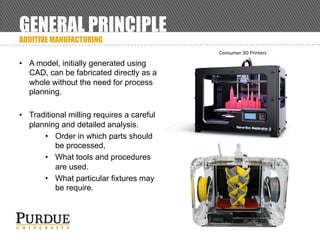
Consumer	3D	Printers
HISTORY
ADDITIVE MANUFACTURING
• Additive manufacturing is relatively new
• The first trace of 3D printing technology in 1980
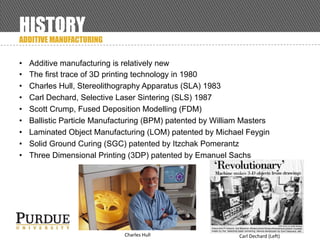
• Charles Hull, Stereolithography Apparatus (SLA) 1983
• Carl Dechard, Selective Laser Sintering (SLS) 1987
• Scott Crump, Fused Deposition Modelling (FDM)
• Ballistic Particle Manufacturing (BPM) patented by William Masters
• Laminated Object Manufacturing (LOM) patented by Michael Feygin
• Solid Ground Curing (SGC) patented by Itzchak Pomerantz
• Three Dimensional Printing (3DP) patented by Emanuel Sachs
Charles	Hull Carl	Dechard (Left)
HISTORY
ADDITIVE MANUFACTURING
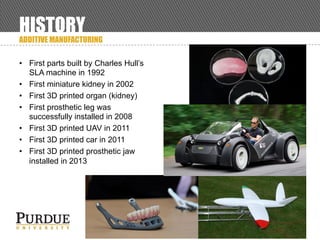
• First parts built by Charles Hull’s
SLA machine in 1992
• First miniature kidney in 2002
• First 3D printed organ (kidney)
• First prosthetic leg was
successfully installed in 2008
• First 3D printed UAV in 2011
• First 3D printed car in 2011
• First 3D printed prosthetic jaw
installed in 2013
ADDITIVE MANUFACTURING PROCESS
ADDITIVE MANUFACTURING
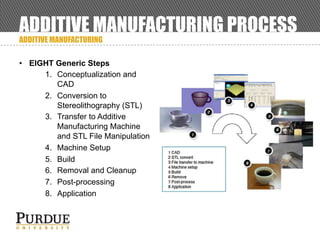
• EIGHT Generic Steps
1. Conceptualization and
CAD
2. Conversion to
Stereolithography (STL)
3. Transfer to Additive
Manufacturing Machine
and STL File Manipulation
4. Machine Setup
5. Build
6. Removal and Cleanup
7. Post-processing
8. Application
DISTINCTION BETWEEN AM AND CNC
MACHINING
AM VS. CNC MANUFACTURING
• AM shares some of its DNA of CNC
• CNC = subtractive manufacturing
• AM = additive manufacturing
• 3D printing requires a lot less
material
• Distinction
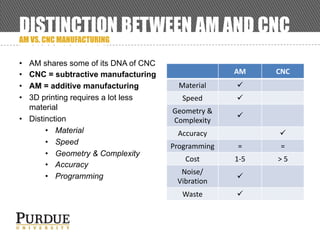
• Material
• Speed
• Geometry & Complexity
• Accuracy
• Programming
AM CNC
Material ĂĽ
Speed ĂĽ
Geometry &	
Complexity
ĂĽ
Accuracy ĂĽ
Programming = =
Cost 1-5 >	5
Noise/
Vibration
ĂĽ
Waste ĂĽ
CLASSIFICATION OF AM
CLASSIFICATION OF ADDITIVE MANUFACTURING
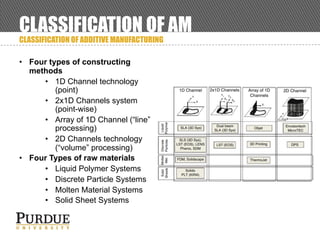
• Four types of constructing
methods
• 1D Channel technology
(point)
• 2x1D Channels system
(point-wise)
• Array of 1D Channel (“line”
processing)
• 2D Channels technology
(“volume” processing)
• Four Types of raw materials
• Liquid Polymer Systems
• Discrete Particle Systems
• Molten Material Systems
• Solid Sheet Systems
AEROSPACE APPLICATIONS
ADDITIVE MANUFACTURING
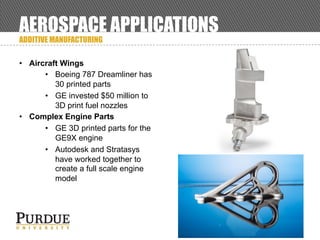
• Aircraft Wings
• Boeing 787 Dreamliner has
30 printed parts
• GE invested $50 million to
3D print fuel nozzles
• Complex Engine Parts
• GE 3D printed parts for the
GE9X engine
• Autodesk and Stratasys
have worked together to
create a full scale engine
model
AEROSPACE APPLICATIONS
ADDITIVE MANUFACTURING
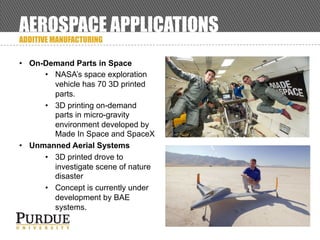
• On-Demand Parts in Space
• NASA’s space exploration
vehicle has 70 3D printed
parts.
• 3D printing on-demand
parts in micro-gravity
environment developed by
Made In Space and SpaceX
• Unmanned Aerial Systems
• 3D printed drove to
investigate scene of nature
disaster
• Concept is currently under
development by BAE
systems.
TECHNOLOGY MATURITY
DR. JOHN W. LINCOLN (STRUCTURAL TECHNOLOGY TRANSITION TO NEW AIRCRAFT)
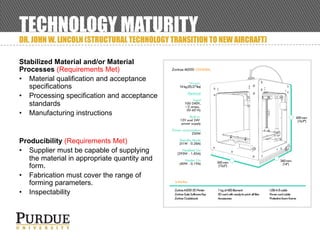
Stabilized Material and/or Material
Processes (Requirements Met)
• Material qualification and acceptance
specifications
• Processing specification and acceptance
standards
• Manufacturing instructions
Producibility (Requirements Met)
• Supplier must be capable of supplying
the material in appropriate quantity and
form.
• Fabrication must cover the range of
forming parameters.
• Inspectability
TECHNOLOGY MATURITY
DR. JOHN W. LINCOLN (STRUCTURAL TECHNOLOGY TRANSITION TO NEW AIRCRAFT)
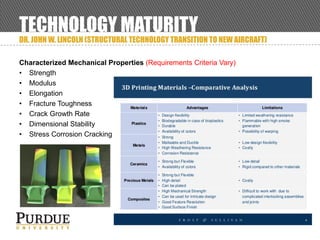
Characterized Mechanical Properties (Requirements Criteria Vary)
• Strength
• Modulus
• Elongation
• Fracture Toughness
• Crack Growth Rate
• Dimensional Stability
• Stress Corrosion Cracking
TECHNOLOGY MATURITY
DR. JOHN W. LINCOLN (STRUCTURAL TECHNOLOGY TRANSITION TO NEW AIRCRAFT)
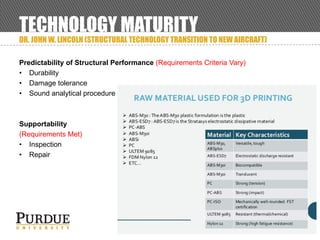
Predictability of Structural Performance (Requirements Criteria Vary)
• Durability
• Damage tolerance
• Sound analytical procedure
Supportability
(Requirements Met)
• Inspection
• Repair
MOVING FORWARD
ADDITIVE MANUFACTURING
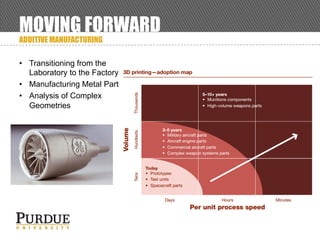
• Transitioning from the
Laboratory to the Factory
• Manufacturing Metal Parts
• Analysis of Complex
Geometries
FUTURE POTENTIAL
ADDITIVE MANUFACTURING
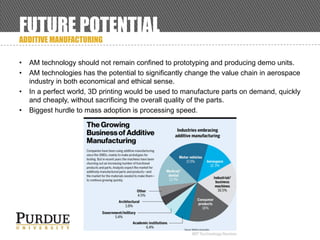
• AM technology should not remain confined to prototyping and producing demo units.
• AM technologies has the potential to significantly change the value chain in aerospace
industry in both economical and ethical sense.
• In a perfect world, 3D printing would be used to manufacture parts on demand, quickly
and cheaply, without sacrificing the overall quality of the parts.
• Biggest hurdle to mass adoption is processing speed.
CONCLUSION
ADDITIVE MANUFACTURING
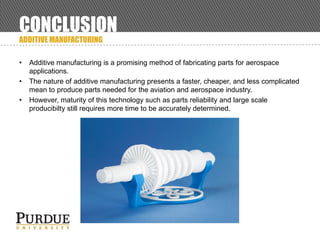
• Additive manufacturing is a promising method of fabricating parts for aerospace
applications.
• The nature of additive manufacturing presents a faster, cheaper, and less complicated
mean to produce parts needed for the aviation and aerospace industry.
• However, maturity of this technology such as parts reliability and large scale
producibilty still requires more time to be accurately determined.
REFERENCES
APA FORMAT
• Thomas, C. L., Gaffney, T. M., Kaza, S., & Lee, C. H. (1996, February). Rapid prototyping of large scale aerospace structures.
In Aerospace Applications Conference, 1996. Proceedings., 1996 IEEE (Vol. 4, pp. 219-230). IEEE.
• Moon, S. K., Tan, Y. E., Hwang, J., & Yoon, Y. J. (2014). Application of 3D printing technology for designing light-weight unmanned aerial
vehicle wing structures. International Journal of Precision Engineering and Manufacturing-Green Technology, 1(3), 223-228.
• Paulsen, J. A., Renn, M., Christenson, K., & Plourde, R. (2012, October). Printing conformal electronics on 3D structures with Aerosol Jet
technology. In Future of Instrumentation International Workshop (FIIW), 2012 (pp. 1-4). IEEE.
• Fischer, F. (2011). Thermoplastics: The Best Choice for 3D Printing. White Paper, Stratasys Inc., Edn Prairie, MN.
• Marks, P. (2011). 3D printing takes off with the world's first printed plane.New Scientist, 211(2823), 17-18.
• Kobryn, P. A., Ontko, N. R., Perkins, L. P., & Tiley, J. S. (2006). Additive manufacturing of aerospace alloys for aircraft structures.
• Lyons, B. (2014). Additive manufacturing in aerospace: examples and research outlook. The Bridge, 44(3).
• Gibson, I., Rosen, D. W., & Stucker, B. (2010). Additive Manufacturing Technologies.
• Dehoff, R. R., Tallman, C., Duty, C. E., Peter, W. H., Yamamoto, Y., Chen, W., & Blue, C. A. (2013). Case study: additive manufacturing of
aerospace brackets. Advanced Materials and Processes, 171(3).
• Ku, C. (2015). 3-D Printed Parts on Airplanes Are Just the Beginning of a Movement. Apex Aero Magazine. Retrieved from
http://apex.aero/airbus-boeing-3D-print-stratasys
• A Brief History of 3D Printing (2011) T. Rowe Price Connections, Retrieved from
http://individual.troweprice.com/staticFiles/Retail/Shared/PDFs/3D_Printing_Infographic_FINAL.pdf
• History of 3D Printing: The Free Beginner’s Guide (2014). 3D Printing Industry, The Authority on 3D Printing. Retrieved from
http://3dprintingindustry.com/3d-printing-basics-free-beginners-guide/history/
• Thompson, S., Marx, C., Thut, M., 3D Printing: A potential game changer for aerospace and defense, Gaining Altitude, Issue 7, Retrieved
from https://www.pwc.com/us/en/industrial-products/publications/assets/pwc-gaining-altitude-issue-7-3d-printing.pdf
• Young, J., (2015) 3D Printed Aircraft Parts and engines Could Lighten Aircraft by 50%. 3DPrinting.com. Retrieved from
http://3dprinting.com/aviation/3d-printed-aircraft-parts-could-lighten-aircrafts-by-fifty-percent/
• Trivedi, G., (2014) 5 Potential Future Application of 3D Printing Within the Aerospace Industry. 3DPrint.com. The Voice of 3D Printing
Technologies. Retrieved from http://3dprint.com/26081/3d-printing-aerospace-5-uses/
• Miller. E., (2014) Color 3D Printing ANSYS ANSYS Mechanical and Mechanical APDL Results. PADT, Inc. Retrieved from
http://www.padtinc.com/blog/the-focus/color-3d-printing-ansys-ansys-mechanical-and-mechanical-apdl-results

chen515_454_termpaper

  • 1.
    3D PRINTING TECHNOLOGY INAEROSPACE INDUSTRY AAE 454 – Prof. Grandt March/08/2016 YI-TSUNG (ERIC) CHEN
  • 2.
    OUTLINE ADDITIVE MANUFACTURING • TechnologyObjective • General Principle • History • Additive Manufacturing Process • Distinction between AM and CNC Machining • Classification of Additive Manufacturing Processes • Aerospace Applications • Technology Maturity • Moving Forward • Future Potential • Conclusion • References
  • 3.
    TECHNOLOGY OBJECTIVE ADDITIVE MANUFACTURING •Additive manufacturing • also known as 3D printing • formalized term for what used to be called rapid prototyping • Utilize computerized numerical control (CNC) • Software such as CATIA or Solidworks • Successive layers of materials • The printer usually contains a range of motion of at least two axis if not all three axis Industrial 3D Printers
  • 4.
    GENERAL PRINCIPLE ADDITIVE MANUFACTURING •A model, initially generated using CAD, can be fabricated directly as a whole without the need for process planning. • Traditional milling requires a careful planning and detailed analysis. • Order in which parts should be processed, • What tools and procedures are used. • What particular fixtures may be require. Consumer 3D Printers
  • 5.
    HISTORY ADDITIVE MANUFACTURING • Additivemanufacturing is relatively new • The first trace of 3D printing technology in 1980 • Charles Hull, Stereolithography Apparatus (SLA) 1983 • Carl Dechard, Selective Laser Sintering (SLS) 1987 • Scott Crump, Fused Deposition Modelling (FDM) • Ballistic Particle Manufacturing (BPM) patented by William Masters • Laminated Object Manufacturing (LOM) patented by Michael Feygin • Solid Ground Curing (SGC) patented by Itzchak Pomerantz • Three Dimensional Printing (3DP) patented by Emanuel Sachs Charles Hull Carl Dechard (Left)
  • 6.
    HISTORY ADDITIVE MANUFACTURING • Firstparts built by Charles Hull’s SLA machine in 1992 • First miniature kidney in 2002 • First 3D printed organ (kidney) • First prosthetic leg was successfully installed in 2008 • First 3D printed UAV in 2011 • First 3D printed car in 2011 • First 3D printed prosthetic jaw installed in 2013
  • 7.
    ADDITIVE MANUFACTURING PROCESS ADDITIVEMANUFACTURING • EIGHT Generic Steps 1. Conceptualization and CAD 2. Conversion to Stereolithography (STL) 3. Transfer to Additive Manufacturing Machine and STL File Manipulation 4. Machine Setup 5. Build 6. Removal and Cleanup 7. Post-processing 8. Application
  • 8.
    DISTINCTION BETWEEN AMAND CNC MACHINING AM VS. CNC MANUFACTURING • AM shares some of its DNA of CNC • CNC = subtractive manufacturing • AM = additive manufacturing • 3D printing requires a lot less material • Distinction • Material • Speed • Geometry & Complexity • Accuracy • Programming AM CNC Material ü Speed ü Geometry & Complexity ü Accuracy ü Programming = = Cost 1-5 > 5 Noise/ Vibration ü Waste ü
  • 9.
    CLASSIFICATION OF AM CLASSIFICATIONOF ADDITIVE MANUFACTURING • Four types of constructing methods • 1D Channel technology (point) • 2x1D Channels system (point-wise) • Array of 1D Channel (“line” processing) • 2D Channels technology (“volume” processing) • Four Types of raw materials • Liquid Polymer Systems • Discrete Particle Systems • Molten Material Systems • Solid Sheet Systems
  • 10.
    AEROSPACE APPLICATIONS ADDITIVE MANUFACTURING •Aircraft Wings • Boeing 787 Dreamliner has 30 printed parts • GE invested $50 million to 3D print fuel nozzles • Complex Engine Parts • GE 3D printed parts for the GE9X engine • Autodesk and Stratasys have worked together to create a full scale engine model
  • 11.
    AEROSPACE APPLICATIONS ADDITIVE MANUFACTURING •On-Demand Parts in Space • NASA’s space exploration vehicle has 70 3D printed parts. • 3D printing on-demand parts in micro-gravity environment developed by Made In Space and SpaceX • Unmanned Aerial Systems • 3D printed drove to investigate scene of nature disaster • Concept is currently under development by BAE systems.
  • 12.
    TECHNOLOGY MATURITY DR. JOHNW. LINCOLN (STRUCTURAL TECHNOLOGY TRANSITION TO NEW AIRCRAFT) Stabilized Material and/or Material Processes (Requirements Met) • Material qualification and acceptance specifications • Processing specification and acceptance standards • Manufacturing instructions Producibility (Requirements Met) • Supplier must be capable of supplying the material in appropriate quantity and form. • Fabrication must cover the range of forming parameters. • Inspectability
  • 13.
    TECHNOLOGY MATURITY DR. JOHNW. LINCOLN (STRUCTURAL TECHNOLOGY TRANSITION TO NEW AIRCRAFT) Characterized Mechanical Properties (Requirements Criteria Vary) • Strength • Modulus • Elongation • Fracture Toughness • Crack Growth Rate • Dimensional Stability • Stress Corrosion Cracking
  • 14.
    TECHNOLOGY MATURITY DR. JOHNW. LINCOLN (STRUCTURAL TECHNOLOGY TRANSITION TO NEW AIRCRAFT) Predictability of Structural Performance (Requirements Criteria Vary) • Durability • Damage tolerance • Sound analytical procedure Supportability (Requirements Met) • Inspection • Repair
  • 15.
    MOVING FORWARD ADDITIVE MANUFACTURING •Transitioning from the Laboratory to the Factory • Manufacturing Metal Parts • Analysis of Complex Geometries
  • 16.
    FUTURE POTENTIAL ADDITIVE MANUFACTURING •AM technology should not remain confined to prototyping and producing demo units. • AM technologies has the potential to significantly change the value chain in aerospace industry in both economical and ethical sense. • In a perfect world, 3D printing would be used to manufacture parts on demand, quickly and cheaply, without sacrificing the overall quality of the parts. • Biggest hurdle to mass adoption is processing speed.
  • 17.
    CONCLUSION ADDITIVE MANUFACTURING • Additivemanufacturing is a promising method of fabricating parts for aerospace applications. • The nature of additive manufacturing presents a faster, cheaper, and less complicated mean to produce parts needed for the aviation and aerospace industry. • However, maturity of this technology such as parts reliability and large scale producibilty still requires more time to be accurately determined.
  • 18.
    REFERENCES APA FORMAT • Thomas,C. L., Gaffney, T. M., Kaza, S., & Lee, C. H. (1996, February). Rapid prototyping of large scale aerospace structures. In Aerospace Applications Conference, 1996. Proceedings., 1996 IEEE (Vol. 4, pp. 219-230). IEEE. • Moon, S. K., Tan, Y. E., Hwang, J., & Yoon, Y. J. (2014). Application of 3D printing technology for designing light-weight unmanned aerial vehicle wing structures. International Journal of Precision Engineering and Manufacturing-Green Technology, 1(3), 223-228. • Paulsen, J. A., Renn, M., Christenson, K., & Plourde, R. (2012, October). Printing conformal electronics on 3D structures with Aerosol Jet technology. In Future of Instrumentation International Workshop (FIIW), 2012 (pp. 1-4). IEEE. • Fischer, F. (2011). Thermoplastics: The Best Choice for 3D Printing. White Paper, Stratasys Inc., Edn Prairie, MN. • Marks, P. (2011). 3D printing takes off with the world's first printed plane.New Scientist, 211(2823), 17-18. • Kobryn, P. A., Ontko, N. R., Perkins, L. P., & Tiley, J. S. (2006). Additive manufacturing of aerospace alloys for aircraft structures. • Lyons, B. (2014). Additive manufacturing in aerospace: examples and research outlook. The Bridge, 44(3). • Gibson, I., Rosen, D. W., & Stucker, B. (2010). Additive Manufacturing Technologies. • Dehoff, R. R., Tallman, C., Duty, C. E., Peter, W. H., Yamamoto, Y., Chen, W., & Blue, C. A. (2013). Case study: additive manufacturing of aerospace brackets. Advanced Materials and Processes, 171(3). • Ku, C. (2015). 3-D Printed Parts on Airplanes Are Just the Beginning of a Movement. Apex Aero Magazine. Retrieved from http://apex.aero/airbus-boeing-3D-print-stratasys • A Brief History of 3D Printing (2011) T. Rowe Price Connections, Retrieved from http://individual.troweprice.com/staticFiles/Retail/Shared/PDFs/3D_Printing_Infographic_FINAL.pdf • History of 3D Printing: The Free Beginner’s Guide (2014). 3D Printing Industry, The Authority on 3D Printing. Retrieved from http://3dprintingindustry.com/3d-printing-basics-free-beginners-guide/history/ • Thompson, S., Marx, C., Thut, M., 3D Printing: A potential game changer for aerospace and defense, Gaining Altitude, Issue 7, Retrieved from https://www.pwc.com/us/en/industrial-products/publications/assets/pwc-gaining-altitude-issue-7-3d-printing.pdf • Young, J., (2015) 3D Printed Aircraft Parts and engines Could Lighten Aircraft by 50%. 3DPrinting.com. Retrieved from http://3dprinting.com/aviation/3d-printed-aircraft-parts-could-lighten-aircrafts-by-fifty-percent/ • Trivedi, G., (2014) 5 Potential Future Application of 3D Printing Within the Aerospace Industry. 3DPrint.com. The Voice of 3D Printing Technologies. Retrieved from http://3dprint.com/26081/3d-printing-aerospace-5-uses/ • Miller. E., (2014) Color 3D Printing ANSYS ANSYS Mechanical and Mechanical APDL Results. PADT, Inc. Retrieved from http://www.padtinc.com/blog/the-focus/color-3d-printing-ansys-ansys-mechanical-and-mechanical-apdl-results