Printing the Future.
Olaf Diegel
From A to Z
Life before academia
Design Today
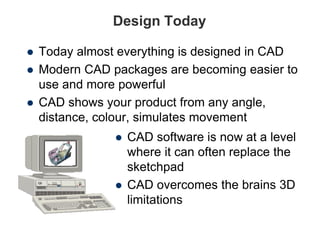
 Today almost everything is designed in CAD
 Modern CAD packages are becoming easier to
use and more powerful
 CAD shows your product from any angle,
distance, colour, simulates movement
 CAD software is now at a level
where it can often replace the
sketchpad
 CAD overcomes the brains 3D
limitations
But…
A design may look pretty on screen, but will it
meet the users’ needs and can it be efficiently
made?
Beautiful 3D computer models can result in
difficult to manufacture hardware that requires
expensive fabrication processes that add cost
and/or increase schedule.
Enter Prototyping…
AM for Prototyping
 Because of the comparative speed it offers
(speed to market, speed to go through extra
iterations, etc.), AM is worth using for
prototyping the vast majority (but not all) of
components.
 Prototyping is also absolutely essential to
avoid costly design or manufacturing
mistakes.
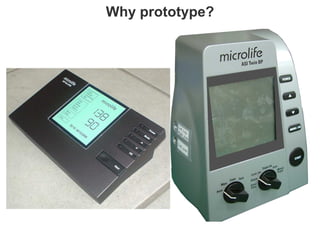
Why prototype?
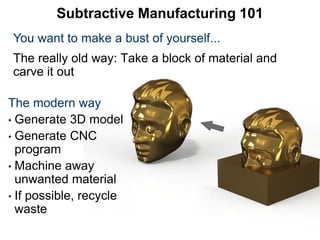
Subtractive Manufacturing 101
The really old way: Take a block of material and
carve it out
You want to make a bust of yourself...
The modern way
• Generate 3D model
• Generate CNC
program
• Machine away
unwanted material
• If possible, recycle
waste
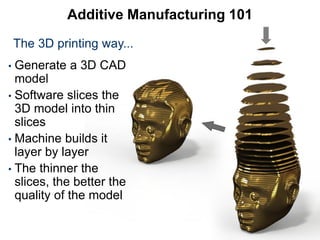
Additive Manufacturing 101
The 3D printing way...
• Generate a 3D CAD
model
• Software slices the
3D model into thin
slices
• Machine builds it
layer by layer
• The thinner the
slices, the better the
quality of the model
AM for Manufacturing
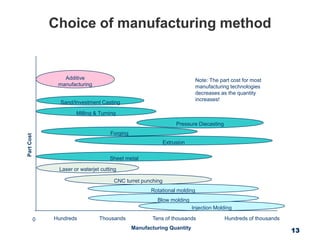
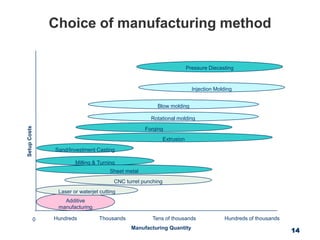
 The decision about whether a product should
be manufactured through AM comes down to
balancing Product Value vs Production
Quantity.
Extrusion
Sand/Investment Casting
Pressure Diecasting
Choice of manufacturing method
13
0 Hundreds Thousands Tens of thousands Hundreds of thousands
Injection Molding
PartCost
Milling & Turning
Rotational molding
Blow molding
Sheet metal
Additive
manufacturing
Laser or waterjet cutting
CNC turret punching
Manufacturing Quantity
Forging
Note: The part cost for most
manufacturing technologies
decreases as the quantity
increases!
Extrusion
Sand/Investment Casting
Pressure Diecasting
Choice of manufacturing method
14
0 Hundreds Thousands Tens of thousands Hundreds of thousands
Injection Molding
SetupCosts
Milling & Turning
Rotational molding
Blow molding
Sheet metal
Additive
manufacturing
Laser or waterjet cutting
CNC turret punching
Manufacturing Quantity
Forging
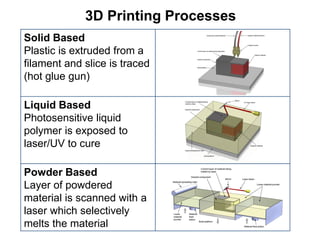
3D Printing Processes
Solid Based
Plastic is extruded from a
filament and slice is traced
(hot glue gun)
Liquid Based
Photosensitive liquid
polymer is exposed to
laser/UV to cure
Powder Based
Layer of powdered
material is scanned with a
laser which selectively
melts the material
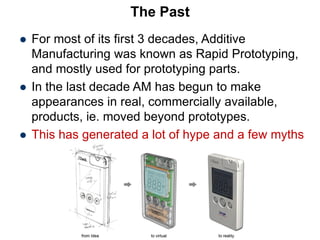
The Past
 For most of its first 3 decades, Additive
Manufacturing was known as Rapid Prototyping,
and mostly used for prototyping parts.
 In the last decade AM has begun to make
appearances in real, commercially available,
products, ie. moved beyond prototypes.
 This has generated a lot of hype and a few myths
Myth
 The vast majority of 3D printing entails a
large amount of post-processing.
 This can range from removing support
material, to polishing, to machining, to
coating, to heat-treating, to colouring, to
sanding and painting, etc.
Just hit print and you are done!
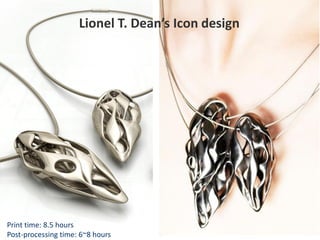
Lionel T. Dean’s Icon design
Print time: 8.5 hours
Post-processing time: 6~8 hours
Myth
 3D Printing will NOT replace conventional
manufacturing!
 It is a complementary technology that, for
certain products, and if used the right way,
gives huge advantages over conventional
manufacturing
3D Printing will kill traditional manufacturing!
Advantage: Complexity for Free
 The more complex the part, the better it is
suited to Additive Manufacturing (AM).
 Many simple parts can often be consolidated
into one much more complex parts as no
assembly is required (so less assembly
labour).
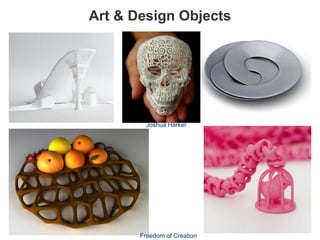
Art & Design Objects
Freedom of Creation
Joshua Harker
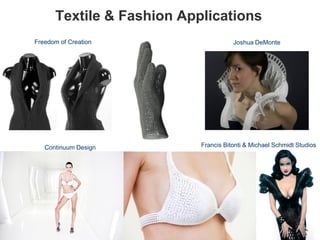
Textile & Fashion Applications
Continuum Design
Freedom of Creation
Francis Bitonti & Michael Schmidt Studios
Joshua DeMonte
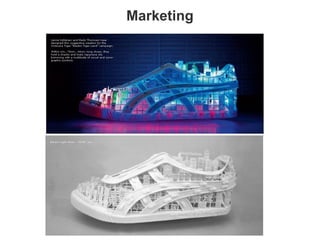
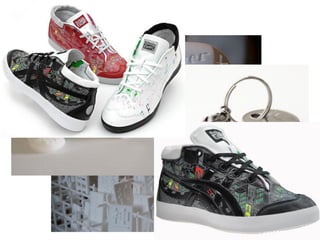
Marketing
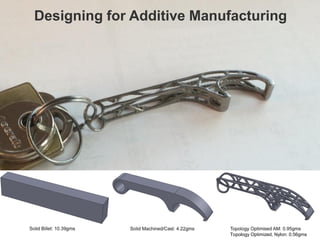
Designing for Additive Manufacturing
Topology Optimized, Nylon: 0.56gms
Myth
 In the context of manufacturing (rather
than prototyping) only parts of a suitable
level of complexity and value are
economically viable for 3D printing.
 Just because you can, doesn’t mean you
should!
Anything can be 3D printed!
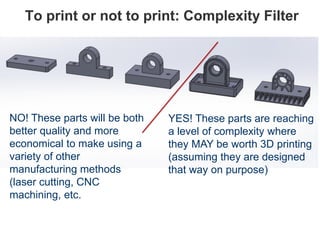
To print or not to print: Complexity Filter
NO! These parts will be both
better quality and more
economical to make using a
variety of other
manufacturing methods
(laser cutting, CNC
machining, etc.
YES! These parts are reaching
a level of complexity where
they MAY be worth 3D printing
(assuming they are designed
that way on purpose)
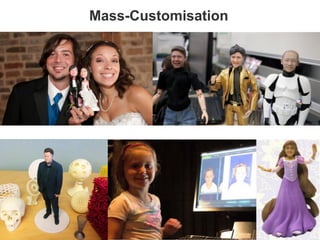
Advantage: Mass customisation
 A small production run of parts can be
undertaken in which each part is uniquely
customized to suit the user
 It costs no more to do 100 different
components than 100 of the same
component
 This opens up a whole new area of business
for products that are mass-custom-made for
the user
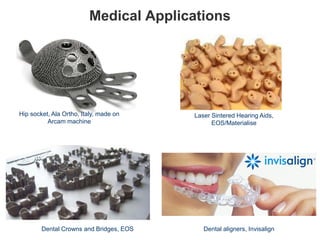
Medical Applications
Dental aligners, Invisalign
Hip socket, Ala Ortho, Italy, made on
Arcam machine
Laser Sintered Hearing Aids,
EOS/Materialise
Dental Crowns and Bridges, EOS
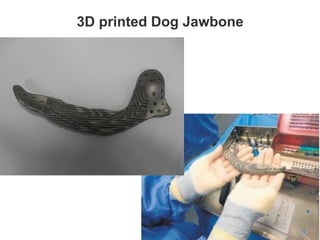
3D printed Dog Jawbone
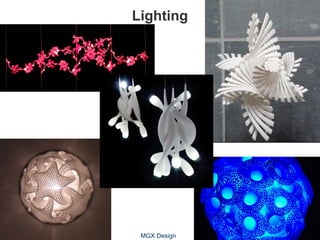
Lighting
MGX Design
Mass-Customisation
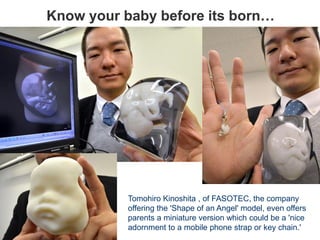
Know your baby before its born…
Tomohiro Kinoshita , of FASOTEC, the company
offering the 'Shape of an Angel' model, even offers
parents a miniature version which could be a 'nice
adornment to a mobile phone strap or key chain.'
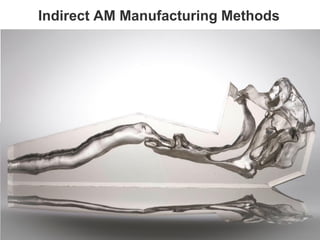
Indirect AM Manufacturing Methods
Advantage: Complete Products
 Additive manufacturing allows the production
of complete products with moving parts. This
can greatly reduce the amount of assembly
(ergo labour) required to make products.
 AM allows many simple parts to be
consolidated into a single more complex part
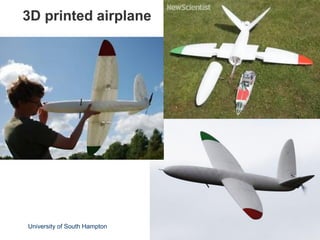
3D printed airplane
University of South Hampton
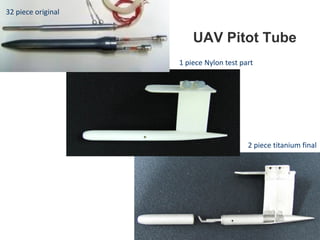
UAV Pitot Tube
32 piece original
1 piece Nylon test part
2 piece titanium final
Advantage: Try Ideas at No Risk
 Testing the market with an idea, using
traditional manufacturing methods, can often
be extremely expensive. AM allows small
production runs of product to be taken to
market with very little capital risk.
 This allows many more inventors to realize
their inventions and test their market validity.
 The potential for new businesses in this area
is enormous!
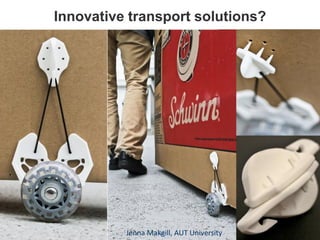
Innovative transport solutions?
Jenna Makgill, AUT University
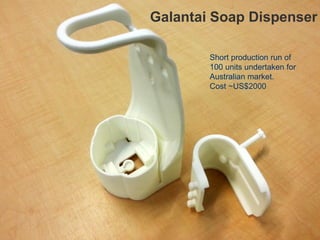
Galantai Soap Dispenser
Short production run of
100 units undertaken for
Australian market.
Cost ~US$2000
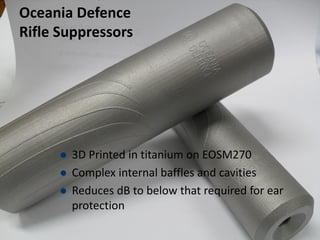
Oceania Defence
Rifle Suppressors
 3D Printed in titanium on EOSM270
 Complex internal baffles and cavities
 Reduces dB to below that required for ear
protection
Americas Cup, Team New Zealand
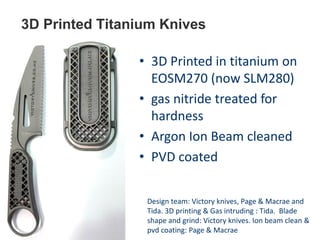
3D Printed Titanium Knives
• 3D Printed in titanium on
EOSM270 (now SLM280)
• gas nitride treated for
hardness
• Argon Ion Beam cleaned
• PVD coated
Design team: Victory knives, Page & Macrae and
Tida. 3D printing & Gas intruding : Tida. Blade
shape and grind: Victory knives. Ion beam clean &
pvd coating: Page & Macrae
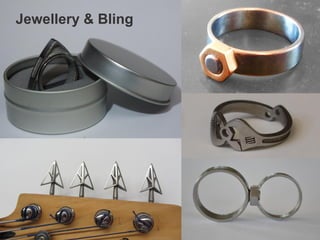
Jewellery & Bling
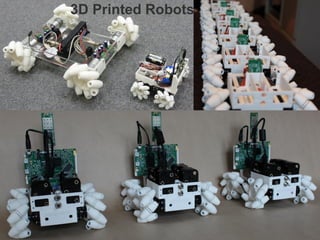
3D Printed Robots
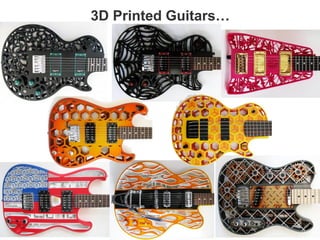
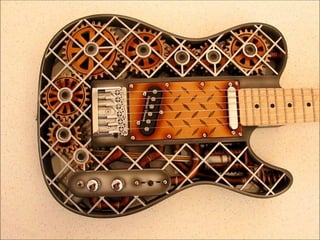
3D Printed Guitars…
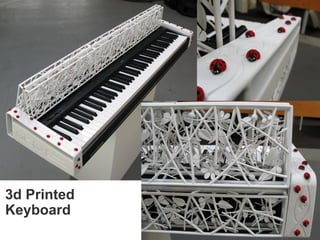
3d Printed
Keyboard
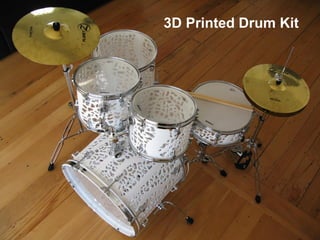
3D Printed Drum Kit
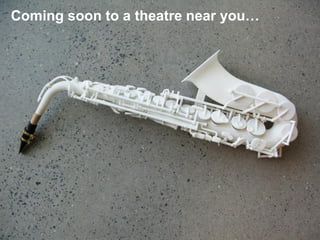
Coming soon to a theatre near you…
Advantage: Encouraging Innovation
 The relatively low-cost ability to easily try out
ideas generates many innovations that would
just not have seen the light of day with
conventional manufacturing.
 AM has seen children returning to making
things. Where, over the past 20 years, they
have slowly drifted into a digital entertainment
age, 3D printing is now allowing them to move
back from digital into reality.
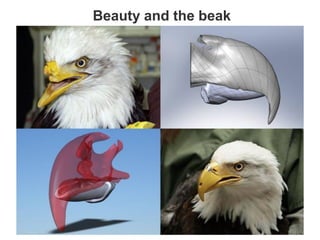
Beauty and the beak
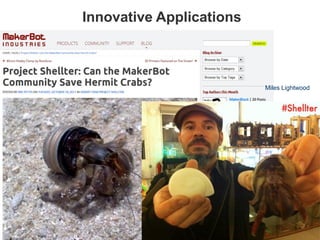
Miles Lightwood
Innovative Applications
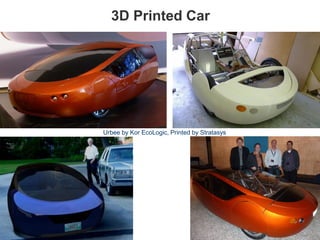
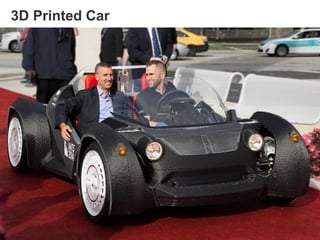
3D Printed Car
Urbee by Kor EcoLogic, Printed by Stratasys
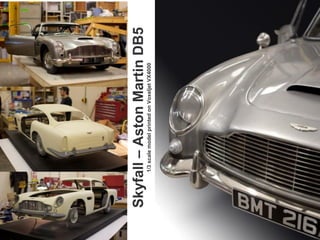
Skyfall–AstonMartinDB5
1/3scalemodelprintedonVoxeljetVX4000
3D Printed Car
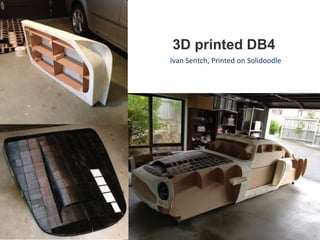
3D printed DB4
Ivan Sentch, Printed on Solidoodle
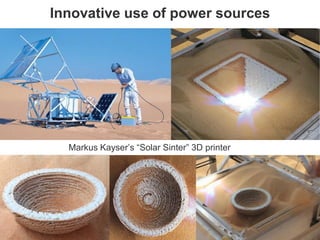
Innovative use of power sources
Markus Kayser’s “Solar Sinter” 3D printer
Virginia tech’s 3D printing vending machine
The DreamVendor is an interactive 3D printing vending machine for Virginia Tech
students to enable them to quickly make prototypes for their academic, or personal,
design projects. Insert an SD card with the 3D model into the machine; the
DreamVendor then prints your 3D part and dispenses it into a bin when it's finished.
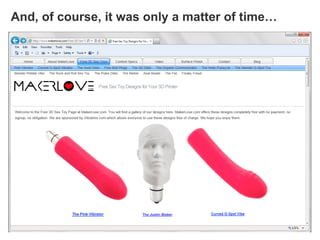
And, of course, it was only a matter of time…
The Justin Bieber
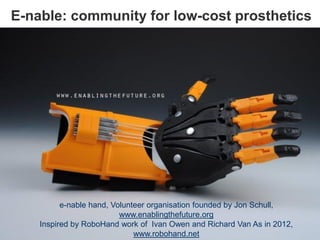
E-nable: community for low-cost prosthetics
e-nable hand, Volunteer organisation founded by Jon Schull,
www.enablingthefuture.org
Inspired by RoboHand work of Ivan Owen and Richard Van As in 2012,
www.robohand.net
Advantage: On-Demand Manufacturing
 Parts can be manufactured as, and when,
needed, rather than having to keep a large
stock of parts on-hand
 Parts can be manufactured locally, rather
than abroad, thus greatly reducing the supply
chain, and the environmental footprint of the
parts
 3D printing is often referred to as the next
industrial revolution
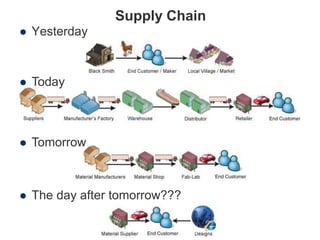
Supply Chain
 Yesterday
 Today
 Tomorrow
 The day after tomorrow???
(Misunderstood) Myth
 Yes! Every home will have a 3D printer, but
these will be used for hobbies and toys.
 It is unlikely that 3D printers will every be
used in a home setting to manufacture
everything we need.
 Many of us have sewing machines, but few
of us are wearing homemade clothes.
Every home will have a 3D printer!
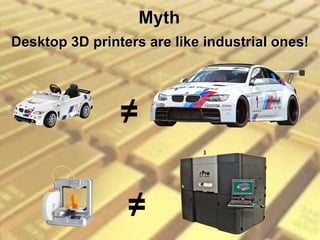
Myth
≠
≠
Desktop 3D printers are like industrial ones!
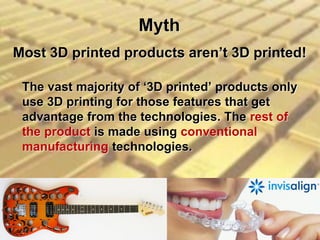
Myth
The vast majority of ‘3D printed’ products only
use 3D printing for those features that get
advantage from the technologies. The rest of
the product is made using conventional
manufacturing technologies.
Most 3D printed products aren’t 3D printed!
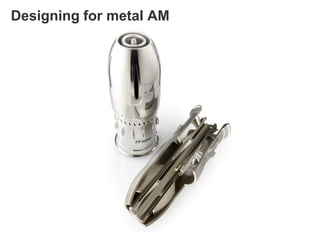
Designing for metal AM
The Truth about Metal AM
 Because of post-processing, a really good
reason is needed to make a metal AM part!
 Typically, parts that are not specifically
designed for metal AM are not worth doing
with AM
 Most metal AM requires support structures
for heat transfer and these, in most cases,
need to be machined off. This can be hard!
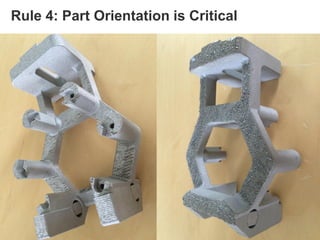
 Part orientation is of critical importance with
metal AM
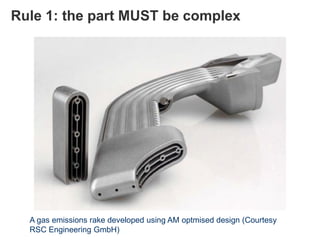
Rule 1: the part MUST be complex
A gas emissions rake developed using AM optmised design (Courtesy
RSC Engineering GmbH)
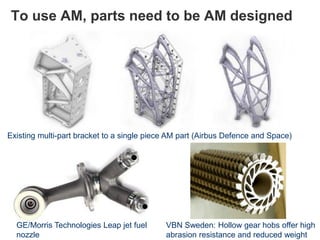
To use AM, parts need to be AM designed
GE/Morris Technologies Leap jet fuel
nozzle
VBN Sweden: Hollow gear hobs offer high
abrasion resistance and reduced weight
Existing multi-part bracket to a single piece AM part (Airbus Defence and Space)
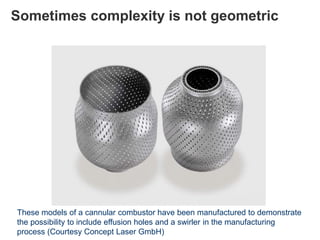
Sometimes complexity is not geometric
These models of a cannular combustor have been manufactured to demonstrate
the possibility to include effusion holes and a swirler in the manufacturing
process (Courtesy Concept Laser GmbH)
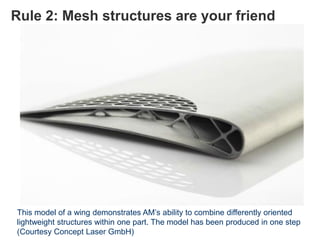
Rule 2: Mesh structures are your friend
This model of a wing demonstrates AM’s ability to combine differently oriented
lightweight structures within one part. The model has been produced in one step
(Courtesy Concept Laser GmbH)
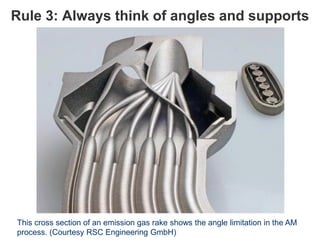
Rule 3: Always think of angles and supports
This cross section of an emission gas rake shows the angle limitation in the AM
process. (Courtesy RSC Engineering GmbH)
Rule 4: Part Orientation is Critical
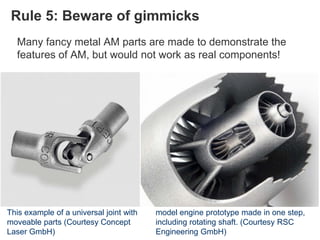
Rule 5: Beware of gimmicks
Many fancy metal AM parts are made to demonstrate the
features of AM, but would not work as real components!
This example of a universal joint with
moveable parts (Courtesy Concept
Laser GmbH)
model engine prototype made in one step,
including rotating shaft. (Courtesy RSC
Engineering GmbH)
Future RP Technologies
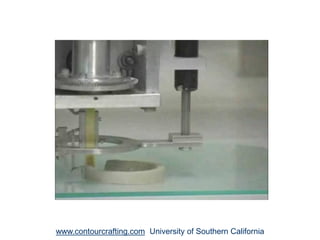
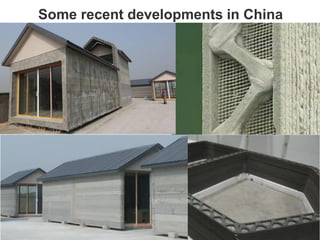
 Printing houses
Prof. Behrockh Khoshnevis, University of Southern California
 Nano-Technology rapid prototyping Prof.
Satoshi Kawata, Japan, Koji Ikuta, Japan
 Bio-printing: Printing body parts
Prof. Anthony Atala, Wake Forrest University
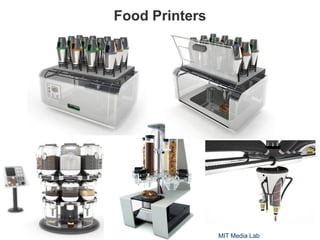
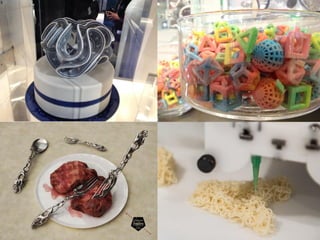
 Food Printers
MIT Media Lab, Fluid Interfaces Group, Marcelo Coelho and
Amit Zoran
Printing Houses
www.contourcrafting.com University of Southern California
Some recent developments in China
Nano-Printing
10µm (1/10th of a hair)
www.e-spaces.com
S. Kawata, Japan
BioPrinting
CBS Evening News
Food Printers
MIT Media Lab
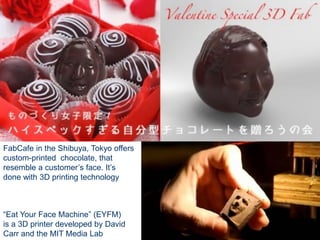
FabCafe in the Shibuya, Tokyo offers
custom-printed chocolate, that
resemble a customer’s face. It’s
done with 3D printing technology
“Eat Your Face Machine” (EYFM)
is a 3D printer developed by David
Carr and the MIT Media Lab
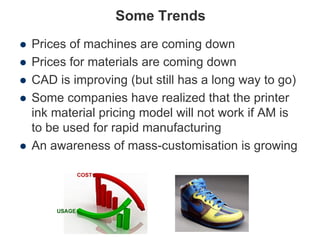
Some Trends
 Prices of machines are coming down
 Prices for materials are coming down
 CAD is improving (but still has a long way to go)
 Some companies have realized that the printer
ink material pricing model will not work if AM is
to be used for rapid manufacturing
 An awareness of mass-customisation is growing
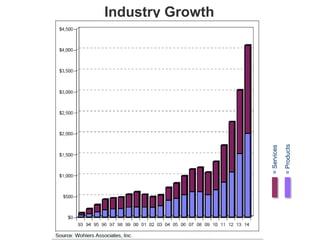
Industry Growth
=Products
=Services
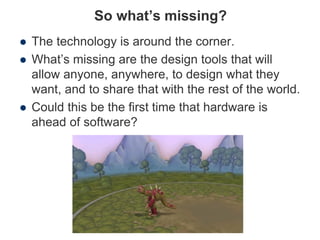
So what’s missing?
 The technology is around the corner.
 What’s missing are the design tools that will
allow anyone, anywhere, to design what they
want, and to share that with the rest of the world.
 Could this be the first time that hardware is
ahead of software?
Not a myth
3D Printing is Great!
Use it!!!

Printing The Future

  • 1.
  • 2.
  • 3.
  • 4.
    Design Today  Todayalmost everything is designed in CAD  Modern CAD packages are becoming easier to use and more powerful  CAD shows your product from any angle, distance, colour, simulates movement  CAD software is now at a level where it can often replace the sketchpad  CAD overcomes the brains 3D limitations
  • 6.
    But… A design maylook pretty on screen, but will it meet the users’ needs and can it be efficiently made? Beautiful 3D computer models can result in difficult to manufacture hardware that requires expensive fabrication processes that add cost and/or increase schedule. Enter Prototyping…
  • 7.
    AM for Prototyping Because of the comparative speed it offers (speed to market, speed to go through extra iterations, etc.), AM is worth using for prototyping the vast majority (but not all) of components.  Prototyping is also absolutely essential to avoid costly design or manufacturing mistakes.
  • 8.
  • 9.
    Subtractive Manufacturing 101 Thereally old way: Take a block of material and carve it out You want to make a bust of yourself... The modern way • Generate 3D model • Generate CNC program • Machine away unwanted material • If possible, recycle waste
  • 10.
    Additive Manufacturing 101 The3D printing way... • Generate a 3D CAD model • Software slices the 3D model into thin slices • Machine builds it layer by layer • The thinner the slices, the better the quality of the model
  • 12.
    AM for Manufacturing The decision about whether a product should be manufactured through AM comes down to balancing Product Value vs Production Quantity.
  • 13.
    Extrusion Sand/Investment Casting Pressure Diecasting Choiceof manufacturing method 13 0 Hundreds Thousands Tens of thousands Hundreds of thousands Injection Molding PartCost Milling & Turning Rotational molding Blow molding Sheet metal Additive manufacturing Laser or waterjet cutting CNC turret punching Manufacturing Quantity Forging Note: The part cost for most manufacturing technologies decreases as the quantity increases!
  • 14.
    Extrusion Sand/Investment Casting Pressure Diecasting Choiceof manufacturing method 14 0 Hundreds Thousands Tens of thousands Hundreds of thousands Injection Molding SetupCosts Milling & Turning Rotational molding Blow molding Sheet metal Additive manufacturing Laser or waterjet cutting CNC turret punching Manufacturing Quantity Forging
  • 15.
    3D Printing Processes SolidBased Plastic is extruded from a filament and slice is traced (hot glue gun) Liquid Based Photosensitive liquid polymer is exposed to laser/UV to cure Powder Based Layer of powdered material is scanned with a laser which selectively melts the material
  • 16.
    The Past  Formost of its first 3 decades, Additive Manufacturing was known as Rapid Prototyping, and mostly used for prototyping parts.  In the last decade AM has begun to make appearances in real, commercially available, products, ie. moved beyond prototypes.  This has generated a lot of hype and a few myths
  • 17.
    Myth  The vastmajority of 3D printing entails a large amount of post-processing.  This can range from removing support material, to polishing, to machining, to coating, to heat-treating, to colouring, to sanding and painting, etc. Just hit print and you are done!
  • 18.
    Lionel T. Dean’sIcon design Print time: 8.5 hours Post-processing time: 6~8 hours
  • 21.
    Myth  3D Printingwill NOT replace conventional manufacturing!  It is a complementary technology that, for certain products, and if used the right way, gives huge advantages over conventional manufacturing 3D Printing will kill traditional manufacturing!
  • 22.
    Advantage: Complexity forFree  The more complex the part, the better it is suited to Additive Manufacturing (AM).  Many simple parts can often be consolidated into one much more complex parts as no assembly is required (so less assembly labour).
  • 23.
    Art & DesignObjects Freedom of Creation Joshua Harker
  • 24.
    Textile & FashionApplications Continuum Design Freedom of Creation Francis Bitonti & Michael Schmidt Studios Joshua DeMonte
  • 25.
  • 27.
    Designing for AdditiveManufacturing Topology Optimized, Nylon: 0.56gms
  • 28.
    Myth  In thecontext of manufacturing (rather than prototyping) only parts of a suitable level of complexity and value are economically viable for 3D printing.  Just because you can, doesn’t mean you should! Anything can be 3D printed!
  • 29.
    To print ornot to print: Complexity Filter NO! These parts will be both better quality and more economical to make using a variety of other manufacturing methods (laser cutting, CNC machining, etc. YES! These parts are reaching a level of complexity where they MAY be worth 3D printing (assuming they are designed that way on purpose)
  • 30.
    Advantage: Mass customisation A small production run of parts can be undertaken in which each part is uniquely customized to suit the user  It costs no more to do 100 different components than 100 of the same component  This opens up a whole new area of business for products that are mass-custom-made for the user
  • 31.
    Medical Applications Dental aligners,Invisalign Hip socket, Ala Ortho, Italy, made on Arcam machine Laser Sintered Hearing Aids, EOS/Materialise Dental Crowns and Bridges, EOS
  • 32.
  • 33.
  • 34.
  • 35.
    Know your babybefore its born… Tomohiro Kinoshita , of FASOTEC, the company offering the 'Shape of an Angel' model, even offers parents a miniature version which could be a 'nice adornment to a mobile phone strap or key chain.'
  • 36.
  • 37.
    Advantage: Complete Products Additive manufacturing allows the production of complete products with moving parts. This can greatly reduce the amount of assembly (ergo labour) required to make products.  AM allows many simple parts to be consolidated into a single more complex part
  • 38.
  • 39.
    UAV Pitot Tube 32piece original 1 piece Nylon test part 2 piece titanium final
  • 40.
    Advantage: Try Ideasat No Risk  Testing the market with an idea, using traditional manufacturing methods, can often be extremely expensive. AM allows small production runs of product to be taken to market with very little capital risk.  This allows many more inventors to realize their inventions and test their market validity.  The potential for new businesses in this area is enormous!
  • 41.
  • 42.
    Galantai Soap Dispenser Shortproduction run of 100 units undertaken for Australian market. Cost ~US$2000
  • 43.
    Oceania Defence Rifle Suppressors 3D Printed in titanium on EOSM270  Complex internal baffles and cavities  Reduces dB to below that required for ear protection
  • 44.
    Americas Cup, TeamNew Zealand
  • 45.
    3D Printed TitaniumKnives • 3D Printed in titanium on EOSM270 (now SLM280) • gas nitride treated for hardness • Argon Ion Beam cleaned • PVD coated Design team: Victory knives, Page & Macrae and Tida. 3D printing & Gas intruding : Tida. Blade shape and grind: Victory knives. Ion beam clean & pvd coating: Page & Macrae
  • 46.
  • 47.
  • 49.
  • 51.
  • 52.
  • 53.
    Coming soon toa theatre near you…
  • 54.
    Advantage: Encouraging Innovation The relatively low-cost ability to easily try out ideas generates many innovations that would just not have seen the light of day with conventional manufacturing.  AM has seen children returning to making things. Where, over the past 20 years, they have slowly drifted into a digital entertainment age, 3D printing is now allowing them to move back from digital into reality.
  • 55.
  • 56.
  • 57.
    3D Printed Car Urbeeby Kor EcoLogic, Printed by Stratasys
  • 58.
  • 59.
  • 60.
    3D printed DB4 IvanSentch, Printed on Solidoodle
  • 61.
    Innovative use ofpower sources Markus Kayser’s “Solar Sinter” 3D printer
  • 63.
    Virginia tech’s 3Dprinting vending machine The DreamVendor is an interactive 3D printing vending machine for Virginia Tech students to enable them to quickly make prototypes for their academic, or personal, design projects. Insert an SD card with the 3D model into the machine; the DreamVendor then prints your 3D part and dispenses it into a bin when it's finished.
  • 64.
    And, of course,it was only a matter of time… The Justin Bieber
  • 65.
    E-nable: community forlow-cost prosthetics e-nable hand, Volunteer organisation founded by Jon Schull, www.enablingthefuture.org Inspired by RoboHand work of Ivan Owen and Richard Van As in 2012, www.robohand.net
  • 67.
    Advantage: On-Demand Manufacturing Parts can be manufactured as, and when, needed, rather than having to keep a large stock of parts on-hand  Parts can be manufactured locally, rather than abroad, thus greatly reducing the supply chain, and the environmental footprint of the parts  3D printing is often referred to as the next industrial revolution
  • 68.
    Supply Chain  Yesterday Today  Tomorrow  The day after tomorrow???
  • 69.
    (Misunderstood) Myth  Yes!Every home will have a 3D printer, but these will be used for hobbies and toys.  It is unlikely that 3D printers will every be used in a home setting to manufacture everything we need.  Many of us have sewing machines, but few of us are wearing homemade clothes. Every home will have a 3D printer!
  • 70.
    Myth ≠ ≠ Desktop 3D printersare like industrial ones!
  • 71.
    Myth The vast majorityof ‘3D printed’ products only use 3D printing for those features that get advantage from the technologies. The rest of the product is made using conventional manufacturing technologies. Most 3D printed products aren’t 3D printed!
  • 72.
  • 73.
    The Truth aboutMetal AM  Because of post-processing, a really good reason is needed to make a metal AM part!  Typically, parts that are not specifically designed for metal AM are not worth doing with AM  Most metal AM requires support structures for heat transfer and these, in most cases, need to be machined off. This can be hard!  Part orientation is of critical importance with metal AM
  • 75.
    Rule 1: thepart MUST be complex A gas emissions rake developed using AM optmised design (Courtesy RSC Engineering GmbH)
  • 76.
    To use AM,parts need to be AM designed GE/Morris Technologies Leap jet fuel nozzle VBN Sweden: Hollow gear hobs offer high abrasion resistance and reduced weight Existing multi-part bracket to a single piece AM part (Airbus Defence and Space)
  • 77.
    Sometimes complexity isnot geometric These models of a cannular combustor have been manufactured to demonstrate the possibility to include effusion holes and a swirler in the manufacturing process (Courtesy Concept Laser GmbH)
  • 78.
    Rule 2: Meshstructures are your friend This model of a wing demonstrates AM’s ability to combine differently oriented lightweight structures within one part. The model has been produced in one step (Courtesy Concept Laser GmbH)
  • 79.
    Rule 3: Alwaysthink of angles and supports This cross section of an emission gas rake shows the angle limitation in the AM process. (Courtesy RSC Engineering GmbH)
  • 80.
    Rule 4: PartOrientation is Critical
  • 81.
    Rule 5: Bewareof gimmicks Many fancy metal AM parts are made to demonstrate the features of AM, but would not work as real components! This example of a universal joint with moveable parts (Courtesy Concept Laser GmbH) model engine prototype made in one step, including rotating shaft. (Courtesy RSC Engineering GmbH)
  • 82.
    Future RP Technologies Printing houses Prof. Behrockh Khoshnevis, University of Southern California  Nano-Technology rapid prototyping Prof. Satoshi Kawata, Japan, Koji Ikuta, Japan  Bio-printing: Printing body parts Prof. Anthony Atala, Wake Forrest University  Food Printers MIT Media Lab, Fluid Interfaces Group, Marcelo Coelho and Amit Zoran
  • 83.
  • 84.
  • 85.
  • 86.
    Nano-Printing 10µm (1/10th ofa hair) www.e-spaces.com S. Kawata, Japan
  • 87.
  • 88.
  • 90.
    FabCafe in theShibuya, Tokyo offers custom-printed chocolate, that resemble a customer’s face. It’s done with 3D printing technology “Eat Your Face Machine” (EYFM) is a 3D printer developed by David Carr and the MIT Media Lab
  • 91.
    Some Trends  Pricesof machines are coming down  Prices for materials are coming down  CAD is improving (but still has a long way to go)  Some companies have realized that the printer ink material pricing model will not work if AM is to be used for rapid manufacturing  An awareness of mass-customisation is growing
  • 92.
  • 93.
    So what’s missing? The technology is around the corner.  What’s missing are the design tools that will allow anyone, anywhere, to design what they want, and to share that with the rest of the world.  Could this be the first time that hardware is ahead of software?
  • 94.
    Not a myth 3DPrinting is Great! Use it!!!