The equilibrium law
•Solve homogeneous equilibrium problems
using the expression for Kc.
–The use of quadratic equations will NOT be
assessed.
• In order to calculate the value of K, we
need to know the concentration in mol.dm-
3 or mol dm-3 of all reactants and products
at equilibrium.
• Sometimes we do not immediately know
all of the concentrations at equilibrium, but
we are given enough information to
determine all of the concentrations at
equilibrium and then K.
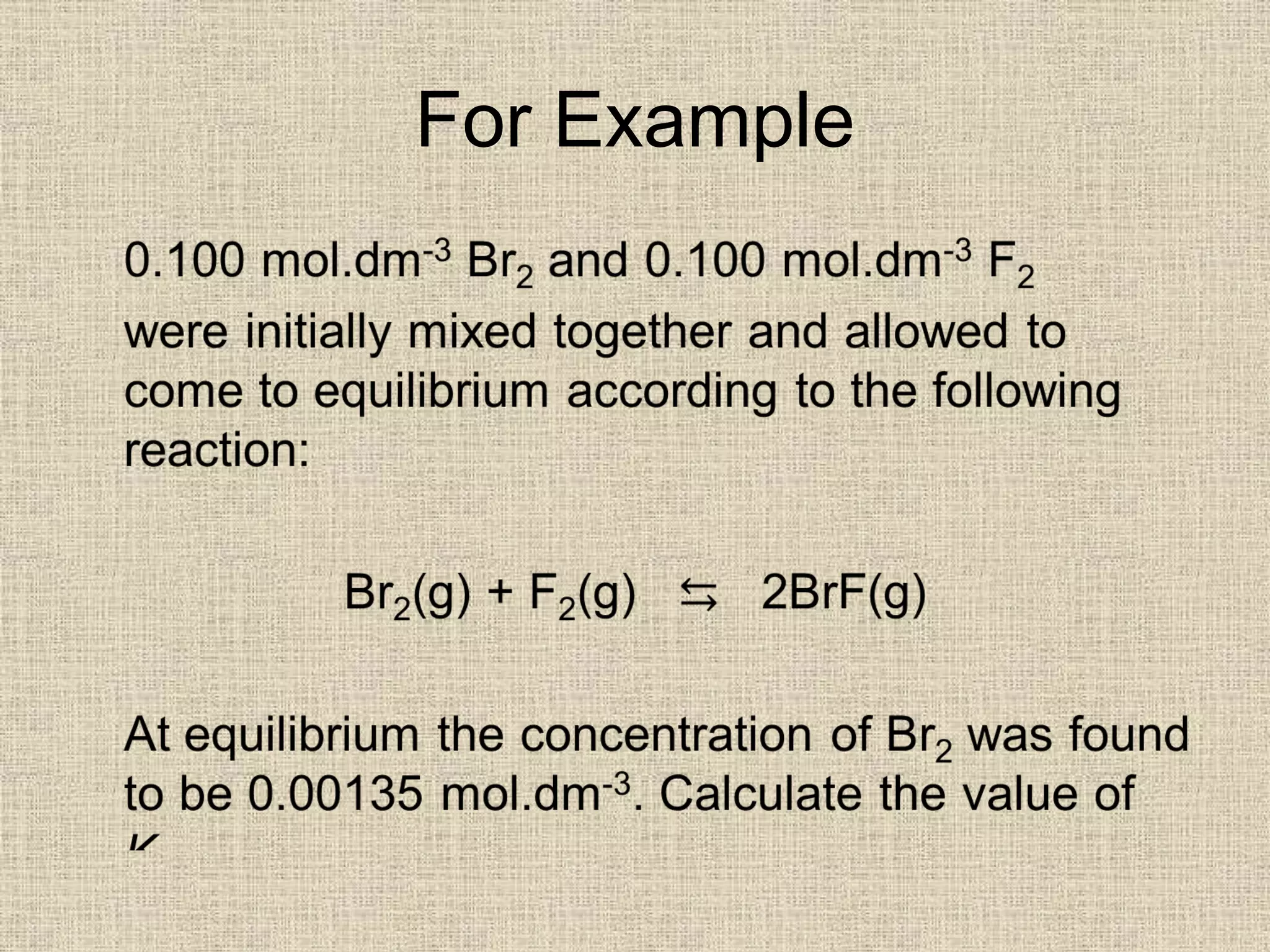
For Example
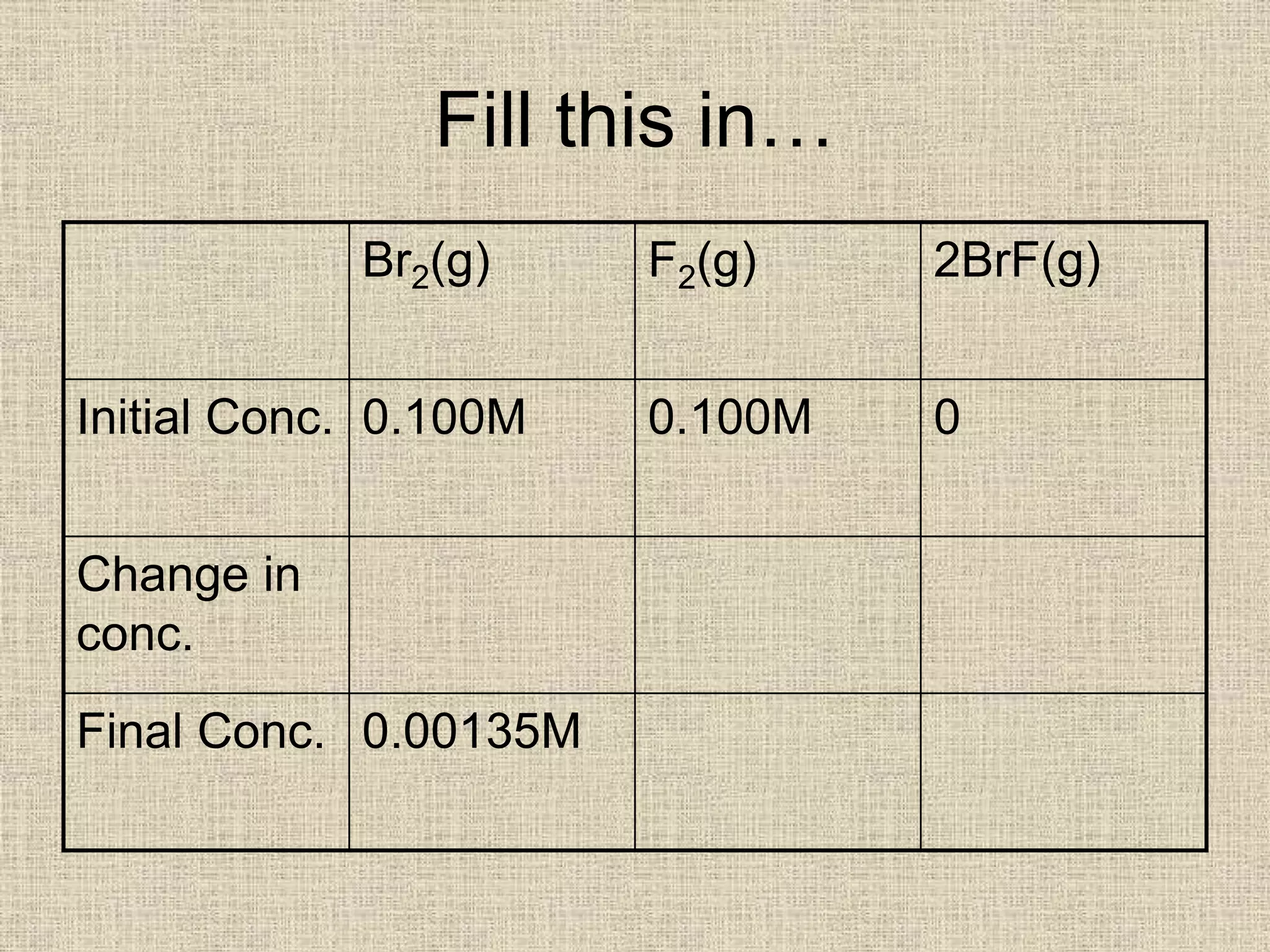
Fill this in…
Br2(g) F2(g) 2BrF(g)
Initial Conc. 0.100M 0.100M 0
Change in
conc.
Final Conc. 0.00135M
Should Look like:
Br2(g) F2(g) 2BrF(g)
Initial Conc. 0.100M 0.100M 0
Change in
conc.
-0.09865M -0.09865M +[2 x
0.09865M]
=0.1973M
Final Conc. 0.00135M 0.00135M 0.1973M
Good ol’ Stoichiometry
• We used stoichiometry (the relationship with the
balanced chemical equation to help us solve for
the final concentrations)
• Since Br2 and F2 were a 1:1 mole ratio and had
the same initial concentration, they would have
the same final.
• But BrF was a 1:2 mole ratio with Br2, so we had
to double the change in concentration and
therefore the final answer.
We’re not finished!
• Now we can solve for K because we found
the final concentrations (at equilibrium)
• K =[BrF]2 / [Br2][F2]
=[0.1973M]2/ [0.00135M][0.00135M]
=2.15 x 10⁴
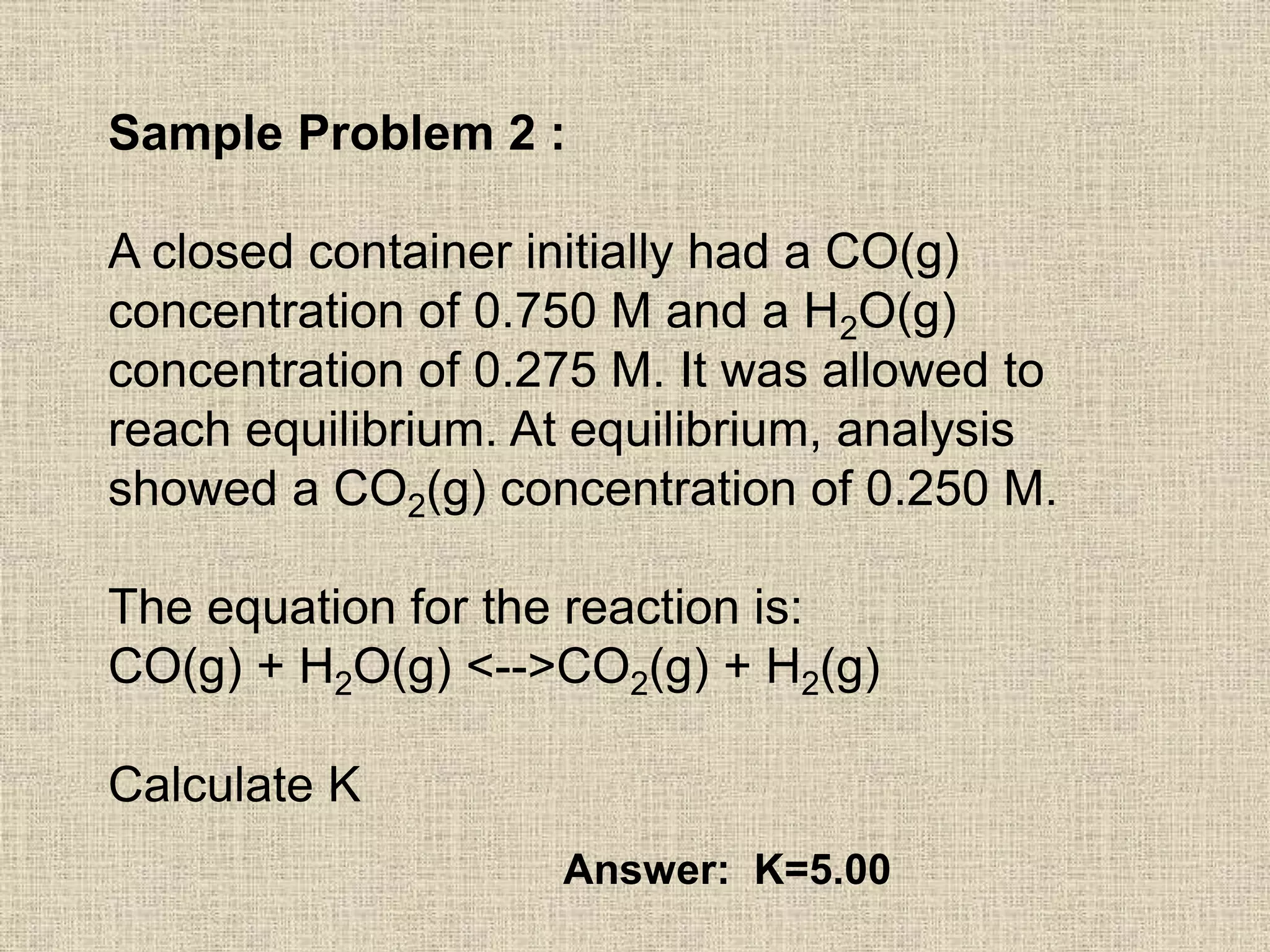
Sample Problem 2 :
A closed container initially had a CO(g)
concentration of 0.750 M and a H2O(g)
concentration of 0.275 M. It was allowed to
reach equilibrium. At equilibrium, analysis
showed a CO2(g) concentration of 0.250 M.
The equation for the reaction is:
CO(g) + H2O(g) <-->CO2(g) + H2(g)
Calculate K
Answer: K=5.00
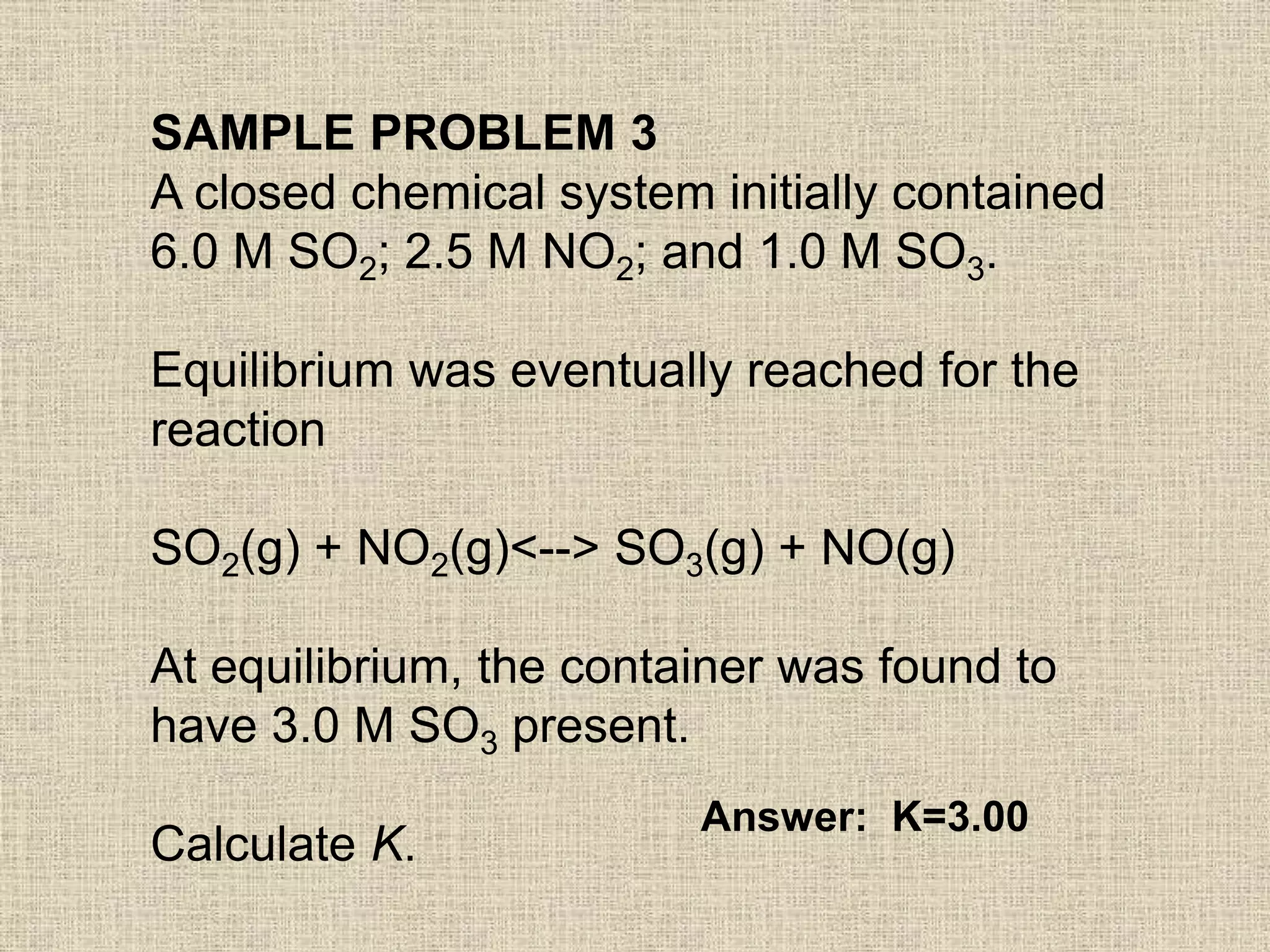
SAMPLE PROBLEM 3
A closed chemical system initially contained
6.0 M SO2; 2.5 M NO2; and 1.0 M SO3.
Equilibrium was eventually reached for the
reaction
SO2(g) + NO2(g)<--> SO3(g) + NO(g)
At equilibrium, the container was found to
have 3.0 M SO3 present.
Calculate K.
Answer: K=3.00
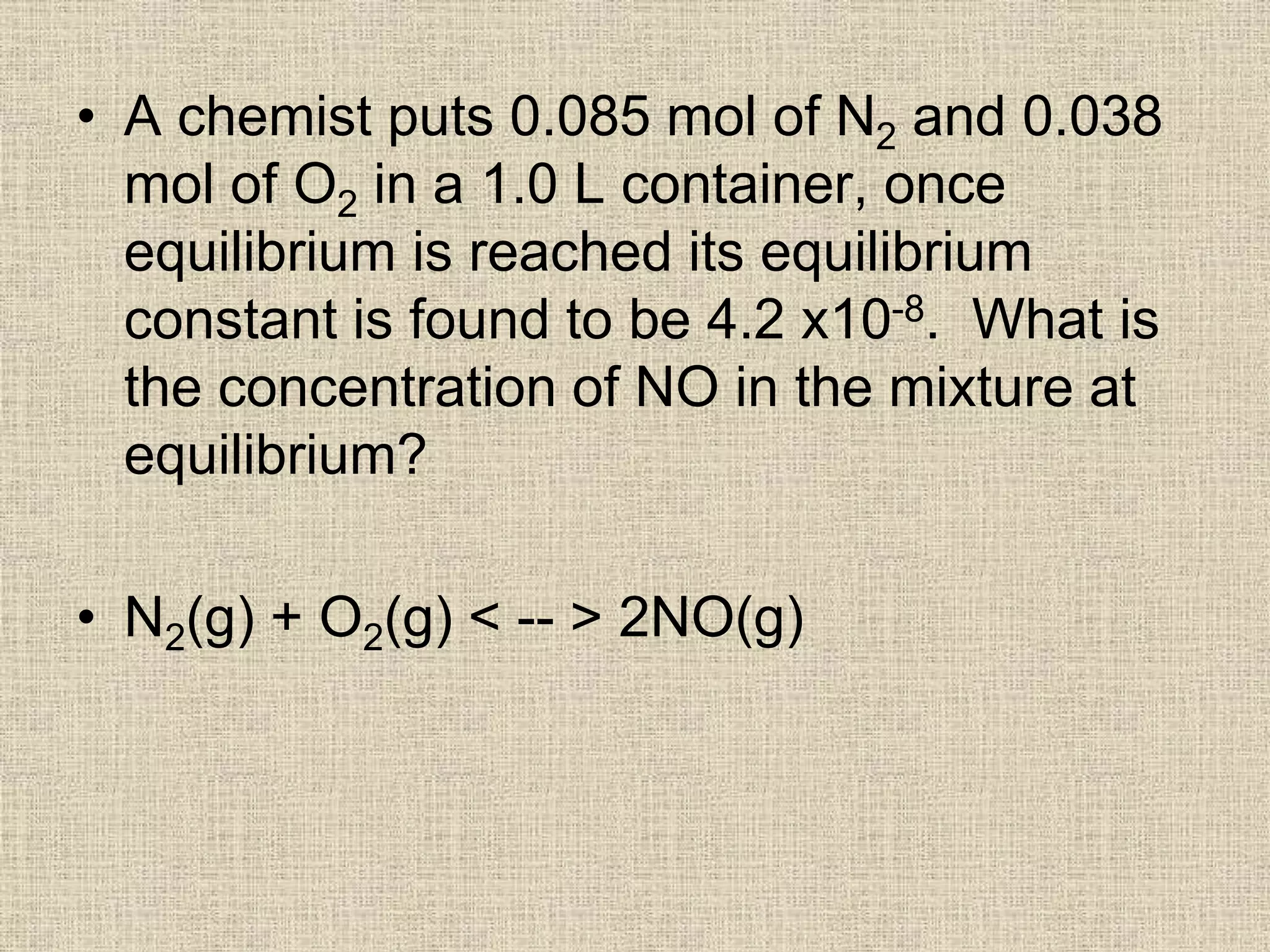
• A chemist puts 0.085 mol of N2 and 0.038
mol of O2 in a 1.0 L container, once
equilibrium is reached its equilibrium
constant is found to be 4.2 x10⁻⁸. What is
the concentration of NO in the mixture at
equilibrium?
• N2(g) + O2(g) < -- > 2NO(g)
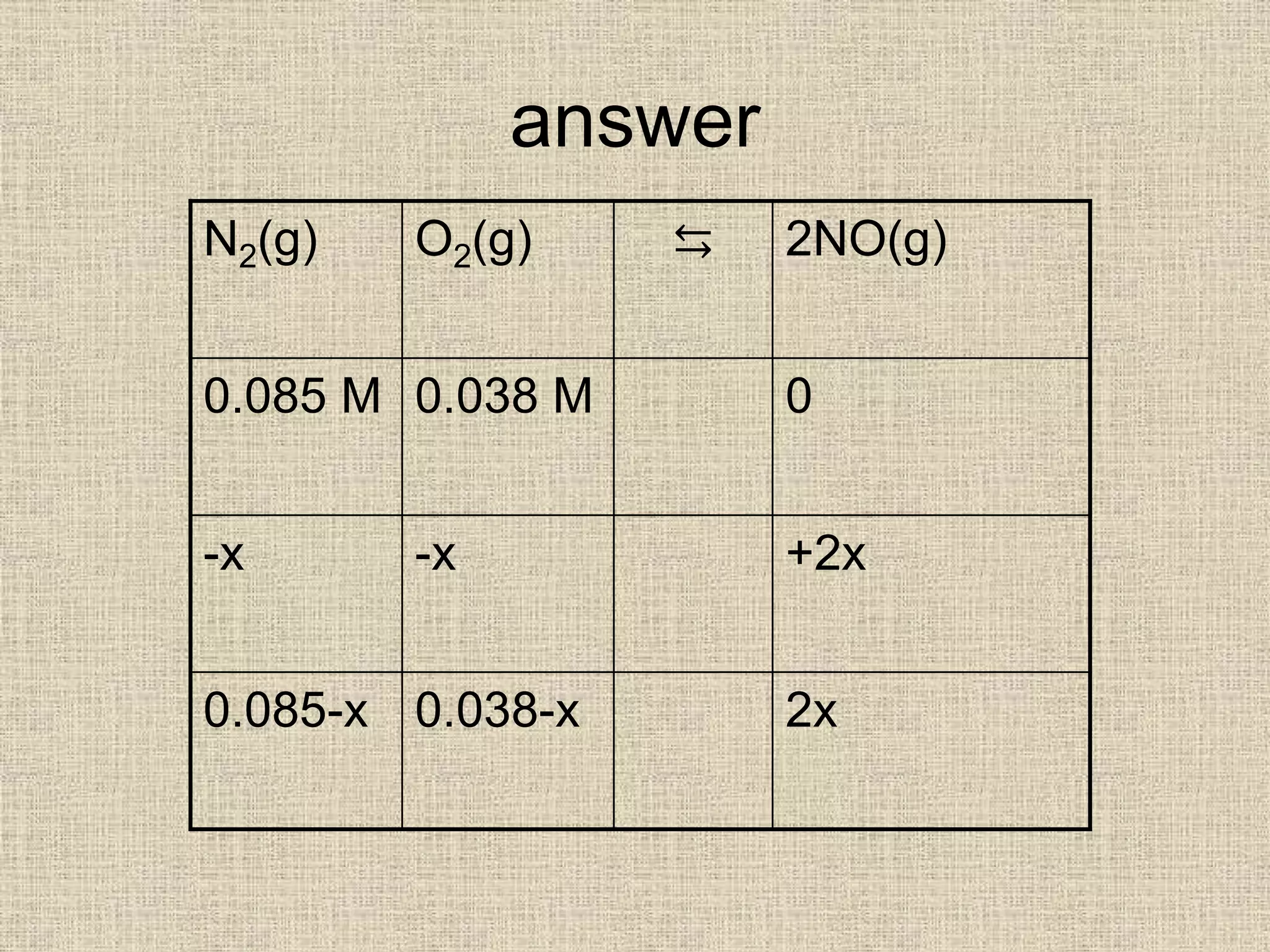
answer
N2(g) O2(g) ⇆ 2NO(g)
0.085 M 0.038 M 0
-x -x +2x
0.085-x 0.038-x 2x
Assumptions
• Normally, you would solve this using the
quadratic equation, but IB has noted that
their students will NOT need to use the
quadratic equation.
• We’re going to do a short cut that we’ll
check to make sure is okay later on.
• Instead of using 0.085-x, we’re going to
ignore the x, same for 0.038-x (ignore the
x) and solve for unknown
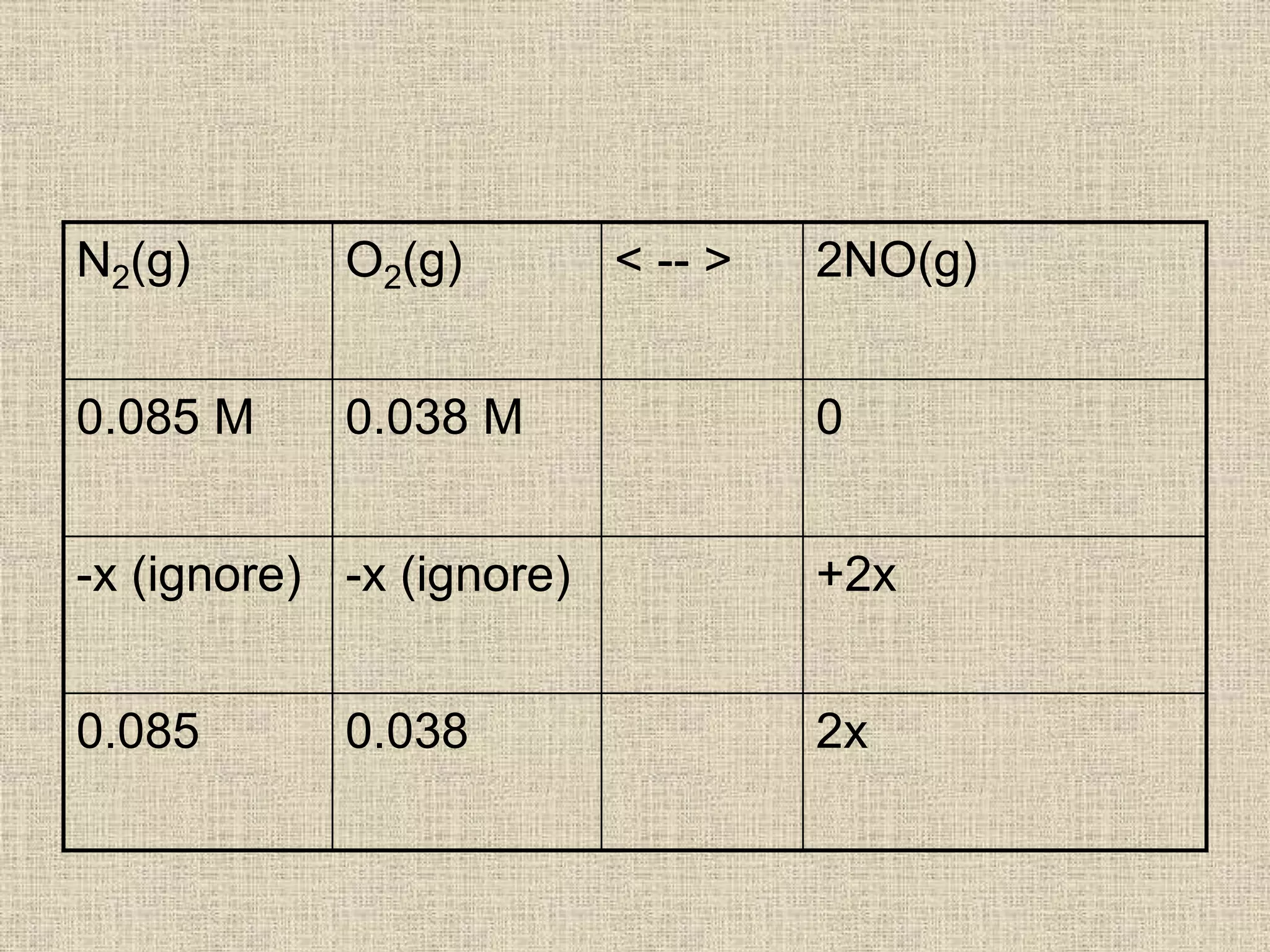
N2(g) O2(g) < -- > 2NO(g)
0.085 M 0.038 M 0
-x (ignore) -x (ignore) +2x
0.085 0.038 2x
• k = [2x]2 =4.2 x10⁻⁸
[0.085][0.038]
4x2 = (4.2x10-8) x [0.085] x [0.038]
4x2 = 1.357 x 10-10
x2 = 3.392 x 10⁻¹¹
x = 5.82 x 10⁻⁶
[NO] = 2x = 2 x 5.82 x10-6 = 1.2 x10⁻⁵ M
• To show that the short cut was okay,
check out your answer if the x wasn’t
omitted.
• Ex: 0.085- 5.82 x 10-6 = 0.085 (when you
only keep 2 sig figs) So it was okay to omit
the x.
• In university you won’t be so lucky!!!
Additional practice:
Using quadratic:

Equilibrium kc calculations

  • 1.
    The equilibrium law •Solvehomogeneous equilibrium problems using the expression for Kc. –The use of quadratic equations will NOT be assessed.
  • 2.
    • In orderto calculate the value of K, we need to know the concentration in mol.dm- 3 or mol dm-3 of all reactants and products at equilibrium. • Sometimes we do not immediately know all of the concentrations at equilibrium, but we are given enough information to determine all of the concentrations at equilibrium and then K.
  • 3.
  • 4.
    Fill this in… Br2(g)F2(g) 2BrF(g) Initial Conc. 0.100M 0.100M 0 Change in conc. Final Conc. 0.00135M
  • 5.
    Should Look like: Br2(g)F2(g) 2BrF(g) Initial Conc. 0.100M 0.100M 0 Change in conc. -0.09865M -0.09865M +[2 x 0.09865M] =0.1973M Final Conc. 0.00135M 0.00135M 0.1973M
  • 6.
    Good ol’ Stoichiometry •We used stoichiometry (the relationship with the balanced chemical equation to help us solve for the final concentrations) • Since Br2 and F2 were a 1:1 mole ratio and had the same initial concentration, they would have the same final. • But BrF was a 1:2 mole ratio with Br2, so we had to double the change in concentration and therefore the final answer.
  • 7.
    We’re not finished! •Now we can solve for K because we found the final concentrations (at equilibrium) • K =[BrF]2 / [Br2][F2] =[0.1973M]2/ [0.00135M][0.00135M] =2.15 x 10⁴
  • 8.
    Sample Problem 2: A closed container initially had a CO(g) concentration of 0.750 M and a H2O(g) concentration of 0.275 M. It was allowed to reach equilibrium. At equilibrium, analysis showed a CO2(g) concentration of 0.250 M. The equation for the reaction is: CO(g) + H2O(g) <-->CO2(g) + H2(g) Calculate K Answer: K=5.00
  • 9.
    SAMPLE PROBLEM 3 Aclosed chemical system initially contained 6.0 M SO2; 2.5 M NO2; and 1.0 M SO3. Equilibrium was eventually reached for the reaction SO2(g) + NO2(g)<--> SO3(g) + NO(g) At equilibrium, the container was found to have 3.0 M SO3 present. Calculate K. Answer: K=3.00
  • 10.
    • A chemistputs 0.085 mol of N2 and 0.038 mol of O2 in a 1.0 L container, once equilibrium is reached its equilibrium constant is found to be 4.2 x10⁻⁸. What is the concentration of NO in the mixture at equilibrium? • N2(g) + O2(g) < -- > 2NO(g)
  • 11.
    answer N2(g) O2(g) ⇆2NO(g) 0.085 M 0.038 M 0 -x -x +2x 0.085-x 0.038-x 2x
  • 12.
    Assumptions • Normally, youwould solve this using the quadratic equation, but IB has noted that their students will NOT need to use the quadratic equation. • We’re going to do a short cut that we’ll check to make sure is okay later on. • Instead of using 0.085-x, we’re going to ignore the x, same for 0.038-x (ignore the x) and solve for unknown
  • 13.
    N2(g) O2(g) <-- > 2NO(g) 0.085 M 0.038 M 0 -x (ignore) -x (ignore) +2x 0.085 0.038 2x
  • 14.
    • k =[2x]2 =4.2 x10⁻⁸ [0.085][0.038] 4x2 = (4.2x10-8) x [0.085] x [0.038] 4x2 = 1.357 x 10-10 x2 = 3.392 x 10⁻¹¹ x = 5.82 x 10⁻⁶ [NO] = 2x = 2 x 5.82 x10-6 = 1.2 x10⁻⁵ M
  • 15.
    • To showthat the short cut was okay, check out your answer if the x wasn’t omitted. • Ex: 0.085- 5.82 x 10-6 = 0.085 (when you only keep 2 sig figs) So it was okay to omit the x. • In university you won’t be so lucky!!!
  • 16.
  • 17.