Chemical Hazards
The overall objective for this
module is that participants will
extract and interpret chemical
hazard information from a Material
Safety Data Sheet
Overview
 Chemical terms and definitions that will
help you when handling chemicals
 General properties of common
chemicals and how to handle them
appropriately
 How to use the Material Safety Data
Sheet to find information about a
chemical
Expectations
 Identify three types of organic hydrocarbons
 Identify the three major hazards associated with organic
compounds
 List the three main types of inorganic chemicals
 Identify the major hazard associated with inorganic
chemicals
 Identify the two chemical types indicated on the pH scale
 Identify a corrosive material based on the OSHA
definition
 Use the Material Safety Data Sheet to find information
about a chemical
What
Are
Chemicals?
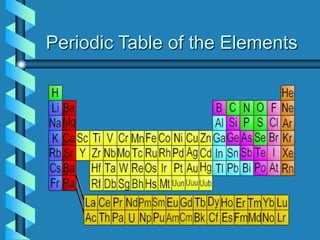
Periodic Table of the Elements
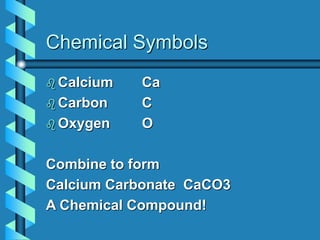
Chemical Symbols
 Calcium Ca
 Carbon C
 Oxygen O
Combine to form
Calcium Carbonate CaCO3
A Chemical Compound!
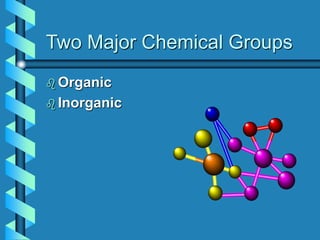
Two Major Chemical Groups
 Organic
 Inorganic
Organic Chemicals
 Based on the chemistry of carbon
 Hydrocarbons are the root of most
organic chemicals
Organic Chemicals
 Aromatic Hydrocarbons
• Benzene, toluene, xylene, and naphthalene
 Halogenated Hydrocarbons
• Freon, CFC’S, and PCB’S
 Phosphorylated Hydrocarbons
• Organophosphates
 Oxygenated Hydrocarbons
• Aldehydes, ketones, and carboxylic acids
Hazards of Organic Chemicals
 Most are flammable
• Characteristics such as flashpoints lower and
upper flammability and autoignition
temperatures should be known
 Most are anesthetics
• They should always be used in well-ventilated
spaces
 Some are carcinogens
• Toxicity limits should be known and appropriate
personal protective equipment worn
Inorganic Chemicals
 Acids
 Bases
 Salts
cleaner
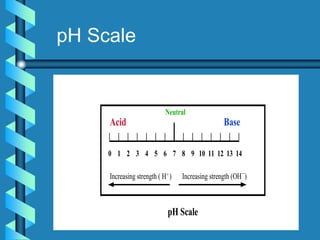
0 1 2 3 4 5 6 7 8 9 10 11 12 13 14
Acid Base
Neutral
Increasing strength ( H ) Increasing strength (OH )
+
_
pH Scale
pH Scale
Identifying Acids
 Acids have a pH less than 7
 High concentration of H+ ions
 Turn litmus paper red
 Taste tart
 React with metals to form hydrogen
gas
Identifying Bases
 Bases have a pH greater than 7
 Low concentration of H+ ions
 Turn litmus paper blue
 Taste bitter
 Have a slippery, soapy feel
Identifying Salts
 Salts are one or more metal ions
combined with one or more nonmetal
ions
 Formed when an acid and base react
with one another
 May be toxic and contain heavy
metals
Hazard of Inorganic
Chemicals
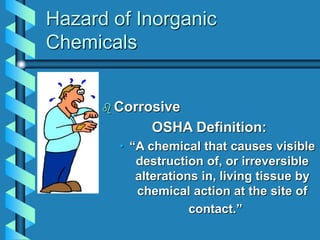
 Corrosive
• The second most commonly used and
transported group of hazardous
materials.
• “Any liquid that has a severe corrosion
rate on steel”.
Hazard of Inorganic
Chemicals
 Corrosive
OSHA Definition:
• “A chemical that causes visible
destruction of, or irreversible
alterations in, living tissue by
chemical action at the site of
contact.”
Properties of Chemicals
 Physical properties - Can be measured
 Chemical properties - How a chemical
will react
Physical Properties
 Volatility
 Boiling point
 Vapor pressure
• Measure of pressure that a gas/vapor will exert
on the inside of a closed container
• Measured in mm of mercury or inches of
mercury
• As temperatures rise the vapor pressure
increases
Physical Properties
 Evaporation rate
 Melting / Freezing point
 Specific gravity
• Water = 1
• Less than one is less dense and will
float in water
• More than one is more dense and will
sink in water
Physical Properties
 Vapor Density
• When the gases and vapors are compared
to normal room air (air = 1)
• Any gas or vapor that has a number less
than one is less dense and will rise in air
• Any gas or vapor that has a number larger
than one is more dense and will sink in air
 Solubility
 Chemical Compatibility
Physical Properties
 pH
• It is a scale
• Low and high numbers are corrosive
 Flashpoint
• Minimum temperature at which a
substance gives off vapor sufficient to
form an ignitable mixture with air
Physical Properties
 Flammable - Flashpoint below 1410 F
 Combustible - Flashpoint above 1410 F
and below 2000 F
 Ignitable - Flashpoint less than 1410 F
Physical Properties
 Lower Flammable Limit (LFL or LEL) and
Upper Flammable Limit (UFL or UEL)
• Are the range of chemical vapor to air ratio
that needs to exist before a chemical will
ignite
Physical Properties
 Lower Flammable Limit
• Lowest concentration, by volume in air,
which will explode, ignite, or burn when
there is an ignition source
 Upper Flammable Limit
• Maximum concentration, by volume in
air, which will explode, ignite, or burn
when there is an ignition source
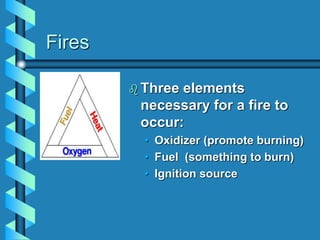
Fires
 Three elements
necessary for a fire to
occur:
• Oxidizer (promote burning)
• Fuel (something to burn)
• Ignition source
Chemical Properties
 Oxidizers
 Pyrophoric
 Water reactive
Oxidizers
 Chemicals that contain oxygen and
will give it up readily
 May cause or enhance the
combustion of other materials
Pyrophoric
 Solids and liquids spontaneously
ignite in air at certain temperatures
Water Reactive
 Chemicals become spontaneously
flammable or give off flammable or
toxic gas when in contact with water
Chemical References
 Material Safety Data Sheets
 The Chemical Dictionary
 Product Label
 Farm Chemical Handbook
 Poison Control Center
Material Safety Data Sheets
(MSDS)
 OSHA Requirements
• Identity
• Physical and Chemical Characteristics
• Physical Hazards
• Health Hazards
• Routes of Entry
• PEL and TLV
 OSHA Requirements
• Carcinogenicity
• Precautions for Safe Handling and Use
• Control Measures
• Emergency and First Aid Procedures
• Date of Preparation
• Name, Address, Phone Number of
Prepare
Material Safety Data Sheets
(MSDS)
Understanding types of chemicals,
properties, potential hazards, and use of
reference materials will enable you to
handle chemicals safely and
appropriately

Chemical Hazards from Material Safety Data Sheet

  • 1.
    Chemical Hazards The overallobjective for this module is that participants will extract and interpret chemical hazard information from a Material Safety Data Sheet
  • 2.
    Overview  Chemical termsand definitions that will help you when handling chemicals  General properties of common chemicals and how to handle them appropriately  How to use the Material Safety Data Sheet to find information about a chemical
  • 3.
    Expectations  Identify threetypes of organic hydrocarbons  Identify the three major hazards associated with organic compounds  List the three main types of inorganic chemicals  Identify the major hazard associated with inorganic chemicals  Identify the two chemical types indicated on the pH scale  Identify a corrosive material based on the OSHA definition  Use the Material Safety Data Sheet to find information about a chemical
  • 4.
  • 5.
    Periodic Table ofthe Elements
  • 6.
    Chemical Symbols  CalciumCa  Carbon C  Oxygen O Combine to form Calcium Carbonate CaCO3 A Chemical Compound!
  • 7.
    Two Major ChemicalGroups  Organic  Inorganic
  • 8.
    Organic Chemicals  Basedon the chemistry of carbon  Hydrocarbons are the root of most organic chemicals
  • 9.
    Organic Chemicals  AromaticHydrocarbons • Benzene, toluene, xylene, and naphthalene  Halogenated Hydrocarbons • Freon, CFC’S, and PCB’S  Phosphorylated Hydrocarbons • Organophosphates  Oxygenated Hydrocarbons • Aldehydes, ketones, and carboxylic acids
  • 10.
    Hazards of OrganicChemicals  Most are flammable • Characteristics such as flashpoints lower and upper flammability and autoignition temperatures should be known  Most are anesthetics • They should always be used in well-ventilated spaces  Some are carcinogens • Toxicity limits should be known and appropriate personal protective equipment worn
  • 11.
    Inorganic Chemicals  Acids Bases  Salts cleaner
  • 12.
    0 1 23 4 5 6 7 8 9 10 11 12 13 14 Acid Base Neutral Increasing strength ( H ) Increasing strength (OH ) + _ pH Scale pH Scale
  • 13.
    Identifying Acids  Acidshave a pH less than 7  High concentration of H+ ions  Turn litmus paper red  Taste tart  React with metals to form hydrogen gas
  • 14.
    Identifying Bases  Baseshave a pH greater than 7  Low concentration of H+ ions  Turn litmus paper blue  Taste bitter  Have a slippery, soapy feel
  • 15.
    Identifying Salts  Saltsare one or more metal ions combined with one or more nonmetal ions  Formed when an acid and base react with one another  May be toxic and contain heavy metals
  • 16.
    Hazard of Inorganic Chemicals Corrosive • The second most commonly used and transported group of hazardous materials. • “Any liquid that has a severe corrosion rate on steel”.
  • 17.
    Hazard of Inorganic Chemicals Corrosive OSHA Definition: • “A chemical that causes visible destruction of, or irreversible alterations in, living tissue by chemical action at the site of contact.”
  • 18.
    Properties of Chemicals Physical properties - Can be measured  Chemical properties - How a chemical will react
  • 19.
    Physical Properties  Volatility Boiling point  Vapor pressure • Measure of pressure that a gas/vapor will exert on the inside of a closed container • Measured in mm of mercury or inches of mercury • As temperatures rise the vapor pressure increases
  • 20.
    Physical Properties  Evaporationrate  Melting / Freezing point  Specific gravity • Water = 1 • Less than one is less dense and will float in water • More than one is more dense and will sink in water
  • 21.
    Physical Properties  VaporDensity • When the gases and vapors are compared to normal room air (air = 1) • Any gas or vapor that has a number less than one is less dense and will rise in air • Any gas or vapor that has a number larger than one is more dense and will sink in air  Solubility  Chemical Compatibility
  • 22.
    Physical Properties  pH •It is a scale • Low and high numbers are corrosive  Flashpoint • Minimum temperature at which a substance gives off vapor sufficient to form an ignitable mixture with air
  • 23.
    Physical Properties  Flammable- Flashpoint below 1410 F  Combustible - Flashpoint above 1410 F and below 2000 F  Ignitable - Flashpoint less than 1410 F
  • 24.
    Physical Properties  LowerFlammable Limit (LFL or LEL) and Upper Flammable Limit (UFL or UEL) • Are the range of chemical vapor to air ratio that needs to exist before a chemical will ignite
  • 25.
    Physical Properties  LowerFlammable Limit • Lowest concentration, by volume in air, which will explode, ignite, or burn when there is an ignition source  Upper Flammable Limit • Maximum concentration, by volume in air, which will explode, ignite, or burn when there is an ignition source
  • 26.
    Fires  Three elements necessaryfor a fire to occur: • Oxidizer (promote burning) • Fuel (something to burn) • Ignition source
  • 27.
    Chemical Properties  Oxidizers Pyrophoric  Water reactive
  • 28.
    Oxidizers  Chemicals thatcontain oxygen and will give it up readily  May cause or enhance the combustion of other materials
  • 29.
    Pyrophoric  Solids andliquids spontaneously ignite in air at certain temperatures
  • 30.
    Water Reactive  Chemicalsbecome spontaneously flammable or give off flammable or toxic gas when in contact with water
  • 31.
    Chemical References  MaterialSafety Data Sheets  The Chemical Dictionary  Product Label  Farm Chemical Handbook  Poison Control Center
  • 32.
    Material Safety DataSheets (MSDS)  OSHA Requirements • Identity • Physical and Chemical Characteristics • Physical Hazards • Health Hazards • Routes of Entry • PEL and TLV
  • 33.
     OSHA Requirements •Carcinogenicity • Precautions for Safe Handling and Use • Control Measures • Emergency and First Aid Procedures • Date of Preparation • Name, Address, Phone Number of Prepare Material Safety Data Sheets (MSDS)
  • 34.
    Understanding types ofchemicals, properties, potential hazards, and use of reference materials will enable you to handle chemicals safely and appropriately