Chapter
3
Fire Safety for
Hazardous Materials
JTA
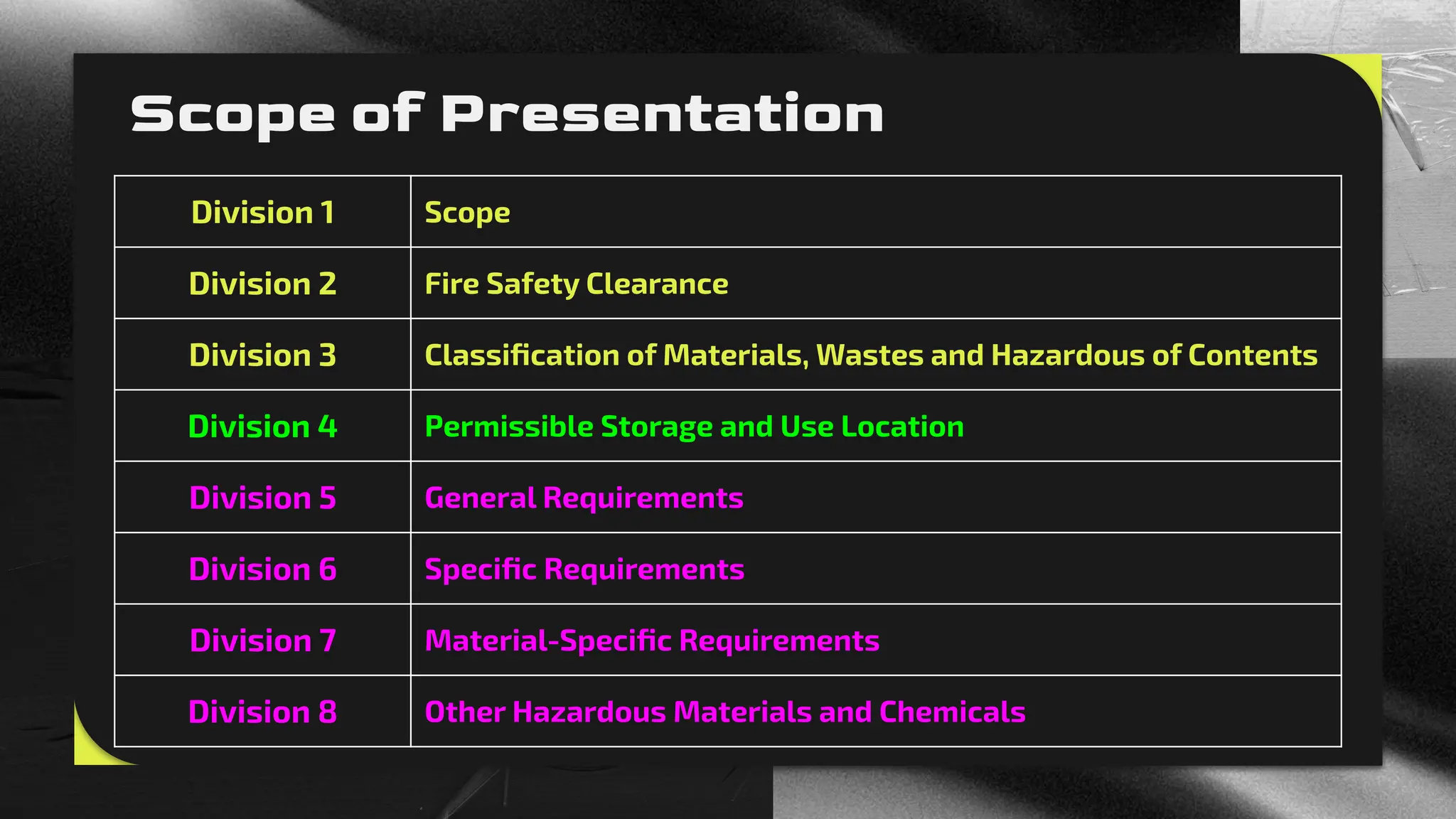
Scope of Presentation
Division 1 Scope
Division 2 Fire Safety Clearance
Division 3 Classification of Materials, Wastes and Hazardous of Contents
Division 4 Permissible Storage and Use Location
Division 5 General Requirements
Division 6 Specific Requirements
Division 7 Material-Specific Requirements
Division 8 Other Hazardous Materials and Chemicals
Scope
Division 1
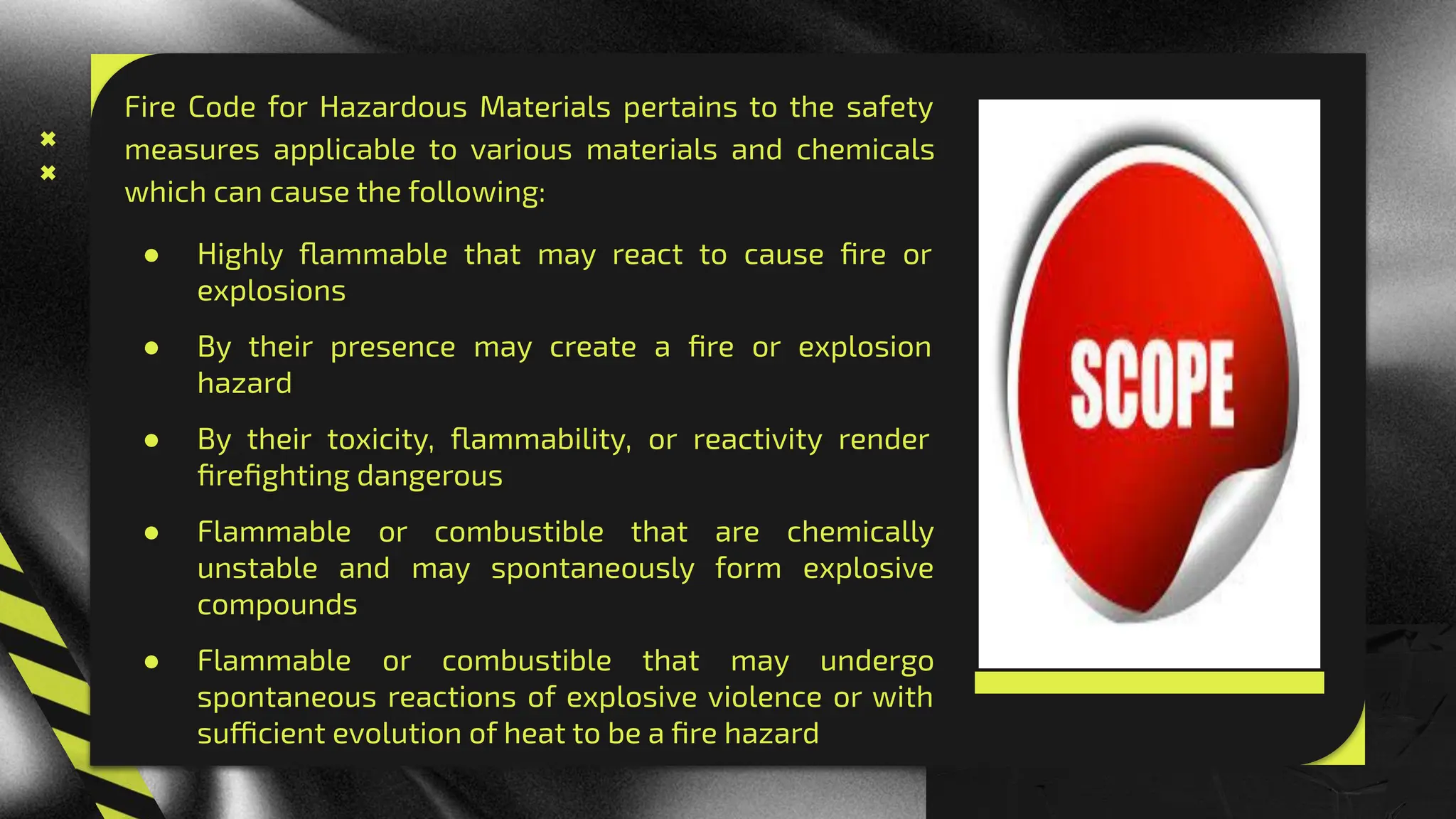
Fire Code for Hazardous Materials pertains to the safety
measures applicable to various materials and chemicals
which can cause the following:
● Highly flammable that may react to cause fire or
explosions
● By their presence may create a fire or explosion
hazard
● By their toxicity, flammability, or reactivity render
firefighting dangerous
● Flammable or combustible that are chemically
unstable and may spontaneously form explosive
compounds
● Flammable or combustible that may undergo
spontaneous reactions of explosive violence or with
sufficient evolution of heat to be a fire hazard
Fire Safety Clearance
(FSC)
Division 2
A Fire Safety Clearance (FSC) for
the installation and conveyance
of all hazardous materials shall
be issued by the BFP as
pre-requisite for the issuance of
appropriate permits and
licenses from the local and other
government agencies
concerned.
Works that needs Fire Safety Clearance (FSC)
Installation of LPG
System
Storage of Flammable
and Combustible
Liquids
Works that needs Fire Safety Clearance (FSC)
Conveyance of
Hazardous Materials
and Chemicals in Cargo
Vehicles
Installation of
Flammable and
Combustible Liquid
Storage Tanks
To obtain the FSC, the following general
steps may be involved:
The applicant must
submit an application for
the Fire Safety Clearance
to the BFP. The application
form typically requires
information about the
facility, the types and
quantities of hazardous
materials, and the contact
details of the applicant.
The applicant needs to
provide supporting
documentation, which
may include an inventory
of the hazardous
materials present, site
and facility plans, safety
measures and
procedures, and evidence
of compliance with fire
safety regulations.
Application
The BFP conducts an
inspection of the facility to
assess compliance with fire
safety requirements. During
the inspection, the BFP
verifies the presence of
appropriate fire protection
systems, such as fire
alarms, fire suppression
systems, and fire
extinguishers. They also
evaluate the storage and
handling practices for
hazardous materials.
Documentation
Inspection
and
Evaluation
To obtain the FSC, the following general
steps may be involved:
Based on the inspection
findings and the
submitted documentation,
the BFP evaluates the
facility's compliance with
fire safety regulations and
determines if the
necessary safety
measures are in place.
If the facility meets the
fire safety requirements,
the BFP issues the Fire
Safety Clearance. This
clearance serves as proof
that the facility has met
the necessary fire safety
standards for the
installation and
conveyance of hazardous
materials.
Compliance
Assessment
Once the Fire Safety
Clearance is obtained, it can
be used as a prerequisite for
obtaining permits and
licenses from other local
government agencies
concerned with hazardous
materials. These permits
and licenses may include
environmental permits,
business permits, or other
relevant certifications
required for the specific
type of hazardous materials
and operations involved.
Issuance of
FSC
Classification of
Materials, Wastes,
and Hazard of
Contents
Division 3
Hazardous Material Classification
Criteria used to classify hazardous materials:
❖ Physical Hazards - refer to substances or materials that
can cause harm without necessarily being ingested,
inhaled, or coming into contact with the skin such as
flammable, explosive, and reactive materials.
❖ Health Hazard - refer to substances that can cause harm
when inhaled, ingested, or come into contact with the
skin such as toxic, carcinogenic and corrosive materials.
- A system used to categorize substances based on their
potential to cause harm to health, environment, or property.
Hazardous materials shall be classified into
one or more of the following categories of
hazardous materials:
❖ Corrosive Solids, Liquids, or Gases
❖ Flammable Solids, Liquids and Aerosols
❖ Flammable, Inert, and Oxidizing Cryogenic Fluids
❖ Flammable and Inert Gases
❖ Organic Peroxide Formulations
❖ Solid and Liquid Oxidizers
❖ Oxidizing Gases
❖ Toxic Solids, Liquids, or Gases
❖ Unstable (Reactive) Solids, Liquids, or Gases
❖ Water-Reactive Solids or Liquids
❖ Radioactive Materials
❖ Explosives
❖ Pyrophoric Solids, Liquids, or Gases
High-Hazard Level 3 of
Contents
Classification of High-Hazard Contents
- Materials that present detonation
hazard
- These are typically highly explosive
and can undergo chemical reactions
that release large amount of energy
- Materials that present deflagration
hazard or a hazard from accelerated
burning
- Also release large amount of energy
but less violent and slower than a
detonation
- Materials that readily support
combustion or present a physical
hazard
- Easily catch fire or contribute to the
spread of fire
- Materials that are acute health
hazards
- Hazard can be acquired through skin
contact, ingestion or inhalation
High-Hazard Level 1 of
Contents
High-Hazard Level 2 of
Contents
High-Hazard Level 4 of
Contents
Categories
High-Hazard Level 1 Contents
● Class 4 Oxidizers
○ Perchloric Acid Solution (greater than
72.5% by weight)
■ Oxidizer that is highly corrosive and
reactive. Commonly used as a
laboratory reagent and in electronics
industrial process
○ Hydrogen Peroxide
■ Oxidizer used as rocket propellant,
bleaching agent for textile and paper,
antiseptic for minor cuts and as
mouthwash, household cleaning
agent and to bleach hair
Categories
High-Hazard Level 1 Contents
● Detonable Pyrophoric Solids or
Liquids
○ Materials with autoignition
temperature in air, at or below
temperature of around 54°C
○ White Phosphorus
■ Used in production of
fireworks and military
ammunition
Categories
High-Hazard Level 1 Contents
● Class 3 Detonable and Class 4
Unstable (Reactive) Solids, Liquids, or
Gases
○ Trinitrotoluene (TNT)
■ Compound used as an
explosive material.
Commonly used explosive
for military, industrial, and
mining application due to
stability and relative low
sensitivity to shock and
friction
Categories
High-Hazard Level 1 Contents
● Detonable Organic Peroxides
○ Organic peroxides that are
capable of detonation and pose
an extremely high-explosion
hazard through rapid explosive
decomposition
○ Unclassified Organic Peroxides
Categories
High-Hazard Level 2 Contents
● Combustible dust stored, used, or generated in a
manner creating a severe fire or explosion
hazard
○ Wood Fibers
● Class I Organic Peroxide
○ Capable of deflagration but do not detonate
but characterized as explosive in package
and very fast burning
○ Methyl Ethyl Ketone Peroxide
● Flammable Gases
○ Methane/Butane
● Flammable Cryogenic Fluids
○ Liquid Hydrogen
● Non-Detonable Pyrophoric Material
○ Matches
● Class 3 Water-Reactive Material
○ Triethylaluminum
Categories
High-Hazard Level 3 Contents
● Flammable solids other than dust classified as
High-Hazard Level 2, stored, used, or generated
in a manner creating a fire hazard
○ Linen, Paper
● Class II & III Organic Peroxide
○ Benzoyl Peroxide
● Class II Solid or Liquid Oxidizers
○ Sodium Chlorate
● Oxidizing Gases
○ Chlorine Gas, Oxygen,
● Oxidizing Cryogenic Fluids
○ Liquid Oxygen
Categories
High-Hazard Level 4 Contents
● Corrosive and Toxic Materials
○ Chlorine
○ Pesticides
Mixtures
❖ Paints
➢ A mixture that typically contains
pigments, binders, solvents, and
additives. The hazard classification of
paint would depend on its specific
formulation and properties. It could be
classified as flammable if it contains
flammable solvents, or as a respiratory
or skin irritant if it contains toxic or
irritant substances.
- Mixtures shall be classified in accordance with the hazards of
the mixtures as a whole by an approved, qualified
organization, individual, or testing laboratories
❖ Cleaning Solutions
➢ Cleaning solutions are often mixtures
of various chemicals, such as
surfactants, solvents, and
disinfectants. The hazard classification
would vary based on the specific
ingredients. Some cleaning solutions
may be classified as corrosive if they
contain strong acids or bases, while
others may be classified as irritants or
respiratory sensitizers.
❖ Adhesives
➢ Mixtures used for bonding materials
together. The hazard classification
would depend on the type of adhesive
and its components. Some adhesives
may be flammable if they contain
volatile solvents, while others may be
classified as respiratory irritants or
sensitizers if they release harmful
fumes during use.
❖ Pesticide Formulation
➢ Mixtures designed to control pests,
including insects, weeds, and fungi. The
hazard classification would be based
on the specific active ingredients and
their concentrations. Pesticides can be
classified as toxic, irritant, or
environmentally hazardous
substances, depending on their
properties.
Multiple Hazards
- Hazardous materials that have multiple hazards shall
conform to the code requirements for each applicable hazard
category
The End
Thank You

Fire Code Chapter 3 Division Chapter 1 to 4.pdf

  • 1.
  • 2.
    Scope of Presentation Division1 Scope Division 2 Fire Safety Clearance Division 3 Classification of Materials, Wastes and Hazardous of Contents Division 4 Permissible Storage and Use Location Division 5 General Requirements Division 6 Specific Requirements Division 7 Material-Specific Requirements Division 8 Other Hazardous Materials and Chemicals
  • 3.
  • 4.
    Fire Code forHazardous Materials pertains to the safety measures applicable to various materials and chemicals which can cause the following: ● Highly flammable that may react to cause fire or explosions ● By their presence may create a fire or explosion hazard ● By their toxicity, flammability, or reactivity render firefighting dangerous ● Flammable or combustible that are chemically unstable and may spontaneously form explosive compounds ● Flammable or combustible that may undergo spontaneous reactions of explosive violence or with sufficient evolution of heat to be a fire hazard
  • 5.
  • 6.
    A Fire SafetyClearance (FSC) for the installation and conveyance of all hazardous materials shall be issued by the BFP as pre-requisite for the issuance of appropriate permits and licenses from the local and other government agencies concerned.
  • 7.
    Works that needsFire Safety Clearance (FSC) Installation of LPG System Storage of Flammable and Combustible Liquids
  • 8.
    Works that needsFire Safety Clearance (FSC) Conveyance of Hazardous Materials and Chemicals in Cargo Vehicles Installation of Flammable and Combustible Liquid Storage Tanks
  • 9.
    To obtain theFSC, the following general steps may be involved: The applicant must submit an application for the Fire Safety Clearance to the BFP. The application form typically requires information about the facility, the types and quantities of hazardous materials, and the contact details of the applicant. The applicant needs to provide supporting documentation, which may include an inventory of the hazardous materials present, site and facility plans, safety measures and procedures, and evidence of compliance with fire safety regulations. Application The BFP conducts an inspection of the facility to assess compliance with fire safety requirements. During the inspection, the BFP verifies the presence of appropriate fire protection systems, such as fire alarms, fire suppression systems, and fire extinguishers. They also evaluate the storage and handling practices for hazardous materials. Documentation Inspection and Evaluation
  • 10.
    To obtain theFSC, the following general steps may be involved: Based on the inspection findings and the submitted documentation, the BFP evaluates the facility's compliance with fire safety regulations and determines if the necessary safety measures are in place. If the facility meets the fire safety requirements, the BFP issues the Fire Safety Clearance. This clearance serves as proof that the facility has met the necessary fire safety standards for the installation and conveyance of hazardous materials. Compliance Assessment Once the Fire Safety Clearance is obtained, it can be used as a prerequisite for obtaining permits and licenses from other local government agencies concerned with hazardous materials. These permits and licenses may include environmental permits, business permits, or other relevant certifications required for the specific type of hazardous materials and operations involved. Issuance of FSC
  • 11.
    Classification of Materials, Wastes, andHazard of Contents Division 3
  • 12.
    Hazardous Material Classification Criteriaused to classify hazardous materials: ❖ Physical Hazards - refer to substances or materials that can cause harm without necessarily being ingested, inhaled, or coming into contact with the skin such as flammable, explosive, and reactive materials. ❖ Health Hazard - refer to substances that can cause harm when inhaled, ingested, or come into contact with the skin such as toxic, carcinogenic and corrosive materials. - A system used to categorize substances based on their potential to cause harm to health, environment, or property.
  • 13.
    Hazardous materials shallbe classified into one or more of the following categories of hazardous materials: ❖ Corrosive Solids, Liquids, or Gases ❖ Flammable Solids, Liquids and Aerosols ❖ Flammable, Inert, and Oxidizing Cryogenic Fluids ❖ Flammable and Inert Gases ❖ Organic Peroxide Formulations ❖ Solid and Liquid Oxidizers ❖ Oxidizing Gases
  • 14.
    ❖ Toxic Solids,Liquids, or Gases ❖ Unstable (Reactive) Solids, Liquids, or Gases ❖ Water-Reactive Solids or Liquids ❖ Radioactive Materials ❖ Explosives ❖ Pyrophoric Solids, Liquids, or Gases
  • 15.
    High-Hazard Level 3of Contents Classification of High-Hazard Contents - Materials that present detonation hazard - These are typically highly explosive and can undergo chemical reactions that release large amount of energy - Materials that present deflagration hazard or a hazard from accelerated burning - Also release large amount of energy but less violent and slower than a detonation - Materials that readily support combustion or present a physical hazard - Easily catch fire or contribute to the spread of fire - Materials that are acute health hazards - Hazard can be acquired through skin contact, ingestion or inhalation High-Hazard Level 1 of Contents High-Hazard Level 2 of Contents High-Hazard Level 4 of Contents
  • 16.
    Categories High-Hazard Level 1Contents ● Class 4 Oxidizers ○ Perchloric Acid Solution (greater than 72.5% by weight) ■ Oxidizer that is highly corrosive and reactive. Commonly used as a laboratory reagent and in electronics industrial process ○ Hydrogen Peroxide ■ Oxidizer used as rocket propellant, bleaching agent for textile and paper, antiseptic for minor cuts and as mouthwash, household cleaning agent and to bleach hair
  • 17.
    Categories High-Hazard Level 1Contents ● Detonable Pyrophoric Solids or Liquids ○ Materials with autoignition temperature in air, at or below temperature of around 54°C ○ White Phosphorus ■ Used in production of fireworks and military ammunition
  • 18.
    Categories High-Hazard Level 1Contents ● Class 3 Detonable and Class 4 Unstable (Reactive) Solids, Liquids, or Gases ○ Trinitrotoluene (TNT) ■ Compound used as an explosive material. Commonly used explosive for military, industrial, and mining application due to stability and relative low sensitivity to shock and friction
  • 19.
    Categories High-Hazard Level 1Contents ● Detonable Organic Peroxides ○ Organic peroxides that are capable of detonation and pose an extremely high-explosion hazard through rapid explosive decomposition ○ Unclassified Organic Peroxides
  • 20.
    Categories High-Hazard Level 2Contents ● Combustible dust stored, used, or generated in a manner creating a severe fire or explosion hazard ○ Wood Fibers ● Class I Organic Peroxide ○ Capable of deflagration but do not detonate but characterized as explosive in package and very fast burning ○ Methyl Ethyl Ketone Peroxide ● Flammable Gases ○ Methane/Butane ● Flammable Cryogenic Fluids ○ Liquid Hydrogen ● Non-Detonable Pyrophoric Material ○ Matches ● Class 3 Water-Reactive Material ○ Triethylaluminum
  • 21.
    Categories High-Hazard Level 3Contents ● Flammable solids other than dust classified as High-Hazard Level 2, stored, used, or generated in a manner creating a fire hazard ○ Linen, Paper ● Class II & III Organic Peroxide ○ Benzoyl Peroxide ● Class II Solid or Liquid Oxidizers ○ Sodium Chlorate ● Oxidizing Gases ○ Chlorine Gas, Oxygen, ● Oxidizing Cryogenic Fluids ○ Liquid Oxygen
  • 22.
    Categories High-Hazard Level 4Contents ● Corrosive and Toxic Materials ○ Chlorine ○ Pesticides
  • 23.
    Mixtures ❖ Paints ➢ Amixture that typically contains pigments, binders, solvents, and additives. The hazard classification of paint would depend on its specific formulation and properties. It could be classified as flammable if it contains flammable solvents, or as a respiratory or skin irritant if it contains toxic or irritant substances. - Mixtures shall be classified in accordance with the hazards of the mixtures as a whole by an approved, qualified organization, individual, or testing laboratories
  • 24.
    ❖ Cleaning Solutions ➢Cleaning solutions are often mixtures of various chemicals, such as surfactants, solvents, and disinfectants. The hazard classification would vary based on the specific ingredients. Some cleaning solutions may be classified as corrosive if they contain strong acids or bases, while others may be classified as irritants or respiratory sensitizers.
  • 25.
    ❖ Adhesives ➢ Mixturesused for bonding materials together. The hazard classification would depend on the type of adhesive and its components. Some adhesives may be flammable if they contain volatile solvents, while others may be classified as respiratory irritants or sensitizers if they release harmful fumes during use.
  • 26.
    ❖ Pesticide Formulation ➢Mixtures designed to control pests, including insects, weeds, and fungi. The hazard classification would be based on the specific active ingredients and their concentrations. Pesticides can be classified as toxic, irritant, or environmentally hazardous substances, depending on their properties.
  • 27.
    Multiple Hazards - Hazardousmaterials that have multiple hazards shall conform to the code requirements for each applicable hazard category
  • 28.