Chemical explosives
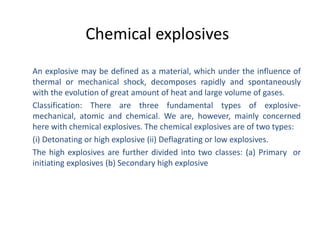
An explosive may be defined as a material, which under the influence of
thermal or mechanical shock, decomposes rapidly and spontaneously
with the evolution of great amount of heat and large volume of gases.
Classification: There are three fundamental types of explosive-
mechanical, atomic and chemical. We are, however, mainly concerned
here with chemical explosives. The chemical explosives are of two types:
(i) Detonating or high explosive (ii) Deflagrating or low explosives.
The high explosives are further divided into two classes: (a) Primary or
initiating explosives (b) Secondary high explosive
Chemical explosives
PETN or Penthrit: Pentaerythritol tetra nitrate [C(CH2ONO2)4] is one of the
most brisant and sensitive military high explosive. For use as a booster
explosive, a bursting charge or a plastic demolition explosive, it is
desensitized by admixture with TNT (the mixture is called pentrolite) or by
the addition of wax. PETN is prepared by the nitration of pentaerythritol
with strong 96% HNO3 at about 5oC.
The decomposition of PETN probably take place in the following
way: C(CH2ONO2)4---- 4H2O + 3CO2+ 2CO+ 2N2
Chemical explosives
RDX or CYCLONITE: RDX or cylconite is sym-trimethylene trinitramine
[(CH2)3N3(NO2)3]. It is one of the most powerful explosives known at
present time. It can be prepare by following methods:
a. Hale method: A British chemist G. C. Hale (1925) prepared RDX by
destructive nitration of hexamethylene tetramine with conc. HNO3
(CH2)6N4 + 3HNO3 -------- C3H6O6N6 + 3HCHO + NH3
b.Ebele-Schlessler-Ross method: This method consists in addition of
paraformaldehyde and amonium nitrate to acetic anhydride at 70oC.
3HCHO + 3NH4NO3 + 6 (CH3CO)2O ------ [(CH2)3N3(NO2)3] +12CH3COOH
RDX is used in a mixture with TNT and aluminum, known as torpex, for
mines, depth charges, and torpedo warheads. It is also used as an
ingredient for explosive for shells and bomb and it is desensitized by wax
or oily material
Chemical explosives
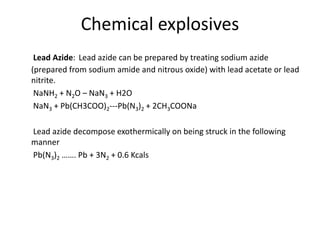
Lead Azide: Lead azide can be prepared by treating sodium azide
(prepared from sodium amide and nitrous oxide) with lead acetate or lead
nitrite.
NaNH2 + N2O – NaN3 + H2O
NaN3 + Pb(CH3COO)2---Pb(N3)2 + 2CH3COONa
Lead azide decompose exothermically on being struck in the following
manner
Pb(N3)2 ……. Pb + 3N2 + 0.6 Kcals
Chemical explosives
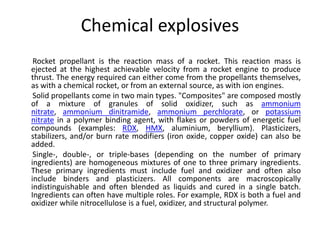
Rocket propellant is the reaction mass of a rocket. This reaction mass is
ejected at the highest achievable velocity from a rocket engine to produce
thrust. The energy required can either come from the propellants themselves,
as with a chemical rocket, or from an external source, as with ion engines.
Solid propellants come in two main types. "Composites" are composed mostly
of a mixture of granules of solid oxidizer, such as ammonium
nitrate, ammonium dinitramide, ammonium perchlorate, or potassium
nitrate in a polymer binding agent, with flakes or powders of energetic fuel
compounds (examples: RDX, HMX, aluminium, beryllium). Plasticizers,
stabilizers, and/or burn rate modifiers (iron oxide, copper oxide) can also be
added.
Single-, double-, or triple-bases (depending on the number of primary
ingredients) are homogeneous mixtures of one to three primary ingredients.
These primary ingredients must include fuel and oxidizer and often also
include binders and plasticizers. All components are macroscopically
indistinguishable and often blended as liquids and cured in a single batch.
Ingredients can often have multiple roles. For example, RDX is both a fuel and
oxidizer while nitrocellulose is a fuel, oxidizer, and structural polymer.

Chemical explosives.pptx

  • 1.
    Chemical explosives An explosivemay be defined as a material, which under the influence of thermal or mechanical shock, decomposes rapidly and spontaneously with the evolution of great amount of heat and large volume of gases. Classification: There are three fundamental types of explosive- mechanical, atomic and chemical. We are, however, mainly concerned here with chemical explosives. The chemical explosives are of two types: (i) Detonating or high explosive (ii) Deflagrating or low explosives. The high explosives are further divided into two classes: (a) Primary or initiating explosives (b) Secondary high explosive
  • 2.
    Chemical explosives PETN orPenthrit: Pentaerythritol tetra nitrate [C(CH2ONO2)4] is one of the most brisant and sensitive military high explosive. For use as a booster explosive, a bursting charge or a plastic demolition explosive, it is desensitized by admixture with TNT (the mixture is called pentrolite) or by the addition of wax. PETN is prepared by the nitration of pentaerythritol with strong 96% HNO3 at about 5oC. The decomposition of PETN probably take place in the following way: C(CH2ONO2)4---- 4H2O + 3CO2+ 2CO+ 2N2
  • 3.
    Chemical explosives RDX orCYCLONITE: RDX or cylconite is sym-trimethylene trinitramine [(CH2)3N3(NO2)3]. It is one of the most powerful explosives known at present time. It can be prepare by following methods: a. Hale method: A British chemist G. C. Hale (1925) prepared RDX by destructive nitration of hexamethylene tetramine with conc. HNO3 (CH2)6N4 + 3HNO3 -------- C3H6O6N6 + 3HCHO + NH3 b.Ebele-Schlessler-Ross method: This method consists in addition of paraformaldehyde and amonium nitrate to acetic anhydride at 70oC. 3HCHO + 3NH4NO3 + 6 (CH3CO)2O ------ [(CH2)3N3(NO2)3] +12CH3COOH RDX is used in a mixture with TNT and aluminum, known as torpex, for mines, depth charges, and torpedo warheads. It is also used as an ingredient for explosive for shells and bomb and it is desensitized by wax or oily material
  • 4.
    Chemical explosives Lead Azide:Lead azide can be prepared by treating sodium azide (prepared from sodium amide and nitrous oxide) with lead acetate or lead nitrite. NaNH2 + N2O – NaN3 + H2O NaN3 + Pb(CH3COO)2---Pb(N3)2 + 2CH3COONa Lead azide decompose exothermically on being struck in the following manner Pb(N3)2 ……. Pb + 3N2 + 0.6 Kcals
  • 5.
    Chemical explosives Rocket propellantis the reaction mass of a rocket. This reaction mass is ejected at the highest achievable velocity from a rocket engine to produce thrust. The energy required can either come from the propellants themselves, as with a chemical rocket, or from an external source, as with ion engines. Solid propellants come in two main types. "Composites" are composed mostly of a mixture of granules of solid oxidizer, such as ammonium nitrate, ammonium dinitramide, ammonium perchlorate, or potassium nitrate in a polymer binding agent, with flakes or powders of energetic fuel compounds (examples: RDX, HMX, aluminium, beryllium). Plasticizers, stabilizers, and/or burn rate modifiers (iron oxide, copper oxide) can also be added. Single-, double-, or triple-bases (depending on the number of primary ingredients) are homogeneous mixtures of one to three primary ingredients. These primary ingredients must include fuel and oxidizer and often also include binders and plasticizers. All components are macroscopically indistinguishable and often blended as liquids and cured in a single batch. Ingredients can often have multiple roles. For example, RDX is both a fuel and oxidizer while nitrocellulose is a fuel, oxidizer, and structural polymer.