Physics and Chemistry of
Explosions
-Nishita Matlani
Nisha Chauhan
Raina Bawa
Koyal Saha
Simran Lalwani
Preeti Gupta
Explosives
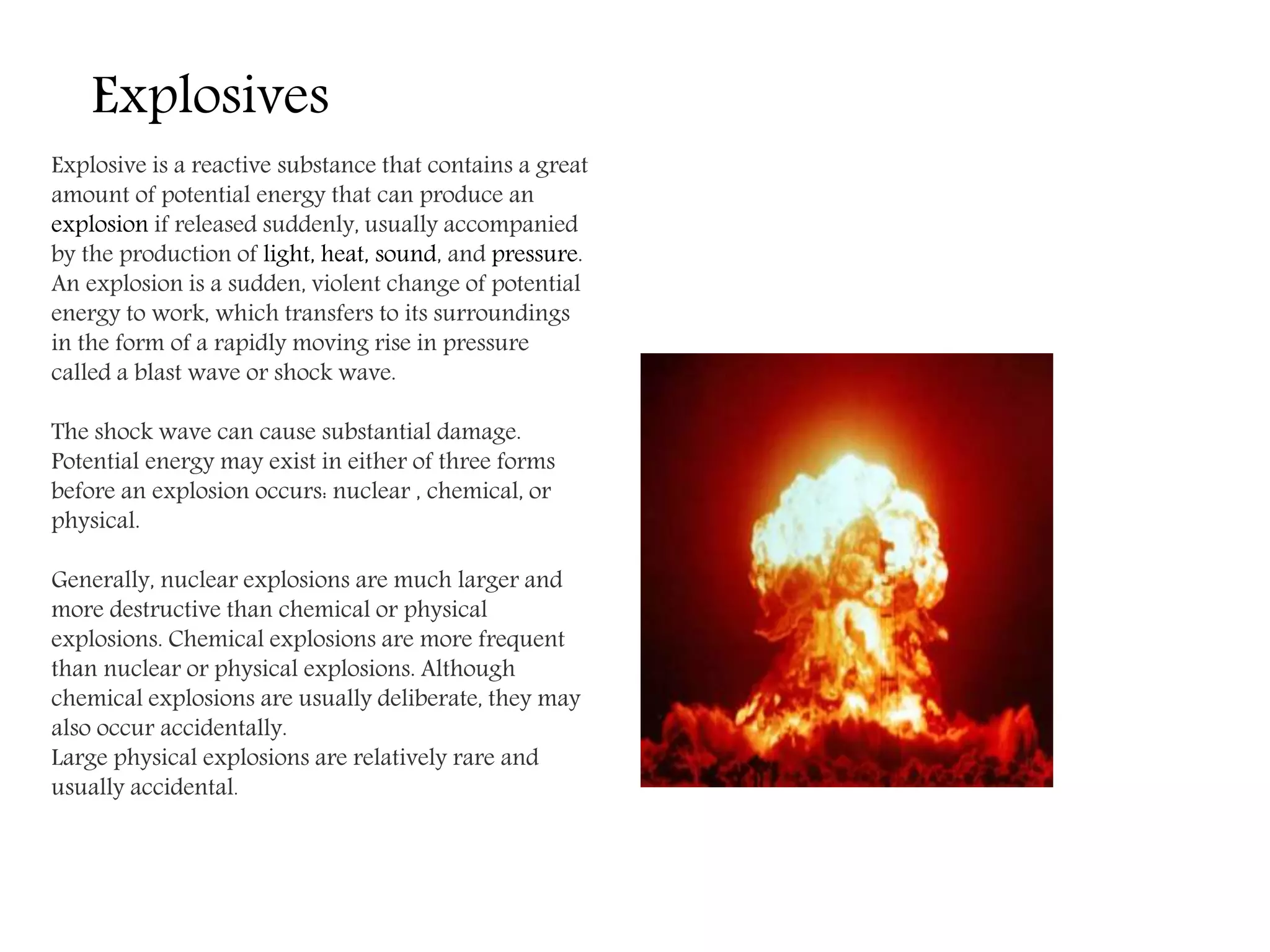
Explosive is a reactive substance that contains a great
amount of potential energy that can produce an
explosion if released suddenly, usually accompanied
by the production of light, heat, sound, and pressure.
An explosion is a sudden, violent change of potential
energy to work, which transfers to its surroundings
in the form of a rapidly moving rise in pressure
called a blast wave or shock wave.
The shock wave can cause substantial damage.
Potential energy may exist in either of three forms
before an explosion occurs: nuclear , chemical, or
physical.
Generally, nuclear explosions are much larger and
more destructive than chemical or physical
explosions. Chemical explosions are more frequent
than nuclear or physical explosions. Although
chemical explosions are usually deliberate, they may
also occur accidentally.
Large physical explosions are relatively rare and
usually accidental.
1. MECHANICAL
•
Mechanical explosions are those in which a high pressure gas produces a
physical reaction, vessel failure or rupture of the container. If the material
that is stored in the container, is flammable, then in many instances a
resultant fire occurs as long as there is an ignition source or the temperature
of the product is above its autogenous ignition temperature. Key to the
resultant fire is the mixing of the fuel with air or an oxygen source.
• The bursting of a sealed or partially sealed container under internal pressure
is often referred to as a 'mechanical explosion'. Examples include an
overheated boiler or a simple tin can of beans tossed into a fire.
• Boiling liquid expanding vapour explosions are one type of mechanical
explosion that can occur when a vessel containing a pressurised liquid is
ruptured, causing a rapid increase in volume as the liquid evaporates.
• The contents of the container may cause a subsequent chemical explosion,
the effects of which can be dramatically more serious.
2. CHEMICAL
• The vast majority of explosives are chemical explosives.The
generation of high pressure gas is the result of an exothermic
reaction resulting from the initiation of chemical explosives or
fuel gases. The rate of reaction will vary, and when explosives are
present, an outside oxidiser is not required.
• The most common artificial explosives are chemical explosives,
usually involving a rapid and violent oxidation reaction that
produces large amounts of hot gas..
• Gunpowder was the first explosive to be discovered and put to
use. Other notable early developments in chemical explosive
technology were development of nitrocellulose in 1865 and
Alfred Nobel's invention of dynamite in 1866. Chemical
explosions (both intentional and accidental) are often initiated by
an electric spark or flame. Accidental explosions may occur in
fuel tanks, rocket engines, etc.
Example: Bhopal Tragedy
• The Bhopal disaster, also referred to as the Bhopal gas tragedy, was
a gas leak incident in India, considered the worlds worst
industrial disaster.
• Occurred on the night of 2–3 December 1984.Over 500,000
people were exposed to methyl isocyanate (MIC) gas and other
chemicals
3. NUCLEAR
• Nuclear explosions may be caused by either fusion or fission reactions.
In a fusion reaction, the nuclei of two small atoms combine to form a
single larger atom, sometimes accompanied by a neutron.
• High quantities of heat and gas are produced as a result of the fusion or
fission process.
• In addition to stellar nuclear explosions, a man-made nuclear weapon is
a type of explosive weapon that derives its destructive force
from nuclear fission or from a combination of fission and fusion. As a
result, even a nuclear weapon with a small yield is significantly more
powerful than the largest conventional explosives available, with a
single weapon capable of completely destroying an entire city.Both
fusion and fission reactions can be used in bombs. The fusion reactions
require a very high temperature to get started, so they are initiated by
fission reactions.
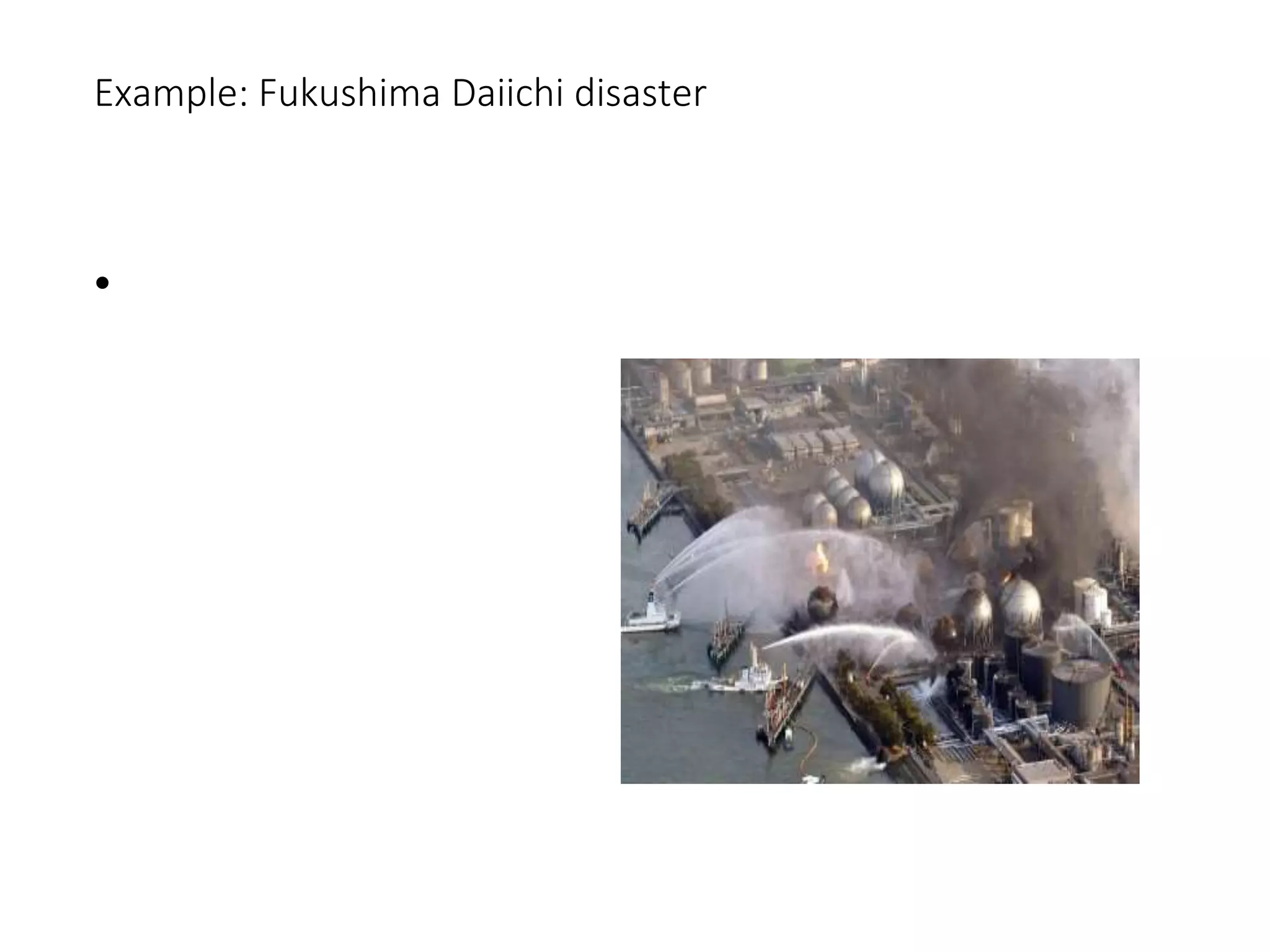
Example: Fukushima Daiichi disaster
•
4. ELECTRICAL
• High energy electrical arcs may generate sufficient heat to cause
an explosion. The resultant heating of the surrounding gases
results in a mechanical explosion. A common example is found in
residential occupancies (and others) is that the cover of the
electrical panel box has been violently dislodged from the
remaining box. Often this has been caused by a lightning strike or
other high energy arc. This reaction may or may not result in
subsequent fire.
• A high current electrical fault can create an 'electrical explosion'
by forming a high energy which rapidly vaporises metal and
insulation material. This hazard is a danger to persons working
on energised switchgear.
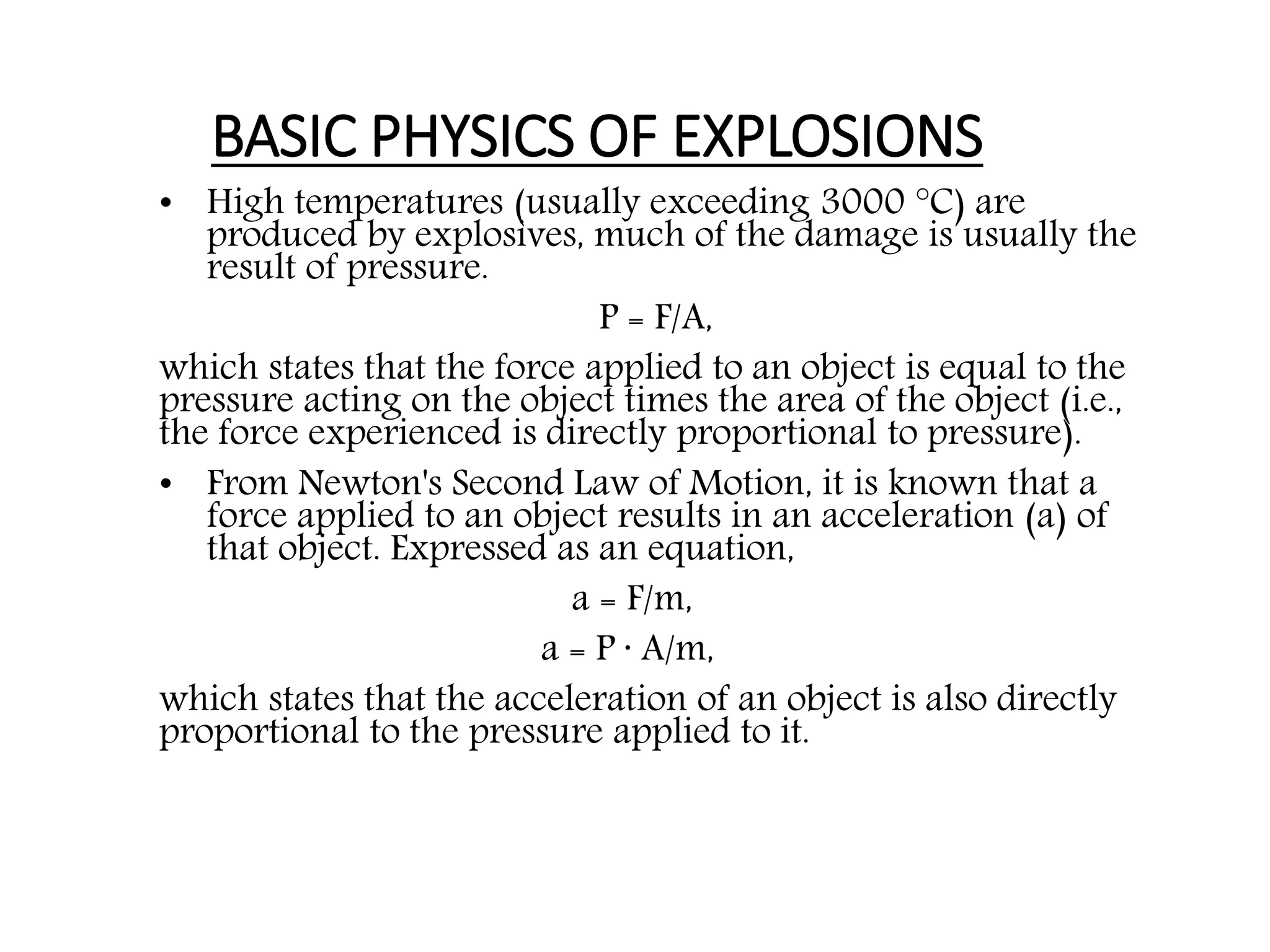
BASIC PHYSICS OF EXPLOSIONS
• High temperatures (usually exceeding 3000 °C) are
produced by explosives, much of the damage is usually the
result of pressure.
P = F/A,
which states that the force applied to an object is equal to the
pressure acting on the object times the area of the object (i.e.,
the force experienced is directly proportional to pressure).
• From Newton's Second Law of Motion, it is known that a
force applied to an object results in an acceleration (a) of
that object. Expressed as an equation,
a = F/m,
a = P · A/m,
which states that the acceleration of an object is also directly
proportional to the pressure applied to it.
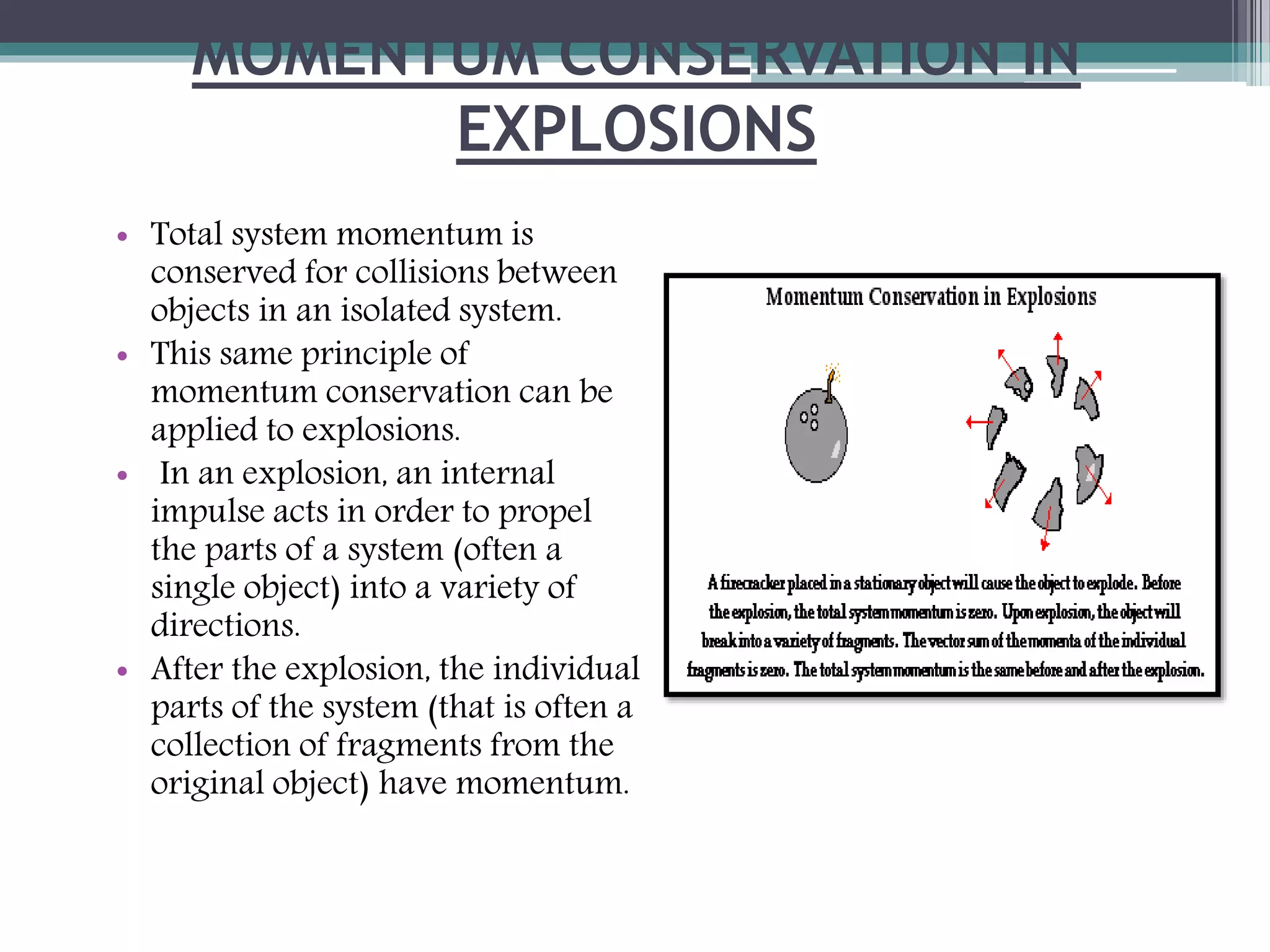
MOMENTUM CONSERVATION IN
EXPLOSIONS
• Total system momentum is
conserved for collisions between
objects in an isolated system.
• This same principle of
momentum conservation can be
applied to explosions.
• In an explosion, an internal
impulse acts in order to propel
the parts of a system (often a
single object) into a variety of
directions.
• After the explosion, the individual
parts of the system (that is often a
collection of fragments from the
original object) have momentum.
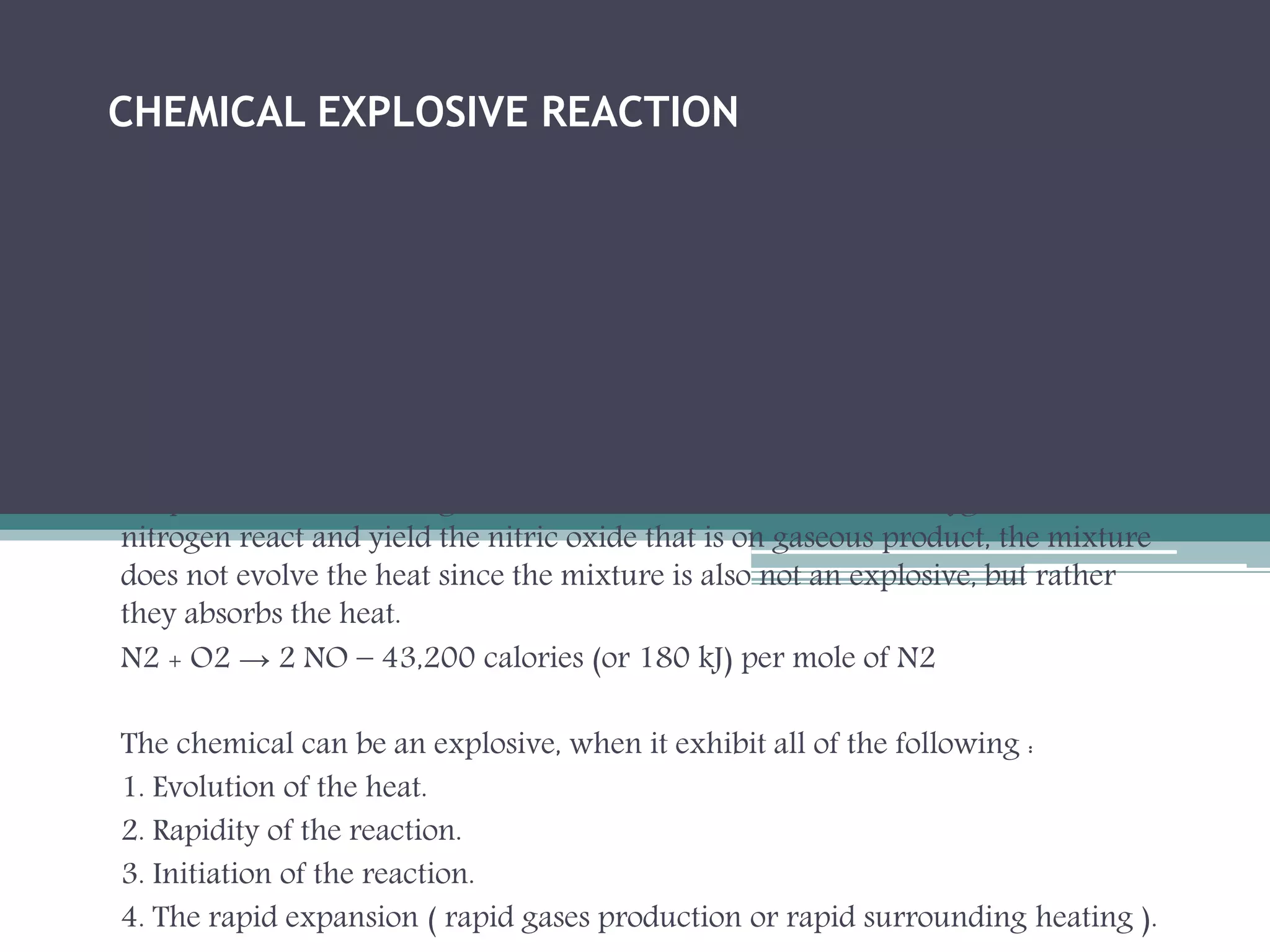
CHEMICAL EXPLOSIVE REACTION
The chemical reaction which is responsible for the production of explosive of
energy and gas that fall into the category that known as combustion.
Fuel + Oxidizer = Combustion products + Heat
Chemical explosive is a mixture or compound which decomposes or rearranges
upon the application of stock and heat with the extreme rapidity that yielding
heat and gas. Many of the substances are not ordinarily classed as the
explosives may one or even the two of these things. For example - at the high
temperature that can be greater then 2000 ℃ the mixture of oxygen and
nitrogen react and yield the nitric oxide that is on gaseous product, the mixture
does not evolve the heat since the mixture is also not an explosive, but rather
they absorbs the heat.
N2 + O2 → 2 NO − 43,200 calories (or 180 kJ) per mole of N2
The chemical can be an explosive, when it exhibit all of the following :
1. Evolution of the heat.
2. Rapidity of the reaction.
3. Initiation of the reaction.
4. The rapid expansion ( rapid gases production or rapid surrounding heating ).
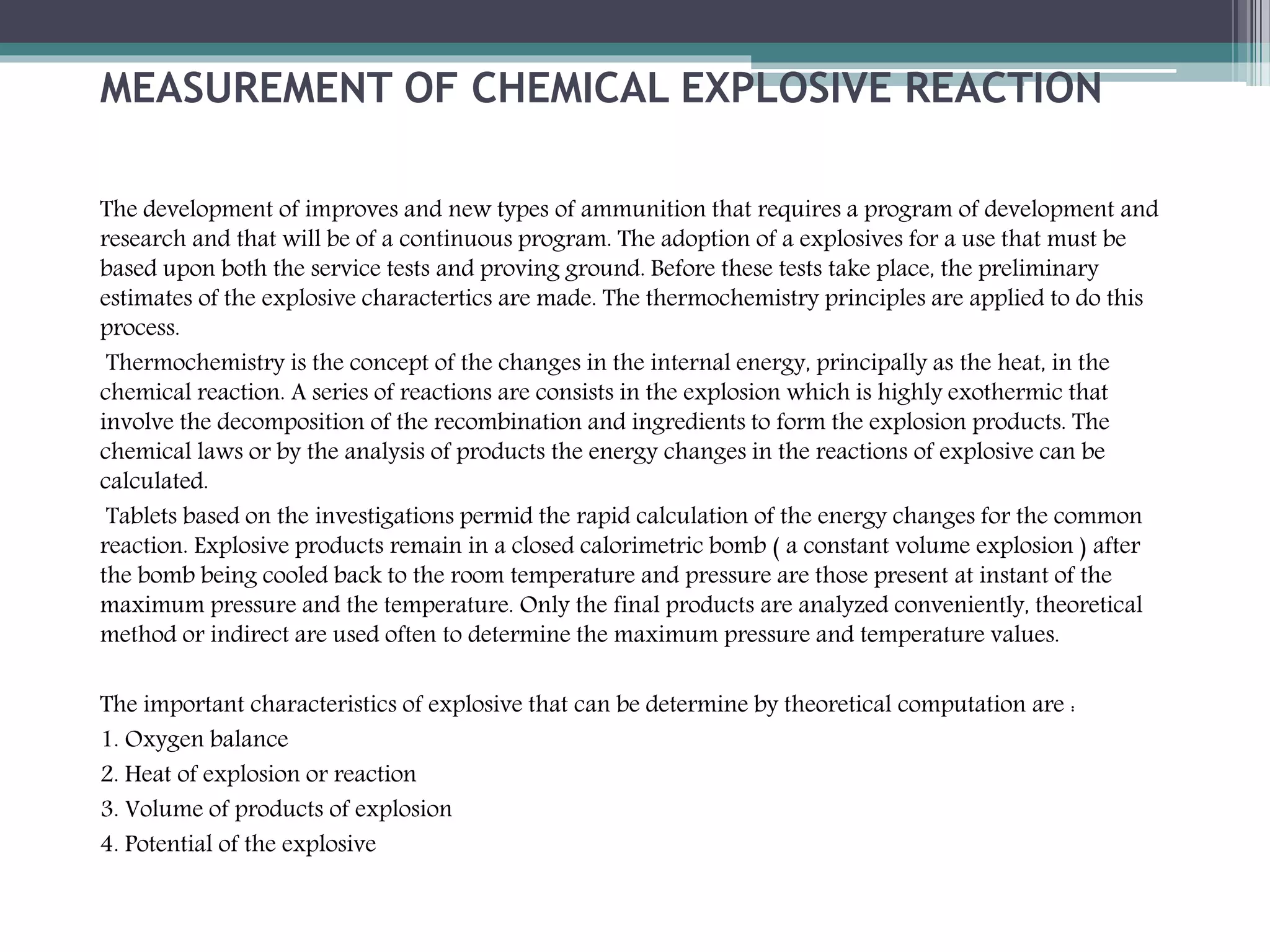
MEASUREMENT OF CHEMICAL EXPLOSIVE REACTION
The development of improves and new types of ammunition that requires a program of development and
research and that will be of a continuous program. The adoption of a explosives for a use that must be
based upon both the service tests and proving ground. Before these tests take place, the preliminary
estimates of the explosive charactertics are made. The thermochemistry principles are applied to do this
process.
Thermochemistry is the concept of the changes in the internal energy, principally as the heat, in the
chemical reaction. A series of reactions are consists in the explosion which is highly exothermic that
involve the decomposition of the recombination and ingredients to form the explosion products. The
chemical laws or by the analysis of products the energy changes in the reactions of explosive can be
calculated.
Tablets based on the investigations permid the rapid calculation of the energy changes for the common
reaction. Explosive products remain in a closed calorimetric bomb ( a constant volume explosion ) after
the bomb being cooled back to the room temperature and pressure are those present at instant of the
maximum pressure and the temperature. Only the final products are analyzed conveniently, theoretical
method or indirect are used often to determine the maximum pressure and temperature values.
The important characteristics of explosive that can be determine by theoretical computation are :
1. Oxygen balance
2. Heat of explosion or reaction
3. Volume of products of explosion
4. Potential of the explosive
BALANCING CHEMICAL EXPLOSION EQUATIONS
In balancing the chemical equations an order is assist. Explosives containing N, O,
C, and H and metal form the reaction products in the priority sequence.
Some of the observation are made to balance an equation:
1. The progression is done from top to bottom, the step which is not applicable
can be skip but never back up.
2. At each of the seperate step there will be never more than the two products and
two composition.
3. The conclusion of balancing, elemental nitrogen, hydrogen and oxygen are
found always in diatomic form.
CHEMICAL EXPLOSIONS
Q. What causes chemical explosions ?
• Many are a result of oxidation reduction reactions.
• One or more reactants are oxidized. One or more are
reduced.
• It should be recognized that not every such reaction results in
explosion .
• Iron combines with moist air to produce rust. The oxygen in
air is reduced. The iron is oxidized.
Q. What are the factors that convert sometimes a
simple reaction into an explosion?
 FACTOR 1 AND 2
• The first factor is reaction speed. The speed must be instantaneous.
• For example, of rust the rate of reaction is very slow. For gunpowder it
is sudden.
• The second factor is “product-to-reactant” volume increase.
• An explosion requires reaction volume increases tremendously.
• Converting solid or liquid reactants into gas does the trick.
• This represents a huge expansion ratio and expansion results in a
pressure increase.
• For instance water’s molecule weight is 18. The volume of 18g of water
is very slight. Convert it to vapour however and it occupies 22.4litres.
CONTD.
 INTENSIFYING FACTOR 2
• An even stronger explosion results if many reactants convert to gas form.
• The total expansion is multiplied.
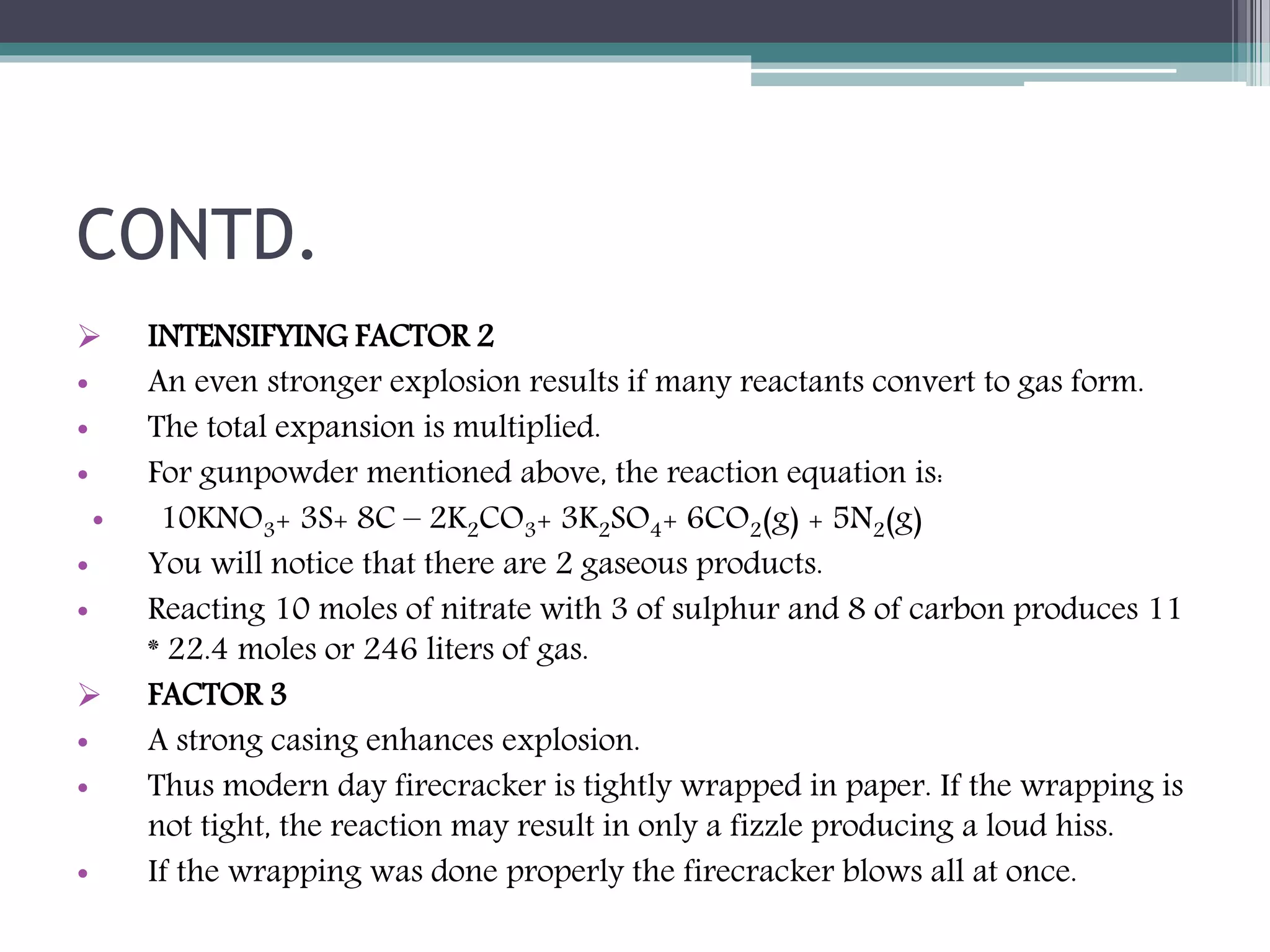
• For gunpowder mentioned above, the reaction equation is:
• 10KNO3+ 3S+ 8C – 2K2CO3+ 3K2SO4+ 6CO2(g) + 5N2(g)
• You will notice that there are 2 gaseous products.
• Reacting 10 moles of nitrate with 3 of sulphur and 8 of carbon produces 11
* 22.4 moles or 246 liters of gas.
 FACTOR 3
• A strong casing enhances explosion.
• Thus modern day firecracker is tightly wrapped in paper. If the wrapping is
not tight, the reaction may result in only a fizzle producing a loud hiss.
• If the wrapping was done properly the firecracker blows all at once.
Ignition and Propagation
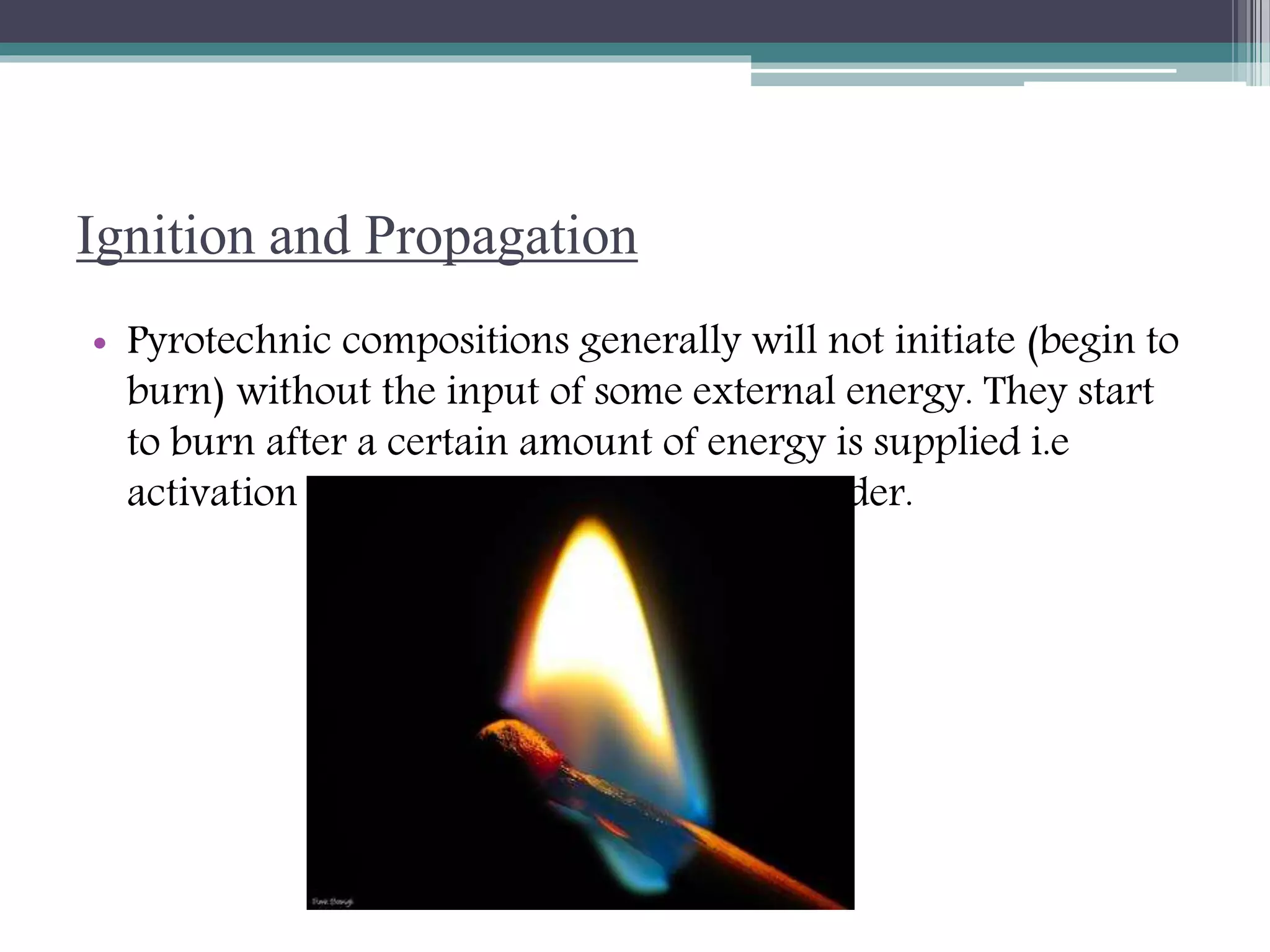
• Pyrotechnic compositions generally will not initiate (begin to
burn) without the input of some external energy. They start
to burn after a certain amount of energy is supplied i.e
activation energy. For example black powder.
Energy relationship for a typical combustion reaction
Factors that make it more likely that a pyrotechnic reaction
will propagate, consuming the total composition:
1. If the pyrotechnic composition has a low activation energy
barriers, such that the feedback of only small amount of
energy is required.
2. If the heat of reaction is large: obviously the more heat
produced by the composition the more likely that each
succeeding layer of material will receive its necessary
activation energy.
3. If the mechanism of energy transfer within the pyrotechnic
composition is highly effective, making the feedback of
energy more efficient.
The explosive chemistry of nitrogen
• Nitrogen gas is a product of many explosive reactions. The
compound nitroglycerine is pictured on the right. It is clear to see
the importance of nitrogen in this compound.
• Nitgrogen is a very stable molecule and has a very low energy
state. For this reason the formation of nitrogen gas from a
compound whose nitrogen atoms are bonded in a high energy state
releases a great deal of energy. Consider the explosive
decomposition of nitroglycerine according to the equation below.
• 4C3H5N3O9(l) => O2(g) + 6N2(g) + 12CO2(g) + 10H2O(g)
• The energy profile for this reaction is shown on the right. Notice
how the reactant, nitroglycerine, is at a higher energy state than
the products. The difference in the energy of the reactants and
products is given off as heat.
• E.g. Nitroglycerin
• C
• Carbon and Hydrogen take up oxygen and
nitrogen is liberated.
• Dynamite is stabilized nitroglycerin.
• Nitroglycerin is considered to explode as:
• 4 C3H5N3O9 --> 12 CO2 + 10 H2O + 6 N2+O2
• But there's considerable variation in the stated
explosion reaction stoichiometry for
trinitrotoluene, ranging from
• 2 C7H5N3O6 → 3 N2 + 5 H2O + 7 CO + 7 C
• to
• 2 C7H5N3O6 → 3 N2 + 5 H2 + 12 CO + 2 C
• Some of the oxygens may be "stolen" from the
water by the carbons. This represents the
"water gas shift reaction", an extremely
important industrial reaction. In any event,
there are some extra elemental carbons
produced -- the explosion is "sooty".
• Why?
• It's because of the great abundance of O's in
nitroglycerin, and the relative scarcity of them,
in TNT.
Chemistry of Nuclear Explosion
• The immense destructive power of atomic weapons derives
from a sudden release of energy produced by splitting the
nuclei of the fissile elements making up the bombs' core.
• The U.S. developed two types of atomic bombs during the
Second World War.
• The first, Little Boy, was a gun-type weapon with
a uranium core. Little Boy was dropped on Hiroshima.
• The second weapon, dropped on Nagasaki, was called Fat
Man and was an implosion-type device with
a plutonium core.
• Fission
• The isotopes uranium-235 and plutonium-
239 were selected by the atomic scientists because
they readily undergo fission.
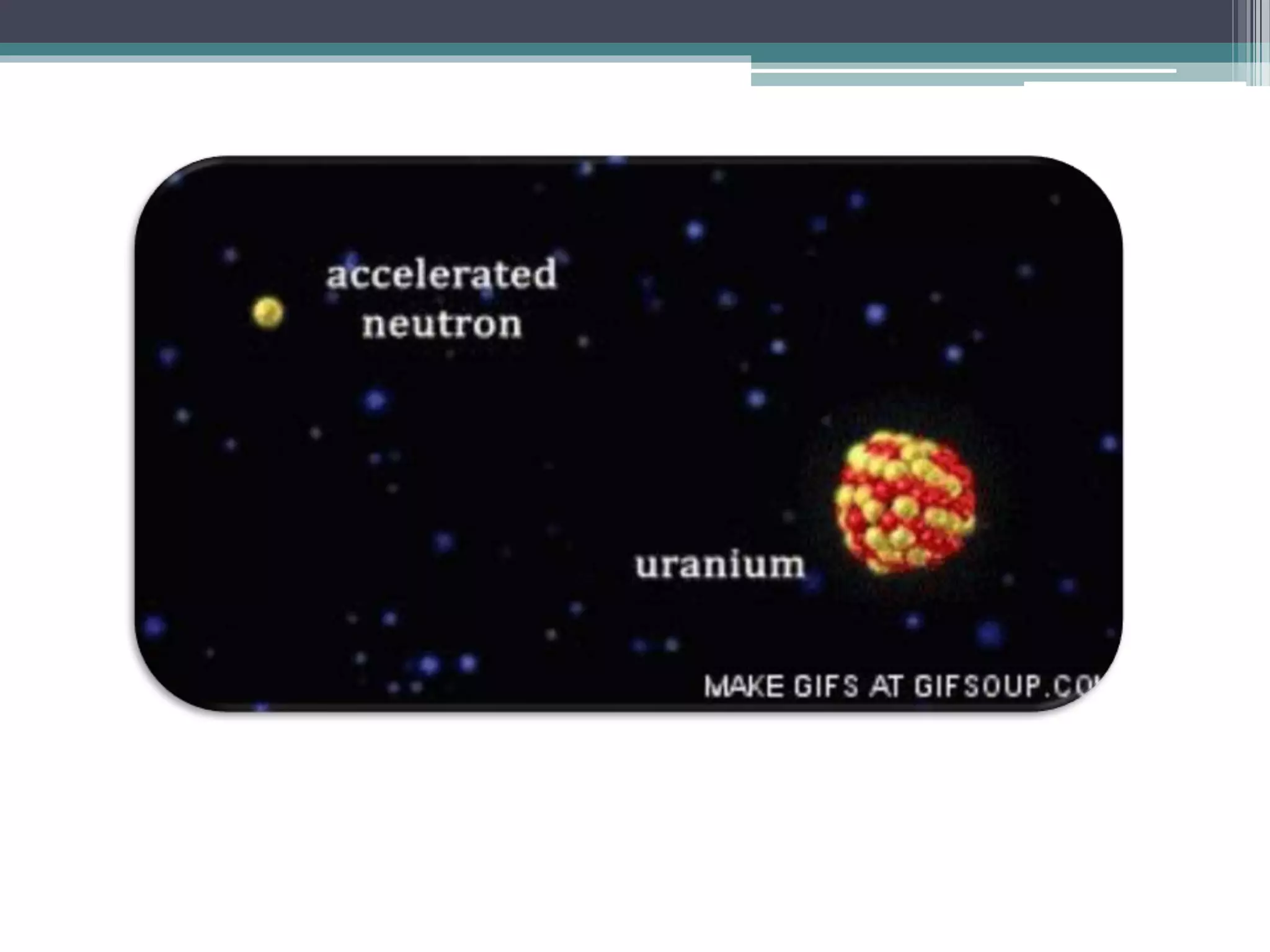
• Fission occurs when a neutron strikes the nucleus
of either isotope, splitting the nucleus into fragments
and releasing a tremendous amount of energy.
• The fission process becomes self-sustaining as
neutrons produced by the splitting of atom strike
nearby nuclei and produce more fission.
• This is known as a chain reaction and is what
causes an atomic explosion.
• When a uranium-235 atom absorbs a neutron and fissions
into two new atoms, it releases three new neutrons and some
binding energy.
• Two neutrons do not continue the reaction because they are
lost or absorbed by a uranium-238 atom.
• However, one neutron does collide with an atom of uranium-
235, which then fissions and releases two neutrons and some
binding energy.
• Both of those neutrons collide with uranium-235 atoms,
each of which fission and release between one and three
neutrons, and so on. This causes a nuclear chain reaction.
Physics and chemistry of explosions

Physics and chemistry of explosions

  • 1.
    Physics and Chemistryof Explosions -Nishita Matlani Nisha Chauhan Raina Bawa Koyal Saha Simran Lalwani Preeti Gupta
  • 2.
    Explosives Explosive is areactive substance that contains a great amount of potential energy that can produce an explosion if released suddenly, usually accompanied by the production of light, heat, sound, and pressure. An explosion is a sudden, violent change of potential energy to work, which transfers to its surroundings in the form of a rapidly moving rise in pressure called a blast wave or shock wave. The shock wave can cause substantial damage. Potential energy may exist in either of three forms before an explosion occurs: nuclear , chemical, or physical. Generally, nuclear explosions are much larger and more destructive than chemical or physical explosions. Chemical explosions are more frequent than nuclear or physical explosions. Although chemical explosions are usually deliberate, they may also occur accidentally. Large physical explosions are relatively rare and usually accidental.
  • 3.
    1. MECHANICAL • Mechanical explosionsare those in which a high pressure gas produces a physical reaction, vessel failure or rupture of the container. If the material that is stored in the container, is flammable, then in many instances a resultant fire occurs as long as there is an ignition source or the temperature of the product is above its autogenous ignition temperature. Key to the resultant fire is the mixing of the fuel with air or an oxygen source. • The bursting of a sealed or partially sealed container under internal pressure is often referred to as a 'mechanical explosion'. Examples include an overheated boiler or a simple tin can of beans tossed into a fire. • Boiling liquid expanding vapour explosions are one type of mechanical explosion that can occur when a vessel containing a pressurised liquid is ruptured, causing a rapid increase in volume as the liquid evaporates. • The contents of the container may cause a subsequent chemical explosion, the effects of which can be dramatically more serious.
  • 4.
    2. CHEMICAL • Thevast majority of explosives are chemical explosives.The generation of high pressure gas is the result of an exothermic reaction resulting from the initiation of chemical explosives or fuel gases. The rate of reaction will vary, and when explosives are present, an outside oxidiser is not required. • The most common artificial explosives are chemical explosives, usually involving a rapid and violent oxidation reaction that produces large amounts of hot gas.. • Gunpowder was the first explosive to be discovered and put to use. Other notable early developments in chemical explosive technology were development of nitrocellulose in 1865 and Alfred Nobel's invention of dynamite in 1866. Chemical explosions (both intentional and accidental) are often initiated by an electric spark or flame. Accidental explosions may occur in fuel tanks, rocket engines, etc.
  • 5.
    Example: Bhopal Tragedy •The Bhopal disaster, also referred to as the Bhopal gas tragedy, was a gas leak incident in India, considered the worlds worst industrial disaster. • Occurred on the night of 2–3 December 1984.Over 500,000 people were exposed to methyl isocyanate (MIC) gas and other chemicals
  • 6.
    3. NUCLEAR • Nuclearexplosions may be caused by either fusion or fission reactions. In a fusion reaction, the nuclei of two small atoms combine to form a single larger atom, sometimes accompanied by a neutron. • High quantities of heat and gas are produced as a result of the fusion or fission process. • In addition to stellar nuclear explosions, a man-made nuclear weapon is a type of explosive weapon that derives its destructive force from nuclear fission or from a combination of fission and fusion. As a result, even a nuclear weapon with a small yield is significantly more powerful than the largest conventional explosives available, with a single weapon capable of completely destroying an entire city.Both fusion and fission reactions can be used in bombs. The fusion reactions require a very high temperature to get started, so they are initiated by fission reactions.
  • 7.
  • 8.
    4. ELECTRICAL • Highenergy electrical arcs may generate sufficient heat to cause an explosion. The resultant heating of the surrounding gases results in a mechanical explosion. A common example is found in residential occupancies (and others) is that the cover of the electrical panel box has been violently dislodged from the remaining box. Often this has been caused by a lightning strike or other high energy arc. This reaction may or may not result in subsequent fire. • A high current electrical fault can create an 'electrical explosion' by forming a high energy which rapidly vaporises metal and insulation material. This hazard is a danger to persons working on energised switchgear.
  • 9.
    BASIC PHYSICS OFEXPLOSIONS • High temperatures (usually exceeding 3000 °C) are produced by explosives, much of the damage is usually the result of pressure. P = F/A, which states that the force applied to an object is equal to the pressure acting on the object times the area of the object (i.e., the force experienced is directly proportional to pressure). • From Newton's Second Law of Motion, it is known that a force applied to an object results in an acceleration (a) of that object. Expressed as an equation, a = F/m, a = P · A/m, which states that the acceleration of an object is also directly proportional to the pressure applied to it.
  • 10.
    MOMENTUM CONSERVATION IN EXPLOSIONS •Total system momentum is conserved for collisions between objects in an isolated system. • This same principle of momentum conservation can be applied to explosions. • In an explosion, an internal impulse acts in order to propel the parts of a system (often a single object) into a variety of directions. • After the explosion, the individual parts of the system (that is often a collection of fragments from the original object) have momentum.
  • 11.
    CHEMICAL EXPLOSIVE REACTION Thechemical reaction which is responsible for the production of explosive of energy and gas that fall into the category that known as combustion. Fuel + Oxidizer = Combustion products + Heat Chemical explosive is a mixture or compound which decomposes or rearranges upon the application of stock and heat with the extreme rapidity that yielding heat and gas. Many of the substances are not ordinarily classed as the explosives may one or even the two of these things. For example - at the high temperature that can be greater then 2000 ℃ the mixture of oxygen and nitrogen react and yield the nitric oxide that is on gaseous product, the mixture does not evolve the heat since the mixture is also not an explosive, but rather they absorbs the heat. N2 + O2 → 2 NO − 43,200 calories (or 180 kJ) per mole of N2 The chemical can be an explosive, when it exhibit all of the following : 1. Evolution of the heat. 2. Rapidity of the reaction. 3. Initiation of the reaction. 4. The rapid expansion ( rapid gases production or rapid surrounding heating ).
  • 12.
    MEASUREMENT OF CHEMICALEXPLOSIVE REACTION The development of improves and new types of ammunition that requires a program of development and research and that will be of a continuous program. The adoption of a explosives for a use that must be based upon both the service tests and proving ground. Before these tests take place, the preliminary estimates of the explosive charactertics are made. The thermochemistry principles are applied to do this process. Thermochemistry is the concept of the changes in the internal energy, principally as the heat, in the chemical reaction. A series of reactions are consists in the explosion which is highly exothermic that involve the decomposition of the recombination and ingredients to form the explosion products. The chemical laws or by the analysis of products the energy changes in the reactions of explosive can be calculated. Tablets based on the investigations permid the rapid calculation of the energy changes for the common reaction. Explosive products remain in a closed calorimetric bomb ( a constant volume explosion ) after the bomb being cooled back to the room temperature and pressure are those present at instant of the maximum pressure and the temperature. Only the final products are analyzed conveniently, theoretical method or indirect are used often to determine the maximum pressure and temperature values. The important characteristics of explosive that can be determine by theoretical computation are : 1. Oxygen balance 2. Heat of explosion or reaction 3. Volume of products of explosion 4. Potential of the explosive
  • 13.
    BALANCING CHEMICAL EXPLOSIONEQUATIONS In balancing the chemical equations an order is assist. Explosives containing N, O, C, and H and metal form the reaction products in the priority sequence. Some of the observation are made to balance an equation: 1. The progression is done from top to bottom, the step which is not applicable can be skip but never back up. 2. At each of the seperate step there will be never more than the two products and two composition. 3. The conclusion of balancing, elemental nitrogen, hydrogen and oxygen are found always in diatomic form.
  • 14.
    CHEMICAL EXPLOSIONS Q. Whatcauses chemical explosions ? • Many are a result of oxidation reduction reactions. • One or more reactants are oxidized. One or more are reduced. • It should be recognized that not every such reaction results in explosion . • Iron combines with moist air to produce rust. The oxygen in air is reduced. The iron is oxidized.
  • 15.
    Q. What arethe factors that convert sometimes a simple reaction into an explosion?  FACTOR 1 AND 2 • The first factor is reaction speed. The speed must be instantaneous. • For example, of rust the rate of reaction is very slow. For gunpowder it is sudden. • The second factor is “product-to-reactant” volume increase. • An explosion requires reaction volume increases tremendously. • Converting solid or liquid reactants into gas does the trick. • This represents a huge expansion ratio and expansion results in a pressure increase. • For instance water’s molecule weight is 18. The volume of 18g of water is very slight. Convert it to vapour however and it occupies 22.4litres.
  • 16.
    CONTD.  INTENSIFYING FACTOR2 • An even stronger explosion results if many reactants convert to gas form. • The total expansion is multiplied. • For gunpowder mentioned above, the reaction equation is: • 10KNO3+ 3S+ 8C – 2K2CO3+ 3K2SO4+ 6CO2(g) + 5N2(g) • You will notice that there are 2 gaseous products. • Reacting 10 moles of nitrate with 3 of sulphur and 8 of carbon produces 11 * 22.4 moles or 246 liters of gas.  FACTOR 3 • A strong casing enhances explosion. • Thus modern day firecracker is tightly wrapped in paper. If the wrapping is not tight, the reaction may result in only a fizzle producing a loud hiss. • If the wrapping was done properly the firecracker blows all at once.
  • 17.
    Ignition and Propagation •Pyrotechnic compositions generally will not initiate (begin to burn) without the input of some external energy. They start to burn after a certain amount of energy is supplied i.e activation energy. For example black powder.
  • 18.
    Energy relationship fora typical combustion reaction
  • 19.
    Factors that makeit more likely that a pyrotechnic reaction will propagate, consuming the total composition: 1. If the pyrotechnic composition has a low activation energy barriers, such that the feedback of only small amount of energy is required. 2. If the heat of reaction is large: obviously the more heat produced by the composition the more likely that each succeeding layer of material will receive its necessary activation energy. 3. If the mechanism of energy transfer within the pyrotechnic composition is highly effective, making the feedback of energy more efficient.
  • 20.
    The explosive chemistryof nitrogen • Nitrogen gas is a product of many explosive reactions. The compound nitroglycerine is pictured on the right. It is clear to see the importance of nitrogen in this compound. • Nitgrogen is a very stable molecule and has a very low energy state. For this reason the formation of nitrogen gas from a compound whose nitrogen atoms are bonded in a high energy state releases a great deal of energy. Consider the explosive decomposition of nitroglycerine according to the equation below. • 4C3H5N3O9(l) => O2(g) + 6N2(g) + 12CO2(g) + 10H2O(g) • The energy profile for this reaction is shown on the right. Notice how the reactant, nitroglycerine, is at a higher energy state than the products. The difference in the energy of the reactants and products is given off as heat.
  • 21.
    • E.g. Nitroglycerin •C • Carbon and Hydrogen take up oxygen and nitrogen is liberated. • Dynamite is stabilized nitroglycerin.
  • 22.
    • Nitroglycerin isconsidered to explode as: • 4 C3H5N3O9 --> 12 CO2 + 10 H2O + 6 N2+O2 • But there's considerable variation in the stated explosion reaction stoichiometry for trinitrotoluene, ranging from • 2 C7H5N3O6 → 3 N2 + 5 H2O + 7 CO + 7 C • to • 2 C7H5N3O6 → 3 N2 + 5 H2 + 12 CO + 2 C
  • 23.
    • Some ofthe oxygens may be "stolen" from the water by the carbons. This represents the "water gas shift reaction", an extremely important industrial reaction. In any event, there are some extra elemental carbons produced -- the explosion is "sooty". • Why? • It's because of the great abundance of O's in nitroglycerin, and the relative scarcity of them, in TNT.
  • 24.
    Chemistry of NuclearExplosion • The immense destructive power of atomic weapons derives from a sudden release of energy produced by splitting the nuclei of the fissile elements making up the bombs' core. • The U.S. developed two types of atomic bombs during the Second World War. • The first, Little Boy, was a gun-type weapon with a uranium core. Little Boy was dropped on Hiroshima. • The second weapon, dropped on Nagasaki, was called Fat Man and was an implosion-type device with a plutonium core.
  • 26.
    • Fission • Theisotopes uranium-235 and plutonium- 239 were selected by the atomic scientists because they readily undergo fission. • Fission occurs when a neutron strikes the nucleus of either isotope, splitting the nucleus into fragments and releasing a tremendous amount of energy. • The fission process becomes self-sustaining as neutrons produced by the splitting of atom strike nearby nuclei and produce more fission. • This is known as a chain reaction and is what causes an atomic explosion.
  • 28.
    • When auranium-235 atom absorbs a neutron and fissions into two new atoms, it releases three new neutrons and some binding energy. • Two neutrons do not continue the reaction because they are lost or absorbed by a uranium-238 atom. • However, one neutron does collide with an atom of uranium- 235, which then fissions and releases two neutrons and some binding energy. • Both of those neutrons collide with uranium-235 atoms, each of which fission and release between one and three neutrons, and so on. This causes a nuclear chain reaction.

Editor's Notes