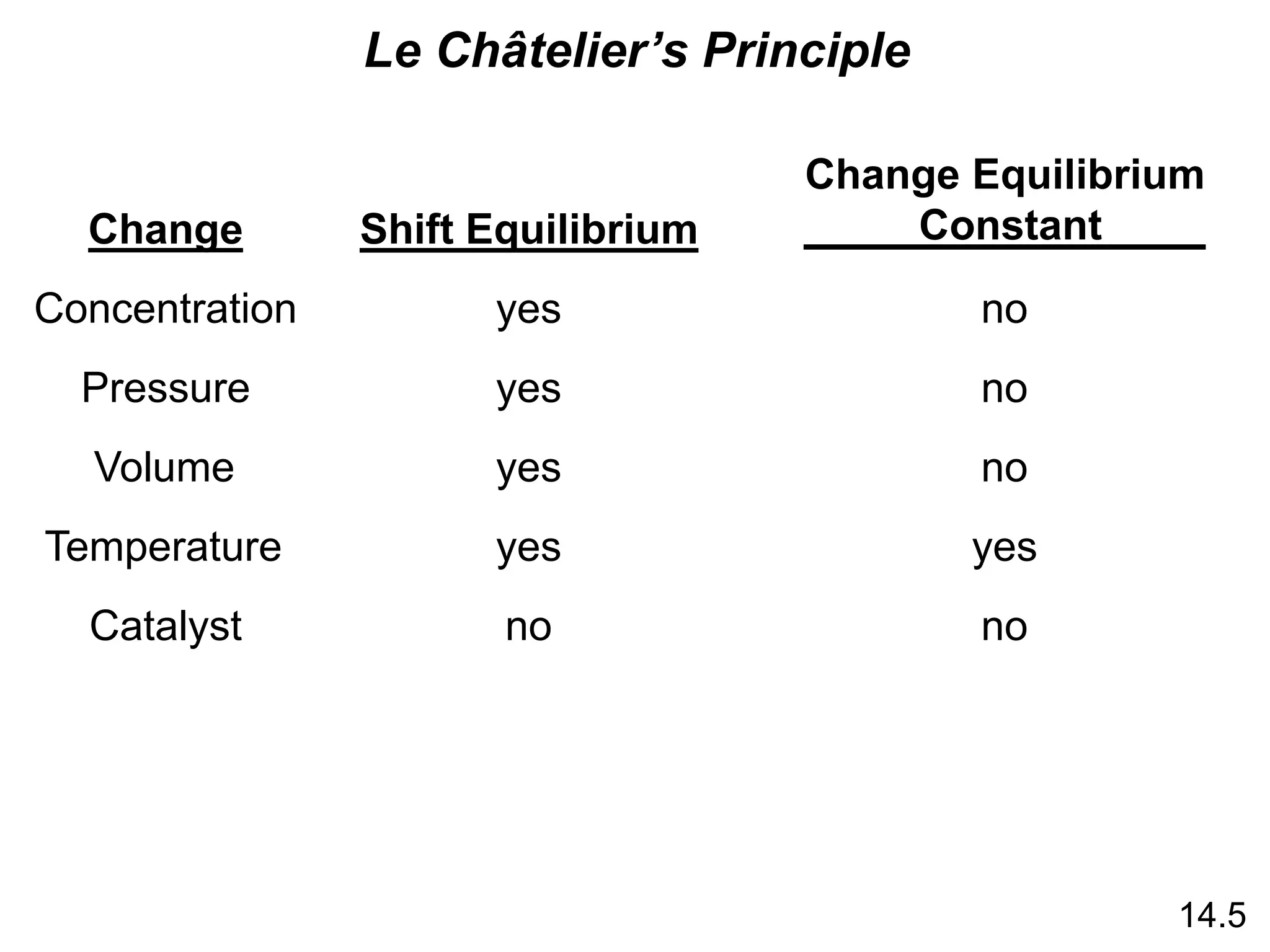
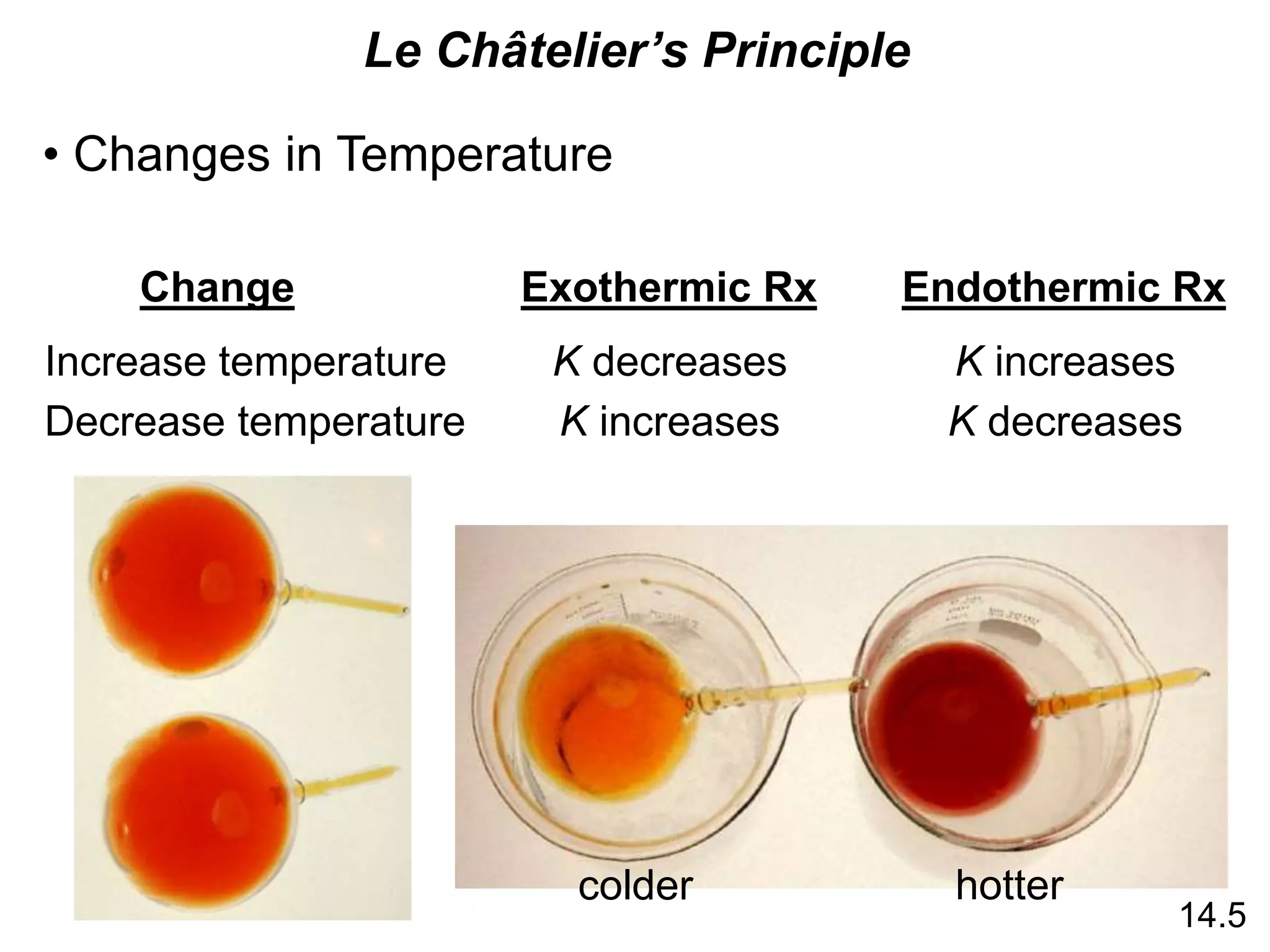
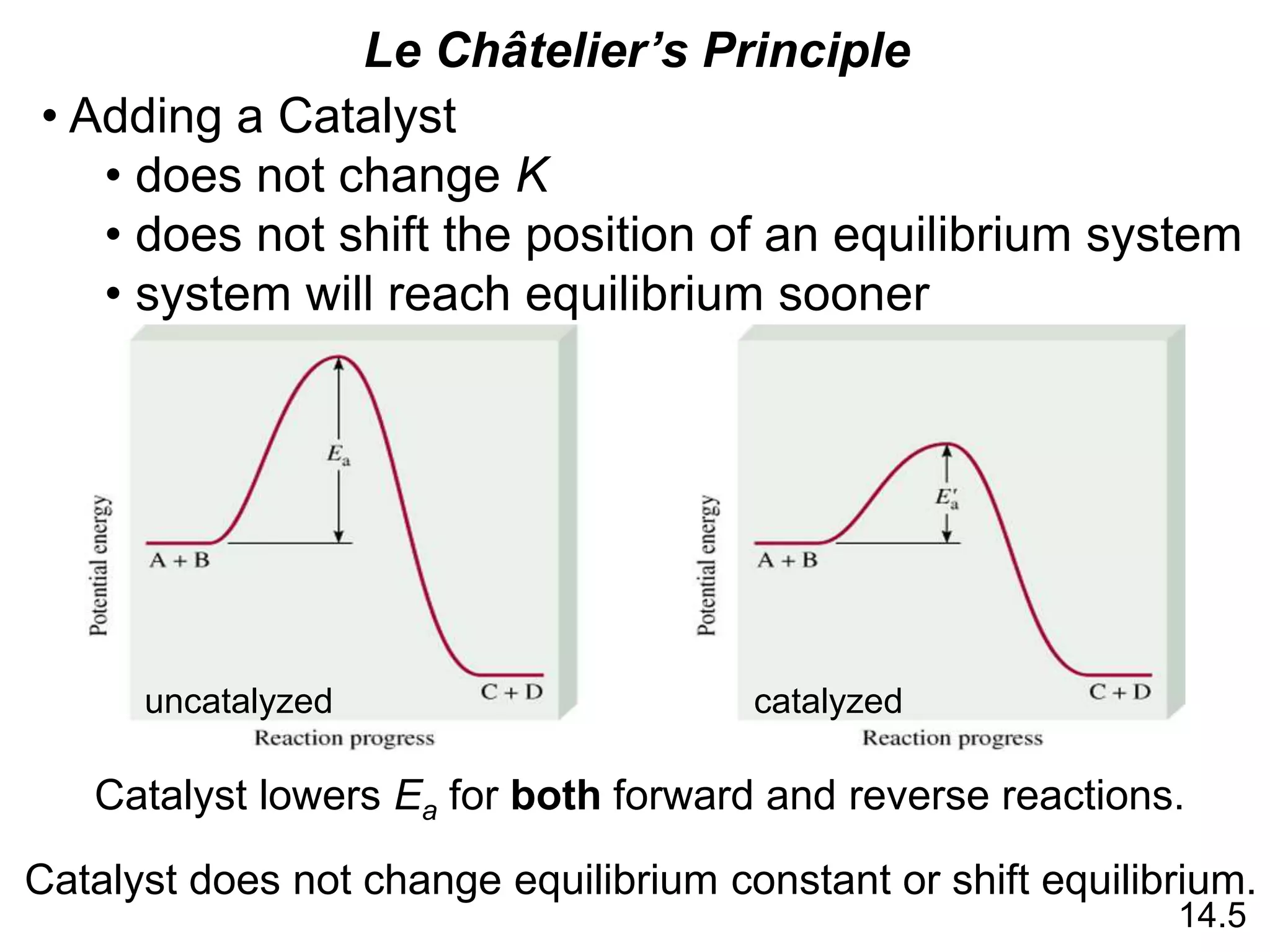
Chemical equilibrium is a state where the rates of the forward and reverse reactions are equal and the concentrations of reactants and products remain constant. The equilibrium constant, K, is a measure of the position of equilibrium and is calculated by dividing the concentrations of products by reactants. Le Châtelier's principle states that if a stress is applied to a system at equilibrium, the equilibrium will shift in a direction that counteracts the applied stress. Changes in concentration, pressure, volume, and temperature will shift equilibrium but not change K, while addition of a catalyst will not shift or change equilibrium.


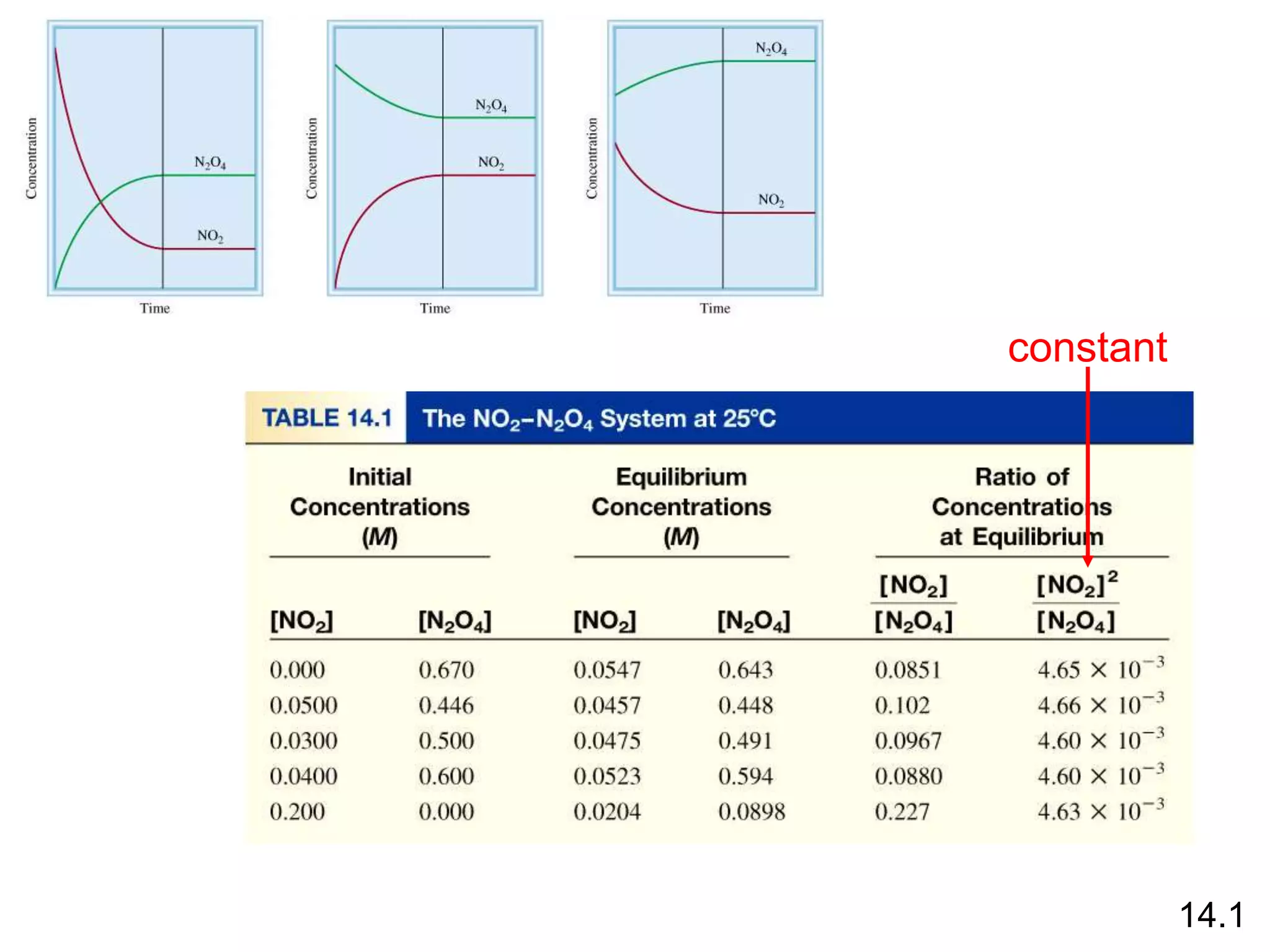
![N2O4 (g) 2NO2 (g)
= 4.63 x 10⁻³
K =
[NO2]2
[N2O4]
aA + bB cC + dD
K =
[C]c[D]d
[A]a[B]b
Law of Mass Action
14.1](https://image.slidesharecdn.com/chapter14chemicalequilibrium-220922215643-c9ad601e/75/chapter_14_chemical-equilibrium-ppt-5-2048.jpg)
![K >> 1
K << 1
Lie to the right Favor products
Lie to the left Favor reactants
Equilibrium Will
K =
[C]c[D]d
[A]a[B]b
aA + bB cC + dD
14.1](https://image.slidesharecdn.com/chapter14chemicalequilibrium-220922215643-c9ad601e/75/chapter_14_chemical-equilibrium-ppt-6-2048.jpg)
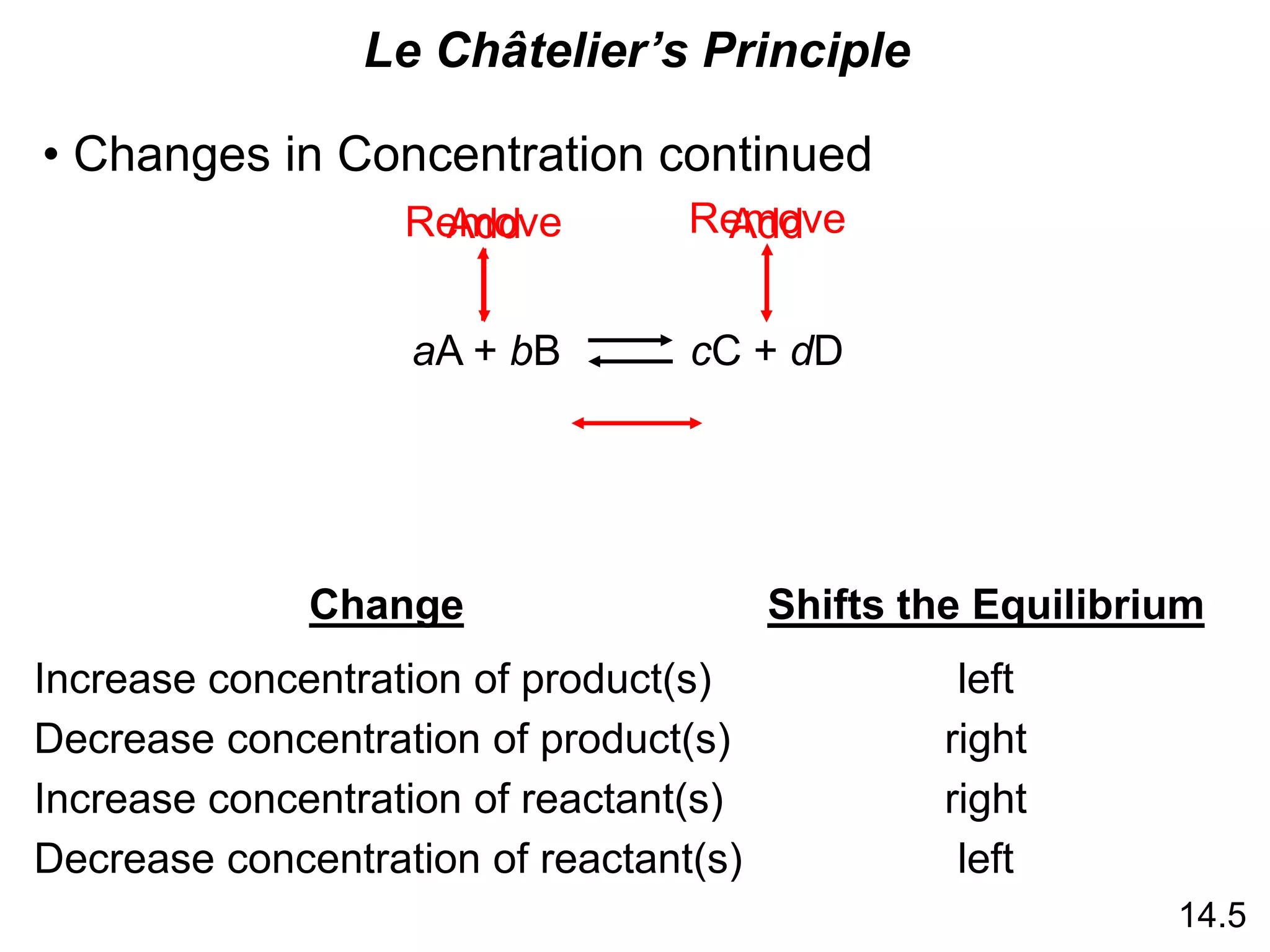
![Homogenous equilibrium applies to reactions in which all
reacting species are in the same phase.
N2O4 (g) 2NO2 (g)
Kc =
[NO2]2
[N2O4]
Kp =
NO2
P2
N2O4
P
aA (g) + bB (g) cC (g) + dD (g)
14.2
Kp = Kc(RT)Dn
Dn = moles of gaseous products – moles of gaseous reactants
= (c + d) – (a + b)
In most cases
Kc Kp](https://image.slidesharecdn.com/chapter14chemicalequilibrium-220922215643-c9ad601e/75/chapter_14_chemical-equilibrium-ppt-7-2048.jpg)
![Homogeneous Equilibrium
CH3COOH (aq) + H2O (l) CH3COO- (aq) + H3O+ (aq)
Kc =
‘
[CH3COO-][H3O+]
[CH3COOH][H2O]
[H2O] = constant
Kc =
[CH3COO-][H3O+]
[CH3COOH]
= Kc [H2O]
‘
General practice not to include units for the
equilibrium constant.
14.2](https://image.slidesharecdn.com/chapter14chemicalequilibrium-220922215643-c9ad601e/75/chapter_14_chemical-equilibrium-ppt-8-2048.jpg)
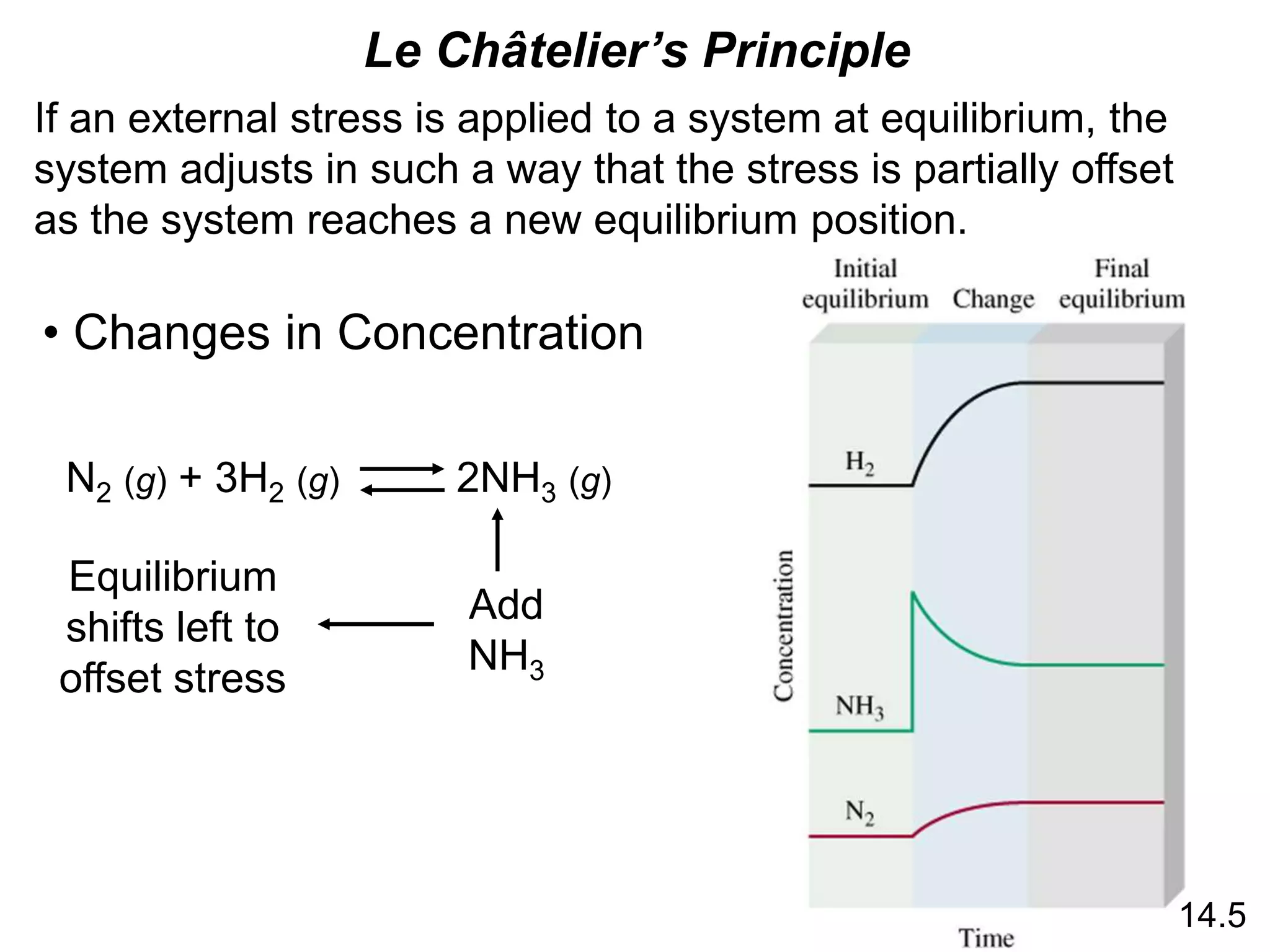
![The equilibrium concentrations for the reaction between
carbon monoxide and molecular chlorine to form COCl2 (g)
at 740C are [CO] = 0.012 M, [Cl2] = 0.054 M, and [COCl2] =
0.14 M. Calculate the equilibrium constants Kc and Kp.
CO (g) + Cl2 (g) COCl2 (g)
Kc =
[COCl2]
[CO][Cl2]
=
0.14
0.012 x 0.054
= 220
Kp = Kc(RT)Dn
Dn = 1 – 2 = -1 R = 0.0821 T = 273 + 74 = 347 K
Kp = 220 x (0.0821 x 347)-1 = 7.7
14.2](https://image.slidesharecdn.com/chapter14chemicalequilibrium-220922215643-c9ad601e/75/chapter_14_chemical-equilibrium-ppt-9-2048.jpg)
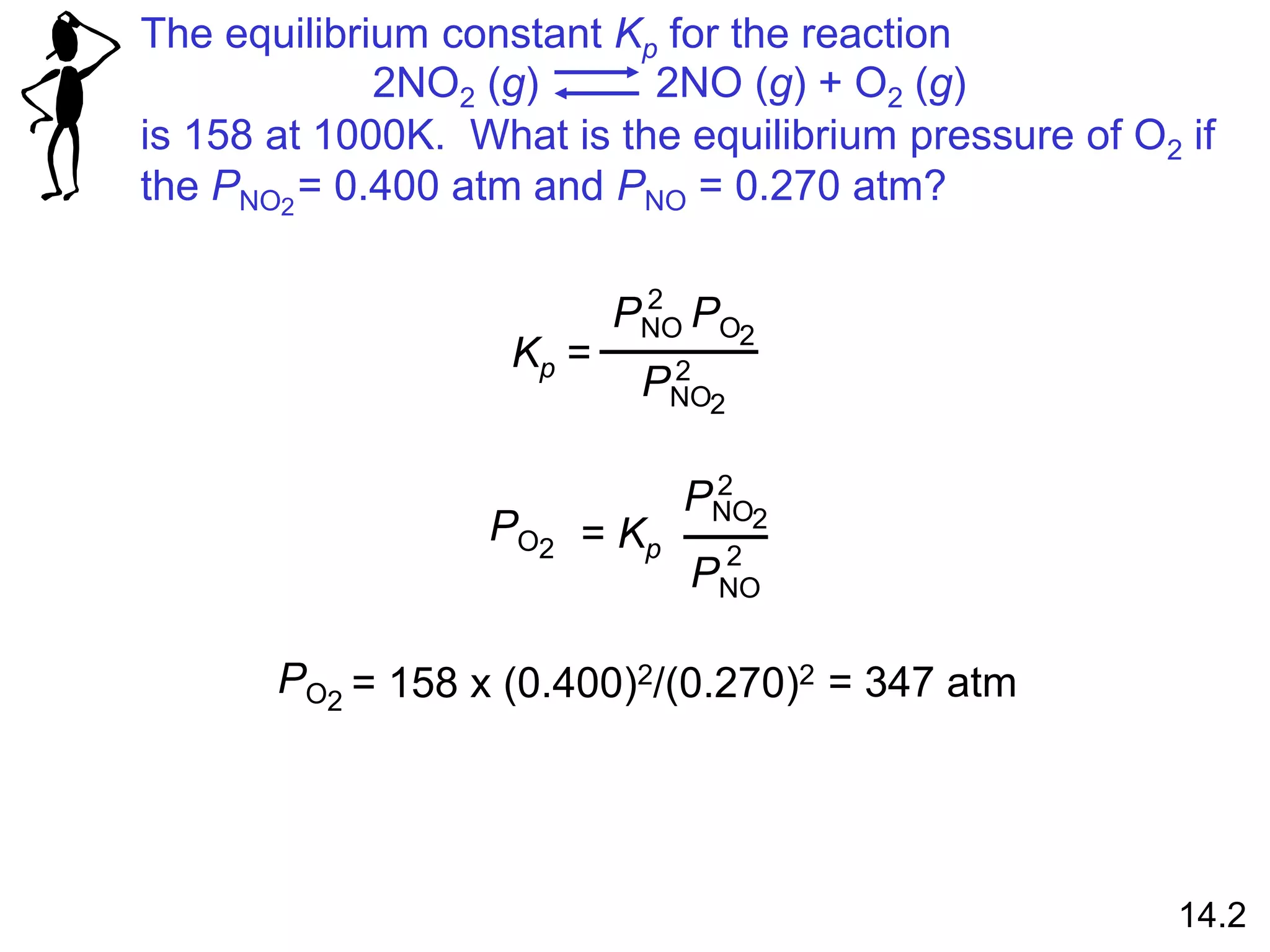
![Heterogenous equilibrium applies to reactions in which
reactants and products are in different phases.
CaCO3 (s) CaO (s) + CO2 (g)
Kc =
‘
[CaO][CO2]
[CaCO3]
[CaCO3] = constant
[CaO] = constant
Kc = [CO2] = Kc x
‘
[CaCO3]
[CaO]
Kp = PCO2
The concentration of solids and pure liquids are not
included in the expression for the equilibrium constant.
14.2](https://image.slidesharecdn.com/chapter14chemicalequilibrium-220922215643-c9ad601e/75/chapter_14_chemical-equilibrium-ppt-11-2048.jpg)
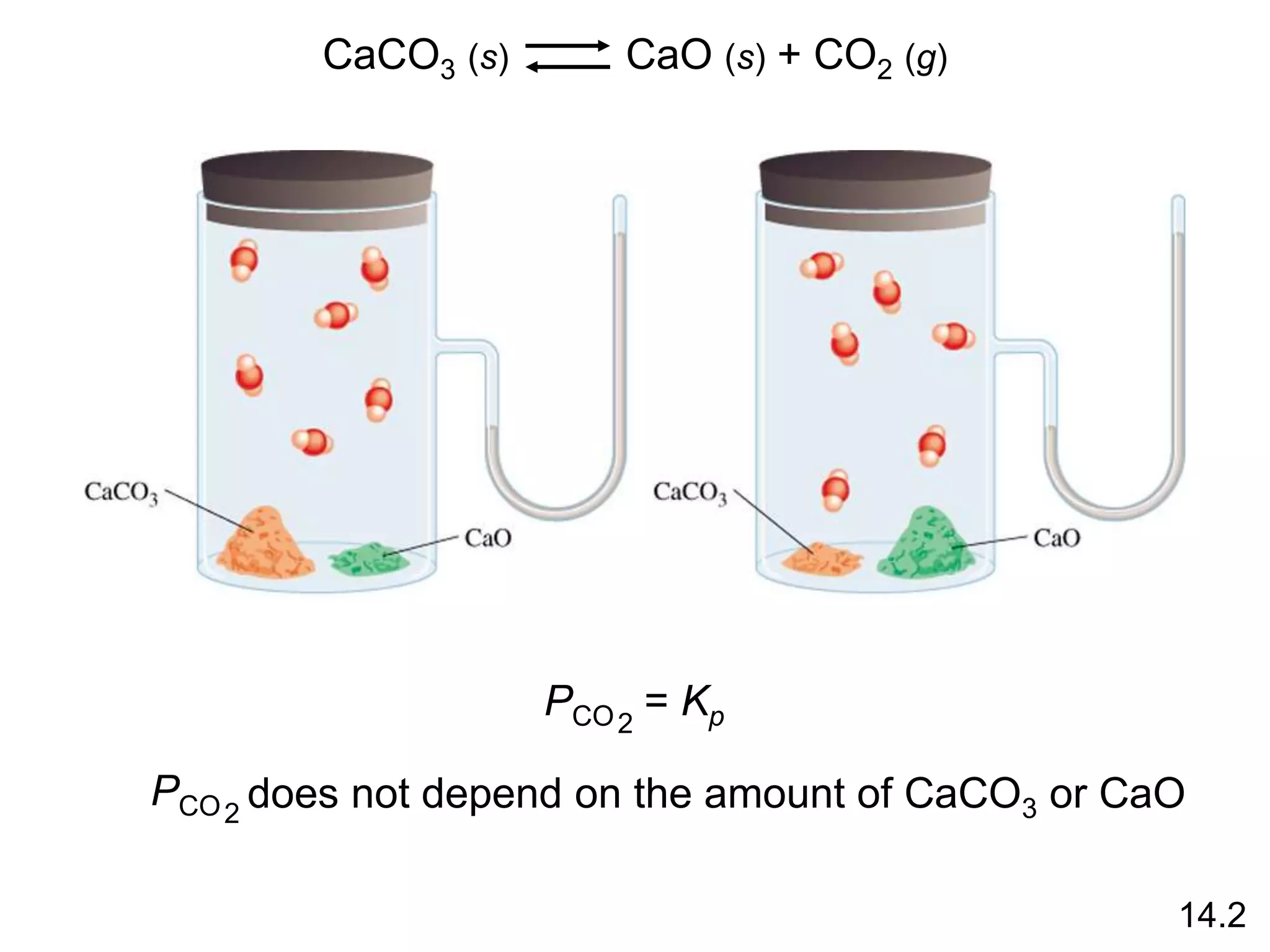
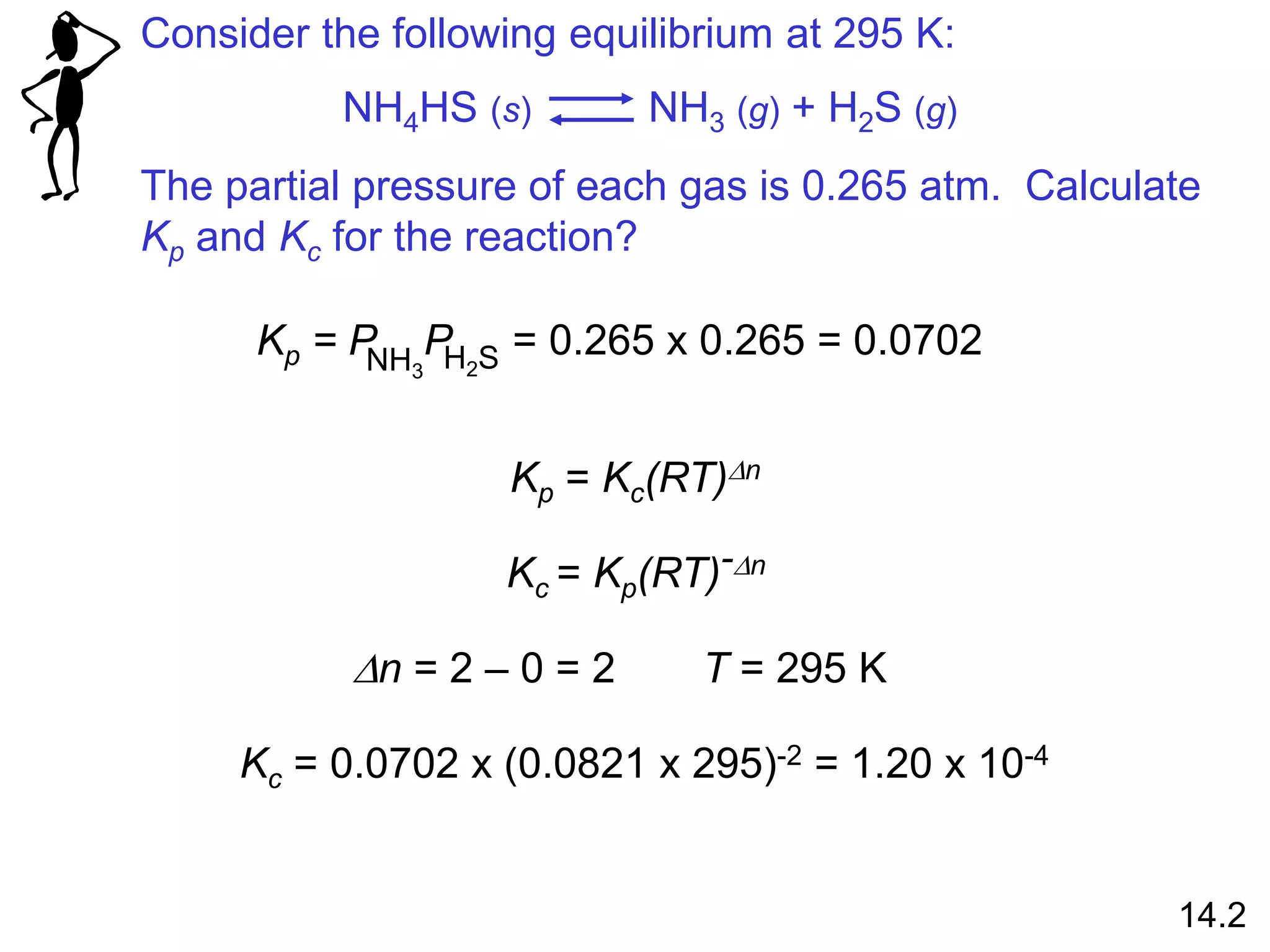
![A + B C + D
C + D E + F
A + B E + F
Kc =
‘
[C][D]
[A][B]
Kc =
‘‘
[E][F]
[C][D]
[E][F]
[A][B]
Kc =
Kc
‘
Kc‘
‘
Kc
Kc = Kc‘
‘
Kc
‘ x
If a reaction can be expressed as the sum of
two or more reactions, the equilibrium
constant for the overall reaction is given by
the product of the equilibrium constants of
the individual reactions.
14.2](https://image.slidesharecdn.com/chapter14chemicalequilibrium-220922215643-c9ad601e/75/chapter_14_chemical-equilibrium-ppt-14-2048.jpg)
![N2O4 (g) 2NO2 (g)
= 4.63 x 10⁻³
K =
[NO2]2
[N2O4]
2NO2 (g) N2O4 (g)
K =
[N2O4]
[NO2]2
‘ =
1
K
= 216
When the equation for a reversible reaction
is written in the opposite direction, the
equilibrium constant becomes the reciprocal
of the original equilibrium constant.
14.2](https://image.slidesharecdn.com/chapter14chemicalequilibrium-220922215643-c9ad601e/75/chapter_14_chemical-equilibrium-ppt-15-2048.jpg)
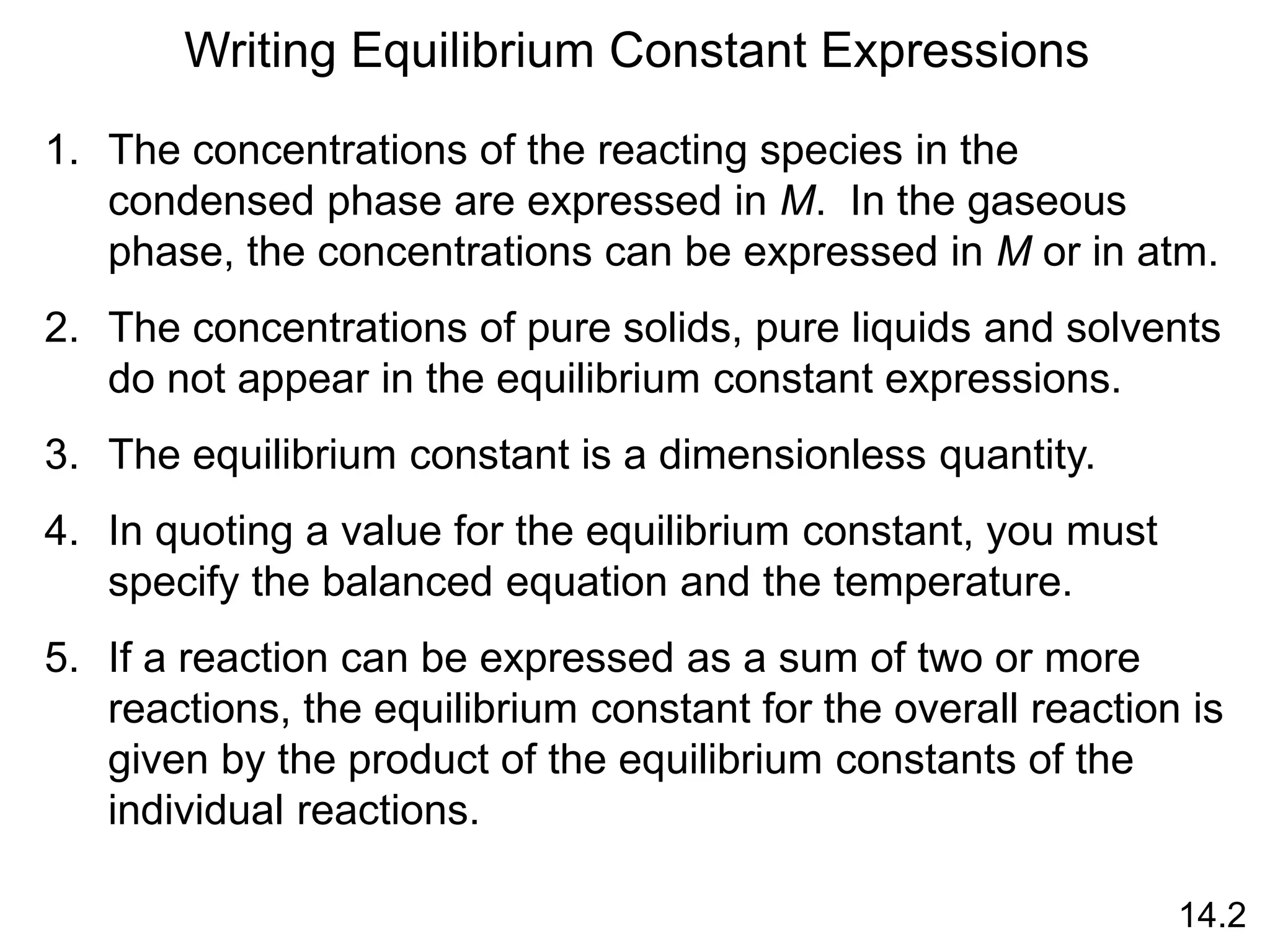
![14.3
Chemical Kinetics and Chemical Equilibrium
A + 2B AB2
kf
kr
ratef = kf [A][B]2
rater = kr [AB2]
Equilibrium
ratef = rater
kf [A][B]2 = kr [AB2]
kf
kr
[AB2]
[A][B]2
= Kc =](https://image.slidesharecdn.com/chapter14chemicalequilibrium-220922215643-c9ad601e/75/chapter_14_chemical-equilibrium-ppt-17-2048.jpg)


![At 12800C the equilibrium constant (Kc) for the reaction
Is 1.1 x 10⁻³. If the initial concentrations are [Br2] = 0.063
M and [Br] = 0.012 M, calculate the concentrations of these
species at equilibrium.
Br2 (g) 2Br (g)
Br2 (g) 2Br (g)
Let x be the change in concentration of Br2
Initial (M)
Change (M)
Equilibrium (M)
0.063 0.012
-x +2x
0.063 - x 0.012 + 2x
[Br]2
[Br2]
Kc = Kc =
(0.012 + 2x)2
0.063 - x
= 1.1 x 10⁻³ Solve for x
14.4](https://image.slidesharecdn.com/chapter14chemicalequilibrium-220922215643-c9ad601e/75/chapter_14_chemical-equilibrium-ppt-20-2048.jpg)
![Kc =
(0.012 + 2x)2
0.063 - x
= 1.1 x 10⁻³
4x2 + 0.048x + 0.000144 = 0.0000693 – 0.0011x
4x2 + 0.0491x + 0.0000747 = 0
ax2 + bx + c =0
-b ± b2 – 4ac
2a
x =
Br2 (g) 2Br (g)
Initial (M)
Change (M)
Equilibrium (M)
0.063 0.012
-x +2x
0.063 - x 0.012 + 2x
x = -0.00178
x = -0.0105
At equilibrium, [Br] = 0.012 + 2x = -0.009 M or 0.00844 M
At equilibrium, [Br2] = 0.062 – x = 0.0648 M
14.4](https://image.slidesharecdn.com/chapter14chemicalequilibrium-220922215643-c9ad601e/75/chapter_14_chemical-equilibrium-ppt-21-2048.jpg)

![Chemistry In Action
Life at High Altitudes and Hemoglobin Production
Kc =
[HbO2]
[Hb][O2]
Hb (aq) + O2 (aq) HbO2 (aq)](https://image.slidesharecdn.com/chapter14chemicalequilibrium-220922215643-c9ad601e/75/chapter_14_chemical-equilibrium-ppt-27-2048.jpg)