LECTURE
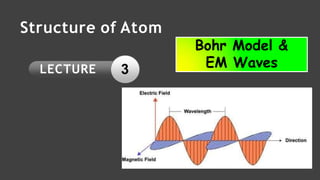
Structure of Atom
Bohr Model &
EM Waves
3
Let’s start the
session….
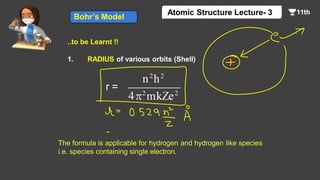
r =
..to be Learnt !!
1. RADIUS of various orbits (Shell)
n2
h2
42
mkZe2
Bohr’s Model
Atomic Structure Lecture- 3
The formula is applicable for hydrogen and hydrogen like species
i.e. species containing single electron.
..to be Learnt !!
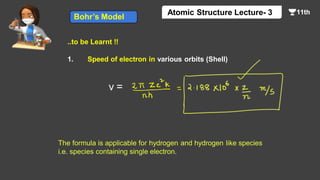
1. Speed of electron in various orbits (Shell)
v =
Bohr’s Model
Atomic Structure Lecture- 3
The formula is applicable for hydrogen and hydrogen like species
i.e. species containing single electron.
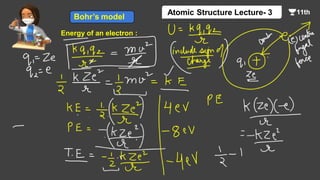
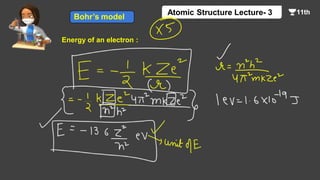
Energy of an electron :
Bohr’s model
Atomic Structure Lecture- 3
Energy of an electron :
Bohr’s model
Atomic Structure Lecture- 3
Energy of an electron :
Bohr’s model
Atomic Structure Lecture- 3
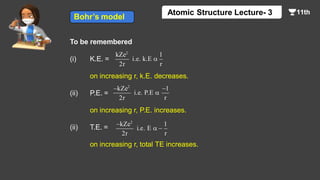
To be remembered
(i) K.E. =
on increasing r, k.E. decreases.

(ii) P.E. =

on increasing r, P.E. increases.
(ii) T.E. =
on increasing r, total TE increases.
kZe2
2r
1
r
i.e. k.E 
–kZe2
2r
–1
r
i.e. P.E 
–kZe2
2r
1
r
i.e. E  –
Bohr’s model
Atomic Structure Lecture- 3
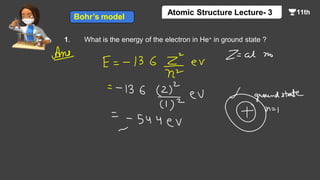
1. What is the energy of the electron in He+ in ground state ?
Bohr’s model
Atomic Structure Lecture- 3
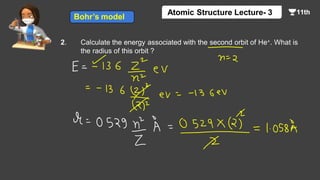
2. Calculate the energy associated with the second orbit of He+. What is
the radius of this orbit ?
Bohr’s model
Atomic Structure Lecture- 3
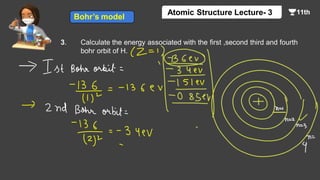
3. Calculate the energy associated with the first ,second third and fourth
bohr orbit of H.
Bohr’s model
Atomic Structure Lecture- 3
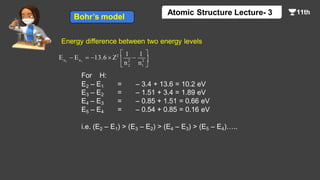
Energy difference between two energy levels
For H:
E2 – E1 = – 3.4 + 13.6 = 10.2 eV
E3 – E2 = – 1.51 + 3.4 = 1.89 eV
E4 – E3 = – 0.85 + 1.51 = 0.66 eV
E5 – E4 = – 0.54 + 0.85 = 0.16 eV
i.e. (E2 – E1) > (E3 – E2) > (E4 – E3) > (E5 – E4)…..
n2 n1 2 2
n n
E – E  –13.6  Z2  1
–
1 
 
 2 1 
Bohr’s model
Atomic Structure Lecture- 3
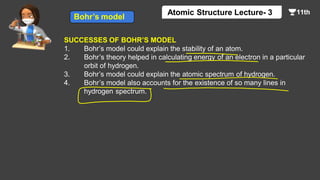
SUCCESSES OF BOHR’S MODEL
1. Bohr’s model could explain the stability of an atom.
2. Bohr’s theory helped in calculating energy of an electron in a particular
orbit of hydrogen.
3. Bohr’s model could explain the atomic spectrum of hydrogen.
4. Bohr’s model also accounts for the existence of so many lines in
hydrogen spectrum.
Bohr’s model
Atomic Structure Lecture- 3
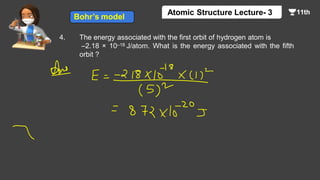
4. The energy associated with the first orbit of hydrogen atom is
–2.18 × 10⁻¹⁸ J/atom. What is the energy associated with the fifth
orbit ?
Bohr’s model
Atomic Structure Lecture- 3
4th POSTULATE
 If the e– remains in the stationary state then it does not lose
energy. Such a state is called ground state (lowest energy state)
Bohr’s model
Atomic Structure Lecture- 3
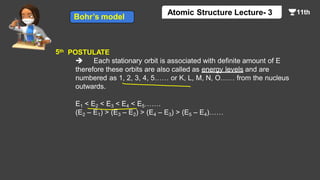
5th POSTULATE
 Each stationary orbit is associated with definite amount of E
therefore these orbits are also called as energy levels and are
numbered as 1, 2, 3, 4, 5…… or K, L, M, N, O…… from the nucleus
outwards.
E1 < E2 < E3 < E4 < E5…….
(E2 – E1) > (E3 – E2) > (E4 – E3) > (E5 – E4)……
Bohr’s model
Atomic Structure Lecture- 3
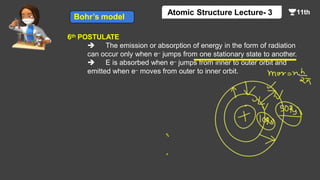
6th POSTULATE
 The emission or absorption of energy in the form of radiation
can occur only when e– jumps from one stationary state to another.
 E is absorbed when e– jumps from inner to outer orbit and
emitted when e– moves from outer to inner orbit.
Bohr’s model
Atomic Structure Lecture- 3
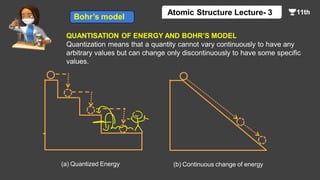
QUANTISATION OF ENERGY AND BOHR’S MODEL
Quantization means that a quantity cannot vary continuously to have any
arbitrary values but can change only discontinuously to have some specific
values.
(a) Quantized Energy (b) Continuous change of energy
Bohr’s model
Atomic Structure Lecture- 3
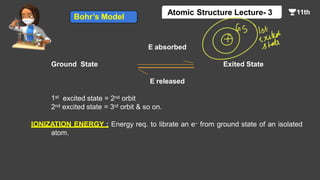
E absorbed
Ground State Exited State
E released
1st excited state = 2nd orbit
2nd excited state = 3rd orbit & so on.
IONIZATION ENERGY : Energy req. to librate an e– from ground state of an isolated
atom.
Bohr’s Model
Atomic Structure Lecture- 3
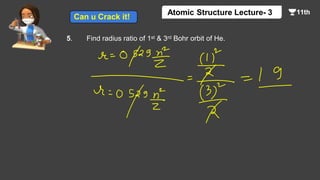
5. Find radius ratio of 1st & 3rd Bohr orbit of He.
Atomic Structure Lecture- 3
Can u Crack it!
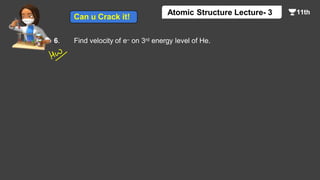
6. Find velocity of e– on 3rd energy level of He.
Atomic Structure Lecture- 3
Can u Crack it!
FREE Special Classes
SUNDAY: 13th June 2021
Time: 12:30 PM LIVE
Stoichiometry &
Limiting Reagent
Unlock Special Free Classes
Code: MBLIVE or MONICA
Unlock Free Content with my Code
MBLIVE
Step 1 Search the “Unacademy
Learning App” in google play
store & download
“Login” in the app & seClass 11
Lect the “goal”
Step 2
SeClass 11 Lect the “menu
button” on the top left corner &
seClass 11Lect “Special”
Enter an “invite code” to unlock
your free plan.
Step 3
Step 4
What’s new with Unacademy?
Unacademy Ask a
Doubt
Ask unlimited doubts Ask doubts at
any time
Get high-quality video
in English
& Hindi
Receive exact matches
for questions
Obtain instant and
accurate to lakhs of
questions
Get assistance with
homework
Unacademy Ask a Doubt
How to
Ask a Doubt
Step 1
Click on ‘Ask a Doubt’
Step 2
SeClass 11 Lect ‘Take a
picture’ or ‘Choose from
Gallery’
Step 3
Click/seClass 11 Lect a
picture of your question
Step 4
Crop to highlight one
specific question
Step 5
Choose the subject that
the question falls under
Step 6
Sit tight, you’ll receive
the solution soon!
How to
Ask a Doubt
Enrolment Code MBLIVE
Using Code MBLIVE
Unacademy Iconic Subscription
Features
‘Iconic Subscription’
redefines mentorship and
ensures hands-on learning.
We are happy to present a
360 degree support system
that gives you all the
assistance you need.
MBLIVE
IIT-JEE/NEET
Plus Subscription
MBLIVE
MBLIVE
Plus/ Iconic
Subscription
MBLIVE
EXCLUSIVE
Use Code
Use Code:
MBLIVE
Step 2
Step 1 Step 2 Step 3 Step 4 Step 5
TRY ALL OF THESE FEATURES
FOR FREE
Download the
Unacademy App Now
Use Code: MBLIVE
Thank
You
Yellow light emitted from a sodium lamp has a wavelength () of 580
nm. Calculate the frequency and wave number of this light.
Atomic Structure Lecture- 3
Can u Crack it!
5. The frequency of strong yellow line in the spectrum of sodium is
5.09 × 10¹⁴ sec–1.
Calculate the wavelength of the light in nanometer.
Atomic Structure Lecture- 3
Can u Crack it!
6. The wavelength of a spectral line of cesium is 460 nm.
Calculate the frequency of the line.
Atomic Structure Lecture- 3
Can u Crack it!
7. A certain radio station broadcasts on a frequency of 980 kHz
(kilohertz). What is the wavelength of electromagnetic radiation
broadcast by the ratio station ?
Atomic Structure Lecture- 3
Can u Crack it!
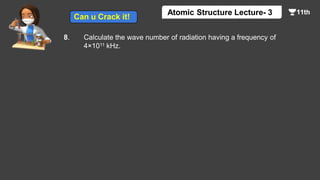
8. Calculate the wave number of radiation having a frequency of
4×10¹¹ kHz.
Atomic Structure Lecture- 3
Can u Crack it!
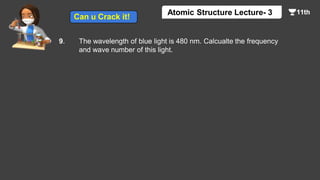
9. The wavelength of blue light is 480 nm. Calcualte the frequency
and wave number of this light.
Atomic Structure Lecture- 3
Can u Crack it!
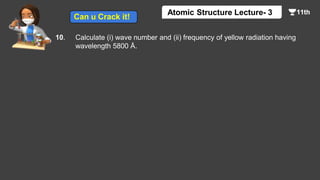
10. Calculate (i) wave number and (ii) frequency of yellow radiation having
wavelength 5800 Å.
Atomic Structure Lecture- 3
Can u Crack it!
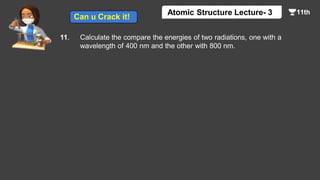
11. Calculate the compare the energies of two radiations, one with a
wavelength of 400 nm and the other with 800 nm.
Atomic Structure Lecture- 3
Can u Crack it!
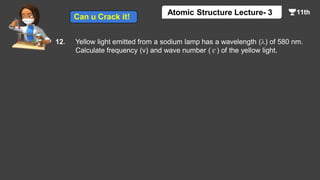
12. Yellow light emitted from a sodium lamp has a wavelength () of 580 nm.
Calculate frequency (v) and wave number ( v ) of the yellow light.
Atomic Structure Lecture- 3
Can u Crack it!
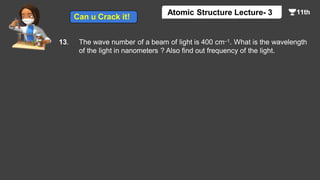
13. The wave number of a beam of light is 400 cm–1. What is the wavelength
of the light in nanometers ? Also find out frequency of the light.
Atomic Structure Lecture- 3
Can u Crack it!

Atomic Structure Lecture -3 12 june (1).pptx

  • 1.
  • 2.
  • 3.
    r = ..to beLearnt !! 1. RADIUS of various orbits (Shell) n2 h2 42 mkZe2 Bohr’s Model Atomic Structure Lecture- 3 The formula is applicable for hydrogen and hydrogen like species i.e. species containing single electron.
  • 4.
    ..to be Learnt!! 1. Speed of electron in various orbits (Shell) v = Bohr’s Model Atomic Structure Lecture- 3 The formula is applicable for hydrogen and hydrogen like species i.e. species containing single electron.
  • 5.
    Energy of anelectron : Bohr’s model Atomic Structure Lecture- 3
  • 6.
    Energy of anelectron : Bohr’s model Atomic Structure Lecture- 3
  • 7.
    Energy of anelectron : Bohr’s model Atomic Structure Lecture- 3
  • 8.
    To be remembered (i)K.E. = on increasing r, k.E. decreases. (ii) P.E. = on increasing r, P.E. increases. (ii) T.E. = on increasing r, total TE increases. kZe2 2r 1 r i.e. k.E  –kZe2 2r –1 r i.e. P.E  –kZe2 2r 1 r i.e. E  – Bohr’s model Atomic Structure Lecture- 3
  • 9.
    1. What isthe energy of the electron in He+ in ground state ? Bohr’s model Atomic Structure Lecture- 3
  • 10.
    2. Calculate theenergy associated with the second orbit of He+. What is the radius of this orbit ? Bohr’s model Atomic Structure Lecture- 3
  • 11.
    3. Calculate theenergy associated with the first ,second third and fourth bohr orbit of H. Bohr’s model Atomic Structure Lecture- 3
  • 12.
    Energy difference betweentwo energy levels For H: E2 – E1 = – 3.4 + 13.6 = 10.2 eV E3 – E2 = – 1.51 + 3.4 = 1.89 eV E4 – E3 = – 0.85 + 1.51 = 0.66 eV E5 – E4 = – 0.54 + 0.85 = 0.16 eV i.e. (E2 – E1) > (E3 – E2) > (E4 – E3) > (E5 – E4)….. n2 n1 2 2 n n E – E  –13.6  Z2  1 – 1     2 1  Bohr’s model Atomic Structure Lecture- 3
  • 13.
    SUCCESSES OF BOHR’SMODEL 1. Bohr’s model could explain the stability of an atom. 2. Bohr’s theory helped in calculating energy of an electron in a particular orbit of hydrogen. 3. Bohr’s model could explain the atomic spectrum of hydrogen. 4. Bohr’s model also accounts for the existence of so many lines in hydrogen spectrum. Bohr’s model Atomic Structure Lecture- 3
  • 14.
    4. The energyassociated with the first orbit of hydrogen atom is –2.18 × 10⁻¹⁸ J/atom. What is the energy associated with the fifth orbit ? Bohr’s model Atomic Structure Lecture- 3
  • 15.
    4th POSTULATE  Ifthe e– remains in the stationary state then it does not lose energy. Such a state is called ground state (lowest energy state) Bohr’s model Atomic Structure Lecture- 3
  • 16.
    5th POSTULATE  Eachstationary orbit is associated with definite amount of E therefore these orbits are also called as energy levels and are numbered as 1, 2, 3, 4, 5…… or K, L, M, N, O…… from the nucleus outwards. E1 < E2 < E3 < E4 < E5……. (E2 – E1) > (E3 – E2) > (E4 – E3) > (E5 – E4)…… Bohr’s model Atomic Structure Lecture- 3
  • 17.
    6th POSTULATE  Theemission or absorption of energy in the form of radiation can occur only when e– jumps from one stationary state to another.  E is absorbed when e– jumps from inner to outer orbit and emitted when e– moves from outer to inner orbit. Bohr’s model Atomic Structure Lecture- 3
  • 18.
    QUANTISATION OF ENERGYAND BOHR’S MODEL Quantization means that a quantity cannot vary continuously to have any arbitrary values but can change only discontinuously to have some specific values. (a) Quantized Energy (b) Continuous change of energy Bohr’s model Atomic Structure Lecture- 3
  • 19.
    E absorbed Ground StateExited State E released 1st excited state = 2nd orbit 2nd excited state = 3rd orbit & so on. IONIZATION ENERGY : Energy req. to librate an e– from ground state of an isolated atom. Bohr’s Model Atomic Structure Lecture- 3
  • 20.
    5. Find radiusratio of 1st & 3rd Bohr orbit of He. Atomic Structure Lecture- 3 Can u Crack it!
  • 21.
    6. Find velocityof e– on 3rd energy level of He. Atomic Structure Lecture- 3 Can u Crack it!
  • 22.
    FREE Special Classes SUNDAY:13th June 2021 Time: 12:30 PM LIVE Stoichiometry & Limiting Reagent Unlock Special Free Classes Code: MBLIVE or MONICA
  • 23.
    Unlock Free Contentwith my Code MBLIVE Step 1 Search the “Unacademy Learning App” in google play store & download “Login” in the app & seClass 11 Lect the “goal” Step 2 SeClass 11 Lect the “menu button” on the top left corner & seClass 11Lect “Special” Enter an “invite code” to unlock your free plan. Step 3 Step 4
  • 24.
    What’s new withUnacademy? Unacademy Ask a Doubt
  • 25.
    Ask unlimited doubtsAsk doubts at any time Get high-quality video in English & Hindi Receive exact matches for questions Obtain instant and accurate to lakhs of questions Get assistance with homework Unacademy Ask a Doubt
  • 26.
    How to Ask aDoubt Step 1 Click on ‘Ask a Doubt’ Step 2 SeClass 11 Lect ‘Take a picture’ or ‘Choose from Gallery’ Step 3 Click/seClass 11 Lect a picture of your question
  • 27.
    Step 4 Crop tohighlight one specific question Step 5 Choose the subject that the question falls under Step 6 Sit tight, you’ll receive the solution soon! How to Ask a Doubt
  • 28.
  • 31.
  • 33.
    Unacademy Iconic Subscription Features ‘IconicSubscription’ redefines mentorship and ensures hands-on learning. We are happy to present a 360 degree support system that gives you all the assistance you need.
  • 35.
  • 36.
  • 37.
  • 38.
    Step 2 Step 1Step 2 Step 3 Step 4 Step 5
  • 39.
    TRY ALL OFTHESE FEATURES FOR FREE Download the Unacademy App Now Use Code: MBLIVE Thank You
  • 40.
    Yellow light emittedfrom a sodium lamp has a wavelength () of 580 nm. Calculate the frequency and wave number of this light. Atomic Structure Lecture- 3 Can u Crack it!
  • 41.
    5. The frequencyof strong yellow line in the spectrum of sodium is 5.09 × 10¹⁴ sec–1. Calculate the wavelength of the light in nanometer. Atomic Structure Lecture- 3 Can u Crack it!
  • 42.
    6. The wavelengthof a spectral line of cesium is 460 nm. Calculate the frequency of the line. Atomic Structure Lecture- 3 Can u Crack it!
  • 43.
    7. A certainradio station broadcasts on a frequency of 980 kHz (kilohertz). What is the wavelength of electromagnetic radiation broadcast by the ratio station ? Atomic Structure Lecture- 3 Can u Crack it!
  • 44.
    8. Calculate thewave number of radiation having a frequency of 4×10¹¹ kHz. Atomic Structure Lecture- 3 Can u Crack it!
  • 45.
    9. The wavelengthof blue light is 480 nm. Calcualte the frequency and wave number of this light. Atomic Structure Lecture- 3 Can u Crack it!
  • 46.
    10. Calculate (i)wave number and (ii) frequency of yellow radiation having wavelength 5800 Å. Atomic Structure Lecture- 3 Can u Crack it!
  • 47.
    11. Calculate thecompare the energies of two radiations, one with a wavelength of 400 nm and the other with 800 nm. Atomic Structure Lecture- 3 Can u Crack it!
  • 48.
    12. Yellow lightemitted from a sodium lamp has a wavelength () of 580 nm. Calculate frequency (v) and wave number ( v ) of the yellow light. Atomic Structure Lecture- 3 Can u Crack it!
  • 49.
    13. The wavenumber of a beam of light is 400 cm–1. What is the wavelength of the light in nanometers ? Also find out frequency of the light. Atomic Structure Lecture- 3 Can u Crack it!