Revision topics

1. Elements, compounds and mixtures

A mixture refers to two or more substances that can be separated by physical means

One important method is filtration

Filtration is used to separate insoluble solids from liquids because solid particles are too large
to pass through the filter.

Can you separate sand and water using filtration?

How about separating sugar and water using filtration?

Did you know that…

Sand can be used for filtration?


And that the teabag work by using a filter?


An insoluble substance cannot dissolve in water

What does dissolving mean?
Something that is soluble can be split up by a solvent into its smallest parts and distributed
throughout the solution.

Solvent is a substance that can dissolve other substances

When you see the word “solution of something”, it means that that substance is the solute and
is actually dissolved in the solvent! (usually the solvent is water)


Did you know that stirring a soluble substance helps it to dissolve faster?


To separate something that has dissolved in water, we have to use the method of
crystallisation.

Crystallisation works because the first step is to heat the solution to obtain a saturated
solution.

Notice that such a solution is holding the maximum amount of the substance it can dissolve.
When we leave the saturated solution to cool, crystals will form. This is because when the
temperature is lower, the maximum amount of solute a solvent can dissolve is lower.
Therefore, some of the solute would have to be crystallised out.

Next we will need to rinse the crystals with cold distilled water. (remember that warm water
can dissolve some of the crystals we purified)


Finally, the last step in purifying our crystals is to dry the crystals using filter paper.

If you dissolve sugar crystals in water, can you get back sugar crystals?

What if you have two different liquids mixed together?

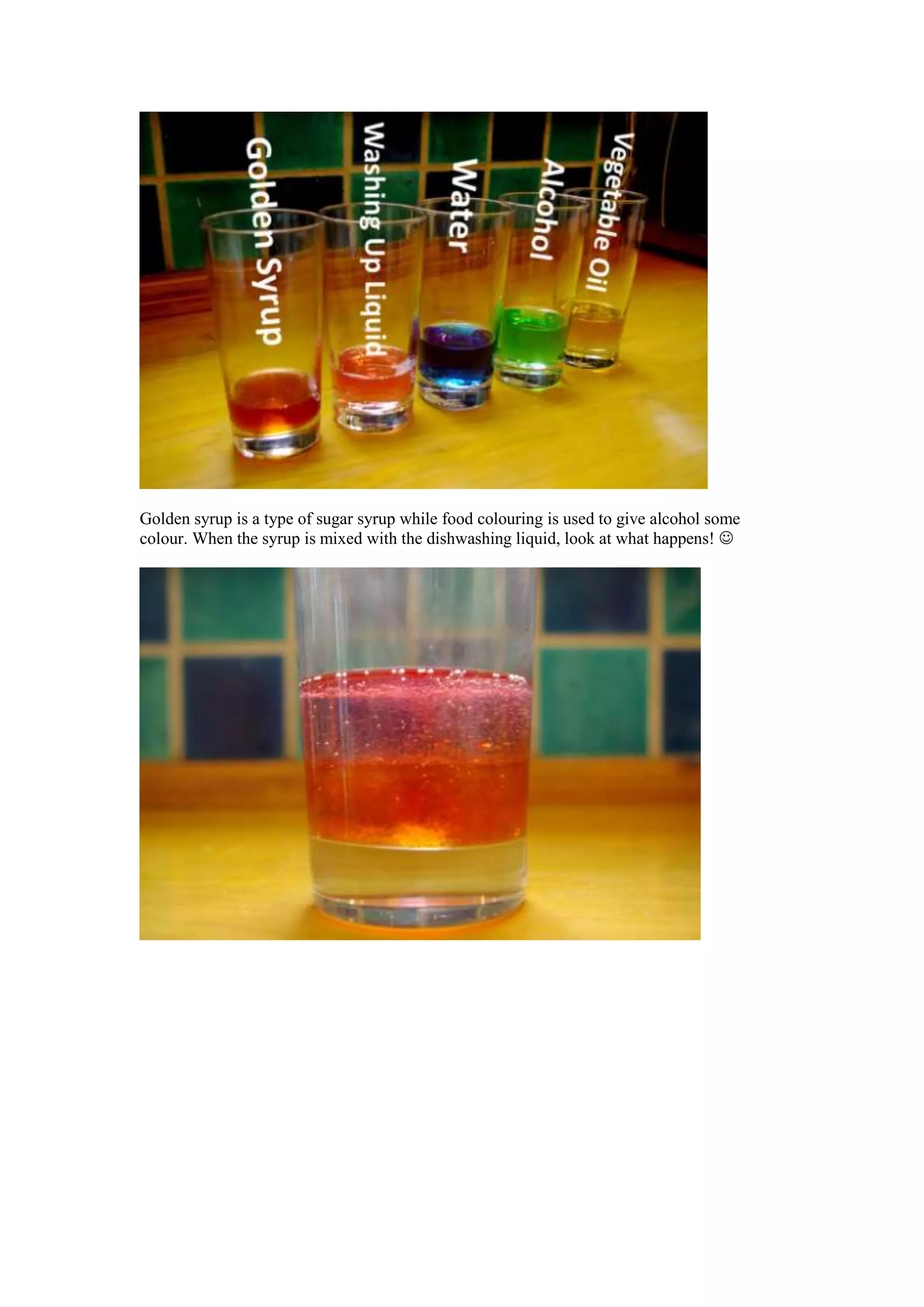
Here we have 5 different liquids
Golden syrup is a type of sugar syrup while food colouring is used to give alcohol some
colour. When the syrup is mixed with the dishwashing liquid, look at what happens! 
Next, look at what happens when the different liquids are added on top of each other carefully
without stirring


Tada!


To separate liquids, we can make use of distillation because liquidshave different boiling
points.
Student Kevin Nguyen (age 10):
Using the same amount of cooking oil and water, which liquid will boil first?
Why is one liquid boiled before the other?


Answer by someone from the University of Illinois Physics Department

The boiling point for oil is roughly 300 degree Celsius while that of water is 100 degree
Celsius.

The boiling point of a liquid is the temperature where the liquid changes into a gas.

The reason why different liquids boil at different temperatures is because of the chemical
bonds that hold them together.

So when we say that oil has a higher boiling point than water, what we are saying is that the
chemical bonds that hold oil molecules together are stronger than the ones holding water
molecules together. Hence, more heat is required to break the stronger bonds in oil.

The distillation process

During distillation, the mixture of liquids is heated and the liquid with the lowest boiling
point boil first.

The gas formed passes through the condenser and condenses back into a liquidand is collected
in a container.
If you are asked to draw the distillation set up, make sure you draw the 1) bunsen burner 2)
distilling flask 3) retort stand 4) thermometer 5) condenser 5) conical flask to collect
the distillate

We also use a similar type of distillation called fractional distillation to separate liquids
which have very close boiling points.


The fractional distillation process

During fractional distillation, the ABACADABRA (could be crude oil or liquefied air) is
heated and the liquid with the lowest boiling point boil first.

The gas formed rises up the fractionating column andas it rises up the column, it starts to cool
down.
When the gas rises up till a certain height such that it has lost enough heat and the
surrounding temperature is equal to the boiling point of the gas, it willcondenses back into a
liquidand is collected in a tray.

The substance with the lowest boiling point will condense at the highest point in the
fractionating column because it turns into a liquid at a very low temperature whereas it was
heated up to a very high temperature and has a lot of heat to lose.


Crude oil is basically a mixture of all the different members of the alkane hydrocarbon
family. We separate them because of their different properties. The first 4 members are gases
at room temperature and can be used in gas burners and lighters. The next few are liquid and
can be used as vehicle fuel as they provide more energy than the gaseous members.
An element refers to a substance that cannot be broken down by chemical means

More resources

The exciting liquids experiment
http://orbitingfrog.com/post/3424287163/exploring-liquids-an-experiment

Filtration:
http://www4.agr.gc.ca/AAFCAAC/displayafficher.do?id=1189706528512&lang=eng

Chem separation techniques

  • 1.
    Revision topics 1. Elements,compounds and mixtures A mixture refers to two or more substances that can be separated by physical means One important method is filtration Filtration is used to separate insoluble solids from liquids because solid particles are too large to pass through the filter. Can you separate sand and water using filtration? How about separating sugar and water using filtration? Did you know that… Sand can be used for filtration? And that the teabag work by using a filter? An insoluble substance cannot dissolve in water What does dissolving mean?
  • 2.
    Something that issoluble can be split up by a solvent into its smallest parts and distributed throughout the solution. Solvent is a substance that can dissolve other substances When you see the word “solution of something”, it means that that substance is the solute and is actually dissolved in the solvent! (usually the solvent is water) Did you know that stirring a soluble substance helps it to dissolve faster? To separate something that has dissolved in water, we have to use the method of crystallisation. Crystallisation works because the first step is to heat the solution to obtain a saturated solution. Notice that such a solution is holding the maximum amount of the substance it can dissolve.
  • 3.
    When we leavethe saturated solution to cool, crystals will form. This is because when the temperature is lower, the maximum amount of solute a solvent can dissolve is lower. Therefore, some of the solute would have to be crystallised out. Next we will need to rinse the crystals with cold distilled water. (remember that warm water can dissolve some of the crystals we purified) Finally, the last step in purifying our crystals is to dry the crystals using filter paper. If you dissolve sugar crystals in water, can you get back sugar crystals? What if you have two different liquids mixed together? Here we have 5 different liquids
  • 4.
    Golden syrup isa type of sugar syrup while food colouring is used to give alcohol some colour. When the syrup is mixed with the dishwashing liquid, look at what happens! 
  • 5.
    Next, look atwhat happens when the different liquids are added on top of each other carefully without stirring Tada! To separate liquids, we can make use of distillation because liquidshave different boiling points.
  • 6.
    Student Kevin Nguyen(age 10): Using the same amount of cooking oil and water, which liquid will boil first? Why is one liquid boiled before the other? Answer by someone from the University of Illinois Physics Department The boiling point for oil is roughly 300 degree Celsius while that of water is 100 degree Celsius. The boiling point of a liquid is the temperature where the liquid changes into a gas. The reason why different liquids boil at different temperatures is because of the chemical bonds that hold them together. So when we say that oil has a higher boiling point than water, what we are saying is that the chemical bonds that hold oil molecules together are stronger than the ones holding water molecules together. Hence, more heat is required to break the stronger bonds in oil. The distillation process During distillation, the mixture of liquids is heated and the liquid with the lowest boiling point boil first. The gas formed passes through the condenser and condenses back into a liquidand is collected in a container.
  • 7.
    If you areasked to draw the distillation set up, make sure you draw the 1) bunsen burner 2) distilling flask 3) retort stand 4) thermometer 5) condenser 5) conical flask to collect the distillate We also use a similar type of distillation called fractional distillation to separate liquids which have very close boiling points. The fractional distillation process During fractional distillation, the ABACADABRA (could be crude oil or liquefied air) is heated and the liquid with the lowest boiling point boil first. The gas formed rises up the fractionating column andas it rises up the column, it starts to cool down.
  • 8.
    When the gasrises up till a certain height such that it has lost enough heat and the surrounding temperature is equal to the boiling point of the gas, it willcondenses back into a liquidand is collected in a tray. The substance with the lowest boiling point will condense at the highest point in the fractionating column because it turns into a liquid at a very low temperature whereas it was heated up to a very high temperature and has a lot of heat to lose. Crude oil is basically a mixture of all the different members of the alkane hydrocarbon family. We separate them because of their different properties. The first 4 members are gases at room temperature and can be used in gas burners and lighters. The next few are liquid and can be used as vehicle fuel as they provide more energy than the gaseous members.
  • 9.
    An element refersto a substance that cannot be broken down by chemical means More resources The exciting liquids experiment http://orbitingfrog.com/post/3424287163/exploring-liquids-an-experiment Filtration: http://www4.agr.gc.ca/AAFCAAC/displayafficher.do?id=1189706528512&lang=eng