Spectroscopy
nuclear magnetic resonance
The nmr spectra included in this presentation have
been taken from the SDBS database with permission.
National Institute of Advanced Industrial Science and Technology


 (http://www.aist.go.jp/RIODB/SDBS/menu-e.html)
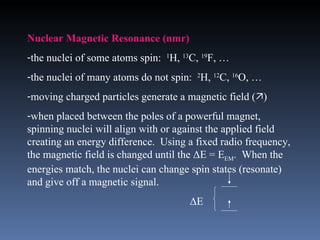
Nuclear Magnetic Resonance (nmr)
-the nuclei of some atoms spin: 1H, 13C, 19F, …
-the nuclei of many atoms do not spin: 2H, 12C, 16O, …
-moving charged particles generate a magnetic field ()
-when placed between the poles of a powerful magnet,
spinning nuclei will align with or against the applied field
creating an energy difference. Using a fixed radio frequency,
the magnetic field is changed until the ΔE = EEM. When the
energies match, the nuclei can change spin states (resonate)
and give off a magnetic signal.
                                     ΔE
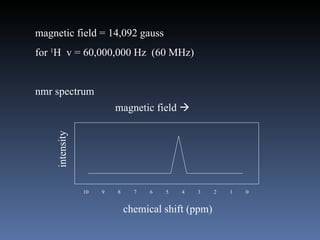
magnetic field = 14,092 gauss
for 1H v = 60,000,000 Hz (60 MHz)


nmr spectrum
                         magnetic field 
    intensity


                10   9   8     7   6   5   4   3    2   1   0


                             chemical shift (ppm)
1
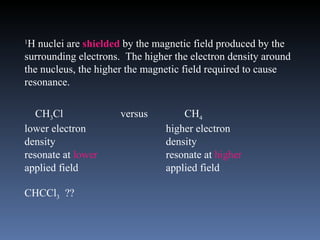
 H nuclei are shielded by the magnetic field produced by the
surrounding electrons. The higher the electron density around
the nucleus, the higher the magnetic field required to cause
resonance.

   CH3Cl             versus         CH4
lower electron                  higher electron
density                         density
resonate at lower               resonate at higher
applied field                   applied field

CHCCl3 ??
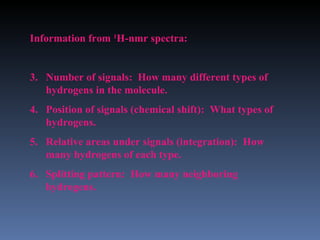
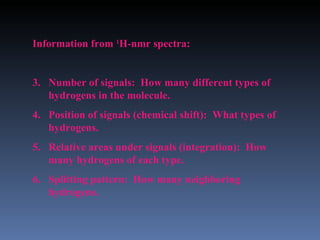
Information from 1H-nmr spectra:


3. Number of signals: How many different types of
   hydrogens in the molecule.
4. Position of signals (chemical shift): What types of
   hydrogens.
5. Relative areas under signals (integration): How
   many hydrogens of each type.
6. Splitting pattern: How many neighboring
   hydrogens.
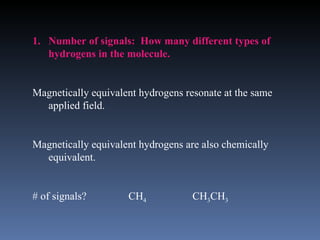
1. Number of signals: How many different types of
   hydrogens in the molecule.


Magnetically equivalent hydrogens resonate at the same
  applied field.


Magnetically equivalent hydrogens are also chemically
  equivalent.


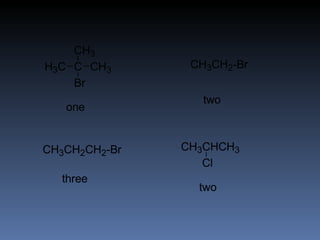
# of signals?        CH4            CH3CH3
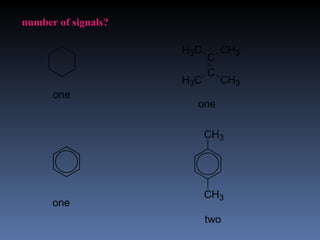
number of signals?

                     H3C       CH3
                           C
                           C
                     H3C       CH3
      one
                       one

                           CH3


                           CH3
      one
                           two
CH3
H3C C CH3       CH3CH2-Br
    Br
                  two
   one


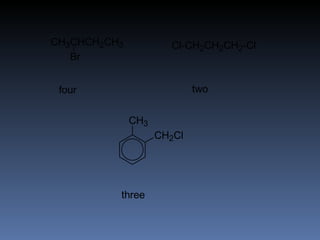
CH3CH2CH2-Br   CH3CHCH3
                  Cl
  three
                 two
CH3CHCH2CH3            Cl-CH2CH2CH2-Cl
   Br


 four                       two


              CH3
                    CH2Cl


          three
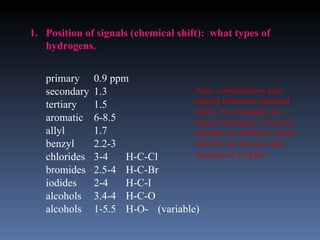
1. Position of signals (chemical shift): what types of
   hydrogens.


   primary     0.9 ppm
   secondary   1.3                 Note: combinations may
   tertiary    1.5                 greatly influence chemical
                                   shifts. For example, the
   aromatic    6-8.5               benzyl hydrogens in benzyl
   allyl       1.7                 chloride are shifted to lower
   benzyl      2.2-3               field by the chlorine and
   chlorides   3-4    H-C-Cl       resonate at 4.5 ppm.
   bromides    2.5-4 H-C-Br
   iodides     2-4    H-C-I
   alcohols    3.4-4 H-C-O
   alcohols    1-5.5 H-O- (variable)
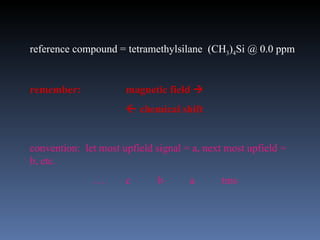
reference compound = tetramethylsilane (CH3)4Si @ 0.0 ppm


remember:             magnetic field 
                       chemical shift


convention: let most upfield signal = a, next most upfield =
b, etc.
              …       c      b       a      tms
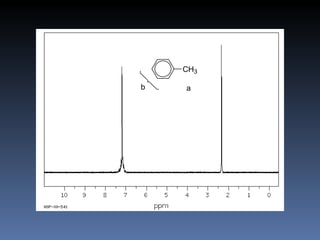
toluene
                  CH3

              b   a


          b             a
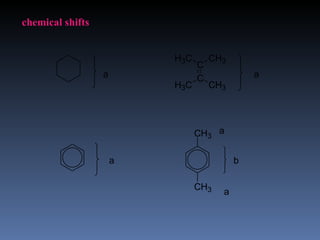
chemical shifts


                          H3C       CH3
                                C
                  a             C             a
                          H3C       CH3


                                CH3 a

                      a                   b

                                CH3
                                      a
a        a   b
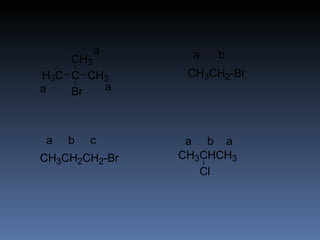
    CH3
H3C C CH3       CH3CH2-Br
a   Br  a


a   b   c       a b a
CH3CH2CH2-Br   CH3CHCH3
                  Cl
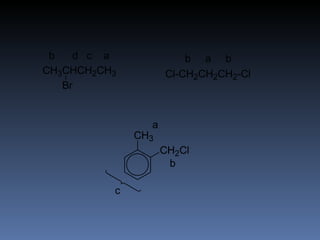
b   d c a              b a b
CH3CHCH2CH3         Cl-CH2CH2CH2-Cl
   Br


                a
              CH3
                    CH2Cl
                     b

          c
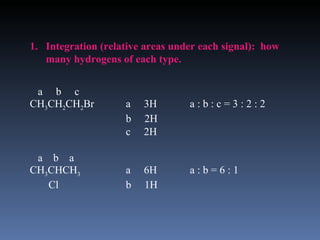
1. Integration (relative areas under each signal): how
   many hydrogens of each type.


 a b c
CH3CH2CH2Br         a   3H        a:b:c=3:2:2
                    b   2H
                    c   2H

 a b a
CH3CHCH3            a   6H        a:b=6:1
   Cl               b   1H
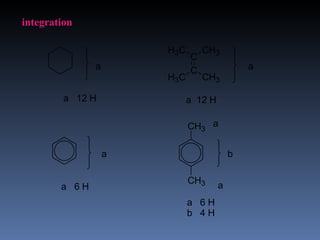
integration

                       H3C       CH3
                             C
               a             C                a
                       H3C       CH3

         a 12 H              a 12 H

                             CH3 a

                   a                      b

                             CH3
        a 6H                          a
                             a 6H
                             b 4H
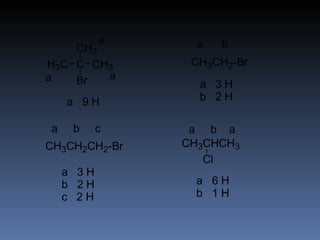
a     a   b
    CH3
H3C C CH3       CH3CH2-Br
a   Br  a
                 a 3H
    a 9H         b 2H

a    b     c    a b a
CH3CH2CH2-Br   CH3CHCH3
                  Cl
    a 3H
    b 2H         a 6H
    c 2H         b 1H
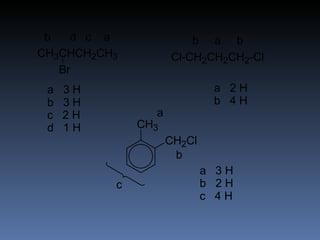
b   d c a              b a b
CH3CHCH2CH3         Cl-CH2CH2CH2-Cl
   Br
 a   3H                      a 2H
 b   3H                      b 4H
 c   2H         a
 d   1H       CH3
                    CH2Cl
                     b
                            a 3H
          c                 b 2H
                            c 4H
c                       b                     a
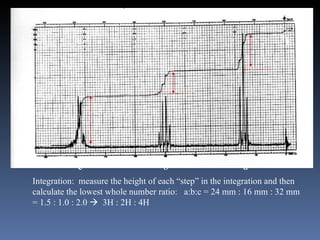
Integration: measure the height of each “step” in the integration and then
calculate the lowest whole number ratio: a:b:c = 24 mm : 16 mm : 32 mm
= 1.5 : 1.0 : 2.0  3H : 2H : 4H
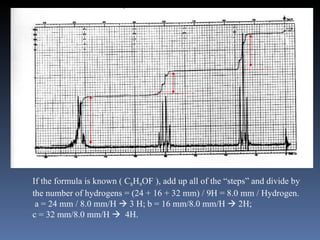
If the formula is known ( C8H9OF ), add up all of the “steps” and divide by
the number of hydrogens = (24 + 16 + 32 mm) / 9H = 8.0 mm / Hydrogen.
 a = 24 mm / 8.0 mm/H  3 H; b = 16 mm/8.0 mm/H  2H;
c = 32 mm/8.0 mm/H  4H.
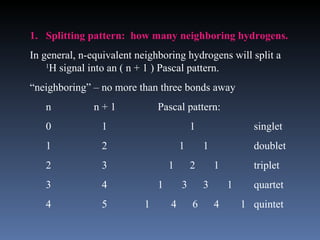
1. Splitting pattern: how many neighboring hydrogens.
In general, n-equivalent neighboring hydrogens will split a
    1
      H signal into an ( n + 1 ) Pascal pattern.
“neighboring” – no more than three bonds away
   n           n+1            Pascal pattern:
   0            1                         1                 singlet
   1            2                     1       1             doublet
   2            3                 1       2       1         triplet
   3            4             1       3       3       1     quartet
   4            5         1       4       6       4       1 quintet
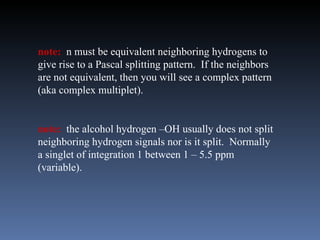
note: n must be equivalent neighboring hydrogens to
give rise to a Pascal splitting pattern. If the neighbors
are not equivalent, then you will see a complex pattern
(aka complex multiplet).


note: the alcohol hydrogen –OH usually does not split
neighboring hydrogen signals nor is it split. Normally
a singlet of integration 1 between 1 – 5.5 ppm
(variable).
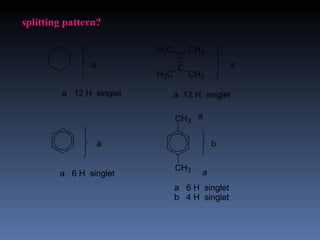
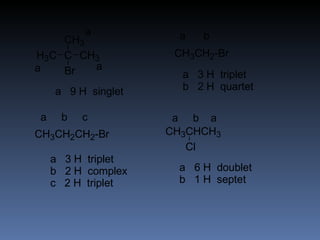
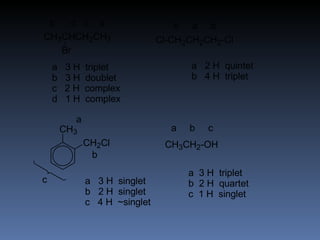
splitting pattern?

                          H3C        CH3
                                 C
               a                 C              a
                          H3C        CH3

         a 12 H singlet         a 12 H singlet

                                CH3 a

                   a                       b

                                CH3
        a 6 H singlet                  a
                                a 6 H singlet
                                b 4 H singlet
a            a   b
    CH3
H3C C CH3            CH3CH2-Br
a   Br  a
                      a 3 H triplet
    a 9 H singlet     b 2 H quartet

a    b   c           a b a
CH3CH2CH2-Br        CH3CHCH3
                       Cl
    a 3 H triplet
    b 2 H complex     a 6 H doublet
    c 2 H triplet     b 1 H septet
b   d c a                         b a b
CH3CHCH2CH3                    Cl-CH2CH2CH2-Cl
   Br
    a   3H    triplet                 a 2 H quintet
    b   3H    doublet                 b 4 H triplet
    c   2H    complex
    d   1H    complex

          a
        CH3                       a   b   c
              CH2Cl             CH3CH2-OH
               b
                                      a 3 H triplet
c             a 3 H singlet           b 2 H quartet
              b 2 H singlet           c 1 H singlet
              c 4 H ~singlet
Information from 1H-nmr spectra:


3. Number of signals: How many different types of
   hydrogens in the molecule.
4. Position of signals (chemical shift): What types of
   hydrogens.
5. Relative areas under signals (integration): How
   many hydrogens of each type.
6. Splitting pattern: How many neighboring
   hydrogens.
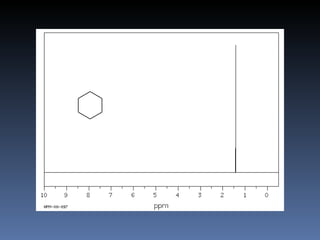
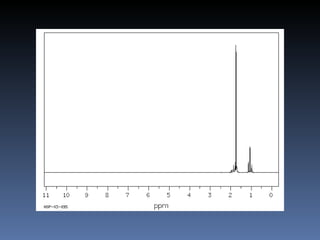
cyclohexane


              a   singlet   12H
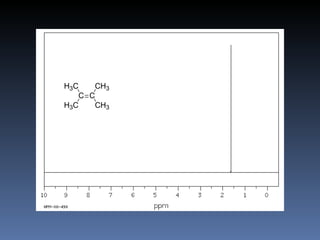
2,3-dimethyl-2-butene

H3C   CH3
   C C        a singlet 12H
H3C   CH3
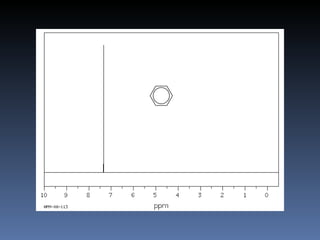
benzene


          a   singlet 6H
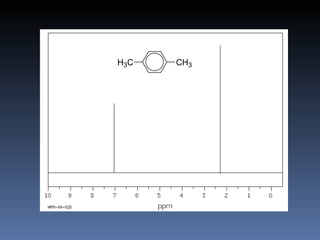
p-xylene   H3C          CH3

           a             a
                  b

                 a singlet 6H
                 b singlet 4H
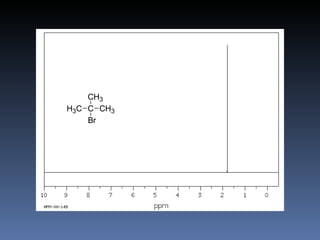
tert-butyl bromide


     CH3      a singlet 9H
 H3C C CH3
     Br
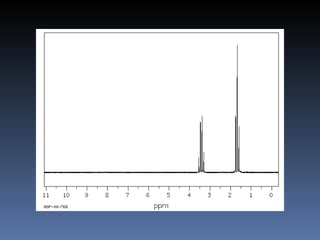
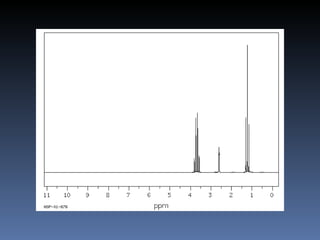
ethyl bromide

 a b
CH3CH2-Br

a triplet 3H
b quartet 2H
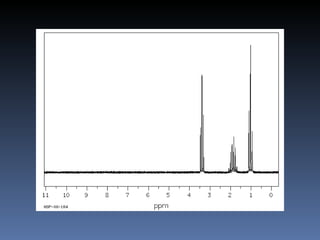
1-bromopropane

 a b c
CH3CH2CH2-Br

a   triplet 3H
b   complex 2H
c   triplet  3H
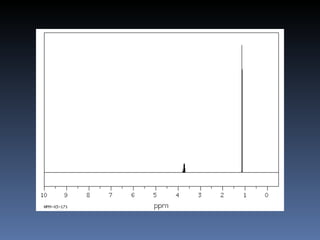
isopropyl chloride

 a b a
CH3CHCH3
   Cl

a doublet 6H
b septet  1H
2-bromobutane
 b d c a
CH3CHCH2CH3
   Br

a    triplet   3H
b   doublet    3H
c   complex    2H
d   complex    1H
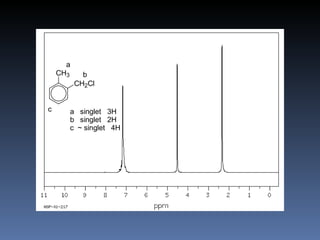
o-methylbenzyl chloride
      a
    CH3     b
          CH2Cl


c      a singlet 3H
       b singlet 2H
       c ~ singlet 4H
ethanol

 a c     b
CH3CH2-OH

a triplet 3H
b singlet 1H
c quartet 2H
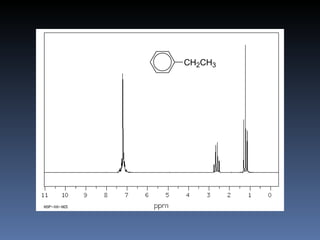
c
ethylbenzene            b a
                       CH2CH3

               a triplet 3H
               b quartet 2H
               c ~singlet 5H
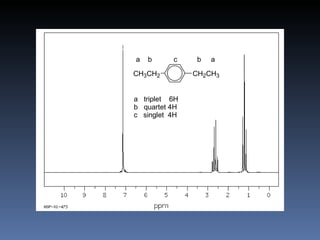
p-diethylbenzene
                   a   b   c   b   a

               CH3CH2          CH2CH3


               a triplet 6H
               b quartet 4H
               c singlet 4H
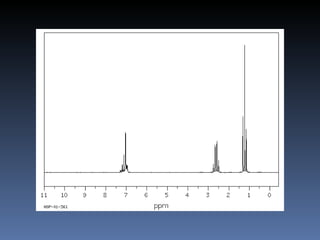
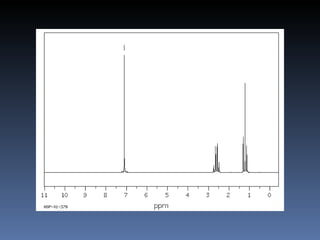
m-diethylbenzene
o-diethylbenzene
2-bromo-2-methylbutane
         b
     CH3
b CH3CCH2CH3 a
     Br c

a triplet 3H
b singlet 6H
c quartet 2H   b & c overlap
di-n-propylether

 a b c       c b a
CH3CH2CH2-O-CH2CH2CH3

a triplet 6H
b complex 4H
c triplet 4H
1-propanol
 a b d c
CH3CH2CH2-OH

a   triplet 3H
b   complex 2H
c   singlet 1H
d   triplet 2H
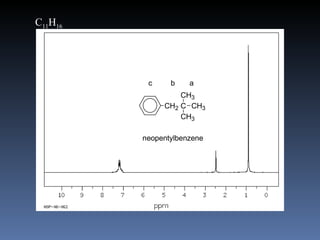
C11H16

  a 9H = 3CH3, no neighbors
                                                9H
  c 5H = monosubstituted benzene
  b 2H, no neighbors      c    b    a
                                  CH3
                              CH2 C CH3
                                  CH3

                        neopentylbenzene
                                           2H
                   5H
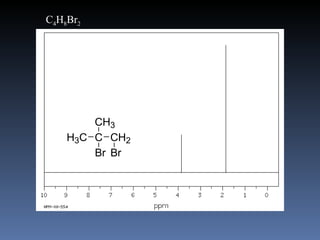
C4H8Br2

a = 6H, two CH3 with no neighbors
                                       6H
  (CH3)2C—
b = CH2, no neighbors & shifted
downfield due to Br

        CH3
                                  2H
    H3C C CH2
        Br Br
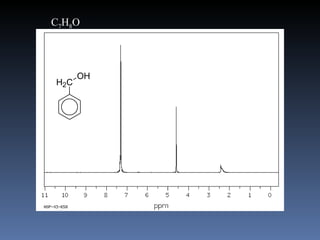
C7H8O

                c = monosubst. benzene

           5H   b = CH2
      OH
H2C             c = OH

                   2H


                           1H
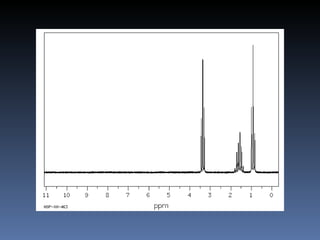
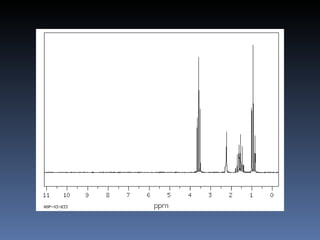
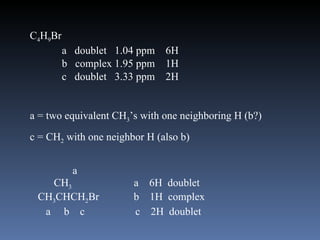
C4H9Br
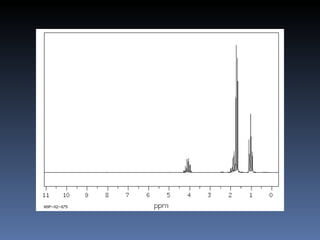
         a doublet 1.04 ppm   6H
         b complex 1.95 ppm   1H
         c doublet 3.33 ppm   2H


a = two equivalent CH3’s with one neighboring H (b?)
c = CH2 with one neighbor H (also b)


           a
   CH3                 a 6H doublet
 CH3CHCH2Br            b 1H complex
  a b c                c 2H doublet
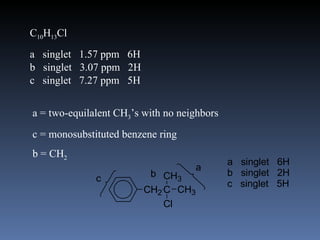
C10H13Cl
a singlet 1.57 ppm 6H
b singlet 3.07 ppm 2H
c singlet 7.27 ppm 5H


a = two-equilalent CH3’s with no neighbors
c = monosubstituted benzene ring
b = CH2
                                             a singlet 6H
                                     a
                          b CH3              b singlet 2H
              c
                                             c singlet 5H
                         CH2 C CH3
                             Cl
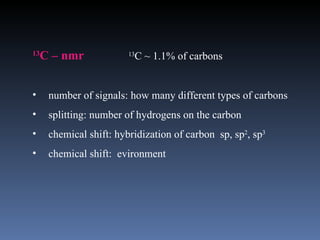
13
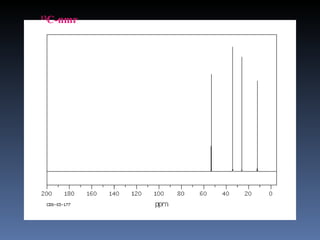
     C – nmr              C ~ 1.1% of carbons
                         13


•     number of signals: how many different types of carbons
•     splitting: number of hydrogens on the carbon
•     chemical shift: hybridization of carbon sp, sp2, sp3
•     chemical shift: evironment
C-nmr
13


     2-bromobutane


     a c   d b
     CH3CH2CHCH3
           Br
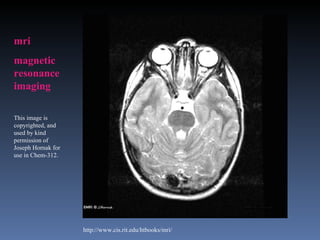
mri
magnetic
resonance
imaging

This image is
copyrighted, and
used by kind
permission of
Joseph Hornak for
use in Chem-312.


                    http://www.cis.rit.edu/htbooks/mri/

Nmr

  • 1.
  • 2.
    The nmr spectraincluded in this presentation have been taken from the SDBS database with permission. National Institute of Advanced Industrial Science and Technology (http://www.aist.go.jp/RIODB/SDBS/menu-e.html)
  • 3.
    Nuclear Magnetic Resonance(nmr) -the nuclei of some atoms spin: 1H, 13C, 19F, … -the nuclei of many atoms do not spin: 2H, 12C, 16O, … -moving charged particles generate a magnetic field () -when placed between the poles of a powerful magnet, spinning nuclei will align with or against the applied field creating an energy difference. Using a fixed radio frequency, the magnetic field is changed until the ΔE = EEM. When the energies match, the nuclei can change spin states (resonate) and give off a magnetic signal. ΔE
  • 4.
    magnetic field =14,092 gauss for 1H v = 60,000,000 Hz (60 MHz) nmr spectrum magnetic field  intensity 10 9 8 7 6 5 4 3 2 1 0 chemical shift (ppm)
  • 5.
    1 H nucleiare shielded by the magnetic field produced by the surrounding electrons. The higher the electron density around the nucleus, the higher the magnetic field required to cause resonance. CH3Cl versus CH4 lower electron higher electron density density resonate at lower resonate at higher applied field applied field CHCCl3 ??
  • 6.
    Information from 1H-nmrspectra: 3. Number of signals: How many different types of hydrogens in the molecule. 4. Position of signals (chemical shift): What types of hydrogens. 5. Relative areas under signals (integration): How many hydrogens of each type. 6. Splitting pattern: How many neighboring hydrogens.
  • 7.
    1. Number ofsignals: How many different types of hydrogens in the molecule. Magnetically equivalent hydrogens resonate at the same applied field. Magnetically equivalent hydrogens are also chemically equivalent. # of signals? CH4 CH3CH3
  • 8.
    number of signals? H3C CH3 C C H3C CH3 one one CH3 CH3 one two
  • 9.
    CH3 H3C C CH3 CH3CH2-Br Br two one CH3CH2CH2-Br CH3CHCH3 Cl three two
  • 10.
    CH3CHCH2CH3 Cl-CH2CH2CH2-Cl Br four two CH3 CH2Cl three
  • 11.
    1. Position ofsignals (chemical shift): what types of hydrogens. primary 0.9 ppm secondary 1.3 Note: combinations may tertiary 1.5 greatly influence chemical shifts. For example, the aromatic 6-8.5 benzyl hydrogens in benzyl allyl 1.7 chloride are shifted to lower benzyl 2.2-3 field by the chlorine and chlorides 3-4 H-C-Cl resonate at 4.5 ppm. bromides 2.5-4 H-C-Br iodides 2-4 H-C-I alcohols 3.4-4 H-C-O alcohols 1-5.5 H-O- (variable)
  • 12.
    reference compound =tetramethylsilane (CH3)4Si @ 0.0 ppm remember: magnetic field   chemical shift convention: let most upfield signal = a, next most upfield = b, etc. … c b a tms
  • 13.
    toluene CH3 b a b a
  • 14.
    chemical shifts H3C CH3 C a C a H3C CH3 CH3 a a b CH3 a
  • 15.
    a a b CH3 H3C C CH3 CH3CH2-Br a Br a a b c a b a CH3CH2CH2-Br CH3CHCH3 Cl
  • 16.
    b d c a b a b CH3CHCH2CH3 Cl-CH2CH2CH2-Cl Br a CH3 CH2Cl b c
  • 17.
    1. Integration (relativeareas under each signal): how many hydrogens of each type. a b c CH3CH2CH2Br a 3H a:b:c=3:2:2 b 2H c 2H a b a CH3CHCH3 a 6H a:b=6:1 Cl b 1H
  • 18.
    integration H3C CH3 C a C a H3C CH3 a 12 H a 12 H CH3 a a b CH3 a 6H a a 6H b 4H
  • 19.
    a a b CH3 H3C C CH3 CH3CH2-Br a Br a a 3H a 9H b 2H a b c a b a CH3CH2CH2-Br CH3CHCH3 Cl a 3H b 2H a 6H c 2H b 1H
  • 20.
    b d c a b a b CH3CHCH2CH3 Cl-CH2CH2CH2-Cl Br a 3H a 2H b 3H b 4H c 2H a d 1H CH3 CH2Cl b a 3H c b 2H c 4H
  • 21.
    c b a Integration: measure the height of each “step” in the integration and then calculate the lowest whole number ratio: a:b:c = 24 mm : 16 mm : 32 mm = 1.5 : 1.0 : 2.0  3H : 2H : 4H
  • 22.
    If the formulais known ( C8H9OF ), add up all of the “steps” and divide by the number of hydrogens = (24 + 16 + 32 mm) / 9H = 8.0 mm / Hydrogen. a = 24 mm / 8.0 mm/H  3 H; b = 16 mm/8.0 mm/H  2H; c = 32 mm/8.0 mm/H  4H.
  • 23.
    1. Splitting pattern:how many neighboring hydrogens. In general, n-equivalent neighboring hydrogens will split a 1 H signal into an ( n + 1 ) Pascal pattern. “neighboring” – no more than three bonds away n n+1 Pascal pattern: 0 1 1 singlet 1 2 1 1 doublet 2 3 1 2 1 triplet 3 4 1 3 3 1 quartet 4 5 1 4 6 4 1 quintet
  • 24.
    note: n mustbe equivalent neighboring hydrogens to give rise to a Pascal splitting pattern. If the neighbors are not equivalent, then you will see a complex pattern (aka complex multiplet). note: the alcohol hydrogen –OH usually does not split neighboring hydrogen signals nor is it split. Normally a singlet of integration 1 between 1 – 5.5 ppm (variable).
  • 25.
    splitting pattern? H3C CH3 C a C a H3C CH3 a 12 H singlet a 12 H singlet CH3 a a b CH3 a 6 H singlet a a 6 H singlet b 4 H singlet
  • 26.
    a a b CH3 H3C C CH3 CH3CH2-Br a Br a a 3 H triplet a 9 H singlet b 2 H quartet a b c a b a CH3CH2CH2-Br CH3CHCH3 Cl a 3 H triplet b 2 H complex a 6 H doublet c 2 H triplet b 1 H septet
  • 27.
    b d c a b a b CH3CHCH2CH3 Cl-CH2CH2CH2-Cl Br a 3H triplet a 2 H quintet b 3H doublet b 4 H triplet c 2H complex d 1H complex a CH3 a b c CH2Cl CH3CH2-OH b a 3 H triplet c a 3 H singlet b 2 H quartet b 2 H singlet c 1 H singlet c 4 H ~singlet
  • 28.
    Information from 1H-nmrspectra: 3. Number of signals: How many different types of hydrogens in the molecule. 4. Position of signals (chemical shift): What types of hydrogens. 5. Relative areas under signals (integration): How many hydrogens of each type. 6. Splitting pattern: How many neighboring hydrogens.
  • 29.
    cyclohexane a singlet 12H
  • 30.
    2,3-dimethyl-2-butene H3C CH3 C C a singlet 12H H3C CH3
  • 31.
    benzene a singlet 6H
  • 32.
    p-xylene H3C CH3 a a b a singlet 6H b singlet 4H
  • 33.
    tert-butyl bromide CH3 a singlet 9H H3C C CH3 Br
  • 34.
    ethyl bromide ab CH3CH2-Br a triplet 3H b quartet 2H
  • 35.
    1-bromopropane a bc CH3CH2CH2-Br a triplet 3H b complex 2H c triplet 3H
  • 36.
    isopropyl chloride ab a CH3CHCH3 Cl a doublet 6H b septet 1H
  • 37.
    2-bromobutane b dc a CH3CHCH2CH3 Br a triplet 3H b doublet 3H c complex 2H d complex 1H
  • 38.
    o-methylbenzyl chloride a CH3 b CH2Cl c a singlet 3H b singlet 2H c ~ singlet 4H
  • 39.
    ethanol a c b CH3CH2-OH a triplet 3H b singlet 1H c quartet 2H
  • 40.
    c ethylbenzene b a CH2CH3 a triplet 3H b quartet 2H c ~singlet 5H
  • 41.
    p-diethylbenzene a b c b a CH3CH2 CH2CH3 a triplet 6H b quartet 4H c singlet 4H
  • 42.
  • 43.
  • 44.
    2-bromo-2-methylbutane b CH3 b CH3CCH2CH3 a Br c a triplet 3H b singlet 6H c quartet 2H b & c overlap
  • 45.
    di-n-propylether a bc c b a CH3CH2CH2-O-CH2CH2CH3 a triplet 6H b complex 4H c triplet 4H
  • 46.
    1-propanol a bd c CH3CH2CH2-OH a triplet 3H b complex 2H c singlet 1H d triplet 2H
  • 47.
    C11H16 a9H = 3CH3, no neighbors 9H c 5H = monosubstituted benzene b 2H, no neighbors c b a CH3 CH2 C CH3 CH3 neopentylbenzene 2H 5H
  • 48.
    C4H8Br2 a = 6H,two CH3 with no neighbors 6H (CH3)2C— b = CH2, no neighbors & shifted downfield due to Br CH3 2H H3C C CH2 Br Br
  • 49.
    C7H8O c = monosubst. benzene 5H b = CH2 OH H2C c = OH 2H 1H
  • 50.
    C4H9Br a doublet 1.04 ppm 6H b complex 1.95 ppm 1H c doublet 3.33 ppm 2H a = two equivalent CH3’s with one neighboring H (b?) c = CH2 with one neighbor H (also b) a CH3 a 6H doublet CH3CHCH2Br b 1H complex a b c c 2H doublet
  • 51.
    C10H13Cl a singlet 1.57ppm 6H b singlet 3.07 ppm 2H c singlet 7.27 ppm 5H a = two-equilalent CH3’s with no neighbors c = monosubstituted benzene ring b = CH2 a singlet 6H a b CH3 b singlet 2H c c singlet 5H CH2 C CH3 Cl
  • 52.
    13 C – nmr C ~ 1.1% of carbons 13 • number of signals: how many different types of carbons • splitting: number of hydrogens on the carbon • chemical shift: hybridization of carbon sp, sp2, sp3 • chemical shift: evironment
  • 53.
    C-nmr 13 2-bromobutane a c d b CH3CH2CHCH3 Br
  • 54.
    mri magnetic resonance imaging This image is copyrighted,and used by kind permission of Joseph Hornak for use in Chem-312. http://www.cis.rit.edu/htbooks/mri/