Chelating agents
ByReiam Ameer Bisharaa
Higher diploma in pharmacology & toxicology
Supervised by
Dr. Ammar A. Hussein
Collage of pharmacy
university of Baghdad 2019
Contents
Introduction
Chelating is useful in applications
Properties of ideal chelating agent
Therapy benefitchelating
Mechanism of action
Classification
Uses
Adverse effects
Case study
References
Introduction
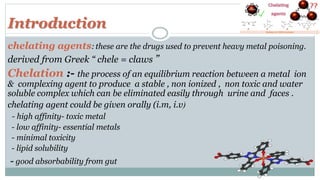
chelating agents:these are the drugs used to prevent heavy metal poisoning.
derived from Greek “ chele = claws ”
Chelation :- the process of an equilibrium reaction between a metal ion
& complexing agent to produce a stable , non ionized , non toxic and water
soluble complex which can be eliminated easily through urine and faces .
(chelating agent could be given orally (i.m, i.v
- high affinity- toxic metal
- low affinity- essential metals
- minimal toxicity
- lipid solubility
good absorbability from gut-
-in biochemistry and microbiology
-in geology
-nutritional supplements
-dental and oral application
-heavy-metal detoxification
-pharmaceuticals
-other medical applications
-catalysis
-water softening
-industrial cleaning
gypsum and cement
personal care and cosmetics
-cleaning and detergents
-food and beverage preservation
-fertilizers
Chelating is useful in applications
-more affinity for metals than endogenous ligands.
-resistance to biotransformation.
-form non-toxic complex with toxic metal.
-cheap & easy to administered.
-accelerate mobilization and removal of the metal
-easy excretion of chelating complex.
-high solubility in water
IDEAL CHELATING AGENTS
Chelation Therapy Benefit
Heavy Metal Poisoning
Chronic Fatigue Syndrome
Iron troubles
Pains across body
Heart / Stroke / High Blood Pressure
Diabetes / Diabetic Neuropathy Patients
Memory Disorders (Dilemma / Neuro degeneration)
Poor wound healing
Insomnia
Multiple Sclerosis / Alzheimer’s / Parkinson’s
Depression
IBS (Irritable Bowel Syndrome)
Low testosterone syndrome in men and women.
Kids with:
Metal Poisoning
Wilson’s diseases
Iron poisoning ( Haemochromatosis / Thalassemia etc.)
Autism
heavy metal combines with one or more reactive
group(ligands),
OXYGEN(-OH, -COO, -OPO)
NITROGEN(-NH2, -NH)
SULPHUR(-SH,-S-S)
e n z y m e i n h i b i t i o n , o x i d a t i v e s t r e s s .
Mechanism of action
1.dimercaperol (British ant lewisite) or BAL(AS , Au, Bi, Hg) poisoning
(2.dimercaptosuccinic acid ( succimer) (Pb
(3.calcium disodium edetate (Edta)( lead poisoning
(4.penicillamine ( Cu , Pb,Hg,Zn
(5.desferrioxamine (iron o v e r l o a d
(6.deferiprone (iron
7.deferasirox
8.trientine
9. pentetate calcium trisodium
10.pentetate zinc trisodium
11.prussian blue
Classification of chelating agents
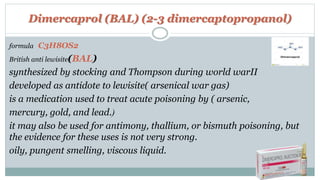
Dimercaprol (BAL) (2-3 dimercaptopropanol)
C3H8OS2formula
British anti lewisite(BAL)
synthesized by stocking and Thompson during world warII
developed as antidote to lewisite( arsenical war gas)
is a medication used to treat acute poisoning by ( arsenic,
(mercury, gold, and lead.
it may also be used for antimony, thallium, or bismuth poisoning, but
the evidence for these uses is not very strong.
oily, pungent smelling, viscous liquid.
dimercaprol competes with the thiol groups for binding the metal ion,
which is then excreted in the urine.
c a n t b e g i v e n o r a l l y
g i v e n b y d e e p i . m i n j e c t i o n
short T½ peak plasma level in ½ hr - 1 hr (i.m)
in 6hrs
cpregnancy category
Mechanism of action
A c u t e p o i s o n i n g b y a r s e n i c , m e r c u r y , g o l d , l e a d
D o s e 5 m g / k g , f o l l o w e d b y 2 _ 3 m g / k g e v e r y 4 _ 8 h r s f o r 2 d a y s a n d t h a n t w i c e d a i l y f o r 1 0
d a y s
as an adjuvant to ( Edta) in lead poisoning
as an adjuvant to penicillamine in Wilson's disease
C O N T R A I N D I C A T I O N
hepatic dis .
iron and cadmium poisoning
adverse effect
i n j e c t i o n . i s p a i n f u l
a l l e r g i c r e a c t i o n
n a u s e a , v o m i t i n g , h e a d a c h e
L a c r i m a t i o n , c o n j u n c t i v i t i s , b l e p h a r o s p a s m
s i a l o r r h o e a , p a r e s t h e s i a , m u s c l e p a i n
h a e m o l y s i s i n g - 6 p d d e f i c i e n c y
angina pain, tachycardia, hypertension
uses
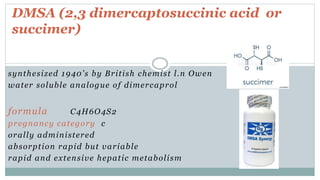
synthesized 1940’s by British chemist l.n Owen
water soluble analogue of dimercaprol
formula C4H6O4S2
cpregnancy category
orally administered
absorption rapid but variable
rapid and extensive hepatic metabolism
DMSA (2,3 dimercaptosuccinic acid or
succimer)
lead poisoning
mercury, arsenic
Side effect
n a u s e a , a n o r e x i a , v o m i t i n g , d i a r r h e a
w e a k n e s s , d i z z i n e s s , r a s h
t r a n s i e n t e l e v a t i o n o f h e p a t i c t r a n s a m i n a s e e n z y m e s
uses
dimercaptopropane sulphonate
water soluble analogue
used or ally and iv
used in sever e acute poisoning with As and H g
less toxic than dimer capr ol
ADERSE EFFECT
skin r eaction
elevated liver enzyme
leukopenia and fever
br onchospasm after i.v administr ation
UNITHIOL (DMPS)
well absorption orally
(absorption is inhibited by ( food , iron, antacid
peak plasma conc. in 1_3 hr
metabolized in liver
USES
for Cu,Hg, Gold, Lead poisoning
Wilson's disease
dose 1-2gm/day in four divided doses
other uses
rheumatoid arthritis
cystinuria
primary biliary cirrhosis and scleroderma
D-PENICILLAMINE
headache, rash,fever,lymphadenopathy,dysguesia
haematological toxicities
a plastic anemia, agranulocytosis, thrombocytopenia
autoimmune syndrome
good pasture’s syndrome, un wanted breast growth, myasthenia
gravis
fever,polyarthritis, exfoliative dermatitis
ADVERSE EFFECT
Trienten
formula C6H18N4
used in removing heavy metal (copper , lead , mercury )
cupriuretic agent
useful in Wilson's disease.
less potent but safer then d-penicillamine
dosage form capsule 250 mg
ADFERSE EFFECT
anemia
f o r m u l a C 2 5 H 4 8 N 6 O 8
c h e l a t o r o f i r o n
r e m o v e s i r o n f r o m h e m o s i d e r i n a n d f e r r i t i n b u t n o t f r o m h a e m o g l o b i n a n d c y t o c h r o m e
mechanism of action
b i n d f e r r i c i r o n t o f o r m f e r r i o x a m i n e ( s t a b l e , w a t e r s o l u b l e )
p o o r l y a b s o r b e d a f t e r o r a l a d m i n i s t r a t i o n , u s e d p a r e n t r a l l y
m e t a b o l i z e d b y e n z y m e p r e s e n t i n p l a s m a
Desferioxamine
acute iron toxicity
1 0 - 1 5 m g / k g / h r c o n s t a n t i n f u s i o n
5 0 m g / k g i . m
chronic iron intoxication
0 . 5 t o 1 g m / d a y , i . m
f o r c h e l a t i o n o f a l u m i n i u m i n d i a l y s i s p a t i e n t
o r a l , s u b c u t a n e o u s ,i . m , i . vr o u t e o f a d m i n i s t r a t i o n
‫ه‬ADFERSE EFFECT
a l l e r g i c r e a c t i o n s ( p r u r i t u s , w h e a l , r a s h )
d y s u r i a a b d o m i n a l d i s c o m f o r t , d i a r r h e a
c a t a r a c t , n e u r o t o x i c i t y
p u l m o n a r y s y n d r o m e
condraindication
r e n a l d i s .
p r e g n a n t w o m e n
Uses
formula C7H9NO2
orally effective but less effective then desferrioxamin e
USE
iron chelator indicated for treatment of transfusion iron
overload caused by thalassemia syndromes when current
chelating therapy is inadequate
ADFERSE EFFECT
anorexia, vomiting, joint pain.
dose 50-100 mg/kg daily in 2-4 divided dose.
Deferiprone
orally effective
use
when desferrioxamine is contraindication in
iron over load
ADFERSE EFFECT
gastrointestinal ulceration
fanconi like syndrome
dose 20-30mg/kg
defrasirox
c h e l a t e s d i v a l e n t o r t r i v a l e n t m e t a l s
n o t a b s o r b e d o r a l l y
d o e s n ’ t c r o s s b l o o d b r a i n b a r r i e r
i . m i n j e c t i o n p a i n f u l
lead poisoning
slow i.v 40mg /kg in two divided doses/day for 5days
Fe, Zn, Cu,, Cd, poisoning
not useful for Hg poisoning
SIDE EFFECT
thromboplebitis
nausea, diarrhea
oliguric renal failure
febril reaction, myalgia,rhinorhea
lacrimation, dermatitis
hypocalcaemia tetany (rapid i.v infusion )
EDTA(ethylene diamine tetra
acetic acid)
f o r m u l a C o 2 ( E D T A ) ( H 2 o ) 6
i t i s a d e r i v a t i v e o f t h e ( n o n - n a t u r a l ) a m i n o
a c i d e t h y l e n e d i a m i n e t e t r a a c e t a te .
used in cyanide poisoning
pharmaceutical form
solution for injection
side effects
hypertension, tachycardia, nausea,
vomiting,
Dicobalt EDTA
Chelator Used in
Dimercaprol (British anti-Lewisite; BAL)
acute arsenic poisoning
acute mercury poisoning
lead poisoning (in addition to Edta)
lewisite poisoning (for which it was developed as an
antidote)
Dimercaptosuccinic acid (DMSA)
lead poisoning
arsenic poisoning
mercury poisoning
Dimercapto-propane sulfonate (DMPS)
severe acute arsenic poisoning
severe acute mercury poisoning
Penicillamine
mainly in: copper toxicity
occasionally adjunctive therapy in:
gold toxicity
arsenic poisoning
lead poisoning
rheumatoid arthritis
Ethylenediamine tetraacetic acid (calcium
disodium versenate) (CaNa2-EDTA)
lead poisoning
Deferoxamine, Deferasirox and Deferipron acute iron poisoning
iron overload
advantages of chelating agents
it is frequently used for stains removal.
it is a simple process that involves adding the chelating
agents to the water.
they are a good treat opening up the articles for
efficient blood circulation.
disadvantages of chelating agents
it has a high amount of acidity. therefore, it is not fit
for human or animal consumption because the water
has very high acidity levels.
activated charcoal is a miraculous detoxing agen
benefits of activated charcoal
. reduce damage caused by high cholesterol, coronary disease and arteriosclerosis.
.work as an antidote for all drugs, chemicals and poisons.
.relieve intestinal complaints, gas, bloating.
.can correct common age -related problems.
.whitens teeth.
.you can reduce joint pain, increase energy and increase mental
function.
.activated charcoal helps to prevent cellular damage to kidneys and
liver, as well as supporting healthy adrenal glands .
Activated Charcoal
Is chelation therapy an effective autism treatment?
chelation therapy is not an effective autism treatment, and it may be dangerous.
some doctors and parents have considered chelation therapy as a potential autism
treatment. proponents believe that autism is caused by mercury exposure, such as from
childhood vaccines. chelation therapy supposedly removes mercury from the body,
which chelation supporters say cures autism — but there's no evidence of a link between
mercury exposure and autism. in addition, chelation therapy can be associated with
serious side effects, including potentially deadly kidney damage.
the subject of exposure to environmental toxic agents — such as mercury, lead and a host
of other toxins — and links to autism spectrum disorder is complex and the quality of
studies varies considerably. that's in part because of all the many variables, such as
geography, genetic factors, metabolism differences in individuals and sampling sources.
studies show conflicting results with no reproducible proof.
there's no cure for autism — now called autism spectrum disorder in the newest diagnostic
and statistical manual of mental disorders (Dsm-5), published by the american
psychiatric association. as a result, many unproven alternative therapies are often
suggested. however, these alternative therapies are usually found to be ineffective and
sometimes harmful.
Case study
There was evidence of aluminium, cadmium and lead intoxication in a 63-
year old Italian woman affected by rheumatoid arthritis (RA). We treated
the patient with calcium disodium edetate (EDTA) once a week for a year
in order to remove traces of heavy metal intoxication. Oxidative status
profile was carried out at the beginning and after 6 months' EDTA
chelation. At the end of the treatment, the patient did not show any signs
of metal intoxication, RA symptoms and oxidative status improved.
References
Iupac. Definition of chelation(gold book.C01012)
Slide share
Chelation community
Gold frank toxicology
George braitberg, in critical care nephrology (third edition),2019
Thank you

Chelating agents

  • 1.
    Chelating agents ByReiam AmeerBisharaa Higher diploma in pharmacology & toxicology Supervised by Dr. Ammar A. Hussein Collage of pharmacy university of Baghdad 2019
  • 2.
    Contents Introduction Chelating is usefulin applications Properties of ideal chelating agent Therapy benefitchelating Mechanism of action Classification Uses Adverse effects Case study References
  • 3.
    Introduction chelating agents:these arethe drugs used to prevent heavy metal poisoning. derived from Greek “ chele = claws ” Chelation :- the process of an equilibrium reaction between a metal ion & complexing agent to produce a stable , non ionized , non toxic and water soluble complex which can be eliminated easily through urine and faces . (chelating agent could be given orally (i.m, i.v - high affinity- toxic metal - low affinity- essential metals - minimal toxicity - lipid solubility good absorbability from gut-
  • 4.
    -in biochemistry andmicrobiology -in geology -nutritional supplements -dental and oral application -heavy-metal detoxification -pharmaceuticals -other medical applications -catalysis -water softening -industrial cleaning gypsum and cement personal care and cosmetics -cleaning and detergents -food and beverage preservation -fertilizers Chelating is useful in applications
  • 5.
    -more affinity formetals than endogenous ligands. -resistance to biotransformation. -form non-toxic complex with toxic metal. -cheap & easy to administered. -accelerate mobilization and removal of the metal -easy excretion of chelating complex. -high solubility in water IDEAL CHELATING AGENTS
  • 6.
    Chelation Therapy Benefit HeavyMetal Poisoning Chronic Fatigue Syndrome Iron troubles Pains across body Heart / Stroke / High Blood Pressure Diabetes / Diabetic Neuropathy Patients Memory Disorders (Dilemma / Neuro degeneration) Poor wound healing Insomnia Multiple Sclerosis / Alzheimer’s / Parkinson’s Depression IBS (Irritable Bowel Syndrome) Low testosterone syndrome in men and women. Kids with: Metal Poisoning Wilson’s diseases Iron poisoning ( Haemochromatosis / Thalassemia etc.) Autism
  • 7.
    heavy metal combineswith one or more reactive group(ligands), OXYGEN(-OH, -COO, -OPO) NITROGEN(-NH2, -NH) SULPHUR(-SH,-S-S) e n z y m e i n h i b i t i o n , o x i d a t i v e s t r e s s . Mechanism of action
  • 8.
    1.dimercaperol (British antlewisite) or BAL(AS , Au, Bi, Hg) poisoning (2.dimercaptosuccinic acid ( succimer) (Pb (3.calcium disodium edetate (Edta)( lead poisoning (4.penicillamine ( Cu , Pb,Hg,Zn (5.desferrioxamine (iron o v e r l o a d (6.deferiprone (iron 7.deferasirox 8.trientine 9. pentetate calcium trisodium 10.pentetate zinc trisodium 11.prussian blue Classification of chelating agents
  • 9.
    Dimercaprol (BAL) (2-3dimercaptopropanol) C3H8OS2formula British anti lewisite(BAL) synthesized by stocking and Thompson during world warII developed as antidote to lewisite( arsenical war gas) is a medication used to treat acute poisoning by ( arsenic, (mercury, gold, and lead. it may also be used for antimony, thallium, or bismuth poisoning, but the evidence for these uses is not very strong. oily, pungent smelling, viscous liquid.
  • 10.
    dimercaprol competes withthe thiol groups for binding the metal ion, which is then excreted in the urine. c a n t b e g i v e n o r a l l y g i v e n b y d e e p i . m i n j e c t i o n short T½ peak plasma level in ½ hr - 1 hr (i.m) in 6hrs cpregnancy category Mechanism of action
  • 11.
    A c ut e p o i s o n i n g b y a r s e n i c , m e r c u r y , g o l d , l e a d D o s e 5 m g / k g , f o l l o w e d b y 2 _ 3 m g / k g e v e r y 4 _ 8 h r s f o r 2 d a y s a n d t h a n t w i c e d a i l y f o r 1 0 d a y s as an adjuvant to ( Edta) in lead poisoning as an adjuvant to penicillamine in Wilson's disease C O N T R A I N D I C A T I O N hepatic dis . iron and cadmium poisoning adverse effect i n j e c t i o n . i s p a i n f u l a l l e r g i c r e a c t i o n n a u s e a , v o m i t i n g , h e a d a c h e L a c r i m a t i o n , c o n j u n c t i v i t i s , b l e p h a r o s p a s m s i a l o r r h o e a , p a r e s t h e s i a , m u s c l e p a i n h a e m o l y s i s i n g - 6 p d d e f i c i e n c y angina pain, tachycardia, hypertension uses
  • 12.
    synthesized 1940’s byBritish chemist l.n Owen water soluble analogue of dimercaprol formula C4H6O4S2 cpregnancy category orally administered absorption rapid but variable rapid and extensive hepatic metabolism DMSA (2,3 dimercaptosuccinic acid or succimer)
  • 13.
    lead poisoning mercury, arsenic Sideeffect n a u s e a , a n o r e x i a , v o m i t i n g , d i a r r h e a w e a k n e s s , d i z z i n e s s , r a s h t r a n s i e n t e l e v a t i o n o f h e p a t i c t r a n s a m i n a s e e n z y m e s uses
  • 14.
    dimercaptopropane sulphonate water solubleanalogue used or ally and iv used in sever e acute poisoning with As and H g less toxic than dimer capr ol ADERSE EFFECT skin r eaction elevated liver enzyme leukopenia and fever br onchospasm after i.v administr ation UNITHIOL (DMPS)
  • 15.
    well absorption orally (absorptionis inhibited by ( food , iron, antacid peak plasma conc. in 1_3 hr metabolized in liver USES for Cu,Hg, Gold, Lead poisoning Wilson's disease dose 1-2gm/day in four divided doses other uses rheumatoid arthritis cystinuria primary biliary cirrhosis and scleroderma D-PENICILLAMINE
  • 16.
    headache, rash,fever,lymphadenopathy,dysguesia haematological toxicities aplastic anemia, agranulocytosis, thrombocytopenia autoimmune syndrome good pasture’s syndrome, un wanted breast growth, myasthenia gravis fever,polyarthritis, exfoliative dermatitis ADVERSE EFFECT
  • 17.
    Trienten formula C6H18N4 used inremoving heavy metal (copper , lead , mercury ) cupriuretic agent useful in Wilson's disease. less potent but safer then d-penicillamine dosage form capsule 250 mg ADFERSE EFFECT anemia
  • 18.
    f o rm u l a C 2 5 H 4 8 N 6 O 8 c h e l a t o r o f i r o n r e m o v e s i r o n f r o m h e m o s i d e r i n a n d f e r r i t i n b u t n o t f r o m h a e m o g l o b i n a n d c y t o c h r o m e mechanism of action b i n d f e r r i c i r o n t o f o r m f e r r i o x a m i n e ( s t a b l e , w a t e r s o l u b l e ) p o o r l y a b s o r b e d a f t e r o r a l a d m i n i s t r a t i o n , u s e d p a r e n t r a l l y m e t a b o l i z e d b y e n z y m e p r e s e n t i n p l a s m a Desferioxamine
  • 19.
    acute iron toxicity 10 - 1 5 m g / k g / h r c o n s t a n t i n f u s i o n 5 0 m g / k g i . m chronic iron intoxication 0 . 5 t o 1 g m / d a y , i . m f o r c h e l a t i o n o f a l u m i n i u m i n d i a l y s i s p a t i e n t o r a l , s u b c u t a n e o u s ,i . m , i . vr o u t e o f a d m i n i s t r a t i o n ‫ه‬ADFERSE EFFECT a l l e r g i c r e a c t i o n s ( p r u r i t u s , w h e a l , r a s h ) d y s u r i a a b d o m i n a l d i s c o m f o r t , d i a r r h e a c a t a r a c t , n e u r o t o x i c i t y p u l m o n a r y s y n d r o m e condraindication r e n a l d i s . p r e g n a n t w o m e n Uses
  • 20.
    formula C7H9NO2 orally effectivebut less effective then desferrioxamin e USE iron chelator indicated for treatment of transfusion iron overload caused by thalassemia syndromes when current chelating therapy is inadequate ADFERSE EFFECT anorexia, vomiting, joint pain. dose 50-100 mg/kg daily in 2-4 divided dose. Deferiprone
  • 21.
    orally effective use when desferrioxamineis contraindication in iron over load ADFERSE EFFECT gastrointestinal ulceration fanconi like syndrome dose 20-30mg/kg defrasirox
  • 22.
    c h el a t e s d i v a l e n t o r t r i v a l e n t m e t a l s n o t a b s o r b e d o r a l l y d o e s n ’ t c r o s s b l o o d b r a i n b a r r i e r i . m i n j e c t i o n p a i n f u l lead poisoning slow i.v 40mg /kg in two divided doses/day for 5days Fe, Zn, Cu,, Cd, poisoning not useful for Hg poisoning SIDE EFFECT thromboplebitis nausea, diarrhea oliguric renal failure febril reaction, myalgia,rhinorhea lacrimation, dermatitis hypocalcaemia tetany (rapid i.v infusion ) EDTA(ethylene diamine tetra acetic acid)
  • 23.
    f o rm u l a C o 2 ( E D T A ) ( H 2 o ) 6 i t i s a d e r i v a t i v e o f t h e ( n o n - n a t u r a l ) a m i n o a c i d e t h y l e n e d i a m i n e t e t r a a c e t a te . used in cyanide poisoning pharmaceutical form solution for injection side effects hypertension, tachycardia, nausea, vomiting, Dicobalt EDTA
  • 24.
    Chelator Used in Dimercaprol(British anti-Lewisite; BAL) acute arsenic poisoning acute mercury poisoning lead poisoning (in addition to Edta) lewisite poisoning (for which it was developed as an antidote) Dimercaptosuccinic acid (DMSA) lead poisoning arsenic poisoning mercury poisoning Dimercapto-propane sulfonate (DMPS) severe acute arsenic poisoning severe acute mercury poisoning Penicillamine mainly in: copper toxicity occasionally adjunctive therapy in: gold toxicity arsenic poisoning lead poisoning rheumatoid arthritis Ethylenediamine tetraacetic acid (calcium disodium versenate) (CaNa2-EDTA) lead poisoning Deferoxamine, Deferasirox and Deferipron acute iron poisoning iron overload
  • 25.
    advantages of chelatingagents it is frequently used for stains removal. it is a simple process that involves adding the chelating agents to the water. they are a good treat opening up the articles for efficient blood circulation. disadvantages of chelating agents it has a high amount of acidity. therefore, it is not fit for human or animal consumption because the water has very high acidity levels.
  • 26.
    activated charcoal isa miraculous detoxing agen benefits of activated charcoal . reduce damage caused by high cholesterol, coronary disease and arteriosclerosis. .work as an antidote for all drugs, chemicals and poisons. .relieve intestinal complaints, gas, bloating. .can correct common age -related problems. .whitens teeth. .you can reduce joint pain, increase energy and increase mental function. .activated charcoal helps to prevent cellular damage to kidneys and liver, as well as supporting healthy adrenal glands . Activated Charcoal
  • 27.
    Is chelation therapyan effective autism treatment? chelation therapy is not an effective autism treatment, and it may be dangerous. some doctors and parents have considered chelation therapy as a potential autism treatment. proponents believe that autism is caused by mercury exposure, such as from childhood vaccines. chelation therapy supposedly removes mercury from the body, which chelation supporters say cures autism — but there's no evidence of a link between mercury exposure and autism. in addition, chelation therapy can be associated with serious side effects, including potentially deadly kidney damage. the subject of exposure to environmental toxic agents — such as mercury, lead and a host of other toxins — and links to autism spectrum disorder is complex and the quality of studies varies considerably. that's in part because of all the many variables, such as geography, genetic factors, metabolism differences in individuals and sampling sources. studies show conflicting results with no reproducible proof. there's no cure for autism — now called autism spectrum disorder in the newest diagnostic and statistical manual of mental disorders (Dsm-5), published by the american psychiatric association. as a result, many unproven alternative therapies are often suggested. however, these alternative therapies are usually found to be ineffective and sometimes harmful.
  • 28.
    Case study There wasevidence of aluminium, cadmium and lead intoxication in a 63- year old Italian woman affected by rheumatoid arthritis (RA). We treated the patient with calcium disodium edetate (EDTA) once a week for a year in order to remove traces of heavy metal intoxication. Oxidative status profile was carried out at the beginning and after 6 months' EDTA chelation. At the end of the treatment, the patient did not show any signs of metal intoxication, RA symptoms and oxidative status improved.
  • 29.
    References Iupac. Definition ofchelation(gold book.C01012) Slide share Chelation community Gold frank toxicology George braitberg, in critical care nephrology (third edition),2019
  • 30.