A PRESENTATION ON
DRUG PROFILE
Presented by
K . Bhanu Sri Chandana
167N1R0042
Vijaya Institute of Pharmaceutical
Sciences For Women
1
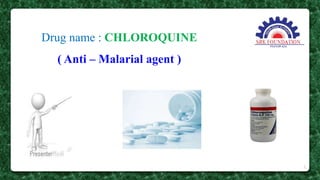
Drug name : CHLOROQUINE
( Anti – Malarial agent )
2
 Introduction
 Physical & Chemical Properties
 Pharmacokinetics
 Pharmacodynamics
 Popular Brands
Contents :
3
INTRODUCTION
Description :
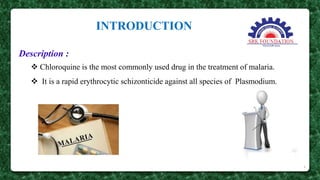
 Chloroquine is the most commonly used drug in the treatment of malaria.
 It is a rapid erythrocytic schizonticide against all species of Plasmodium.
4
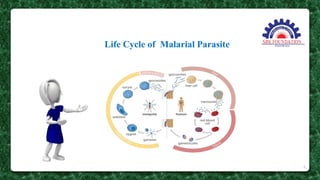
Malaria :
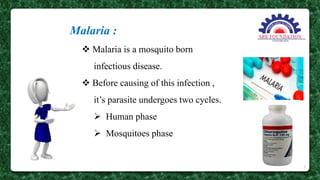
 Malaria is a mosquito born
infectious disease.
 Before causing of this infection ,
it’s parasite undergoes two cycles.
 Human phase
 Mosquitoes phase
5
Life Cycle of Malarial Parasite
6
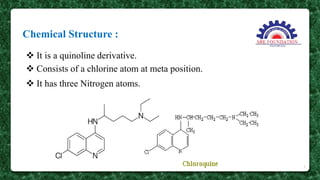
Chemical Structure :
7
 It is a quinoline derivative.
 Consists of a chlorine atom at meta position.
 It has three Nitrogen atoms.
Physical and Chemical Properties of the Drug
8
IUPAC Name :
 N-(7-Chloroquinolin-4-yl)-N, N- dimethyl
-pentane-1,4-diamine
Empirical Formula : C18 H26 ClN3
Molecular weight : 319.872 g/mol.
Melting point : 87 degrees Celsius.
Form :
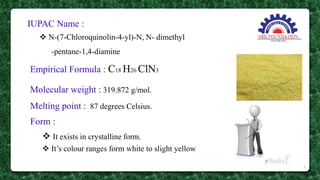
 It exists in crystalline form.
 It’s colour ranges form white to slight yellow
9
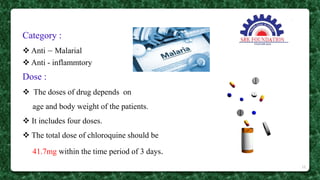
Category :
 Anti – Malarial
 Anti - inflammtory
Dose :
 The doses of drug depends on
age and body weight of the patients.
 It includes four doses.
 The total dose of chloroquine should be
41.7mg within the time period of 3 days.
10
pKa value : Chloroquine has three pKa
values i.e., 4.0, 8.4, and 10.2.
Stability : Chloroquine is stable in heat up
to the pH 4.0 to 6.5.
Storage conditions :
 Chloroquine is stable at the room temperatures.
 It is a light sensitive drug. So, it should be protected from light.
 The powdered form of the drug is more stable. So, it can be stored for
nearly 6 months.
11
Half – Life : 78 hours after administration.
Solubility :
 It is very slightly soluble in water.
 Soluble in dilute acids, chloroform
and ether.
 Insoluble in alcohol and benzene.
12
13
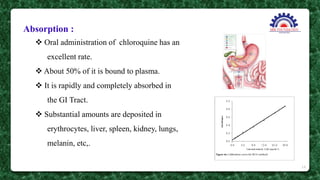
Absorption :
 Oral administration of chloroquine has an
excellent rate.
 About 50% of it is bound to plasma.
 It is rapidly and completely absorbed in
the GI Tract.
 Substantial amounts are deposited in
erythrocytes, liver, spleen, kidney, lungs,
melanin, etc,.
14
Bio-availability :
 The bioavailability of chloroquine varies.
 Along with intake of food i.e., decreases.
Biological Half-life :
One to Three days of administration.
Distribution :
 About 70-85% of drug is present in blood.
Higher concentration of drug is found in serum
Also present in thrombocytes and granulocytes
15
Plasma elimination half-life :
 The plasma elimination half-life of
chloroquine is One - Three weeks
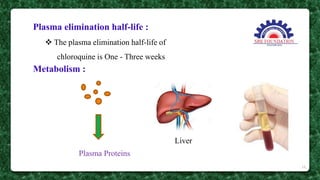
Metabolism :
Plasma Proteins
16
Liver
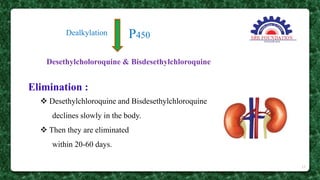
Elimination :
 Desethylchloroquine and Bisdesethylchloroquine
declines slowly in the body.
 Then they are eliminated
within 20-60 days.
Desethylcholoroquine & Bisdesethylchloroquine
P450
Dealkylation
17
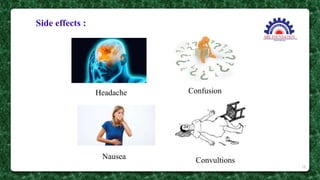
Side effects :
Headache Confusion
Nausea Convultions
18
Loss of Vision Renal impairment
Psychosis Rheumatoid Arthritis
19
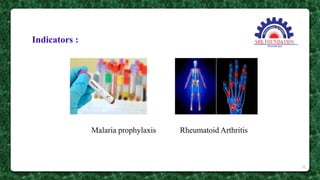
Indicators :
Malaria prophylaxis Rheumatoid Arthritis
20
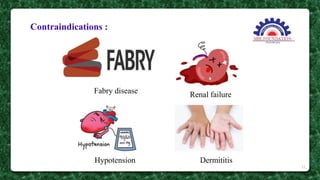
Contraindications :
Fabry disease Renal failure
Hypotension Dermititis
21
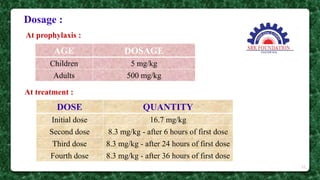
Dosage :
AGE DOSAGE
Children 5 mg/kg
Adults 500 mg/kg
DOSE QUANTITY
Initial dose 16.7 mg/kg
Second dose 8.3 mg/kg - after 6 hours of first dose
Third dose 8.3 mg/kg - after 24 hours of first dose
Fourth dose 8.3 mg/kg - after 36 hours of first dose
At prophylaxis :
At treatment :
22
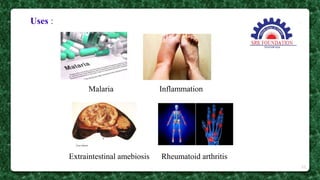
Uses :
Malaria Inflammation
Extraintestinal amebiosis Rheumatoid arthritis
23
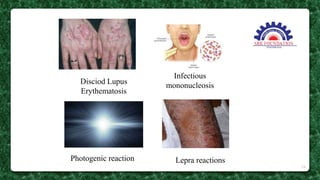
Disciod Lupus
Erythematosis
Infectious
mononucleosis
Photogenic reaction Lepra reactions
24
25
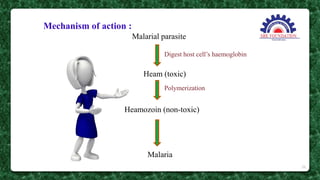
Mechanism of action :
Malarial parasite
Digest host cell’s haemoglobin
Heam (toxic)
Heamozoin (non-toxic)
Polymerization
Malaria
26
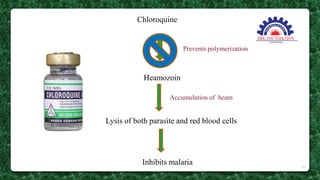
Chloroquine
Heamozoin
Prevents polymerization
Lysis of both parasite and red blood cells
Accumulation of heam
Inhibits malaria 27
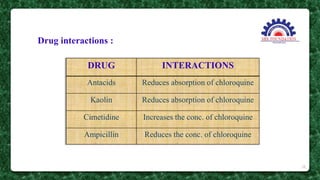
Drug interactions :
DRUG INTERACTIONS
Antacids Reduces absorption of chloroquine
Kaolin Reduces absorption of chloroquine
Cimetidine Increases the conc. of chloroquine
Ampicillin Reduces the conc. of chloroquine
28
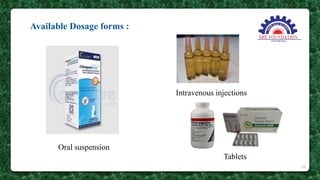
Available Dosage forms :
Oral suspension
Intravenous injections
Tablets
29
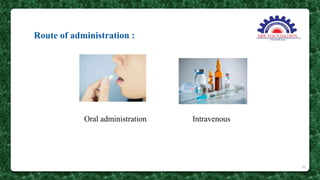
Route of administration :
Oral administration Intravenous
30
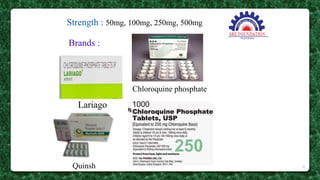
Strength : 50mg, 100mg, 250mg, 500mg
Brands :
Lariago
Chloroquine phosphate
Quinsh 31
Any Questions ???....
32
33

Chloroquine

  • 1.
    A PRESENTATION ON DRUGPROFILE Presented by K . Bhanu Sri Chandana 167N1R0042 Vijaya Institute of Pharmaceutical Sciences For Women 1
  • 2.
    Drug name :CHLOROQUINE ( Anti – Malarial agent ) 2
  • 3.
     Introduction  Physical& Chemical Properties  Pharmacokinetics  Pharmacodynamics  Popular Brands Contents : 3
  • 4.
    INTRODUCTION Description :  Chloroquineis the most commonly used drug in the treatment of malaria.  It is a rapid erythrocytic schizonticide against all species of Plasmodium. 4
  • 5.
    Malaria :  Malariais a mosquito born infectious disease.  Before causing of this infection , it’s parasite undergoes two cycles.  Human phase  Mosquitoes phase 5
  • 6.
    Life Cycle ofMalarial Parasite 6
  • 7.
    Chemical Structure : 7 It is a quinoline derivative.  Consists of a chlorine atom at meta position.  It has three Nitrogen atoms.
  • 8.
    Physical and ChemicalProperties of the Drug 8
  • 9.
    IUPAC Name : N-(7-Chloroquinolin-4-yl)-N, N- dimethyl -pentane-1,4-diamine Empirical Formula : C18 H26 ClN3 Molecular weight : 319.872 g/mol. Melting point : 87 degrees Celsius. Form :  It exists in crystalline form.  It’s colour ranges form white to slight yellow 9
  • 10.
    Category :  Anti– Malarial  Anti - inflammtory Dose :  The doses of drug depends on age and body weight of the patients.  It includes four doses.  The total dose of chloroquine should be 41.7mg within the time period of 3 days. 10
  • 11.
    pKa value :Chloroquine has three pKa values i.e., 4.0, 8.4, and 10.2. Stability : Chloroquine is stable in heat up to the pH 4.0 to 6.5. Storage conditions :  Chloroquine is stable at the room temperatures.  It is a light sensitive drug. So, it should be protected from light.  The powdered form of the drug is more stable. So, it can be stored for nearly 6 months. 11
  • 12.
    Half – Life: 78 hours after administration. Solubility :  It is very slightly soluble in water.  Soluble in dilute acids, chloroform and ether.  Insoluble in alcohol and benzene. 12
  • 13.
  • 14.
    Absorption :  Oraladministration of chloroquine has an excellent rate.  About 50% of it is bound to plasma.  It is rapidly and completely absorbed in the GI Tract.  Substantial amounts are deposited in erythrocytes, liver, spleen, kidney, lungs, melanin, etc,. 14
  • 15.
    Bio-availability :  Thebioavailability of chloroquine varies.  Along with intake of food i.e., decreases. Biological Half-life : One to Three days of administration. Distribution :  About 70-85% of drug is present in blood. Higher concentration of drug is found in serum Also present in thrombocytes and granulocytes 15
  • 16.
    Plasma elimination half-life:  The plasma elimination half-life of chloroquine is One - Three weeks Metabolism : Plasma Proteins 16 Liver
  • 17.
    Elimination :  Desethylchloroquineand Bisdesethylchloroquine declines slowly in the body.  Then they are eliminated within 20-60 days. Desethylcholoroquine & Bisdesethylchloroquine P450 Dealkylation 17
  • 18.
    Side effects : HeadacheConfusion Nausea Convultions 18
  • 19.
    Loss of VisionRenal impairment Psychosis Rheumatoid Arthritis 19
  • 20.
    Indicators : Malaria prophylaxisRheumatoid Arthritis 20
  • 21.
    Contraindications : Fabry diseaseRenal failure Hypotension Dermititis 21
  • 22.
    Dosage : AGE DOSAGE Children5 mg/kg Adults 500 mg/kg DOSE QUANTITY Initial dose 16.7 mg/kg Second dose 8.3 mg/kg - after 6 hours of first dose Third dose 8.3 mg/kg - after 24 hours of first dose Fourth dose 8.3 mg/kg - after 36 hours of first dose At prophylaxis : At treatment : 22
  • 23.
    Uses : Malaria Inflammation Extraintestinalamebiosis Rheumatoid arthritis 23
  • 24.
  • 25.
  • 26.
    Mechanism of action: Malarial parasite Digest host cell’s haemoglobin Heam (toxic) Heamozoin (non-toxic) Polymerization Malaria 26
  • 27.
    Chloroquine Heamozoin Prevents polymerization Lysis ofboth parasite and red blood cells Accumulation of heam Inhibits malaria 27
  • 28.
    Drug interactions : DRUGINTERACTIONS Antacids Reduces absorption of chloroquine Kaolin Reduces absorption of chloroquine Cimetidine Increases the conc. of chloroquine Ampicillin Reduces the conc. of chloroquine 28
  • 29.
    Available Dosage forms: Oral suspension Intravenous injections Tablets 29
  • 30.
    Route of administration: Oral administration Intravenous 30
  • 31.
    Strength : 50mg,100mg, 250mg, 500mg Brands : Lariago Chloroquine phosphate Quinsh 31
  • 32.
  • 33.